What Roman Women Wore: The Stola, the Palla & the Original Capsule of Elegance
A Rome-born house answers what Roman women wore: the tunica, stola and palla — and maps that original capsule onto a modern woman's wardrobe.
On this page
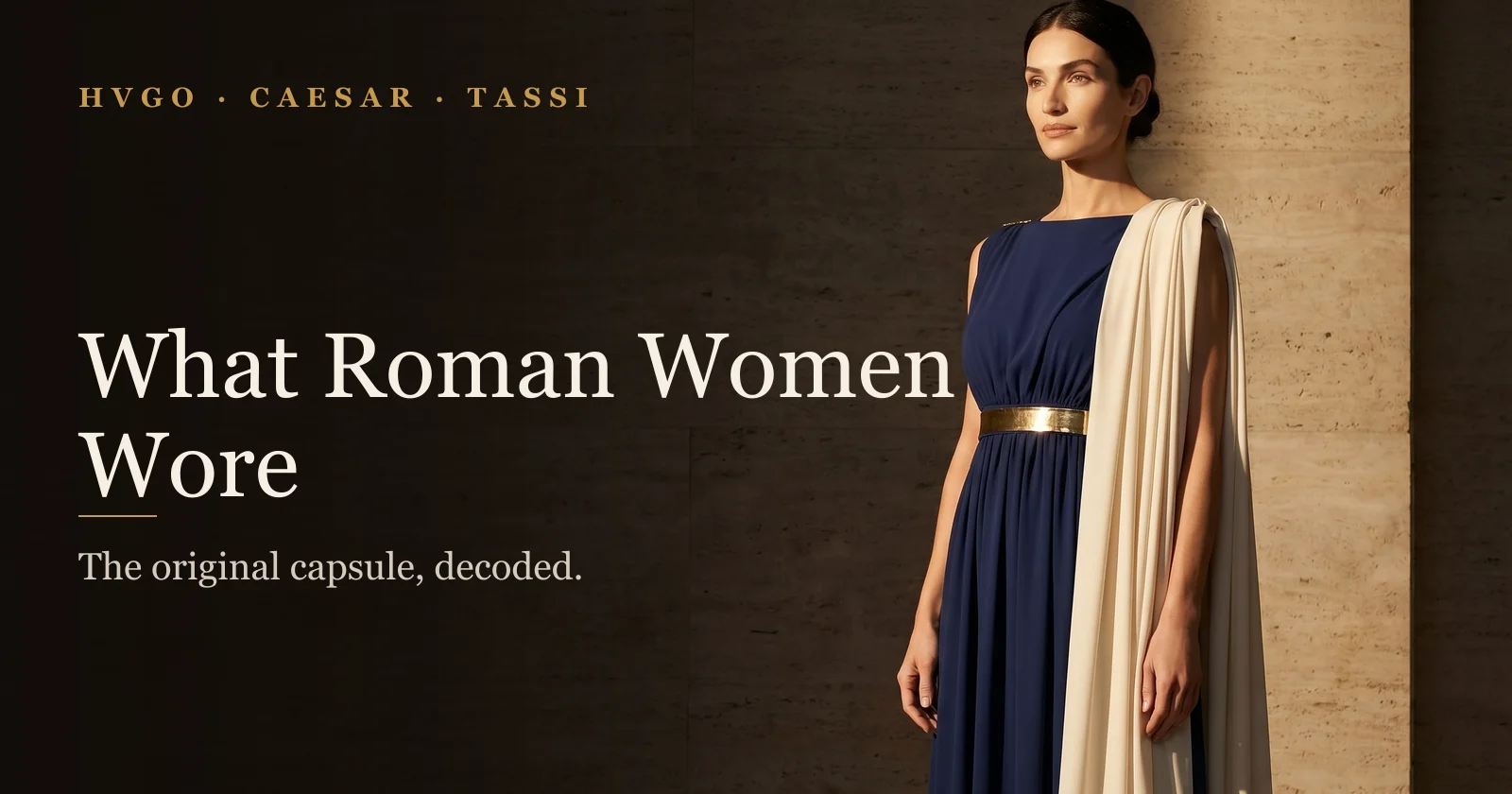
Roman women wore three pieces of cloth in order: a tunica next to the skin, a stola draped over it, and a palla wrapped on top. Hugo Caesar Tassi has cut women's clothes in Rome since 2004, and the house reads that trio as the first true capsule. This guide dresses her layer by layer, then maps the wardrobe onto pieces you can wear now.
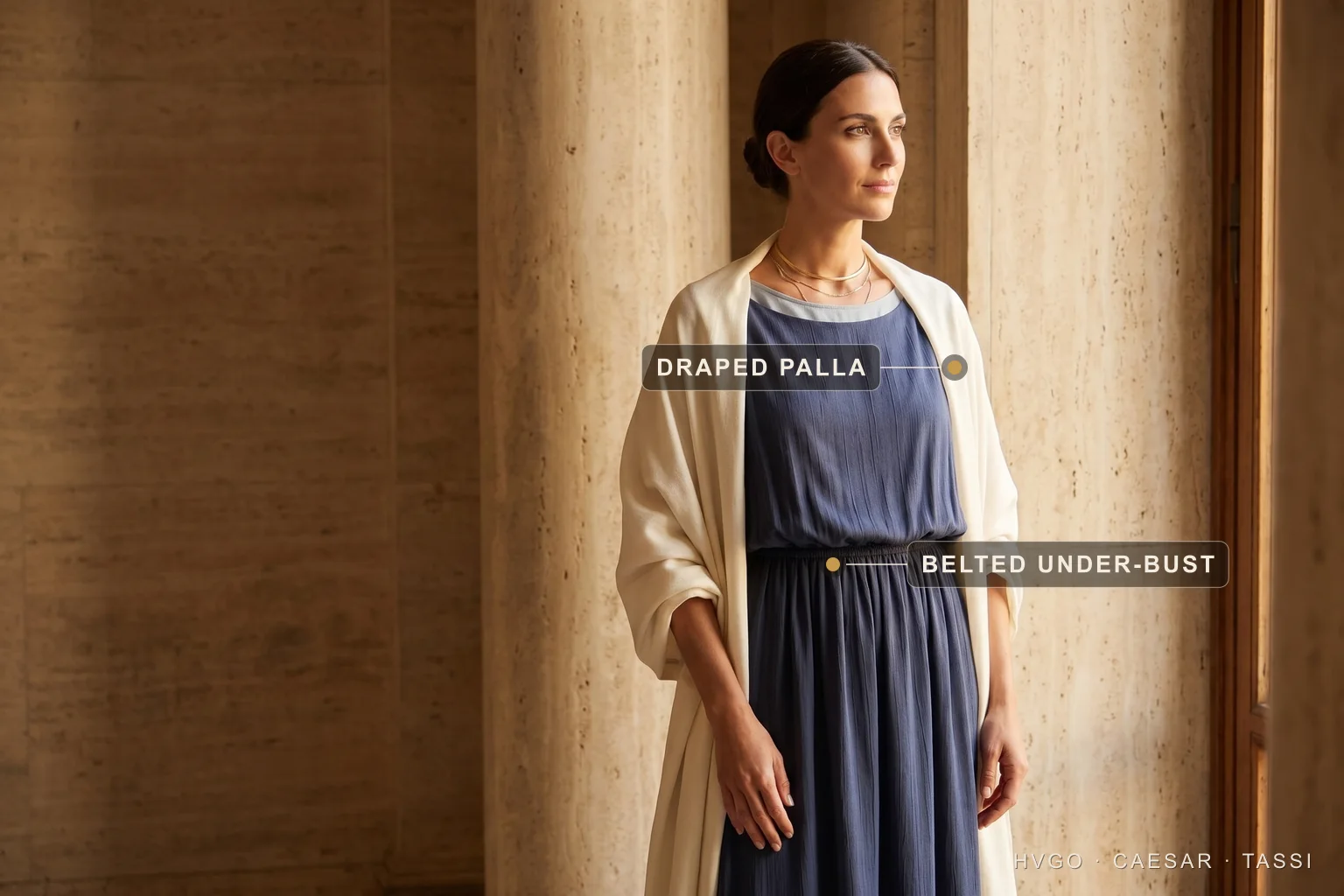
- Draped palla — the rectangular ivory mantle wound over the shoulders, the outdoor layer worn on top of the stola
- Belted under-bust — the high belt that closes the stola just below the bust, creating its short blouson over a long column
#What Roman women wore, head to toe, in one answer
A respectable matron put on three named garments, tunica, stola and palla, plus a belt, a brooch and a hair fillet. That short list ran her whole wardrobe. A wife in Pompeii and an enslaved kitchen worker shared the same garment names. Only fiber, dye and layer count told them apart.
#The three-piece answer: tunica, stola, palla
The tunica went on first, against the skin. The stola, a long draped overdress, fell to the ankle over it. The palla, a large rectangular mantle, wound on top so she could step outside.
Each layer did one job. The tunica supplied cover. The stola supplied standing. The palla supplied the public version of herself, and a working woman often owned only the first and the third. She skipped the middle layer entirely, an edge case that drives the whole class story further down this page.
#Draped, not tailored: the one rule behind the whole wardrobe
Roman dress arranged itself on the body, never cut to a pattern. The loom delivered a finished rectangle of wool or linen. A woman then shaped that rectangle with belts, folds and pins, not with scissors and seams, which is the single rule behind everything that follows.
The fit lived in two places. It lived at the shoulder, fastened with a fibula (a bronze or gold brooch, the safety-pin's ancestor). It lived again at the waist, cinched by a cingulum (a woven girdle). Later tailoring would seam curved panels onto the torso instead, whereas the Roman silhouette stayed loose, vertical and arranged. For the full chronology of how that drape evolved, read the history of Roman dress.
#What Roman women wore under their clothes: the hidden layer
Under the visible tunica went a linen subligaculum and a wrapped breast band, the two practical foundations behind every draped silhouette. Support and modesty came from soft cloth tied close. Rome shaped the body by wrapping it, whereas tailoring would later shape it by cut.
#The under-tunic and the linen layer
Beneath the outer tunica sat a thinner inner tunic and a subligaculum, linen briefs or a wrapped loincloth knotted at the hip. Linen washed well. So it stayed nearest the skin, where laundering mattered most. As an edge case, an athlete might wear the subligaculum almost alone, which is why some mosaics show women in what looks like a two-piece.
#The breast band: the Roman answer to support
The strophium, also called the mamillare or fascia pectoralis, wrapped the bust in a band of soft cloth or supple leather and tied it. A woman tightened it for the street and loosened it at home. A contemporary bra engineers shape into the garment itself. The strophium did the opposite: it flattened and steadied with tension alone, and never lifted.
#The stola Roman women wore: the dress that marked a respectable wife
The stola was the matron's overdress, an ankle-length suspended column that announced a freeborn married woman before she said a word. It worked as a badge first and a dress second. No piece a Roman woman owned read more clearly across a room, and its vertical folds fell unbroken from shoulder to floor in the silhouette the house still cuts today.
#What the stola looked like and how it was worn
The stola hung from the shoulders on straps called umerale. It fell sleeveless or short-sleeved over the tunica. A belt closed it twice: once high under the bust, then again at the natural waist. A band at the hem, the instita, gave it its defining trim.
That double belt did the work. It created two cascades of fold, a short blouson above and a long column below. A draped midi mimics exactly that line now, which is the first hint of the modern translation this guide closes on.
#Who was allowed to wear it, and who wasn't
The stola belonged, in practice, to the married freeborn woman. The unmarried girl, the working freedwoman and the prostitute typically went without it. So the garment sorted a room by status at a single glance.
The exclusions carried the meaning. A respectable wife wore the stola. A woman convicted of adultery could be forced into the male toga instead, the dress flipped into a punishment. Read this way, the stola was simply a worn certificate of standing, and that argument runs deeper in the heritage sibling pages.
#The palla Roman women wore: the wrap that turned a dress into outdoor wear
The palla was a large rectangular mantle a woman wound over her stola to go out, and it handed her the most personal control over how she appeared in public. One length of cloth, endlessly arranged. It stayed unstitched, and unlike the fixed stola it was the variable, the piece that changed by the hour and the errand, the closest ancient cousin to a modern wrap.
#How the palla was draped, pinned and worn over the head
A woman threw the palla over her left shoulder, carried it across the back, and brought it forward again. She secured the drape with a fibula or with simple tension at the elbow. Drawn up over the head, it turned into an instant veil. A matron leaving at midday wrapped it high against sun and scrutiny, then let it slip to the elbows at a private dinner. The edge case is the windy day: an unpinned arrangement loosened, which is why brooches survive in such numbers.
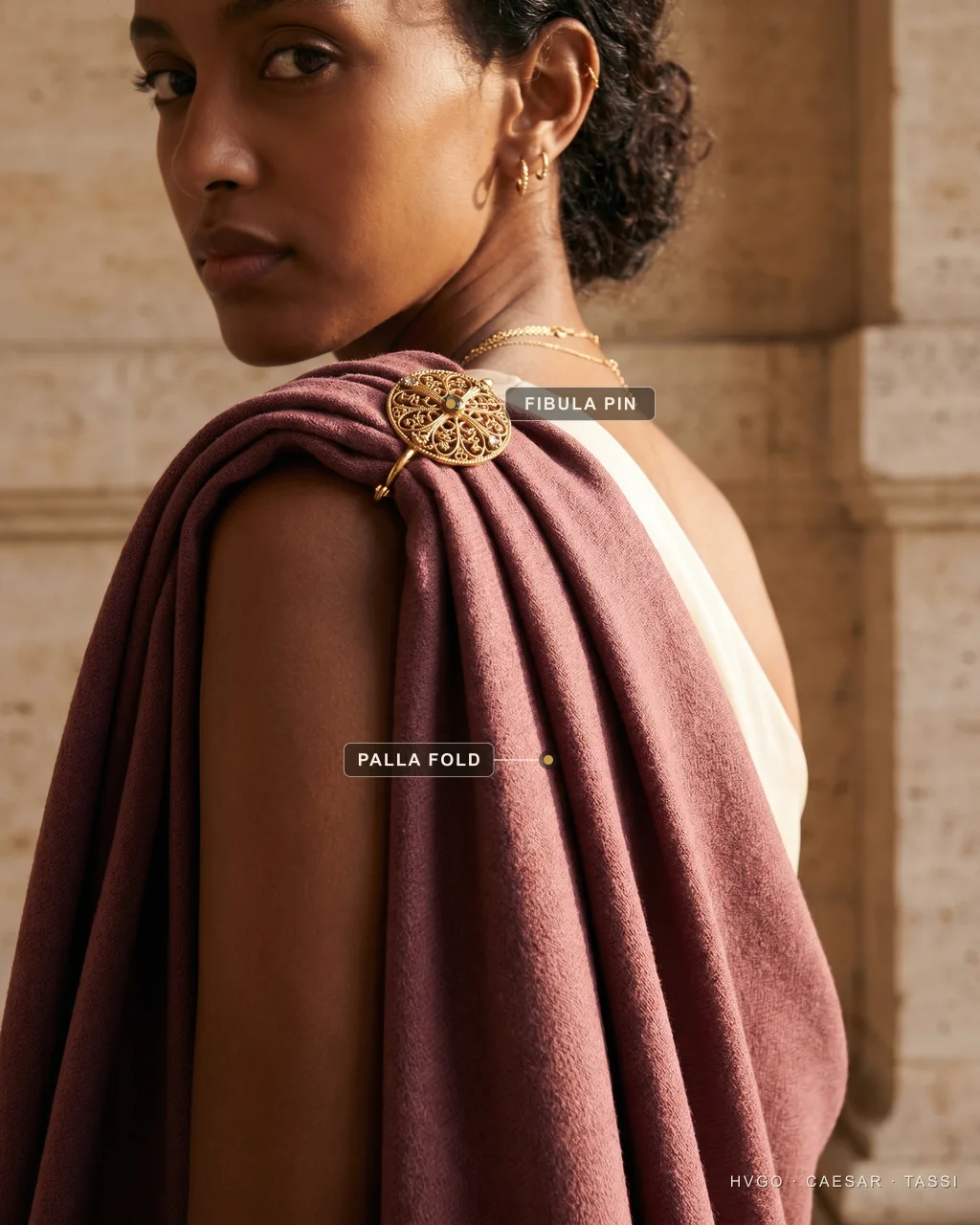
- Fibula pin — the gold brooch (the safety-pin's ancestor) that fastened the palla at the shoulder
- Palla fold — the soft sculptural folds of the unstitched rectangular mantle as it drapes across the back
#The vitta, the veil and being seen in public
The vitta, a woolen fillet bound into the hair, sat as the matron's badge beneath the palla. Together they formed the modesty grammar a woman carried on her head whenever she stepped out. The vitta declared her married standing. The palla drawn over it declared her care for how she was seen. A bareheaded matron read as careless, whereas the veiled head read as composed.
#What wealthy Roman women wore versus what poor and enslaved women wore
Rich and poor shared the same three-garment grammar, but fiber, dye and jewelry split them instantly: silk and murex purple at the top, coarse undyed wool at the bottom. The pieces matched. The materials never did, and a "what did poor Roman women wear" search is really asking about that gap. Class never changed the names of the garments, only their thread count, color and number, which the table below sorts by station.
| Wardrobe element | Wealthy matron | Working or enslaved woman |
|---|---|---|
| Fiber | Finely combed wool, Coan and Chinese silk, cotton | Coarse wool, occasional linen |
| Dye | Saffron-yellow, deep reds, murex purple | Undyed, or the cheapest local plant dye |
| Layers owned | All three, plus spare dyed stolae | One belted tunica and one plain palla |
| Jewelry | Gold earrings, rings, collars, gemstones | Little or none |
| Dressing help | A trained maid (the ornatrix) | None; dressed herself |
#At the top: silk, fine wool, dye and gold
A wealthy woman's luxury sat in things you could measure. Coan silk arrived sheer enough to read as scandalous. Murex purple swallowed thousands of shellfish per garment, which kept it near the throne. The dye economics that made murex a near-imperial monopoly get their full treatment in the imperial purple guide.
#At work and in the home: the single belted tunica
Most women owned one practical garment day to day, a belted tunica with no stola, the palla their single good layer. The enslaved woman sat at the edge of that spectrum: she often wore a household-issued tunic with no claim to the stola's status at all. Dress put function first. Color went to whatever dye was cheapest locally.
#The bride and the special occasion
The Roman bride wore a distinct dress-up kit. It paired a white tunica recta with a belt knotted in the nodus Herculaneus (the "knot of Hercules"), the flame-colored flammeum veil, and hair plaited into the six-braid seni crines. The flammeum was the most saturated color a respectable woman wore in her life, and it sat at the opposite pole from the laundress's single tunic. For the goddess-leaning end of this lineage, see what is a goddess gown.
#What Roman women wore for hair, jewelry, shoes and makeup
Accessories completed the picture: styled and pinned hair, gold earrings and rings, a table of cosmetics, and sandals indoors versus closed shoes outdoors. The garments draped. The details declared. Here the wealth gap reopened, because accessories were where a woman spent her taste.
#Hair and headpieces
Wealthy women favored elaborately pinned and curled styles, often built up with wigs, then secured with the vitta, hairpins (acus) and fine nets. A Flavian-era tower of curls cost an hour and signaled leisure, whereas a working woman's plain plait cost minutes.
#Jewelry, cosmetics and footwear
A Roman woman put on gold and gemstone earrings, finger rings, snake-coil armlets and a gold collar, then worked her face from a table of white lead, ochre and kohl. Soft soleae sandals stayed indoors. Sturdier calcei went on for the street. Reclining at dinner in street shoes marked a person as ill-bred, betraying the wearer as surely as a cheap dye did.
#Why the toga was the one thing Roman women never wore
The toga became exclusively male civic dress, so a respectable woman wore the stola and palla as her counterpart, and a woman seen in a toga signaled disgrace. Crossing that line delivered a social verdict, not a fashion choice.
#The toga as male civic dress
The toga draped the citizen man for the forum, the courts and the census. The stola and palla carried the equivalent weight for women, which kept the two systems strictly separate. The exception confirms the rule: a woman forced into the toga had typically been convicted of adultery.
#How Hugo Caesar Tassi rebuilds what Roman women wore as a modern capsule
The house reads the tunica-stola-palla trio as the first capsule of elegance and translates it piece for piece: the palla becomes a silk scarf, the stola becomes a draped column, the belt becomes a modern waist. The kit survives. Only the materials modernize. A museum page cannot draw this maker's translation, because its story stops at the display case while the house's starts at the Rome atelier. The Roman woman built presence from few pieces worn well, and read through the posture lens in the art of la bella figura, those pieces become carriage rather than costume.
#The original capsule, mapped one-to-one
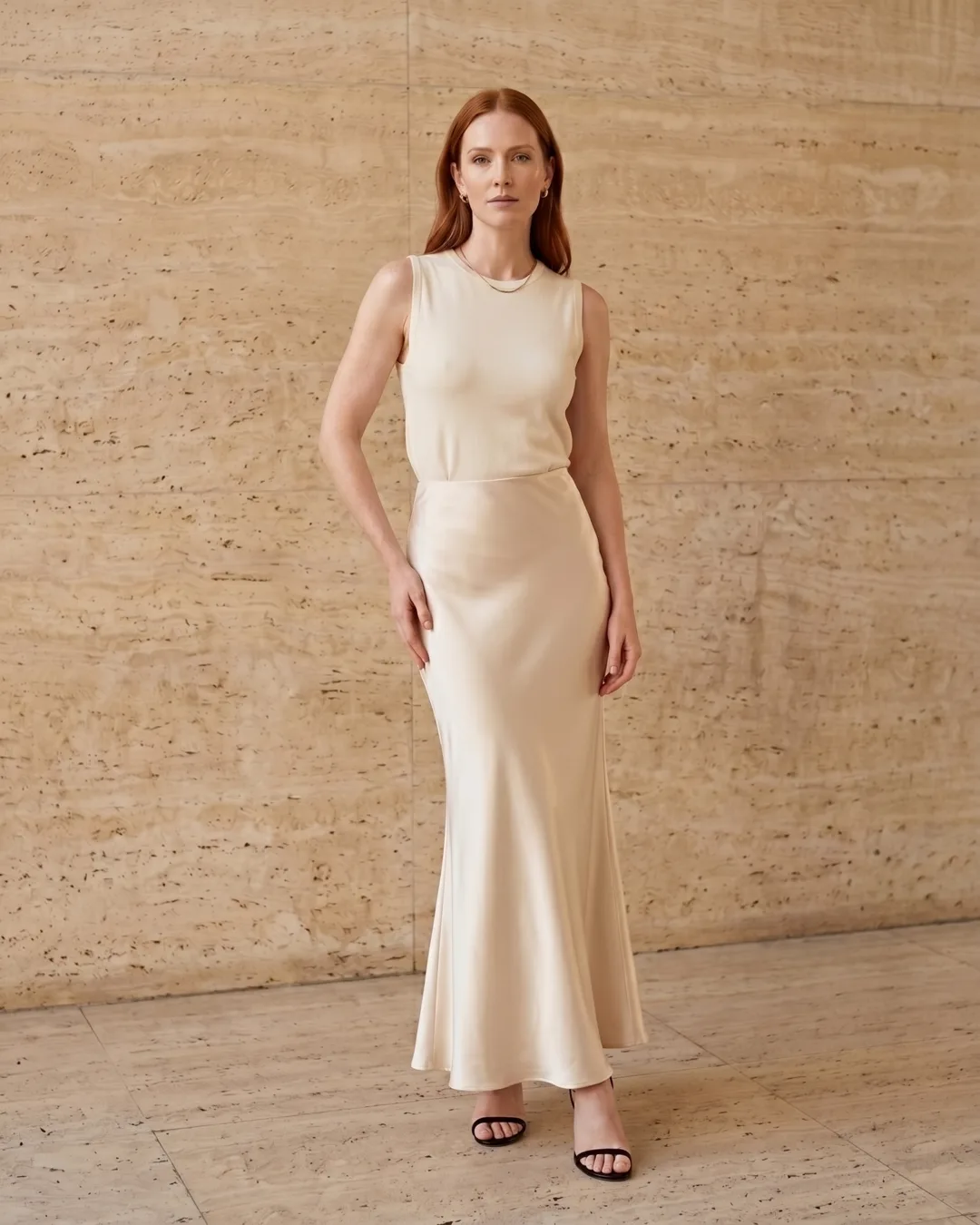
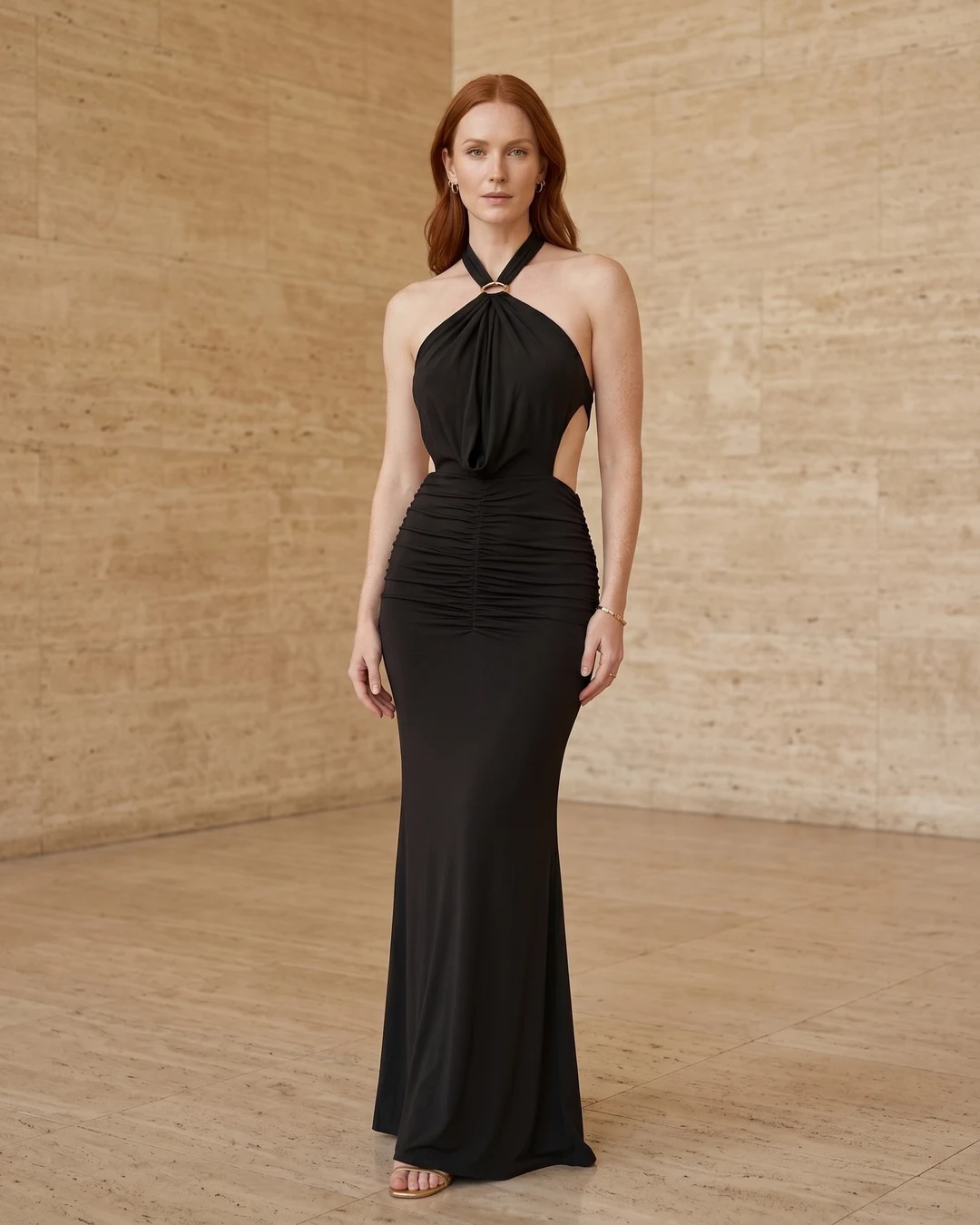
The palla maps to the silk scarf. The stola maps to the draped column midi that falls in the old vertical folds. The cingulum maps to a defined modern waist, and the matte palette maps to imperial colors like Porpora (wine) and Vermiglio (red). The mapping runs on the house elegance doctrine: one statement color per outfit, a hem at the knee or the floor, the shoulder seam fitted first, matte before shine, one focal point only. A Roman matron honored every rule by instinct. The capsule works now for the reason it worked then: restraint reads as standing.
The Roman capsule, mapped to now
Each ancient layer has a modern HCT counterpart you can actually wear.
#The pieces that carry it in the collection
In the current range, the Livilla floral-print chiffon midi plays the everyday stola in motion, a draped column you belt and wear in daylight. The Carina, Palmyra and Vesta silk square scarves play the palla reborn. You should keep the ancient styling rule intact and wear one column plus one scarf, then stop. If you want the column, browse the midi dress collection; for the wrap, choose the silk scarf collection.
#What Roman women wore, in one outfit you can wear now
Three layers ran the Roman wardrobe, tunica, stola and palla, and the rich-versus-poor split came down to fiber, dye and number, never the names of the garments. The keepable version is a single outfit: one draped column, one wrapped scarf in an imperial color, and a straight back. For more of the lineage, start at the Roman heritage hub and follow the thread to the goddess-gown and imperial-color reads.
You now know what a Roman woman wore, and how little it takes to wear it now. You can pick the modern stola from our midi range and the modern palla from the silk scarves, then see the same drape carried into evening in Roman dress and modern elegance.
#Frequently asked questions
What were Roman women's clothes called?
Roman women's clothes were called the tunica, the stola and the palla, the under-tunic, the matron's overdress and the wrapped outdoor mantle. Beneath them she wore a linen subligaculum and a breast band called a strophium.
What did poor Roman women wear?
Poor Roman women wore a single belted tunica of coarse, undyed or simply dyed wool, usually without the status-marking stola. A plain palla served as their one good outer layer, and fine fabric, bright dye and jewelry drew the line between rich and poor.
What did Roman women wear as underwear?
Roman women wore as underwear a linen subligaculum and a strophium, a soft band wound around the bust for support. The subligaculum was a wrap or briefs tied at the hip, and the strophium worked as the Roman equivalent of a bra, both hidden under the tunica.
Did Roman women wear the toga?
Roman women did not wear the toga, because it became exclusively male civic dress and the stola served as the respectable woman's equivalent. A woman seen in a toga was signaling disgrace, typically after a conviction for adultery; the garment marked the male citizen, not the matron.
What colors did Roman women wear?
Roman women wore mostly undyed or white wool, while wealthier women added saffron-yellow, rich reds and wines, and at the very top costly murex purple. Color and the quality of the dye read directly as a woman's wealth, so the plainer the cloth, the lower the household.
How can I dress in Roman style without looking like a costume?
You can dress in Roman style by keeping the structure and dropping the props: one draped column, one wrapped scarf, one imperial color. Choose a crepe or chiffon midi for the stola and a silk scarf for the palla, with no gold cord or toga wrap, which is how the atelier rebuilds the Roman wardrobe as a wearable modern capsule.
More Roman Heritage guides
A History of Roman Dress
A Roman fashion house traces the history of Roman dress for women — the stola, palla and tunic, and how their drape became the modern occasion gown.
Trace the stola to the gownHow Ancient Rome Still Dresses Us
A Rome-born house traces the Roman influence on modern fashion for women: toga drape to Fortuny, Madame Grès and the goddess gown, with the one rule kept.
Trace the Roman drape lineageTyrian Purple
Why Tyrian purple cost more than gold, who was forbidden to wear it, what it truly looked like — and how to wear imperial wine in a dress today.
Unpack the color of emperorsThe Goddess Gown, Decoded
A Rome-born house defines the goddess gown by three tests: drape, fluid fabric, column neckline, plus how to choose the Grecian gown for your shape.
Apply the three-drape test