Best Dress for Your Body Type: The Italian Art of Flattering Your Figure, Not Hiding It
Find the most flattering occasion dress for your body type the Italian way: follow your longest line, skim one focal point, never hide. Shop your shape.
On this page
The best dress for your body type follows your longest vertical line and skims one focal point you choose to lead with, rather than concealing the rest. Most advice on the subject is a list of things to hide. The Roman house of Hugo Caesar Tassi was built on the opposite instinct.
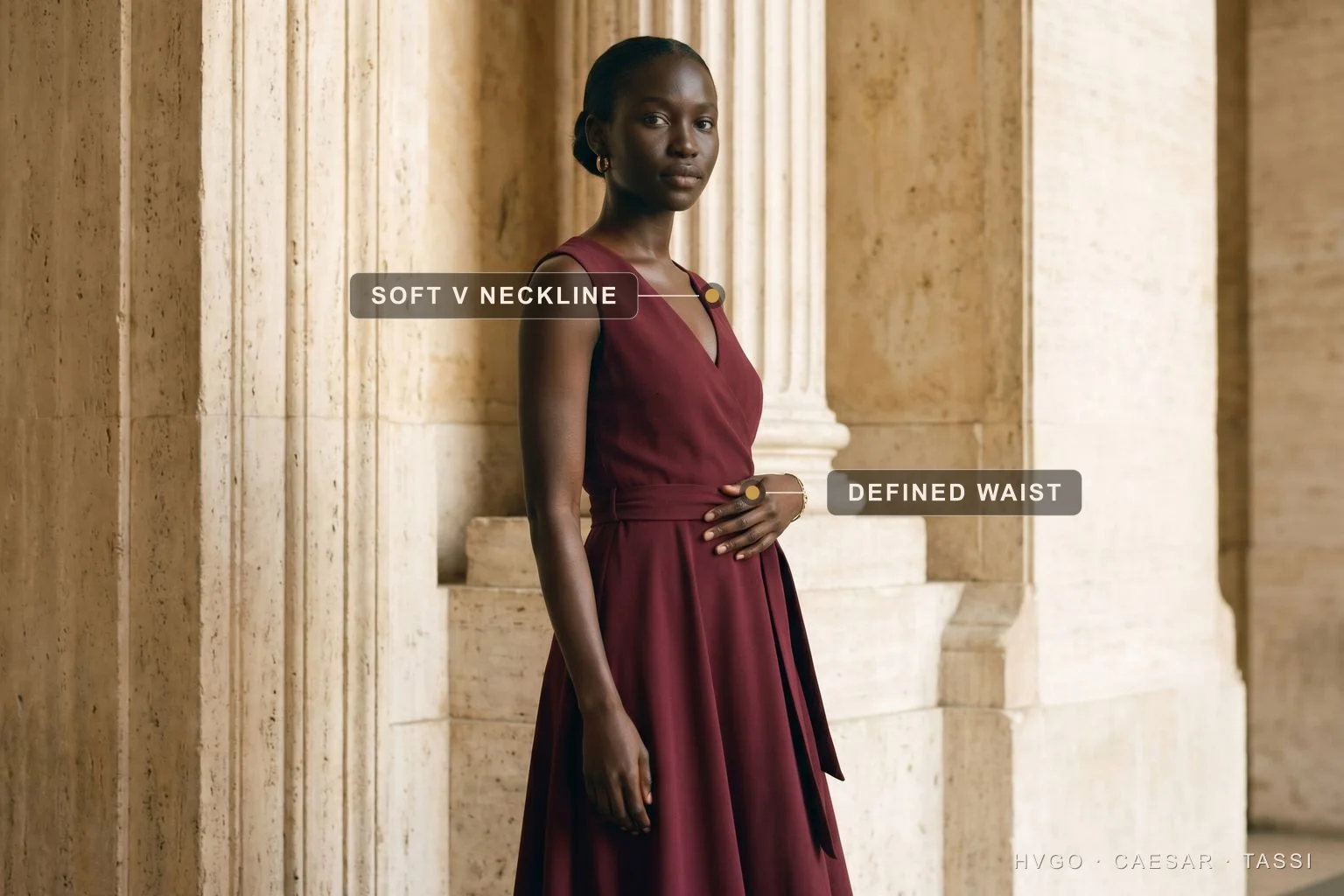
- Soft V neckline — opens a vertical line up to the face to lengthen and lift the eye
- Defined waist — the faux-wrap crosses and ties to mark the narrowest point and trace the figure
#What does "dressing for your body type" really mean, and why the Italian version isn't about hiding?
Choosing a cut that works with your proportions, rather than a costume that disguises them, is the whole idea. That distinction decides whether a dress flatters or merely covers.
#The "hide your flaws" trap most guides set
Concealment-led advice treats a woman's body as a problem to manage, which is why it rarely flatters. The verbs give it away: hide, disguise, camouflage, minimize. A pear gets told to drown her hips in dark fabric; an apple gets sent to shapewear.
Covering one zone only shifts attention to the cover-up; a tunic cut three sizes loose adds bulk that reads as effort. The counter-case proves it: a fitted bias slip on a fuller hip flatters because it traces the line instead of fighting it.
#La bella figura: flatter your body type, don't hide it
La bella figura, presenting your most composed self, replaces "what to cover" with "what to lead with." The Italian phrase names a habit of carrying yourself well in public, so you choose a feature to put first instead of a defect to solve.
Hugo Caesar Tassi, designed in Roma and founded in 2004, builds this into its ethos, Nata Imperare, born to rule. Instead of asking which zone to obscure, you ask which single line draws the eye. The italian style hub traces the phrase from the Roman street to the fitting room.
#The atelier rule: one focal point, your longest line, skim not compress
The founder's fitting-room rule has three parts: choose one focal point, cut to the longest vertical line, and let fabric skim rather than grip. This first-party principle anchors every shape page that follows. Pick one focal point, whether waist, neckline, shoulders or legs, and never two; a plunging neckline plus a thigh slit plus a cinched waist competes with itself. The skim test settles the rest: fabric should graze the body with about a half-inch of air, neither clinging to every contour nor compressing flesh into a held shape.
#How do you find your body type before you choose a dress?
You sort your shape by reading three landmarks, the shoulder line, natural waist and full hip, and comparing their relative width. No tape measure is required for orientation.
#The shoulder-waist-hip read in plain terms
Three landmarks define every shape: the shoulder-and-bust line, the natural waist, and the fullest part of the hip. Stand square in a mirror and read which is widest, which is narrowest, and whether the waist nips in.
Your natural waist sits at the narrowest point above the navel; your full hip is the widest sweep below, often three to four inches under the waist. Width relationships do the sorting, not single numbers. For the tape-measure version that confirms a borderline case, work through the measured method on the body shape finder.
#The five core body types at a glance
Five shapes cover most women: hourglass, pear, apple, rectangle, and inverted triangle. Each is a proportion, not a verdict:
- Hourglass: bust and hip balanced, waist clearly defined; the hourglass figure page covers fitted cuts.
- Pear (triangle): hips wider than shoulders, waist nipped; the pear shape page covers waist-release silhouettes.
- Apple (round): fullness through the middle, slimmer legs, often a softer waist.
- Rectangle (straight/column): shoulder, waist and hip near-even, waist undefined.
- Inverted triangle (broad-shoulder/athletic): shoulders and bust wider than hips.
The edge case worth naming: many women read as two shapes at once, such as an hourglass with a fuller midsection. When in doubt, dress the proportion that bothers you least and lead with it.
#Where the modifiers fit: petite, over 50, plus-size
Petite, over-50 and plus-size are modifiers that layer on top of your core shape, not replacements for it. A petite pear is still a pear; she simply scales the proportions to a shorter frame.
Height changes where a hem breaks; life stage shifts where you want coverage; size affects fabric weight and seam placement, never the focal-point logic. The rule holds across all three: one focal point, longest line, skim not compress.
#What is the most flattering dress silhouette for each body type?
Each figure has one cut that wins: define a waist, release volume away from a full zone, or build a vertical line. The table below maps shape to cut.
| Body type | Lead silhouette | Focal point | Why it flatters |
|---|---|---|---|
| Hourglass | Bias slip / fishtail | Defined waist | Traces the curve without adding bulk |
| Pear | A-line from the waist | Neckline or shoulders | Releases over the hip, lifts the eye up |
| Apple | Empire seam | Bust and neckline | Falls free over the midriff |
| Rectangle | Wrap or self-belt | Created waist | Carves a waist on a straight line |
| Inverted triangle | Soft V-neck, A-line hem | Lower body | Narrows the shoulder, adds volume below |
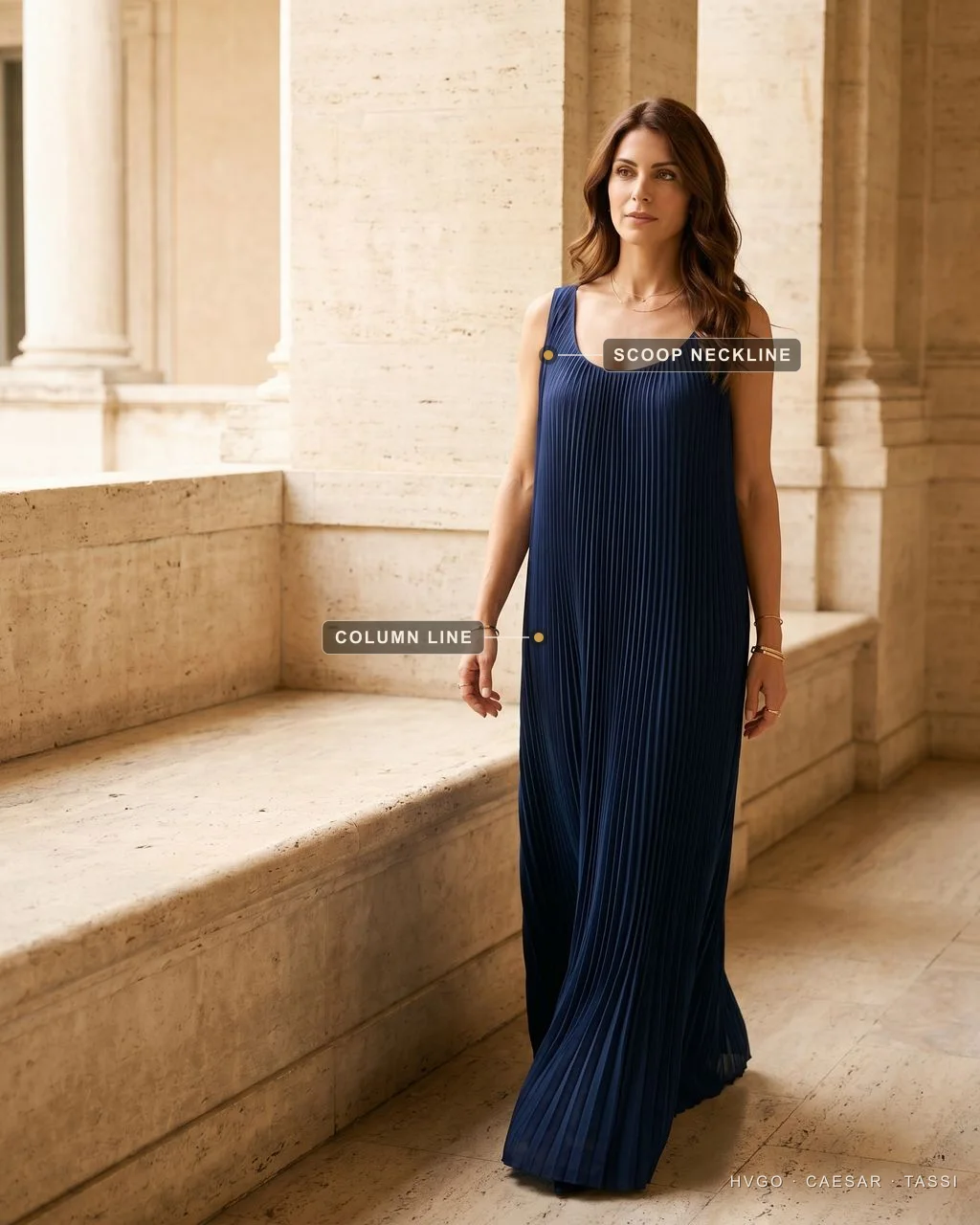
- Scoop neckline — a soft open neck that frames the décolletage without widening the shoulder
- Column line — unbroken knife pleats fall in one vertical to elongate a straight, even figure
Your shape, your lead silhouette
Find your figure, then lead with the HCT cut designed for it.
#Hourglass and pear: define the waist, balance the hips
An hourglass leads with her waist; a pear releases fabric over the hip and lifts the focal point upward. They share a defined waist but differ in where the volume belongs.
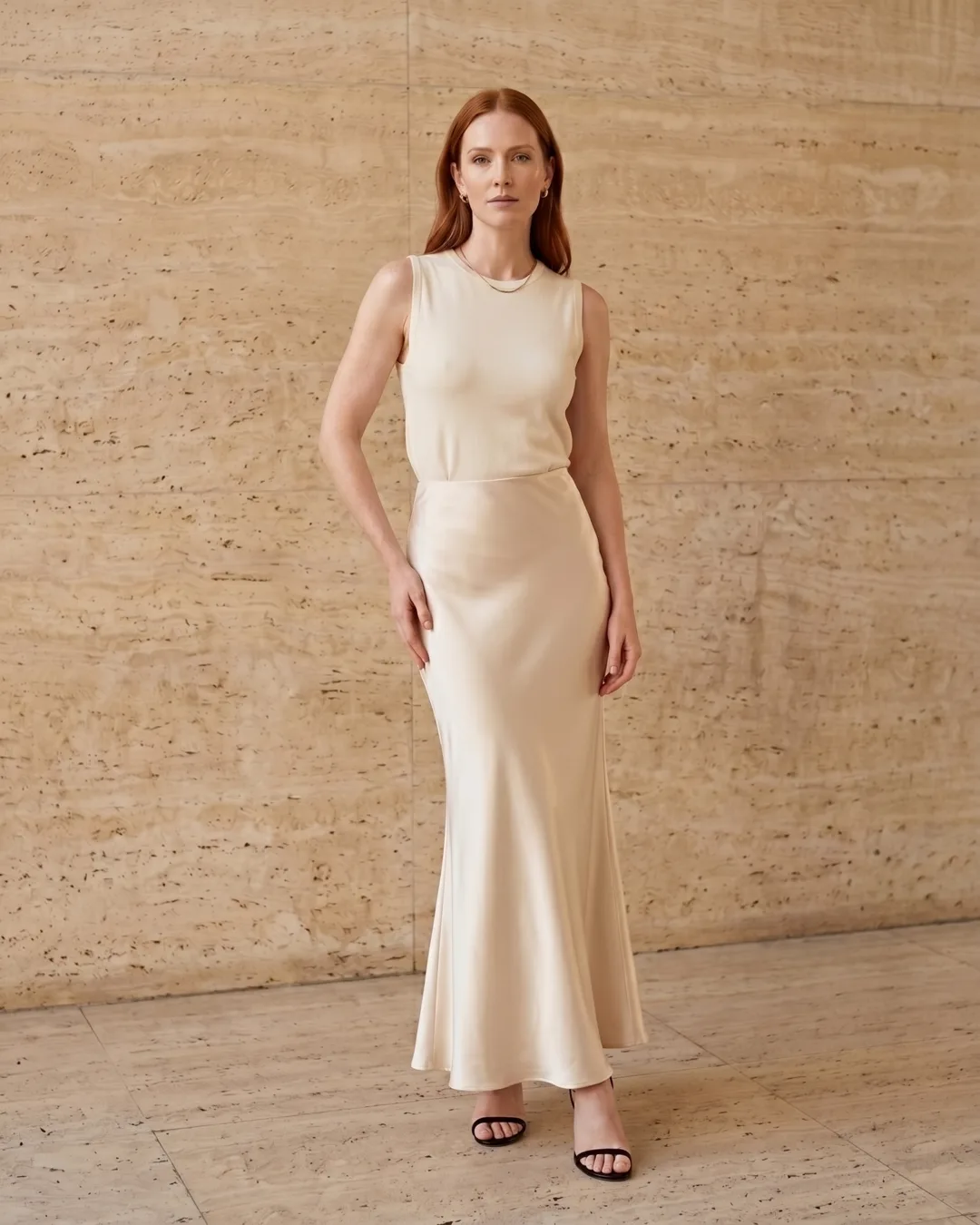
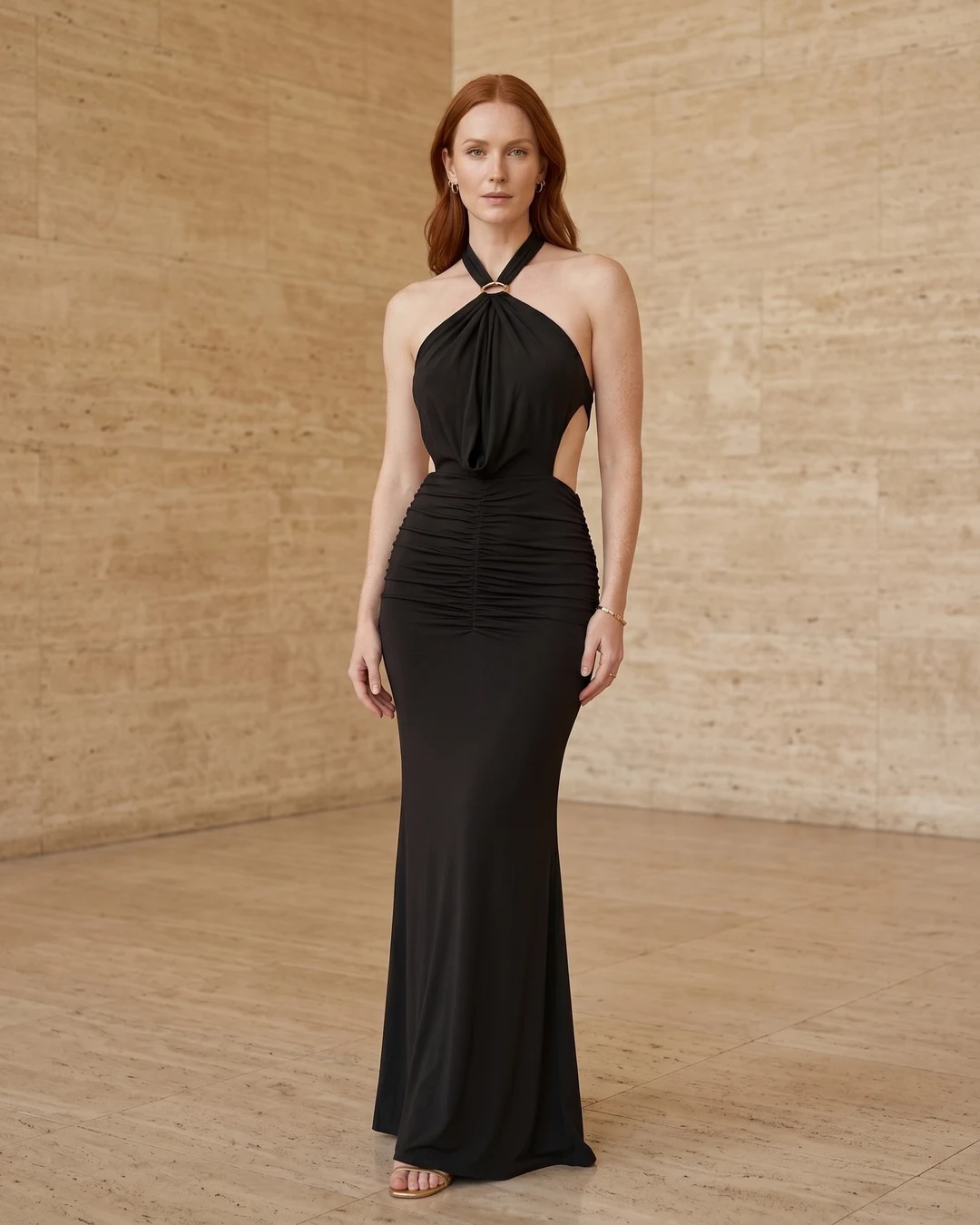
For an hourglass, a defined natural-waist seam in fluid bias-cut satin traces the curve she already has, as the Calpurnia fishtail satin gown holds the waist before it flares below the knee. A pear inverts the plan: an A-line releases from the waist and skims the hip while an open neckline pulls the eye up. The counter-case is the bodycon sheath, which clings exactly where a pear wants air.
#Apple and rectangle: skim the middle or build a waist
An apple skims the middle with an empire seam; a rectangle builds a waist on a straight line with a wrap or belt. These two ask opposite things of the cut.
For an apple, an empire seam sits just under the bust and lets fabric fall free over the midriff, so the dress never leans on shapewear. A rectangle has the opposite task: a wrap, self-belt or bias slip carves a waist where the body reads straight. Skip the shift dress, which echoes the straight line.
#Inverted triangle: open the neckline, add volume below
The inverted triangle opens her neckline to narrow the shoulder and builds volume below the hip to balance an athletic frame. The goal is to move visual weight down, not pile it on top.
A soft V-neck or scoop draws a vertical down the chest and narrows a broad shoulder line, while pleated or A-line volume at the hip builds out the lower half. Avoid the off-shoulder bardot here, flattering as it is elsewhere, because it widens the very line an inverted triangle wants softened.
#Which fabrics and cuts flatter your body type instead of hiding it?
Cloth that grazes the body flatters; cloth that grips reveals every line; cloth that squeezes reads as effort. The fiber decides as much as the cut.
#Skim vs. cling vs. compress, the drape test
The drape test sorts every fabric into three behaviors: skim, cling, or compress. Skim grazes the body with a margin of air and flatters; cling maps every contour; compress squeezes flesh into a held shape and reads as labor.
Hold the fabric up and let it fall. A matte crepe keeps a clean vertical and resists cling, whereas a thin jersey collapses onto the body. The exception is instructive: a fitted bias satin appears to cling yet still skims, because the diagonal cut lets the cloth move with the wearer, as the fabric guide explains.
#Matching fiber to figure
Match fluid fibers to curves you want to trace, airy fibers to shapes that want lift, and structured fibers to lines you want held.
- Bias-cut satin and draped modal trace a curve for an hourglass who wants the line followed.
- Airy chiffon over lining gives a pear or apple lightness and lift without weight on a full zone.
- Matte structured crepe holds a clean vertical and a defined waist for a rectangle building shape.
- Knife-pleated chiffon adds movement low for an inverted triangle balancing the hip.
The same body type changes character with the fiber: an hourglass in crepe reads architectural, the same hourglass in bias satin reads fluid. Neither is wrong, because they lead with different focal points.
#Necklines and waistlines that lead the eye
Necklines and waistlines route the eye: V and scoop lengthen upward, square and off-shoulder widen and balance, and waist placement resets proportion. The focal-point rule decides which to pick.
A V-neck or scoop lifts attention toward the face, whereas a square or off-shoulder neckline widens the shoulder line, balancing a pear yet overloading an inverted triangle. An empire seam lengthens the leg; a natural waist marks the true middle; a dropped waist lowers the visual break.
#How does Hugo Caesar Tassi cut its dresses to flatter every body type?
Each silhouette in the collection answers one shape's logic and comes across the imperial palette, not only in slimming black. The range maps cut to figure.
#The house silhouettes, mapped to body types
Every core cut answers a different shape's brief, so a woman finds her focal point in a named silhouette rather than compromising on a generic one.
The Vipsania draped modal column gown and the Julia French-pleated chiffon maxi deliver fluid skim and a long vertical for a rectangle or apple. The Calpurnia fishtail satin gown defines a waist for an hourglass, while the Aemilia A-line chiffon maxi releases over the hip, the pear's silhouette by design. Each is fully lined with a concealed zip, and the house publishes every model's height, near 175 cm, so you can judge where a hem breaks on your own frame.
#Fabric and drape across the imperial palette
The house chooses weight and fall for skim, then offers each flattering cut in color rather than defaulting to slimming black. Black is a habit, not a rule.
A statement color leads an outfit more confidently than another black dress, following the doctrine of one statement color per look. Porpora wine, Cobalto navy, Verde Antico green and Travertine stone all flatter while leading the eye through hue. Occasion dressing here designs out bridal white and funereal black, so a wine column reads as composed at an evening wedding where black would read as severe.
#Should you "dress for your body type" at all, or just dress for the occasion?
You should treat body-type guidance as a starting confidence, not a cage, then layer it onto the occasion. Shape rules orient you, but they do not own you.
#When body-type rules help, and when to break them
Shape rules help as a default and should break the moment a dress you love still follows your longest line and one focal point. The rule is a floor, not a ceiling.
Some argue that a pear must never wear a column gown. The case falls apart in practice: a draped modal column that releases cleanly over the hip and leads with the neckline flatters a pear because it follows her longest line. Break a rule only when the dress still passes the two real tests, one focal point and fabric that skims; a clinging bodycon fails both, so the rule stands there.
#Your figure plus the dress code
Your figure and the event's dress code work together: pick the silhouette for your shape, then meet the occasion in length, fabric and formality. A dress can flatter your body and still be wrong for the room.
A black-tie gala asks for floor length and evening fabric, whereas a daytime event allows a midi and a lighter weight; the hourglass fishtail that wins at a gala overdresses a garden lunch. For the longer view on reading a dress code against your shape, the evening gowns edit pairs formality with cut.
#Which page should you read next for your body type?
Go straight to the guide written for your exact shape, then shop the occasion edit once you know your cut. This pillar orients; your shape page delivers specifics.
#A decision map to your shape page
Each shape and modifier has its own page that delivers cuts, fabrics and examples for that figure.
- Hourglass: fitted bias and fishtail cuts.
- Pear: A-line and waist-release silhouettes.
- Apple: empire seams and free-falling fabric.
- Rectangle: wraps and belts that build a waist.
- Inverted triangle: open necklines and lower-body volume.
- Petite, over-50, plus-size: the same rule, scaled, on dedicated guides.
#Start measured, then shop your shape
Start with the measured method, read your shape page, then bring the cut to the occasion collection. Confirm your shape first so you are not guessing in the fitting room, then learn its lead silhouette and fabrics on the page for that figure. The collection then narrows to a few right dresses rather than a hundred maybes.
#Frequently asked questions
What is the best dress for my body type?
The best dress for your body type follows your longest vertical line and skims a single focal point you want to lead with. A defined waist suits an hourglass, an A-line over the hip suits a pear, an empire seam that falls free suits an apple. Find your shape, then read that shape's page for the exact cuts.
How do I know my body type?
You know your body type by comparing your shoulder-and-bust width, natural waist and full hip. Balanced with a defined waist is hourglass, hips wider than shoulders is pear, fullness through the middle is apple, near-even with a soft waist is rectangle, shoulders wider than hips is inverted triangle. The finder gives the exact measured method.
Is it true you should dress to hide your body type?
No, dressing to hide your body type is the framing this house rejects. In the la bella figura tradition a dress flatters by leading with your best feature and skimming the body, never compressing or apologizing for it.
What dress silhouette suits the most body types?
A bias-cut or A-line dress with a defined or empire waist suits the widest range of body types. It traces a waist while skimming the hip in a clean vertical line, though the truly flattering choice still depends on the focal point you want to lead with.
Does my body type matter more than the occasion?
Your body type and the occasion matter together, not one over the other. Pick a silhouette that follows your figure, then confirm it meets the event's dress code in length, fabric and formality. That way the dress is right for both your body and the moment.
Should petite, over-50 or plus-size women follow different body-type rules?
Petite, over-50 and plus-size women follow the same body-type rule, scaled to proportion. Those labels are modifiers that layer on top of your core shape, not separate rules, with adjustments for proportion, sleeve and fabric on dedicated guides.
Lead with your one focal point: find your shape with our measured method, read the page written for it, then bring it to the occasion edit when you are ready to choose.
Body Shape guides
Best Dresses for an Apple Shape
The apple-shape dresses that skim a fuller middle with cut, not shapewear: empire seams, bias drape and fluid crepe from the Roman atelier of HCT.
See the apple-shape editElegant Dresses for Women Over 50
Occasion dresses that flatter over 50 — a three-quarter sleeve, soft V neck and crepe that skims. The age-positive guide to weddings and evenings.
Dressing well over 50Best Dresses for an Hourglass Figure
The silhouettes, fabrics and necklines that trace an hourglass figure instead of hiding it, plus the atelier fluid-weight rule and HCT gowns to shop.
See the hourglass editHow to Find Your Body Shape
Take three measurements and learn your body shape for sure with the atelier ratio method and exact thresholds, not vague compare-to-fruit guesswork.
Find your body shapeHow to Dress an Inverted Triangle Body Shape
Open the neckline into a soft V to narrow broad shoulders, then add a skirt-width of pleated-chiffon volume at the hip until your shape reads balanced.
Style the inverted triangleBest Occasion Dresses for a Pear Shape
The shapes, necklines and fabrics that balance a pear shape: A-line chiffon that skims the hip and a neckline that lifts the eye one body-third up.
See the pear-shape editThe Petite Woman's Guide to Occasion Dresses
The lengths, waistlines and silhouettes that lengthen a petite frame, with the exact hem rule and the one-color column that reads taller.
See the petite editPlus-Size Occasion Dresses
Plus-size occasion dresses in flattering cuts and real color, not just black. Silhouette, fabric and confident fit from the Roman house of HCT.
See the plus-size editBest Dresses for a Rectangle Shape
The wraps, belts, peplums and bias cuts that build a waist on a straight figure, ranked by how much curve each adds, plus the HCT gowns our atelier picks.
See the rectangle edit