How Ancient Rome Still Dresses Us: The Roman Influence on Modern Fashion
A Rome-born house traces the Roman influence on modern fashion for women: toga drape to Fortuny, Madame Grès and the goddess gown, with the one rule kept.
On this page
Pull a one-shoulder gown off the rack today and you hold a two-thousand-year-old idea. The Roman influence on modern fashion is one construction principle: drape a single length of cloth on the body rather than cut and sew a woman into it. Written from Rome, here is the named, dated proof.
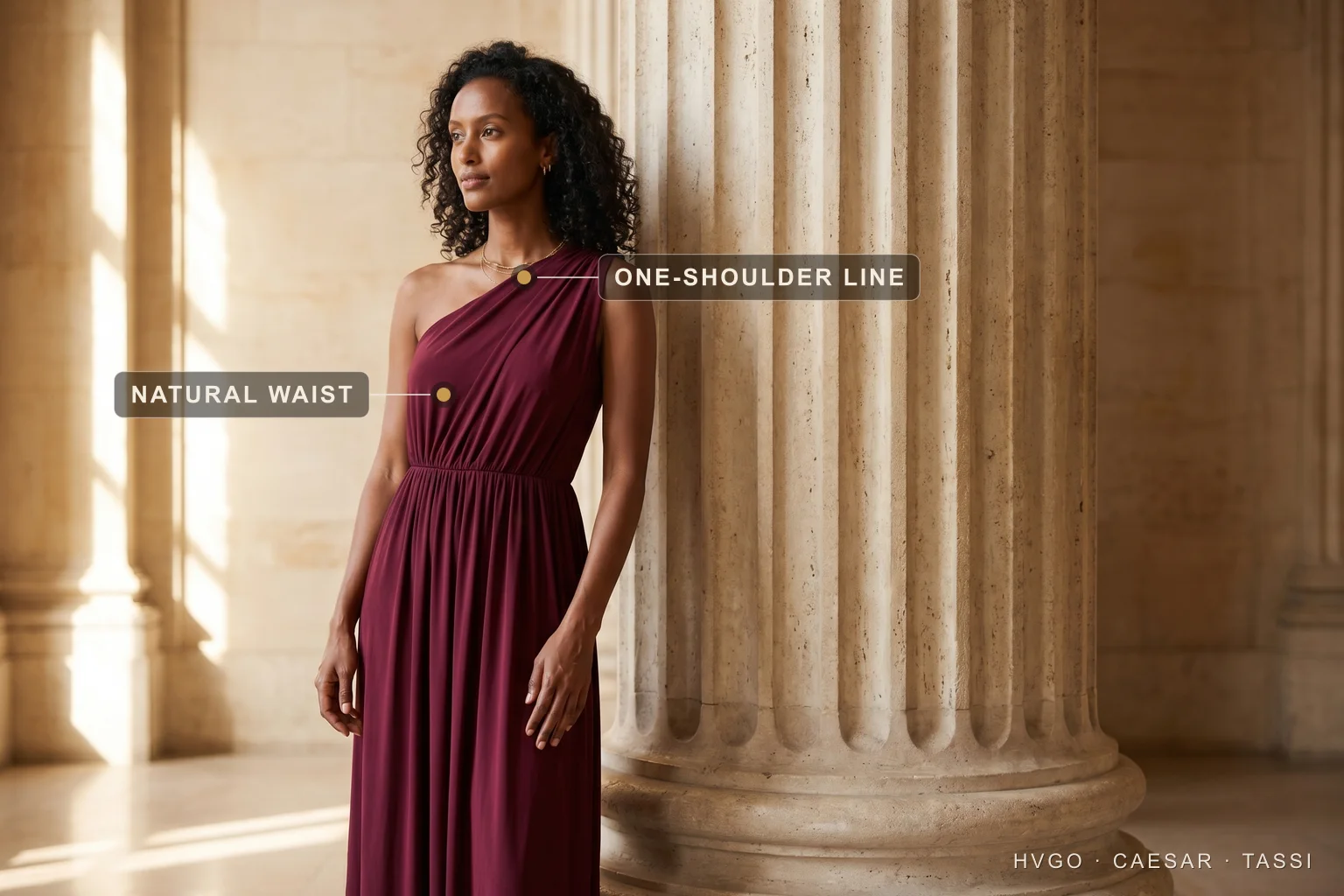
- One-shoulder line — the wrapped length crosses one bare shoulder on a clean diagonal, the toga drape resolved into a modern neckline.
- Natural waist — the cloth is gathered, not seamed or boned, so the column falls from a soft fastened waist exactly as a draped rectangle did in antiquity.
#What is the Roman influence on modern fashion, really, and what is just costume?
The lasting inheritance is a construction method, not a motif: one continuous length of cloth shaped on the body by drape and pleat, fastened rather than tailored. Ancient dress solved the body with geometry. A weaver produced a flat rectangle, and the wearer wrapped, belted, or pinned it so gravity did the shaping. The cloth fell in vertical folds because nothing interrupted its length. Every later era borrowed that through-line, from the column gown to the asymmetric neckline to the high-waisted Empire dress.
#The one principle Rome handed down
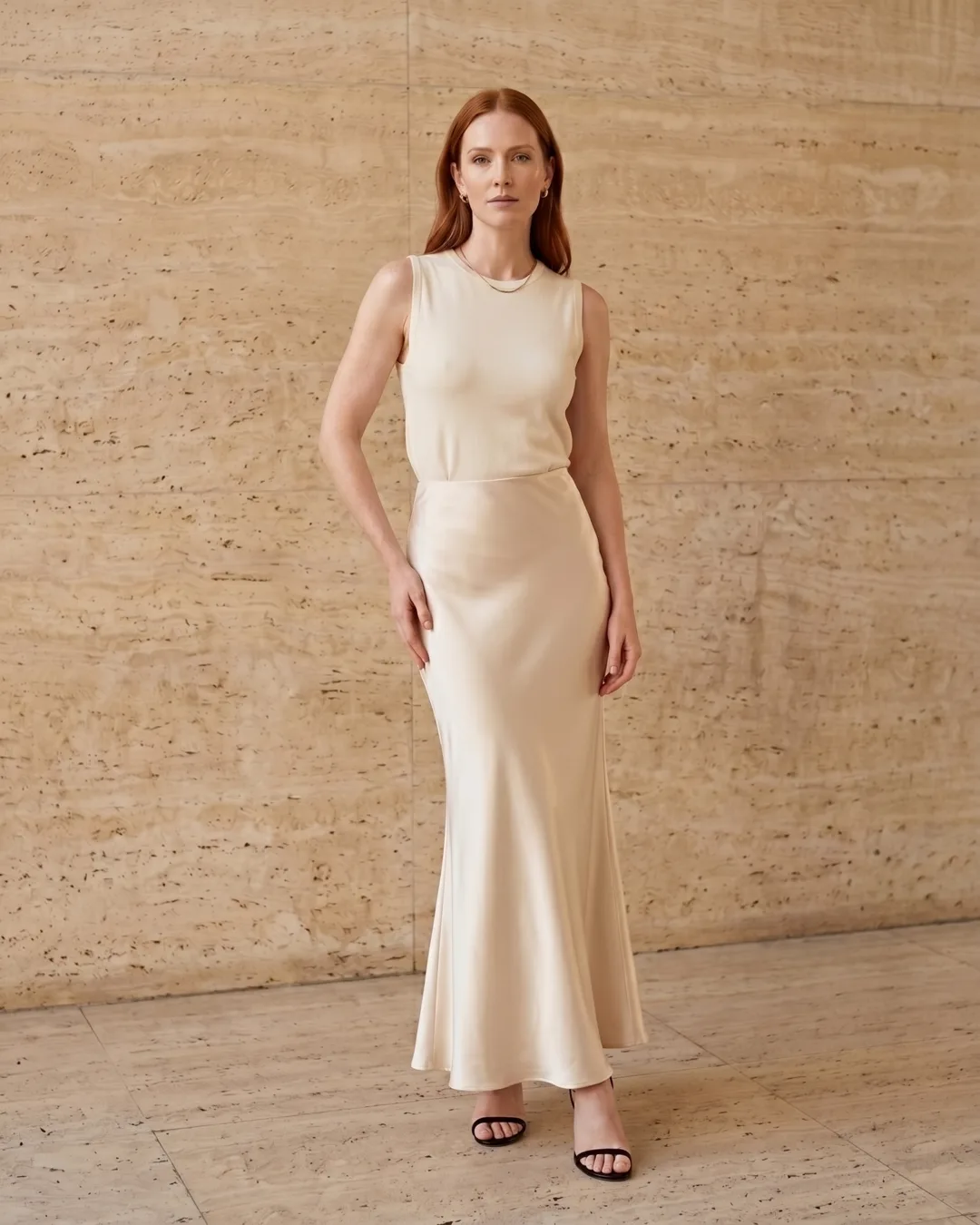
Roman dress built the garment from an uncut length, so the fabric resolved into vertical columns the cutter never had to engineer. A Roman woman owned cloth and the skill to arrange it, not a fitted bodice. The modern bias-cut satin slip proves the survival: it clings and pours without a single dart, obeying the same physics a draped rectangle obeyed in antiquity.
Stiff brocade with a boned bodice owes Rome nothing. That ball skirt is built by internal architecture, the opposite tradition, even when the color reads classical.
#Heritage as a design language, not a toga party
Wearing the Roman influence means borrowing the drape, the column line, and the imperial restraint, never pinning an actual bedsheet at the shoulder. A fluid one-shoulder column in a single deep color quotes Rome with discipline. The reference lives in the fall of the fabric and one clean fastening, not in props bolted on top.
Compare the rental-store toga: a white sheet, a gold cord, a plastic laurel. That copies the surface and ignores the principle, whereas heritage worn well keeps the grammar and drops the literal nouns.
#Which Roman garments are the source of the Roman influence on fashion women wear now?
Three garments carry the line: the toga as the drape source, the palla as the wrapped mantle, and the stola as the vertical-fold column. Each maps onto a silhouette a woman can buy today. Read the history of Roman dress for the full wardrobe account; here the garments appear only as the ancestors of modern cuts.
#The toga and the palla: the source of the drape
The toga, Rome's draped semicircle, became the visual shorthand for classical drape, while the palla, the woman's large rectangular mantle, became the wrapped and one-shouldered look. Carry one edge of a rectangle over a shoulder and let the rest fall across the torso. You produce the diagonal line every "one-shoulder gown" sells; the palla did it with wool, a modern atelier with chiffon.
A two-shoulder draped cowl shows the limit. It borrows the soft fold but not the asymmetry, so it reads Grecian without the toga's signature diagonal.
#The stola and the column line
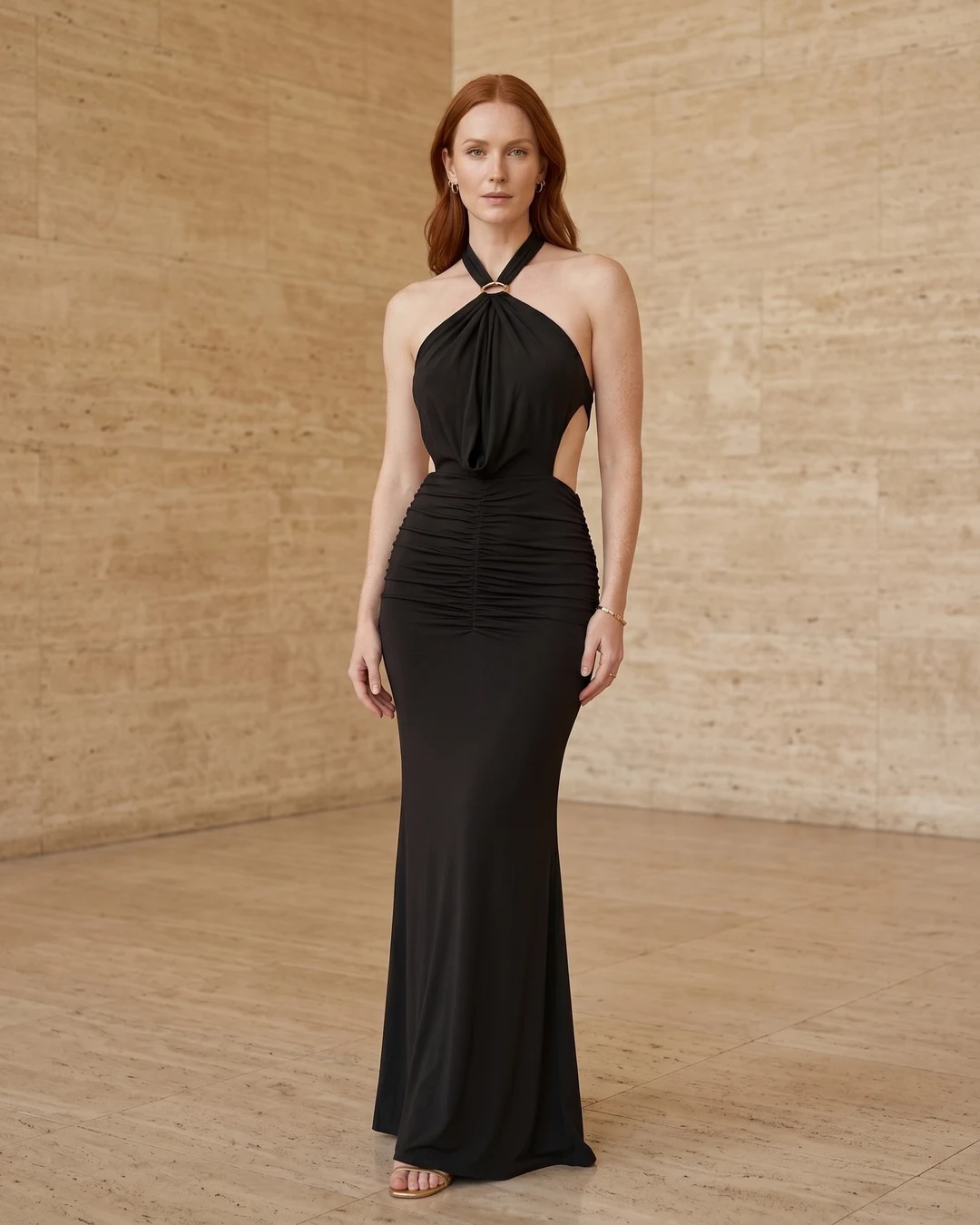
The stola fell to the ankle in soft vertical folds, which makes it the direct ancestor of the modern column gown and the high-waisted Empire silhouette. A floor-grazing modal column gown reproduces that fall almost exactly: narrow through the body, unbroken to the floor, the line flattering because nothing chops the vertical.
A tiered ruffle maxi proves the opposite. It uses length but cuts the column into horizontal bands, so the stola lineage stops at the hem. Length alone is not the column. For the wardrobe detail of what Roman women actually wore, see what did Roman women wear.
#The Greek drape Rome adopted and passed on
Rome inherited the column from Greece, where the chiton and peplos were pinned at the shoulder and belted, then carried that logic across the empire and into every later revival. The peplos was a tube of cloth pinned at each shoulder. The chiton hung from pinned or sewn shoulders and belted at the waist. Rome absorbed both, so the modern goddess gown answers to either label, "Grecian" and "Roman" naming one draping tradition. For the buyer's full definition, see what is a goddess gown.
Watch the label that means trim, not drape. A border motif is decoration, whereas the inherited principle is structural.
#How did toga draping become the one-shoulder and column silhouettes that carry the Roman influence on fashion today?
Toga draping survives through three mechanisms: the wrapped length that resolves into a one-shoulder neckline, the bias cut that lets woven cloth pour, and the Empire waist that revives the column.
#From wrapped cloth to the one-shoulder neckline
A single wrapped length resolves into the asymmetric neckline when one edge crosses a shoulder and the remainder cascades across the body. To spot a true toga drape, follow the diagonal from one shoulder to the opposite hip. The Flavia strapless satin gown reads it from the other direction, stripping the shoulder so the wrapped bodice carries the drape. A one-shoulder dress with a structured cup and a horizontal bandeau band only mimics the look; the rigid construction means the cloth never actually drapes.
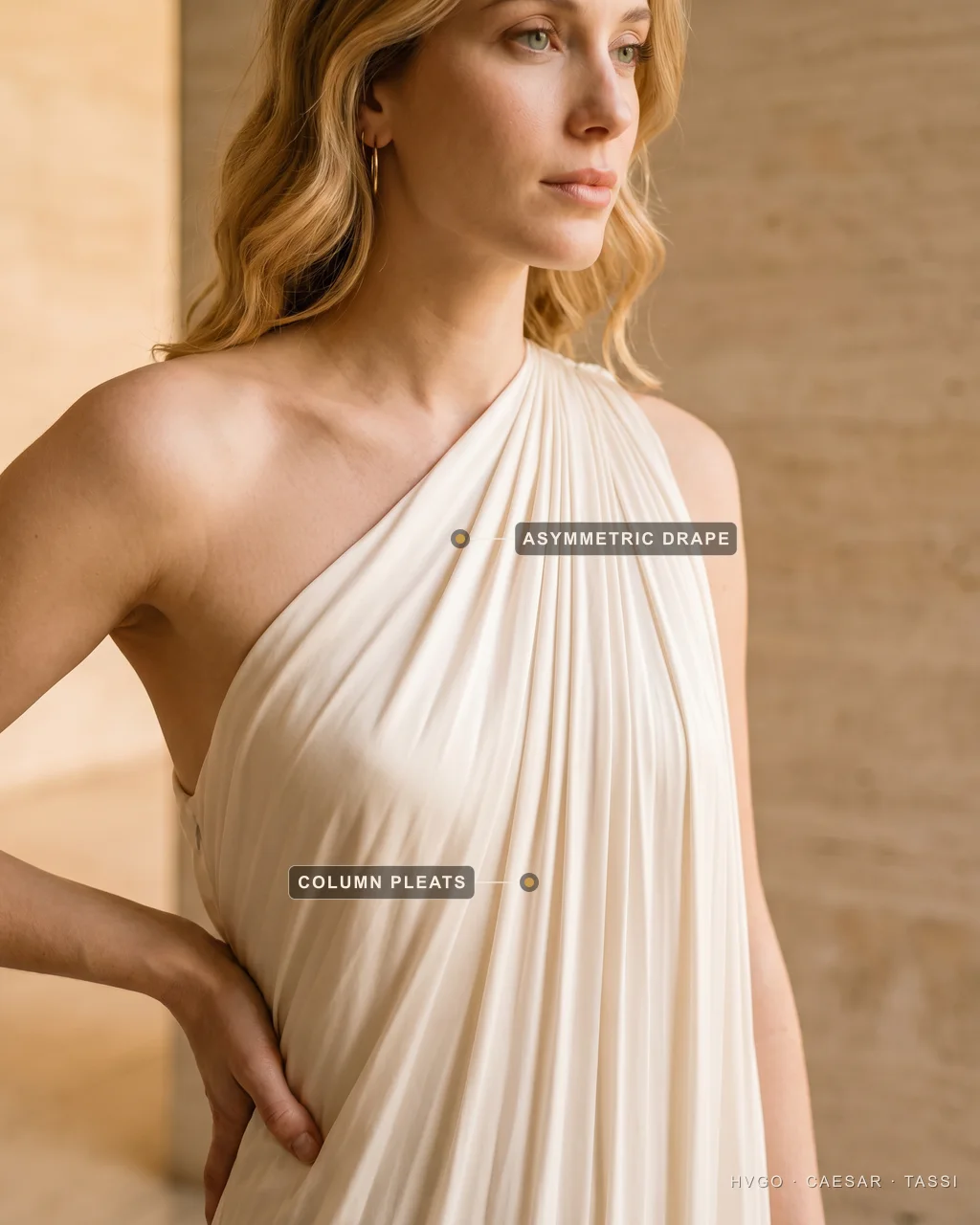
- Asymmetric drape — one edge of the cloth crosses a single shoulder on a diagonal, the wrapped-palla line that gives every one-shoulder gown its signature.
- Column pleats — the gathered length resolves into unbroken vertical folds, the stola column carried into modern cloth.
#The bias cut: making woven cloth drape like antiquity
Madeleine Vionnet's bias cut, developed in the 1920s, turned the fabric forty-five degrees to the grain so stitched woven cloth would fall in fluid columns without a single pin. Antiquity got fluidity for free because the cloth was never cut. Vionnet recovered it by cutting against the weave. A stiff, tightly woven fabric defeats the trick: heavy taffeta cut on the bias still resists the body, because the method needs cloth soft enough to surrender.
#The Empire waist and the column
The Empire line raises the seam to just under the bust, dropping a straight column to the floor and lengthening the visible line of the leg. By letting the skirt fall unbroken, the Empire cut reads as one long vertical, which is why it flatters most frames: the eye reads height, not width. The line reaches straight through to today's column maxi.
A very high Empire seam can backfire on a petite frame. It shortens the torso and reads as maternity, so the same cut that lengthens one figure foreshortens another.
#Which couturiers carried the Roman influence on fashion forward, from Fortuny to Madame Grès?
Four hinges carry the chain: the Neoclassical revival reopened the door, Fortuny patented the pleat, Vionnet engineered the bias, and Madame Grès set the standard for the hand-pleated column.
| Couturier era | Date | The classical move | What it gave modern dress |
|---|---|---|---|
| Neoclassical / Directoire | 1790s–1820s | White muslin column, high waist | Revived the Greco-Roman line wholesale |
| Mariano Fortuny | early 1900s | Patented permanent silk pleating | The Delphos gown, antiquity as couture |
| Madeleine Vionnet | 1920s | The bias cut | Woven cloth that drapes without a pin |
| Madame Grès (Alix) | mid-century | Hand-pleated silk jersey | The reference-standard goddess column |
#The Neoclassical revival that reopened the door
After the French Revolution, the Directoire and Regency years dressed women in white columnar muslin with a high waist, the first wholesale modern reissue of the Greco-Roman line. Madame Récamier sat for her portrait in exactly this column, the fussy panniers of the old court giving way to a single falling line.
The revival cooled fast. By the 1830s the waist dropped and skirts ballooned again, so the column receded for nearly a century until couture reclaimed it.
#Mariano Fortuny and the Delphos gown
Mariano Fortuny released the Delphos gown in the early 1900s, a pleated-silk column whose patented permanent pleating clung and fell exactly like an antique fluted shaft. The pleats were the engineering. Fixed into the silk, the gown poured straight from shoulder to floor and packed into a small coil when stored, the hinge where antiquity became wearable couture.
Fortuny quoted a Greek bronze, the Charioteer of Delphi, by name. A classical column had become a modern garment.
#Madame Grès and the hand-pleated Hellenic column
Madame Grès, working under the name Alix, built sculptural goddess gowns from hundreds of hand-pleated tucks in silk jersey, the purest modern translation of the draped Greco-Roman column. Trained as a sculptor, she narrowed yards of jersey into fine vertical pleats. Each gown fell from the shoulder in a single column, which is why this page treats her as the reference standard.
Her discipline shows by contrast. A printed, embellished "Grecian" gown buries the pleat under decoration, whereas Grès let the fold be the only ornament.
#The designers who still quote Rome
Living houses keep the line current: Versace's Medusa and Greca motifs, Valentino and Dolce & Gabbana's classical references, and Elie Saab and Marchesa's red-carpet goddess gowns. Versace pairs the Greek-key border with draped one-shoulder columns, and Marchesa builds the floating goddess gown the red carpet now expects, the women's eveningwear context a Rome-born house sits within.
A motif-only house shows the trap. Stamp a Greek key on a structured cocktail dress and the reference is decorative, not structural. The drape is what makes it Roman, not the border.
#Where else does the Roman influence on fashion hide: motifs, jewelry and shoes?
Beyond drape, Rome survives as decoration and footwear: the Greek key, the cameo, the laurel, and the strappy sandal, all accents used one at a time.
#The Greek key, the cameo and the laurel
The meander or Greek-key border, the carved cameo, and the laurel-wreath and coin-medallion jewelry form the decorative layer of Roman influence, distinct from the structural drape. A single cameo pendant on a plain column lets the reference whisper. So does a Greek-key cuff with an unadorned gown. The house rule is one focal point, so the drape stays the subject and the motif stays the footnote.
Stacking is the trap. Greek-key trim plus a cameo plus a coin necklace plus a laurel headband reads as theme-party, not heritage.
#The Roman sandal and the gladiator lace-up
The strappy "Roman" sandal and the flat leather gladiator lace-up are the most literal surviving Roman garments in a modern wardrobe. A fine leather lace-up flat genuinely descends from Roman footwear, and worn with a quiet column it grounds the look without shouting. An over-buckled knee-high gladiator boot under a draped goddess gown overloads it: two loud classical signals compete, so choose one classical cue, the shoe or the trim, not both.
#How does Hugo Caesar Tassi read the Roman influence on fashion in an atelier dress?
Hugo Caesar Tassi translates antiquity by a four-part method (drape, pleat, palette, posture), keeping the continuous-drape principle and the imperial palette while refusing literal togas and gladiator kitsch. This is the house's defensible point of view.
#The house lens: drape, pleat, palette, posture
The house keeps four things from Rome and discards the props: continuous drape, the pleat, the imperial color palette, and upright posture, never a costume. Drape keeps the cloth falling in vertical columns. Pleat lets the fold carry the line, whether knife-pleated chiffon or French-pleated crepe. Palette means one statement color from the imperial range, Porpora or Basalt. Posture means a column cut that asks the wearer to stand straight, the motto Nata Imperare made physical.
| House keeps | House refuses |
|---|---|
| Continuous-drape construction | Literal toga wrapping |
| The vertical pleat and column line | Boned, architectural ball skirts |
| One imperial statement color | Stacked Greek-key, cameo and laurel together |
| Restraint, one focal point | Gladiator-sandal kitsch with a gown |
#The unbroken line in a real gown
The lineage lands on named gowns: Vipsania reborn drape, Tullia and Julia carry the couture pleat, and Livilla brings the column into everyday wear. Vipsania, the draped modal column gown, is the stola and palla drape reborn in modal. Tullia, the pleated crepe column, and Julia, the French-pleated chiffon maxi, carry the Fortuny and Grès pleat into modern cloth. Livilla, the floral-print chiffon midi, is the everyday descendant at a hem that breaks at the knee. Browse the maxi dresses range to see the lineage at length.
A print so busy it hides the drape is the one thing the house rejects. When the pattern wins, the principle loses, so the heaviest prints stay off the column gowns.
Toga to wardrobe: the drape, named
Each Roman source garment maps onto a column you can actually wear today.
#The Roman influence on modern fashion, as one dated lineage
The whole story is one chain, each link inheriting the same principle: one continuous length of cloth, draped not cut.
- Greek chiton and peplos: cloth pinned at the shoulder, belted into a column
- Roman toga, stola, palla: the wrapped, draped and vertically folded sources
- Neoclassical / Empire revival (1790s–1820s): white muslin columns, the high waist returns
- Fortuny's Delphos (early 1900s): patented permanent pleating, antiquity as couture
- Vionnet's bias cut (1920s): woven cloth made to pour without a pin
- Madame Grès' Hellenic columns (mid-century): hand-pleated jersey, the reference standard
- Today's red-carpet goddess gown: the same drape reissued in new fabric
- An HCT crepe column: the line, named and wearable, in the imperial palette
Whenever a gown reads "Grecian" or "Roman," check whether the cloth is shaped by fold or by seam, because the fold is the inheritance. For more on how this heritage shapes the silhouettes you choose, see the dress silhouettes guide or the wider Roman Heritage hub.
#Frequently asked questions
How did ancient Rome influence modern fashion?
Ancient Rome influenced modern fashion through one construction principle, not a motif: clothing built from a single draped length of cloth shaped on the body. That method survives as the column gown, the one-shoulder neckline, and the draped Grecian goddess dress, the fold carrying the line where a tailor would otherwise cut a seam.
Which fashion designers were inspired by ancient Rome and Greece?
The fashion designers most clearly inspired by ancient Rome and Greece are Mariano Fortuny, Madeleine Vionnet, and Madame Grès. Fortuny patented the pleated Delphos gown, Vionnet engineered the bias cut, and Madame Grès hand-pleated Hellenic columns. Living houses like Versace, Valentino, and Elie Saab still quote classical drape and the Greek-key motif.
What is a toga-inspired dress?
A toga-inspired dress borrows the toga's logic of one wrapped length of cloth rather than recreating an actual toga. It usually appears as a one-shoulder or asymmetric draped neckline above a soft column skirt, the diagonal fold from shoulder to opposite hip the signature to look for.
What is the difference between Greek and Roman influence in fashion?
The difference between Greek and Roman influence in fashion is mostly a label, because both name one inherited drape. Rome adopted the Greek chiton-and-peplos column and passed it forward, so modern "Grecian" and "Roman" gowns describe a single continuous Greco-Roman draping tradition.
How do you wear Roman-inspired fashion without looking like a costume?
You wear Roman-inspired fashion without looking like a costume by keeping the drape and the column line while dropping the literal props. Choose a fluid one-shoulder or pleated column in a restrained imperial color. Let one cameo or Greek-key accent do the referencing instead of a laurel crown and a gold cord.
Why do red-carpet "goddess gowns" look so Roman?
Red-carpet goddess gowns look so Roman because the column-and-drape line never died. It passed through the Neoclassical revival and couturiers like Fortuny and Madame Grès into present-day eveningwear. Every modern goddess gown is the same Greco-Roman principle reissued in new fabric.
You can now trace the drape from the toga to the present. See where the line lands today, and meet the column reborn in our evening dresses. For the longer story of how this heritage became wearable, read the journal account of Roman dress to modern elegance.
More Roman Heritage guides
A History of Roman Dress
A Roman fashion house traces the history of Roman dress for women — the stola, palla and tunic, and how their drape became the modern occasion gown.
Trace the stola to the gownTyrian Purple
Why Tyrian purple cost more than gold, who was forbidden to wear it, what it truly looked like — and how to wear imperial wine in a dress today.
Unpack the color of emperorsWhat Roman Women Wore
A Rome-born house answers what Roman women wore: the tunica, stola and palla — and maps that original capsule onto a modern woman's wardrobe.
Meet the stola and pallaThe Goddess Gown, Decoded
A Rome-born house defines the goddess gown by three tests: drape, fluid fabric, column neckline, plus how to choose the Grecian gown for your shape.
Apply the three-drape test