The Goddess Gown, Decoded: Grecian & Roman-Inspired Dressing for the Modern Woman
A Rome-born house defines the goddess gown by three tests: drape, fluid fabric, column neckline, plus how to choose the Grecian gown for your shape.
On this page
A goddess gown is a floor-length evening dress that passes three tests: a single unbroken drape line, fabric that falls in soft vertical folds, and an asymmetric or column neckline. The drape is the whole point. Search the term and you meet costume listings instead.
At Hugo Caesar Tassi, a women's house founded in Roma in MMIV on the motto Nata Imperare (born to rule), we read the silhouette straight from its source: the single draped length the Greek chiton and the Roman palla taught the body. This guide hands you the three-test rule, the necklines and fabrics that earn it, and the gown that flatters your shape for a real occasion.
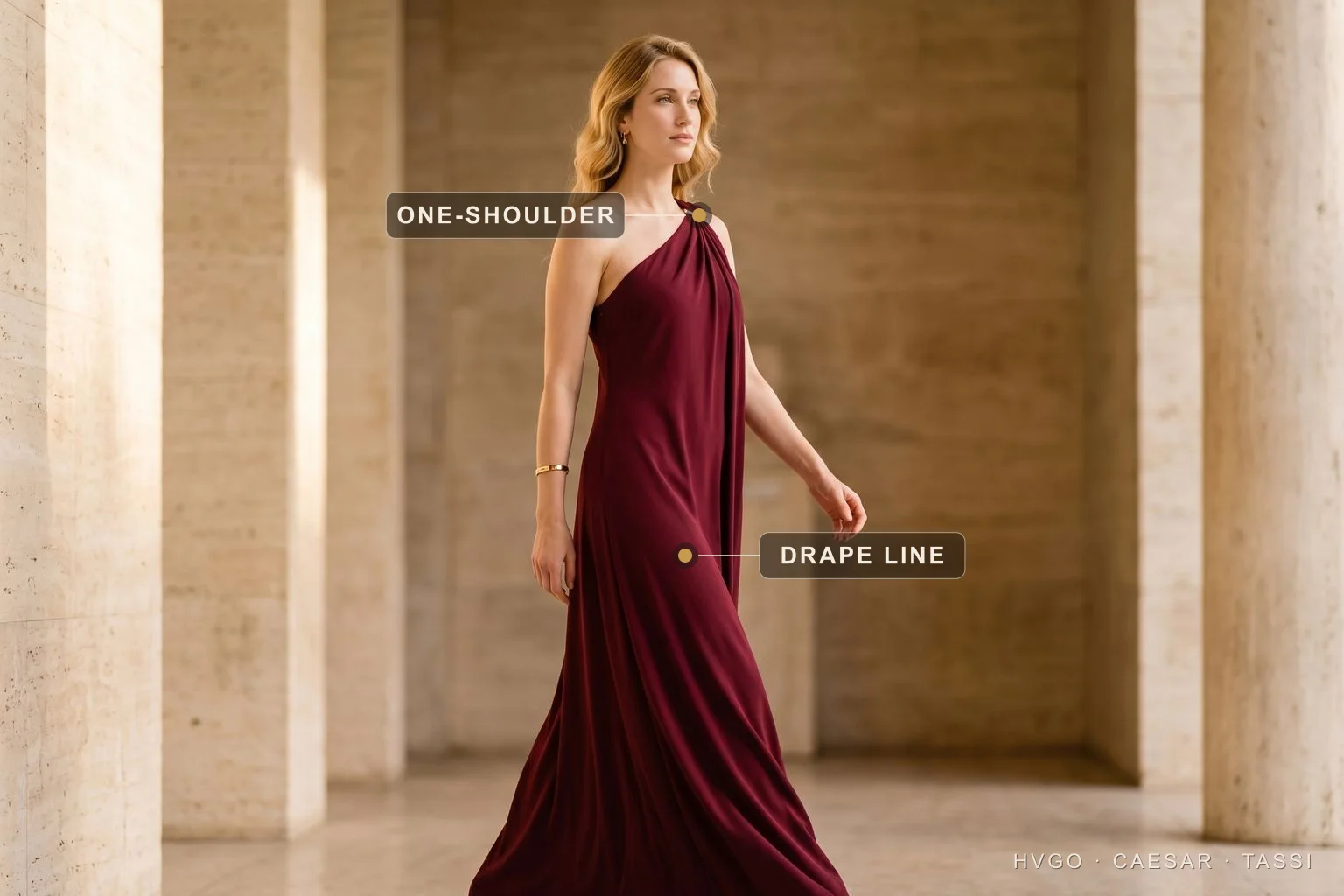
- One-shoulder — the fabric gathers and pins at a single shoulder, recreating the fibula-fastened chiton.
- Drape line — one continuous vertical fall from shoulder to hem, with no waist seam breaking the body.
Five HCT gowns, matched to the test
Each column is auditioned against the drape line, fluid fabric, and column neckline before it earns a place.
#What is a goddess gown, really, and why most search results get it wrong
Drape, not laurel leaves or gold cord, defines the gown, which is occasion eveningwear rather than fancy dress. Most listicles stop at "flowy Greek dress," an adjective that lets a Halloween costume and a duchess-satin bridal column both claim the name. They cannot both be right.
The confusion is structural. A search engine groups "Grecian," "goddess," and "Greek" by keyword, so a cheap polyester toga ranks beside a couture column. The shopper then can't tell which dress will actually move like the reference image in her head. We fix that with a rule she can apply to any listing, in any store, in ten seconds.
A real one reads as one continuous vertical line from shoulder to floor. The fabric pools and travels when she walks. The neckline breaks the symmetry or stays clean and columnar. Miss any one of the three, and the dress belongs to a different category, however "Grecian" the product title insists.
#The three-test definition of a true goddess gown
Three tests separate the real thing from everything that borrows the word: one drape line, one fluid fabric, one column-clean neckline. Apply each in order and you can audit any dress yourself, without trusting the listing's adjectives.
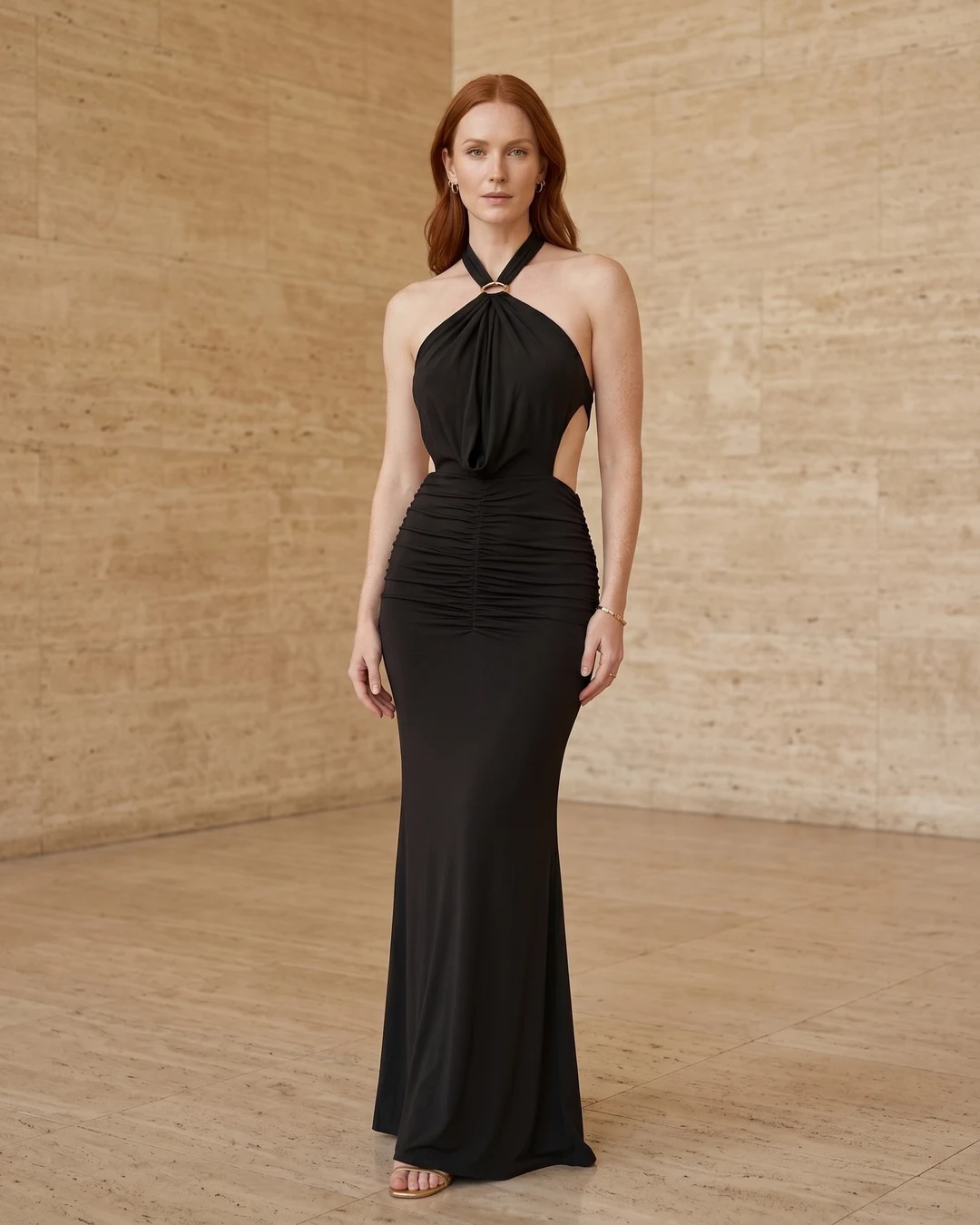
Test one is the drape line. The gown must read as a single uninterrupted column from the highest shoulder point to the hem, with no waist seam chopping the body in half. Test two is fluid fabric: crepe, modal jersey, chiffon, or georgette that breaks into soft folds rather than holding a built shape. Test three is the neckline, one of one-shoulder, cowl, draped V, or halter, all of which echo the way ancient drapery gathered at a single point.
A concrete pass: the house's Vipsania, a draped modal column, falls in one jersey line, moves with the wearer, and gathers at a soft cowl. It clears all three. The counter-case is a sequinned mermaid gown with a built corset bodice, fluid in name only, because the boning interrupts the drape line and the test fails at step one. Use the tests as gates, not as a wish list; one failure disqualifies.
#Goddess gown vs. costume vs. bridal column
Graded eveningwear is the gown; fancy dress is the costume; wedding apparel built to hold its shape is the bridal column. All three share a vague "Grecian" vocabulary, yet only one moves like draped cloth.
The gold-cord, laurel-leaf "Greek goddess costume" fails on fabric and intent: thin polyester crepe-de-chine, plastic trim, and one-night construction that photographs as a party prop. The stiff strapless duchess-satin bridal column fails differently, since duchess satin is woven dense to stand away from the body, so it sculpts rather than drapes and reads bridal-white by default. A goddess gown sits between them as evening and occasion wear, dressed in a color that is neither funereal black nor bridal white.
| Attribute | Goddess gown | Greek costume | Bridal column |
|---|---|---|---|
| Drape line | one unbroken column | broken by trim and elastic | broken by built bodice |
| Fabric hand | fluid crepe, modal, chiffon | thin polyester | stiff duchess satin |
| Neckline | one-shoulder, cowl, draped V | tied or elasticated | strapless or sweetheart |
| Color | imperial palette or ivory | metallic or printed | white and ivory only |
| Occasion | gala, opera, black-tie | one-night fancy dress | the wedding itself |
#Grecian, Roman or neoclassical: which goddess gown are you actually wearing?
Grecian, Roman, and neoclassical name three labels for one draping logic, so you are wearing the same silhouette under whichever word the listing chose. The distinction is heritage, not construction. The drape is shared.
This matters when you shop, because a search for "roman goddess dress" and a search for "grecian goddess gown" should return the same column, and the better stores treat them as synonyms. The lineage is worth knowing only so far as it explains why the gown looks ancient and modern at once.
#The Greek chiton and the Roman palla: the shared drape
The Greek chiton and the Roman palla rely on the same idea: a single rectangle of cloth pinned at the shoulder and gathered at the waist. That is why "Grecian" and "Roman" describe one gown rather than two.
The chiton was a length of wool or linen fastened at one or both shoulders with a fibula (a brooch-pin), then belted so the surplus cloth bloused over the cord. The Roman stola and the palla that draped over it worked the same way, wrapping rather than cutting. Neither garment was tailored; both got their line from how the cloth fell. A goddess gown inherits that logic directly, taking its structure from the shoulder gather and the waist tie. For the full story of these garments, the history of Roman dress and the guide to what Roman women wore carry it further than this section will.
The edge case worth naming: a sewn-in, fully fitted dress can still qualify if it reads as draped cloth. Modern construction replaces the fibula with a draped shoulder seam, so the pin is gone but the line survives.
#Neoclassical to couture: where the modern goddess gown descends from
The modern goddess gown descends from the Neoclassical empire revival and two named couturiers, Mariano Fortuny and Madame Grès, who rebuilt Greek drape as eveningwear. That lineage gives the term its authority.
The Neoclassical period raised the waistline to just under the bust, freeing the skirt to fall in a long vertical sweep. Fortuny's Delphos gown of the early twentieth century set thousands of permanent fine pleats into silk so a column shimmered without bulk. Madame Grès pinned and folded jersey directly on the body into draped Hellenic columns. HCT positions itself as the inheritor of that line, not its inventor; the Roman influence on fashion guide tells the designers' full story, and the Roman heritage hub collects the wider history.
#Which silhouettes and fabrics give a goddess gown its draped, Grecian fall?
Two silhouettes and a short list of fluid fabrics produce the goddess fall: the floor-skimming column or the high empire waist, cut in crepe, modal, or chiffon. Get the silhouette and the fabric right and the drape follows.
#The column and the empire waist
The column and the empire waist are the two structural routes to a goddess line, and both elongate the body by running the eye vertically. They differ only in where the cloth releases.
The column is straight and floor-skimming, releasing from the shoulder in one fall with no waist break. The empire (or girdle) waist gathers just under the bust, then lets the skirt drop free in vertical folds. A thigh slit or a soft fishtail extends either line at the hem. Choose the column when you want the longest unbroken read; choose the empire when you want the midsection skimmed rather than traced. The house cuts both, using Vipsania for the pure column and Tullia for the pleated version.
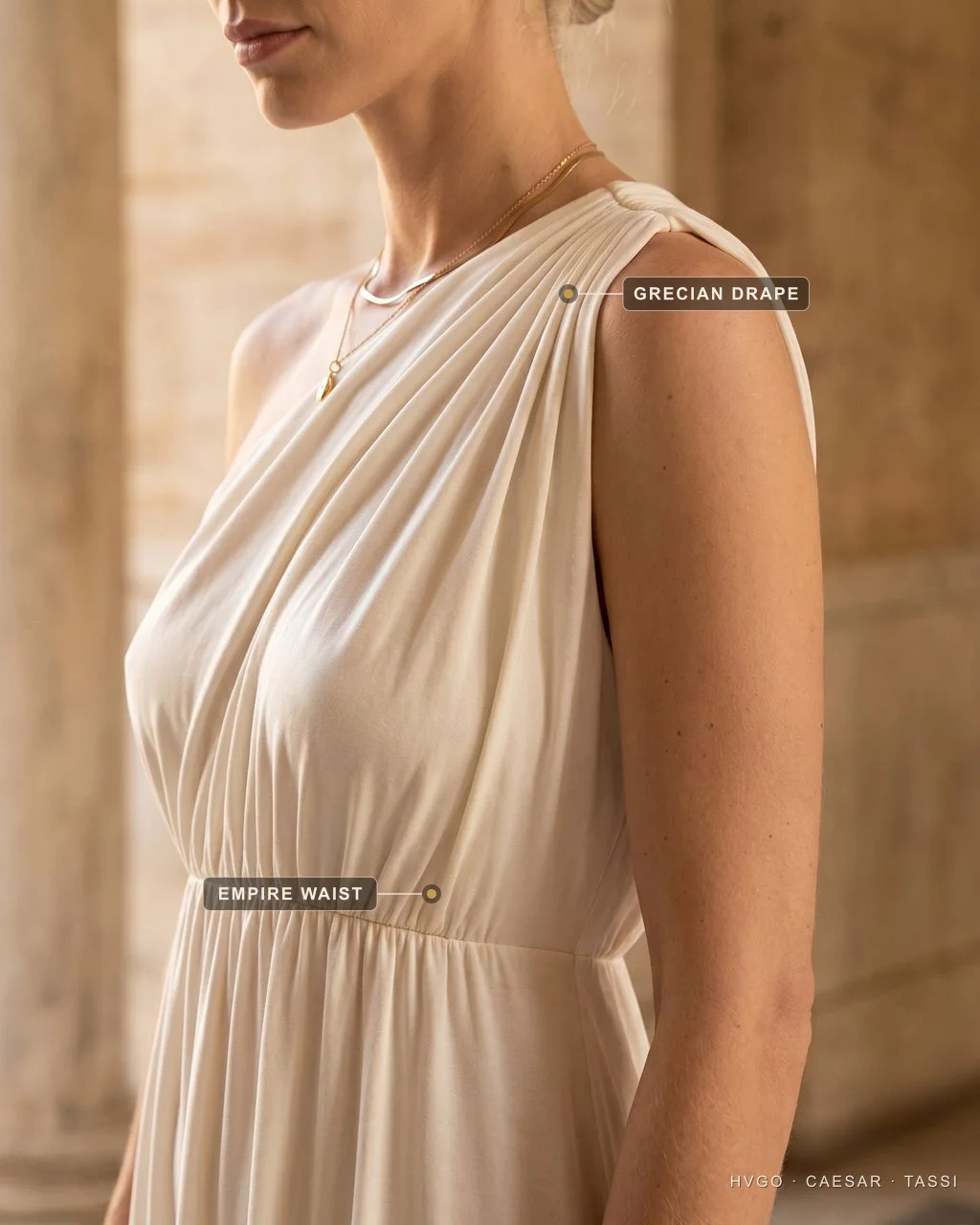
- Grecian drape — fine pleats fan from the shoulder seam, the modern replacement for the ancient shoulder pin.
- Empire waist — the cloth gathers just under the bust, then drops free in vertical folds to skim the midsection.
#Fluid fabrics that fall vs. fabrics that fight the drape
Fluid fabrics pool and travel, while structured fabrics hold their own built shape and fight the drape. Tell them apart by the hand and by how a fold breaks.
Crepe, modal jersey, chiffon, georgette, and silk charmeuse all fall in soft folds that move as you move, and HCT cuts its goddess columns in a matte structured crepe and a draped modal precisely for this reason. Stiff duchess satin, taffeta, and brocade are woven dense to stand away from the body; pinch a fold and it creases into an angle instead of a curve. That is the test in your fingers. The deeper fabric guide explains chiffon, satin, and crepe in full.
The exception that proves the rule is bias-cut satin. Cut on the diagonal grain, satin loses its stiffness and drapes like liquid, which is why Calpurnia's fishtail satin and Flavia's off-shoulder satin still pass: fluid drape, not the stiff bridal kind.
#Pleating and fluting: the Fortuny effect
Permanent fine pleating and knife pleats create a rippling column without adding bulk, unlike gathered fullness that adds volume. The Fortuny effect is drape multiplied, not skirt multiplied.
Fine fluting sets dozens of narrow vertical pleats so the fabric ripples close to the body, keeping the column slim while it catches movement. Gathered fullness, by contrast, pulls cloth onto a waistband and builds outward volume, useful for a ball skirt but wrong for a goddess line. The pleated chiffon of Claudia and the pleated crepe of Tullia rely on the fluting route, which is why they read columnar rather than full.
#Goddess gown necklines: one-shoulder, cowl, halter and draped V
The goddess neckline keeps the drape visible at the top of the gown, running to one-shoulder, cowl, draped V, or twisted halter. Each carries the cloth differently, so each sets a different mood.
#The one-shoulder and asymmetric neckline
The one-shoulder neckline is the signature goddess cut because it recreates the fibula-pinned chiton gathered at a single point. Asymmetry reads instantly Grecian.
A single draped shoulder pulls the fabric diagonally across the body, so the eye travels up and across. It flatters a pear shape because it widens the line at the shoulder to balance the hip. The counter-case: a strict one-shoulder can crowd a broad or inverted-triangle frame, where a cleaner draped V balances better.
#Cowl, draped V and twisted halter
The cowl and draped V carry the drape down to the décolletage, while the twisted halter lifts it back up at the neck. Each shifts the gown from soft to statuesque.
The cowl loops fabric into a soft fold across the chest, reading relaxed and forgiving. The draped V plunges the same drape into a sharper line, reading more formal. The twisted or Grecian halter gathers cloth behind the neck and frames the shoulders, the most architectural of the three. The dress necklines guide maps every option against face and frame.
#Sleeves: flutter, cap and bare-shoulder
Goddess sleeves stay light, whether a flutter "wing," a cap sleeve, or no sleeve at all, so they never weigh down the drape. Coverage is the only real variable.
The flutter sleeve drops a short cape of fabric over the upper arm, echoing the fall of a chiton's overfold; the cap sleeve covers just the shoulder cap; the bare shoulder shows the most skin and the cleanest line. Choose a flutter when you want arm coverage without a structured sleeve, the bare shoulder when the drape itself is the statement.
#How do you choose a goddess gown that flatters your body shape?
Match the drape entry point to your body shape and the rest takes care of itself: empire for apple, one-shoulder for pear, bias column for hourglass. The cloth forgives, but the entry point decides.
#Match the drape entry point to your shape
Send the eye where the cloth gathers, and the silhouette flatters nearly every shape. Five shapes, five entry points.
- Apple: an empire waist releases above the midsection and skims it in vertical folds.
- Pear: a one-shoulder draws the eye up and balances a fuller hip.
- Hourglass: a bias-cut column traces the waist without a seam, celebrating the curve.
- Rectangle: a soft cowl adds dimension across a straighter frame.
- Inverted triangle: a defined waist tie creates a middle the broad shoulder needs.
The detailed walk-through lives in our body shape guide, which routes each shape to its own page. The caveat: these are starting points, not rules. Fit the shoulder seam first, because a gown that pulls at the shoulder ruins the drape no matter how well the waist suits you.
#Length, height and the column line
A true column suits most heights when hemmed to break just at the floor, with a high waist saving the petite frame. Length is correctable; the column line is not.
A floor-skimming column elongates a tall frame effortlessly. A petite woman keeps the line by raising the waist and choosing vertical drape to add visual height, then adds a thigh slit so a maxi column doesn't swallow her. The edge case: an overly long hem that puddles reads as drag, not drape. The house publishes each model's height (about 175 cm) so you can judge where a hem will break on your own frame before you buy.
#How to wear a goddess gown without tipping into costume
Keep the principle and drop the props: real color, real shoes, one piece of jewelry, no laurel. The line does the work.
#Color: white-and-ivory or the imperial palette
Two color routes read authentic, the classic Hellenic ivory and the saturated imperial palette, and both beat metallic or printed "toga" tones. Saturation reads expensive; novelty reads costume.
The first route is the Hellenic white and ivory (Avorio), the marble-statue read. The second is the Roman imperial palette: Porpora (wine), Verde Antico (green), Travertine (stone), Cuoio (tan). A deep wine or a stone green looks modern and quietly expensive, whereas a shiny gold lamé reads party prop. The imperial palette journal shows each tone styled in full.
#Accessories and the one-prop rule
Accessorize with one focal point and nothing literal: fine sandals, a single gold cuff, soft hair, and no rope belt. One statement only.
Skip the gold rope belt and the laurel crown entirely, since those are the costume tells. Choose fine strappy sandals, one sculptural gold cuff or one earring, and soft waves, then let the drape carry the look. The do-and-don't split below keeps the discipline.
| Do | Don't |
|---|---|
| Fine strappy sandals in a neutral tone | Gladiator lace-ups to the knee |
| One sculptural gold cuff or single earring | Stacked bangles plus statement necklace |
| Soft waves or a low chignon | A laurel-leaf headpiece |
| A silk wrap in a palette tone | A gold rope belt at the waist |
| One saturated color head to toe | Metallic lamé or printed "Greek key" |
#Where a goddess gown belongs
Formal evening occasions are where the style belongs: black-tie weddings, galas, the opera, and award evenings. It is the wrong choice anywhere casual.
The full-length drape and the evening palette place it firmly after dark; a maxi column at a daytime garden party reads overdressed. For a black-tie wedding, choose an imperial tone rather than ivory so you never compete with the bride. Our black-tie attire guide covers the dress codes in detail.
#How Hugo Caesar Tassi builds a goddess gown that passes all three tests
Hugo Caesar Tassi auditions every evening piece against the same three tests, then cuts the gown to pass them in fluid fabric. The construction replaces the ancient fibula, not the ancient line.
#The atelier's drape-first construction
The atelier builds the drape first and the seams second, using a bias cut and a draped shoulder seam where the chiton used a pin. That is why the gowns move like cloth, not like architecture.
Every HCT evening gown is fully lined with a concealed zip, so nothing interrupts the column from the outside. The bias cut runs the grain on the diagonal so even satin falls fluid, and the draped shoulder seam carries the load the fibula once held. The house cuts these columns in matte crepe and modal jersey, never stiff bridal satin, because the fabric test is the one no styling can rescue.
#The gowns, matched to the test
Five HCT gowns map to the three tests, from pure jersey column to bias-cut satin exception. Pick by which test you most want satisfied.
- Vipsania (draped modal column): the modern palla, pure draped jersey, the cleanest column line.
- Tullia (pleated crepe column): the fluted Fortuny route in matte crepe.
- Claudia (pleated-slit chiffon maxi): pleated chiffon with a leg-lengthening slit.
- Flavia (strapless off-shoulder satin): the bias-cut satin exception, fluid not bridal.
- Calpurnia (fishtail satin): bias-cut satin again, drape extended into a soft fishtail.
The full evening and maxi ranges hold the rest, each gown already auditioned against the drape line, the fluid fabric, and the column neckline before it earns a place.
#The goddess gown in one rule, and which one to choose next
The whole guide reduces to one checklist: drape line, fluid fabric, column neckline, with all three required for a true goddess gown. Use it as a buying filter on any listing.
Run the checklist before you click buy. Does it read as one unbroken column? Does the fabric fall and move? Does the neckline gather or stay clean? Three yeses, and the dress is the real thing. For a draped jersey column choose Vipsania; for a fluted column choose Tullia; for a slit maxi choose Claudia.
Now you can tell a true goddess gown from a costume in three tests: drape line, fluid fabric, column neckline. See the rule made wearable in our draped crepe and modal columns. Start with the evening gowns collection, then browse the floor-length maxi dresses.
#Frequently asked questions
What is a goddess gown?
A goddess gown is a Grecian- and Roman-inspired evening dress defined by a single continuous drape line, fluid fabric that falls in soft vertical folds, and an asymmetric or column neckline. The fabrics are crepe, modal jersey, or chiffon, and the necklines run to one-shoulder or cowl. It is eveningwear, not a costume, because the drape is the whole point.
What is the difference between a Grecian dress and a goddess gown?
A Grecian dress and a goddess gown describe the same silhouette under two labels, one naming the origin and the other the floor-length evening version. "Grecian dress" points to the Greek chiton; "goddess gown" names the long evening column drawn from it. A Roman goddess dress is the same idea by way of the Roman palla and stola.
What fabric is a goddess gown made of?
A goddess gown is made of fluid fabrics that pool and flow, such as crepe, modal jersey, chiffon, georgette, or soft charmeuse. Bias-cut satin counts too, because the diagonal grain makes it drape. Stiff duchess or bridal satin, taffeta, and brocade hold their own shape and fail the goddess test.
What body shape suits a goddess gown?
Nearly every body shape suits a goddess gown, because the drape forgives, and the trick is matching the waist and neckline to your frame. An empire waist skims the midsection, a one-shoulder lifts the eye, a bias column flatters an hourglass, and a soft cowl adds dimension to a straighter shape. Our body-shape guides walk each one through.
Where can you wear a goddess gown?
You can wear a goddess gown to formal evening occasions, including black-tie weddings, galas, the opera, and award evenings. Choose ivory or white for the classic Hellenic read, or an imperial tone like wine or stone green to look modern rather than costumed. It is too formal for anything casual or daytime.
How do you wear a goddess gown without looking like you're in a costume?
You avoid the costume look by keeping the drape and dropping the props, so no gold rope belt and no laurel crown. Pick fine strappy sandals, one sculptural gold cuff or earring, soft waves, and a single sophisticated color. Then let the column do the work.
More Roman Heritage guides
A History of Roman Dress
A Roman fashion house traces the history of Roman dress for women — the stola, palla and tunic, and how their drape became the modern occasion gown.
Trace the stola to the gownHow Ancient Rome Still Dresses Us
A Rome-born house traces the Roman influence on modern fashion for women: toga drape to Fortuny, Madame Grès and the goddess gown, with the one rule kept.
Trace the Roman drape lineageTyrian Purple
Why Tyrian purple cost more than gold, who was forbidden to wear it, what it truly looked like — and how to wear imperial wine in a dress today.
Unpack the color of emperorsWhat Roman Women Wore
A Rome-born house answers what Roman women wore: the tunica, stola and palla — and maps that original capsule onto a modern woman's wardrobe.
Meet the stola and palla