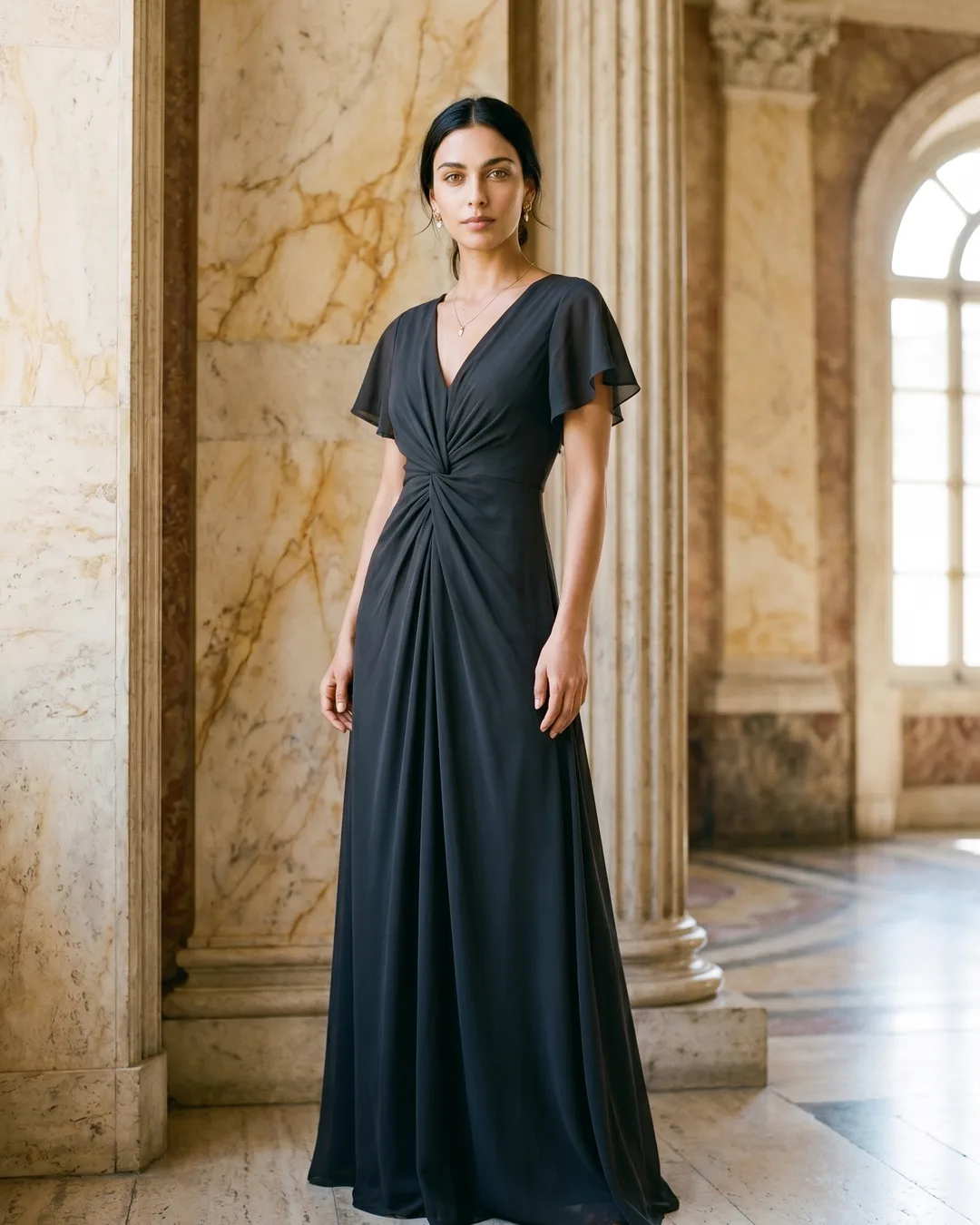
Roman Heritage in Fashion: How Ancient Rome Still Dresses the Modern Woman
How Roman heritage still shapes the modern woman's wardrobe: drape, pleat, palette and posture decoded by a Rome-born house. Read where to start next.
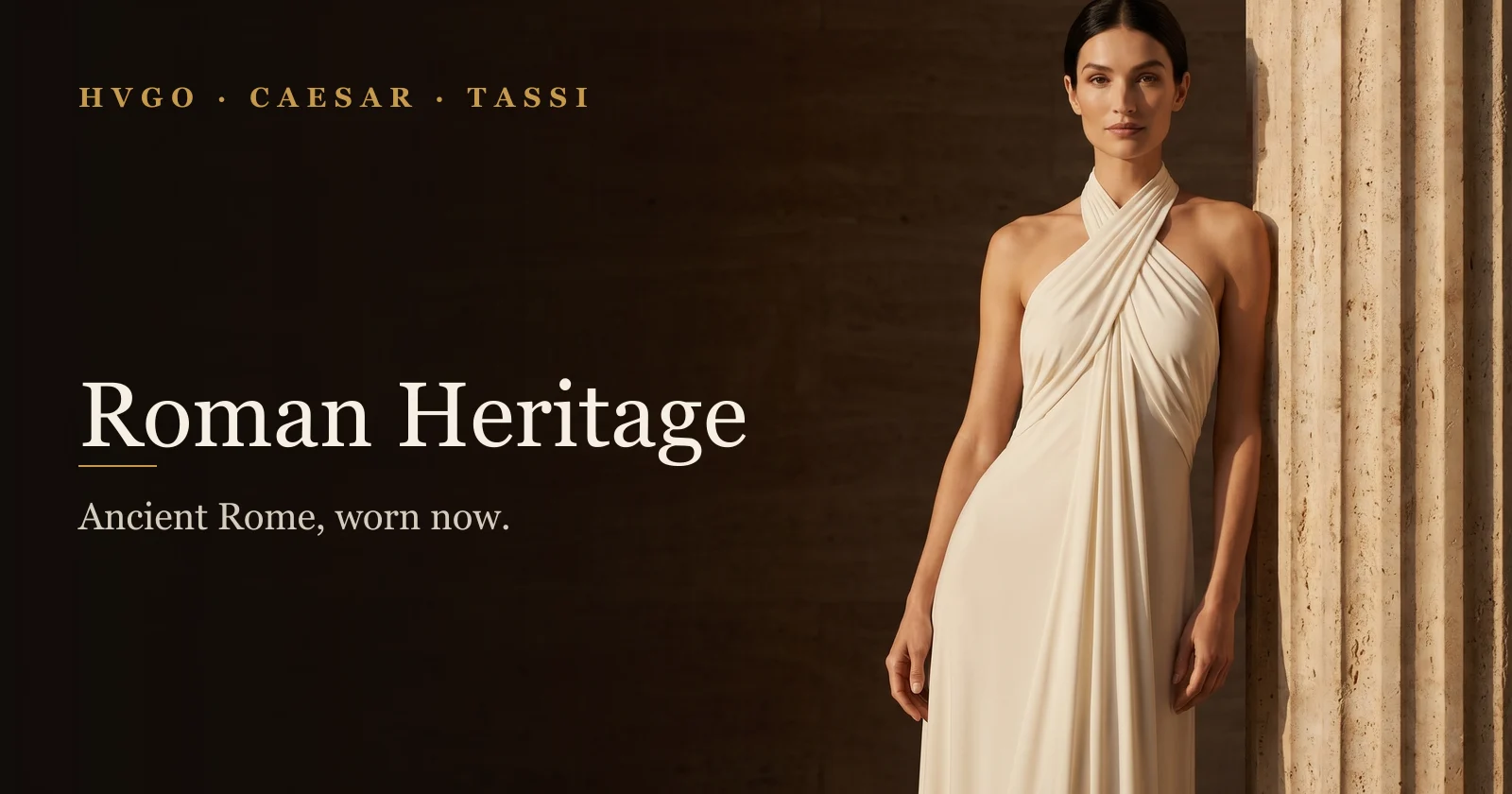
On this page
Roman heritage still dresses the modern woman through one surviving idea: a single length of cloth, pinned at the shoulder and draped into living columns. A Roman woman commanded a room in that uncut garment two thousand years ago, and the silhouette never left fashion; it only changed its name. This hub maps the lineage and routes you to the exact story you came to settle.
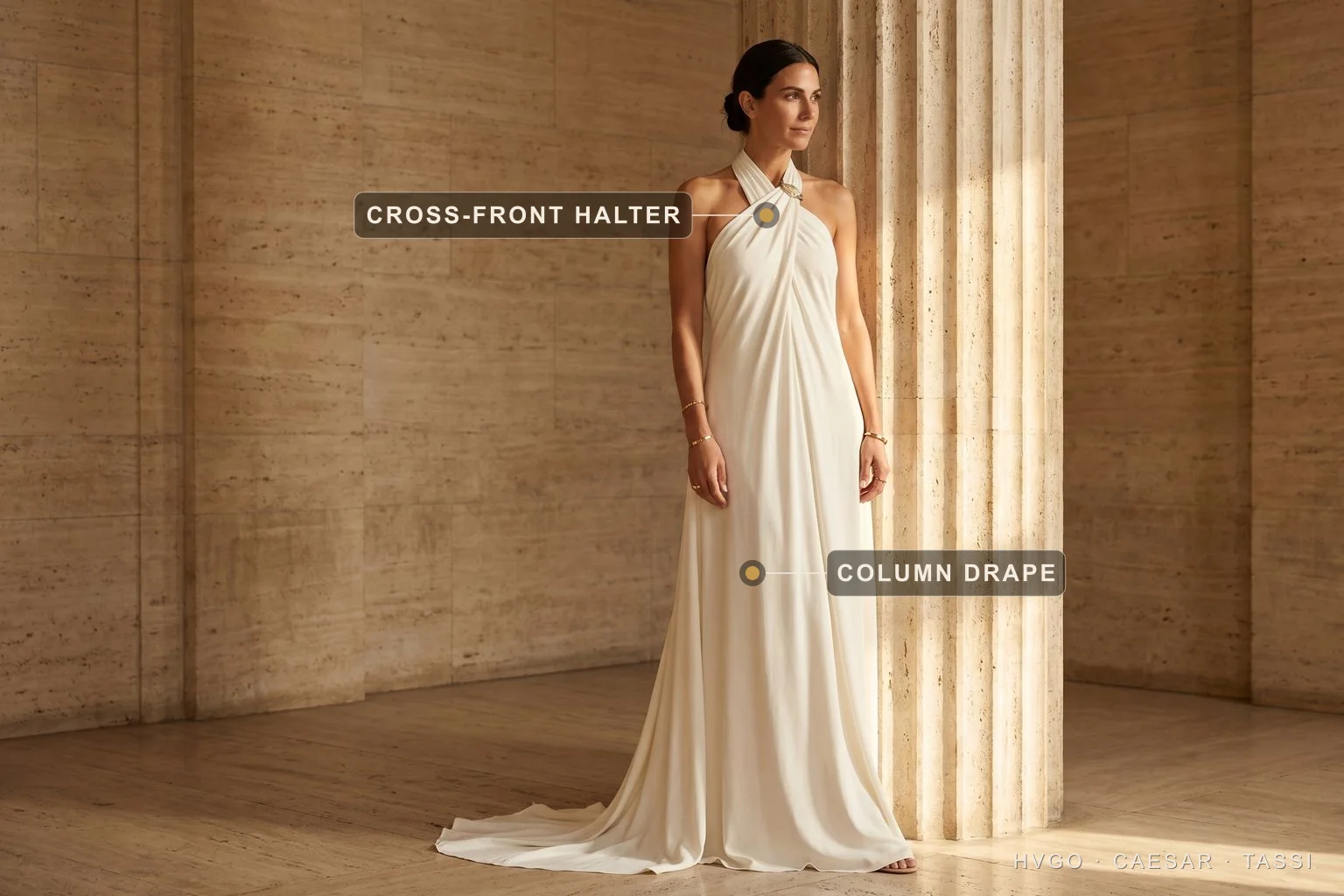
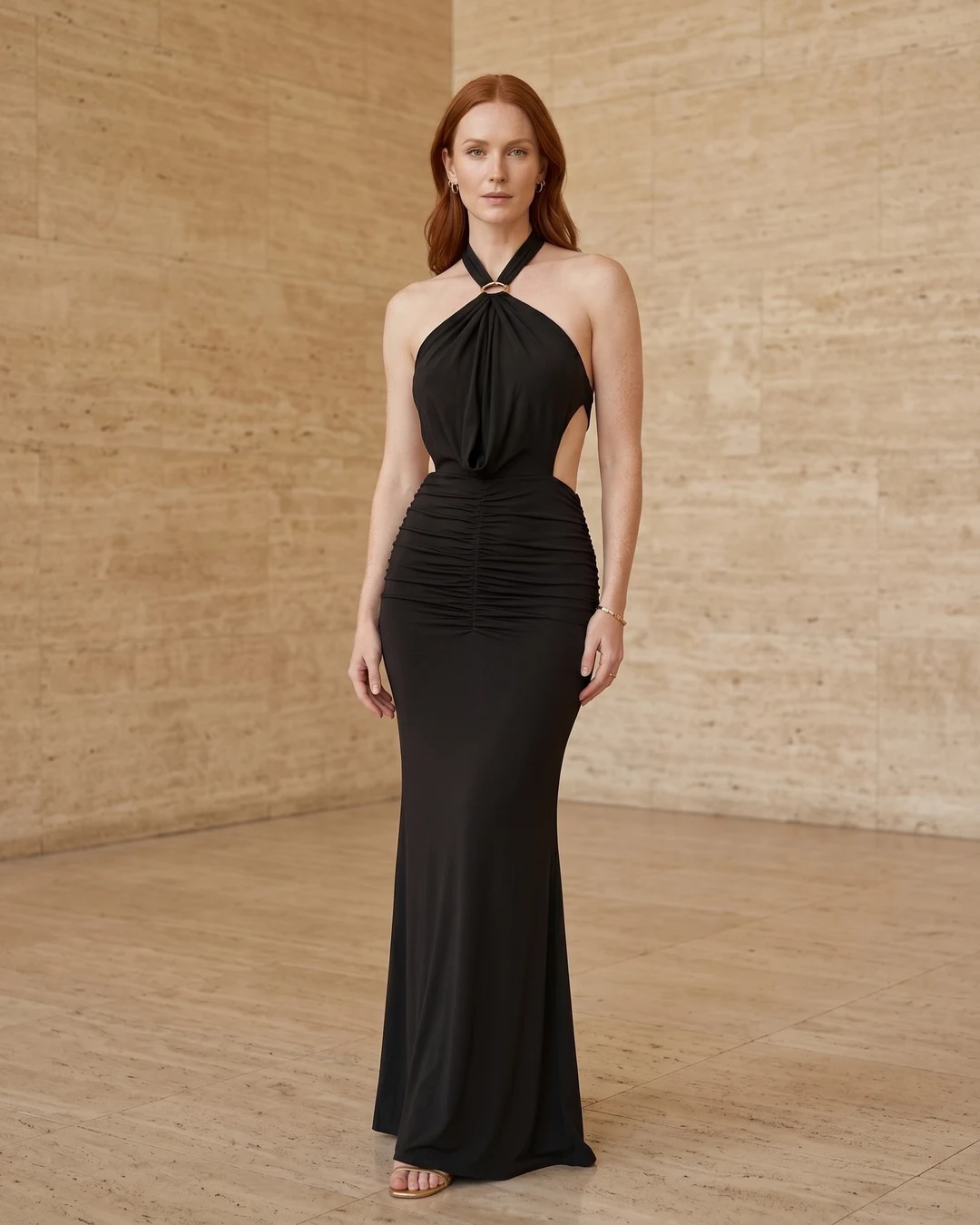
- Cross-front halter — the one-shoulder/halter drape crosses and pins at the throat exactly where a Roman fibula once sat
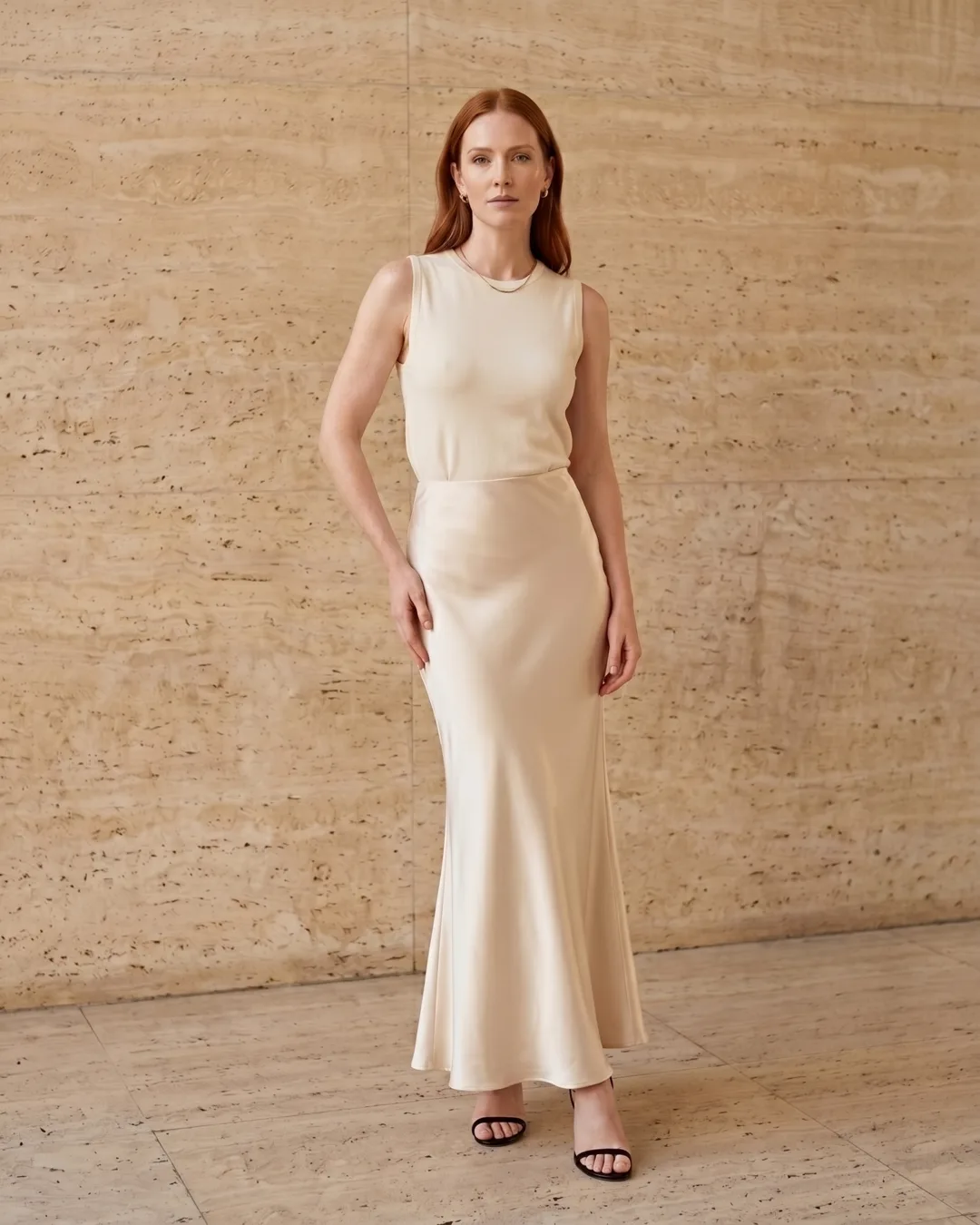
- Column drape — fluid ivory jersey falls in one continuous diagonal column line, the palla's fall of cloth made modern
#What does Roman heritage actually mean for the clothes a woman wears today?
For your wardrobe, it means a draped, columnar design language you can wear now: the source of goddess gowns and one-shoulder evening dress, not fancy dress. Hugo Caesar Tassi (women's luxury occasionwear house, Roma MMIV) reads antiquity as a working brief, not a costume rental.
#A living design language, not a museum costume
The Roman wardrobe handed fashion two structural moves that still build a gown: the unstitched draped garment and fluted fabric pleating. Both ideas survive in a contemporary dress without a single visible reference to the empire. A bias-cut satin column gown borrows the palla's fall of cloth; a knife-pleated chiffon maxi borrows the fluting Greek and Roman sculptors carved into marble drapery.
Consider the difference plainly. Dressed as a Roman means gold cord, a laurel wreath, a literal toga wrap, a Halloween outline. Inspired by Rome means one continuous drape line in modern crepe, cut to a knee or floor hem and fitted at the shoulder seam: recognizably 2026, structurally ancient.
Every example on this hub is women-scoped. Roman men wore the toga; Roman women did not. The garments that translate forward (the stola, the palla, the imperial colors) are women's dress, and that is the only lineage this guide traces.
#Why a Rome-born fashion house is the right guide to Roman heritage
The house was founded in Rome in MMIV on the motto Nata Imperare ("born to rule"), so it reads the city's dress history from inside the craft rather than the library. An encyclopedia catalogs what was worn; an atelier asks what still cuts. That distinction shapes everything below.
HCT audits Roman heritage through a four-part maker's lens: drape, pleat, palette, posture. Each principle names a real design decision, and each produces a specific modern garment. The rest of this hub walks that lens, then points you to the dedicated guide that expands the part you care about.
#The Roman eye: the four principles that carry Roman heritage into a modern dress
Drape, pleat, palette and posture do the carrying, and each one produces a different garment a woman wears today. Drape and pleat are structural; palette and posture supply the meaning and the carriage.
The four-principle Roman eye
Drape, pleat, palette and posture each turn into a different garment a woman wears today.
#Drape and pleat: the column that never went out of style
Roman dress was built from cloth that fell, unlike clothing cut to the body. The palla wrapped and draped; the stola hung in vertical folds from the shoulder, fluting downward like the channels of a marble column. Those are the two structural ideas the empire handed down, and they survive intact.
Drape becomes the bias cut. A bias-cut satin gown, the house's Calpurnia fishtail evening gown for one, falls in a continuous diagonal line that pours over the hip exactly as a draped palla once did. Pleat becomes knife-pleated and French-pleated chiffon, the recycled chiffon HCT pleats into the Julia and Claudia gowns, each fold echoing carved drapery.
The edge case worth naming: drape only registers as heritage in fluid fabric. Stiff bridal satin breaks the column and turns the silhouette into a ballgown, not a goddess line. The fuller story of how this fall of cloth descended through two millennia sits in the history of Roman dress, and its leap onto modern runways is traced in Roman influence on fashion.
#Palette and posture: color as rank, carriage as authority
Color in Rome encoded rank before it decorated a gown. Tyrian purple signaled power because it cost more than gold; the surrounding palette of wine, oxblood, stone and ivory carried quieter status. The house keeps that code in the imperial palette: Porpora (wine), Vermiglio (red), Travertine (stone), Avorio (ivory), Basalt (black).
Posture is the half of the lens no fabric supplies. Gravitas (the Roman bearing of weight and seriousness) and the Italian la bella figura together describe carriage as authority: shoulders set, spine long, the dress worn rather than displayed. A column gown demands that posture and rewards it. You can read the carriage principle in full through la bella figura, and the way those neutrals still signal old money in the old money color palette.
#What did Roman women actually wear, and how does that heritage map to a wardrobe now?
Three draped layers made up the kit, a tunica, a stola and a palla, and never the toga, which was male dress. Each layer maps to one modern garment a woman owns today.
#The three-piece kit: tunica, stola, palla
The tunica sat next to the skin as a simple shift, the practical base layer. Over it came the stola, the floor-length draped overdress that marked a married Roman woman and hung in vertical folds, often finished with the instita, a band at the hem. Over both went the palla, a large rectangle of wool wrapped and pinned with a fibula (a shoulder brooch): part shawl, part veil, fully draped.
The toga belonged to men and, pointedly, to disgraced women alone; a respectable Roman woman's status garment was the stola. That single fact rules out the toga wrap as women's heritage entirely. The full layer-by-layer breakdown, with what each teaches a modern closet, is set out in what Roman women wore.
#From ancient layers to the modern column and scarf
The translation runs almost one to one. The palla, that wrapped rectangle of cloth, becomes the silk square scarf a woman knots today; the house cuts Carina, Palmyra and Vesta as exactly that, a piece of draped cloth with no seams. The stola becomes the column midi or floor gown, vertical and fluid, the Vipsania draped modal column gown its closest living descendant.
The everyday read matters too. A printed chiffon midi like Livilla carries the stola-and-palla logic in a daytime register, not only on a black-tie carpet. Where this breaks down: a structured crepe sheath, however elegant, is tailoring instead of drape, so it sits outside the lineage.
#Why was purple the color of power in Roman heritage, and what other colors did Rome leave us?
Rank, not taste, drove the choice: Tyrian dye cost more than gold to make, so wearing it advertised an emperor's standing. Rome also left a quieter palette of wine, stone and ivory that still signals inherited wealth.
#Tyrian purple, the dye worth more than gold
Tyrian purple was extracted in tiny quantities from murex sea snails along the eastern Mediterranean, each shell yielding a single drop, the labor making the dye worth more than its weight in gold. To wear it was to declare rank, which is the literal origin of the phrase "born to the purple." Emperors guarded the color by law.
The common myth needs correcting: authentic murex dye never matched the bright violet most people picture. It cured to a deep red-wine, closer to dried blood than to lavender, which is why the house names its wine shade Porpora rather than any violet. The complete murex story sits in Tyrian purple.
#The natural-dye palette behind the imperial colors
Beyond purple, Rome wore what its plants and minerals could fix: madder and oxblood reds, undyed wool ivory, the gray-stone of unbleached cloth, earthen tan. Those are not loud colors, and that restraint is exactly why they still signal old money more than new spending. The atelier codes them as Vermiglio, Cornelia, Avorio, Travertine and Cuoio.
The principle holds across two thousand years: status sat in fabric weight and color depth, never in shine. One statement color per outfit, matte before sparkle: the house elegance doctrine restates the Roman rule. The journal's imperial-palette essay carries the same range into a styling context.
#How did the stola and palla turn into the goddess gown we still wear to events?
An unbroken drape lineage carried those two layers from Greek temples to modern ateliers, becoming the gown you now see at events. Each maker kept the single continuous fall of cloth: chiton, palla, Fortuny's Delphos, Madame Grès' columns, today's crepe.
#The drape lineage, named and dated
The chain is datable, not vague. The Greek chiton and himation gave Rome the pinned-at-the-shoulder draped logic; the Roman stola and palla formalized it into a status wardrobe. Centuries later Mariano Fortuny pleated his Delphos gown (a finely fluted silk column, Venice, 1907) directly from Hellenic drapery, and Madame Grès built her career on draped jersey columns sculpted on the body.
That lineage is the spine of the goddess gown's evolution. The contrast that proves the point: a sequined mermaid gown shares the silhouette but breaks the lineage, because surface sparkle replaces the drape that defined it for two thousand years.
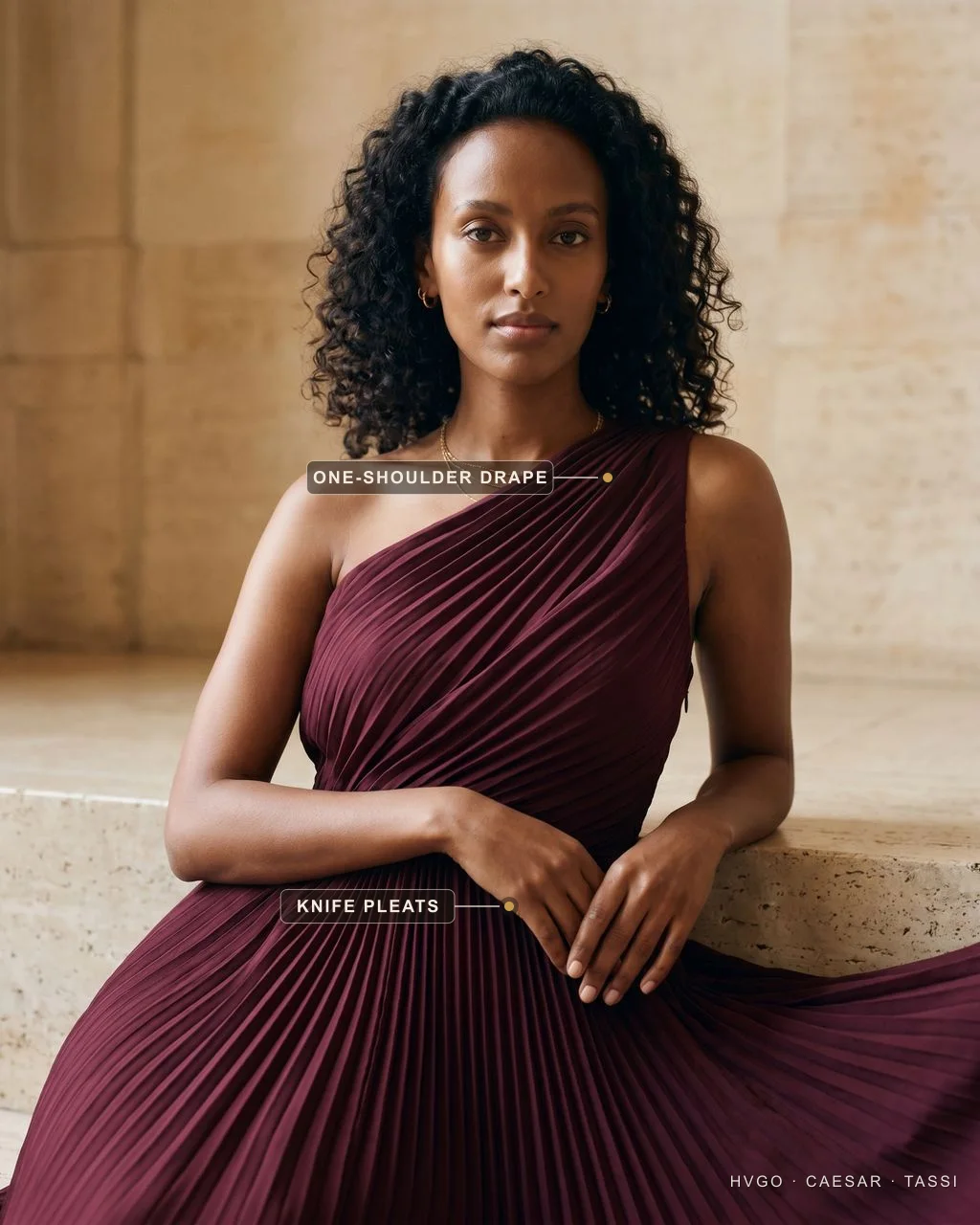
- One-shoulder drape — a single draped shoulder secured where a Roman fibula brooch once fastened the palla
- Knife pleats — precise vertical fluting that translates the carved drapery of marble sculpture into crepe
#What makes a dress a "goddess gown"
A goddess gown passes three tests: a single continuous drape line, fluid column fabric (crepe, jersey or chiffon, never stiff bridal satin), and an asymmetric or one-shoulder neckline secured where a Roman fibula once sat. Meet all three and the dress earns the name; miss the fabric test and it is a column-shaped ballgown instead.
This is the commercial bridge of the hub, the point where reading turns into a dress you can wear to an event. The full three-test definition, matched to a real gown, is the one explainer to open if a black-tie invitation is the reason you are here.
#Where should a woman start reading across this Roman heritage hub?
Start with what Roman women wore, then read history, influence, and color in order, ending at the goddess gown as the shop-ready finale. Or skip the order and jump straight to the question you arrived with.
#A suggested reading order
Read the hub as a curriculum and the five guides build on each other in sequence:
- What Roman women wore: the three-layer wardrobe, your foundation.
- The history of Roman dress: how those layers developed over centuries.
- Roman influence on fashion: how the drape reached the modern runway.
- Tyrian purple: the color story and what "born to the purple" meant.
- What is a goddess gown: the shop-ready finale, principle made wearable.
#Pick by the question you came with
If a curriculum feels slow, choose the fast-track table instead. Each row sends one intent to the single guide that owns it, so you never read the same ground twice. Pick the row that matches your open question and you can skip straight to its owner page.
| You came to settle… | Open this guide | Because it owns… |
|---|---|---|
| What did women actually wear? | What Roman women wore | the tunica–stola–palla wardrobe |
| Why did purple mean power? | Tyrian purple | the murex dye and "born to the purple" |
| How did Rome reach the runway? | Roman influence on fashion | the Fortuny and Grès lineage |
| I need a gown for an event | What is a goddess gown | the three-test, shop-ready definition |
| Which neutrals read old money? | The old money color palette | the wine-stone-ivory styling range |
#How Hugo Caesar Tassi designs from Roman heritage instead of copying it
HCT auditions every dress against the four-part lens of drape, pleat, palette and posture rather than reproducing a Roman garment. That maker's stance, plus Roman-Italian provenance, is the angle no costume-history page can claim.
#The four-part maker's lens, stated plainly
The house tests a design the way Rome would have judged it. Does the cloth drape or merely cover? Does a pleat flute the fabric vertically? Does the color sit in the imperial palette? Does the cut demand the posture of gravitas? A dress that fails any of the four does not enter the collection.
The provenance is the part no encyclopedia owns: a house founded in Roma in MMIV, dressing women under Nata Imperare, reading its own city's antiquity as a brief rather than a footnote. The lineage ends where the atelier begins.
#Worked examples from the collection
Three gowns show the lens at work. Vipsania (draped modal column gown) and Tullia (pleated crepe column gown) carry drape and pleat in their purest form, the stola made modern. Claudia (pleated-slit chiffon maxi gown) pairs the pleat with the imperial wine of Porpora, two principles in one dress.
The counter-example proves the rule from the everyday end. Livilla (floral-print chiffon midi) reads the stola-and-palla idea in a daytime register, drape without a single ancient prop, heritage you could wear to lunch. See the lens resolved across the range in the evening gowns, where drape, pleat and the imperial palette meet on one rail.
#Roman heritage in one line, and where to go next
The whole inheritance reduces to four reads, drape and pleat and palette and posture, each a design decision you can now spot in any gown. That is the map in a sentence.
#The recap and the next click
Four words now decode any gown you meet. Drape is the fall of cloth, pleat is the fluting, palette is the imperial color code, posture is the carriage that wears it. Carry that vocabulary into the child guide your question points to.
Read the rest of the empire's wardrobe like a designer: drape, pleat, palette, posture. Open the guide that answers your question, then see the principle made wearable across the occasion edit.
#Frequently asked questions
What did ancient Roman women wear?
Ancient Roman women wore three draped layers: a tunica next to the skin, a stola over it as the signature garment, and a wrapped palla on top, never the toga, which was male dress. The stola hung in vertical folds and marked a married woman; the palla functioned as both shawl and veil. Our dedicated guide breaks down each layer and what it teaches a modern wardrobe.
How does Roman heritage influence women's fashion today?
Roman heritage influences women's fashion through two surviving ideas: the draped, unstitched column that becomes the bias-cut and one-shoulder gown, and fabric pleating that becomes pleated chiffon and crepe. The goddess gown seen at black-tie events descends directly from the Roman palla drape. Both ideas reach you in fluid modern fabric, not ancient wool.
Why was purple associated with Roman emperors?
Purple was associated with Roman emperors because Tyrian dye, extracted in tiny amounts from murex sea snails, cost more than its weight in gold, making the color a literal mark of imperial rank. That cost is the origin of "born to the purple." Authentic murex dye cured to a deep red-wine, not the violet most people picture.
What is a goddess gown?
A goddess gown is a Grecian- and Roman-inspired evening dress defined by a single continuous drape line, fluid column fabric, and an asymmetric or column neckline. The fabric must be crepe, jersey or chiffon, never stiff bridal satin. Our goddess-gown guide gives the full three-test definition and matches each test to a real dress.
What is the difference between Greek and Roman dress for women?
The difference between Greek and Roman dress for women is one of formality, not logic: Roman women's dress grew directly out of the Greek chiton and himation and shares its draped, pinned-at-the-shoulder construction. The Roman stola and palla simply formalized that drape into a status wardrobe. Both feed the same modern goddess silhouette.
How do you wear Roman-inspired fashion without looking like a costume?
You wear Roman-inspired fashion without looking like a costume by keeping the principle and dropping the props: one draped or pleated column, one imperial-leaning color, modern fabric and tailoring. No gold cord, no laurel, no literal toga wrap. That restraint is exactly how the atelier translates Roman heritage into a wearable gown.
Roman Heritage guides
A History of Roman Dress
A Roman fashion house traces the history of Roman dress for women — the stola, palla and tunic, and how their drape became the modern occasion gown.
Trace the stola to the gownHow Ancient Rome Still Dresses Us
A Rome-born house traces the Roman influence on modern fashion for women: toga drape to Fortuny, Madame Grès and the goddess gown, with the one rule kept.
Trace the Roman drape lineageTyrian Purple
Why Tyrian purple cost more than gold, who was forbidden to wear it, what it truly looked like — and how to wear imperial wine in a dress today.
Unpack the color of emperorsWhat Roman Women Wore
A Rome-born house answers what Roman women wore: the tunica, stola and palla — and maps that original capsule onto a modern woman's wardrobe.
Meet the stola and pallaThe Goddess Gown, Decoded
A Rome-born house defines the goddess gown by three tests: drape, fluid fabric, column neckline, plus how to choose the Grecian gown for your shape.
Apply the three-drape test