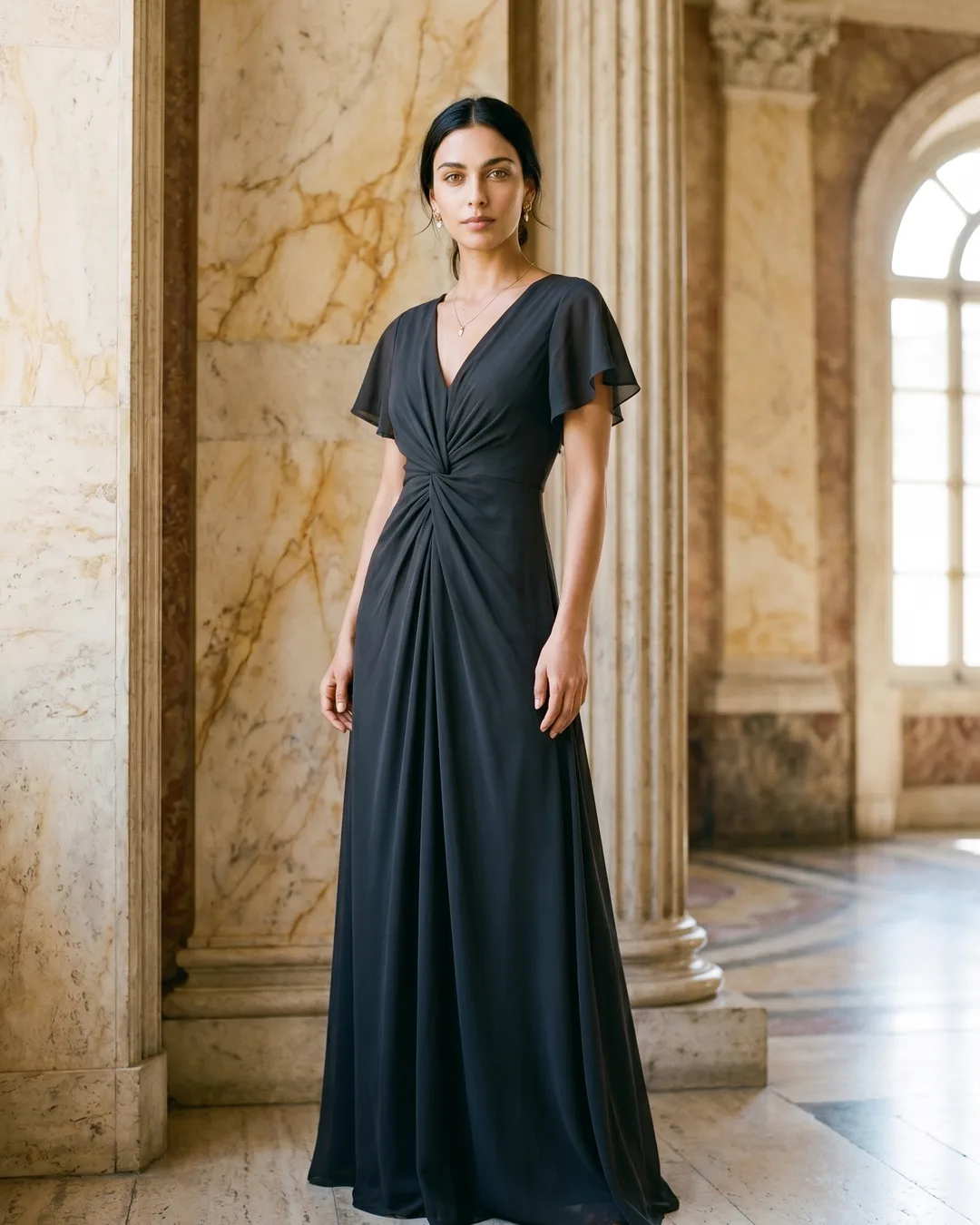
A History of Roman Dress: From the Stola to the Modern Occasion Gown
A Roman fashion house traces the history of Roman dress for women — the stola, palla and tunic, and how their drape became the modern occasion gown.
On this page
For a thousand years a woman built her wardrobe from three rectangles of woven cloth and one pinned brooch, draping rather than tailoring every garment she owned. Hugo Caesar Tassi has cut women's clothes in Rome since 2004, and this is the chronological account: what each piece was, and how its drape reaches the gown you might wear this season.
Read a Roman drape into a modern gown
Turn each ancient garment into one wearable construction decision.
- Start from the stola's falling column The matron's ankle-length overdress fell from the shoulders in soft vertical folds. For a pure, unbroken line choose a draped column gown like the Vipsania in fluid modal, the closest living echo of that shape.
- Add the stola's high-gathered pleat The stola was belted high under the bust to release long folds. The Tullia pleated column gown rebuilds that high-gathered fold in matte crepe when you want movement and texture in the fall, not a flat drape.
- Carry the pleat into motion When the occasion calls for walking-room, the Claudia pleated-slit maxi takes the stola's fold and opens it into a chiffon slit, keeping the ancient column but letting it move.
- Translate the palla into a neckline The palla was a single rectangle wrapped over one shoulder. That wrap becomes the one-shoulder neckline and the Calpurnia fishtail gown's single drape to a satin hem, the most expressive length you can compose today.
- Trust the layer you cannot see Roman women smoothed the drape with a hidden base layer. The modern equivalent is full lining: every HCT gown is lined so the outer drape hangs true, exactly as a clean foundation let the stola fall.
- Don't chase a tailored, seam-fitted bodice if you want the Roman look; the line lived in the drape, not the dart.
- Don't read murex purple as the only Roman colour; undyed Avorio cream was the everyday default and reads just as historic.
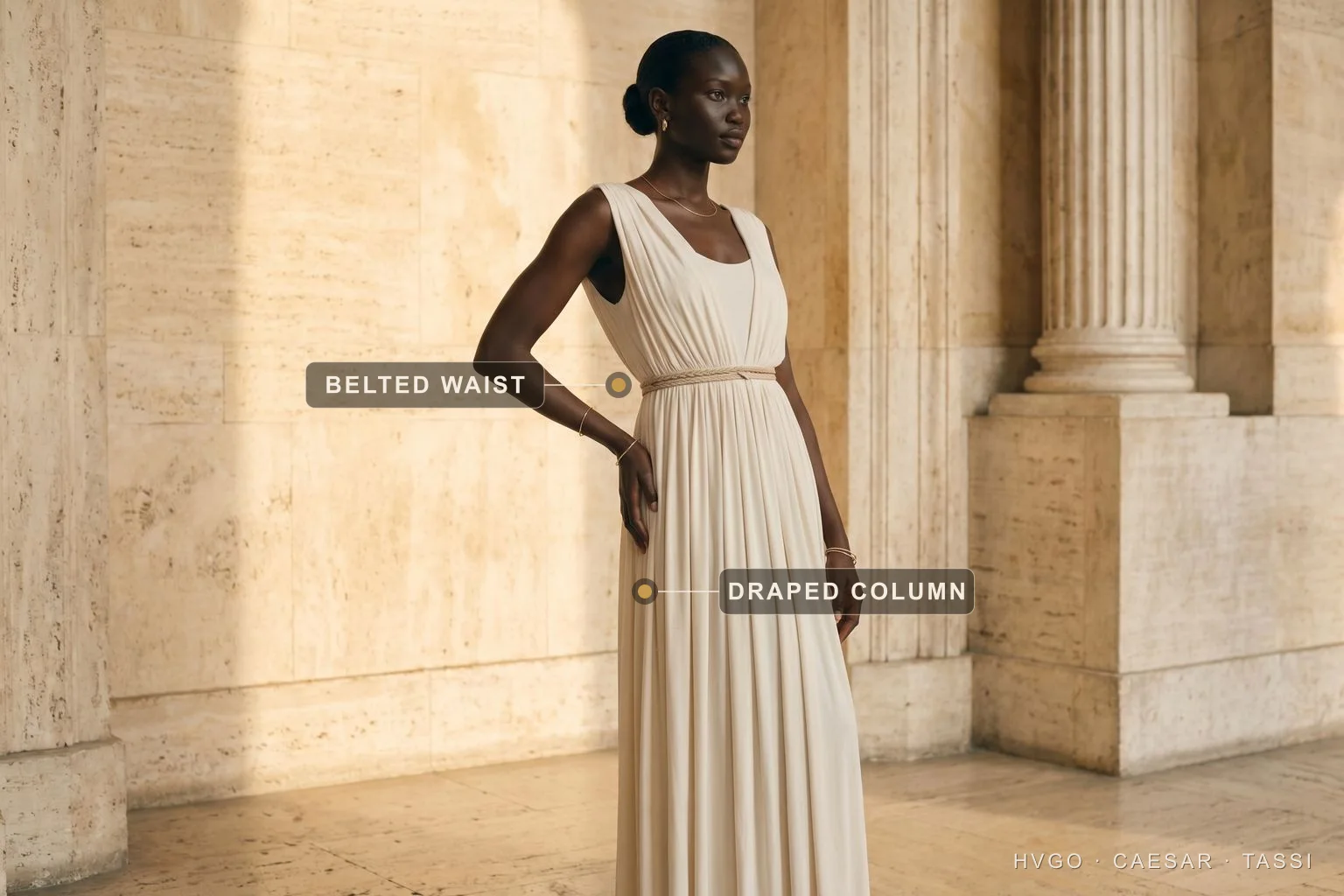
- Belted waist — a slim woven cinch sets the column's high gather, the Roman drape's only point of fit.
- Draped column — the loom-width cloth falls in long unstitched vertical folds, the stola silhouette in its purest form.
#What was Roman dress, and why is its history really a history of draping?
A woman shaped flat woven cloth on her own body with belts, folds and a brooch, so this story records how she arranged fabric, not what a tailor sewed. No paper pattern existed; the loom produced a finished rectangle, and her hands did the rest.
This single principle organizes the whole timeline below. A modern dress is engineered from curved panels seamed to a body. A Roman garment kept the loom-width rectangle intact and let gravity and a belt do the shaping. So when historians chart "change" across six centuries, they are charting how women folded, pinned and layered a constant raw material.
#Cloth over cut: the principle that defines Roman dress
A Roman woman fastened a tunica at the shoulders with one fibula (a bronze or gold brooch, the safety-pin ancestor) and cinched it with a woven belt. That was construction. The cloth stayed whole.
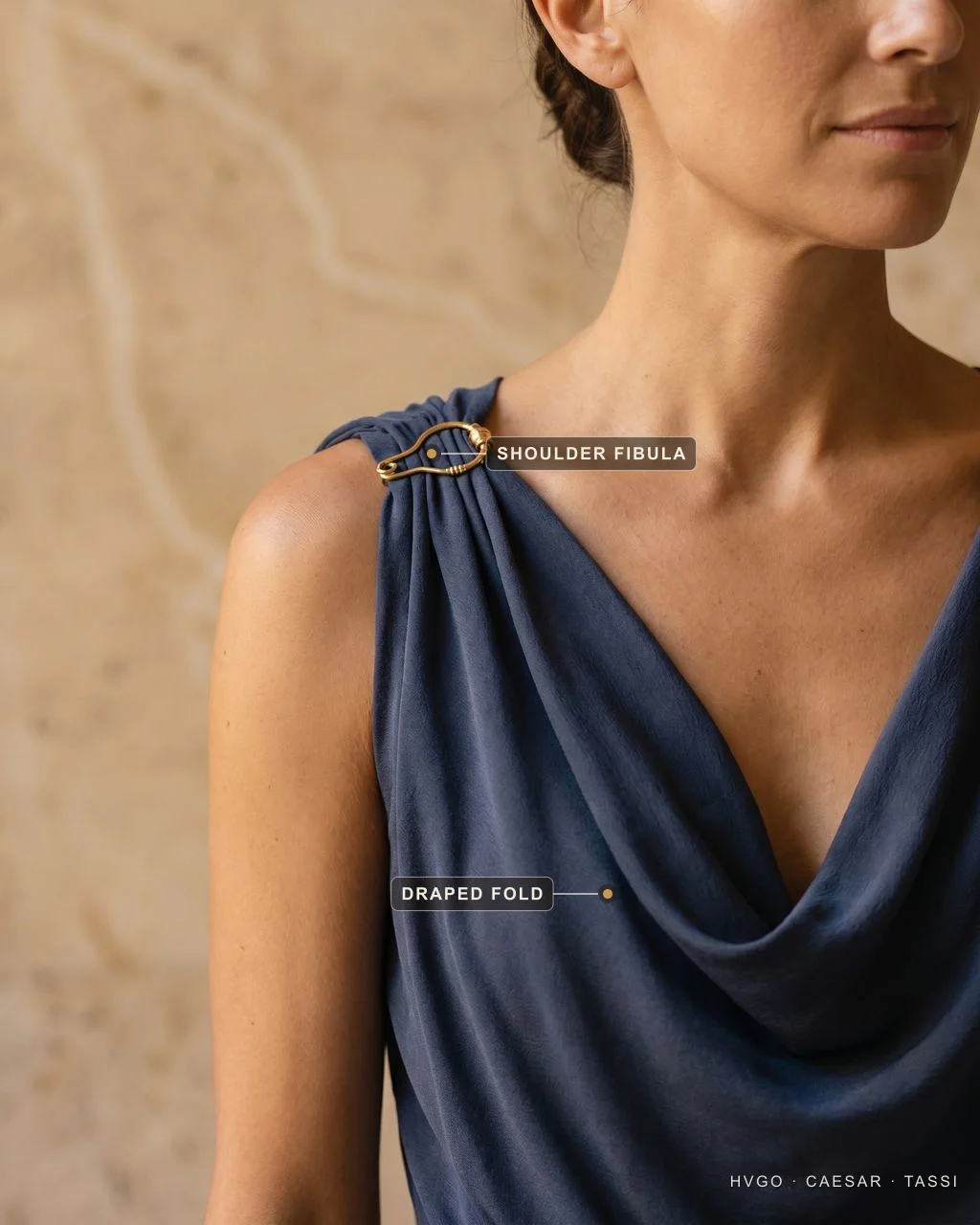
- Shoulder fibula — the gold brooch fastens the cloth at the shoulder, the ancient safety-pin ancestor that did the construction.
- Draped fold — released from the fibula, the fabric falls into the deep soft overfold that defines the Roman column.
Two consequences follow, and they run through every century ahead. First, fit lived at the shoulder seam and the waist tie, not in darts, which is exactly where a draped garment still has to fit today. Second, the drape itself became the design: the number of folds, the depth of the overfall, the way a length wrapped. The edge case proves the rule. The toga's curved cut shows Romans could shape cloth when civic ceremony demanded it, yet women's everyday dress refused that path for centuries because draping read as both modest and noble.
#The three layers a Roman woman built
A respectable Roman woman dressed in three named pieces, innermost to outermost: the tunica, the stola, the palla. Name them once here and the chronology has its scaffolding.
The tunica sat next to the skin as the foundation. The stola, the married woman's overdress, fell from the shoulders to the feet. The palla wrapped over both as the public mantle. The full day-in-the-life styling of these layers, how they moved and what a woman reached for at dawn, belongs to its own account; read what Roman women wore for that depth. Here, the three names simply anchor the timeline that follows.
#Where the history of Roman dress begins: Etruscan and Greek roots
Rome inherited its wardrobe rather than inventing it, absorbing draped dress from the Etruscans next door and the Greeks across the sea before refining both. The Roman silhouette is a borrowed silhouette, improved.
This matters because it explains why "Roman" dress already looked accomplished at the Republic's start. Two donor cultures had done the developmental work.
#The Etruscan inheritance
The Etruscans, who ruled central Italy before Rome's rise, draped a semicircular mantle called the tebenna across one shoulder. That curved cloth is the direct ancestor of the toga, and Etruscan women's dress paired fitted under-layers with draped overpieces.
Early Rome took the form and the instinct: drape an outer length over a simpler base. The counter-case is instructive. Etruscan women wore more fitted, sometimes laced bodices than later Roman women did, so Rome did not copy wholesale. It kept the drape and discarded the tailoring, sharpening the unstitched logic that became its own.
#The Greek borrowing: chiton, peplos and the Hellenic eye
Greek dress gave Rome the pinned-shoulder column. The chiton, a tunic fastened at intervals along the arms, and the peplos, a heavier rectangle folded over at the top and pinned at the shoulders, taught a belted vertical fall.
Rome adopted that logic and dressed it richer as Greek culture became fashionable luxury. The pinned shoulder, the deep overfold, the belt setting the column: these are the moves that, two thousand years later, define the goddess gown. Whereas the Etruscan gift was the curved mantle, the Greek gift was the falling column, and Roman women's dress fused the two.
#The stola: the garment at the heart of Roman dress history
Worn only by the married Roman woman, this long overdress hung from shoulder straps and fell to the feet in soft vertical folds, the column silhouette in its purest ancient form. Every later "Roman" gown descends from that shape.
#What the stola actually was
The stola covered the tunica and reached the instep, suspended from each shoulder by short straps called umerale. Belted high under the bust and again at the waist, it broke the cloth into long vertical folds running floor-ward.
Read it as engineering and the modern echo is exact: a single fall of fabric, gathered at one high point, released into a column. The Tullia pleated crepe column gown is that same logic in matte crepe. One concrete contrast sets it apart from the tunica below it: the stola added length, weight and folds, turning a working garment into a statement of rank.
#The stola as a badge, not just a dress
The stola functioned as a legal badge as much as a garment. Only the respectable married Roman woman, the matrona, was entitled to wear it; the law and custom denied it to prostitutes and, in practice, to many freedwomen.
Her signature was the instita, a sewn flounce along the hem that marked the wearer as a citizen wife. Status was, quite literally, hung from her shoulders. The edge case is sharp: a woman convicted of adultery lost the right to the stola, so the silhouette itself published her standing to the street.
#Under the stola: tunica, breast band and the base layer
Beneath the drape sat practical engineering. The tunica formed the everyday base layer; over the breasts a woman bound a strophium or mamillare (a linen breast band); below, a subligaculum (a linen loincloth) served as the undergarment.
These pieces never showed, yet they made the column work: a smooth foundation under falling cloth. The point holds today: clean construction underneath is what lets an outer drape hang true, which is why every HCT gown is fully lined.
#The palla and the veil: how Roman dress wrapped status and modesty
Rome's great mantle was a large rectangle wrapped over the stola and often the head, and paired with the veil it turned dress into a public grammar of status and modesty. It was the most expressive length a woman controlled.
#The palla, Rome's great mantle
The palla measured a broad rectangle of wool, wound around the body and frequently drawn up over the hair. A woman pinned it, looped it across one arm, or simply held its folds, with every arrangement a small public statement.
Unlike the fixed stola, the palla was hers to compose moment to moment. Its lightweight modern descendant is the silk wrap and the square scarf, an HCT thread carried by pieces like the Vesta and Tessera scarves. The drape itself, though, is the inheritance that matters here.
#The vitta, the veil and the rules of being seen
Roman dress assigned virtue through covering. The vitta, a woolen band binding a matron's hair, signaled chaste married status, and a respectable woman drew her palla over her head as a veil in public.
To be seen uncovered was to forfeit standing. The grammar was strict and the counter-case proves it: a woman barred from the vitta and the stola, a prostitute by law, was marked precisely by what her dress was not allowed to do.
#The toga women lost
Here is the detail most accounts skip: the toga began as unisex and ended as a male monopoly. In Rome's earliest days both sexes wore the draped toga, but it hardened into male civic dress, and by the late Republic a woman in a toga signaled disgrace.
The stola and palla became the respectable female counterpart, a parallel wardrobe defined partly by what women were no longer permitted. The toga, once shared, survived in the female wardrobe only as the forced mark of the adulteress and the prostitute.
#How fabric, color and silk changed across Roman dress through the ages
Across the centuries the Roman silhouette barely moved, but its materials transformed, running from home-spun wool to scandalous imported silk and the most restricted dyes in the ancient world. The drape stayed; the cloth got richer.
#Wool and linen: the everyday backbone
Wool and linen carried Roman dress from the Republic through the early Empire. Women spun and wove wool at home, a virtue so prized that Roman epitaphs praised wives for it, while linen came largely from Egypt for lighter, cooler garments.
Undyed cream and white were the everyday default, the color of cloth straight off the loom. The labor was enormous, and that is the point: every garment took hours of spinning before a single fold was draped.
#Silk, saffron and the luxury palette
Luxury arrived as silk and bright color. Coan silk from the island of Kos and true Chinese silk reached Rome as costly, near-transparent fabric that moralists denounced as scandalous; saffron-yellow marked ceremony and the bride.
The richest, most restricted color of all was murex purple, prized above every other dye in antiquity. That story is its own; read tyrian purple for the full account, because this page only points to it. The contrast frames the era: wool clothed the citizen, silk and purple clothed the imperial few.
#Sumptuary law and the bride
Rome legislated against female finery and ritualized it at the wedding. The lex Oppia of 215 BC restricted women's gold and colored dress during wartime austerity, and its later repeal sparked open public protest, proof of how charged women's clothing already was.
The bride answered with a fixed costume: the tunica recta, woven upright on an old-style loom for luck, and the flammeum, a flame-colored veil. That bridal saffron-and-flame is one of the few truly stable color codes in the whole timeline.
#How Roman dress evolved from the Republic to the late Empire
The silhouette refined rather than reinvented itself for centuries, then broke its own rule in the late Empire when sewn, wide-sleeved garments began replacing pure drape. The hinge of the whole history sits here.
#Republic to high Empire: refinement, not revolution
The silhouette held remarkably steady from the Republic into the high Empire because the drape principle simply did not need rebuilding. What changed was degree, not kind: finer wool, imported silk, more layering, more ornament at the hem and shoulder.
A Republican matron and an early-Imperial one would recognize each other's outfits instantly. The shift was a question of fineness and wealth, which is why a stable silhouette can still tell you a woman's century from her cloth.
#The late Empire and the dalmatica
The clean break came with the dalmatica, a wide-sleeved tunic cut and sewn rather than draped, which spread through the later Empire. Its sleeves and seamed body announced a new instinct: shape the cloth before it touches the body.
This is where antiquity tips toward Byzantium. Decorated bands called clavi ran down the dalmatica, and structure began to matter more than fall, the first real surrender of pure drape to cut.
#Where Roman dress went after Rome
Roman dress never actually ended; it migrated. The draped-and-sewn late-Roman wardrobe passed straight into Byzantine court dress, then echoed across medieval Europe, and much later it returned as the Neoclassical and Empire-line revival around 1800.
That long survival explains why "Roman" reads as a living style, not a dead one. The full designer chain that carried it into modern couture has its own account in roman influence on fashion; here it is enough that the line never broke.
#How the history of Roman dress reaches a modern women's occasion gown
Each ancient Roman garment produced one precise modern construction decision in the HCT atelier, turning a museum silhouette into a wearable gown. This is the bridge an encyclopedia cannot draw, because its story ends where a Roman workroom begins.
#The maker's bridge: ancient garment to modern construction
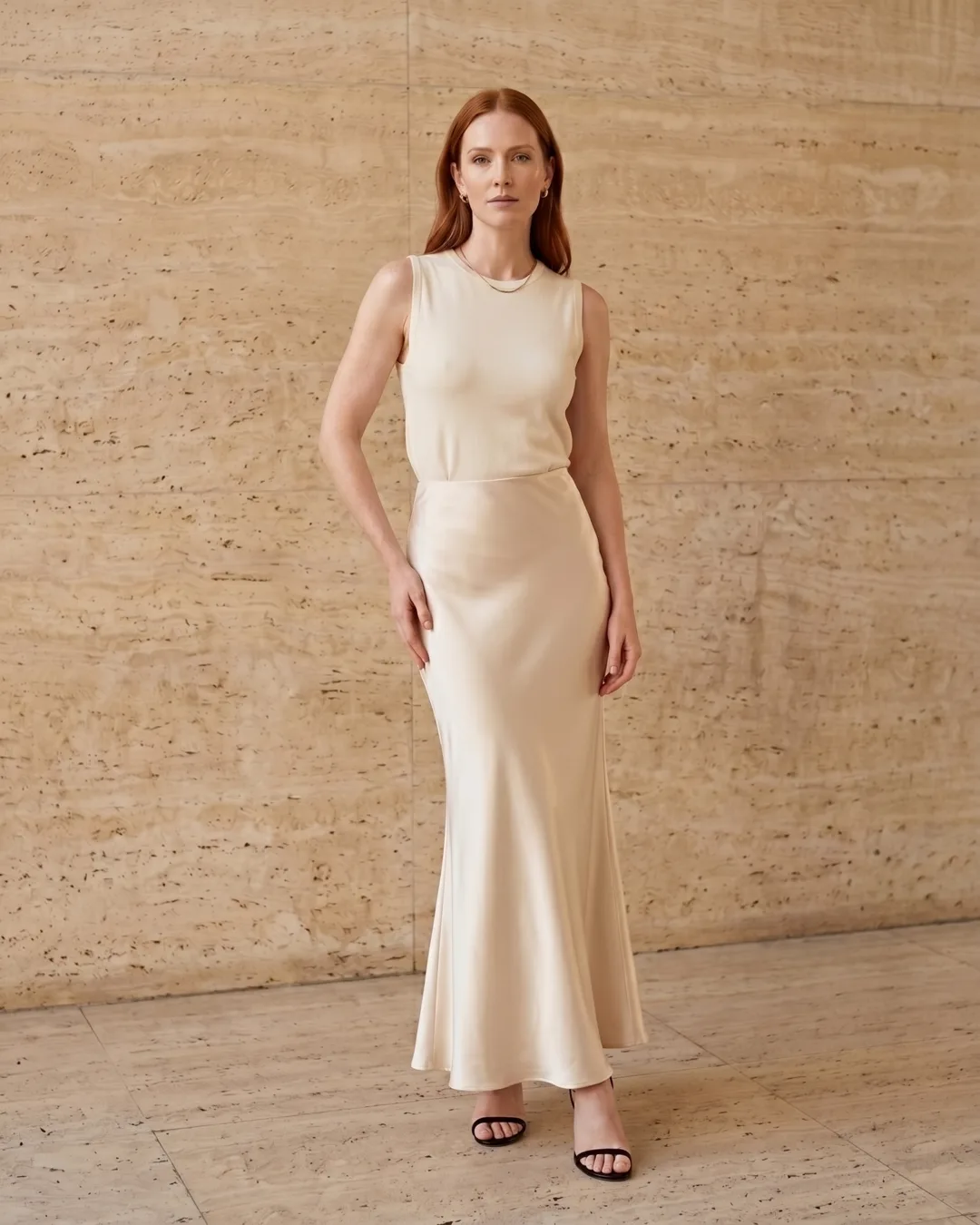
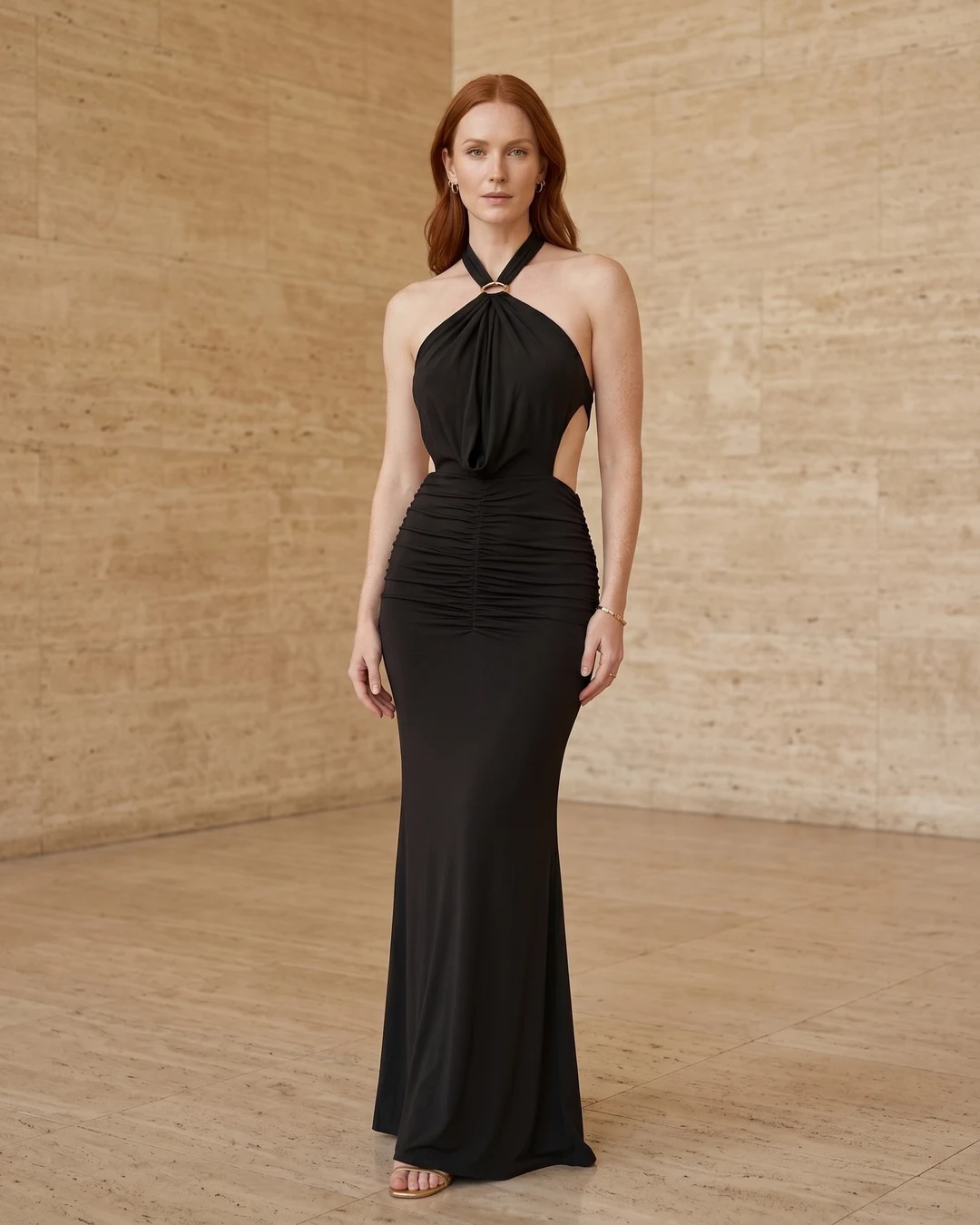
The translation is direct, piece to piece. The stola's unstitched falling column becomes a bias-cut crepe or modal drape; the palla's single wrapped length becomes a one-shoulder neckline; the pinned-shoulder fibula becomes a clean draped shoulder seam.
Each old solution answers a modern problem. Where the Roman matron pinned a brooch, the HCT cutter sets a concealed seam that holds the same fall without the metal. The principle survives; only the fastening changed.
#The HCT pieces that carry the line
Four current gowns carry the ancient logic forward, each tracing a named garment. The mapping is exact, and the table keeps it scannable rather than buried in prose.
| Ancient garment | Construction principle | HCT gown | Fabric |
|---|---|---|---|
| Stola (falling column) | Unstitched vertical fall | Vipsania draped column gown | Modal |
| Stola, pleated reading | High-gathered fold release | Tullia pleated column gown | Crepe |
| Stola with motion | Pleat carried into a slit | Claudia pleated-slit maxi gown | Chiffon |
| Palla into a hem | Single drape to a fishtail | Calpurnia fishtail evening gown | Satin |
The dress silhouette vocabulary behind these cuts, from column to A-line to sheath, is worth knowing on its own; the dress silhouettes guide lays it out. The payoff is the gown: two thousand years of drape, resolved into something you can zip and wear to an occasion.
#The history of Roman dress in one timeline
The whole arc compresses into one screenshot-ready sequence, from borrowed roots to the modern draped gown. Keep this and you hold the entire history in seven steps.
- Etruscan and Greek roots: the curved tebenna mantle and the pinned Greek column give Rome its draped vocabulary.
- Republican core (from ~509 BC): the tunica, stola and palla settle as the layered female wardrobe; the stola becomes the matron's badge.
- High Empire: silk, saffron and murex purple enrich the silhouette without changing its shape.
- Late Empire: the sewn, wide-sleeved dalmatica introduces cut over pure drape.
- Byzantine continuation: Roman draping migrates into Eastern court dress and survives the fall of Rome.
- Neoclassical revival (~1800): the Empire line returns the high-waisted Roman column to European fashion.
- Modern occasion gown: Fortuny and Madame Grès revive the pleated column, and houses like HCT cut it as today's draped and pleated gowns.
For a fuller narrative of that final leap from antiquity to the runway, the journal account of roman dress today walks it scene by scene.
#Frequently asked questions
What did Roman women wear instead of a dress?
Roman women wore three draped pieces rather than one tailored dress: a tunica next to the skin, a stola over it, and a palla wrapped on top. The stola marked her as a respectable married woman; nothing was sewn to a pattern. Each piece was pinned and belted, then arranged by hand for going out.
What is a stola and who was allowed to wear one?
The stola was the ankle-length overdress of the Roman matrona, hung from shoulder straps and falling in soft vertical folds. It worked as a badge of married respectability, denied to prostitutes and, in practice, to many unmarried and freed women. Its hem flounce, the instita, signaled a citizen wife at a glance.
Why didn't Roman women wear the toga?
Roman women did not wear the toga because it shifted from unisex dress into exclusively male civic dress. By the late Republic, a woman in a toga signaled disgrace rather than status. The stola and palla became the respectable female equivalent instead.
What fabrics and colors did Roman dress use?
Roman dress used wool and linen for everyday wear, usually undyed or white, with silk and rich dyes reserved for the wealthy. Saffron-yellow marked ceremony and brides. Murex, or Tyrian, purple was the most prized and restricted color of all.
How did Roman dress change over time?
Roman dress changed mainly in its fabric and ornament while its draped silhouette stayed strikingly stable for centuries. The clearest break came in the late Empire with the sewn, wide-sleeved dalmatica. That garment pointed the way toward Byzantine dress and the slow rise of cut over drape.
Why do modern occasion gowns still look Roman?
Modern occasion gowns still look Roman because the column-and-drape logic of the stola and palla never died. It passed through Byzantine and Neoclassical dress, then returned through couturiers like Fortuny and Madame Grès. Their draped, pleated columns are the direct ancestors of today's goddess and occasion gowns.
Now that you can see the stola in a modern silhouette, walk the line forward. Read how a single drape became the goddess gown, then meet the column reborn in our maxi dresses and occasion dresses.
More Roman Heritage guides
How Ancient Rome Still Dresses Us
A Rome-born house traces the Roman influence on modern fashion for women: toga drape to Fortuny, Madame Grès and the goddess gown, with the one rule kept.
Trace the Roman drape lineageTyrian Purple
Why Tyrian purple cost more than gold, who was forbidden to wear it, what it truly looked like — and how to wear imperial wine in a dress today.
Unpack the color of emperorsWhat Roman Women Wore
A Rome-born house answers what Roman women wore: the tunica, stola and palla — and maps that original capsule onto a modern woman's wardrobe.
Meet the stola and pallaThe Goddess Gown, Decoded
A Rome-born house defines the goddess gown by three tests: drape, fluid fabric, column neckline, plus how to choose the Grecian gown for your shape.
Apply the three-drape test