How to Clean, Condition and Store a Leather Bag So It Ages Beautifully
The atelier's gentle routine to clean, condition and store a leather bag, plus the conditioning cadence that builds a patina and stops cowhide cracking.
On this page
A leather bag ages beautifully when you do less, not more: dry-wipe it after use, condition it two to four times a year, and store it stuffed and breathing. Most cracking, sagging and staining traces back to overcleaning. This is the Hugo Caesar Tassi atelier routine for the full-grain Italian cowhide we use, tuned for handbags rather than boots.

- Full-grain leather — the hide's intact outer surface, which drinks conditioner and earns a patina over time.
- Structured base — the squared, footed bottom that needs firm stuffing to hold its shape in storage.
#Before you clean a leather bag, identify the leather you're working with
Check the care card and the cut edge first, because the leather type decides every step that follows.
Full-grain cowhide, top-grain cowhide and bonded leather react to water and cream in opposite ways, so treating them alike risks darkening one while starving another. A 30-second check saves a ruined bag: find the care card that ships with a quality handbag, then study a raw cut edge inside a pocket. Full-grain shows a tight, fibrous edge, while bonded leather shows a uniform, papery layer that peels. That single tell sets your whole approach for the steps below.
#Full-grain, top-grain, genuine and bonded, and why it matters
Full-grain cowhide ranks most durable; bonded leather ranks least, and that gap changes what you can safely do. Full-grain keeps the hide's outer surface intact, so it drinks conditioner and earns a patina over years. Top-grain sands that surface lightly for a smoother, thinner panel that still conditions well. Genuine leather sits below both: real hide, but lower split layers under a stamped finish. Bonded leather is shredded scraps pressed onto a backing, and it flakes once that bond fails, so you wipe bonded pieces with a barely damp cloth and skip conditioner, since cream cannot reach the hide through a plastic top coat. HCT bags use full-grain and top-grain cowhide precisely so home care works: the Aventina soft cowhide tote takes a thin cream readily, whereas a bonded fast-fashion bag beads it on the surface.
#Finished vs. unfinished leather, and the suede/nubuck exception
Finished leather wipes clean with a damp cloth; unfinished aniline soaks up water in seconds and spots for good. Finished cowhide carries a thin protective top coat, so a droplet sits long enough to blot, while aniline has no coat, which is why one raindrop can leave a ring. Suede and nubuck break the routine entirely. Both are napped surfaces, raised and brushed, so water mats the fibers and conditioner stains them; reach for a suede brush and a rubber eraser block, never the cloth-and-cream method below. To tell finished from aniline, dab a hidden spot with one drop of distilled water: beading means finished, instant soaking means aniline, and aniline wants a specialist.
#Always spot-test on a hidden area first
Test every cleaner and conditioner on a hidden patch and wait five minutes before treating the visible bag. The underside of a strap or the inner flap reveals whether a product darkens or lifts color, with no risk to the front panel. Apply a coin-sized amount, rub gently, then watch for two failures: a darker tone that will not even out as it dries, and dye on your cloth. Either result means stop. A colorless cream on Cuoio (tan) cowhide, for instance, can darken it half a shade, which the strap underside shows before anyone else does.
#How to clean a leather bag at home, step by step
Empty the bag, dust it dry, then wipe small sections with a barely damp cloth, and never soak it.
Cleaning leather is a run of light passes, not one wet scrub, and working in sections keeps moisture even, which heads off the water rings that patchy drying leaves behind. The whole exterior clean runs under ten minutes for a typical tote, because the mechanism is simple: leather is collagen fiber, and flooding it swells those fibers, then leaves them stiff as they dry.
The everyday leather-bag clean
The atelier's gentle five-minute routine for a full-grain or top-grain cowhide bag, no soaking.
- Empty and dust dry Tip out the contents, then dust the whole exterior with a soft dry microfiber cloth after each use, lifting skin oils before they oxidize into dull, darkened patches.
- Spot-test, then damp-wipe in sections Test on a hidden strap underside first, then wring a microfiber cloth in distilled (not tap) water until barely moist and wipe one panel at a time so moisture stays even.
- Reach for cleaner only for set-in dirt For grime that survives water, decant a little pH-balanced leather cleaner onto the cloth, never the bag; wipe in small circles, then pass a second clean damp cloth to lift the residue.
- Give corners, handles and edges gentle attention These high-wear zones darken first; dab edge paint rather than rub it, and condition handles lightly since they dry out fastest. Never over-scrub, which wears straight through a top-grain finish.
- Air-dry away from heat, then condition Let cleaned panels dry naturally, never on a radiator, then work a colorless cream over the spot so the hide does not dry out. A soft Aventina cowhide tote takes the cream readily; a structured Esquilina tote wants it twice a year.
- Never use dish soap, baby wipes or saddle soap, which strip the hide's own oils
- Never soak the bag, which swells the collagen fibers and leaves them stiff
- Never dry it with a heat gun or radiator, which cracks the grain
#The everyday dry wipe and weekly damp wipe
Dust the bag with a soft dry microfiber cloth after each use, and add a damp pass roughly weekly only when grime shows. The dry wipe lifts dust and skin oils before they settle into the grain. Skip it and that film oxidizes into dull, darkened patches that read as wear but are really neglect. For the damp pass, empty the bag, wring a microfiber cloth in distilled water until barely moist, and wipe one panel at a time; distilled water carries no minerals, so it leaves none of the chalky residue hard tap water does. A daily-carry Tivoli cowhide basket bag may want this weekly, whereas a clutch used twice a year almost never does.
#When and how to use a leather cleaner
Reach for a pH-balanced leather cleaner only for set-in dirt, apply it to the cloth not the bag, and condition afterward. Most weeks the damp cloth suffices. A cleaner is for grime that survives water, and the order is what protects the finish:
- Decant a little pH-balanced leather cleaner onto a clean microfiber cloth, never straight onto the leather.
- Wipe the soiled area gently in small circles, lifting dirt rather than grinding it in.
- Pass a second, clean damp cloth to remove cleaner residue.
- Let the panel air-dry away from heat, then condition the cleaned area.
Avoid dish soap, baby wipes and harsh saddle soap on fine handbag leather. Dish soap is a degreaser that strips the hide's own oils; baby wipes leave alcohol and lotion behind; saddle soap, built for thick tack, over-strips a thin panel.
#Cleaning the corners, handles and edges
Corners, handles and edges darken first, so give them gentle attention and never over-scrub. Handles absorb hand oils with every carry while base corners grind against tabletops, which is why these high-wear zones report damage earliest. Wipe handles with the same barely damp cloth, then condition them lightly, since they dry out fastest. Edge paint, the painted finish sealing a cut leather edge, chips with abrasion, so dab rather than rub it. The real hazard is over-scrubbing: aggressive cleaning rubs straight through a top-grain finish, and unlike a stain, that abrasion will not reverse at home.
#How to clean the inside of a leather bag and the lining
Empty and vacuum the interior first, then match your method to the lining, fabric or leather.
The inside collects crumbs, pen marks and makeup that migrate to whatever you carry next, and a fabric lining and a leather lining want opposite treatments. A two-minute vacuum prevents most interior stains, though one edge case is worth flagging: a suede-lined interior follows the suede rule, brush only, no water.
#Emptying, vacuuming and turning out the lining
Shake out debris, vacuum with a soft brush nozzle, and gently turn out a fabric lining where the construction allows. Crumbs and grit act like sandpaper on the lining seams over time. Hold the bag upside down and shake, then run a soft-brush vacuum nozzle into the corners and seams; where the lining detaches or turns out, do so gently to reach trapped debris. A leather-lined interior takes the exterior treatment instead: a dry dust, then a barely damp wipe, panel by panel.
#Spills, makeup and pen marks inside
Blot interior spills immediately, lift powder and makeup with a dry cloth, and treat fabric stains with a touch of mild soap and water. Speed decides the outcome: a blotted spill stays a smudge, while a soaked one becomes a permanent shadow. Dab a dry cloth onto liquids to absorb rather than spread them, and for pressed-powder or foundation smears, lift with a dry cloth before any water touches the mark. Treat a fabric-lining stain with a little mild soap and water; treat a leather lining like finished leather. Then let the bag dry fully open, since a closed damp interior breeds the mildew the storage section warns against.
#How to condition a leather bag, and how often
Condition a leather bag every three to six months with a colorless cream, because conditioning is what stops it cracking.
This is the atelier's core cadence rule, and it overrides the boot-and-saddle advice to grease leather constantly: fine handbag leather wants far less feeding than work boots do, and a thin cream twice a year keeps an everyday tote supple for years. The mechanism is simple replenishment.
#Why conditioning is what keeps leather from cracking
Leather is tanned hide that slowly loses its natural oils, and conditioner replenishes them so fibers stay flexible. As those oils evaporate, collagen fibers stiffen, then split under the flex of daily carry; that is what cracking actually is. Conditioner re-lubricates the fibers so they bend instead of fracturing, and it builds an even patina rather than dry, gray patches. A neglected bag shows the counter-case plainly: hairline cracks along the fold lines of a handle, which no cream can fully reverse once the fibers have broken.
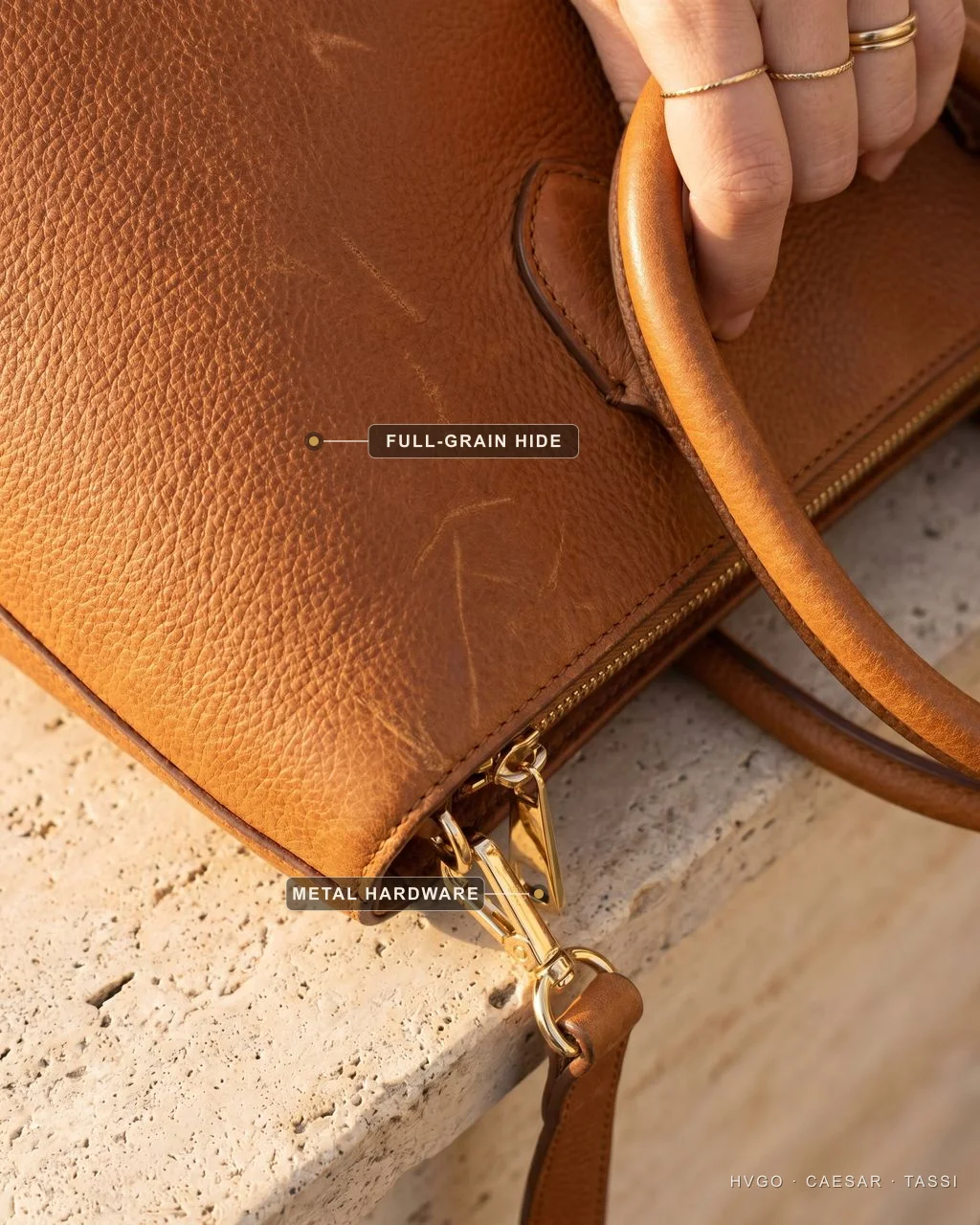
- Full-grain hide — the natural grain and pores that condition with a thin colorless cream every three to six months.
- Metal hardware — gold-tone plating that wants only a dry or barely damp buff, never leather cleaner or conditioner.
#Choosing a conditioner: cream and balm vs. mink oil and saddle soap
Pick a light leather cream, lotion or beeswax-lanolin balm for handbags, and avoid heavy mink oil and saddle soap. Creams and balms deposit a thin, controllable film. Mink oil and saddle soap, made for boots and tack, over-soften a thin panel and darken it noticeably.
| Product | Best for | Effect on fine bag leather | Use on a handbag? |
|---|---|---|---|
| Light leather cream or lotion | Everyday handbags, totes | Replenishes oils, minimal darkening | Yes, atelier default |
| Beeswax / lanolin balm | Drier panels, handles, edges | Conditions plus light water resistance | Yes, sparingly |
| Mink oil | Work boots, outdoor gear | Over-softens, darkens several shades | No |
| Saddle soap | Saddles, thick tack | Strips oils, can leave residue | No |
| Tinted / colored conditioner | Matching scuffed colored leather | Risks uneven tinting on smooth hide | Rarely; colorless is safer |
Choose a colorless formula whenever you can, since a tinted cream can streak smooth cowhide. The exception: a deeply scuffed colored bag sometimes needs a matched tint, and that job is worth handing to a professional.
#The atelier's 3-to-6-month conditioning cadence
Apply a thin layer on a soft cloth, buff it in, wipe the excess, and repeat every three to six months, never weekly. Weekly conditioning over-softens the structure and darkens the grain past recovery, so the steps stay short:
- Put a pea-sized amount of colorless cream onto a soft cloth, not onto the bag.
- Buff it across one panel in light circles until the surface looks even.
- Wipe off any excess so none settles into the seams.
- Let it absorb for an hour, then carry on.
Lean toward three months if you carry a daily tote or live with dry winter heat, where radiators pull moisture from the hide fast, and stretch to six for an occasional clutch. A bag kept in a dry, heated room ages faster than one in a stable closet, so tune the rhythm to the room.
#How to remove color transfer, stains and water marks from a leather bag
Match the stain to its method: dye transfer lifts with cleaner, oil draws out with powder, and water spots even out with more water.
Each stain type fails differently, so no universal fix exists, and scrubbing the wrong way sets most of them for good. The classic case is a pale tote against dark jeans; the counter-case is ink, which usually defeats home treatment and belongs with a specialist.
#How to remove color transfer (dye from dark denim and bags)
Lift color transfer gently with a pH-balanced leather cleaner or a barely damp melamine sponge, then recondition and protect the spot. Dye transfer is the blue-gray shadow dark denim leaves on a light bag's back panel and corners. Work the cleaner in lightly, since the dye sits in the top finish, not deep in the hide; a melamine sponge, the white "magic eraser" foam, helps used very sparingly, because it is a fine abrasive that dulls the finish under pressure. Recondition afterward, then apply a leather protectant spray so the next denim contact slides off instead of staining.
#Oil, grease and ink stains
Blot oil and grease, dust the mark with cornstarch or talc overnight to draw it out, and leave ink to a professional. Oil sinks into leather rather than sitting on it, so powder, not water, is the tool. Press a dry cloth on the fresh spot, then heap cornstarch or talc over it and leave it eight to twelve hours; the powder wicks the oil up, and you brush it away the next morning, repeating if a shadow remains. Ink and deep dye stains are the edge case: rubbing alcohol can lift ink but also strips the finish on a fine bag, so skip the home fix and consult a leather specialist.
#Water spots, salt lines and mildew
Even out a water spot by dampening the whole panel, lift salt rings with diluted vinegar, and wipe mildew with a mild vinegar solution. A water spot is a tide line where minerals dried unevenly, so re-wetting the full panel and drying it evenly erases the edge. Winter salt leaves white rings; dab them with one part white vinegar to two parts distilled water, then condition once dry. Mildew, the fuzzy gray bloom of damp storage, wipes off with the same diluted vinegar, but the real fix is the cause: move the bag out of the humid spot, or the bloom returns within weeks.
#How to care for the hardware on a leather bag
Buff metal hardware with a dry or barely damp soft cloth, and keep leather cleaners and conditioners off the plating.
Zippers, clasps and gold-tone fittings need almost nothing beyond a wipe, since the products that feed the hide will haze or strip thin plating. A quick buff after a rainy day prevents most tarnish; the one edge case is a sticky zipper.
#Keeping zippers, clasps and gold-tone hardware bright
Wipe zippers, clasps and gold-tone hardware with a dry cloth, and never take abrasive metal polish to plated finishes. Gold-tone hardware is a thin gold-colored plating over brass, so harsh polish scours the color straight off. For a balky zipper, rub a soft pencil graphite tip or a little clear wax along the teeth; graphite is a dry lubricant that frees the slider without oiling the leather around it. Keep cleaner and conditioner off the plating, since both cloud the shine. Solid brass hardware, unlike plating, can take a gentle dedicated brass polish, because no thin coat will wear through.
#How to store a leather handbag so it keeps its shape
Stuff the bag, slip it into a breathable cotton dust bag, and stand it upright so it holds its shape between wears.
Left empty and flat, a bag collapses along its own creases, so stuffing supports the structure from inside while the dust bag shields it from grime and light. Done right, this prevents the slow sag that no conditioning fixes, and the hard rule below is that plastic is never the answer.
#Stuff it, dust-bag it, and let it breathe
Fill the bag with acid-free tissue or bubble wrap to hold its form, then store it upright in its cotton dust bag with the handles up. Acid-free tissue will not yellow the lining the way ordinary paper can. Stuff enough to round out the panels without straining the seams, and skip newspaper, whose ink transfers onto a pale lining. Stand the bag upright on a shelf, handles up rather than crushed under heavier bags, so the base keeps its shape. A structured Esquilina or Pincia leather tote especially wants firm stuffing, since its panels are cut to stand on their own.
#Why a leather bag must never be sealed in plastic
Sealing leather in plastic traps moisture against the hide and grows mildew, because leather must breathe. A plastic cover or zip-bag holds humid air against the surface, and that trapped damp is exactly where mold blooms. Keep bags out of direct sunlight, which fades dyed cowhide, and away from radiators that bake out the oils. A silica gel packet inside the dust bag absorbs ambient humidity in a damp closet. Rotate your bags so none sits untouched for years, because a leather bag left idle dries and stiffens faster than one in regular, gentle use.
#How to soften and revive a stiff or stored leather bag
Soften a stiff or long-stored bag with a light conditioning, a reshape with stuffing, and a day of being carried. Stiffness is dried-out fiber, and warmth plus oil relaxes it. Apply a thin layer of colorless cream, buff it in, and let the bag reach body temperature as you carry it, stuffing it back into shape while the cream absorbs. The counter-case is force: never heat-gun, microwave or soak a stiff bag to rush this, because sudden heat cracks the grain and water stains it. Patience over a day beats any shortcut.
#How Hugo Caesar Tassi makes leather bags that age into a patina
Hugo Caesar Tassi cuts its bags from full-grain and top-grain Italian cowhide and ships each with a care card naming its default verb: wipe, condition, store.
That finish and lining are chosen so the simple home routine above is all a bag ever needs, and a woman following the wipe-condition-store rhythm keeps an HCT bag supple for years without a specialist.
#Full-grain Italian cowhide and the house care card
The care card assigns each bag one default care verb, so you know its everyday need at a glance. Full-grain cowhide is finished to take conditioner and build patina, while top-grain is sanded smooth for structured silhouettes that hold a shape. The card distills this routine into one word per bag: a soft everyday tote reads "condition," a structured tote reads "store," and an occasion clutch reads "wipe." It removes the guesswork that turns leather care into anxiety.
#The bags and the care they ask for
Each silhouette asks for a slightly different emphasis within the same wipe-condition-store routine. Pick the rhythm that matches how you carry the bag: everyday totes want regular feeding, structured totes want stuffing, and occasion pieces want careful storage.
| Bag | Type | Primary care it asks for | Cadence |
|---|---|---|---|
| Tivoli cowhide basket bag | Everyday tote | Condition to keep cowhide supple | Every 3 months |
| Aventina soft cowhide tote | Everyday tote | Condition, since soft hide dries fastest | Every 3 months |
| Esquilina leather tote | Structured tote | Stuff to hold its shape | Store stuffed, condition every 6 months |
| Pincia large leather tote | Structured tote | Stuff and store upright | Store stuffed, condition every 6 months |
| Palatina shoulder bag | Shoulder bag | Dust-bag between wears | Condition every 6 months |
| Quirina envelope clutch | Evening clutch | Tissue and dust-bag between events | Wipe, condition once a year |
The Aventina, softest of the hides, drinks conditioner fastest, so it sits at the three-month end. The Quirina clutch, carried rarely, sits at the once-a-year end and asks mostly for protective storage.
#Your leather bag care routine at a glance
Dry-wipe always, damp-clean only when needed, condition every three to six months, and stuff plus dust-bag between wears.
That four-beat rhythm is the whole routine, and it deliberately asks for less than the heavy-duty advice written for boots.
| Step | When | What you do | Skip if |
|---|---|---|---|
| Dry wipe | After each use | Soft dry microfiber cloth over the surface | Never skip |
| Damp clean | Weekly to monthly, as grime shows | Barely damp distilled-water cloth, section by section | The bag looks clean |
| Condition | Every 3-6 months | Thin colorless cream, buffed in and wiped off | Conditioned within 3 months |
| Store | Between wears | Stuff with acid-free tissue, cotton dust bag, upright | In daily rotation |
Keep the rhythm light and steady and a bag improves every year. For routines across the rest of your wardrobe, the garment care hub gathers the matching guides, while the dedicated walk-through on caring for a silk scarf handles woven accessories the same gentle way.
#Frequently asked questions
How do you clean a leather bag at home?
You clean a leather bag at home by emptying it, dusting it dry, then wiping in small sections with a cloth barely dampened in distilled water. For set-in grime, put a pH-balanced leather cleaner on the cloth rather than the bag, lift the dirt gently, and let it air-dry away from heat. Always condition the cleaned area afterward so it does not dry out. Within the same care silo, storing occasion dresses follows the same gentle principle.
How often should you condition a leather bag?
You should condition a leather bag every three to six months, more often for an everyday tote or in dry winter heat. An occasional clutch needs it less, closer to once or twice a year. Conditioning weekly over-softens and darkens fine handbag leather, so a light touch on a steady rhythm is the rule.
How do you remove color transfer from a light leather bag?
You remove color transfer from a light leather bag by gently lifting the dye with a pH-balanced leather cleaner or a barely damp melamine sponge used sparingly. Recondition the spot once it is clean, then apply a leather protectant spray so dark denim does not transfer again. Press lightly, since the dye sits in the surface finish.
Can you use baby wipes or dish soap on a leather bag?
Baby wipes and dish soap should not go on a leather bag, because both strip the finish and dry the hide out. Use a cloth with distilled water for most cleaning and a dedicated leather cleaner for stubborn dirt. Follow either with conditioner to replace the oils any cleaning removes.
How do you store a leather handbag long-term?
You store a leather handbag long-term by stuffing it with acid-free tissue, keeping it in a breathable cotton dust bag, and standing it upright away from sunlight, heat and damp. Never seal it in plastic, which traps moisture and grows mildew. Check and lightly condition it a couple of times a year. The companion guide on caring for an occasion dress covers wardrobe storage in the same spirit.
How do you soften a stiff leather bag?
You soften a stiff leather bag by applying a thin layer of colorless conditioner, buffing it in, and letting it absorb. Carrying the bag for a day and reshaping it with stuffing helps it relax further. Avoid heat or water as shortcuts, since both can crack or stain the leather instead of softening it.
Now that a leather bag is no longer intimidating to own, explore the full-grain Italian cowhide totes, shoulder bags and clutches in the Hugo Caesar Tassi leather-bags edit, or browse the whole accessories collection to complete the look.
More Care & Fabrics guides
How to Wash, Store and Revive a Silk Scarf Without Losing Its Color or Sheen
Wash, de-crease, dry and store a silk scarf without dulling the color or warping the hem — the atelier's cold-water method and white-vinegar acid rinse.
Wash silk the right wayHow to Wash a Chiffon Dress at Home (Plus Satin and Crepe) Without Ruining It
The atelier's safe way to wash, refresh and steam chiffon, satin and crepe at home — plus the fiber test that decides hand-wash vs. dry clean.
Wash chiffon, satin & crepe safelyHow to Care for Pleated Chiffon Without Losing the Pleats
Wash, dry, store and travel with pleated chiffon without flattening the pleats — the atelier's heat-set method, hand-wash steps and a pleat-revival fix.
Keep the pleats knife-sharpHow to Pack a Dress Without Wrinkles
The atelier's fabric-by-fabric method to pack a dress wrinkle-free: roll chiffon in tissue, fold crepe on its seams, plus a 10-minute arrival revival.
Pack a dress wrinkle-freeHow to Remove Stains From a Dress
The atelier's fabric-safe way to remove wine, makeup, sweat, deodorant and oil stains from a delicate dress — blot, don't rub, and know when to stop.
Rescue a stained dressHow to Store Occasion Dresses So They Stay Ready to Wear
Store occasion dresses with no creases, sagging or yellowing: the atelier's fabric-weight hang-or-fold rule, acid-free tissue method and moth-proof plan.
Store gowns the right way