How to Remove Stains From a Dress: Wine, Makeup, Sweat, Deodorant and Oil, the Atelier Way
The atelier's fabric-safe way to remove wine, makeup, sweat, deodorant and oil stains from a delicate dress — blot, don't rub, and know when to stop.
On this page
Almost any stain on an occasion dress is winnable if your first three moves are right: blot rather than rub, reach for cold water rather than hot, and test your solution on a hidden seam before it touches anything visible. Get those wrong and a small spot becomes a permanent halo. This is the Hugo Caesar Tassi atelier method, fabric by fabric.

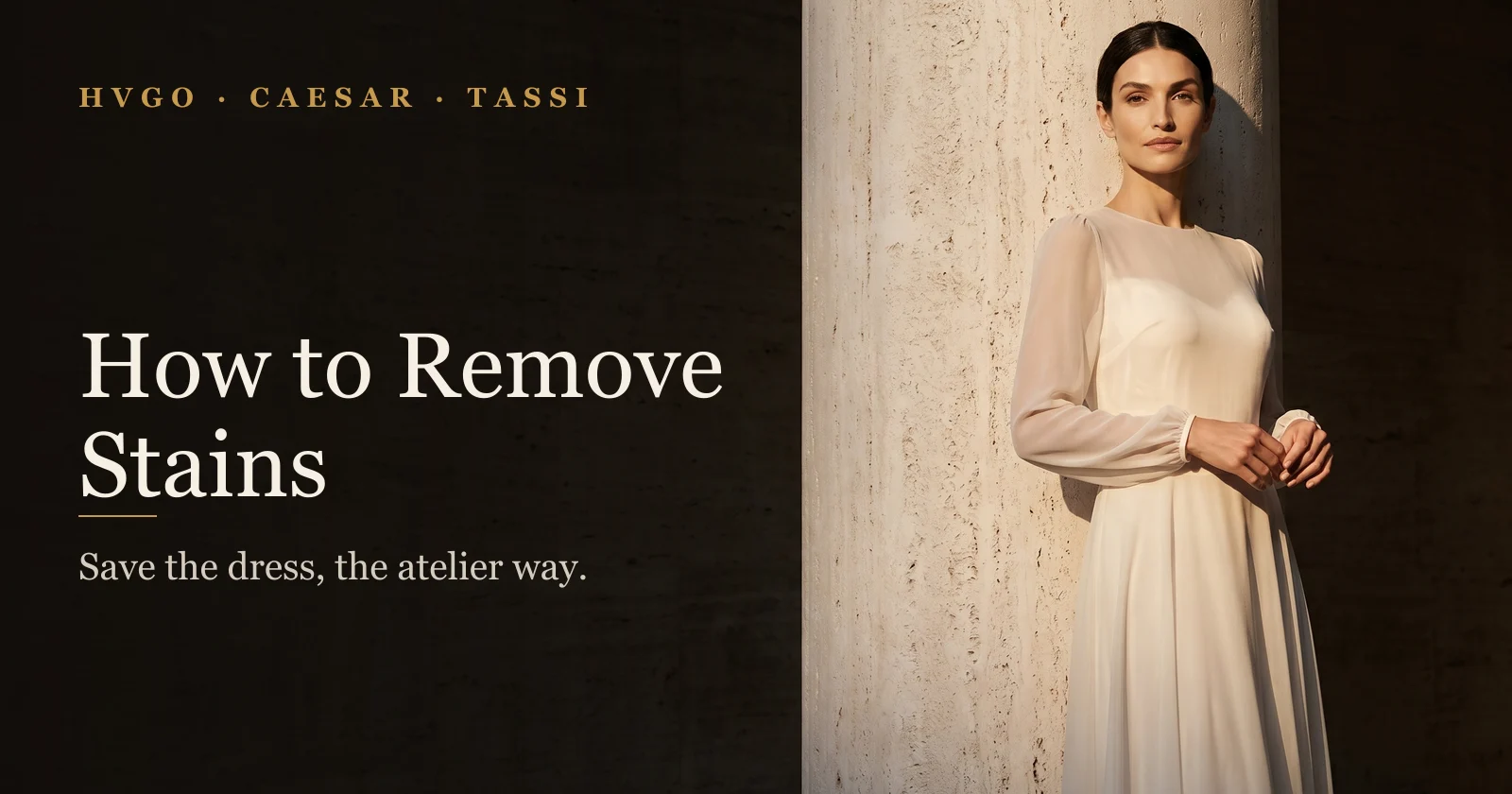
- Sheer chiffon — the fine translucent weave that frays if rubbed, so every spill is pressed, never scrubbed
- Pale ivory weave — light, undyed cloth where a stain shows instantly and must be lifted while still fresh
The atelier stain-rescue method
Five moves in order rescue most stained dresses — work them top to bottom.
- Blot, never rub Press a clean white cloth straight down to lift the spill, working from the back of the fabric and the outside of the mark inward. Rubbing drives pigment deeper, frays chiffon and dulls satin into a ring you cannot reverse.
- Keep everything cold Use cold or cool water only. Heat from an iron, hairdryer or tumble dryer permanently sets protein stains (sweat, makeup) and tannin stains (wine, coffee). Air-dry flat, away from radiators.
- Identify the stain family Tannin, protein, oil, dye and mineral each need different chemistry. Flush tannins with water; absorb oil with talc before any liquid; lipstick needs the oil step then the dye step. Naming the stain is your real first move.
- Test on a hidden seam Dab any solution — detergent, vinegar or alcohol — on the seam allowance first. Clean cloth, proceed; tinted cloth, the dye is bleeding and you stop. Non-negotiable on rich colorways like Porpora and Vermiglio or any printed silk.
- Lift, then know when to stop Work the family-matched fix by dabbing, repeating gently rather than scrubbing. A set or large stain, oil on silk or satin, ink, or a failed seam test belongs to a specialist — go fast and name the fiber and stain when you brief them.
- Never rub — it spreads one mark into a permanent halo
- Never use heat — it cooks protein and tannin stains in for good
- Never pour salt on wine — it can set the tannin and dull silk
- Never bleach sweat or deodorant — it yellows silk further
#The first 60 seconds: the atelier rule to remove any stain from a dress
Your opening minute decides the outcome: lift the stain straight up, keep every drop cold, and prove your treatment safe on a concealed seam before you commit it. Three reflexes, in that order, save most dresses a panicking woman thinks she has ruined.
Speed matters because a fresh spill sits on top of the fibers; a set one has bonded inside them. A drop of red wine on a chiffon skirt is still loose for the first minute or two. The same drop, dried and reheated by a car-ride home, has chemically gripped the weave.
#Blot, never rub, and work from the back
Press a clean white cloth straight down onto the spot to lift the stain; never rub it. Rubbing drives pigment deeper into the weave, frays chiffon, dulls satin's surface sheen, and spreads one small mark into a wide ring you cannot reverse.
The mechanism is simple. Blotting transfers liquid from the dress onto an absorbent surface by pressure alone. Rubbing, by contrast, grinds the stain sideways across hundreds of fiber crossings and forces it through to the back. On a sheer or fine dress, flush from the reverse side so the spill exits the way it entered, and work from the outside of the mark inward. Start at the edge and a halo forms; start outside and move in, and you contain it.
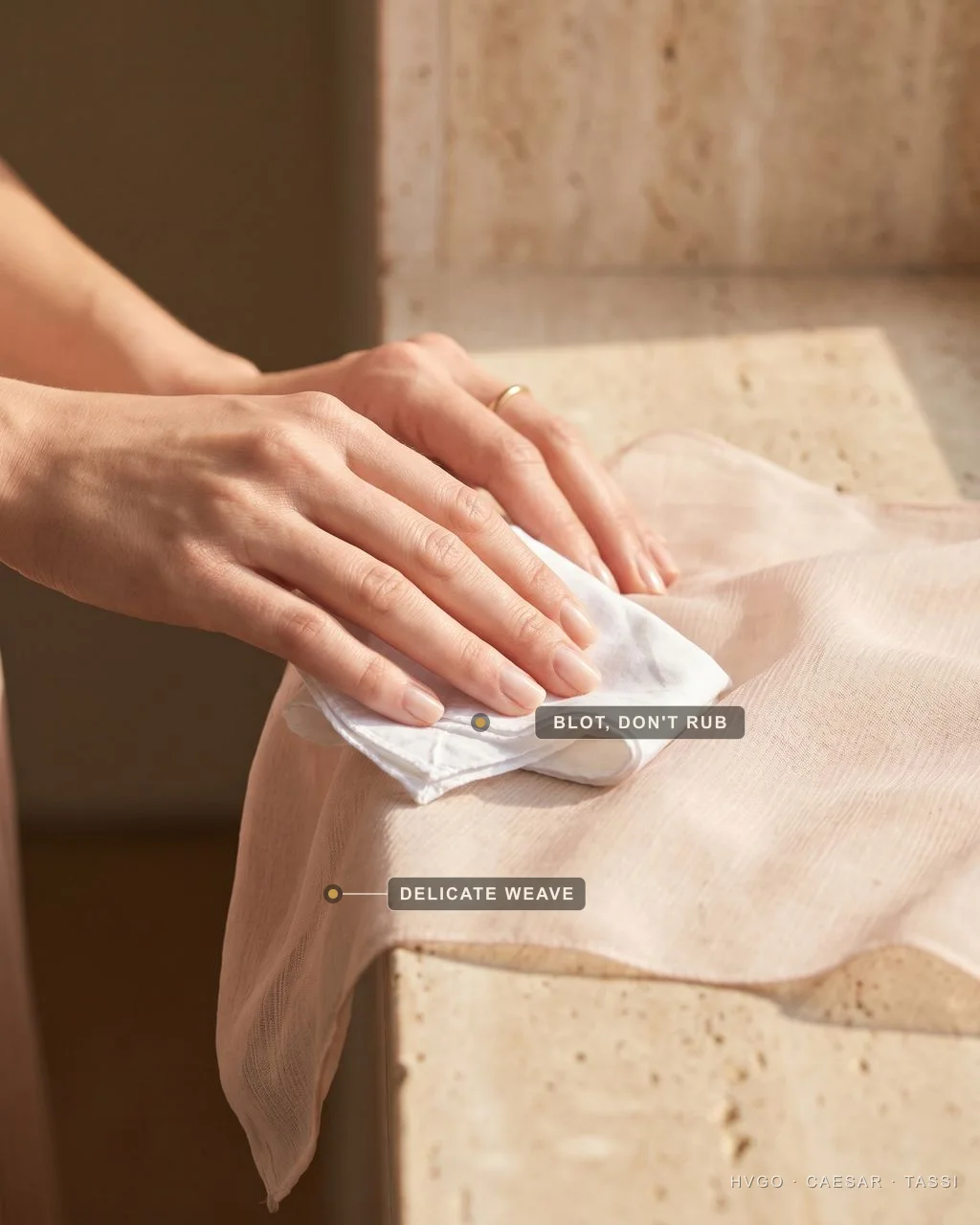
- Blot, don't rub — press the clean cloth straight down to lift the stain; rubbing grinds pigment deeper and spreads a ring
- Delicate weave — sheer chiffon that water-spots and frays, so treat the whole panel gently and never scrub the spot
One counter-case: a thick foundation smear sitting on the surface should be lifted off first with the edge of a spoon or a dry cloth before you blot, or you press solids further in.
#Cold water only, and why heat is the enemy
Use cold or cool water for nearly every stain, because heat permanently sets the two most common ones. Hot water, a hairdryer, an iron, or a tumble dryer cooks protein stains and tannin stains into the fiber for good.
Protein stains (sweat, many makeups) coagulate when warmed, exactly as an egg white turns solid in a hot pan. Tannin stains (red wine, coffee, tea) oxidize and darken with heat. So a woman who blots a wine spill, then blasts it dry with a hotel hairdryer to leave faster, has just made the only mistake she cannot undo. Air-dry instead, flat and away from radiators. The one exception runs the other way: an oil stain wants no water at all, hot or cold, until you have absorbed it first.
#Test on a hidden seam before you treat the dress
Dab any cleaning solution on the seam allowance or inside hem first; if color lifts onto your cloth, the fabric is not colorfast and you must stop. This single test, taking ten seconds, prevents the worst home disaster: a treatment that removes the stain and the dye together.
Detergent, white vinegar, and rubbing alcohol all carry this risk on deep dyes and printed silk. Press your dampened swab to a concealed spot, hold five seconds, lift, and read the cloth. Clean cloth means proceed. Tinted cloth means the dye is migrating, and you route the dress to a specialist. Rich imperial-palette colorways like Porpora (wine) and Vermiglio (red), and any printed silk, are the most likely to bleed, so the seam test is non-negotiable on them.
#Identify the stain first: why tannin, protein, oil, dye and mineral stains each need a different fix
Five stain families behave differently, and matching the family to the method is what actually saves the dress. Treat oil like wine, or wine like oil, and you set the mark while convinced you are removing it.
#Why the type of stain decides how you remove it
Each stain family responds to one chemistry and resists the others, so naming the stain is your real first step. Wine is not foundation; sweat is not deodorant.
Here is the triage the atelier teaches, and the prose below it never repeats these cells:
| Stain family | Examples | First move | Avoid |
|---|---|---|---|
| Tannin | Red and white wine, coffee, tea | Cold-water flush, then a drop of delicate detergent | Hot water, salt |
| Protein | Sweat, some makeup, dairy | Cold water, pH-neutral or enzyme wash on safe fabrics | Any heat |
| Oil-based | Foundation, body oil, salad dressing | Absorb with talc, then a dab of dish soap | Adding water first |
| Dye-based | Lipstick pigment, ink, fake tan | Careful solvent dabbing, tested first | Rubbing across pale fabric |
| Mineral | Deodorant aluminum salts, hard-water | A mild acid, such as diluted white vinegar | Bleach |
The logic chain runs from chemistry to method. Tannins dissolve in water, so you flush them. Oils repel water, so you draw them out with an absorbent powder before any liquid. A common edge case trips people up: lipstick belongs to two families at once, pigment dye suspended in a waxy oil, so it needs the oil step and the dye step in sequence.
#Match the way you remove the stain to your fabric
Your fabric narrows the safe options further, and silk narrows them most. The same wine spill is a sink job on polyester chiffon and a specialist job on silk satin.
Silk and silk chiffon are the most fragile: no bleach, no enzyme cleaners, no strong solvents, and they water-spot at the slightest splash, so every treatment must wet a whole panel evenly. Satin watermarks and shows rings, which means you treat the entire panel, not just the spot. Crepe is sturdier yet puckers if rubbed. Polyester chiffon, including the recycled chiffon the house weaves, is the most forgiving and releases fresh stains readily. When you are unsure which fiber you are holding, the chiffon, satin and crepe explained guide tells you how each one behaves under water.
#How to remove red wine stains from a dress (plus white wine, coffee and other tannins)
Red wine lifts cleanly when you blot every drop, flush the back with cold water, and dab in a little delicate detergent, all while it is fresh. Wine is a tannin, so cold water is your ally and heat is your enemy.
#Fresh red wine: blot, flush cold, then lift
Blot up all the liquid you can, flush the reverse of the fabric under cold running water, then work a single drop of pH-neutral detergent in by dabbing. Repeat the blot-flush cycle until the cloth comes away clean.
White wine poured on red wine does dilute the spill, but plain cold water does the same job without adding sugars, so reach for water if a sink is near. Club soda can help lift a fresh spot through agitation and dilution. Salt, however, is a myth worth retiring: poured on silk it can set the tannin and dull the surface rather than absorb it. A practical example: a glass tipped onto an Aemilia chiffon maxi at dinner, blotted and cold-flushed within two minutes, usually leaves no trace by morning. The counter-case is a textured satin like Calpurnia, where flushing one spot risks a ring, so you wet the whole panel.
#A dried or set wine stain on a delicate dress
A set wine stain needs patient soaking and a tested vinegar dab, and on silk or satin it often needs a professional instead. Dried tannins have oxidized, so they resist the gentle methods that lift a fresh spill.
For a washable polyester or crepe dress, give it a long cool soak, then dab diluted white vinegar (one part vinegar to two parts water) onto a seam-tested spot and lift gently, repeating rather than scrubbing. On silk or satin, a set red-wine mark is a dry-cleaner job, full stop. Pushing vinegar and friction into fragile silk to chase a stubborn ring risks stripping dye and leaving a watermark worse than the wine. The full routine for washing an occasion dress tells you whether the rest of the dress is washable at all.
#How to remove makeup, foundation and lipstick stains from a dress
Most makeup marks are oil-based or dye-plus-oil, so you cut the grease before you chase the color. The neckline smear is the single most common occasion-dress casualty.
#Foundation and concealer (the neckline smear)
Lift the excess foundation off without smearing, then blot with micellar water or a touch of dish soap on a tested spot, working from the edge inward. Most foundations are oil-based, which is why plain water beads off them and does nothing.
The usual culprit is the dress going over the head after makeup is done, dragging color across the neckline. Prevent it by stepping into the dress, or by laying a silk scarf over the face as you pull the fabric down. Micellar water suits delicate fibers because it lifts oil without solvents. Dish soap, used in a pinpoint amount, suits a heavier mark. One edge case: a powder foundation is not oil-based, so brush it off dry first and you may need no liquid at all.
#Lipstick and mascara (dye plus oil)
Absorb the waxy oil first, then dab the pigment with micellar water or a hidden-tested touch of rubbing alcohol; never drag color across pale chiffon. Lipstick is dye held in a wax-and-oil base, so it sits in two stain families at once.
Follow the oil routine below to draw out the base, then address the remaining color with light dabbing. Mascara behaves the same way. On pale Avorio (ivory) or Cipria (pink) chiffon, one careless rub turns a pinpoint of red into a wide pink bruise, so every motion is a press, not a sweep. Rubbing alcohol can lift stubborn pigment but bleaches some dyes, which is exactly why the seam test comes first.
#How to remove sweat stains and deodorant marks from a dress
Sweat and deodorant are two different stains, and the deodorant fix is dry while the sweat fix is cold and wet. Confuse them and you spread chalk or set yellowing.
#White deodorant chalk marks (the quick rescue)
Brush dry white deodorant marks away while they are still dry, using a clean dry sponge, a dryer sheet, nylon hosiery, or a folded scrap of the dress's own fabric. Never wet a fresh chalk mark, which only dissolves it into the weave.
The chalk sits on the surface as a powder, so friction from a like-textured material lifts it cleanly. A real save: a dark Basalt (black) crepe column streaked with white in the restroom mirror, fixed in seconds by buffing with a folded edge of the hem. Prevention is easier still, letting deodorant dry fully before you dress. The counter-case is a deodorant that has gone wet and yellow under the arm, which is no longer chalk and needs the sweat treatment instead.
#Underarm sweat marks and yellowing
Treat perspiration as a protein-and-salt stain with cold water and a pH-neutral or enzyme wash on safe fabrics, and break aluminum-salt yellowing with diluted white vinegar tested on a seam. Never bleach it, which yellows silk and protein fibers further.
Aluminum salts from antiperspirant bond with sweat protein to create the stubborn yellow halo. A mild acid dissolves the mineral half; cold water and a gentle wash lift the protein half. Enzyme cleaners work well on cotton linings but are risky on silk and wool, so reserve them for fabrics you have confirmed are safe. Treat the mark fresh and air the lining, and most underarm shadowing never sets. The deeper underarm refresh sits inside the occasion-dress care routine linked above.
#How to remove an oil or grease stain from a dress
Oil is the one stain you absorb before you ever add liquid, because water seals grease into the fiber rather than lifting it. Powder first, soap second, in that strict order.
#Absorb first with talc or cornstarch
Sprinkle talc, cornstarch, or baby powder over the grease and let it draw the oil out for 15 to 30 minutes before you brush it away. For a set mark, leave the powder overnight and repeat.
Powder-before-water is the counterintuitive step that saves silk. Salad dressing, butter, body oil, and sunscreen are all oil carriers, and powder pulls the oil upward by capillary action. Brush the saturated powder off with a soft dry brush, then reapply if a shadow remains. The edge case worth knowing: on a beaded panel, keep powder off the embellishment, since it lodges between stones and dulls them.
#Then cut what's left with a dab of dish soap
Work a tiny amount of grease-cutting dish soap into the residue by dabbing on a tested spot, then flush with cool water. Dish soap is formulated to break oil, which household detergent does less efficiently.
After the powder has done the heavy lifting, soap finishes the job on whatever shadow remains. Oil is also the stain most likely to defeat home treatment on silk and satin, because the absorbent step alone rarely clears a set grease ring from a fine weave. When a body-oil mark has sat overnight on silk satin, skip straight to a specialist rather than wetting it repeatedly. Knowing which fabric you are treating, again, decides whether the sink or the cleaner is right.
#When you can't remove the stain: stop and take the dress to a specialist
The luxury answer to some stains is to stop, because the next attempt risks a permanent watermark. Knowing the limit protects the dress more than any solution does.
#The stains and fabrics you shouldn't fight at home
Stop on a set or large stain, any oil mark on silk or satin, a dye that lifted in your seam test, ink, and anything on beaded, boned, or heavily lined gowns. "Dry-clean only" on the label is an instruction, not a suggestion.
Each of these shares one trait: the home fix carries a higher chance of damage than of success. A set stain has bonded; a large one cannot be evenly treated; a non-colorfast dye will bleed; embellishment and boning trap moisture and shift. A printed silk gown with a coffee ring that resisted the cold flush is exactly the moment to fold it carefully and let a professional take over.
#How to brief a dry cleaner so they can actually help
Go fast, point out the exact spot, and tell the cleaner what the stain is and what you already applied. A fresh stain is far more removable than one that has waited a week.
Name the fiber and any embellishment so the cleaner picks the right process, and ask for delicate or eco wet-cleaning where the fabric allows, rather than aggressive perchloroethylene. Above all, never iron the dress or dry it out first to look tidy, since heat sets the very stain you want lifted. The honest list of what to attempt and what to surrender:
- Tell the cleaner the stain's identity and your home treatment, every time
- Bring the dress within 48 hours while the stain is still loose
- Flag silk, beading, boning, or lining before they choose a method
- Ask for the gentlest cleaning the fiber permits, not the strongest
#How Hugo Caesar Tassi builds dresses that shrug off stains, and the kit it swears by
The house designs forgiveness into the fabric and the seam, then hands you a five-piece kit to carry. Stain resistance starts on the cutting table, not at the sink.
#The atelier's stain-resistance choices
Hugo Caesar Tassi weaves a recycled polyester chiffon that water-spots less and releases fresh stains more readily than fine silk. The fiber choice is a deliberate hedge against the spilled-wine moment.
The house also finishes seam allowances generously, so every dress carries a hidden patch where you can run the colorfastness test before you treat the visible cloth. The founder's doctrine, blot rather than rub, cold water only, test on a hidden seam, shapes how the atelier builds the garments, not just how a woman later cleans them. This is one place where polyester chiffon beats silk on practicality, whereas silk still wins on hand and drape.
#The five-piece event clutch stain kit
Carry five small items and you can rescue almost any spill the moment it lands. The kit fits a clutch and protects every gown in the wardrobe.
- A folded white cotton handkerchief for blotting and seam-testing
- A few micellar-water wipes for makeup and lipstick
- A tiny dish-soap sachet for grease
- A small sachet of talc to absorb oil before it sets
- A travel stain pen, tested on a hidden seam in advance
This is the kit that saves an Aemilia chiffon maxi at the table, a Calpurnia or Flavia satin gown at the reception, and a Tullia crepe column on the dance floor. The one item people forget is the pre-test: a stain pen used cold on an untested silk can leave its own ring, so prove it on a seam at home first.
#Remove any stain from a dress: your by-stain cheat-sheet and five-step decision tool
Run five steps in order every time, then apply the one-line fix for your stain. Blot, identify, test, lift, and know when to stop.
The five-step spine, in sequence:
- Blot the spill straight up with a clean white cloth
- Identify the stain family before you choose a treatment
- Test that treatment on a hidden seam for colorfastness
- Lift the stain with the family-matched method, dabbing only
- Stop and brief a specialist the moment the seam test fails or the stain resists
Keep the one-line fixes within reach: wine takes a blot, cold flush, and detergent; makeup takes micellar water or dish soap; deodorant takes a dry brush; sweat takes cold water and vinegar; oil takes talc then dish soap; lipstick takes absorb then dab. For the full wash-and-store cycle that follows a rescue, the dress care and fabrics pillar collects every routine, and how to store occasion dresses keeps the saved dress safe afterward.
#Frequently asked questions
How do you get a stain out of a dress without rubbing it in?
You get a stain out of a dress by blotting, not rubbing. Press a clean white cloth straight down to lift the stain, working from the back of the fabric and from the outside of the mark inward, so you push it out of the weave instead of grinding it deeper or spreading it into a ring.
How do you remove red wine from a dress?
You remove red wine from a dress by blotting, cold-flushing, and dabbing in detergent. Lift the excess, flush the reverse of the fabric with cold water, then work in a drop of pH-neutral delicate detergent and lift gently, never with heat. A set wine stain on silk or satin is safest left to a dry cleaner.
How do you get deodorant marks off a dress quickly?
You get deodorant marks off a dress by brushing them away while dry. Use a clean dry sponge, a dryer sheet, nylon hosiery, or a folded scrap of the dress's own fabric, and never wet a fresh chalk mark, which only spreads it. Let deodorant dry fully before dressing to avoid it.
How do you remove an oil or grease stain from a dress?
You remove an oil stain from a dress by absorbing it before adding any water. Cover the grease with talc, cornstarch, or baby powder, leave it 15 to 30 minutes, then brush it off and cut any residue with a dab of dish soap on a tested spot. Oil on silk or satin often needs a dry cleaner.
Can you remove a stain from a chiffon or silk dress at home?
You can often remove a stain from a chiffon or silk dress at home if you act fast. Blot rather than rub, use only cold water, and test any solution on a hidden seam first, but skip bleach and strong solvents on silk, and take set, oily, or large stains to a specialist before you risk a watermark. Forgiving recycled-chiffon styles release fresh stains more easily than fine silk.
Does salt or club soda really remove wine stains?
Club soda helps lift a wine stain, but salt is a myth that can set it. The bubbles and dilution of club soda lift a fresh spot, whereas salt can fix the tannin and dull silk rather than absorb it. Cold water and gentle blotting stay safer and more effective on a delicate dress.
Now you can remove a stain the moment it lands, and know when to let a specialist take over. Explore the easy-care occasion dresses worth saving, with the forgiving recycled-chiffon pieces in the chiffon dresses collection as the gentlest route of all.
More Care & Fabrics guides
How to Clean, Condition and Store a Leather Bag So It Ages Beautifully
The atelier's gentle routine to clean, condition and store a leather bag, plus the conditioning cadence that builds a patina and stops cowhide cracking.
Care for a leather bagHow to Wash, Store and Revive a Silk Scarf Without Losing Its Color or Sheen
Wash, de-crease, dry and store a silk scarf without dulling the color or warping the hem — the atelier's cold-water method and white-vinegar acid rinse.
Wash silk the right wayHow to Wash a Chiffon Dress at Home (Plus Satin and Crepe) Without Ruining It
The atelier's safe way to wash, refresh and steam chiffon, satin and crepe at home — plus the fiber test that decides hand-wash vs. dry clean.
Wash chiffon, satin & crepe safelyHow to Care for Pleated Chiffon Without Losing the Pleats
Wash, dry, store and travel with pleated chiffon without flattening the pleats — the atelier's heat-set method, hand-wash steps and a pleat-revival fix.
Keep the pleats knife-sharpHow to Pack a Dress Without Wrinkles
The atelier's fabric-by-fabric method to pack a dress wrinkle-free: roll chiffon in tissue, fold crepe on its seams, plus a 10-minute arrival revival.
Pack a dress wrinkle-freeHow to Store Occasion Dresses So They Stay Ready to Wear
Store occasion dresses with no creases, sagging or yellowing: the atelier's fabric-weight hang-or-fold rule, acid-free tissue method and moth-proof plan.
Store gowns the right way