How to Store Occasion Dresses So They Stay Ready to Wear
Store occasion dresses with no creases, sagging or yellowing: the atelier's fabric-weight hang-or-fold rule, acid-free tissue method and moth-proof plan.

On this page
Store an occasion dress by fabric weight, not by habit. Hang the light pieces, fold the heavy ones flat in archival tissue, and never seal a gown in plastic. The Hugo Caesar Tassi atelier folds anything over roughly 250 g/m² and covers everything in breathable cotton. A gown then comes out creaseless instead of asking for the cleaner.

- Padded hanger — a broad, contoured form spans the whole shoulder seam so weight never digs in at two points.
- Breathable cover — cotton or muslin keeps dust off while the fibers exchange air, never sealed plastic.
The atelier storage protocol
Run the same four steps on every gown before the closet door closes.
- Clean it first Never store a dress carrying sweat, deodorant, perfume or food residue — those marks oxidize into set stains and feed moths over the long months. Refresh or deep-clean by fiber and dry fully before it goes away.
- Decide hang or fold by weight Use the HCT threshold: fold anything heavier than roughly 250 g/m², hang anything lighter. No tag? Bunch a fistful of skirt — if it falls heavy and holds a fold it folds, if it floats open it hangs. Test the heaviest panel.
- Hang the light pieces right Put chiffon and georgette maxis like an Aemilia on broad, padded, shoulder-width hangers that span the whole seam, and load the inner waist ribbons so the straps carry no weight. Retire every wire and dry-cleaner hanger.
- Fold the heavy ones in tissue Lay a Calpurnia or Flavia satin gown flat, cushion every fold line with acid-free, lignin-free tissue, and roll bias or stretch columns like a Vipsania around a tissue tube. Slip tissue into the bodice so the cloth never presses against itself.
- Cover breathable, never plastic Use cotton, canvas or muslin bags for hanging gowns and acid-free archival boxes for folded ones. Strip dry-cleaner plastic the moment you walk in — sealed bags trap damp, off-gas yellowing fumes and suffocate the fibers.
- Store cool, dark and check seasonally Keep gowns in a cool, dry, dark space away from windows, with a silica-gel absorber and cedar or lavender. Every few months, refold along fresh lines an inch from the last and refresh the repellents.
- Never hang a heavy, beaded or bias-cut gown — it stretches the shoulders or pulls threads loose at the seams
- Never seal a gown in plastic or a dry-cleaner bag for storage — it breeds mildew and yellows the cloth
- Never clip a satin waistband on the face of the cloth — grip a seam allowance or it leaves a permanent watermark
- Never use naphthalene mothballs — the toxic odor lingers in delicate fabric
#Why storing dresses well matters more than any single wash
A dress spends most of the year in the closet, so slow storage damage retires more gowns than any night out.
A gown worn three or four times a year sits in storage near 360 days, against maybe twelve hours on a body. Stretch, creases, yellowing and moth holes all build up in that dark stretch, none of it visible the night you wear the dress. A satin gown washed perfectly but hung on a wire hanger for two summers still cracks at the shoulder seams. The damage is slow and silent, which is why it surprises people who treat each wear with care yet shut the closet door without a thought. A shoulder that elongates a little each season looks fine until the day it droops on the hanger. A fold that sets over a year reads as a permanent line the first time you steam it. So the question that decides a gown's life is not how you clean it, but how you put it away.
#Clothes spend most of their life in storage
An occasion piece sits unworn for months, which is exactly when invisible damage sets in.
Shoulders elongate under hanging weight, fold lines harden, ivory dyes oxidize toward yellow, and larvae find protein fibers. A Tullia pleated crepe column crammed on a tight rail flattens its pleats within a season, whereas a lined polyester A-line shrugs off careless storage for years.
#Clean before you store, always
Never store a dress carrying perspiration, deodorant, perfume or food residue, because those marks oxidize into stains and feed moths.
Sweat and sugar stay invisible on dark cloth, then brown into set stains months later as larvae burrow toward the salt. Clean every gown by its fiber and dry it fully; for the wash-or-refresh call, work from the occasion dress care routine. A piece worn twenty minutes over a slip can simply air and steam.
#Should you hang or fold a dress? Let fabric weight decide
Fabric weight settles the hang-or-fold question: heavy, dense or stretchy gowns fold flat, while light, airy ones hang safely. A heavy dress on a hanger pulls on its shoulder seams for months and stretches them into points, turning a guess into one weighable fact.
#The fabric-weight rule (the HCT threshold)
Fold anything heavier than roughly 250 g/m² and hang anything lighter, the threshold the Hugo Caesar Tassi atelier uses for its own gowns.
Heavy satin, structured crepe, jersey and beaded pieces clear that weight; most chiffon, georgette and light silk fall under it. With no spec tag, bunch a section of skirt in your fist. If it falls heavy and holds a fold, it folds; if it floats open, it hangs. Beadwork is the edge case, since it adds weight to a light base fabric. Test the heaviest panel, not the lightest, and you will rarely misjudge a gown.
#What to hang
Hang lightweight pieces that wrinkle when folded and have seams or waist loops strong enough to bear their own weight. Chiffon and georgette maxis, unlined A-lines and most light silk keep their drape open on a hanger. An Aemilia A-line chiffon maxi is the model candidate; a gown on delicate spaghetti straps moves to the waist-hang method instead.
#What to fold
Fold bias-cut and stretch-knit columns, heavily beaded gowns and slip-prone strapless pieces, since hanging stretches or tears them. Knits and bias cuts grow longer every week they hang, and beadwork pulls threads loose at the seams. A draped Vipsania modal column elongates visibly on a hanger within a month or two. A strapless bodice slips off any hanger that does not grip it, then creases where it lands. Beaded gowns carry the worst of both, since the beads concentrate weight that strains every seam. Lay all of these flat instead. Cushion the folds with tissue and refold along fresh lines every few months. None of them belongs on a hanger for more than the hour it takes to dress.
#The in-between: hang from the waist
Hang a heavier dress from its waistband or inner loops with clip or skirt hangers, so the weight loads the waist instead of the shoulders.
Most guides skip this third option, which suits a structured satin gown too long to fold. Foam-lined clips grip the waistband while the bodice hangs slack, or the sewn-in inner ribbons take the strain when a gown has them. The single caution is pressure: clip too tight on satin and you leave a watermark, so pad the clips or grip a seam allowance rather than the face of the cloth.
#How to hang a dress so it keeps its shape
Match the hanger to the shoulder width, use a contoured or padded form, and load the inner straps rather than the fabric edges.
The right hanger spreads weight across the whole seam; the wrong one drives it onto two points, and spacing then keeps air moving so creases never set.
#Choose the right hanger and ditch the wire ones
Use broad, contoured, padded or wooden hangers that span the shoulder seam, and retire every wire and dry-cleaner hanger. A narrow hanger leaves two bumps where the wire ends dig in, and wire also rusts in humidity and stamps orange marks onto pale cloth. That is why a pale Avorio (ivory) gown never touches metal.
| Hanger type | Effect on the gown | Use it for |
|---|---|---|
| Thin wire / dry-cleaner | Shoulder bumps, creases, rust marks | Nothing; discard |
| Flat plastic | Even but unpadded, can slip straps | Light, casual pieces only |
| Padded / satin-covered | Cushions the seam, grips straps | Chiffon, silk, fine maxis |
| Broad contoured wood | Spreads weight across full seam | Lined gowns, jackets, structure |
| Clip / skirt hanger | Loads the waist, frees shoulders | Heavy gowns hung from the waist |
#Use the inner straps and don't overcrowd
Hook the sewn-in waist ribbons so the shoulder straps carry no weight, then space gowns so air circulates between them.
A hand's width between covered gowns keeps drape uncrushed, though a cold, damp walk-in still needs a moisture absorber nearby.
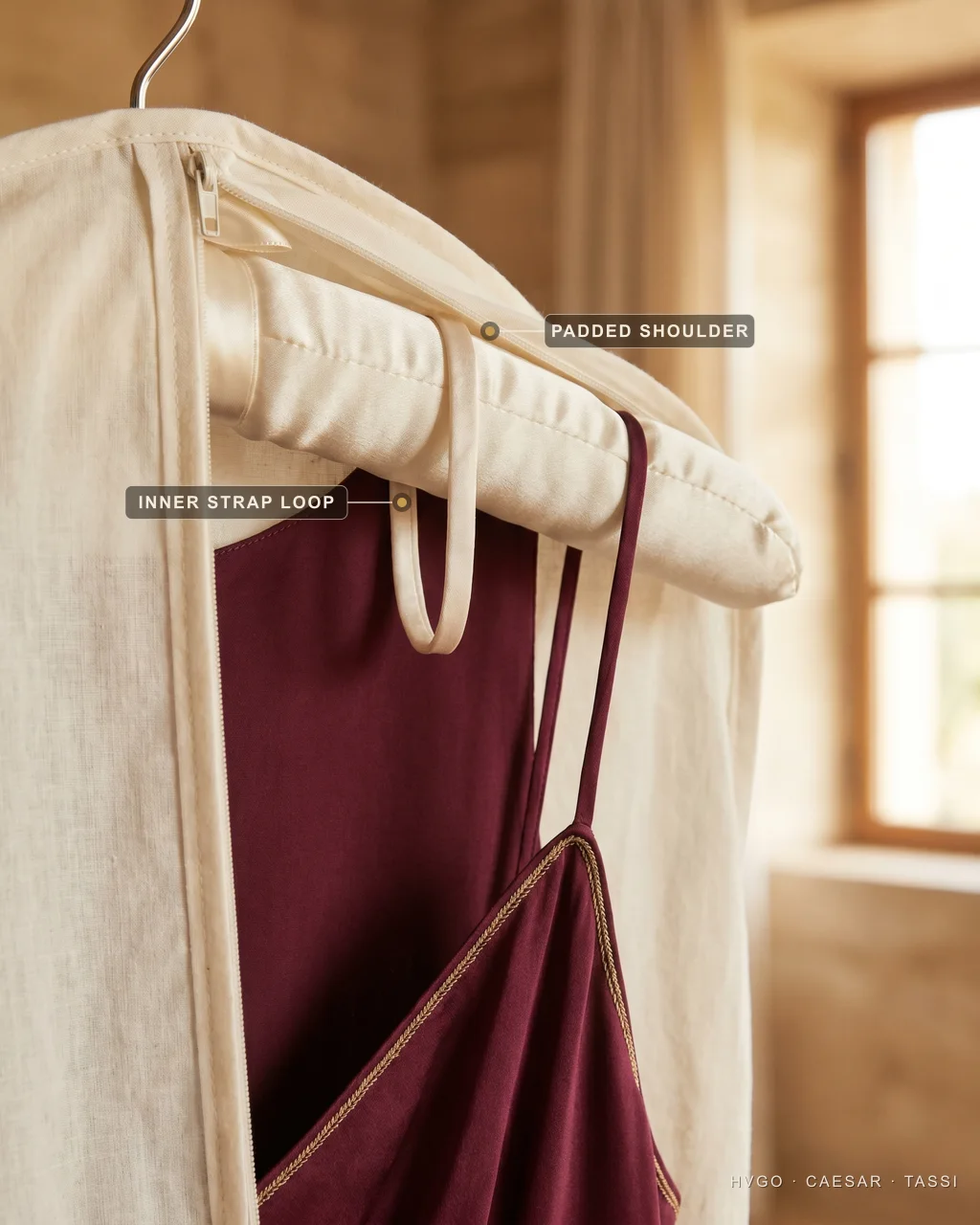
- Padded shoulder — the broad cushioned form cradles the gown without leaving hanger bumps in the cloth.
- Inner strap loop — hooking the sewn-in ribbon means the fine shoulder straps carry no weight.
#How to fold a dress with acid-free tissue so it comes out creaseless
Fold a heavy dress loosely along its own seams, with acid-free, lignin-free tissue cushioning every fold line. Archival tissue buffers the cloth and softens each crease, so the gown unpacks ready to steam rather than ready to re-clean. The technique matters as much as the material. Fold along the seams the dress already has, never into sharp new lines across the body. Slip tissue inside every bend and into the bodice so the fabric never presses hard against itself. Roll bias and stretch pieces around a tissue tube rather than folding them at all. Refold along fresh lines every few months so no single crease has time to harden. Treated this way, even a heavy gown comes out of a season's storage needing nothing but a light steam.
#Why acid-free, lignin-free tissue
Choose acid-free, lignin-free, pH-neutral tissue, because regular paper and cardboard release acids that yellow and weaken fibers.
Lignin, the compound that browns old newspaper, migrates into any fabric pressed against it. Plain printer paper looks harmless yet can brown a silk hem within a year, so reserve pH-neutral tissue for pure silk and wool.
#The fold-with-tissue method, step by step
Lay the clean dress flat, place tissue along each fold line, fold loosely along existing seams, and roll bias or stretch pieces instead of creasing them. Follow these steps so the gown comes out uncrushed.
- Lay the clean, fully dry dress flat on a wide surface, face up.
- Smooth out air bubbles and align the side seams so it sits symmetrical.
- Lay acid-free tissue along each fold line, then fold loosely along the seams, never into sharp new creases.
- Slip crumpled tissue into the bodice and structured areas to hold their shape.
- Roll bias-cut and stretch-knit pieces around a tissue-wrapped tube rather than folding.
- Store the gown flat in a breathable box or roomy drawer, refolding along fresh lines every few months.
A beaded gown adds one step: lay tissue between every layer so the beads cannot imprint into the facing cloth. Pack folded gowns loosely, since compression undoes the cushioned fold and forces fresh creases. The aim throughout is to let the cloth rest, not to wedge it into the smallest possible space.
#Why you should never store a dress in plastic (and what to use instead)
Sealed plastic traps moisture, off-gasses chemicals and stops fibers breathing, so it breeds mildew and yellows fabric.
A breathable cover does the opposite, keeping dust off while the cloth exchanges air, so the fastest upgrade most closets need is stripping the dry-cleaner bags.
#What plastic and dry-cleaner bags do
Plastic and dry-cleaner bags seal humidity against the cloth, off-gas yellowing fumes, and suffocate the fibers.
Trapped damp turns to mildew while the plastic's vapors oxidize whites toward yellow. The bag that kept a gown clean on the drive home is what ruins it on the rail, so strip it the moment you walk in. The lone exception is a few hours of transit.
#Breathable covers that actually protect
Use cotton, canvas or muslin garment bags for hanging gowns and acid-free archival boxes for folded ones, so dust stays out and air stays in. A clean cotton pillowcase over a short dress works the same way. In a dusty attic, fine grit slips through breathable bags, so a sealed archival box guards a folded gown better.
#How humidity, light and temperature quietly damage stored dresses
Damp, heat and light degrade a stored dress invisibly: humidity breeds mildew, heat speeds yellowing, and light fades dye.
A cool, dry, dark space stops all three at once, and most storage failures trace to one of these conditions rather than to the dress.
#Control humidity and keep gowns cool and dark
Keep stored gowns in a cool, dry, climate-controlled space and add a moisture absorber, since damp closets breed mildew and musty odor.
A basement closet grows mildew on a folded gown within one wet season. An attic above 90°F speeds yellowing and dries out fibers, so neither extreme suits an occasion dress. The ideal is an interior closet on a living floor, with silica-gel packs or a refillable absorber to catch the residual damp that even a good room carries in summer. Dry or replace the packs once they feel heavy, and a gown in a stable room rarely needs more than that.
#Keep light off the fabric
Store gowns away from windows, because UV and even ambient light fade dyes and oxidize whites toward yellow. Light is cumulative, so a gown in indirect sun for a year shows a faded line where it struck. A Cipria (pink) or Avorio (ivory) piece shows damage long before a Basalt (black) one.
#How to store dresses to prevent moths and keep them fresh
Store every dress clean and well-spaced in a breathable cover, because clean storage starves moths far better than any repellent.
Clothes moths chase soiled protein fibers, not the fabric itself, so an enclosed, airy closet removes the food source that draws them.
#What moths actually eat (and why clean storage stops them)
Clothes-moth and carpet-beetle larvae eat protein fibers like silk and wool, drawn by the perspiration and food residue on them. The adult moth does no harm; its larvae target the salt and sweat in a worn gown. A silk gown put away unwashed is the textbook target, whereas pure polyester offers no protein to eat.
#Cedar, lavender and why to skip mothballs
Repel moths with cedar blocks and lavender sachets, and skip naphthalene mothballs, which leave a toxic odor in delicate fabric.
Cedar's oils deter larvae and lavender does the same more gently, though both fade and need seasonal refreshing. Cedar works best as a sanded block tucked beside, not against, a delicate gown. Its raw oils can mark silk on direct contact, so keep a barrier between block and cloth. Lavender suits the most fragile fabrics, where even cedar feels too strong. Both are aids, not shields. Layered over a clean, covered gown they add insurance; over a soiled one they merely scent the meal. Sand the cedar and swap the sachets each season, and the closet stays inhospitable to moths.
| Repellent | How it works | Why or why not |
|---|---|---|
| Cedar blocks | Natural oils deter larvae | Sand lightly each season to renew the scent |
| Lavender sachets | Aromatic oils repel moths | Gentle on silk; replace as the scent fades |
| Naphthalene mothballs | Fumigant gas kills larvae | Toxic odor lingers in fine fabric; avoid |
| Clean, sealed storage | Removes the food source | The real defense; repellents only assist |
Reach for a repellent only after the gown is clean and covered; on its own, no sachet protects a soiled dress.
#How to store a dress long term vs. between wears
Between wears, air and cover a dress lightly; for long-term storage, deep-clean and box it with tissue and moisture control. Matching the method to the timeframe saves effort on short gaps and protects the gown on long ones.
#Between wears (a few weeks)
For a few weeks, air out the dress, steam any travel creases, spot-check for marks, then hang or fold it under a breathable cover.
A short gap needs no deep clean unless the dress is visibly soiled, though a spill or sweat mark jumps the gown straight to a proper clean however brief the gap.
#Long-term and seasonal storage
For long-term storage, deep-clean first, fold heavy or beaded gowns flat in lignin-free tissue inside an archival box, and add moisture and moth control.
Store the box cool, dark and dry, then check and refold every few months. A beaded Calpurnia fishtail satin evening gown packed for the off-season needs this full protocol, since even archival storage can set a fold left untouched for a year. The seasonal check is the step most people skip, yet it is the one that decides whether a gown emerges fresh or creased. Open the box and lift the gown out fully. Refold it along lines that fall an inch from the last so no crease repeats. Confirm the moisture absorber has not saturated and the cedar still carries scent. Replace either if it has tired. Close the box again, and the protocol resets for another season.
#How to store satin, chiffon, crepe and beaded gowns
Each fabric stores by its own rule: heavy satin folds, light chiffon hangs, crepe folds clean, and beaded gowns lie flat in tissue. The 250 g/m² threshold sorts most of them, with a few fabric-specific cautions on top.
#Satin and silk gowns
Fold a heavier satin gown loosely with generous tissue to avoid crush lines, and hang a lighter satin on a padded hanger.
Satin shows pressure as a permanent watermark, so every fold needs cushioning and no clip grips its face. A dense Flavia strapless satin off-shoulder gown folds flat with tissue between layers, while a light satin slip hangs happily on the house's satin dresses rail. The watermark risk is what sets satin apart from sturdier weaves: a crease that a crepe shrugs off can scar satin for good. Generous tissue, loose folds and a clip on the seam allowance rather than the face are the habits that keep it pristine. Skip any one and a single careless season leaves a mark steam cannot lift.
#Chiffon, crepe and beaded or structured pieces
Hang light chiffon while watching for snags, fold crepe cleanly with tissue, and lay beaded or boned gowns flat so weight never pulls the threads.
Chiffon's open weave catches on rough rails, so a Julia French-pleated chiffon maxi keeps its pleats best hung in a roomy cover; for the pleats themselves, the pleated chiffon care guide covers keeping knife pleats sharp.
#How Hugo Caesar Tassi stores its gowns (the atelier method)
The atelier folds above roughly 250 g/m², hangs below it, cleans every piece first, and covers everything breathable rather than plastic. The same threshold runs across the house's range, paired with published fabric weights so you can apply it to your own closet. A recycled-chiffon Aemilia sits well below the line and hangs, while a bias-cut satin Calpurnia sits above it and folds. The clean-before-store rule holds regardless of weight. The breathable cover replaces plastic on every piece, light or heavy. The atelier weighs its fabrics precisely, but a hand-test gets a home wardrobe close enough. None of it depends on owning the house's gowns, since the same logic places any dress on the right side of the line.
#The house storage standard
The house rule is simple: clean before storing, fold over the weight threshold, hang under it, and never seal a gown in plastic.
Heavy bias-cut satin and structured crepe sit above the line, while recycled chiffon and light silk sit below it, so a hand-test against the threshold answers hang-or-fold for any wardrobe.
#Storing the house's gowns by name
Fold the heavier satin and beaded gowns flat, hang the light chiffon maxis, and waist-hang or fold the bias columns.
Fold a Calpurnia or Flavia satin gown flat with tissue, hang a light Aemilia chiffon maxi on a padded hanger, and store the pleated Julia and Tullia gowns hung and roomy. A draped Vipsania modal column folds flat or hangs from the waist by its length.
#Your dress-storage checklist at a glance
Run the same four steps on every gown: clean it, decide hang or fold by weight, cover it breathable, and store it cool, dark and moth-proof.
This sequence runs from memory at the closet door.
- Clean first: never store a dress with sweat, perfume or food residue; refresh or deep-clean and dry fully.
- Decide hang or fold: hang light pieces on padded, shoulder-width hangers; fold heavy, beaded or stretchy gowns flat in acid-free tissue.
- Cover breathable: cotton, canvas or muslin bags for hanging; acid-free archival boxes for folded; never plastic.
- Store cool, dark, moth-proof: a dry space away from light, with a moisture absorber, cedar or lavender, and room to breathe.
- Check seasonally: refold along fresh lines, refresh repellents, and inspect for any mark or damp.
Before a gown leaves the closet for an event, the pack a dress routine carries the same crease-free principles into a suitcase. Both methods share one rule: cushion every fold and never let weight or damp settle into the cloth.
#Frequently asked questions
Should you hang or fold an occasion dress?
Whether you hang or fold an occasion dress depends on its fabric weight: hang light pieces and fold heavy ones flat. Hang chiffon and georgette on padded, shoulder-width hangers, and fold heavy, stretchy or beaded gowns flat in acid-free tissue so their weight does not stretch the shoulders. A useful threshold is to fold anything heavier than about 250 g/m².
Why shouldn't you store dresses in plastic?
You shouldn't store dresses in plastic because sealed plastic traps moisture and off-gasses chemicals that yellow fabric and breed mildew. It also stops the fibers from breathing, so damp closes in against the cloth. Remove dry-cleaner bags immediately and use a breathable cotton or muslin cover instead.
How do you store a dress long term without yellowing?
You store a dress long term without yellowing by cleaning it first, wrapping it in acid-free tissue, and keeping it cool, dark and dry. Clean off invisible stains, then fold or wrap the gown in lignin-free tissue inside a breathable cover or archival box. Avoid plastic, attics and damp basements, which all cause yellowing.
How do you store dresses to prevent moths?
You store dresses to prevent moths by always storing them clean, since moths are drawn to perspiration and food residue on silk and wool. Keep each gown in a breathable but enclosed cover with cedar blocks or lavender sachets. Skip naphthalene mothballs, which leave a toxic odor in delicate fabric.
What are the best hangers for storing dresses?
The best hangers for storing dresses are broad, contoured, padded or wooden ones that match the shoulder width. Add clip or skirt hangers for hanging heavier dresses from the waistband instead of the shoulders. Avoid thin wire hangers, which leave shoulder bumps, creases and rust marks.
How do you store a satin dress without wrinkles?
You store a satin dress without wrinkles by folding a heavier gown loosely along its seams with plenty of acid-free tissue between the layers. That cushioning prevents crush lines and watermarks, or you can hang a lighter satin on a padded hanger. Keep it covered, cool and dry, and steam out travel creases rather than ironing.
Now that your gowns will keep their shape in the closet, explore the easy-to-store satin and chiffon pieces in the Hugo Caesar Tassi occasion dresses edit, or read how to pack a dress without wrinkles before your next trip.
More Care & Fabrics guides
How to Clean, Condition and Store a Leather Bag So It Ages Beautifully
The atelier's gentle routine to clean, condition and store a leather bag, plus the conditioning cadence that builds a patina and stops cowhide cracking.
Care for a leather bagHow to Wash, Store and Revive a Silk Scarf Without Losing Its Color or Sheen
Wash, de-crease, dry and store a silk scarf without dulling the color or warping the hem — the atelier's cold-water method and white-vinegar acid rinse.
Wash silk the right wayHow to Wash a Chiffon Dress at Home (Plus Satin and Crepe) Without Ruining It
The atelier's safe way to wash, refresh and steam chiffon, satin and crepe at home — plus the fiber test that decides hand-wash vs. dry clean.
Wash chiffon, satin & crepe safelyHow to Care for Pleated Chiffon Without Losing the Pleats
Wash, dry, store and travel with pleated chiffon without flattening the pleats — the atelier's heat-set method, hand-wash steps and a pleat-revival fix.
Keep the pleats knife-sharpHow to Pack a Dress Without Wrinkles
The atelier's fabric-by-fabric method to pack a dress wrinkle-free: roll chiffon in tissue, fold crepe on its seams, plus a 10-minute arrival revival.
Pack a dress wrinkle-freeHow to Remove Stains From a Dress
The atelier's fabric-safe way to remove wine, makeup, sweat, deodorant and oil stains from a delicate dress — blot, don't rub, and know when to stop.
Rescue a stained dress