How to Wash, Store and Revive a Silk Scarf Without Losing Its Color or Sheen
Wash, de-crease, dry and store a silk scarf without dulling the color or warping the hem — the atelier's cold-water method and white-vinegar acid rinse.
On this page
Wash a silk scarf in cold water with one drop of pH-neutral soap, skip the wring, and dry it flat in shade. That single routine protects the print, the sheen and the hand-rolled hem better than any dry cleaner does. Hot water, hard twisting and sealed plastic are what actually wreck the fiber.
Below is the Hugo Caesar Tassi method, including the white-vinegar acid rinse that locks the imperial-palette dyes.
The cold-water silk-scarf wash
The atelier's five-step routine that protects the print, the sheen and the hand-rolled hem.
- Test the dye in a hidden corner Press a damp white cloth to a concealed corner for ten seconds. A clean cloth means colorfast and safe to wash; any pink, red or blue transfer means the print bleeds, so it goes to a dry cleaner. Test the darkest ground first, as a deep Porpora or Vermiglio holds more loose dye than a pale Avorio.
- Hand-wash cold for under three minutes Dissolve one drop of pH-neutral soap or clear baby shampoo in a basin of cold water. Submerge the square and swish in slow figure-eights. Never rub the print, scrub a stain, twist the cloth or leave it soaking.
- Finish with a white-vinegar acid rinse Rinse clear, then give a final rinse of one tablespoon of white vinegar per liter of cool water. This re-acidifies the silk to its natural pH near 5, so the sheen returns and the screen-printed dye sets instead of bleeding. The smell vanishes as it dries.
- Roll in a towel, then dry flat in shade Lay the scarf on a dry towel, roll the two together and press with flat palms to wick the water. Unroll onto a fresh towel and dry flat, out of sun and away from radiators. Never wring or hang it wet, which drags the bias and warps the hem.
- Store rolled in breathable darkness Roll each square around acid-free tissue or fold it loosely, and keep it in a fabric pouch or lined drawer. Avoid sealed plastic, which traps humidity and yellows the fiber, and keep it out of light, which slowly bleaches the dye.
- Wash a print that lifts dye onto the test cloth
- Use hot water, chlorine bleach or enzyme detergent
- Wring, twist or hang the scarf while it is wet
- Press a hot plate directly on the print or hem

- Twill silk — the lustrous diagonal-woven silk twill body of the square, which tolerates gentle cold-water washing better than light chiffon
- Soft knot — a loose triangle knot at the throat keeps the scarf off anything that soils it, so airing and steaming usually beat washing
#Before you wash a silk scarf: read the label and test the dye
Check two things first: the sewn-in fiber content, and whether the dye lifts onto a damp white cloth. A five-minute test prevents a ruined print.
Silk answers to chemistry, not just water. The dye, the weave and the finish together decide whether a square survives a basin or needs a specialist.
#Care label, fiber and momme weight first
Find the narrow tag stitched into a corner or hem. It states the fiber as "100% silk" or "soie" and carries wash symbols. A tub with a hand means hand-wash only; a plain circle, or a circle marked "P," means professional dry cleaning; a crossed-out tub forbids water entirely. Momme weight matters more than most labels admit. Momme measures silk's mass per area. A 14-momme twill carré (heavier, tighter weave) takes gentle washing far better than a 6-momme chiffon scarf, which warps at the first wrong move. The Palmyra twill silk square sits in that sturdier band.
#The hidden-corner colorfastness test
Dampen a white cotton cloth with cool water, then press it against a concealed corner for ten seconds and inspect it. A clean cloth means the dye is colorfast and the scarf hand-washes safely. Any pink, red or blue transfer means the print bleeds, so it goes to a dry cleaner. Screen-printed silk behaves unpredictably here. A deep Porpora (wine) or Vermiglio (red) ground holds more loose surface dye than a pale Avorio (ivory), so test the darkest area. A colorfast print shrugs off cold water, whereas a fugitive one runs on contact.
#Can you hand-wash a silk scarf? Yes — here's the cold-water method
Colorfast silk hand-washes safely in under three minutes of cold water and one drop of gentle soap. No rubbing, no soaking, no heat.
The mechanism is simple. Silk is a protein, close kin to your own hair, so it tolerates cool water and a near-neutral pH but degrades under heat, alkali and friction.
#What you'll need
Gather the kit before the scarf touches water:
- Cold or cool water and a clean basin or sink
- A pH-neutral, no-rinse delicate wash, or a single drop of clear baby shampoo
- White vinegar for the acid rinse (one tablespoon per liter)
- Two clean, dry towels in a light color
Avoid chlorine bleach, enzyme detergents and "brightening" formulas. Enzymes digest the protein silk is made of, and ordinary dish soap runs too alkaline.
#The wash, step by step
Work quickly and gently:
- Fill the basin with cold water and dissolve a tiny amount of gentle soap by hand.
- Submerge the square and swish it in slow figure-eights for under three minutes.
- Never rub the print against itself, scrub a stain, twist the cloth or leave it soaking.
- Drain the basin and lift the foulard out by its full weight, not by one corner.
A short wash refreshes the whole square evenly. The edge case is a heavily soiled foulard: resist the urge to scrub or extend the soak, because prolonged soap contact pulls dye from a screen print.
#The white-vinegar acid rinse
Rinse first in fresh cool water until no suds remain. Then give it a final rinse of one tablespoon of white vinegar per liter of cool water. This is the founder's rule. Tap water and detergent both push silk toward alkaline, which leaves the fiber dull and faintly stiff. The dilute acetic acid re-acidifies the silk to its natural pH near 5, flattening the protein scales so light reflects evenly and the sheen returns. It also helps set screen-printed dye against bleeding, and the smell vanishes as the square dries.
#How to dry a silk scarf without watermarks or a warped hem
Roll the scarf in a dry towel to wick water, then dry it flat in shade; never wring, never hang wet. Twisting and gravity both distort the bias.
#Roll in a towel, never wring
Lay the wet scarf flat on a clean dry towel, roll the two together, and press along the roll with flat palms. The towel draws out most of the water without a single twist. Wringing is the cardinal sin. A wrung square has its bias (the true cross-grain, where the weave runs at 45 degrees) yanked out of true. The twist then bakes in creases an iron struggles to release. Drip-drying is the other trap. Water that pools in one spot dries last and leaves a tide-mark ring, the faint hard line owners mistake for a stain.
#Dry flat, in shade, away from heat
Unroll the damp scarf onto a fresh dry towel and leave it flat, out of direct sun and away from radiators. Silk is thin, so it air-dries in about an hour. Heat and hanging both cause damage you cannot undo. A foulard hung soaking carries its own water weight, which drags on the bias and stretches the square into a rhombus. Direct sun fades dye fastest while the cloth is still wet.
#How to remove wrinkles from a silk scarf (iron vs steam)
Iron on the lowest silk setting through a cloth from the reverse, or skip the iron and steam it instead. Steam runs gentler and risks no scorch.
| Method | Heat | Where to apply | Best for | Main risk |
|---|---|---|---|---|
| Dry iron, silk setting | Lowest, no steam burst | Reverse, through a pressing cloth | Sharp de-creasing before wear | Scorch or shine on a screen print |
| Handheld steamer | Steam, held 4 inches off | Hanging, either side | Quick refresh, deep folds | Water spotting if held too close |
| Steamy bathroom | Ambient | Hanging on a padded hanger | Hands-off overnight relax | Slow; won't sharpen a fold |
#Iron cool, on the reverse, through a cloth
Set the iron to its lowest or silk mark and turn off the steam burst. Press it wrong-side up through a thin cotton cloth while the silk is slightly damp; that buffers the contact that causes a glazed shine. Never run a hot plate over a screen-printed face or a hand-rolled hem; both flatten and scorch. The counter-case is worth knowing: a bone-dry square creases harder under an iron than a damp one, so mist lightly rather than crank the heat.
#The gentler fix: hang and steam
Hang the square on a padded hanger and pass a handheld steamer a few inches away. Warm vapor relaxes the fibers without the plate touching the cloth. A steamy bathroom does the same overnight.
Let it cool and dry before you fold or tie it, since folding a warm, damp foulard sets fresh creases right back in.
#How to get a stain out of a silk scarf
Blot a stain from the back with cool water as fast as possible, and test any solution on a hidden corner first. Speed and patience beat any product.
#Treat it fast and from the back
Lay the foulard face-down and blot the back of the mark with a damp white cloth. Push the stain out the way it came rather than driving it deeper. Use cool water for fresh spots, and dab from the outside inward to stop a ring. Rubbing spreads a stain and abrades the print. Before any spot treatment, repeat the hidden-corner test, since a cleaner safe on one dye can lift another.
#Common culprits: perfume, makeup, deodorant, water spots
Different stains call for different first moves:
- Perfume and hairspray: alcohol-based rings; blot fast with cool water before the alcohol dries the dye unevenly.
- Foundation and lipstick: oil-based and stubborn; lift the excess, treat from the back, but expect to need a specialist.
- Deodorant and perspiration: alkaline residue dulls silk; a cold rinse with the vinegar finish neutralizes it.
- Dried water spots: the tide marks from earlier; a light all-over cold rinse and flat dry usually clears them.
Stop and take the foulard to a cleaner when the mark is oily, set, or on a print that failed the colorfastness test. Home treatment on non-colorfast silk turns one stain into a bleed across the square. The full method for fabric emergencies sits in the dress care guides hub.
#How to store silk scarves so they stay crease-free and unfaded
Store silk rolled or loosely folded, in breathable darkness, never hung taut and never sealed in plastic. Storage matters as much as washing.
#Roll or loosely fold, never hang taut
Roll each scarf around a tube of acid-free tissue, or fold it loosely along existing creases. Scarves in heavy rotation can live on a padded hanger or smooth ring. Hanging a square by one corner is the slow killer. The full weight pulls on one diagonal, which drags the bias and warps the hand-rolled hem into a permanent wave you cannot iron out. The same logic governs structured pieces in the occasion dress care routine.
#Breathable, dark and protected
Keep scarves in a fabric pouch, lined drawer or acid-free tissue, where air can move. Sealed plastic is the enemy: it traps humidity against the silk, which yellows the fiber and breeds mildew over a season. Light is the other threat: even ambient daylight slowly bleaches dye, so a dark drawer beats an open display. For pests, tuck in cedar rather than mothballs, because moths and silverfish chew protein fibers but avoid cedar oil. A folded square finishes an outfit once you know how to accessorize a dress.
#How to keep a silk scarf's color and sheen for years
Light, friction and fragrance fade and dull a scarf faster than dirt does, so rotate, layer scent first, and wash rarely. Over-washing ages silk faster than wearing it.
#Light, friction and fragrance are the real enemies
UV light fades dye fastest, which is why rotation and dark storage do more for longevity than any wash routine. A scarf left in a sunny spot loses a Cornelia (rose) or Cipria (pink) to a washed-out blush within months. Spray perfume and hairspray, let them dry, then tie the square, so alcohol never lands wet on the cloth. Air a worn foulard overnight rather than folding it away.
#Wash rarely, refresh often
A scarf worn at the neck rarely touches anything that soils it, so most "dirty" scarves need only air and steam. Every wash, however gentle, costs a screen print a little saturation and the silk a little hand. Reserve the cold basin for genuine soiling, and a square keeps its color far longer than one washed after every wear.
#How Hugo Caesar Tassi makes its silk scarves (and what that means for care)
Hugo Caesar Tassi screen-prints its squares on real silk twill, then finishes each with a hand-rolled hem on the true bias. That construction dictates dry-flat, store-rolled care, and it explains every rule above.
#Hand-rolled hems and screen-printed twill
Each house square is screen-printed in the imperial palette on woven silk twill. The edge is then hemmed by hand so it rolls and stitches along the true bias rather than machine-sewn flat. That rolled bias edge is why these squares dry flat and store rolled: hung wet or taut, the diagonal stretches and the hem ripples for good. The founder's vinegar-rinse rule protects that print. One tablespoon of white vinegar per liter of cold water, used as the final rinse, re-acidifies the twill and fixes the dye. A Porpora ground stays deep instead of bleeding pale.
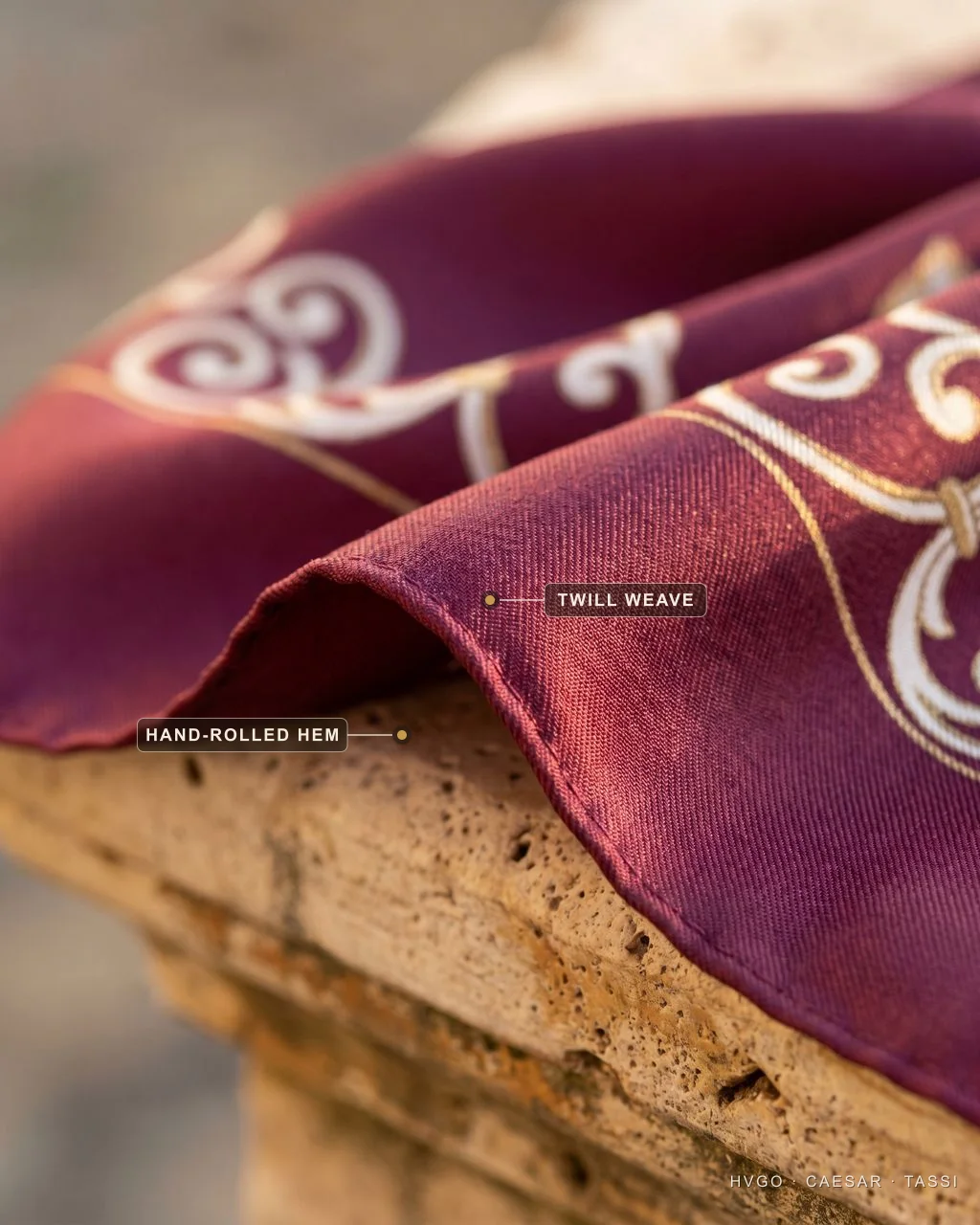
- Twill weave — the fine diagonal twill of woven silk catches light with a soft sheen; the white-vinegar rinse re-acidifies it so that sheen returns
- Hand-rolled hem — the edge rolled and stitched by hand on the true bias is why these squares must dry flat and store rolled, never hung wet or taut
#The silk squares in the house
One cold-wash, dry-flat, store-rolled routine fits all four house squares:
| Scarf | Print and finish | Care notes |
|---|---|---|
| Carina | Glossy silk square | Cold hand-wash, vinegar rinse to revive the gloss |
| Palmyra | Twill silk square | Heavier twill, most water-tolerant; dry flat |
| Tessera | Paisley silk square | Dense print, test the darkest motif first |
| Vesta | Versatile silk square | Roll-store to keep the everyday hem true |
The routine never changes; only print density and ground color shift how cautious the colorfastness test should be. The same hand-finishing runs through the wider accessories range.
#Your silk scarf care routine at a glance
Colorfast-test, cold-wash with one drop of soap, vinegar-rinse, towel-roll and dry flat, then store rolled in breathable dark. Keep this near the basin.
| Do | Don't |
|---|---|
| Hidden-corner test before any wash | Wash a print that lifts dye onto a cloth |
| Cold water and one drop of gentle soap | Hot water, bleach or enzyme detergent |
| Final rinse with one tablespoon vinegar per liter | Skip the acid rinse and leave silk dull |
| Roll in a towel, then dry flat in shade | Wring, twist or hang the scarf wet |
| Iron cool on the reverse through a cloth | Press a hot plate on the print or hem |
| Store rolled or loosely folded in fabric | Hang taut by a corner or seal in plastic |
Leather and silk care share one principle: gentle, fiber-matched cleaning beats aggressive cleaning, as the leather bag care routine shows. Follow the table and a scarf outlives the trend that sold it.
#Frequently asked questions
Can you machine-wash a silk scarf?
Machine-washing a silk scarf is risky and best avoided. Where the label permits it, use a mesh bag on a cold delicate cycle with a silk-safe detergent and no spin. A two-minute cold hand-wash stays safer for any printed foulard.
Does a silk scarf need dry cleaning?
A silk scarf needs dry cleaning only when the label demands it, the dye runs, or the stain is oily or set. Otherwise colorfast silk hand-washes at home. Tell the cleaner it is silk with a hand-rolled hem so they press it correctly.
Will a silk scarf shrink if I wash it?
A silk scarf can shrink and pucker in hot water or under agitation, but not in careful cold-water washing. Use cold water with no rubbing or wringing, then dry it flat, and a twill scarf holds its shape.
How do I get wrinkles out of a silk scarf without an iron?
Removing wrinkles without an iron means steam, not heat-and-pressure. Hang the scarf and pass a handheld steamer a few inches away, or leave it in a steamy bathroom. Let it cool and dry before folding. If the iron is your only option, use the silk setting on the reverse through a cloth.
Why has my silk scarf lost its shine or feels stiff?
A silk scarf loses its shine and turns stiff when alkaline detergent or hard water raises its pH. A final rinse of one tablespoon of white vinegar per liter of cold water re-acidifies the fiber and brings back the sheen.
Should I hang or fold a silk scarf for storage?
Folding or rolling a silk scarf beats hanging it for storage. Roll it around acid-free tissue or fold it loosely along existing lines. Never hang a square taut by one corner, which stretches the bias and warps the hand-rolled hem.
You can now keep a silk scarf saturated and crease-free for years. Explore the house's hand-rolled silk squares in the house silk squares collection, led by the Palmyra twill square.
More Care & Fabrics guides
How to Clean, Condition and Store a Leather Bag So It Ages Beautifully
The atelier's gentle routine to clean, condition and store a leather bag, plus the conditioning cadence that builds a patina and stops cowhide cracking.
Care for a leather bagHow to Wash a Chiffon Dress at Home (Plus Satin and Crepe) Without Ruining It
The atelier's safe way to wash, refresh and steam chiffon, satin and crepe at home — plus the fiber test that decides hand-wash vs. dry clean.
Wash chiffon, satin & crepe safelyHow to Care for Pleated Chiffon Without Losing the Pleats
Wash, dry, store and travel with pleated chiffon without flattening the pleats — the atelier's heat-set method, hand-wash steps and a pleat-revival fix.
Keep the pleats knife-sharpHow to Pack a Dress Without Wrinkles
The atelier's fabric-by-fabric method to pack a dress wrinkle-free: roll chiffon in tissue, fold crepe on its seams, plus a 10-minute arrival revival.
Pack a dress wrinkle-freeHow to Remove Stains From a Dress
The atelier's fabric-safe way to remove wine, makeup, sweat, deodorant and oil stains from a delicate dress — blot, don't rub, and know when to stop.
Rescue a stained dressHow to Store Occasion Dresses So They Stay Ready to Wear
Store occasion dresses with no creases, sagging or yellowing: the atelier's fabric-weight hang-or-fold rule, acid-free tissue method and moth-proof plan.
Store gowns the right way