How to Wash a Chiffon Dress at Home (Plus Satin and Crepe) Without Ruining It
The atelier's safe way to wash, refresh and steam chiffon, satin and crepe at home — plus the fiber test that decides hand-wash vs. dry clean.
On this page
A chiffon dress almost never belongs in the washing machine, and the spin cycle is exactly how chiffon snags, satin watermarks and crepe loses its shape. One fact decides everything: the fiber. Silk chiffon wants a cold hand-wash, polyester chiffon tolerates a gentle cycle, and most days the right answer is no wash at all.

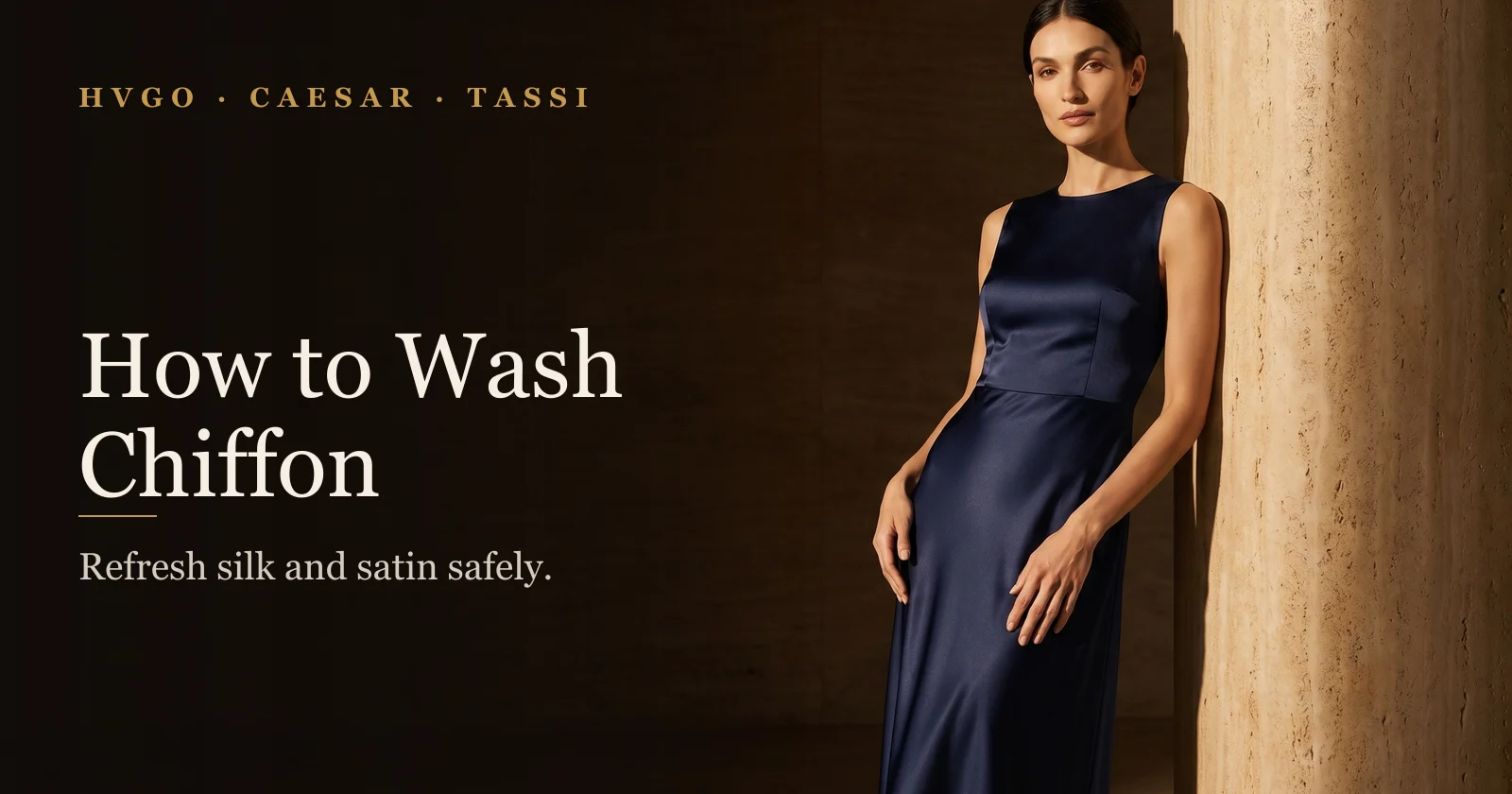
- Lined bodice — the fully lined, fitted bodice is what makes satin hang true, and why heavy lining is never submerged.
- Satin sheen — the reflective bias-cut surface shows water rings readily, so it must dry evenly in shade to avoid a watermark.
The safe-wash sequence
Five moves, in order — most evenings you stop at step one.
- Refresh before you wash A gown worn over a slip collects perfume and warmth, not grime. Air it overnight, mist the lining with 1:1 vodka-and-water, then steam — and skip washing entirely.
- Identify the fiber first Read the fiber tag. Silk chiffon feels warm and dry; polyester is cooler and slicker. Only the fiber decides: silk takes a cold hand-wash, polyester a 30°C delicate cycle.
- Hand-wash cool and gentle Fill a basin with cool water, add a few drops of pH-neutral detergent, submerge and swish three to five minutes. No rubbing, scrubbing or wringing — friction frays the sheer weave.
- Press dry flat, never wring Press the water out between two clean towels, then dry flat or over a wide padded hanger, away from heat and sun. Even drying is what stops a watermark ring forming.
- Steam, never iron Hang the dress and hold a vertical steamer a few inches off the cloth. Rising heat relaxes the weave without scorching silk or glazing satin. Steam satin from the inside.
- Never machine-wash silk chiffon, or anything beaded, boned or lined.
- Never wring or hang a chiffon, satin or crepe dress to dry wet — the bias stretches and rings.
- Never spray perfume on the face of the fabric; the oils stain silk permanently.
#Before you wash a chiffon dress: wash, refresh, or dry-clean?
Most occasion dresses worn for an evening need refreshing, not washing, so check the label and the soil level before any water touches the cloth. A gown that spent four hours over a slip collects perfume and a little body warmth, not grime. The Hugo Caesar Tassi atelier sorts every dress into one of three verbs first: refresh, hand-wash, or dry-clean. That decision, made before the sink, prevents the damage no rinse can undo.
Take the wine-stained exception. A red splash down the front of a Cipria (pink) chiffon midi skips the refresh route entirely and goes straight to spot-treatment or a specialist, because a set dye stain will not air out.
#Read the care label and the fiber content first
The sewn-in care label and the fiber-content tag are your first stop, since the symbols and percentages tell you what the fabric can survive. A wash-tub symbol with a hand means hand-wash only; a plain circle means dry-clean; a crossed-out tub means keep it dry entirely. Read the percentage tag beside it: "100% silk" and "100% polyester" lead to opposite methods.
Watch the wording, too. "Dry clean only" is a hard instruction tied to construction or dye, whereas "dry clean recommended" leaves room for a careful cold hand-wash when you know the fiber. When in doubt, the more cautious symbol wins.
#Most chiffon dresses need refreshing, not washing
A chiffon dress worn briefly over other layers is rarely dirty, and over-washing causes more premature wear than wearing ever does. Each wash agitates the fine weave, fades the dye and weakens seam threads. Airing and steaming restore freshness without that toll.
The refresh-first principle has a clear limit. Visible soil, sweat odor that survives a night of airing, or a spilled drink overrides it. Then you move to a wash or the cleaner, matched to the fiber.
#The fiber test that decides how to wash a chiffon dress (silk vs. polyester)
Identifying the fiber, not reading the label's hedged advice, is what splits cold hand-wash from a gentle machine cycle. Silk chiffon and polyester chiffon look near-identical on the hanger yet demand different water, different temperatures and different drying. Get the fiber right and every later step follows automatically.
The atelier runs this identification before any unlabeled dress meets water, because guessing wrong on a vintage silk piece ruins it on the first attempt.
#How to tell silk chiffon from polyester chiffon
Check the fiber tag first, and only when a dress is unlabeled do you test a tiny snip from the hidden seam allowance with the burn-and-feel method. Snip a few threads from inside the seam, hold them with tweezers over a sink, and watch how they react to a flame. The two fibers behave in opposite ways:
- Silk: smolders slowly, curls away from the flame, and leaves a brittle, crushable ash.
- Silk smell: burnt hair or feathers, since silk is a protein fiber.
- Polyester: shrinks from the flame, then melts into a hard plastic bead.
- Polyester smell: sweet and chemical, like melting plastic.
Touch tells you more before you ever light a thread. Silk chiffon feels warm and slightly dry to the hand and stays cool only for a moment, whereas polyester chiffon feels cooler, slicker and springs back faster when crushed. One counter-case: a silk-poly blend smells of both and beads unevenly, so treat any blend as the more delicate of its two fibers and hand-wash cold.
#Why the answer changes everything
Silk chiffon takes a cold hand-wash or the dry cleaner and never the machine, while polyester chiffon handles a 30°C/86°F delicate cycle in a mesh bag. Silk is a protein that loses strength wet and watermarks where minerals dry unevenly. Polyester is a synthetic that shrugs off cool water and mild agitation.
This single fork drives the whole guide. A labeled "100% polyester" georgette midi can go in the machine on the gentlest setting; an unlabeled silk-feeling gown gets the sink. The fabric guide on chiffon and satin explains how each weave is built, which is why the two fibers behave so differently in water.
#How to wash a chiffon dress by hand, step by step
Hand-washing chiffon means cool water, a few drops of pH-neutral detergent, three to five minutes of gentle swishing, and no rubbing or twisting. The goal is to lift soil by dilution, not by friction, because friction is what frays the sheer weave. Work in a clean sink or basin large enough for the dress to move freely.
A beaded silk gown is the exception that cancels this whole routine. Beading, boning and heavy lining never get submerged, even when the base fabric is washable.
#The cold-water hand-wash routine
Fill a basin with lukewarm-to-cool water, add a few drops of delicate detergent, submerge the dress, and swish gently for three to five minutes. Follow these steps in order:
- Fill a clean basin with cool water, no warmer than 30°C/86°F.
- Add a few drops of pH-neutral or no-rinse delicate detergent, never regular powder.
- Submerge the whole dress and swish slowly for three to five minutes.
- Skip all rubbing, scrubbing and wringing, which abrade and distort the weave.
- Rinse in fresh cool water, refreshing it until the suds run clear.
One drop too many of detergent leaves a residue that dulls chiffon, so err light. If the water discolors during the first rinse, the dye is bleeding, so stop, rinse fast in cold water, and dry flat away from other garments.
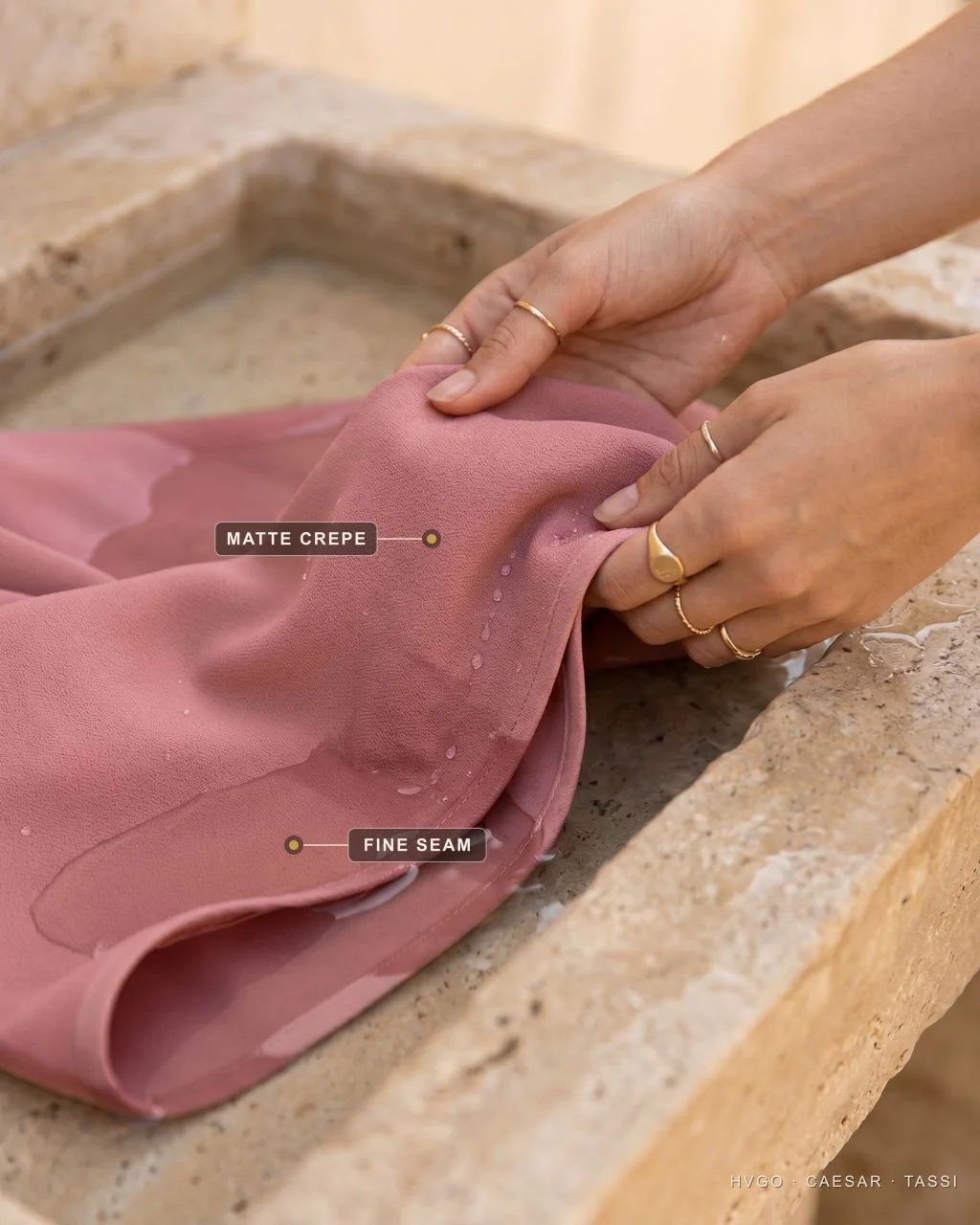
- Matte crepe — the high-twist matte weave collapses with heat and agitation, so it gets only cool water and gentle handling.
- Fine seam — the bias seams and lined edge stay supported, never wrung, so the cut keeps its shape as it dries.
#How to dry chiffon without watermarks or stretch
Never wring a chiffon dress; press the water out flat between two clean towels, then dry it flat or over a padded hanger away from heat and sun. Wringing stretches the bias and sets creases the steamer then has to fight. Even drying is what stops a watermark forming.
Silk watermarks because dissolved minerals migrate to wherever the fabric dries last and deposit a faint ring. Dry the whole dress evenly, flat on a towel or supported on a wide padded hanger, and no ring can form. Direct radiator heat is the counter-case to avoid, since it dries the edges first and rings the center.
#When a polyester chiffon dress can go in the machine
A sturdy, unlined polyester chiffon dress can take a delicate cycle in cold water inside a mesh bag, with mild detergent, no softener and the lowest spin. Zip the dress into a mesh wash bag so it cannot snag on the drum, then air-dry it.
Some synthetic dresses still stay out of the machine. Anything beaded, lined, structured or boned is hand-washed or dry-cleaned regardless of fiber, because the drum stresses the join between trim and cloth even on a gentle cycle.
#How to wash a satin dress at home without watermarking it
Wash a satin dress in cool water with minimal agitation, supporting its wet weight so the seams never pull, then dry it flat in shade. Satin's smooth face shows water rings far more readily than chiffon, so even, supported drying matters even more here. The fiber under the sheen, not the sheen itself, sets the method.
A Calpurnia-style fishtail satin gown with a long train is the edge case: its weight when wet can tear a shoulder seam if you lift it by the straps, so cradle the whole garment in both hands.
#Silk satin vs. polyester satin
Silk satin leans dry-clean and watermarks at the slightest uneven drying, whereas polyester or acetate satin forgives a careful cool hand-wash. Run the same burn-and-feel test you used on chiffon, because the glossy finish hides the fiber completely. The sheen looks the same on both; only the fiber decides.
Acetate is the trap. It feels silk-like and crisp but reacts badly to alcohol and to heat, so an acetate satin gown skips both the vodka refresh spray and any direct iron, and goes to a cleaner instead.
#The gentle satin hand-wash and the no-wring rule
Use cool water, a delicate detergent and the gentlest movement, and never wring satin, because uneven drying leaves rings on its reflective surface. Support the wet weight from underneath so the bias-cut seams do not stretch. Press the moisture out between towels exactly as with chiffon.
Dry satin flat, in shade, on a clean towel. Sunlight yellows white and ivory satin and weakens silk; a draped-over-a-line dry pulls the fabric out of true and prints a hard crease where it folds over the rail.
#How to wash a crepe dress and keep its matte structure
Wash crepe only in cool water with gentle handling, then reshape it damp and dry it flat to protect the matte, structured hand. Crepe's crinkled, high-twist weave is exactly what heat and agitation destroy. The texture that gives a Tullia (pleated crepe column) its body is also its vulnerability.
#Why crepe shrinks and loses its hand if washed hot
Heat and rough agitation relax crepe's high-twist yarns, so the crinkle collapses and the fabric shrinks and goes limp. The crepe weave holds its texture through tightly over-twisted threads; warm water lets that twist unwind. Cool water and slow handling keep the twist locked.
Reshape the dress while it is still damp, smoothing it to its original dimensions on a flat towel. A crepe dress hung wet is the counter-case: its own water weight drags it longer and thinner, and it dries that way.
#Spot-cleaning crepe between washes
Blot a fresh stain on crepe, never rub it, and test colorfastness on a hidden seam before treating any visible area. Rubbing pills the matte surface and pushes the stain deeper into the twist. Press a clean damp cloth onto the mark and lift.
Tackle every stain while fresh; a dried oil mark on matte crepe needs a specialist, because home blotting only spreads it. Dab a hidden seam allowance with your cleaning solution first and wait a minute to confirm the dye holds.
#Refreshing a chiffon dress between wears: airing, spritzing and removing odor without washing
Refresh a chiffon dress by airing it overnight, misting the inside with diluted vodka or white vinegar to neutralize odor, then steaming it. This is the route most evening dresses take, since they are tired rather than dirty. Refreshing keeps the dye and seams intact far longer than repeat washing.
The wine or makeup accident is where refreshing stops working and spot-treatment begins.
#Air it out and steam the freshness back in
Hang the dress in a ventilated room overnight, then lift any lingering odor with a light 1:1 vodka-and-water or diluted white-vinegar spritz before steaming. Alcohol and dilute acid both break down odor molecules and then evaporate clean, leaving no scent of their own.
Mist the lining and inside seams, never the face of the fabric, and never spray perfume onto chiffon. Perfume oils stain silk and leave a halo that does not air out, which is the exact thing you came to avoid.
#Spot-treating sweat, deodorant and makeup marks
Lift deodorant, sweat and makeup with dry blotting and targeted, color-safe treatment rather than soaking the whole dress. Address each mark by its type, because sweat, white deodorant and oily makeup respond to different handling:
| Mark | Where it sits | Safe lift |
|---|---|---|
| White deodorant streak | Underarm, inner side seam | Buff with a dry makeup sponge or color-safe wipe |
| Underarm sweat | Lining, not the face | Sponge the lining with cool water and a drop of detergent |
| Makeup at neckline | Bust and shoulder edge | Lift gently with a damp cloth, blot outward |
| Perfume / alcohol stain | Where sprayed on silk | Blot fast with cool water; set marks need a cleaner |
A long-set deodorant build-up is the counter-case: once it has crusted into the weave over several wears, dry buffing fails and the piece needs a gentle hand-wash or a specialist.
#How to steam (never iron) chiffon to lift wrinkles without scorching
Steam chiffon vertically with the steamer head held a few inches off the cloth, so rising heat relaxes the weave without melting or glazing it. An iron's plate makes direct contact, and direct contact scorches silk, glazes satin and flattens chiffon's loft. Steam works at a distance, which is precisely why it is safe.
#Steaming chiffon, then satin and crepe, the safe way
Hang the dress, hold a vertical steamer a few inches from the fabric, and let steam fall through chiffon, then satin, then crepe before the dress cools on the hanger. Move top to bottom in slow passes and keep the head off the cloth.
Treat each fabric to its own quirk. Steam satin from the inside so condensation never spots the reflective face; give crepe a touch longer for the twist to relax; let any dress hang and cool fully before wearing, since warm fabric creases again instantly. Beaded sections are the exception, since trapped steam loosens adhesive on glued beads, so steam around them.
#If you must press chiffon: lowest heat and a pressing cloth
Press chiffon only on the coolest setting, through a clean pressing cloth, with no steam burst and never directly on beading or sequins. The pressing cloth puts a barrier between the hot plate and the sheer weave so the fibers never touch metal.
Keep the iron moving and skip the steam shot entirely on silk chiffon, since a concentrated burst watermarks it on contact. A sequined panel is the hard stop: heat melts and clouds the plastic, so steam those areas instead, or leave them.
#When a chiffon, satin or crepe dress belongs at the dry cleaner, not the sink
Send beaded, boned, structured or heavily lined gowns, deep-set or oily stains, and anything labeled dry-clean-only straight to a specialist. The sink cannot reach an oil stain or protect a boned bodice, and the wrong solvent sets a dye stain forever. Knowing which dresses to hand off is as important as knowing how to wash the rest.
#Dresses that should go to a specialist, not the sink
Dresses with construction or stains beyond home methods need a professional, and you should point out both the stain and the fiber when you drop them off. Tell the cleaner what caused the mark and what the fabric is, so they choose the right solvent. The following all skip the sink:
- Beaded or sequined gowns, where water and agitation loosen the trim.
- Boned or structured bodices, which lose their shape soaked and reshaped wrongly.
- Heavily lined column gowns, where the lining and shell dry at different rates.
- Oil-based or set-in stains, which home blotting only spreads.
#How often, and choosing an eco-friendly cleaner
Clean an evening gown only when it is truly soiled, usually no more than once a season, and ask your cleaner about gentler solvents. Each professional clean uses solvent that, over many cycles, dries out delicate fibers, so frequency is the enemy.
Ask whether the cleaner offers liquid-CO2 or professional wet-cleaning instead of perchloroethylene, the solvent behind the dry-clean "P" symbol. Both gentler methods clean delicate silk without the harsh solvent residue. Remove the plastic bag the moment you get home, since trapped solvent fumes and condensation both harm the fabric over time.
#How Hugo Caesar Tassi builds dresses for easy care
The Hugo Caesar Tassi atelier assigns every house fabric a default care verb and finishes seams and linings to survive gentle home care. Each dress is designed to be refreshed or hand-washed where possible, so the cleaner is the exception rather than the rule. Construction choices, made in the Roma atelier, are what make that possible.
#The atelier's fabric-to-care map
Each Hugo Caesar Tassi fabric maps to one default care verb, so a single glance tells you whether to refresh, hand-wash or dry-clean. The house recycled chiffon, bias-cut satin and matte structured crepe each behave predictably, and the linings are cut to dry at the same rate as the shell:
| House fabric | Build | Default care verb |
|---|---|---|
| Recycled chiffon | Knife-pleated or bias-cut, fully lined | Refresh first, then cold hand-wash |
| Bias-cut satin | Bias-cut, concealed zip, lined | Gentle hand-wash or dry-clean, steam inside-out |
| Matte crepe | Structured, modal-blend lining | Cool hand-wash, reshape damp |
| Modal column | Fluid drape, fully lined | Cold hand-wash, dry flat |
A heavily beaded special order is the exception the map does not cover, and those pieces ship with a dry-clean-only instruction.
#Pieces and the care they ask for
Each named Hugo Caesar Tassi piece carries its own routine, set by its fabric and its construction. The Livilla floral-print chiffon midi and the Aemilia A-line chiffon maxi both take a cold hand-wash and a flat dry. The Calpurnia fishtail satin gown and the Flavia strapless satin gown take a gentle hand-wash or dry-clean and steam from the inside.
Pleated styles are the case that needs its own method, since reshaping pleats wet is a skill of its own. The pleated chiffon care guide walks through holding a knife-pleat through washing and drying, and the pleated chiffon journal shows the routine on a finished gown.
#Your chiffon-dress washing routine at a glance
Refresh first, wash only by the fiber rule, steam rather than iron, and store correctly, and a chiffon, satin or crepe dress lasts for years. This is the whole decision in one sequence, fabric by fabric. Run it in order and you rarely reach the wash step at all.
The full sequence moves: refresh between wears, identify the fiber before any wash, hand-wash silk and machine only sturdy polyester, dry flat to dodge watermarks, steam instead of iron, then store. From here, the broader garment care hub covers belts, bags and knits, while the dress storage guide takes over once the dress is clean and dry.
#Frequently asked questions
Can you hand wash a polyester chiffon dress?
You can hand wash a polyester chiffon dress, and it also takes a 30°C/86°F delicate machine cycle in a mesh bag with mild detergent. Skip fabric softener entirely, never wring it, and air-dry it away from direct heat. The only synthetic pieces that stay out of water are beaded, boned or heavily structured ones.
How often should you wash a chiffon dress?
You should wash a chiffon dress as rarely as possible, usually no more than once a season. A dress worn for a few hours over a slip just needs airing and steaming. Wash or dry-clean only when it is visibly soiled or smells after a night of airing.
How do you get the sweat smell out of a chiffon dress without washing it?
You get the sweat smell out of a chiffon dress by airing it overnight, then misting the inside with a 1:1 vodka-and-water or diluted white-vinegar spray. Steam it afterward to finish. Never spray perfume directly onto the fabric, since the oils stain silk and the scent does not air out.
Will a silk dress get watermarks if I hand wash it?
A silk dress can get watermarks if it dries unevenly, but careful drying prevents them. Wash and rinse fully in cool water, press the moisture out between towels rather than wringing, then dry the whole dress flat and evenly so no ring forms. Delicate or vintage silk is safer at the cleaner.
Can I iron a chiffon or satin dress?
You should avoid ironing a chiffon or satin dress, because direct heat scorches chiffon and glazes satin. Use a vertical steamer held a few inches off the cloth instead. If you must press, use the coolest setting with a pressing cloth, and steam satin from the inside to protect its sheen.
Is it safe to machine wash a chiffon dress?
It is safe to machine wash only sturdy, unstructured, unlined polyester chiffon, on a cold delicate cycle inside a mesh bag. Silk chiffon loses strength wet and watermarks, so it needs a hand-wash. Beaded, boned or lined gowns belong at the dry cleaner whatever their fiber.
Now you can wash a chiffon dress, and its satin and crepe cousins, without fear. Explore the easy-care chiffon gowns in the chiffon dress edit, reach for an evening piece from the satin dresses, or browse the wider occasion dress collection.
More Care & Fabrics guides
How to Clean, Condition and Store a Leather Bag So It Ages Beautifully
The atelier's gentle routine to clean, condition and store a leather bag, plus the conditioning cadence that builds a patina and stops cowhide cracking.
Care for a leather bagHow to Wash, Store and Revive a Silk Scarf Without Losing Its Color or Sheen
Wash, de-crease, dry and store a silk scarf without dulling the color or warping the hem — the atelier's cold-water method and white-vinegar acid rinse.
Wash silk the right wayHow to Care for Pleated Chiffon Without Losing the Pleats
Wash, dry, store and travel with pleated chiffon without flattening the pleats — the atelier's heat-set method, hand-wash steps and a pleat-revival fix.
Keep the pleats knife-sharpHow to Pack a Dress Without Wrinkles
The atelier's fabric-by-fabric method to pack a dress wrinkle-free: roll chiffon in tissue, fold crepe on its seams, plus a 10-minute arrival revival.
Pack a dress wrinkle-freeHow to Remove Stains From a Dress
The atelier's fabric-safe way to remove wine, makeup, sweat, deodorant and oil stains from a delicate dress — blot, don't rub, and know when to stop.
Rescue a stained dressHow to Store Occasion Dresses So They Stay Ready to Wear
Store occasion dresses with no creases, sagging or yellowing: the atelier's fabric-weight hang-or-fold rule, acid-free tissue method and moth-proof plan.
Store gowns the right way