How to Care for Pleated Chiffon Without Losing the Pleats
Wash, dry, store and travel with pleated chiffon without flattening the pleats — the atelier's heat-set method, hand-wash steps and a pleat-revival fix.

On this page
Care for pleated chiffon by cold hand-washing it, then drip-drying it vertically from a padded hanger so gravity re-tensions each fold. Never tumble-dry, wring, or iron it. The pleat survives because it was heat-set at the atelier, not pressed in at home. This guide covers washing, drying, storing, and traveling.
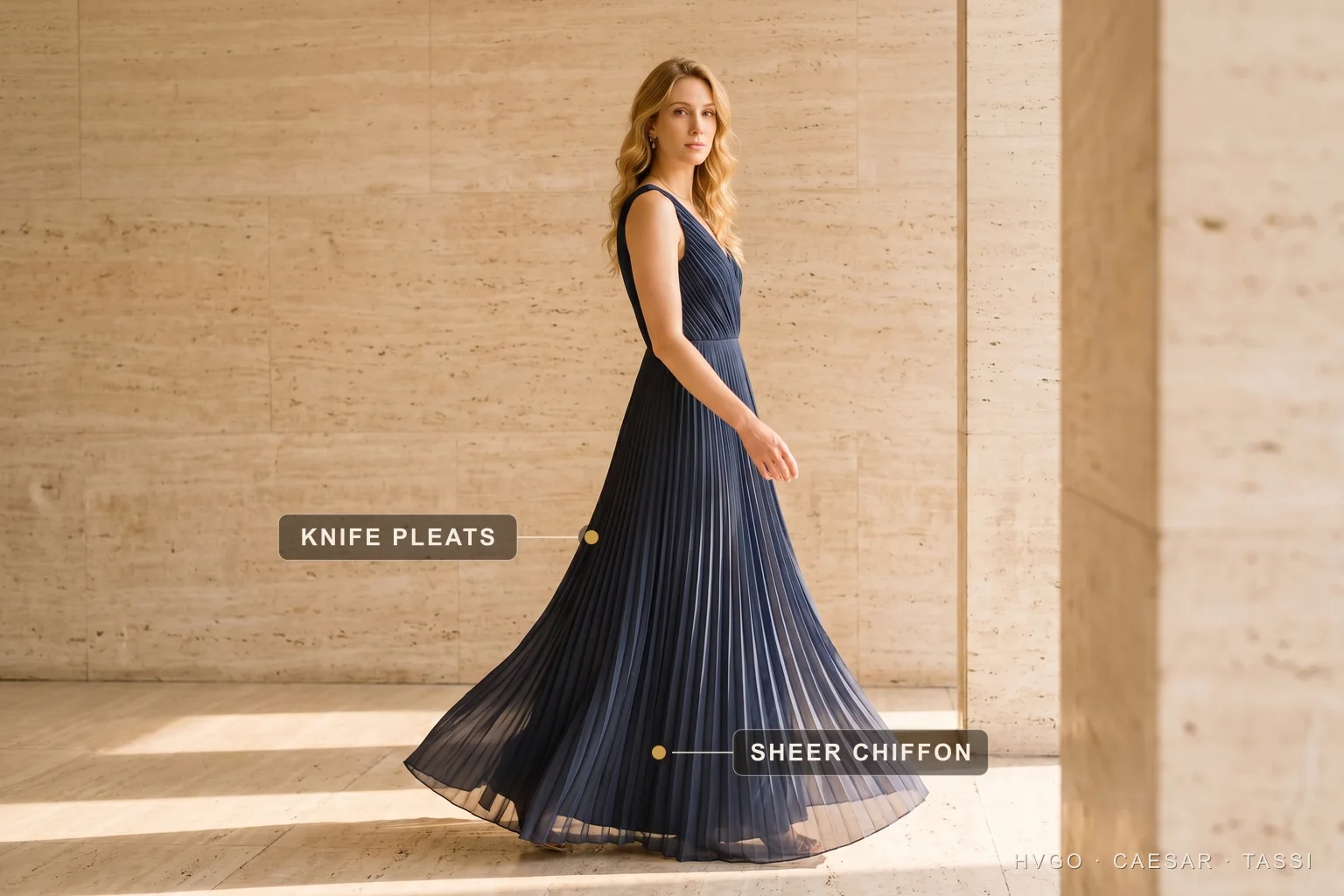
- Knife pleats — sharp, narrow folds all facing one direction, the line that reads as movement
- Sheer chiffon — the fine translucent weave that glows where light passes through the lower hem
The pleat-safe wash & dry
Five gentle moves that let water clean a heat-set chiffon pleat while gravity keeps the fold.
- Wash cold, by hand Dissolve a teaspoon of pH-neutral detergent in cold water (at or below 86°F), lower the dress in flat, and swish thirty seconds with the pleat direction. Water never harms a polyester pleat; heat, agitation and wringing do.
- Rinse and gather, never wring Rinse in fresh cold water until clear, then cup both hands under the whole garment and squeeze gently along the pleat line. Wringing twists folds against each other and breaks the set.
- Drip-dry vertically by the shoulders Hang the wet dress from a broad padded hanger by the shoulder seams in shade, away from sun and radiators. Its own wet weight re-tensions every fold as it dries — gravity does the work an iron cannot.
- Steam, never press For travel creases, hold a handheld steamer two to three inches off the fabric and move top-to-bottom with the folds, letting each section cool before you move on. Pressing the plate flat flattens the pleat you are reviving.
- Hang to store, never fold Keep the dress on a broad or clip hanger inside a cotton or breathable cover, with an inch of air on each side. Folding sets a permanent cross-crease that no steam fully removes.
- Never tumble-dry — heat bakes in random creases and relaxes the original set, usually beyond home repair.
- Never iron or lay flat — a hot plate exceeds the fiber's set point and glazes polyester; flat drying presses creases across the fold.
- Never seal in plastic — it traps moisture, breeds mildew and yellows the dye over a season.
#Why pleated chiffon needs its own care method
Pleated chiffon holds its fold through a permanent heat-set, so the usual wash-and-press routine erases the one detail you bought it for. A standard dress tolerates an iron; a pleated chiffon gown does not. The repeating knife-edge that catches light as you move is fixed into the fiber under pressure and temperature, and any heat above that set point relaxes it back toward flat. Treat the fold as the fragile part, and every care decision follows from there.
Hugo Caesar Tassi (women's luxury occasionwear house, designed in Roma, founded 2004) builds its chiffon from a recycled polyester chiffon, knife-pleated or bias-cut. That fiber choice is the reason the care method works at all.
#Heat-set pleats vs hand-pressed folds
Heat-set pleats are baked into the fiber under tension, whereas a hand-pressed crease is only a temporary deformation that the next wash relaxes. The atelier clamps the chiffon between pleating boards, applies heat near 180°C, and lets the fiber cool locked in that shape. The fold becomes the fiber's new resting form.
This durability cuts both ways. A heat-set pleat survives gentle washing far better than a pressed one, yet you cannot recreate it at home, because a household iron cannot apply even pressure across hundreds of folds at the correct temperature. The Julia French-pleated maxi keeps its line through repeated wears for that reason. The edge case: once a heat-set pleat is genuinely cooked out by a tumble dryer, no home tool restores it.
#Polyester vs silk chiffon and why it matters
Polyester chiffon is thermoplastic, so it holds heat-set pleats permanently and tolerates cool water; silk chiffon pleats are far more fragile and usually prefer dry cleaning. Thermoplastic means the fiber softens and re-forms with heat, then locks that shape when cool. That property is exactly what makes a permanent pleat possible.
You can tell which fiber you own from the care label's content line. A label reading 100% polyester signals a heat-set pleat that handles a careful cold hand-wash. A silk or silk-blend label means the pleat was set by a more delicate process and may not survive water at all. When the label and this guide disagree, follow the label.
#Knife, accordion and sunray pleats
Chiffon dresses carry three common pleat types, and knowing yours tells you which direction to support the fold. Each is heat-set, each flattens under the same enemies, and each re-tensions the same way when you dry it hanging.
- Knife pleats: sharp, narrow folds all facing one direction, the crisp line on the Claudia pleated-slit gown.
- Accordion pleats: even zig-zag folds of equal width that expand and collapse like a bellows.
- Sunray pleats: folds that fan from narrow at the waist to wide at the hem, common on circle skirts.
- Box pleats: paired folds turned away from each other, flatter and broader than knife pleats.
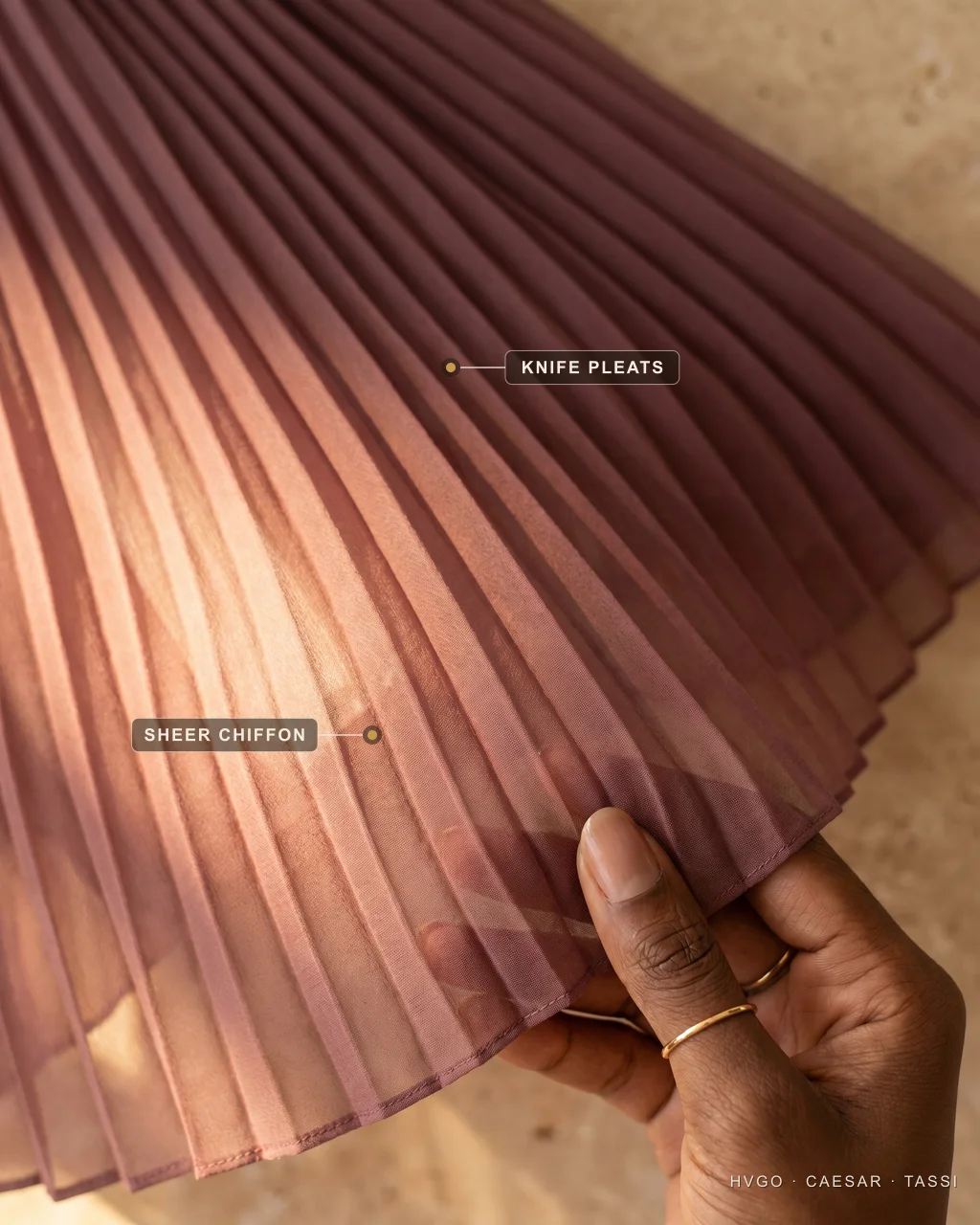
- Knife pleats — crisp narrow folds all turned the same way, the heat-set line you must never iron flat
- Sheer chiffon — the fine translucent fabric you can see through between the folds
#How to read a pleated chiffon care label before you do anything
The sewn-in instructions override every general rule here and tell you whether water is even safe to use. That tag is a legal disclosure of what the maker actually tested. Five symbols decide your method: the wash tub, the hand symbol, the iron, the tumble-dry circle, and the dry-clean circle.
A worked example: a label showing a hand in a tub plus a crossed-out iron plus a crossed-out tumble symbol means hand-wash cold, never iron, never machine-dry. That is the standard profile for a heat-set polyester pleat. The counter-case is a plain circle with no bar, which permits any solvent and signals a garment the maker expects you to clean professionally.
#Decoding the symbols
Five laundry symbols carry every instruction a pleated chiffon label gives, and a bar or cross under any symbol is a prohibition. Learn the cluster once and you can decode any dress in seconds.
| Symbol | What it shows | What to do with pleated chiffon |
|---|---|---|
| Wash tub with a hand | Hand-wash only | Wash cold by hand; skip the machine |
| Triangle, crossed out | Do not bleach | Use a gentle, bleach-free detergent |
| Square with a circle, crossed out | Do not tumble-dry | Drip-dry vertically instead |
| Iron, crossed out | Do not iron | Steam vertically, never press |
| Circle with P or F | Dry-clean, solvent type | Take to a cleaner; say no pressing |
#When the label says "dry clean only"
A dry-clean-only label means professional solvent cleaning is the safest route, and you should warn the cleaner that the pleats are permanent. Solvent cleaning uses perchloroethylene or a hydrocarbon rather than water, which protects fibers that water would distort, such as silk chiffon.
Tell the cleaner one sentence: permanent pleats, no pressing. The risk is a well-meaning presser who runs a hot finishing iron over the dress and flattens the fold in a single pass. Ask them to steam-finish on the hanger instead. For the full fabric background, the house keeps a guide on chiffon and crepe fabrics you can read before your first clean.
#How to hand-wash pleated chiffon so the pleats survive (step by step)
Hand-wash pleated chiffon in cold water with a pH-neutral detergent, supporting the wet weight the whole time so it never drags the folds open. Water itself does not harm a heat-set polyester pleat; agitation, heat, and wringing do. Remove those three and washing becomes routine.
#What you need
Four items cover a safe hand-wash, and none of them involves heat or harsh chemistry. Gather everything before you wet the dress so you are never holding a sodden gown one-handed.
- Cold or cool water: at or below 86°F, never warm.
- A pH-neutral or delicate detergent: no bleach, no enzyme or optical-brightener formula that can dull color.
- A clean basin or stoppered sink: large enough to submerge the dress flat.
- A mesh garment bag: optional support for lifting the wet weight evenly.
#The wash, step by step
Wash in five gentle moves: fill, dissolve, submerge, swish, and soak — with no scrubbing at any point. Each step protects the fold by keeping the fabric calm in still water.
- Fill the basin with cold water and dissolve a teaspoon of gentle detergent fully before the dress goes in.
- Lower the dress in flat and let it sink rather than pushing it under.
- Swish slowly by hand for thirty seconds, moving with the pleat direction, never across it.
- Soak five to ten minutes to lift body oils and light soil.
- Drain the basin without lifting the dress yet, so the water leaves before the weight does.
The mistake to avoid: twisting or scrubbing a stained patch. Friction across knife pleats opens them permanently, so dab a stain instead, as the spot-cleaning section below describes.
#Rinsing without disturbing the fold
Rinse in fresh cold water until it runs clear, then press the water out by gathering the fabric rather than wringing it. Wet chiffon weighs several times its dry weight, and that load is what pulls a vertical pleat flat if you let the dress hang from one corner.
Lift with both hands cupped under the whole garment, or lift it inside the mesh bag so the support is even. Gather the dress into a loose bundle and squeeze gently along the pleat line. Whereas wringing twists folds against each other and breaks the set, gathering presses water out while keeping every fold parallel.
#Spot-cleaning between wears
Spot-clean deodorant marks and perspiration by dabbing a damp cloth on the spot, never rubbing, so a single stain does not cost you a full wash. Most occasion wear needs cleaning far less often than daily clothes, and over-washing ages fabric faster than careful spot work.
For a deodorant smudge, press a slightly damp microfiber cloth onto the mark and lift; repeat with a clean section. For light creasing rather than a stain, a few seconds of vertical steam relaxes the wrinkle without touching water at all. If a stain has set into the weave, move to a full cold hand-wash rather than scrubbing harder.
#Why you must never tumble-dry or iron pleated chiffon
Heat is the single thing that destroys a heat-set pleat, so the dryer and the iron are both off-limits for chiffon. A pleat is held by the fiber's memory of one temperature; exceed it and the memory resets toward flat. The damage is usually irreversible at home.
#Heat is the enemy of the pleat
No, you cannot iron pleated chiffon, because a hot iron exceeds the fiber's set temperature and relaxes the fold while it scorches the surface. Polyester also shines or melts under a dry iron, leaving a glazed patch that no cleaning removes.
The mechanism is direct: above the glass-transition temperature the fiber softens, and any pressure then flattens what the atelier locked in. A wedding guest who presses a travel crease out of her Julia maxi with a hotel iron typically erases a hand-span of pleats in one stroke. The fix she needed was steam, covered next.
#The tumble dryer trap
A tumble dryer crushes and randomizes the fold while its heat bakes in fresh creases, which is why drip-drying is non-negotiable. Tumbling tangles the dress around itself, presses folds in arbitrary directions, and adds static that attracts lint to the chiffon.
High heat compounds the damage by relaxing the original set at the same time. The result is a dress that comes out smaller in feel, fuzzed with static, and stamped with creases running against the pleat line. Air, not a machine, dries this fabric.
#Steam instead, and how
Steam is the only safe heat for pleated chiffon: hold a vertical handheld steamer a few inches off the fabric and move with the pleats, never pressing. Steam relaxes a wrinkle without the crushing contact pressure of an iron, so the pleat re-sets as it cools.
Keep the steamer head two to three inches away and travel along the fold from top to bottom. Let the section dry before you move it, so the fold cools locked in place. Pressing the steamer plate flat against the fabric defeats the purpose and flattens the very folds you are reviving.
#How to dry pleated chiffon so gravity keeps the pleats
Dry pleated chiffon by hanging it vertically from the shoulders so the fabric's own wet weight pulls each fold straight as it dries. Gravity does the work an iron cannot. Chiffon is thin and dries within a couple of hours hung this way.
#Drip-dry vertically by the shoulders
Hang the wet dress from a broad padded hanger by the shoulder seams, letting it drip so vertical tension re-forms every pleat. The drying fiber takes the shape it is held in, and held vertically under its own weight, it sets straight folds.
Never lay a pleated dress flat to dry, which presses random creases across the fold, and never peg it by the hem, which drags the pleats sideways. The Claudia gown re-tensions cleanly on a padded hanger because the bias-cut chiffon hangs true. The exception worth noting: a very heavy beaded dress can over-stretch when hung wet, but a plain chiffon pleat is light enough that hanging only helps.
#Avoid water spotting and direct sun
Dry pleated chiffon in shade away from radiators, because uneven or forced heat leaves tide marks and direct sun fades the dye. Even, slow air-drying lets the whole panel release water at one rate, so no mineral ring forms where a wet edge dried last.
Keep the dress off a hot radiator, which is just a slower iron. Keep it out of a sunny window, which fades color over a single afternoon on rich tones like Porpora wine or Vermiglio red. A shaded indoor rail is ideal.
#How to store a pleated chiffon dress between wears and seasons
Store a pleated chiffon dress hanging in a breathable cover, never folded, so the vertical pleats stay tensioned and never crease across the fold. Storage damage is slow and silent, which makes it easy to ignore until the dress comes out marked.
#Hang, don't fold
Hang the dress on a broad or clip hanger so its weight keeps the pleats vertical; folding sets a permanent cross-crease across every fold. A fold pressed under the weight of other clothes for a season becomes a second, unwanted heat-set from ambient warmth and pressure.
Use a padded hanger for a shoulder-strap dress, or a clip hanger gripping the waistband for a strapless gown like the styles in the maxi dress range. Give the dress an inch of air on each side so neighboring garments do not compress the folds.
#The breathable garment bag
Cover a stored pleated dress in a cotton or breathable garment bag, never sealed plastic, which traps moisture and yellows the fabric over time. Plastic seals in humidity that breeds mildew and oxidizes dye to a yellow cast.
A breathable cover keeps dust off while letting the fabric exchange air. Store it in a cool, dark closet, and use cedar blocks rather than mothballs, whose oils can stain. Space hung dresses so no pleat is pinned flat against the next bag.
#Travel and packing
Pack pleated chiffon by rolling it loosely around tissue along the pleat line, or carry it in a hang-style suit bag, then steam out travel creases on arrival. Folding for a suitcase recreates the same cross-crease problem as folding for storage, only faster.
Lay tissue paper down the length of the dress, then roll from the hem so the folds curl together rather than crushing. On arrival, hang the dress in a steamy bathroom or pass a handheld steamer down it. The house keeps a dedicated dress packing guide for longer trips with multiple gowns.
#How to revive a flattened pleat in pleated chiffon at home
Revive a tired pleat with light vertical steam, then hang the dress immediately so gravity re-tensions the original fold as it cools and dries. A pleat that is relaxed but not destroyed often returns; a pleat baked flat in a dryer usually does not.
#The gravity-and-steam revival
Steam the slack section vertically, then hang it under its own weight at once, letting the cooling fiber re-set the fold you started with. The two forces work together: steam softens the fiber back toward pliable, and gravity supplies the tension the atelier originally used.
- Hang the dress on a padded hanger before you steam.
- Pass the steamer down the slack panel two inches off the fabric, moving with the pleats.
- Let the section hang undisturbed until fully dry, so it cools locked straight.
- Pinch a single stray fold back into line with cool fingers if one drifts.
#When to call the cleaner
Call a professional when the heat-set is genuinely lost, because re-pleating needs industrial boards and temperatures no home setup can match. A specialist re-pleater re-clamps the panel and heat-sets it again, the only real fix once the fiber memory is gone.
Set expectations honestly: a re-pleat works best on simple knife or accordion folds and may not perfectly match a complex sunray. If your dress only sags rather than failing, the steam-and-hang revival above is cheaper and usually enough. For broader routines, see the house occasion dress care guide.
#How Hugo Caesar Tassi heat-sets its pleated chiffon (and what that means for you)
Hugo Caesar Tassi heat-sets its pleats at roughly 180°C under tension, which is why they last for years and why you can never re-press them at home. That single fact rewrites the care logic: stop chasing the fold with heat, and start letting gravity do the re-tensioning.
#The atelier heat-set
The atelier fixes each pleat at about 180°C while the chiffon is clamped under tension, locking the fold into the fiber's permanent memory. Your kitchen iron tops out lower and cannot apply even pressure across the panel, so any home attempt flattens more than it sets.
The founder's rule follows directly: dry and store the dress vertically by the shoulders, and let the fabric's own weight re-tension every pleat. This is house practice spoken from the atelier floor, and it is the reason the dress care guides hub leads with vertical drying for every pleated piece.
#The pleated styles in the house
Three house gowns show the method in action: the Julia French-pleated maxi, the Claudia pleated-slit gown, and the Tullia pleated crepe column. Each is heat-set, so each follows the same cold-wash, vertical-dry routine.
The Julia and Claudia are recycled chiffon; the Tullia is a matte pleated crepe column. The same gravity-and-steam care applies to flowing chiffon pieces without permanent pleats, such as the Aemilia A-line maxi, which simply skips the pleat-tension step. The pleat reads differently across the house palette, sharper on a matte Basalt black than on a lighter Cipria pink.
#Your pleated chiffon care routine at a glance
Cold-wash or solvent-clean, never heat: that single rule drives every line in the checklist below. Keep the dress moving with its folds, never against them.
#Do / don't checklist
Seven paired rules separate a pleat that lasts from one that flattens. The prose above explains why; this table is the quick reference to keep by the closet.
| Do | Don't |
|---|---|
| Hand-wash in cold water | Wash warm or hot |
| Use a pH-neutral detergent | Use bleach or enzyme formulas |
| Gather and press water out | Wring or twist |
| Drip-dry vertically by the shoulders | Lay flat or peg by the hem |
| Steam vertically a few inches off | Iron or press the folds |
| Hang in a breathable cover | Fold or seal in plastic |
| Roll with tissue for travel | Pack folded into a case |
#Frequently asked questions
Can you machine-wash pleated chiffon?
Machine-washing pleated chiffon is safe only when the care label allows it, using a mesh garment bag on a cold delicate cycle. Add mild detergent, skip the spin where you can, and hang the dress to dry the moment the cycle ends. Hand-washing in cold water stays the safer choice for any heat-set pleated gown.
Does pleated chiffon shrink?
Polyester pleated chiffon is heat-stable and will not shrink in cold water, though hot water or a dryer can relax the fibers and distort both size and pleat. Silk chiffon can shrink outright, which is why cold water or dry cleaning is essential for it. Check your label's fiber line to know which rule applies.
How do you get wrinkles out of pleated chiffon without ironing?
You get wrinkles out of pleated chiffon by steaming it vertically, passing a handheld steamer a few inches away and moving with the folds. The steam relaxes the crease while the pleat re-sets as it cools and dries. Never press a hot iron flat against the fabric.
Will the pleats come back if they flatten?
Flattened pleats often come back after light steam followed by vertical hang-drying, which re-tensions a tired heat-set fold. A genuinely lost set on a heat-pleated dress usually needs professional re-pleating rather than a home fix. The difference is whether the fiber merely relaxed or was baked flat.
Can you put a pleated chiffon dress in the dryer?
No, you cannot put a pleated chiffon dress in the dryer, because tumbling crushes and randomizes the fold while the heat permanently relaxes it. Always drip-dry the dress vertically from a padded hanger instead. Air-drying is the only method that preserves the set.
Should a pleated chiffon dress be hung or folded for storage?
A pleated chiffon dress should be hung, not folded, on a broad or padded hanger inside a breathable cover so the vertical pleats stay tensioned. Folding sets a permanent cross-crease across the pleat line that no steam fully removes. Give it air on both sides so nothing compresses the folds.
Now that you can keep the pleats knife-sharp, explore the house's pleated and flowing styles in the chiffon dress collection, led by the Julia French-pleated maxi.
More Care & Fabrics guides
How to Clean, Condition and Store a Leather Bag So It Ages Beautifully
The atelier's gentle routine to clean, condition and store a leather bag, plus the conditioning cadence that builds a patina and stops cowhide cracking.
Care for a leather bagHow to Wash, Store and Revive a Silk Scarf Without Losing Its Color or Sheen
Wash, de-crease, dry and store a silk scarf without dulling the color or warping the hem — the atelier's cold-water method and white-vinegar acid rinse.
Wash silk the right wayHow to Wash a Chiffon Dress at Home (Plus Satin and Crepe) Without Ruining It
The atelier's safe way to wash, refresh and steam chiffon, satin and crepe at home — plus the fiber test that decides hand-wash vs. dry clean.
Wash chiffon, satin & crepe safelyHow to Pack a Dress Without Wrinkles
The atelier's fabric-by-fabric method to pack a dress wrinkle-free: roll chiffon in tissue, fold crepe on its seams, plus a 10-minute arrival revival.
Pack a dress wrinkle-freeHow to Remove Stains From a Dress
The atelier's fabric-safe way to remove wine, makeup, sweat, deodorant and oil stains from a delicate dress — blot, don't rub, and know when to stop.
Rescue a stained dressHow to Store Occasion Dresses So They Stay Ready to Wear
Store occasion dresses with no creases, sagging or yellowing: the atelier's fabric-weight hang-or-fold rule, acid-free tissue method and moth-proof plan.
Store gowns the right way