How to Pack a Dress Without Wrinkles: A Woman's Guide to Arriving Event-Ready
The atelier's fabric-by-fabric method to pack a dress wrinkle-free: roll chiffon in tissue, fold crepe on its seams, plus a 10-minute arrival revival.
On this page
Match the packing method to the fabric, and a dress arrives ready to wear. Roll chiffon and light silk in acid-free tissue, fold crepe and structured satin along their own seams, and coil heat-set pleats into a loose rope. This is the Hugo Caesar Tassi protocol, born in a women's house that has shipped gowns across Rome since MMIV.
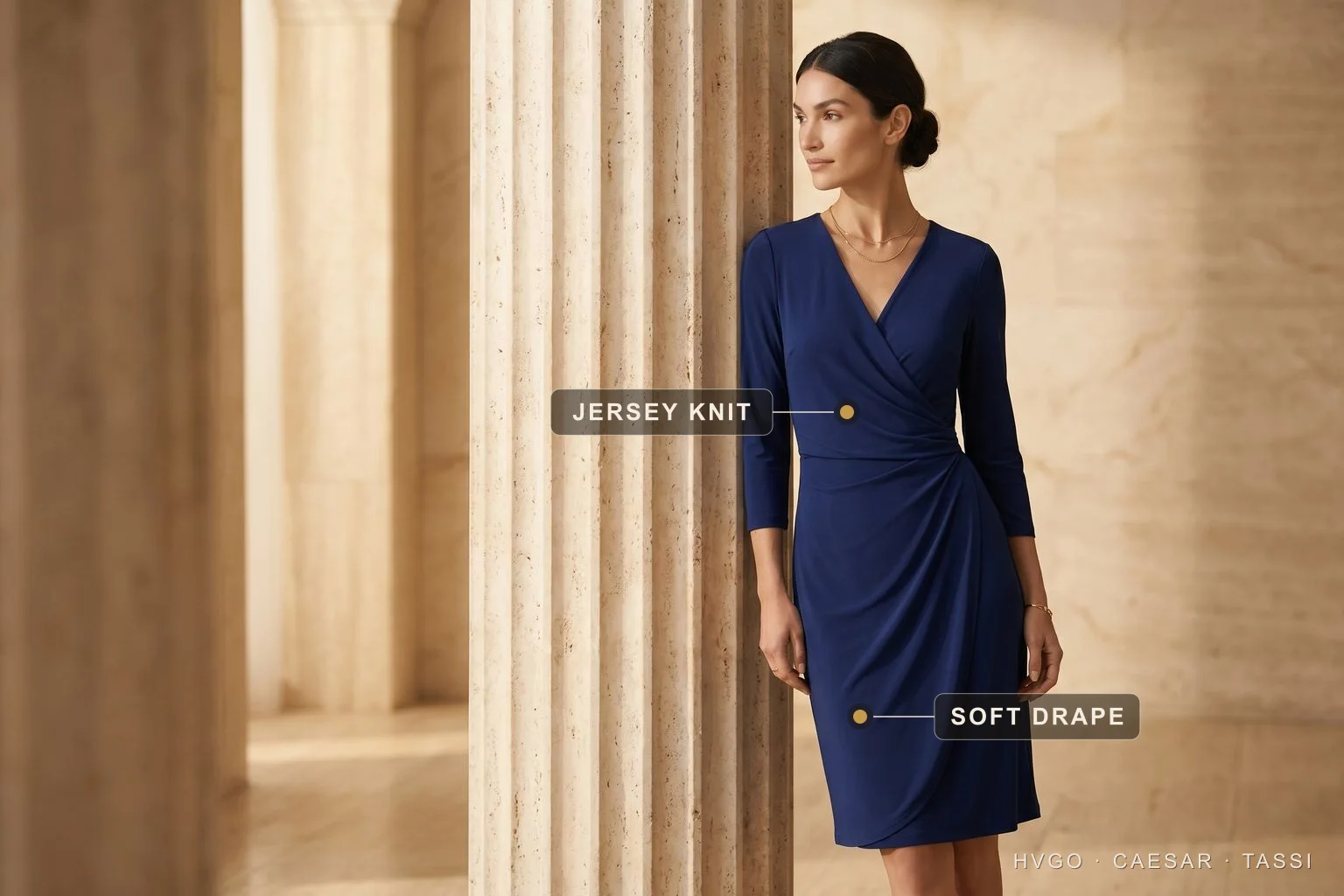
- Jersey knit — the supple knit has no hard fold line to crease, so it travels smooth.
- Soft drape — fluid draping falls back into place instead of holding a wrinkle.
Pack a dress wrinkle-free, step by step
The atelier method — arrive event-ready.
- Choose the fabric Jersey, crepe and chiffon travel best; heavy satin holds a fold.
- Line with tissue Lay acid-free tissue over the dress so the fabric can’t grip itself.
- Roll, don’t fold Roll the dress loosely around the tissue core — one soft radius, no sharp crease.
- Pack on top Place the roll last, on top of everything, so nothing presses a line into it.
- Hang and steam on arrival Hang in a steamy bathroom; the last creases drop out in minutes.
- Fold along a hard edge
- Wring or compress under heavy items
- Iron satin or chiffon directly
#Why does a dress wrinkle in a suitcase, and what stops it?
Three forces crease a dress in transit: weight pressing fibers along sharp folds, heat that sets those folds, and trapped humidity that locks them in. Eliminate the hard fold, cushion the pressure, keep the dress loose, and almost nothing creases.
#Pressure, folding and humidity are the three culprits
Compression, sharp creasing and moisture work together, so a packed gown wrinkles fastest where weight meets a fold in a warm, humid bag. A satin gown folded flat under 12 kg in a warm checked hold heat-sets the fold like a pleat you never wanted in four hours. The counter-case proves the mechanism: the same gown rolled loosely on a half-empty carry-on flies the identical route and steps out smooth, because no single crease ever carried the load.
#The golden rules that apply when you pack a dress in any fabric
Five habits protect any dress regardless of fiber: pack it last and on top, never fold where a crease would show, cushion every fold, keep a slippery cover around it, and leave the case half empty. These rules cost nothing and cut creasing more than any gadget.
- Pack the dress last, on the very top layer so no item presses it from above.
- Never fold across the lap, bust or hem where a crease reads from across the room.
- Cushion every necessary fold with a sausage of rolled tissue so the bend curves instead of knifing.
- Keep the dress in its dry-cleaner plastic or a breathable sleeve so the layers slide rather than grip.
- Pack a half-empty case, since a loose gown wrinkles far less than one crushed into a stuffed bag.
The half-empty rule has one honest exception: a short jersey shift survives a packed cube fine, because the fabric barely holds a crease. Save the loose-on-top treatment for the dress that matters that weekend.
#Should you roll or fold to pack a dress without wrinkles?
Roll the soft, fluid fabrics and fold the structured or embellished ones. Chiffon, light silk, jersey and modal resist creasing when rolled, because a roll has no sharp fold line. Crepe, duchess satin and beaded bodices keep their shape better folded along their seams.
The debate comes down to whether the fabric has built-in structure. Rolling a boned bodice distorts the boning; folding a bias chiffon puts a hard line where the cloth wants to fall in a curve.
#When rolling wins
Rolling wins for any soft, lightweight, fluid fabric, because curving it around a core leaves no crease line for the fiber to remember. Lay the dress flat, smooth it, then roll loosely from the hem up around a tissue core. An Aemilia A-line chiffon maxi travels this way beautifully. The edge case: a chiffon dress weighted with a dense beaded panel rolls unevenly and the beads imprint the next layer, so that one folds with the beading faced inward instead.
#When folding wins
Folding wins for structured, mid-weight or heavily embellished pieces, because rolling bends a shape the garment was built to hold. Fold along an existing seam and pad each fold with tissue so the bend stays soft. A Tullia pleated crepe column gown folds along its side seams and stays crisp. The counter-case: a thin slip dress in light crepe is fluid enough that rolling serves it better, so weight, not fabric name alone, makes the call.
#The bundle-wrap method for a do-it-all answer
The bundle-wrap curves a whole dress around a soft core so it bends at one big radius instead of creasing at any sharp line. It suits a single special gown far better than packing cubes, which compress separates into tidy bricks, the opposite of what a gown needs.
- Lay the dress face-down and smooth out every panel.
- Place a soft core at the waistline, a rolled sweater or a tissue bundle.
- Wrap the bodice down over the core, then the skirt up, so the dress hugs the bundle.
- Slip the whole parcel into a garment sleeve and rest it above everything else.
#What should you pack a dress in for travel?
A dress travels best in a slippery, breathable layer inside a roomy case: dry-cleaner plastic or a garment bag against the cloth, acid-free tissue around delicate panels, and a soft case with space to spare. The cover lets layers slide; the room lets the dress lie loose.
#Garment bag, tissue and dry-cleaner plastic
A slick cover stops friction creases and snags by letting the dress slide instead of grip whatever sits beside it. Keep the dry-cleaner plastic on, or sheath the gown in a breathable garment bag, and wrap acid-free tissue around any beaded panel. A bare satin skirt rubbing a zipper picks up snags and shine marks across a single flight. Choose a tri-fold garment bag when you drive; choose a flat garment sleeve when the dress goes inside a case. A Calpurnia fishtail satin gown rides in tissue and plastic so its hem never catches the case lining.
#Suitcase, packing folder or cube: which protects a gown best
A roomy soft case or a dedicated garment compartment protects a gown best, because it lets the dress lie loose instead of crushing it into a rigid shell. A wide garment-folder board cushions one clean fold for a shorter dress.
| Container | Protects best | Fold lines | Best for |
|---|---|---|---|
| Soft case, half empty | A loose single gown | None forced | The dress you cannot replace |
| Garment-folder board | A short or midi dress | One cushioned fold | Crepe and jersey separates |
| Tri-fold garment bag | A gown by car | One soft fold or none | Driving to the event |
| Packing cube | Folded separates | Many hard folds | Tops, knits, denim, not a gown |
| Stuffed hard-shell | Nothing delicate | Sharp, set by pressure | Avoid for occasionwear |
A wide garment-folder works for a Portia short-sleeve chiffon A-line on a short trip. Skip the cube for a gown: it is engineered to compress, and compression is exactly what sets the crease you are trying to prevent.
#How do you pack a chiffon dress in a suitcase so it floats out crease-free?
Pack a chiffon dress by rolling it loosely in acid-free tissue around a soft core, then resting the roll above everything else. Tissue keeps the slippery fabric from gripping itself and catching, so the gown floats out rather than fights you.
#The acid-free tissue roll, step by step
An acid-free tissue roll keeps chiffon from creasing because the tissue prevents the fabric from gripping itself and removes every sharp fold. Follow it exactly:
- Lay the chiffon dress flat on the bed and smooth out the skirt and bodice.
- Lay a full sheet of acid-free tissue over the whole dress.
- Starting at the hem, roll loosely upward around a soft tissue core.
- Slip the finished roll into a garment sleeve and load it last, crowning everything else.
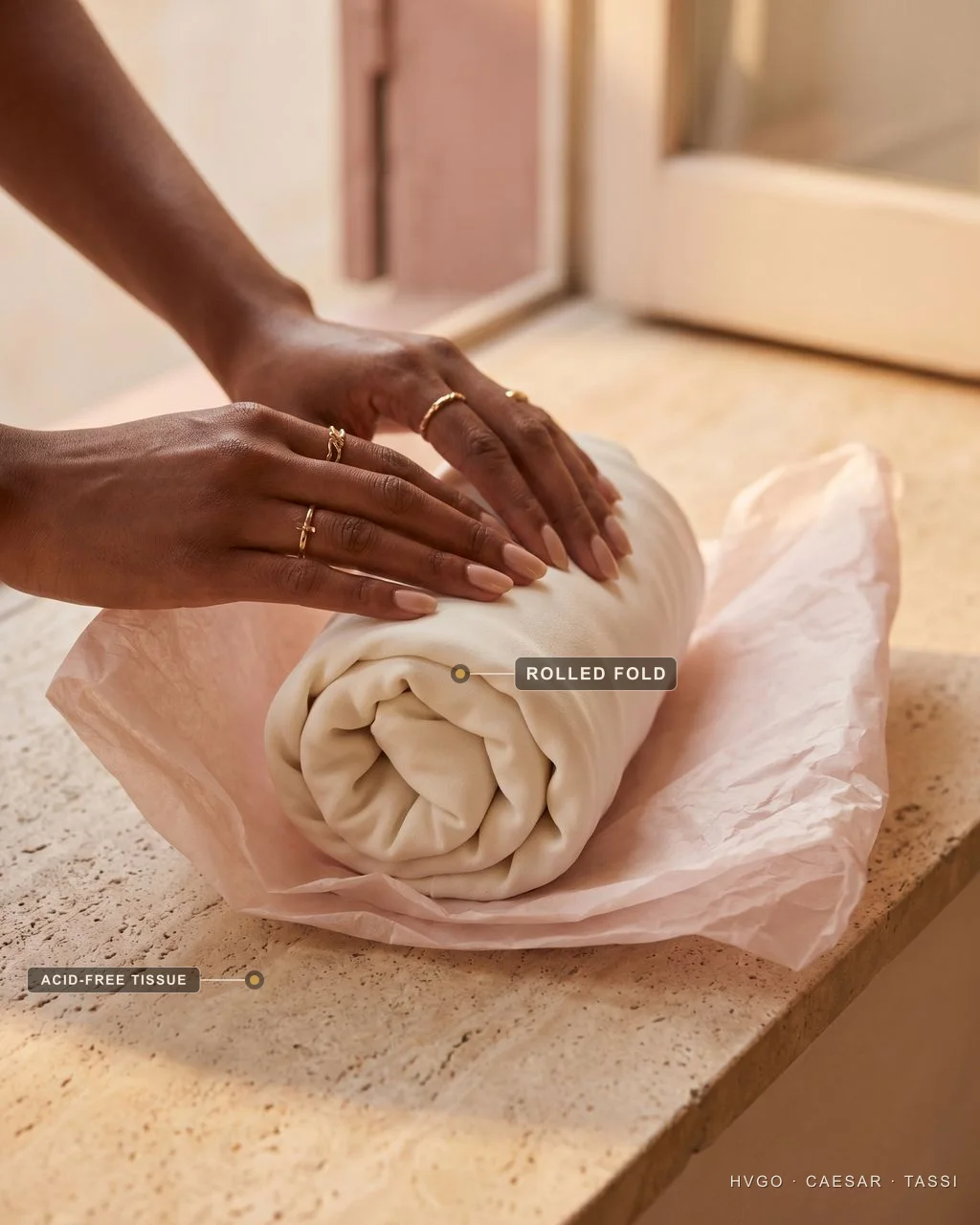
- Rolled fold — coiling the dress leaves a single soft radius, never a sharp crease line.
- Acid-free tissue — the tissue layer keeps slippery fabric from gripping and catching itself.
A Julia French-pleated chiffon maxi rolls this way, though its pleats then want the rope method below for the skirt itself.
#Lining, slip and snag protection
Smooth the lining flush with the outer layer and tuck every strap and bead inside the roll, so nothing twists or snags in transit. A lining that bunches under the chiffon prints its own creases through the sheer top layer, and any beading folded toward the core stays clear of a zipper that could hook a thread. The edge case: a chiffon dress with a separate heavy slip travels calmer if you roll the slip on its own and pair the two on arrival.
#What's the best way to pack a long dress or maxi gown without a hem crease?
Fold a floor-length gown in halves or thirds with a rolled-tissue sausage at every fold, bringing the hem up to the bodice so each bend curves rather than knifes. A maxi is taller than any case, so the fold is unavoidable; the cushion is what saves it.
#Folding a floor-length gown without a knife crease
A cushioned fold turns a sharp crease into a soft curve, which a steamer drops out in minutes instead of an iron fighting for an hour. Bring the hem to the bodice, lay a tissue sausage across the bend, then fold over it once or twice at most, never in a tight stack. A Claudia pleated-slit chiffon maxi folds with tissue at the waist so the slit and hem never knife. The counter-case: a heavily beaded floor gown gains so much weight that even a cushioned fold imprints, so that gown goes on a hanger in a garment bag instead.
#The garment-bag-and-hanger option for the car or carry-on
Keeping a gown on a padded hanger inside a garment bag avoids fold creases entirely and stops the shoulders from denting. Lay the bagged gown flat over the back seat, or fold it once over a carry-on. A padded hanger spreads the shoulder load across 4–5 cm of curve rather than the 1 cm point a wire hanger leaves. For the longer life of the gown between trips, the occasion dress storage guide carries the same padded-hanger logic home.
#Protecting embellishment, slits and trains
Face every beaded or sequined panel inward, pad it with tissue, and fold a slit or train back on itself with tissue between the layers. Hard embellishment is the one thing that crushes a neighboring garment and snags itself.
Never let beading press against another dress's zipper or a buckle. Fold a train back over tissue so the embellished face meets only soft paper, never another panel.
#How do you pack a pleated dress so the pleats survive the suitcase?
Pack a pleated dress as a loose rope, never a flat fold. HCT pleats are permanently heat-set under tension at roughly 180°C, so no hotel iron can re-press them on the road. Gather the skirt lengthwise, coil it gently, and the folds reopen the moment you hang it.
#Why heat-set pleats travel best as a "rope"
A rope coil preserves heat-set pleats because it follows the existing folds instead of cutting across them. Gather the pleated skirt lengthwise into its own folds, twist it gently into a loose spiral, then slip the coil into a leg of tights or a tissue sleeve to hold the shape. Set it on top, and the dress drops back to full pleats on the hanger. A Julia French-pleated maxi coils this way in minutes.
#Accordion vs. knife pleats and what not to do
Never fold across the pleats and never roll them tight, because a cross-fold sets a permanent second crease and a tight roll flattens the folds. Accordion and knife pleats both hold their own fold; your job is only to keep that fold from being crushed or contradicted.
A knife pleat folded crosswise gains an ugly horizontal scar that no steam removes. For the full pressing-and-revival method, the pleated chiffon care guide covers what the suitcase cannot.
#How do you pack a satin or crepe dress without creasing it?
Fold satin face-inward against heavy tissue padding and fold crepe along a clean seam with light tissue. Satin shows every fold and water-spots, so it needs the most cushioning; crepe is the most forgiving fabric of the three.
#Satin: fold on the bias, pad every fold, face it inward
Cushion satin heavily and turn its glossy face inward, because satin records every fold line and shines wherever pressure rubs it. Fold along the bias seams, pad each fold thickly with tissue, and pack flat on top. Over-tight rolling leaves shine marks where the weave burnishes against itself, which is why a Flavia strapless satin gown folds rather than rolls. The bias cut helps: folded on the bias, satin recovers far better than folded on the straight grain.
#Crepe: the easiest traveler, folded along its seams
Crepe travels easiest of all, because its high-twist matte weave springs back from a fold instead of holding it. A clean seam-line fold with light tissue padding is all it asks, so a Tullia pleated crepe column is the smart pick for a packed trip. For the weave differences that explain why, the chiffon and crepe guide lays out the fibers side by side.
#Carry-on or checked: where should you pack a dress for a flight?
Carry your dress on, always. A checked bag can vanish or arrive late past your event. The hold also runs rougher and more humid than the cabin, so an irreplaceable gown belongs with you in a garment bag or atop a carry-on.
#Why your dress belongs in your carry-on
A carry-on keeps the dress in your control and out of the rough, humid hold, which is the single biggest wrinkle and loss risk in travel. A missed checked bag means no dress at all on the night, so keep an irreplaceable gown overhead. If you must check it, photograph the dress, pack accessories separately, and accept the risk. The case for checking holds only when the gown is replaceable and the carry-on is full.
#Soft vs. hard cases and the half-empty rule
A roomy soft case lets a gown lie loose, while a stuffed hard-shell crushes it, so leave the dress space and load weight away from it. Place heavy items at the wheel-end so nothing rolls onto the dress.
The dress is the last thing in and the first thing out, every time. A soft case at half capacity beats a rigid shell packed full, because pressure, not the shell, sets the crease.
#How do you get wrinkles out of a dress once you arrive?
Steam, never iron. Hang the gown in the bathroom and run the shower hot for 10 minutes with the door shut. Humid heat relaxes the fibers; a travel steamer or a light water mist then finishes the job.
#The 10-minute steamy-bathroom revival
A steamy bathroom relaxes set creases in about 10 minutes by softening the fibers with humid heat, no iron required. Follow the routine:
- Hang the dress on a padded hanger on the back of the bathroom door.
- Run the shower on its hottest setting for 10 minutes with the door shut.
- Let the steam fill the room and relax the creases.
- Leave the dress to hang and cool fully, and never wear it damp.
This works on chiffon, satin and pleats alike, and it replaces the iron you should never put on the road. The exception is a soaked-through gown after a humid flight; that one needs a dry hang first, then steam.
#Travel steamers, wrinkle-release spray and gravity
A handheld steamer, a light wrinkle-release mist and plain gravity finish what the shower starts, with no scorch risk. Hold a travel steamer a few centimeters off the cloth, and steam satin from the inside so the face never spots. Mix a mist from water with a few drops of fabric softener, or water and a little vodka, then spritz lightly from arm's length.
Often the simplest fix wins. Hang the gown overnight and let gravity pull most creases out by morning. The firm rule still stands: never set a hotel iron directly on chiffon, satin or heat-set pleats. A full no-iron revival lives in the occasion dress care routine.
#How Hugo Caesar Tassi builds gowns to pack a dress beautifully
HCT gowns are built to relax back into shape, so the atelier's pack-by-fabric protocol works because the fabrics are chosen to recover. Recycled chiffon, bias satin and seam finishes are engineered to drop creases in steam rather than hold them.
#The atelier's pack-by-fabric protocol, at a glance
One decision rule covers every gown: roll the soft, fold the structured, coil the pleated, and revive everything in steam. The fabric tells you the method.
- Roll chiffon and light silk loosely in acid-free tissue around a core.
- Fold crepe and structured satin along their own seams with padded tissue.
- Coil heat-set pleats into a loose tissue rope.
- Revive all of it in a steamy bathroom, never under a hotel iron.
Where a stiff fused interfacing locks a crease, the atelier's seam finishes let the recycled cloth fall back open under humid heat.
#The most travel-friendly gowns in the collection
The most travel-friendly HCT gowns are the crepe and pleated columns, because they fold or coil and spring straight back. Each style maps to one packing move.
| Gown | Fabric | Packing move | Why it travels well |
|---|---|---|---|
| Tullia pleated column | Crepe | Fold on seams | Matte weave resists creasing |
| Aemilia A-line maxi | Chiffon | Roll in tissue | No sharp fold to set |
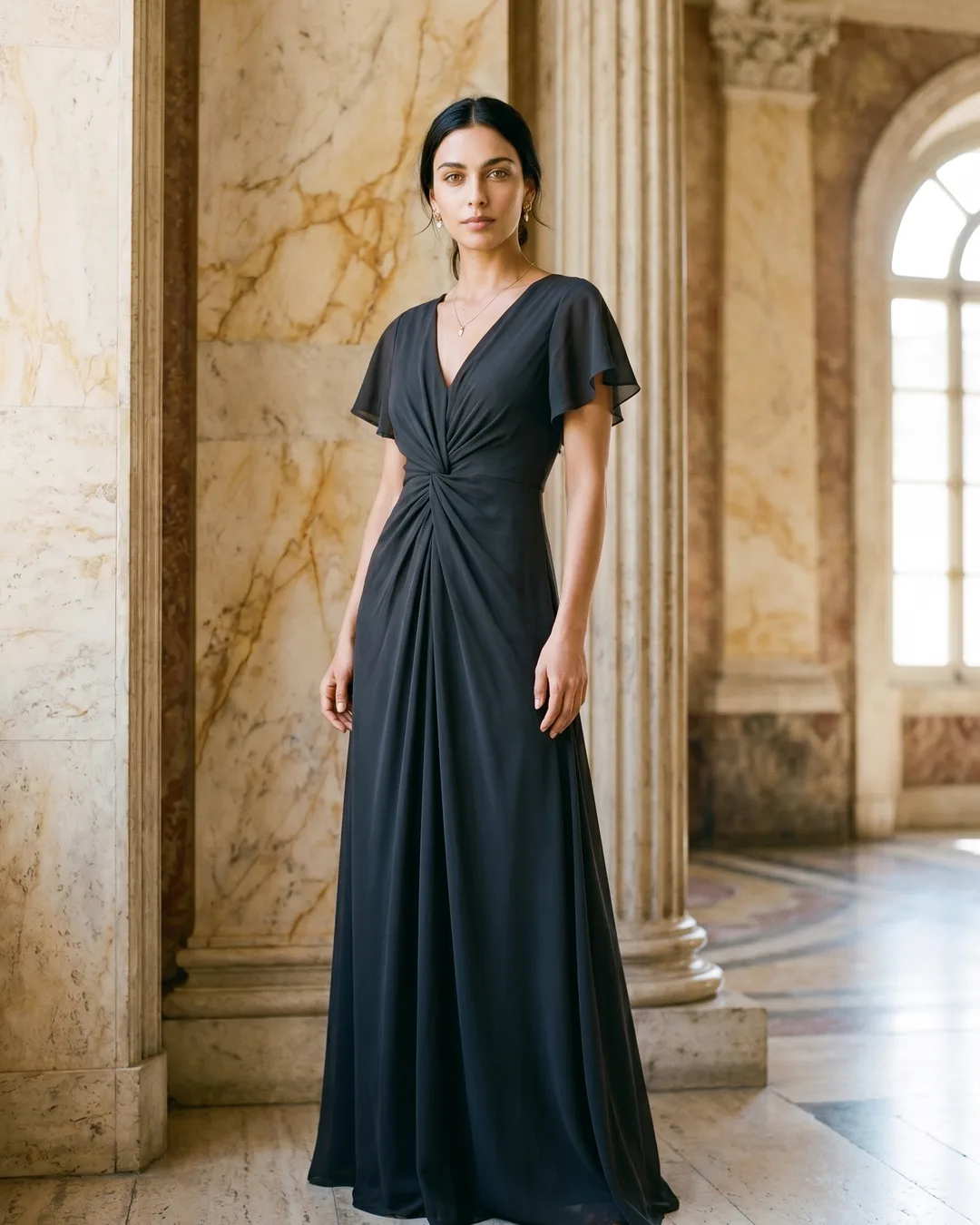
| Portia short-sleeve A-line | Chiffon | Roll in tissue | Light and short to roll |
| Julia French-pleated maxi | Pleated chiffon | Coil as a rope | Pleats reopen on the hanger |
| Calpurnia fishtail gown | Satin | Fold face-in, tissue | Bias cut recovers from folds |
A reader packing for a destination wedding can browse the chiffon dresses that roll cleanly, and match the gown to the day with the italian wedding guide. The honest counter: a fully beaded gown never packs flat well, so that one always travels on a hanger.
#Your wrinkle-free routine to pack a dress, in one glance
The whole protocol fits one line: identify the fabric, roll or fold to match, tissue-cushion and bag it, pack it last and on top, carry it on, then steam (never iron) on arrival. Run it in order and the dress steps out ready.
#The pack → protect → revive cheat-sheet
Three stages carry any dress from closet to event: pack to the fabric, protect with tissue and a slick cover, then revive in steam. Keep the sequence and skip nothing.
- Pack: roll soft fabrics, fold structured ones, coil pleats.
- Protect: acid-free tissue inside, dry-cleaner plastic or a garment bag outside, half-empty case.
- Position: dress last in, on the very top, in the carry-on.
- Revive: steamy bathroom for 10 minutes, hang to cool, no iron.
After the trip, the dress goes back into rotation the right way. Hand off to the wider dress care guides and the storage methods you used to pack, and the gown is ready for the next event before you have unpacked your shoes.
#Frequently asked questions
Should you roll or fold a dress to avoid wrinkles?
Roll a dress when the fabric is soft and fluid, and fold it when the fabric is structured or embellished. Chiffon, light silk and jersey have no hard fold line to crease, so they reward a loose roll. Crepe, duchess satin and beaded gowns hold a built-in shape that rolling distorts, so fold them along their seams with tissue padding.
How do you pack a chiffon dress in a suitcase?
Pack a chiffon dress by rolling it loosely in acid-free tissue, never folding it flat. Lay it out, cover it with a tissue sheet, then roll from the hem up around a soft core so the fabric cannot grip itself. Slip the roll into a garment sleeve or its dry-cleaner plastic and load it last, above everything else.
What should you pack a dress in for travel?
Pack a dress inside a slippery, breathable cover so the layers slide instead of grip. Keep it in its dry-cleaner plastic or a breathable sleeve, and sheath any delicate or beaded panel in acid-free tissue. A roomy soft case or a dedicated garment compartment protects a gown far better than a stuffed hard-shell.
How do you pack a pleated dress without losing the pleats?
Pack a pleated dress as a loose coil that follows its own folds, never a flat or crosswise fold. Gather the pleated skirt lengthwise, coil it into a soft rope, and slip it into a tissue sleeve or a leg of tights to hold the shape. Never fold across the pleats or pack tight, because the pleats reopen when you hang the dress.
How do you get wrinkles out of a dress while traveling without an iron?
Get wrinkles out of a traveling dress with steam, not an iron. Hang it in the bathroom, run a hot shower for 10 minutes with the door shut, and let the steam relax the creases, then leave it to cool on a hanger. A small travel steamer or a light water-and-fabric-softener mist works too, but never iron chiffon, satin or pleats on the road.
Should I pack a formal dress in my carry-on or check it?
Pack a formal dress in your carry-on, not your checked luggage. A checked bag can be delayed or lost past your event, and the hold runs rougher and more humid than the cabin. Keep an irreplaceable gown with you in a garment bag or on top of your carry-on.
Now your dress can fly with you and arrive ready to rule. See the crepe, chiffon and pleated gowns our atelier builds to travel beautifully in the occasion dresses edit.
More Care & Fabrics guides
How to Clean, Condition and Store a Leather Bag So It Ages Beautifully
The atelier's gentle routine to clean, condition and store a leather bag, plus the conditioning cadence that builds a patina and stops cowhide cracking.
Care for a leather bagHow to Wash, Store and Revive a Silk Scarf Without Losing Its Color or Sheen
Wash, de-crease, dry and store a silk scarf without dulling the color or warping the hem — the atelier's cold-water method and white-vinegar acid rinse.
Wash silk the right wayHow to Wash a Chiffon Dress at Home (Plus Satin and Crepe) Without Ruining It
The atelier's safe way to wash, refresh and steam chiffon, satin and crepe at home — plus the fiber test that decides hand-wash vs. dry clean.
Wash chiffon, satin & crepe safelyHow to Care for Pleated Chiffon Without Losing the Pleats
Wash, dry, store and travel with pleated chiffon without flattening the pleats — the atelier's heat-set method, hand-wash steps and a pleat-revival fix.
Keep the pleats knife-sharpHow to Remove Stains From a Dress
The atelier's fabric-safe way to remove wine, makeup, sweat, deodorant and oil stains from a delicate dress — blot, don't rub, and know when to stop.
Rescue a stained dressHow to Store Occasion Dresses So They Stay Ready to Wear
Store occasion dresses with no creases, sagging or yellowing: the atelier's fabric-weight hang-or-fold rule, acid-free tissue method and moth-proof plan.
Store gowns the right way