Dress Silhouettes Explained: How Fabric and Fit Create the Classical Line
Every dress silhouette explained: A-line, column, sheath, fishtail, empire, plus the fabric that holds each shape and the body it flatters.
On this page
A dress silhouette is the outline a garment draws around your body, and it decides how a dress looks long before color, print, or trim ever matter. Yet the same silhouette falls like liquid or stands like architecture depending on its fabric. This guide reads every shape through one Roman rule: the eye should travel one unbroken vertical line.
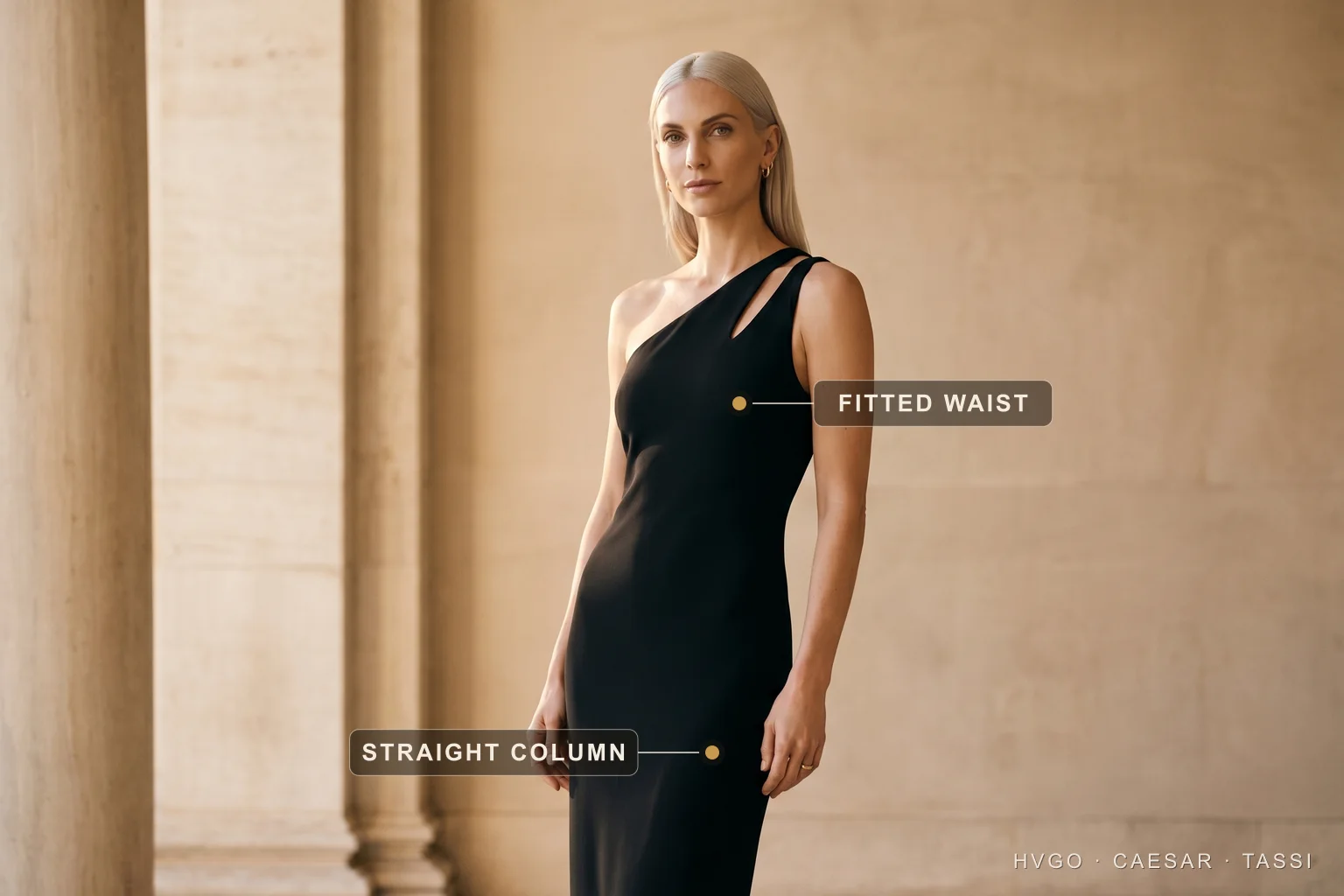
- Fitted waist — the one place the near-vertical line draws in close to the body
- Straight column — the skirt drops near-vertical from waist to hem, tracing the line a sheath would follow
#What is a dress silhouette, and why does it decide everything else?
A silhouette is the dress's profile against your body, and it sets the proportion every later choice answers to. Neckline, hemline, and trim refine a shape; they never rescue the wrong one. Choose the outline first, then dress it.
The silhouette governs where the eye starts and stops. A Hugo Caesar Tassi (women's luxury occasionwear house, designed in Roma, founded 2004) gown commits to its outline in the pattern stage, before a single bead is considered. Get the profile right and a plain Basalt (black) crepe outperforms a busy print in the wrong shape.
#Silhouette, shape and cut: the words untangled
Silhouette names the whole outline; shape names a single zone like the waist; cut names how the cloth meets the grain. The terms overlap in catalog copy, which confuses shoppers who think a "fit-and-flare cut" and a "fit-and-flare silhouette" are different products. They are the same outline described twice.
A neckline changes the frame at the collarbone, not the line down the body. The Flavia strapless satin off-shoulder gown keeps a column silhouette whether you read its neckline as bare or draped. One concrete test: squint at a dress until detail blurs. What remains is the silhouette.
The edge case is the convertible wrap. Its silhouette shifts as you tie it, so the cut, not a fixed pattern, defines the final outline.
#The classical line: why the eye should follow one unbroken vertical
The most elegant silhouette leads the eye top-to-toe without a horizontal break, the proportion principle our atelier returns to first. A waist seam at the wrong height cuts you in two and shortens the frame. A single vertical reads taller and calmer.
This is la bella figura applied to cloth: one focal point, one moving line. A floor-length Cobalto (navy) column proves it; a tiered Cipria (pink) ruffle skirt fights it with three competing horizontals. The principle bends for daywear, where a defined waist adds welcome movement, but the vertical stays the default for evening. Read the full method in our la bella figura guide before you shop a gown.
#The core dress silhouettes, and how each one is actually built
Six families cover almost every occasion dress: column, A-line, empire, trumpet, bias slip, and the volume shapes. Each is built from a different seam logic, and that logic, not the fabric alone, sets how forgiving the shape will be. Learn the construction and you can name any dress on a rail.
The six core silhouettes
Each shape is its own outline and its own body logic — name it, then dress it.
#Column and sheath: the straight vertical line
A column drops in one straight line from shoulder to floor; a sheath nips lightly at the waist and traces the hip. Both run near-vertical seams, which makes them the most architectural and least forgiving silhouettes. They need structure under them.
The Tullia pleated crepe column gown holds its line because matte crepe stands slightly away from the body. A sheath, by contrast, follows every contour, so it rewards an hourglass frame and exposes a soft midsection. Choose a column when you want the line without the scrutiny.
#A-line and fit-and-flare: the widening triangle
An A-line fits the shoulder and bust, then releases to a wider hem in a clean triangle; fit-and-flare adds a defined waist seam. This is the great all-rounder, balancing a narrow top against fuller hips. It forgives more than any straight cut.
The Aemilia A-line chiffon maxi skims the hip and floats outward, hiding the line a sheath would trace. Fit-and-flare draws a sharper waist, which suits a rectangle frame that wants curve. The limit: in stiff fabric an A-line can read like a triangle traffic cone, so the cloth must move.
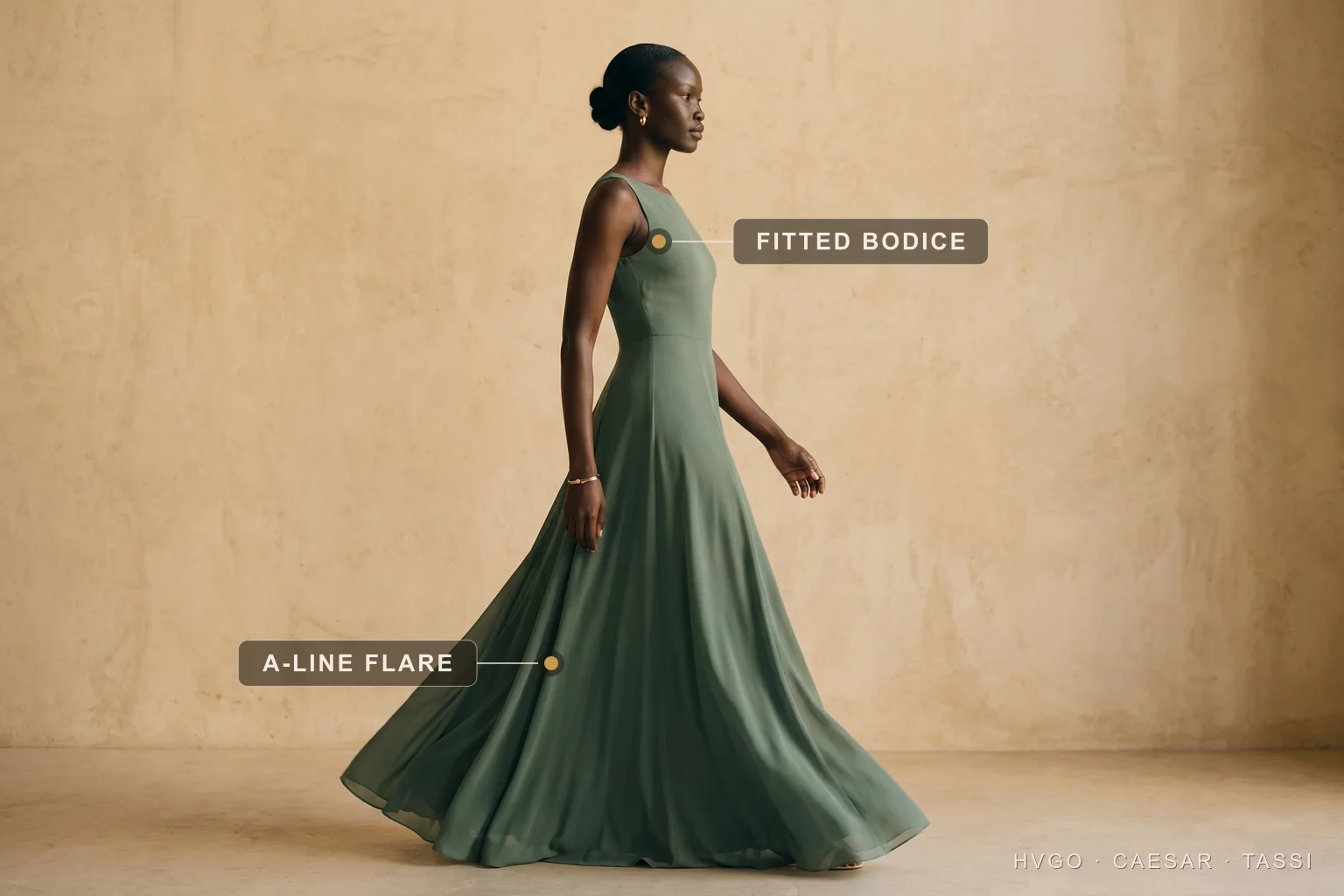
- Fitted bodice — the shape holds close through the shoulder and bust
- A-line flare — the skirt widens away from the waist into a triangle, hiding the line a sheath would trace
#Empire and the raised waist
An empire seam sits directly under the bust, and the fabric falls free below it. This lengthens the leg line and skims the entire midsection. It is the kindest silhouette during pregnancy or after a large meal at a long dinner.
The raised waist works because the eye reads everything below the seam as leg. A petite woman gains visual height; an apple shape gains a clean drop past the stomach. The counter-case is a full bust, where an empire seam can balloon the fabric and add width you did not want.
#Trumpet, fishtail and mermaid: the curved-then-flared line
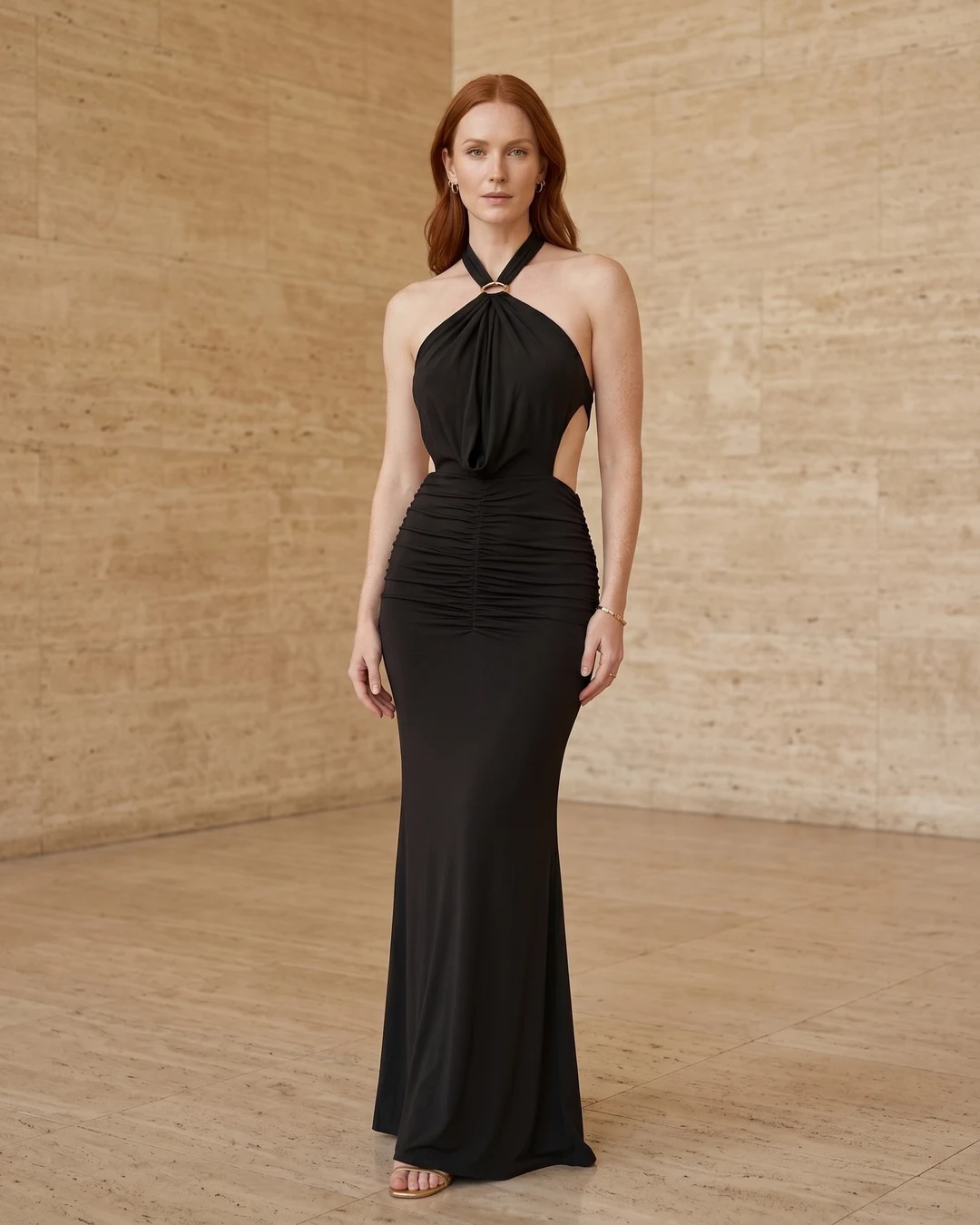
These three name one silhouette that hugs the body, then flares: trumpet flares higher and softer, mermaid lower and sharper. It is the most overtly hourglass shape, tracing the waist and hip before the skirt opens. Walking room is the trade-off.
The Calpurnia fishtail satin evening gown flares near the knee, so it photographs as pure curve on a red carpet. The flare below the knee restricts a long stride, which makes stairs and dancing the real edge case to test in the fitting room.
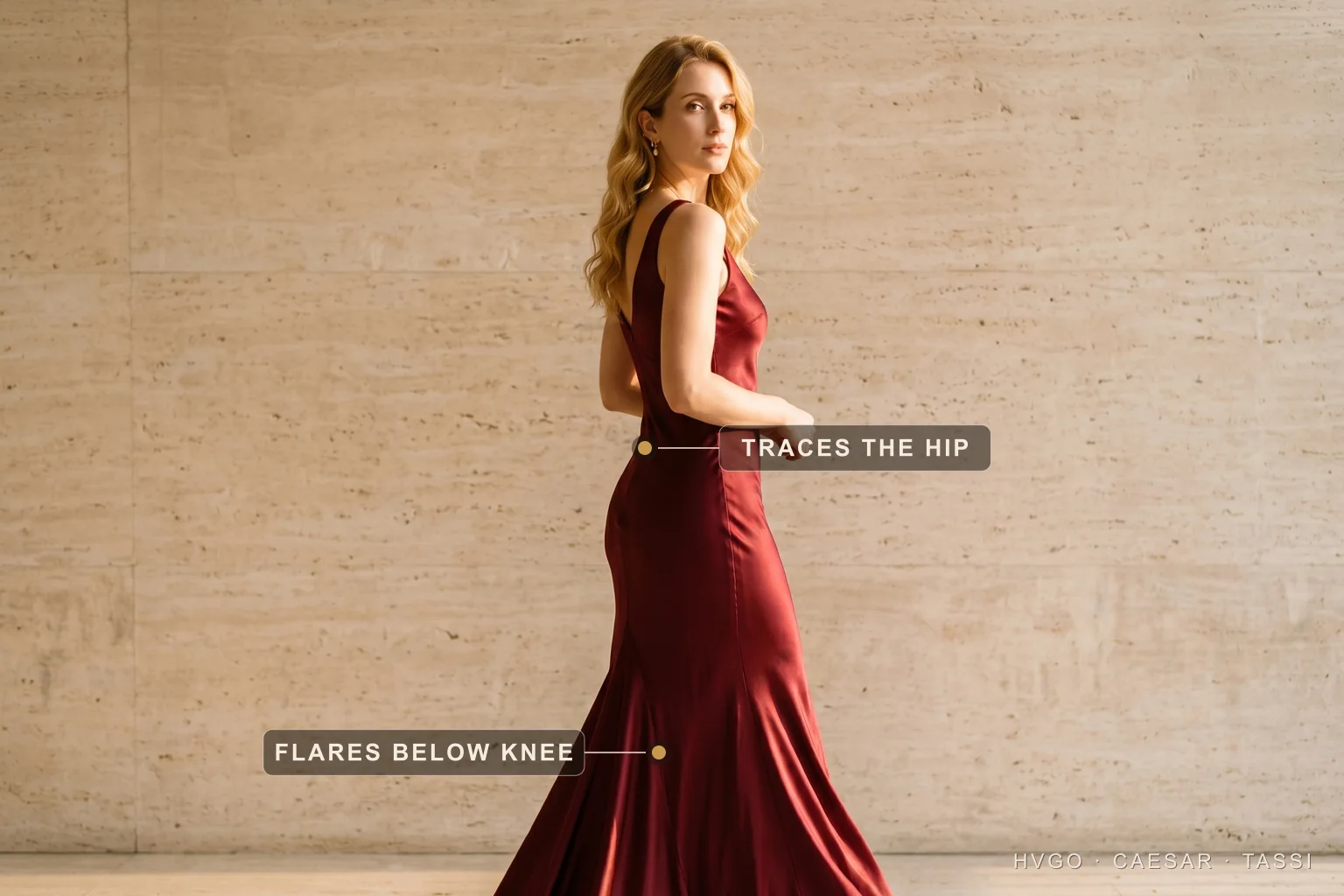
- Traces the hip — the bias satin follows bust, waist and hip in one close line
- Flares below knee — the trumpet hem opens low and sharp, the move that restricts a long stride
#Bias-cut slip and the draped column
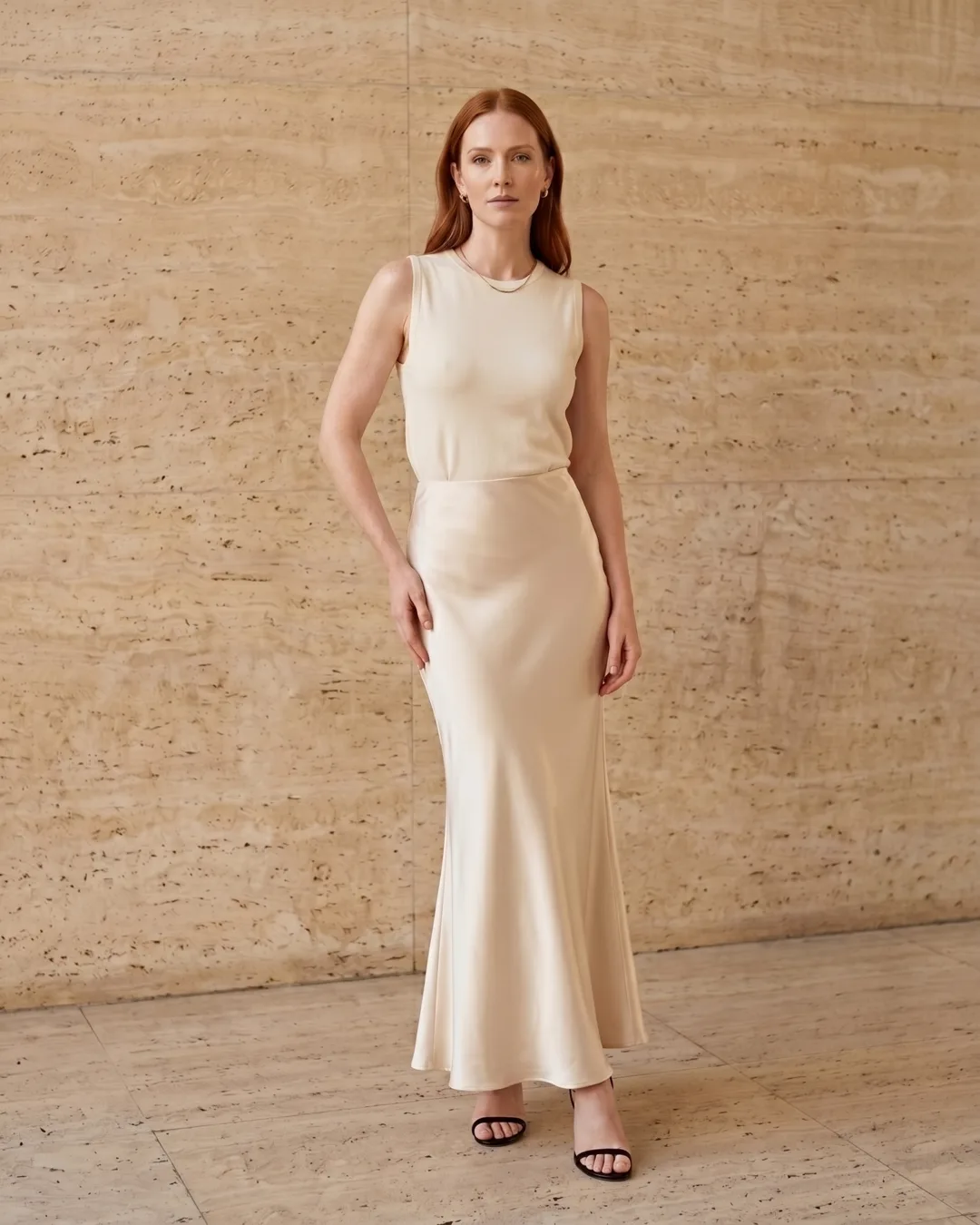
A bias-cut slip is cut on the diagonal grain so the fabric clings and ripples into a soft liquid vertical. It reads "straight" like a column, yet it moves where a structured column stays put. The grain, not the pattern, creates the difference.
Bias satin follows the body and slides over the hip, which flatters a long lean frame and clings to anything it crosses. A structured crepe column hides; a bias slip reveals. Both keep the single vertical, but one is architecture and the other is water.
#Ball gown, trapeze and shift: the volume silhouettes
Volume silhouettes trade the close vertical for shape: a ball gown fits the bodice over a full skirt, a trapeze swings from the shoulder, a shift drops straight with no waist. Each places fullness somewhere different. Each suits a different room.
A ball gown belongs at black tie, where its skirt has space. A trapeze hides the midsection while keeping the shoulders neat, useful when you want ease without a tent. The shift, waistless and breezy, reads casual, so it rarely carries a formal occasion on its own.
#Which fabric makes each dress silhouette hang correctly?
Fabric controls the shape more than the pattern does, because weight, drape, and hand decide whether cloth stands or falls. A pattern name alone tells you almost nothing about the finished line. Always judge a silhouette together with its cloth.
#Why fabric, not the pattern, controls the shape
One A-line pattern reads as two different dresses depending on whether you cut it in stiff crepe or floaty chiffon. Weight measured in grams per square meter, drape, and hand do the visible work. The paper pattern is identical; the result is not.
Stiff cloth holds the triangle wide and crisp. Soft cloth collapses the same triangle into a gentle fall around the legs. The Julia French-pleated chiffon maxi proves how a fluid fiber turns a structured idea into movement. The reverse fails too: a fluid silhouette cut in board-stiff fabric simply will not drape.
#Structured fabrics for an architectural line
Matte crepe near 220 gsm and duchess-weight satin hold a column, a sheath, and a ball gown because they stand away from the body and keep a clean edge. These cloths resist collapse, so the seam line you cut is the line you keep. Weight is doing the engineering.
Our crepe is matte and structured, which is why the Tullia column reads as a true vertical rather than a draped one. The Calpurnia fishtail uses bias-cut satin so the flare snaps outward and holds its curve. Structure has a cost: too much body can read stiff on a small frame, so scale the cloth to the wearer.
#Fluid fabrics for a soft, moving line
Lightweight chiffon near 8 mm and washed modal jersey float an A-line, an empire, and a draped column because they fall, ripple, and follow the body. Our chiffon is a recycled chiffon, knife-pleated or bias-cut, and the modal carries a true draped column. These fibers move with you.
The Vipsania draped modal column gown shows what fluid weight does to a straight shape: it pours rather than stands. The Claudia pleated-slit chiffon maxi ripples with each step. The limit of fluid cloth is honesty: it skims curves but hides nothing it crosses, so it suits a body you are happy to trace.
#The HCT fabric-to-silhouette matrix
Each Hugo Caesar Tassi silhouette is realized by one fabric chosen for its weight and drape, paired below as the atelier pairs them. Read the table as a rule: the cloth on the right is what makes the shape on the left hang correctly. The single vertical survives only when the two match.
| Silhouette | HCT fabric | Weight / cut | What the fabric does |
|---|---|---|---|
| Sheath | Matte crepe | ~220 gsm, structured | Holds a clean contoured edge |
| Column | Washed modal jersey | Mid-weight, draped | Pours into one soft vertical |
| A-line | Recycled chiffon | ~8 mm, knife-pleated | Floats the hem outward |
| Fishtail | Duchess satin | Heavy, bias-cut | Snaps the flare and holds curve |
| Empire | Recycled chiffon | ~8 mm, bias-cut | Falls free below the bust seam |
| Draped column | Modal jersey | Mid-weight, bias drape | Clings and ripples vertically |
A competitor glossary names these pairings; it rarely explains why 220 gsm stands and 8 mm floats. That mechanism is the difference between a shape that works and one that sags.
#Which dress silhouette flatters your body shape?
Match the silhouette to the line you want to draw, not to a rigid chart, then let fabric finish the job. Body-shape pairings are a starting map, not a verdict. The goal stays constant: one unbroken vertical.
#Hourglass, pear and apple
An hourglass suits a sheath or fishtail to trace the curve, a pear suits an A-line or fit-and-flare to balance the hips, and an apple suits an empire or column to skim the midsection. Each pairing answers where the body carries its weight. Each keeps the eye moving down.
A pear gains balance because the A-line hem widens to meet fuller hips, ending the contrast. The apple gains a clean drop because the empire seam releases fabric above the stomach. The edge case is a curvy petite frame, where a full fishtail can overwhelm height, so scale down the flare.
#Rectangle, inverted triangle and petite
A rectangle suits fit-and-flare or a wrap to create a waist, an inverted triangle suits an A-line to add hip volume, and a petite frame suits a column or empire with a high waist to lengthen. The shape you lack is the shape the silhouette supplies. That is the whole logic.
An inverted triangle, broad at the shoulder, gains balance as the A-line adds visual width below. A petite woman reads taller because the raised seam sends the leg line upward. The counter-case: a petite hourglass may want a sheath instead, since too much added volume swallows a small frame.
#Reading flattery through the vertical line, not the rule book
Choose the silhouette that keeps the eye traveling up and down rather than the one a body-shape chart assigns you. Charts generalize; your mirror does not. Trust the single vertical over the category.
A rectangle frame can wear a column beautifully if the cloth drapes, even though the chart prefers a defined waist. The rule book is a draft, not a law. To pin down your own starting point, work through our body shape finder before you commit to a cut.
#How classical proportion matches dress silhouettes to the occasion
The occasion sets the formality, and formality sets how long and how vertical the silhouette should run. Daytime tolerates a defined waist and movement; evening rewards the longest, cleanest line. The room tells you the length.
#Daytime, garden and races
A-line and fit-and-flare midis read polished without formality, with the movement and ease a standing event demands. A garden party or a day at the races keeps you upright for hours, so a skirt that moves beats one that restricts. Comfort is part of the line here.
A Verde Antico (green) fit-and-flare midi photographs crisp on a lawn and lets you walk on grass. The Portia short-sleeve chiffon A-line carries the same ease. Avoid a floor-length fishtail by daylight; its drama reads as costume before dusk.
#Evening, gala and black tie
Column, sheath, and fishtail silhouettes in satin or matte crepe make the strongest evening line because their long uninterrupted vertical reads formal and elongating in floor length. Evening is where the single vertical earns its keep. Length and restraint carry the drama.
A floor-length Porpora (wine) crepe column needs no print to command a gala. The Calpurnia fishtail delivers overt glamour where the dress code invites it. The edge case is a low-ceiling dinner with tight seating, where a fishtail's narrow knee makes sitting awkward, so a column serves better.
#Weddings as a guest
A draped column or an A-line maxi photographs cleanly and sits elegantly through a long wedding day as a guest. These shapes move from ceremony to dinner without crushing. They also keep you appropriately quiet beside the couple.
Our occasion dressing designs out bridal white and funereal black, which settles the two colors a guest should never wear. An Avorio (ivory) gown reads too close to white, so reach for Cornelia (rose) or Cobalto instead. The shape that fails here is a high-volume ball gown that competes with the bride.
#How Hugo Caesar Tassi cuts each silhouette in the collection
The house cuts two opposing lines: a structured vertical that stands, and a fluid vertical that pours, each engineered by its fabric. Both obey the single unbroken line. The cloth decides which one you get.
#The structured line: Tullia, Calpurnia, Flavia
The atelier engineers an architectural vertical using crepe and bias satin that hold their own edge. Structure here means the seam line survives a full evening of standing. The fabric does the standing for you.
The Tullia pleated crepe column rises as a true vertical at ~220 gsm. The Calpurnia fishtail in bias-cut satin snaps its flare and holds the curve. The Flavia strapless satin off-shoulder gown keeps a clean column despite its bare neckline, proving structure lives in the cloth, not the straps.
#The fluid line: Aemilia, Vipsania, Claudia
The house floats a soft vertical using recycled chiffon and washed modal that fall and follow the body. Fluid here means the line moves as you move while still reading as one column. Drape replaces stiffness.
The Aemilia A-line chiffon maxi floats outward at ~8 mm. The Vipsania modal column pours into a draped vertical that clings without gripping. The Claudia pleated-slit maxi ripples and reveals a leg through its slit, fluid where the structured line stays firmly closed.
#Choosing your silhouette: a quick decision summary
Decide in three questions: the occasion, the fabric you want against your skin, and the body line you want to draw. Answer them in that order and the silhouette names itself. Fabric and shape always travel together.
#The three-question shortcut
Run occasion, then fabric, then body line, and read the silhouette off the table below. The sequence matters because the room rules out lengths before the body narrows the shape. Use it as a quick filter, not a final fitting.
| Your answer | Points to |
|---|---|
| Daytime, want movement | A-line or fit-and-flare in chiffon |
| Evening, want drama | Column, sheath, or fishtail in crepe or satin |
| Want to skim the midsection | Empire or column |
| Want to trace the curve | Sheath or fishtail |
| Petite, want height | Column or empire with a raised waist |
| Wedding guest | Draped column or A-line maxi |
For the wider field of cuts behind these choices, browse our types of dresses guide, then compare lengths in the length guide and frame the neckline using the necklines guide.
#Frequently asked questions
What is the most flattering dress silhouette?
The most flattering dress silhouette is the one that keeps the eye on a single unbroken vertical for your frame, though fit-and-flare and A-line flatter the widest range. Both define a waist and skim the hips, which suits most body shapes. There is no universal winner; the cloth and your proportions finish the answer.
What is the difference between a column and a sheath silhouette?
A column and a sheath both fall near-vertical, but a sheath fits and lightly contours the waist and hip while a column drops straighter and looser. The sheath is body-conscious; the column is the softer, more forgiving line. Fabric structure separates them as much as the seams do.
What is the difference between a mermaid and a fishtail dress?
A mermaid and a fishtail describe the same trumpet-shaped silhouette, used interchangeably by most houses. Mermaid usually flares lower and more dramatically near the knee; fishtail or trumpet can flare a touch higher and softer. The terms shift between catalogs, so confirm the flare point rather than the name.
Does fabric really change a dress silhouette?
Fabric really does change a dress silhouette, controlling the finished shape more than the pattern does. The same A-line cut floats in 8 mm chiffon but stands crisp in 220 gsm crepe. Always judge a silhouette together with its fabric weight and drape.
Which dress silhouette is best for an evening gown?
The best dress silhouette for an evening gown is a column, sheath, or fishtail in satin or matte crepe. Their long, uninterrupted vertical reads formal and elongating in floor length. A fluid draped column works too when you want movement over architecture.
What silhouette is best for a petite woman?
The best silhouette for a petite woman is a column or empire with a raised waist. The high seam and single vertical line visually lengthen the leg and avoid cutting the body in half. Keep any flare small so added volume does not swallow the frame.
Now that you can read a silhouette and its fabric together, explore the cut that suits you in our evening gowns collection.
More Dress Knowledge guides
Dress Necklines Explained
Every dress neckline named, with the jewelry each one takes, the bust and shoulders it flatters, and the formality it signals. A house guide.
Decode every dress necklineDress Sleeve Types
Every dress sleeve named and shown — how much arm each covers, the climate it suits and the occasion it signals, from cap and flutter to dolman.
Match a sleeve to the occasionHow to Choose a Dress
A quiet-luxury method for choosing a dress — occasion first, then silhouette, fabric, length, fit, and only then color. Buy one you'll wear for years.
Learn the five-step methodHow to Measure for an Occasion Dress
Take your bust, waist and hip dress measurements at home and match them to the HCT size chart, with US/EU conversion and per-fabric ease, to order once.
Find your size in the occasion dresses editMidi vs Maxi vs Mini
Every dress length in real inches: mini, midi, tea, maxi, measured on a 5'7\" fit model, plus a height rule for where each hits on you.
Find your hem length in real inchesTypes of Dresses
Every formal dress type named and shown — slip, column, A-line, sheath, fishtail, one-shoulder and more — each with its fabric and best occasion.
Name every dress type