How to Dress Like an Italian Woman: The Roman Rules of Effortless Elegance
A Roman house's real rules for dressing like an Italian woman: fit, fabric, color and the scarf-and-leather signatures that read elegant, never touristy.
On this page
Dressing like an Italian woman means owning a few excellent pieces and wearing them with quiet conviction, not chasing logos or trends. The look rests on impeccable fit, honest natural fibers, a disciplined palette, and two signatures she keeps for a decade. Hugo Caesar Tassi has cut women's clothes in Rome since 2004; here are the rules.
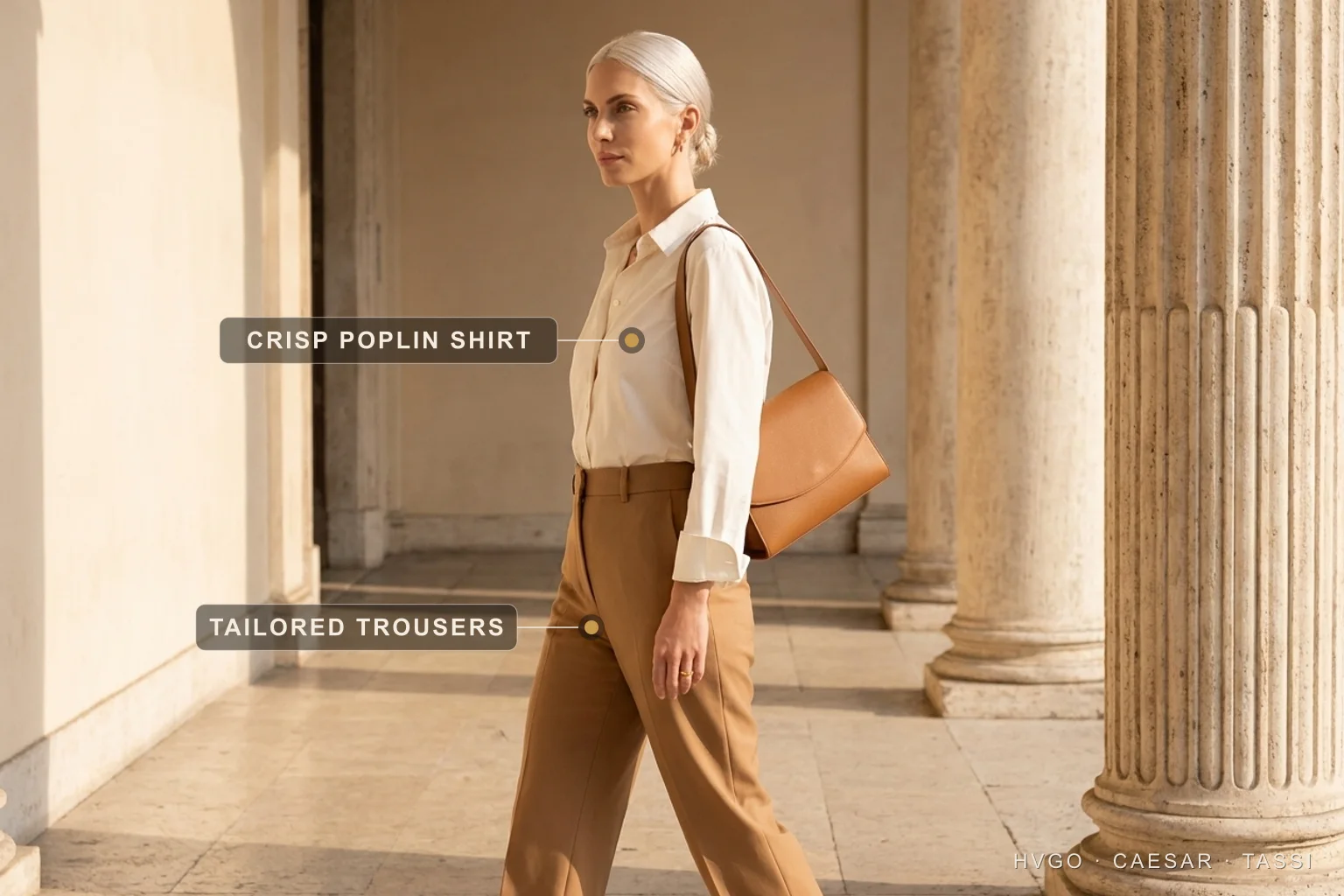
- Crisp poplin shirt
- Tailored trousers
The Italian woman's rules
What to do, and what to avoid, to read elegant rather than touristy.
- Edit hard to 30-40 natural-fiber pieces you genuinely wear, and buy once to keep for years.
- Fit the shoulder seam first, then have a sarta nip the waist and shorten the hem so fabric skims, never clings.
- Choose honest fibers - silk, fine merino, cotton poplin, linen, crepe - that drape and read rich in daylight.
- Build on four or five neutrals (Avorio, Travertine, Cuoio, Cobalto, Basalt) and lift them with one saturated accent like Porpora or Verde Antico.
- Keep two signatures - one 90 cm silk square and one full-grain leather bag - then remove one thing before you leave.
- Do not hoard trend buys or chase logos; a visible monogram signals less than a perfect shoulder.
- Do not size down for a sleeker look - it strains the bust and back instead of slimming.
- Do not settle for shiny synthetics that hang stiff and read flat on camera.
- Do not mix four competing colors or stack scarf, statement earrings and bracelets at once.
- Do not cut hems at the unflattering mid-calf; stop at the knee or the floor.
#What does it actually mean to dress like an Italian woman?
An Italian woman dresses from a small, edited wardrobe of well-fitting, natural-fiber pieces, lifting a neutral base with one rich color. She buys less, fits everything to her body, and repeats the same garments without apology.
The tourist version reaches for a logo belt and a printed airport scarf. The real version reaches for a white cotton-poplin shirt, dark trousers, leather loafers, and a single gold ring. Both spend money; only one looks Italian, because elegance here is restraint rather than a pile of purchases.
#Effortless, not careless: the Italian woman's sprezzatura
Sprezzatura describes studied nonchalance, an ease that takes real planning to achieve. The term dates to Castiglione's Book of the Courtier (1528), and it means hiding the effort so the result looks accidental.
An Italian woman engineers that ease. She presses the shirt, rolls the cuff once, and lets a 90 cm silk scarf sit slightly undone at the neck. The fuller cultural idea of carrying yourself well in public belongs to la bella figura, so this page stays on cut and fabric.
Compare that to Anglo "casual," which often means a hoodie chosen for zero thought. Sprezzatura is the opposite: maximum thought, hidden completely. Over-styling marks the limit, where three trends at once turns into costume and an Italian woman strips it back to one focal point.
#Quality over quantity: why an Italian woman owns less
An Italian woman keeps roughly 30 to 40 garments she genuinely wears, buying once and keeping each for years. A full-grain leather bag stays in rotation for a decade; a fast-fashion bag frays in a season.
She reads value as wear-time, not ticket price. One €250 bag worn twice a week for ten years outperforms five cheap bags discarded each summer, and that math drives the whole closet: fewer hangers, better seams, no impulse buys.
Where this backfires is the rigid capsule that bores its owner back into shopping. An Italian woman avoids it by choosing pieces with range, like one dress that moves from a market morning to a dinner on a swap of accessories.
#Which wardrobe essentials does every Italian woman actually own?
Every Italian woman builds on the same core: a white shirt, tailored trousers, a fine knit, a day dress, an evening dress, one leather bag, and good leather shoes. These seven categories cover almost every occasion she dresses for, and each earns its place by fitting more than one outfit.
#The core capsule, piece by piece
Seven categories form the capsule, each chosen for range rather than for a single outfit. Use the checklist below to shop against.
- The crisp white shirt: cotton poplin, body-skimming, worn open over a tank or tucked into trousers.
- Tailored trousers: a straight or slightly tapered leg in stone, navy, or black, hemmed to break at the shoe.
- A fine-gauge knit: merino or cashmere in a neutral, layered under a blazer or worn alone.
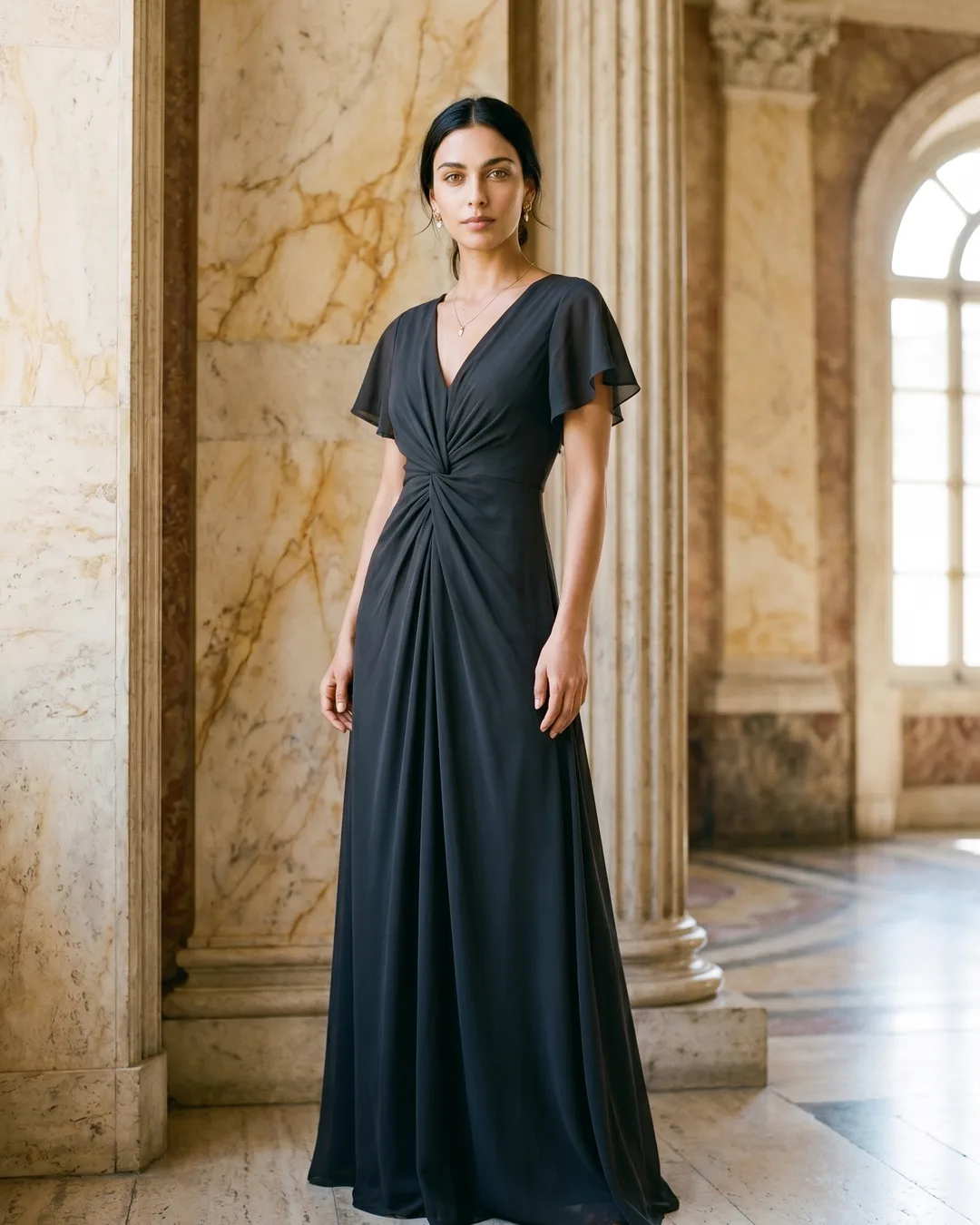
- A body-skimming day dress: chiffon or crepe at the knee, like the Portia short-sleeve chiffon A-line.
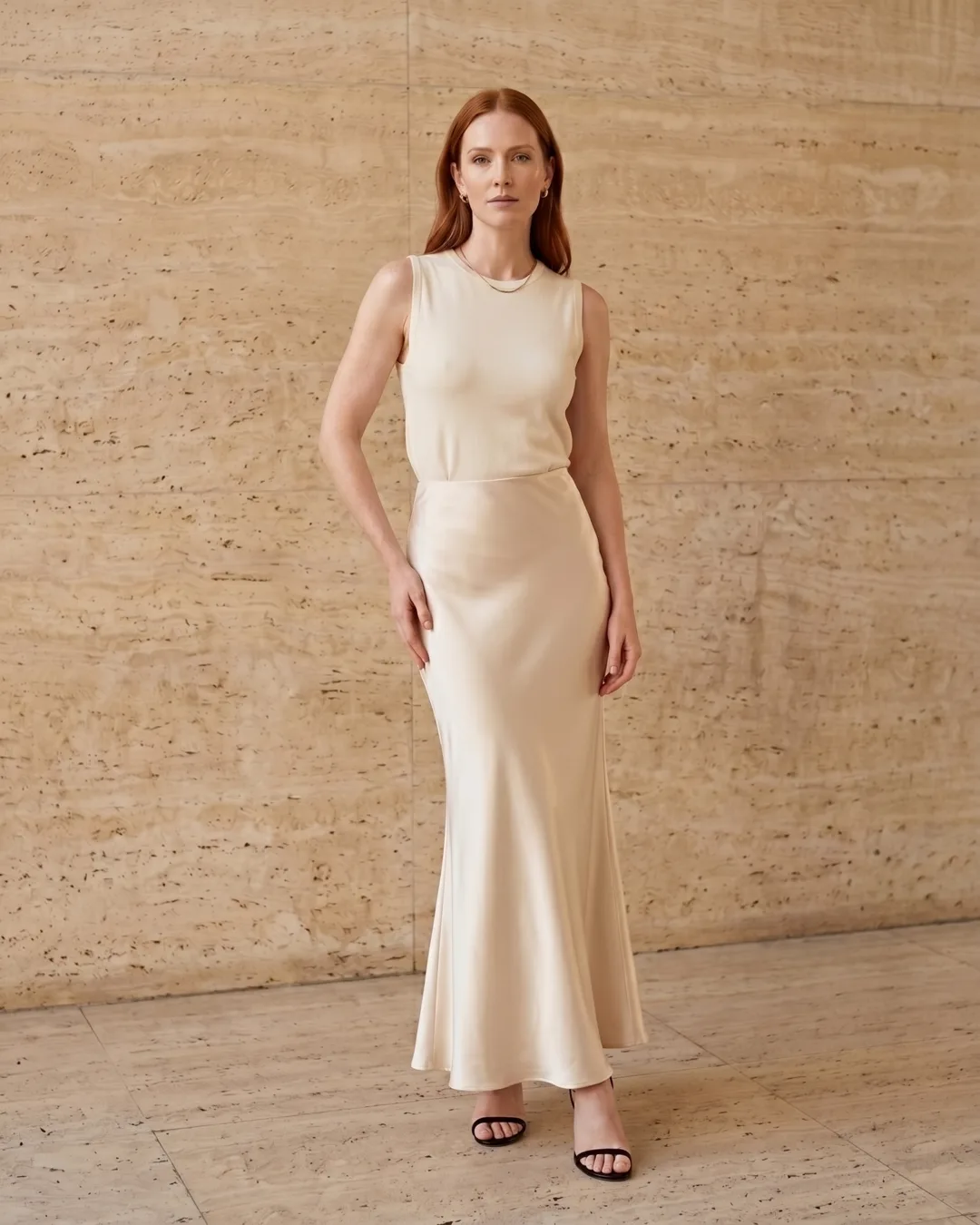
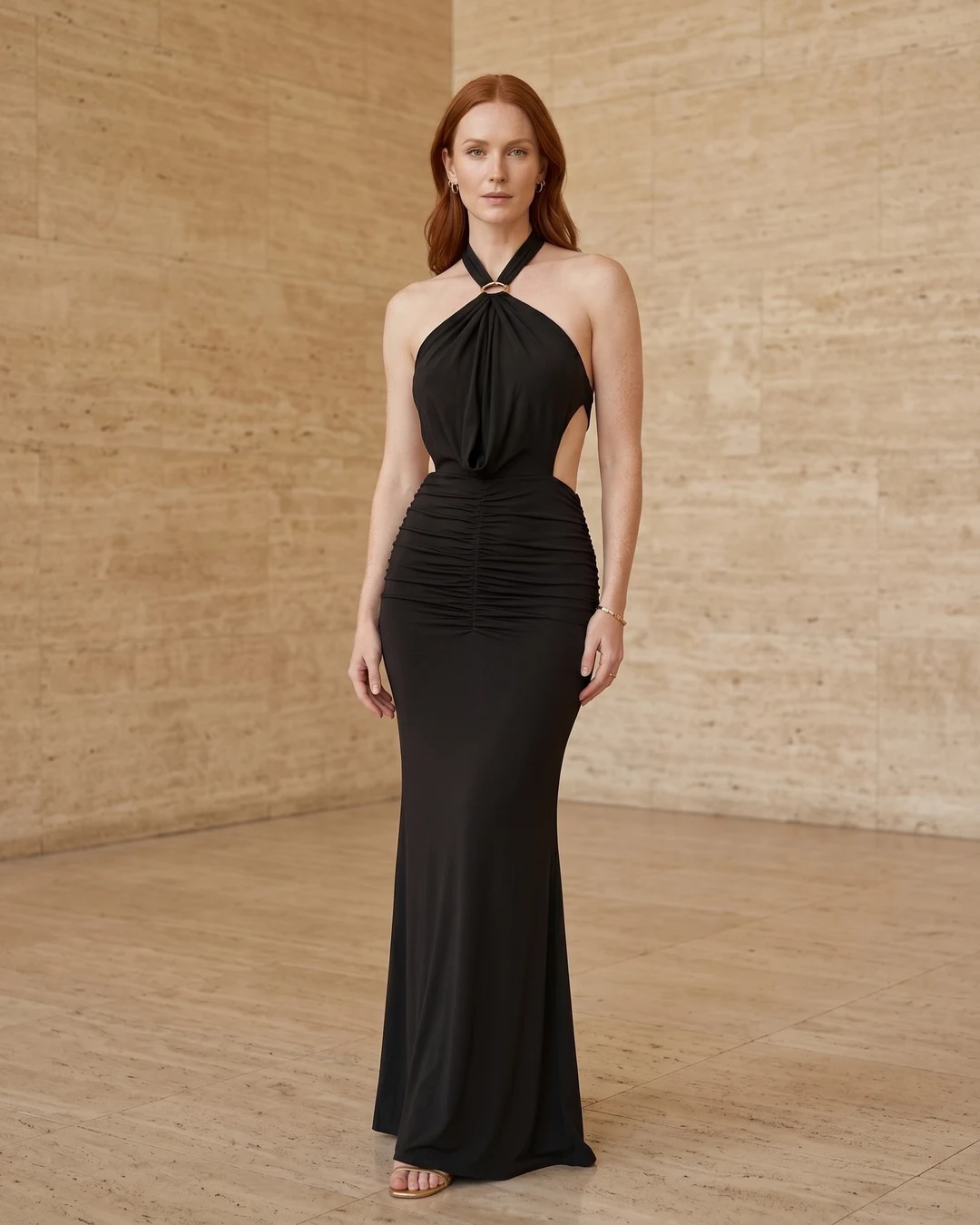
- An evening dress: a column or slip silhouette in satin or modal, such as the Tullia pleated crepe column.
- One structured leather bag: full-grain cowhide in a neutral, large enough for daily life.
- Leather loafers or flats: polished, comfortable on cobblestones, repairable.
One exception proves the point: a woman in a hot coastal climate swaps the merino knit for a linen overshirt without breaking the rule. The categories flex; the discipline does not.
#One dress, dressed up or down
An Italian woman re-wears one dress from day to evening by changing only the scarf, bag, and shoes. The garment stays; the three accessories carry the transition.
A floral chiffon midi like the Livilla works for daytime with flat sandals and a woven tote, then turns into dinner with gold earrings, a leather clutch, and a heeled sandal. She never owns a separate "evening wardrobe"; she owns evening accessories.
#Does an Italian woman wear denim?
Yes, an Italian woman wears a dark, well-cut jean styled with a fine knit, a leather bag, and polished shoes. The denim is the canvas, not the statement.
She avoids heavy distressing, oversized logos, and pale washes that look sloppy. A clean indigo straight-leg with a tucked merino knit and loafers passes the bella-figura test on any city street. The edge case: denim rarely appears for an occasion that calls for a dress, where she defaults to crepe or chiffon.
#How should clothes fit on an Italian woman?
Clothes on an Italian woman skim the body without clinging, and the fit is corrected by a tailor when the rack falls short. Fit beats label every time.
#Body-skimming, never tight
A body-skimming cut follows the line of the body while leaving a few millimeters of air, so fabric drapes rather than compresses. The difference shows in motion: a skimming dress moves with you, a tight one pulls at the seams.
An Italian woman fits the shoulder seam first, because a shoulder that sits wrong cannot be saved by anything below it. She has the waist nipped and the hem shortened by a sarta, the neighborhood seamstress, for the price of a lunch. Drape over compression is the whole doctrine.
Sizing down for a "sleeker look" is the common mistake, and it produces strain lines across the bust and back. An Italian woman sizes to the shoulder and tailors the rest.
#Length and proportion rules
An Italian woman cuts her hems at the knee or the floor, never the unflattering mid-calf, and defines the waist on at least one layer. Proportion does the flattering, not skin.
She balances a fitted top with an eased trouser, or a fluid dress with a structured bag, so one half always holds shape. A maxi gown grazing the floor lengthens the line; a knee-grazing chiffon A-line keeps it light. The house cuts these silhouettes to break at flattering points and publishes a model height so you can place the hem on your own frame.
A petite frame flips the rule: a floor-length column can overwhelm, so she chooses a knee-length crepe in one color head to toe.
#What fabrics and quality does an Italian woman insist on?
An Italian woman insists on natural fibers, because silk, fine merino or cashmere, cotton poplin, linen, and crepe drape, breathe, and age well. Synthetics read flat in daylight and in photographs.
#Natural fibers first
Natural fibers absorb and reflect light unevenly, so a silk hem falls in soft folds while a polyester one hangs stiff and shiny. That single visual cue separates expensive-looking from cheap on camera and in person.
She runs a real-fabric test before buying: she lifts a hem and watches it fall, then tilts the cloth to the light. Honest silk twill ripples; a knife-pleated recycled chiffon holds its fold; a matte crepe sits structured without sheen. A coastal linen creases, and that crease is a feature.
Performance fabric for travel is the honest exception. A wrinkle-resistant blend earns a place for a long flight, but she keeps it for utility, not for the occasions where drape matters.
#The finishing details an Italian woman checks
An Italian woman checks the seams, the buttons, the lining, and the hand-feel before she trusts a garment's price. Construction tells the truth that a label hides.
She turns the dress inside out to confirm it is fully lined with a concealed zip, not a raw seam and an exposed coil, then rubs the cloth between two fingers for weight. A modest silk square can outclass a costly one when the twill is dense and the edges are hand-rolled rather than machine-cut.
A beautiful fabric ruined by a flimsy button or a puckered seam fails her check, regardless of the name on the tag.
#What color palette does an Italian woman build her wardrobe on?
An Italian woman builds on four or five neutrals and lifts them with exactly one saturated accent at a time. One statement color per outfit is the ceiling.
#A neutral base with one rich accent
A neutral base of ivory, stone, tan, navy, and black makes every piece combine with every other, while a single rich color supplies the focus. The base does the work; the accent does the talking.
She wears a wine scarf against a stone dress, or a deep-green knit over navy trousers, never both at once. In summer she shifts the neutrals lighter, choosing ivory and travertine over basalt and cobalt. The principle of a quiet foundation lifted by one note runs through the old-money color palette, which maps the same restraint across a wider wardrobe.
An all-neutral outfit that goes lifeless is the first failure, and one saturated accessory rescues it. The opposite failure is the rainbow, where four competing colors cancel each other and the eye finds no focal point.
#The imperial palette, dyed in Rome
Hugo Caesar Tassi dyes its range across nine disciplined colors that work as a built example of the one-accent rule. Each neutral anchors; each saturated tone accents.
| Color | American name | Role in the outfit |
|---|---|---|
| Porpora | wine | saturated accent on a neutral base |
| Vermiglio | red | bold single statement |
| Cornelia | rose | soft accent for daywear |
| Verde Antico | green | deep accent against navy or stone |
| Travertine | stone | core neutral base |
| Cuoio | tan | warm neutral and leather match |
| Avorio | ivory | summer-light base |
| Basalt | black | evening anchor |
| Cobalto | navy | versatile base across seasons |
Read the table as a kit: pick two or three neutrals as the base, then add one saturated row as the accent. A worked styling walk-through lives in the imperial palette journal piece, which pairs each color to specific pieces.
#How does an Italian woman accessorize: the scarf, the bag, the jewelry?
An Italian woman accessorizes with one silk scarf, one excellent leather bag, and a little fine gold, then removes one thing before she leaves. Two signatures, total restraint.
#The silk square scarf as an Italian woman's signature
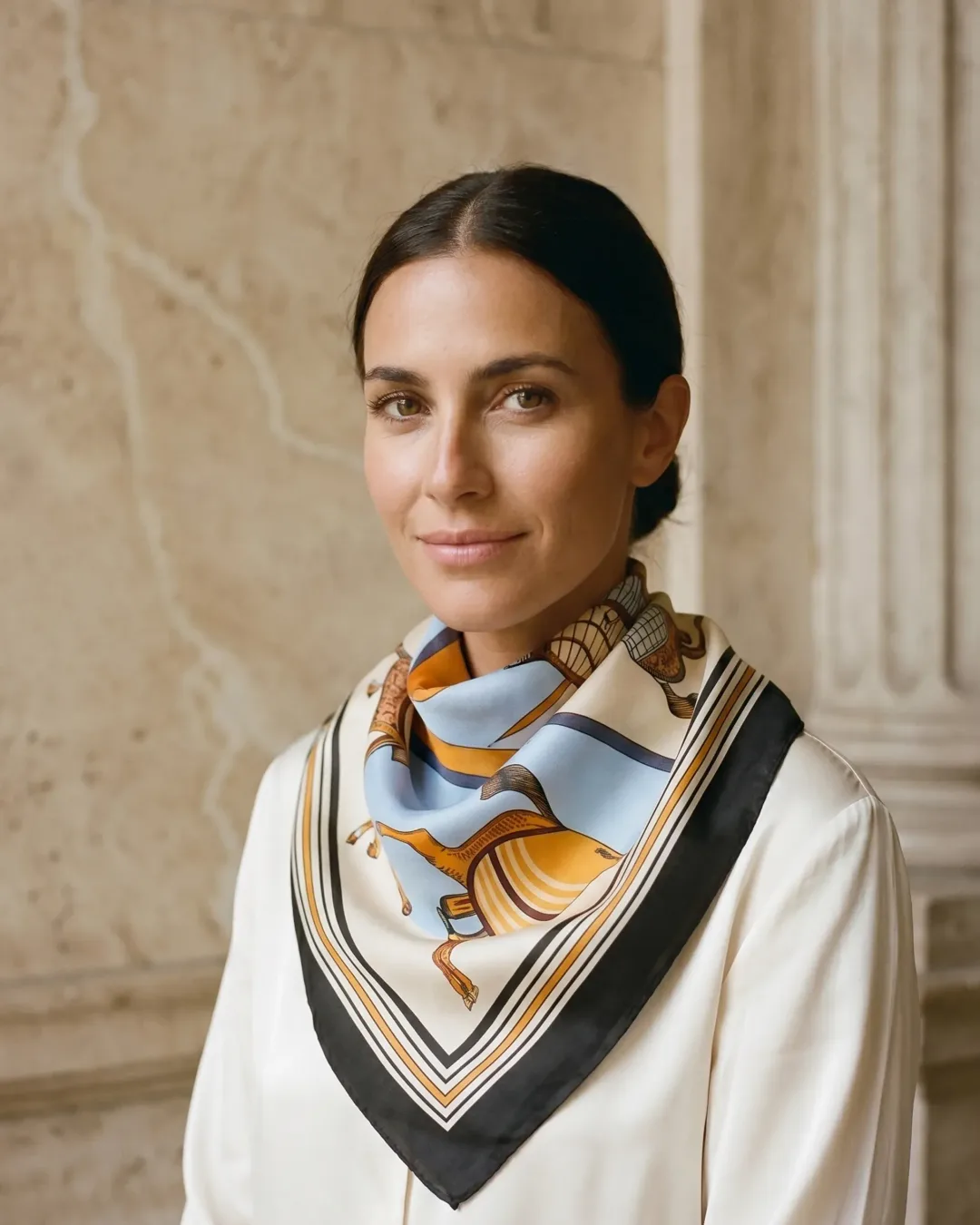
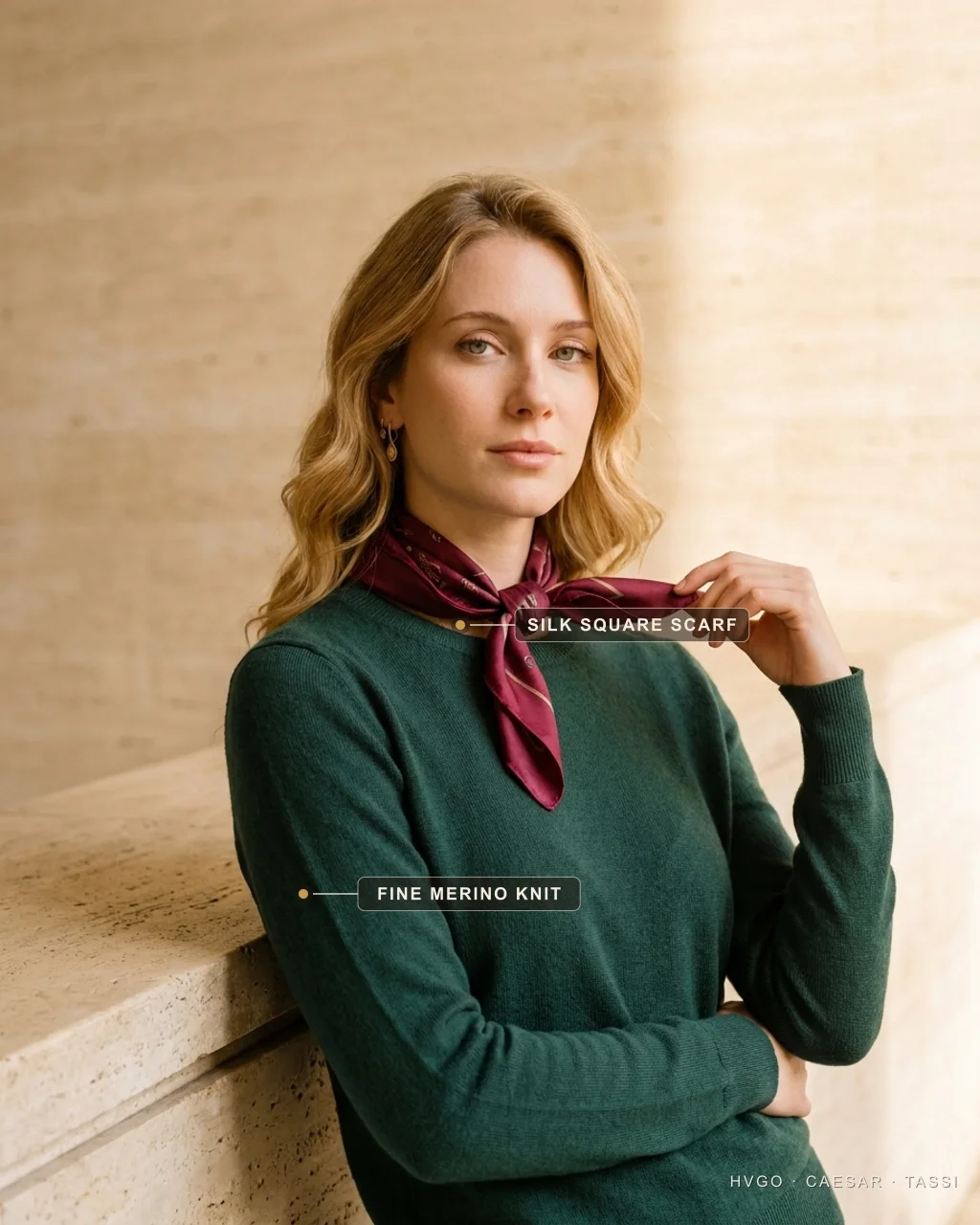
A 90 cm silk-twill square is the Italian woman's most flexible accessory, worn at least three ways from one piece of cloth. It elevates the plainest outfit for the cost of a single garment.
She knots it at the neck over a white shirt, folds it into a hair band, or ties it to a bag handle so it moves as she walks. The Palmyra twill silk square does all three. A dense twill rolls and holds a knot; a thin printed scarf slides loose and reads cheap. The full range sits in silk scarves, each cut to the same square dimension.
- Silk square scarf
- Fine merino knit
Over-accessorizing is where it breaks down: scarf, statement earrings, and stacked bracelets together fight the one-focal-point rule, so she keeps the scarf and drops the rest.
#One excellent leather bag
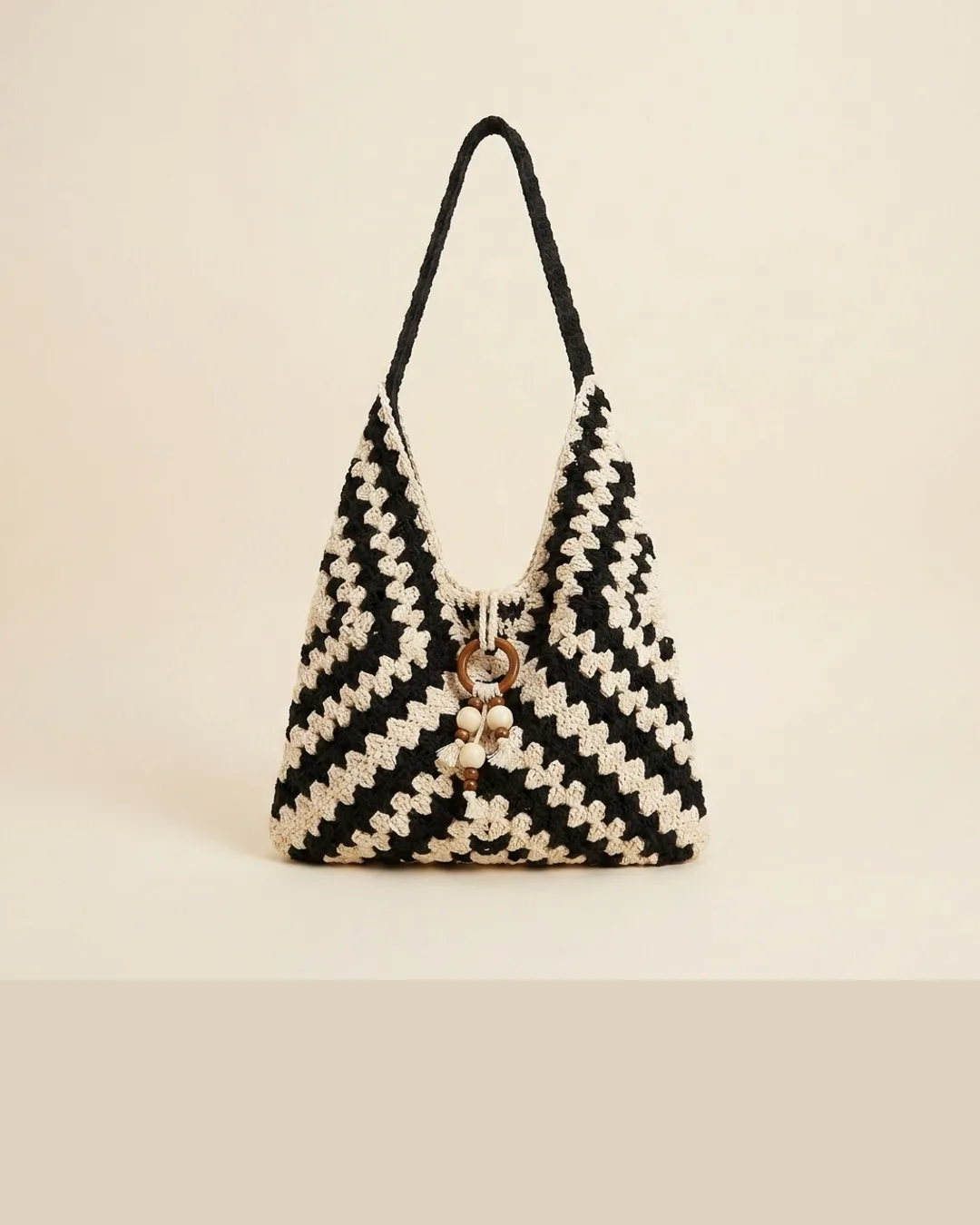
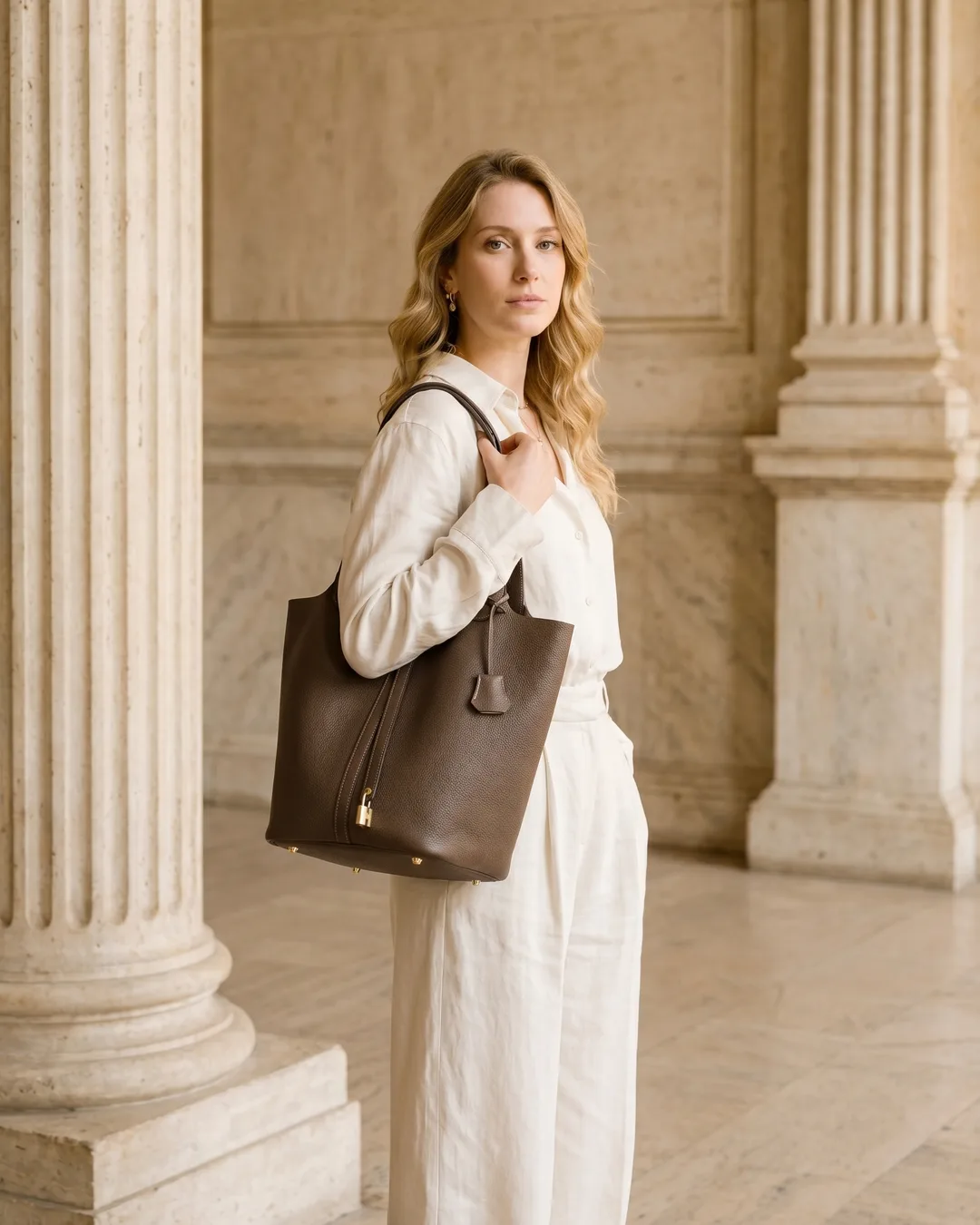
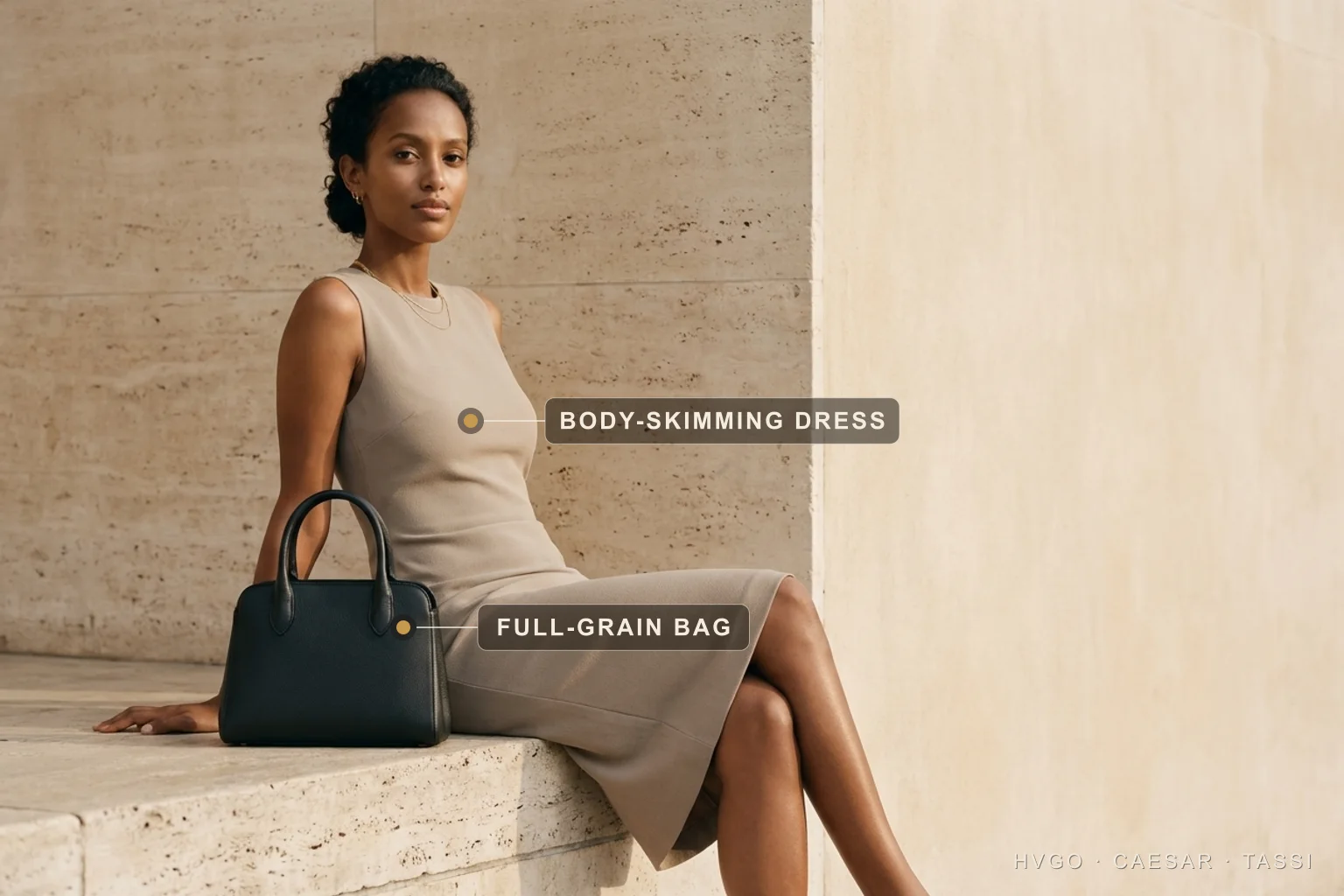
An Italian woman owns one structured full-grain cowhide bag in a neutral rather than several cheap ones. Quality leather develops a patina; bonded leather peels.
She chooses a shape that holds its form when set down and a tone that matches most of her wardrobe, usually tan, basalt, or cobalt. The Palatina leather shoulder bag answers that brief, and the wider leather bags selection runs to totes, crossbodies, and clutches in the same full-grain hide.
- Full-grain bag
- Body-skimming dress
The counter-case is the matching-set instinct. Bag, shoes, and belt in identical leather reads dated, so she matches the bag to the outfit's mood, not to her shoes.
#Restraint in jewelry, hair and shoes
An Italian woman wears a little fine gold, keeps hair and skin groomed, and chooses polished leather shoes, then subtracts one accessory. Less, checked twice.
A guide to choosing the metal that suits your skin sits in the gold or silver explainer; an Italian woman tends to favor warm gold. She wears leather loafers, ballet flats, or low sandals that stay comfortable on stone streets, kept clean and reheeled. The "remove one thing" habit, often credited to Coco Chanel, is the final edit before the door.
An evening event shifts the math: one larger gold piece replaces the daytime stack rather than adding to it.
#Why does an Italian woman never wear a visible logo?
An Italian woman avoids visible logos because cut, fabric, and fit signal quality more reliably than a printed name. Confidence shows in the seam, not the monogram.
#The no-logo confidence rule
The no-logo rule treats quiet construction as the real luxury signal, so a perfect shoulder outranks any branded hardware. Hugo Caesar Tassi was founded on that restraint in 2004.
She lets a bias-cut satin or a knife-pleated chiffon speak through its drape. The fuller argument for spending on weight and fit over flash is laid out in the quiet luxury guide. Flash announces price; restraint announces taste.
A discreet maker's mark inside a bag, invisible until you open it, is the accepted exception, because it brands nothing to the street.
#Regional and life-stage nuance: Roman, Milanese, coastal
An Italian woman flexes the rules by city, season, and age rather than applying one stereotype everywhere. Rome, Milan, and the coast each tilt the same doctrine.
A Roman woman leans warm and a little undone; a Milanese woman cuts sharper and more monochrome; a coastal woman trades crepe for linen and flat sandals. The Italian vs French style comparison shows where Italian color-confidence parts from French austerity, while warm weather has its own Italian summer style rules.
Age flexes the rule without breaking it: a woman of 60 keeps the same fit-and-fabric discipline but raises a neckline and lowers a hem, so the doctrine scales across a lifetime.
#How Hugo Caesar Tassi dresses you like an Italian woman
The house maps every rule above to specific Roman-cut pieces in honest fabrics across S–3XL (EU 34–44). Each garment is fully lined with a concealed zip and dyed in the imperial palette.
#The house pieces that build the look
The house translates the doctrine into day dresses, an evening column, two signatures, and a published model height for hem judgment. Each rule becomes a real piece.
The Julia French-pleated chiffon maxi and the Portia short-sleeve chiffon A-line cover body-skimming daywear; the Livilla floral-print chiffon midi suits a passeggiata, the evening stroll. The Palmyra silk square and the Palatina leather shoulder bag supply the two signatures. Because the house publishes each model's height near 175 cm, you can judge where a hem breaks on your frame.
#Your first three buys, in order
Buy the leather bag first, the silk scarf second, and the dress third, because the two signatures carry every outfit you already own. Order matters.
- The bag: one full-grain neutral that anchors a decade of looks.
- The scarf: a 90 cm silk square that restyles what you have.
- The dress: a body-skimming day or evening piece in your accent color.
If your closet already holds good basics, invert the order and buy the dress first.
#The Italian woman's rules, in one glance
The whole doctrine fits one screen: edit hard, fit perfectly, choose natural fibers, discipline the palette, keep two signatures, hide the logos. Screenshot the table before you shop.
| Rule | Do | Don't |
|---|---|---|
| Wardrobe size | Keep 30–40 pieces you wear | Hoard trend buys |
| Fit | Skim the body, tailor the rest | Size down until it strains |
| Fabric | Choose silk, merino, poplin, linen, crepe | Settle for shiny synthetics |
| Palette | Build neutrals, add one accent | Mix four competing colors |
| Length | Cut at knee or floor | Stop at the mid-calf |
| Signatures | Keep one bag, one scarf for years | Buy many cheap versions |
| Logos | Let cut and fabric speak | Wear a visible monogram |
| Final edit | Remove one accessory | Stack scarf, earrings, bracelets |
#Frequently asked questions
How do Italian women dress so well on a normal budget?
Italian women dress well on a normal budget by buying fewer, better pieces and re-wearing them constantly. They spend on one leather bag, one silk scarf, and well-fitting basics rather than a closet of trend pieces. Tailoring what you already own stretches the budget furthest.
What shoes do Italian women actually wear?
Italian women wear leather loafers, ballet flats, and elegant low or flat sandals in neutral tones. The shoes stay comfortable on cobblestones, never turn flashy, and are kept polished and reheeled rather than replaced each season.
What colors do Italian women wear most?
Italian women wear a disciplined neutral base of ivory, stone, tan, navy, and black, lifted by one rich accent. A single saturated note like wine, red, or deep green supplies the focus. They avoid wearing many colors at once.
How do Italian women look elegant without much makeup?
Italian women look elegant without much makeup because grooming and posture carry the impression. Clean skin, neat brows, tidy hair, an upright stance, and clothes that fit do more than a painted face, since the whole impression outranks any single feature.
Do Italian women wear jeans?
Italian women wear jeans, choosing a well-cut dark or tailored pair styled with a fine knit and good shoes. They skip distressing and visible logos. Denim rarely appears for an occasion that calls for a dress, where crepe or chiffon takes over.
Is dressing like an Italian woman the same as quiet luxury or old money?
Dressing like an Italian woman overlaps with quiet luxury and old money on restraint and quality, but runs warmer. It allows one saturated accent and expressive tailoring, where quiet luxury stays muted. The shared ground is honest fabric, perfect fit, and no visible logos.
Start the look with the two signatures every Italian woman keeps for years: browse the silk-scarves and leather-bags collections, then choose a body-skimming house dress from women's dresses.
More Italian Style guides
Italian Summer Style
A Roman house's Italian summer style rulebook: fibers that breathe, the Riviera palette, and how to stay elegant, never touristy, in the heat.
Dress an Italian summerItalian vs French Style
A Roman house compares Italian vs French style for women on fit, color and attitude, then names which elegance is yours from the Italian side.
Compare Italian vs French eleganceLa Bella Figura
What la bella figura really means, and how a Roman house turns it into a three-part dressing code for women: sprezzatura and brutta figura explained.
Master la bella figuraLa Dolce Vita Style
La dolce vita style: Fellini's 1960 Rome in oxblood-and-ivory satin, and how to dress it now: the slip, the scarf, the dark shades. From a Roman house.
Decode 1960 Roman glamourWhat to Wear in Lake Como and the Riviera
A Roman house edits what to wear in Lake Como and the Riviera: four real moments mapped to the dress, color and sandal that fit each.
Dress the lakeside evening