Italian Summer Style: How a Roman House Dresses the Riviera in the Heat
A Roman house's Italian summer style rulebook: fibers that breathe, the Riviera palette, and how to stay elegant, never touristy, in the heat.
On this page
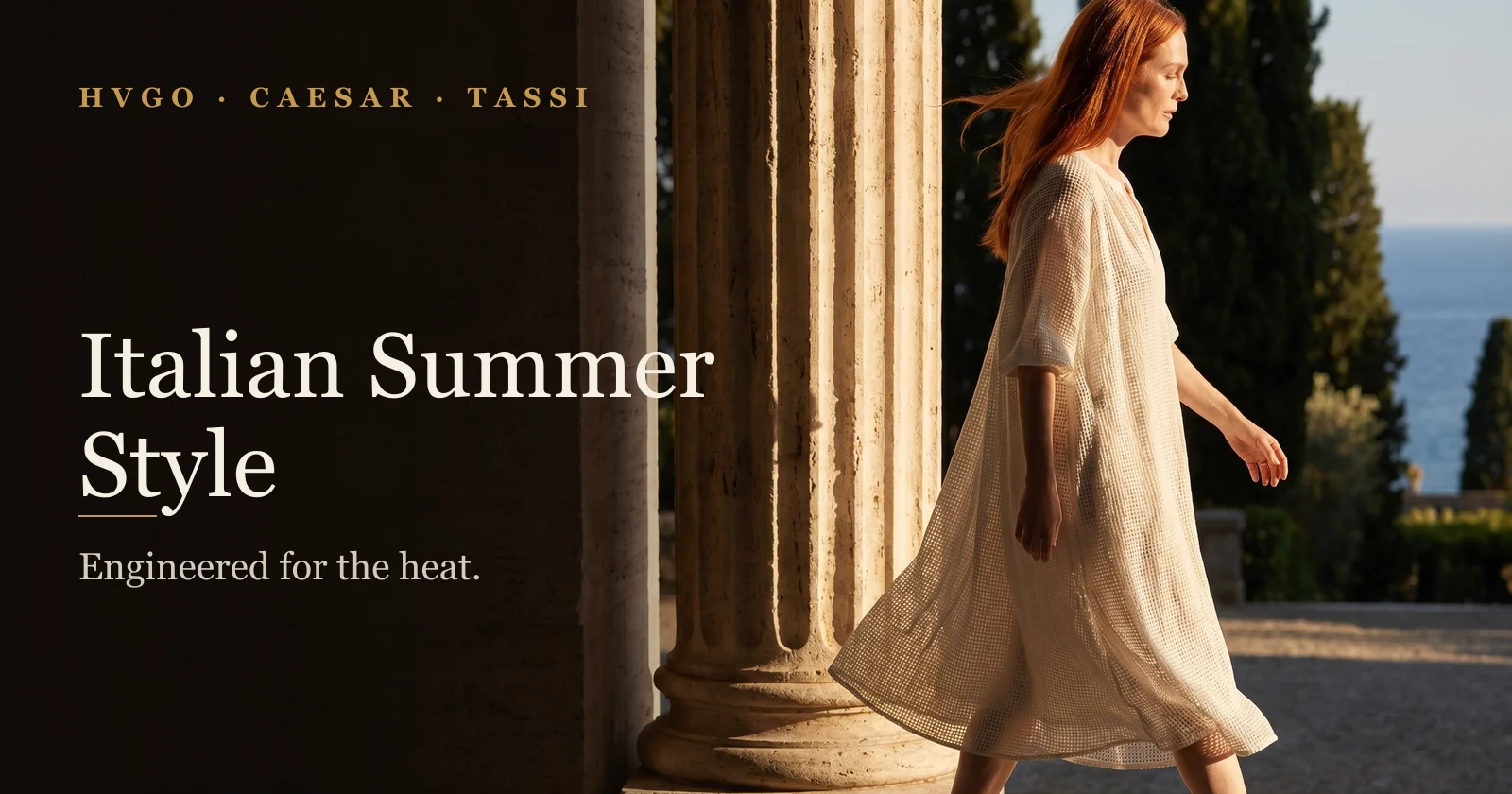
Italian summer style stays cool because it is engineered, not lucky: the women composed through a 90-degree Portofino afternoon picked the fiber, the length and the palette before the look. Hugo Caesar Tassi, a Roman house founded in 2004 on the motto Nata Imperare, treats the summer wardrobe as a fabric law. Here is that law, packable.
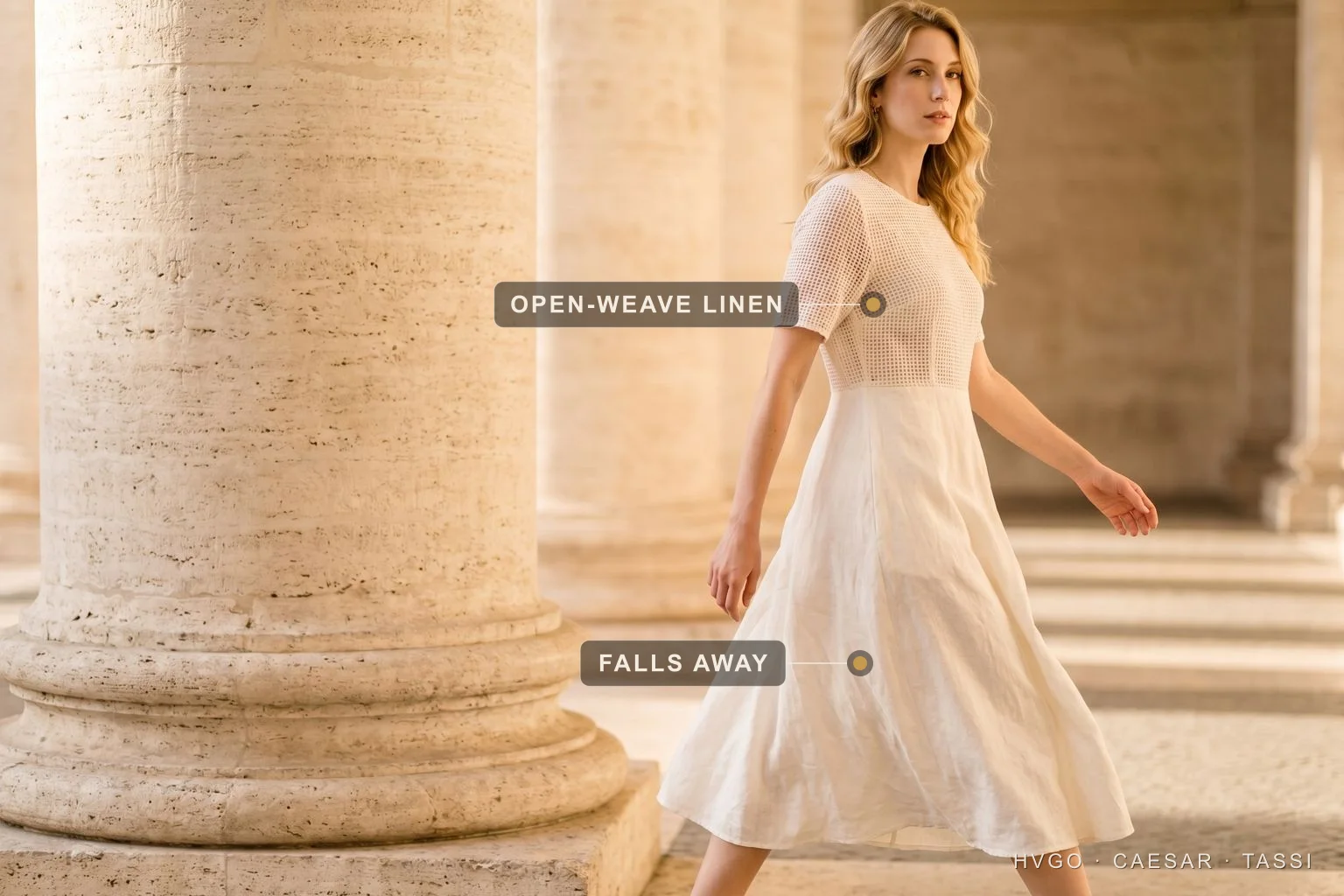
- Open-weave linen — a loose, matte weave that moves air across the skin
- Falls away — cut loose so the cloth drops free of the body rather than clinging
#What is Italian summer style, and why doesn't it look like sweating in a sundress?
Italian summer style is la bella figura applied to heat: a woman stays composed by choosing breathable fiber and flattering cut before she ever picks a color. The whole system answers one question: how do you cross a sweltering noon piazza and an evening aperitivo looking deliberate at both ends? The difference between composed and damp is mechanical. A loose-woven linen dress moves air across the skin; a clingy polyester sundress traps a humid layer and shows every minute of the afternoon.
#Engineered ease, not luck
A woman looks effortless in heat because she made three decisions before she left the room: fiber, length, palette. Sprezzatura, the studied carelessness Italians prize, is the visible result of invisible choices. Pick a knee-or-floor hem, never the unflattering middle, and one statement color.
Consider a Tuscan villa lunch at 2 p.m. A 175-cm woman in a knife-pleated chiffon midi reaches the shade still pressed, because pleats hold cloth off the leg. The same woman in a bodycon jersey mini spends lunch peeling fabric off her thighs. Same heat, opposite outcomes.
#The maker's view vs. the tourist's view
This page is written from the cutting table, not a holiday snapshot, which separates it from the affiliate lists that own this search. The English-language results for Italian summer outfits are travel bloggers ranking straw bags, none of whom has cut a summer dress or watched recycled chiffon behave under Mediterranean glare.
That maker's standing is the whole point. A house publishes its construction facts, like fully lined dresses, concealed zips and recycled chiffon, so a reader can verify the rules instead of trusting a vibe. For the attitude underneath, the la bella figura guide sets the philosophy, and the italian style pillar holds the year-round system this seasonal page narrows.
#The fabrics that make Italian summer style breathable yet elegant
Loose-woven natural and natural-derived fibers let air move and wick humidity, while dense synthetics trap it: linen, cotton, silk, viscose and the house's recycled chiffon all breathe. Fiber is the first decision because it sets the ceiling on how cool you can stay. A lightweight, slightly open weave passes air; a tight, heavy one seals it in even when the label says cotton.
#The breathable fibers: linen, cotton, silk, viscose and chiffon
Five fibers carry an Italian summer because each one moves air rather than holding heat against the skin: linen, cotton, silk, viscose or modal, and recycled chiffon. Linen wrinkles by design; those creases are the texture, not a failure. Recycled chiffon, knife-pleated or bias-cut, drapes weightlessly and dries in minutes.
Care is the trade-off you accept knowingly. Linen creases on purpose and presses out in a steam; chiffon needs a gentle hand. One edge case: viscose loses strength when wet, so a damp viscose dress should hang-dry, never wring. The chiffon satin crepe guide breaks down each fiber in full.
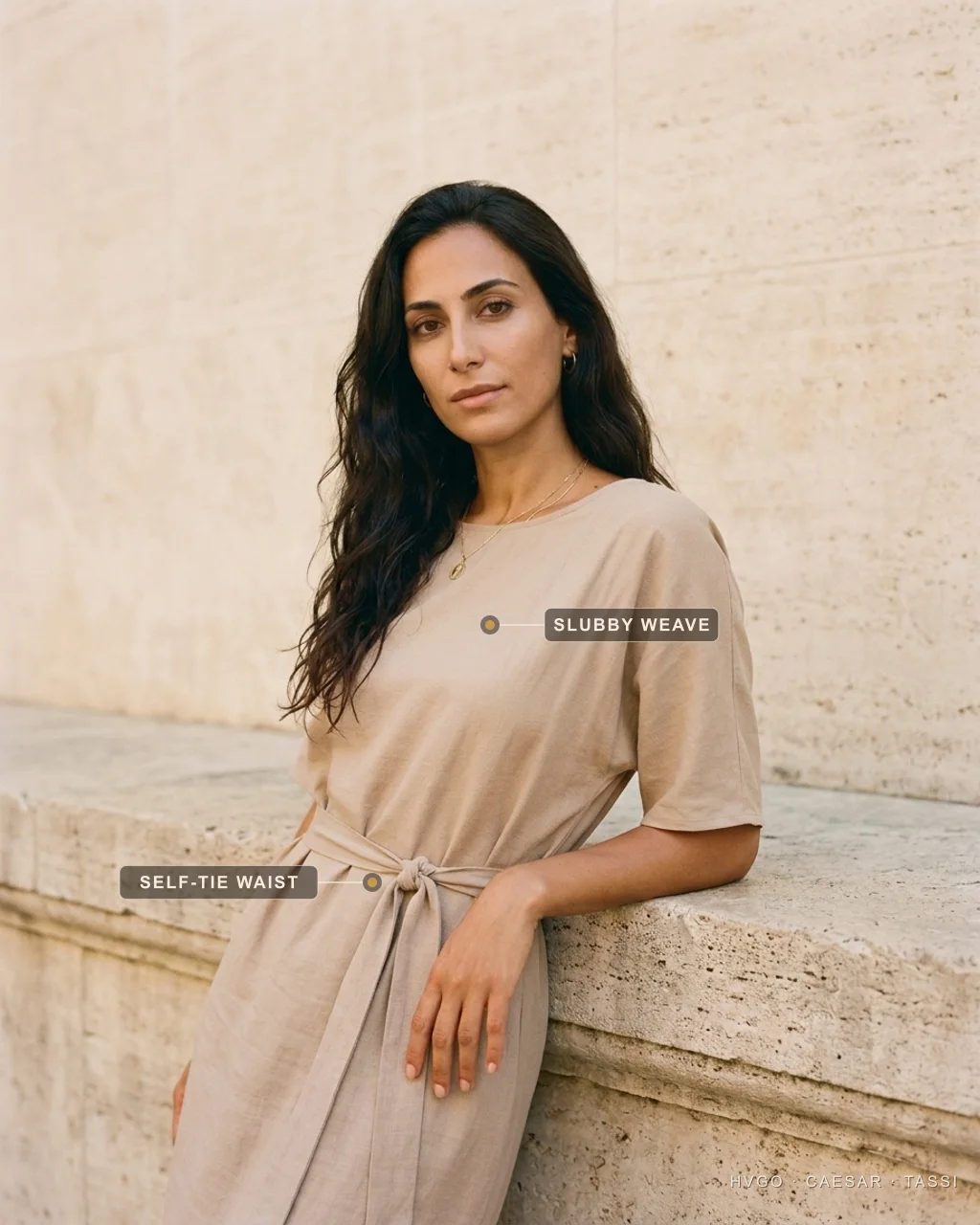
- Slubby weave — a fine, matte Tencel-linen texture that breathes against the skin
- Self-tie waist — a soft knotted tie that shapes the waist without constriction
#The fabrics to leave at home
Polyester, acetate and heavy synthetics trap heat, cling when you sweat, and read cheap under strong Mediterranean light. Their fibers don't wick, so humidity pools at the skin and flashes a plasticky sheen no cut can disguise.
The nuance separates good advice from a blanket ban. High-quality satin is gorgeous and worth packing, but it is an evening fabric, never a noon one, because its weight and shine suit cooler air. That exception sets up the divide every Italian woman runs by instinct.
#The daytime-versus-evening fabric divide
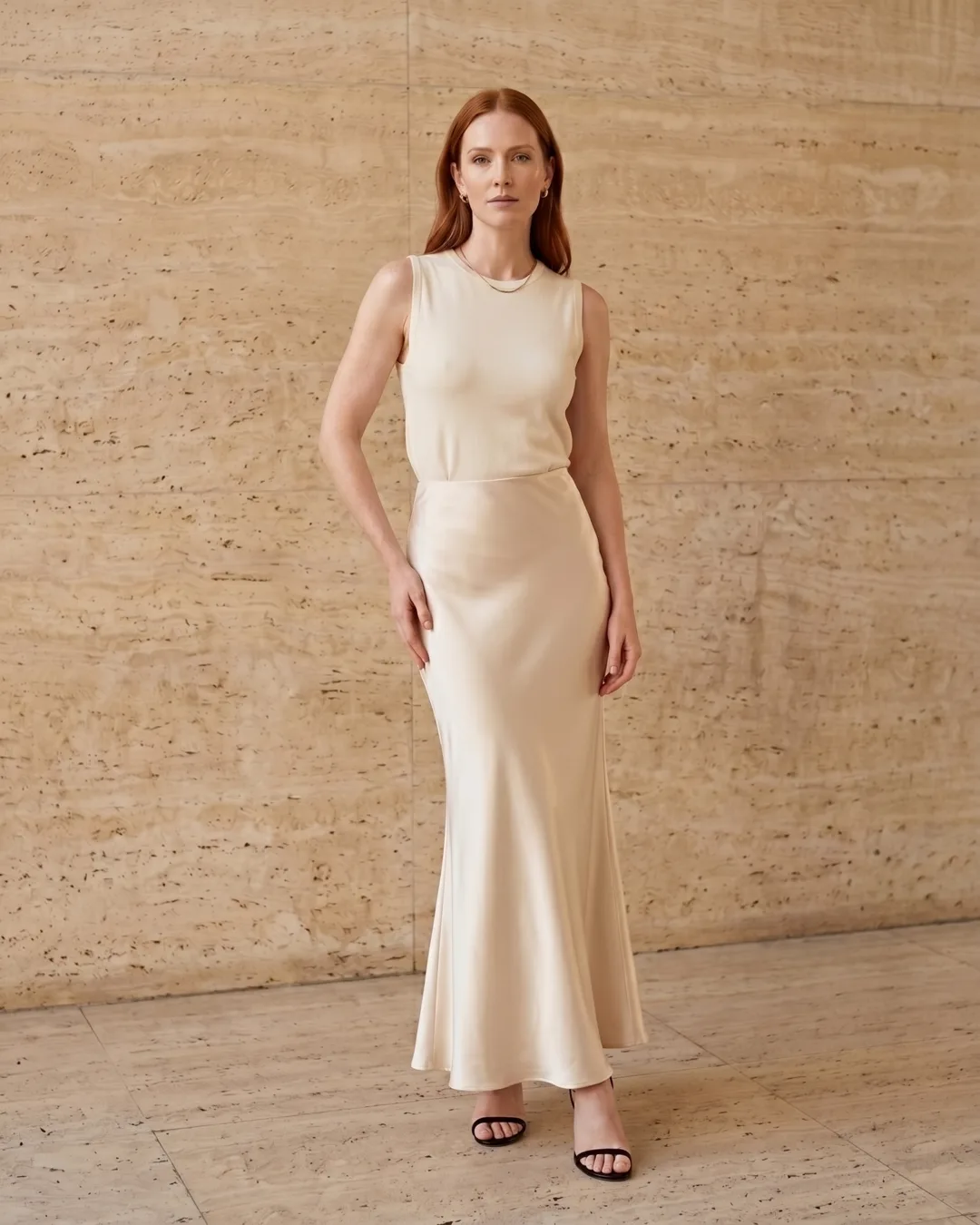
Chiffon, crepe, cotton and linen carry the hot daytime hours; satin and heavier silk wait for the cool of evening. This signature rule keeps a traveler from over-dressing at noon and under-dressing at dinner. The clock, not the calendar, picks the cloth: the Pantheon at midday calls for a matte crepe column that breathes, while the same woman at a 9 p.m. trattoria steps up to bias-cut satin.
| Fabric | Best hours | Why it works | Hold for |
|---|---|---|---|
| Recycled chiffon | Day (10am to 6pm) | Open weave, near-weightless drape | n/a |
| Linen / cotton | Day, full sun | Wicks humidity, shades the skin | n/a |
| Matte crepe | Day into early evening | Structured, breathes, no cling | n/a |
| Bias-cut satin | Evening (after 7pm) | Drape and shine suit lamplight | Midday heat |
| Heavier silk | Evening, dinner | Cooler-air luster | Strong sun |
#The dresses that anchor an Italian summer style wardrobe for women
Three dress shapes anchor a woman's summer wardrobe: a breezy daytime A-line, a pleated maxi for cover and movement, and one light column for evening. Each flows away from the body, covering every hour from market to aperitivo without a single clingy silhouette. Length does real work too: a midi or maxi shades the legs from coastal sun and reads more grown-up than a sundress.
#The breezy daytime dress: A-line and fluttery midi
A short-sleeve chiffon A-line and a printed chiffon midi are the daytime workhorses because they flutter away from the skin and move with the air. The house's Portia, a short-sleeve chiffon A-line, and Livilla, a floral-print chiffon midi, both fall loose from the shoulder. The shoulder seam is fitted first; everything below it floats.
A fluttery midi stays cooler than a bodycon mini and looks more elegant doing it, because the mini clings where the midi vents. For a market morning in Florence, the A-line is the answer; the clingy mini is a slow surrender.
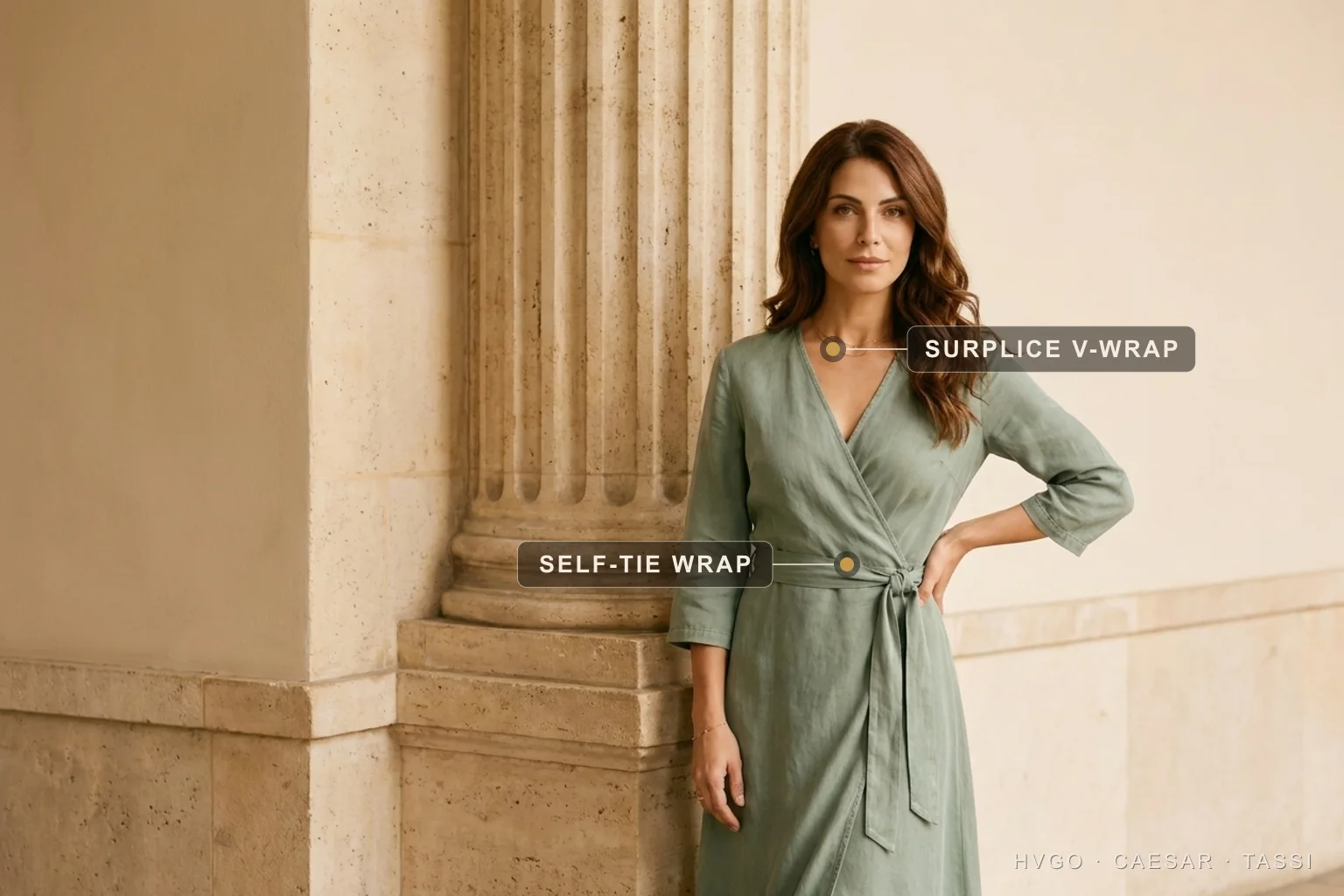
- Surplice V-wrap — a diagonal crossover neckline that opens the chest and lengthens the line
- Self-tie wrap — an adjustable knotted tie that sets the waist tension yourself
#The pleated maxi for cover and movement
A French-pleated maxi covers the legs for churches and strong sun yet stays airy because the pleats hold the fabric off the skin. The Julia, a French-pleated chiffon maxi, is the do-everything piece: knee-and-ankle coverage with no heat penalty, since the pleats act like vents along the cloth.
This is the maxi's advantage over a flat-cut floor dress, which seals against the legs in still air. A pleated Julia carries from a noon Cinque Terre trail to an early dinner without a change, whereas a heavy column would have you melting by the second village.
#One easy column for the evening
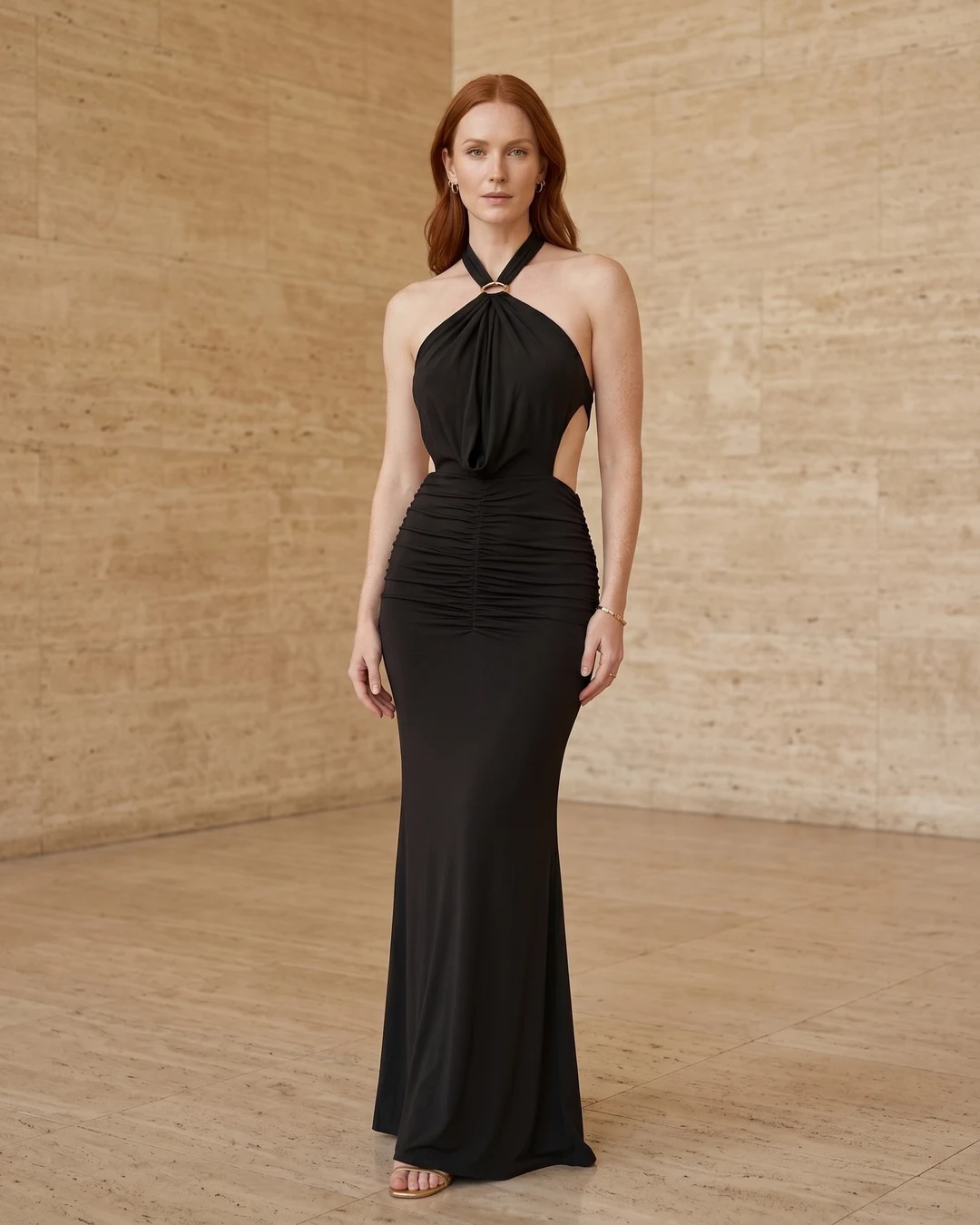
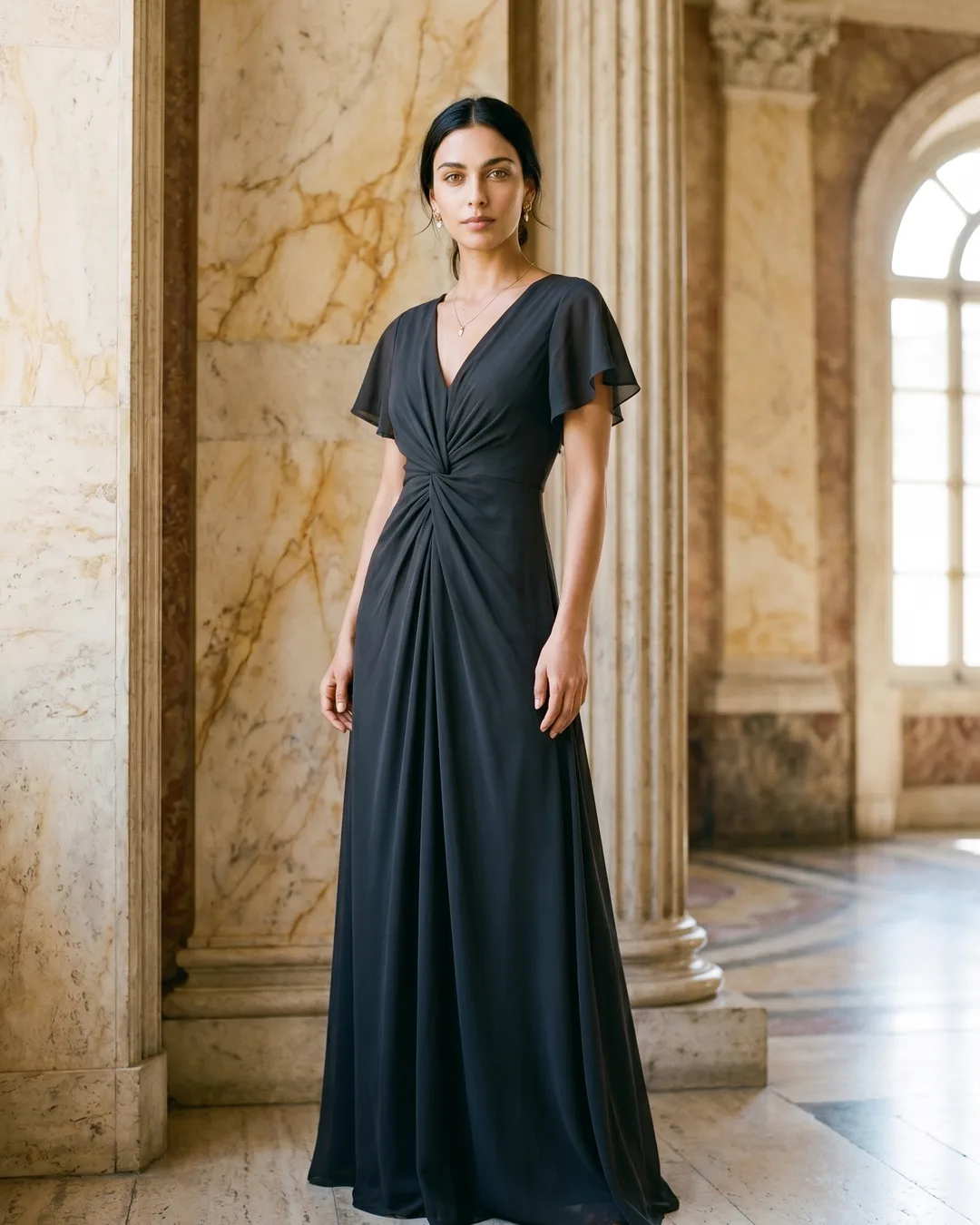
A summer capsule needs exactly one dressier piece: a draped modal or light column for dinner and aperitivo. The Vipsania, a draped modal column gown, slips on for the evening without the weight of a satin gown, because modal drapes like silk yet breathes like cotton.
Keep the heavy satin evening gowns out of the daytime conversation entirely. They suit true occasions, and the lake como and riviera edit hands you the full evening lineup so this page stays on the daytime core.
#The colors that define Italian summer style on the Riviera
The Riviera palette is warm and sun-washed because those tones belong to the coast's white architecture, terracotta and sea light: Avorio ivory, Travertine stone, Cipria pink, Cornelia rose and soft Verde Antico. Color is the third decision, after fiber and length. Get it right and you disappear into the place; get it wrong and you signal "visitor" from across the piazza, with ivory and stone as the daytime defaults.
#The Riviera palette: ivory, stone, soft pink and faded brights
Ivory, stone, soft pink, rose and muted green match Liguria's whitewashed walls and terracotta roofs. Avorio and Travertine echo the buildings; Cipria and Cornelia pick up the bougainvillea; sun-washed Verde Antico answers the sea. The doctrine is one statement color per outfit, never a rainbow.
There is room for a faded brand, like a dusty cornflower, provided it looks bleached by sun. Neon does the opposite, broadcasting newness against a centuries-old wall.
#Why white and neutrals look local, and black-in-August looks foreign
Crisp white, sand and warm neutrals are the local default in heat, while head-to-toe black in August marks you instantly as a tourist. Black absorbs sun and looks out-of-season; the neutral story reflects light and matches the architecture. This is the single most reliable tell on the street.
A nuance keeps it from being a rule against black entirely. A black silk scarf or evening column is perfectly Italian after dark, whereas a black daytime dress at noon turns heavy and out of season. Compared to a Travertine linen midi, the August-black sundress loses on both temperature and place.
#Prints that read Italian, not loud
Small florals, paisley, abstract botanicals and watercolor stripes read Italian; oversized logos, slogan tees and licensed-character prints do not. Scale is the deciding factor: a quiet pattern suits the coast, while a logo across the chest suits an airport.
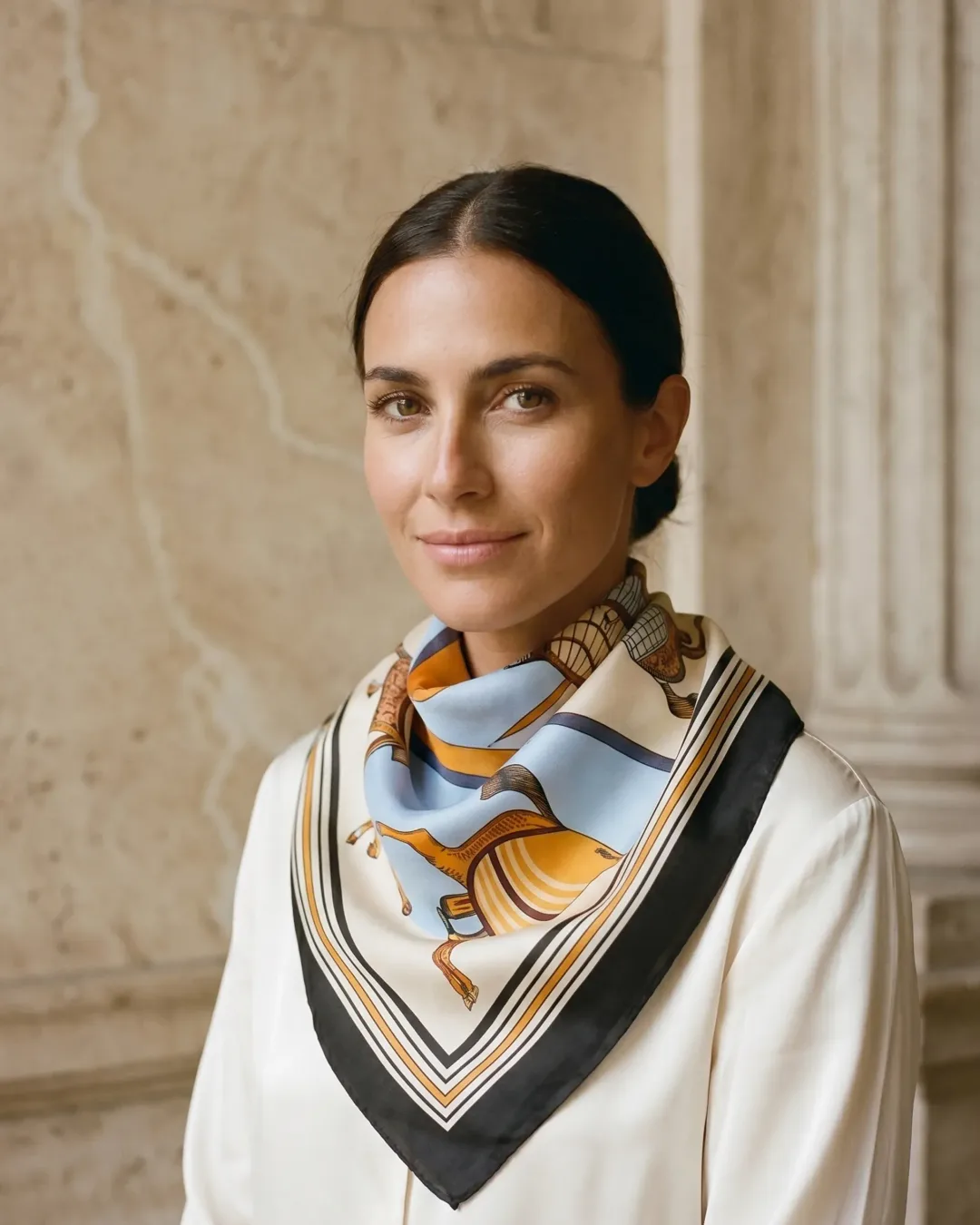
A printed chiffon midi or a paisley silk scarf adds the pattern without the volume. The Tessera, a paisley silk square, carries the print on 90 cm of cloth instead of across a chest, which is exactly the restraint the look demands.
#How to accessorize Italian summer style without overdoing it
Italian summer accessories run on restraint: one silk square scarf, one summer bag, and barely-there jewelry do the work of a packed case. The doctrine is one focal point only, since fewer, better pieces beat a stack that traps warmth and reads anxious. Gold suits summer light better than silver, and a brimmed hat earns its place by doing real sun work.
#The silk square scarf as a summer multitool
One 90 cm silk square out-earns a suitcase of jewelry because it works at the neck, in the hair, on a bag handle, over the shoulders or as a beach throw. HCT's Carina, a glossy silk square, ties five ways from a single 90-by-90-cm piece, which is why it anchors the capsule.
In a church the same scarf becomes an instant shoulder cover; on the sand, a light throw. Keep its washing in mind, since silk dye runs in hot water; the silk scarf guide covers the cool-water method.
#The summer bag: woven tote by day, structured leather by night
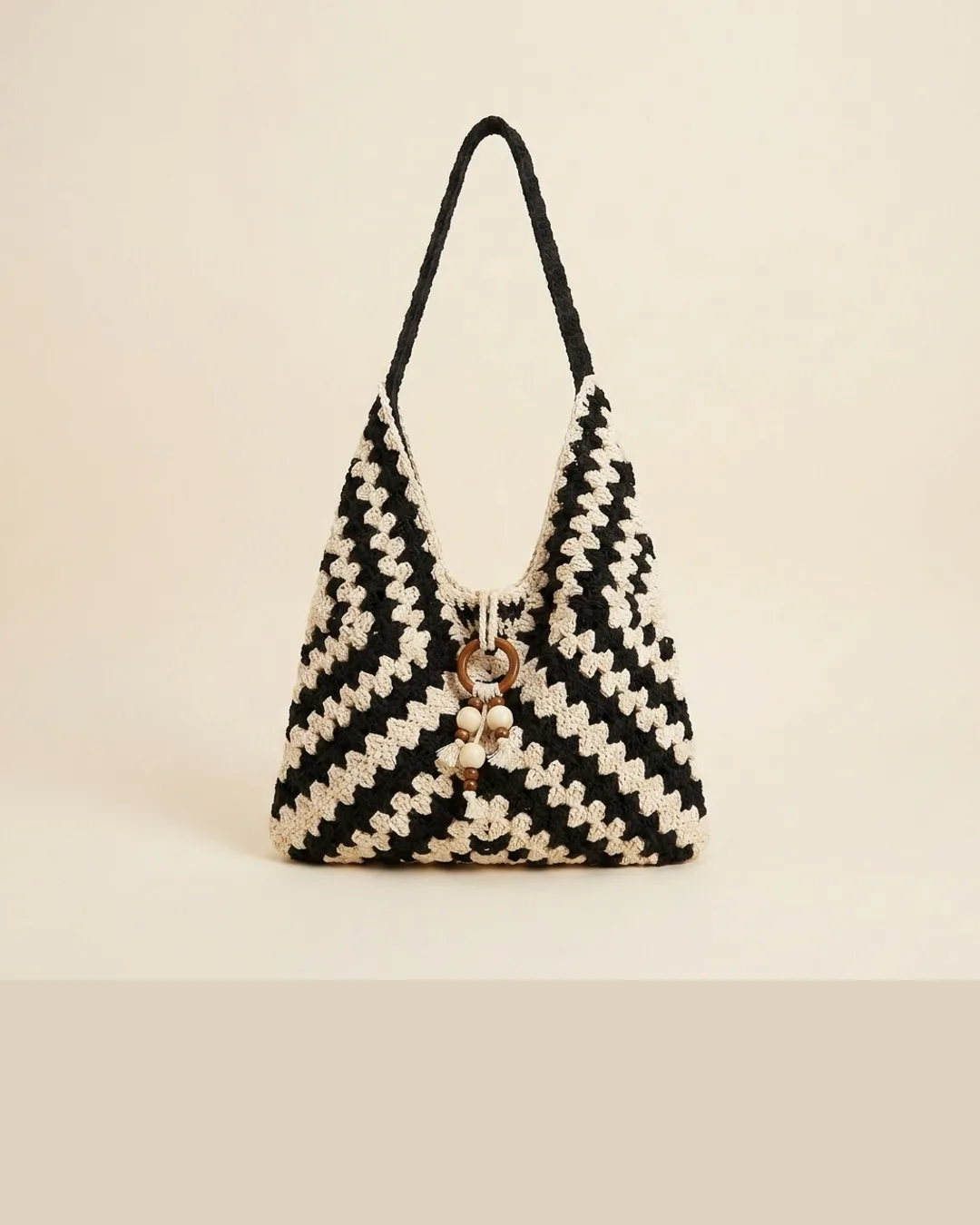
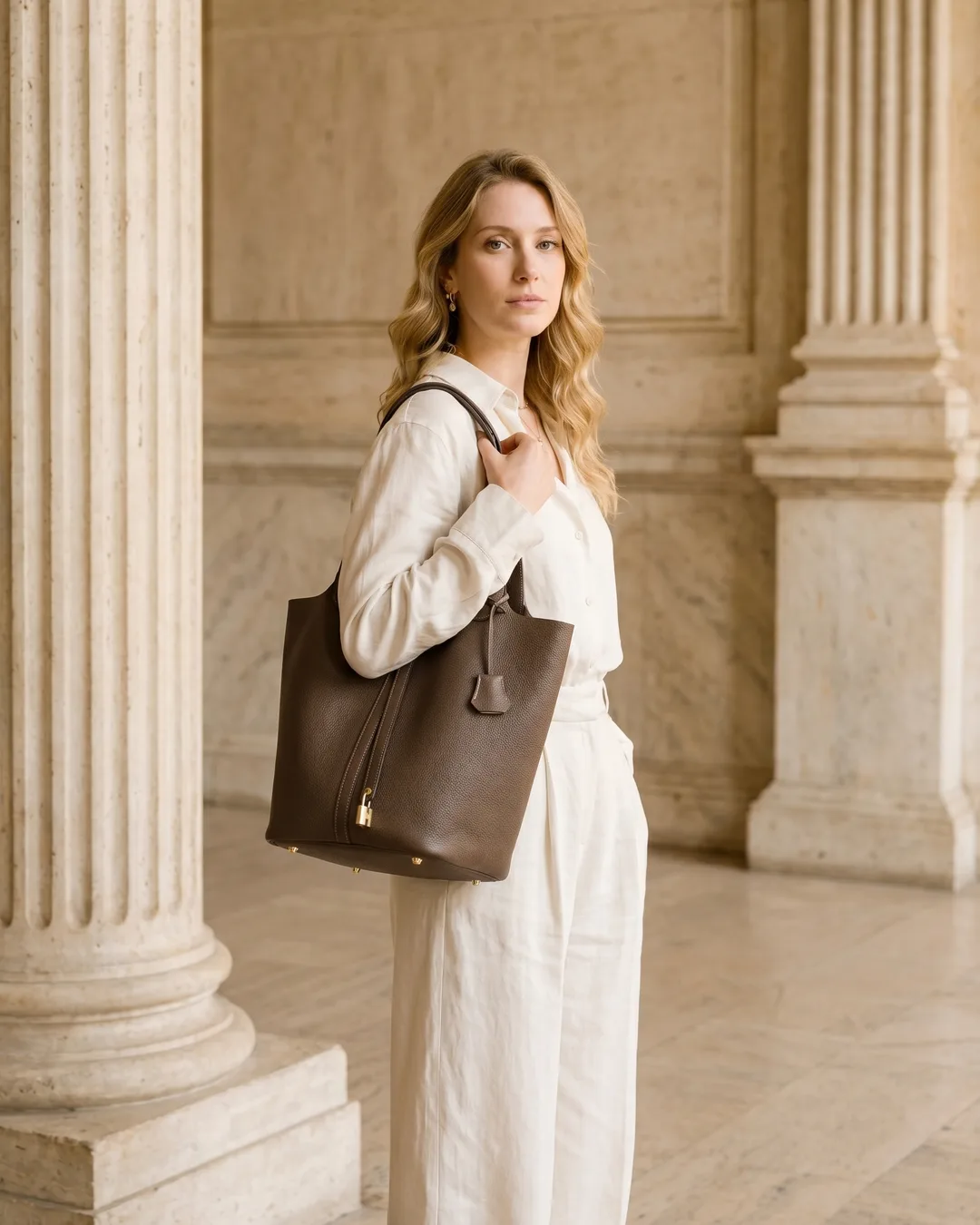
A woven shoulder tote or cowhide basket bag carries the day; a structured leather shoulder bag or envelope clutch finishes the evening. HCT's Ostia, a woven shoulder tote, and Tivoli, a cowhide basket bag, read Riviera at the market and the beach, roomy enough for a hat, a scarf and water.
A basket-shaped woven tote belongs to the coast in a way a nylon backpack never will. For dinner, swap to a clean full-grain leather shoulder bag; the backpack, by contrast, flags "tourist" from the first glance.
#Sun, skin and restraint
A brimmed straw hat, oversized sunglasses, light fragrance and bare jewelry finish the look without crowding it. The hat and glasses do genuine sun work; the restraint is the elegance. Matte before shine, one focal point only.
Footwear stays simple: leather sandals, espadrilles or a low block heel, with the detailed picks deferred to the broader accessories edit. Heavy perfume in 90-degree heat travels badly, so keep fragrance light and close to the skin.
#Italian summer style without the tourist tells, and how to stay covered for a church
You avoid the tourist look by dressing for the day, not the flight, and you solve church modesty with a midi plus a scarf instead of a separate cover-up. The covered-shoulder rule and the tourist tells are the practical traps every packing list forgets. An Italian woman is assembled for the hours ahead, while the visitor is dressed for transit in sneakers and a logo tee.
#The covered-shoulder rule for churches and nice restaurants
The Vatican, the Duomo and many churches require covered shoulders and knees, which a midi or maxi plus a silk scarf solves instantly. Choose a dress that already covers the knee, then carry the square to throw over bare shoulders at the door. No bulky shawl, no second outfit.
The same slightly dressier daytime dress earns respect at a good restaurant, where shorts and a tank do not. One garment clears both the basilica and the lunch reservation.
#The tourist tells to avoid
The reliable tourist tells are athleisure as daywear, sneakers, slogan tees, visible logos, beachwear in town and synthetic fast-fashion sundresses. Each one signals dressed-for-transit. The fix is never more clothing; it is the right four pieces.
- Gym leggings and sneakers in a piazza, where a real dress and a sandal belong
- Slogan tees and visible logos, against the small-print rule
- Beachwear worn into town, instead of a cover that travels off the sand
- Synthetic fast-fashion sundresses that cling and sheen under the sun
#How Hugo Caesar Tassi builds an Italian summer style capsule
The house capsule is three dresses, one scarf and two bags in a single Avorio-and-Travertine palette, all chosen fiber-first. It fits a carry-on because every piece shares one color story. Nata Imperare is the founder's summer-fabric law in three words: rule the heat by dressing for it.
#A three-dress, one-scarf, two-bag capsule
Seven pieces in one palette cover a full Italian summer, day to night. The daytime A-line is Portia; the printed midi is Livilla; the cover-and-movement maxi is Julia; the evening column is Vipsania. The scarf is Carina, with Tessera as the paisley alternate, and the daytime bag is Ostia or Tivoli.
| Piece | HCT name | Fiber | When |
|---|---|---|---|
| Daytime A-line | Portia | Recycled chiffon | Market, lunch |
| Printed midi | Livilla | Floral chiffon | Sightseeing |
| Cover maxi | Julia | French-pleated chiffon | Church, sun, trail |
| Evening column | Vipsania | Draped modal | Dinner, aperitivo |
| Multitool scarf | Carina / Tessera | Silk, 90 cm | All day, all uses |
| Daytime bag | Ostia / Tivoli | Woven / cowhide | Beach, market |
#Noon to aperitivo on one wardrobe
The same maxi carries from a noon piazza to an evening aperitivo with two swaps: scarf placement and bag. At midday, knot the scarf at the neck, carry the woven tote, add the hat. By evening, move the scarf to the hair and switch to a structured leather bag. The dress never changes.
That two-move transition proves the capsule logic works in the field. For true dinner-and-occasion looks beyond an aperitivo, the Riviera evening edit picks up where this daytime core ends.
The Italian summer capsule
Seven pieces in one Avorio-and-Travertine palette that carry a full Riviera summer, day to night.
#Your Italian summer style wardrobe, in one rule
Choose the fiber first, then the length, then the palette, then one scarf and the right bag; that sequence is Italian summer style. La bella figura in summer means staying cool and composed at once, never one at the expense of the other.
#The fabric-first recap
The takeaway is a four-step order: fiber, length, palette, accessories. Linen, cotton, silk, chiffon and crepe by day; satin only at night. Midi or maxi for sun and cover. Ivory, stone, soft pink and faded brights, never neon and never noon-black.
The edge case to remember: a beautiful fabric in the wrong palette still flags you as a tourist, and the right palette in a synthetic fiber still feels cheap. Both decisions have to land.
#Where to go next
From here, shop the breathable core and read the evening and year-round guides. Build from the breathable dresses, add the one accessory that does the most work, and study the broader rules in the how to dress like an italian woman guide for the seasons beyond July.
#Frequently asked questions
What colors do Italian women wear in summer?
Italian women wear mostly warm neutrals and soft, sun-washed colors in summer: ivory, stone, sand, soft pink and rose, with the occasional faded blue or green. These tones belong to the coast's white architecture, terracotta roofs and sea light, so they read local. Neon brights and head-to-toe black in August read like a tourist.
What fabrics are best for hot weather dresses?
The best fabrics for hot weather dresses are loose-woven natural and natural-derived fibers: linen, cotton, silk, viscose or modal, and lightweight chiffon and crepe. Each lets air move and resists clinging when you sweat. Avoid polyester and acetate, which trap heat, and keep heavier satin for cooler evenings.
How do I dress for Italy in summer without looking like a tourist?
You dress for Italy in summer without looking like a tourist by wearing a real dress in a breathable fiber and a warm neutral palette. Carry a woven or leather bag instead of a backpack, and skip the athleisure, sneakers and slogan tees. The Italian rule is to dress for the day, not the flight.
What should I pack for an Italian summer trip?
You should pack one capsule in a single palette for an Italian summer trip. Bring two to three breathable daytime dresses (an A-line, a printed midi and a pleated maxi), one light column for evening, one silk square scarf, a woven daytime tote and a structured leather bag for night. Mixing and matching in one color story keeps it to a carry-on.
How do I stay cool but still cover up for churches in Italy?
To stay cool yet covered for churches in Italy, choose a midi or maxi that already covers the knees and pack a silk square scarf you can throw over bare shoulders. It becomes an instant shrug at the Vatican or the Duomo, solving the modesty rule without a separate cover-up. The scarf still breathes, so you don't trade coverage for heat.
Are maxi dresses good for hot weather?
Yes, maxi dresses are good for hot weather when they're cut in a breathable fiber. A lightweight, loose or pleated maxi keeps the cloth off your skin, shades your legs from strong sun and reads more elegant than a clingy mini. Choose chiffon, linen or crepe rather than a heavy synthetic, and the length becomes an asset instead of a heat trap.
Build your capsule from the fiber up: shop the breathable chiffon dresses edit, add the one scarf that does the work of ten pieces from the silk scarves collection, and read the Lake Como & Riviera edit for the evening occasion looks that finish the trip.
More Italian Style guides
How to Dress Like an Italian Woman
A Roman house's real rules for dressing like an Italian woman: fit, fabric, color and the scarf-and-leather signatures that read elegant, never touristy.
Dress like an Italian womanItalian vs French Style
A Roman house compares Italian vs French style for women on fit, color and attitude, then names which elegance is yours from the Italian side.
Compare Italian vs French eleganceLa Bella Figura
What la bella figura really means, and how a Roman house turns it into a three-part dressing code for women: sprezzatura and brutta figura explained.
Master la bella figuraLa Dolce Vita Style
La dolce vita style: Fellini's 1960 Rome in oxblood-and-ivory satin, and how to dress it now: the slip, the scarf, the dark shades. From a Roman house.
Decode 1960 Roman glamourWhat to Wear in Lake Como and the Riviera
A Roman house edits what to wear in Lake Como and the Riviera: four real moments mapped to the dress, color and sandal that fit each.
Dress the lakeside evening