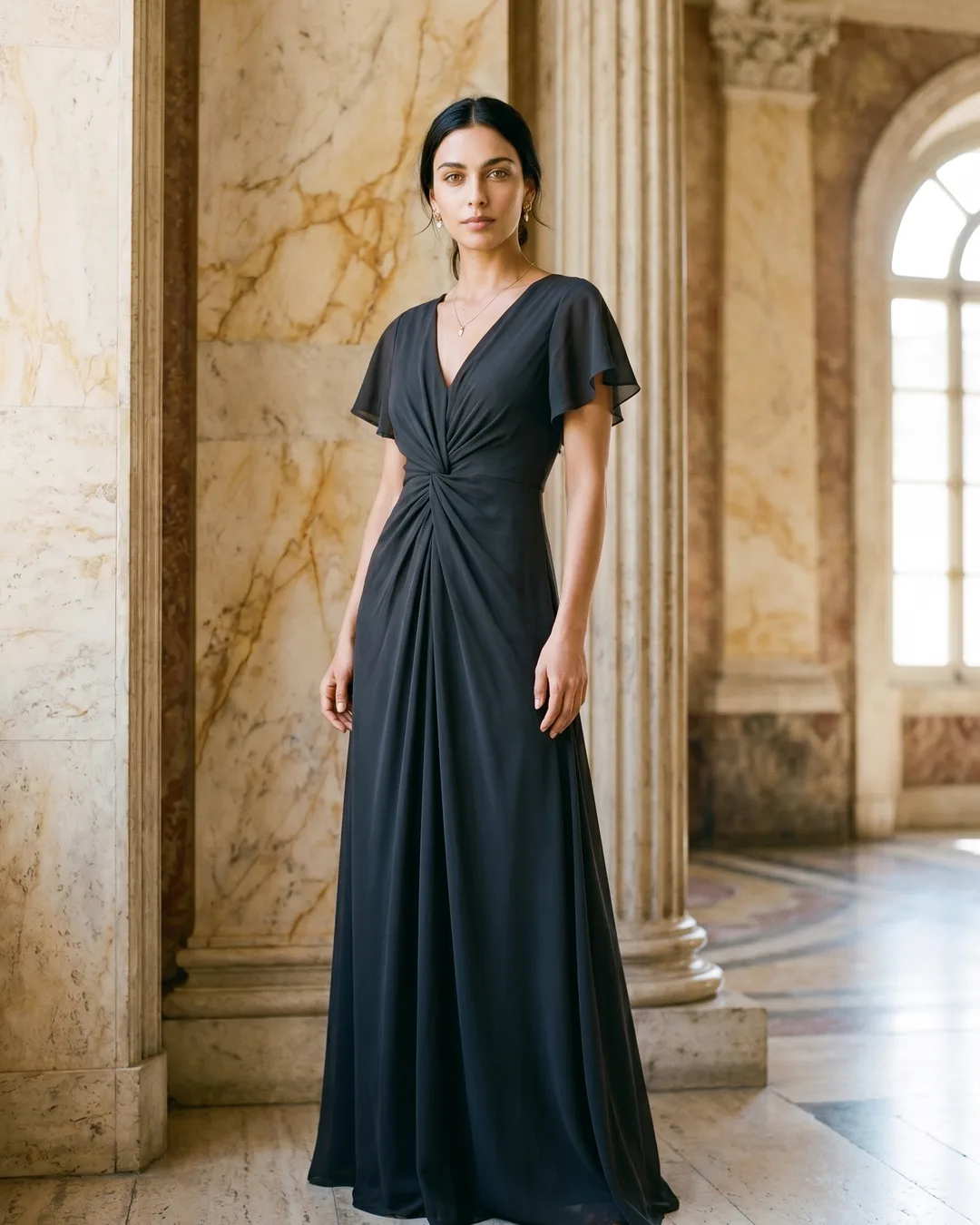
Quiet Luxury, Explained: Old Money vs New Money vs Stealth Wealth
A Roman house defines quiet luxury by the garment, not the price — then settles how it differs from old money, new money and stealth wealth for women.
On this page
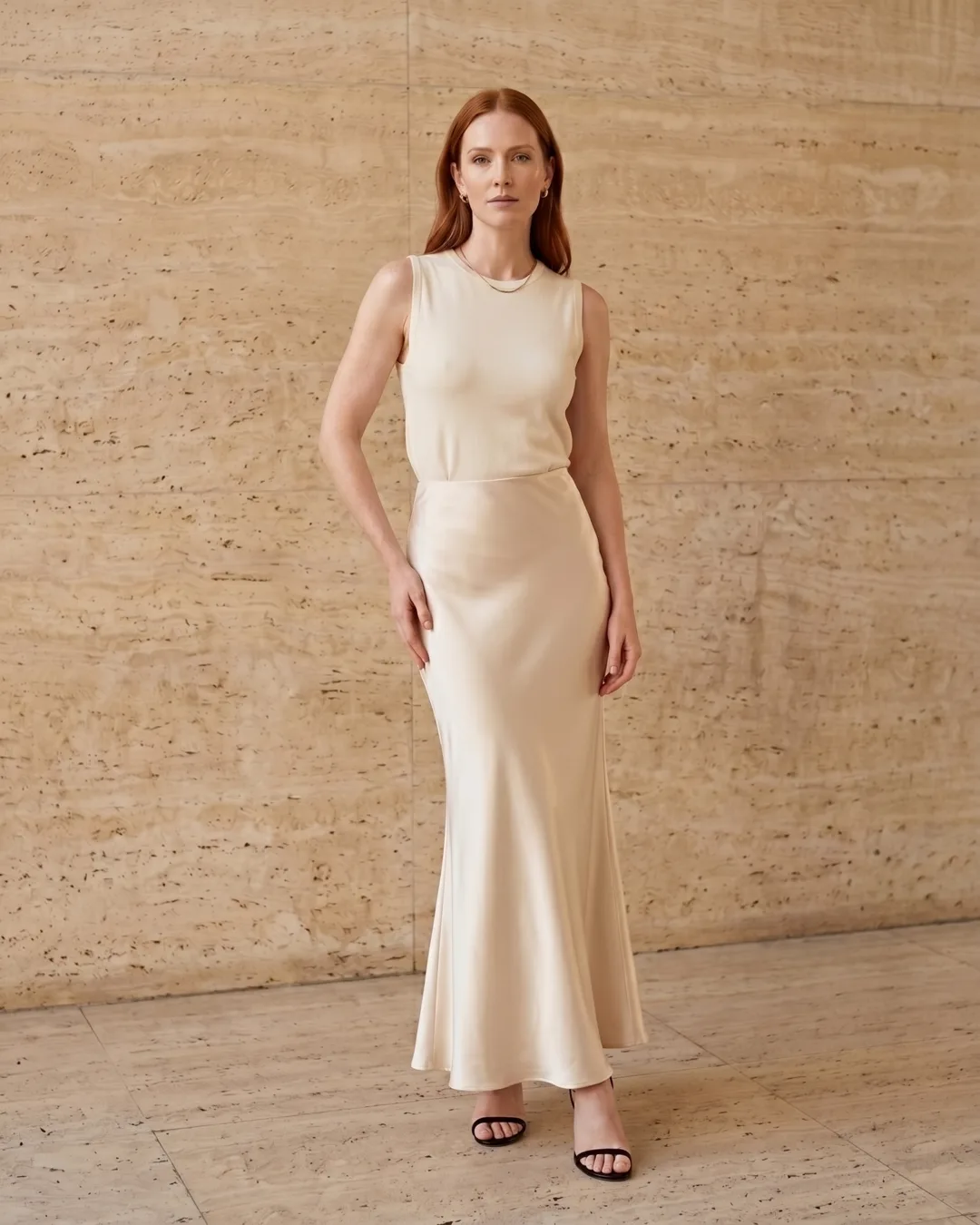
Quiet luxury means a woman's garment reads expensive through how it is made, not what it cost or whose logo it shows. The tells are physical: matte drape, a full lining, finished seams, a clean shoulder, no visible branding. This guide defines that standard, then settles three terms everyone blurs.
The quiet-luxury garment test
Run these on the dress itself, not on the price tag or the label.
- Check matte drape first: the cloth should fall cleanly from the hip without standing away or catching hard light, like Vipsania modal or dry Claudia chiffon
- Confirm a full bagged lining and finished, enclosed seam allowances inside the dress
- Fit the shoulder seam to sit exactly at your shoulder edge: a wandering seam collapses the whole reading
- Keep the field to restrained neutrals: Avorio, Travertine, Basalt, Cobalto or Cuoio, with at most one accent like Porpora
- Reserve any satin sheen for after dark, and wear it matte-side by day so weight carries the quality, not glare
- Don't equate price with quiet luxury: a EUR90 lined matte dress passes where a EUR900 shiny half-lined one fails
- Don't treat absence of a logo as enough: a stiff, papery, logo-free dress that stands off the body does not qualify
- Don't add a high-chroma clashing print: legible loud color does the same new-money work a logo used to
- Don't reach for high-shine satin before dark when crepe, modal or dry chiffon would read quieter
- Don't force the register onto a festive or celebratory occasion that genuinely calls for shine and a statement
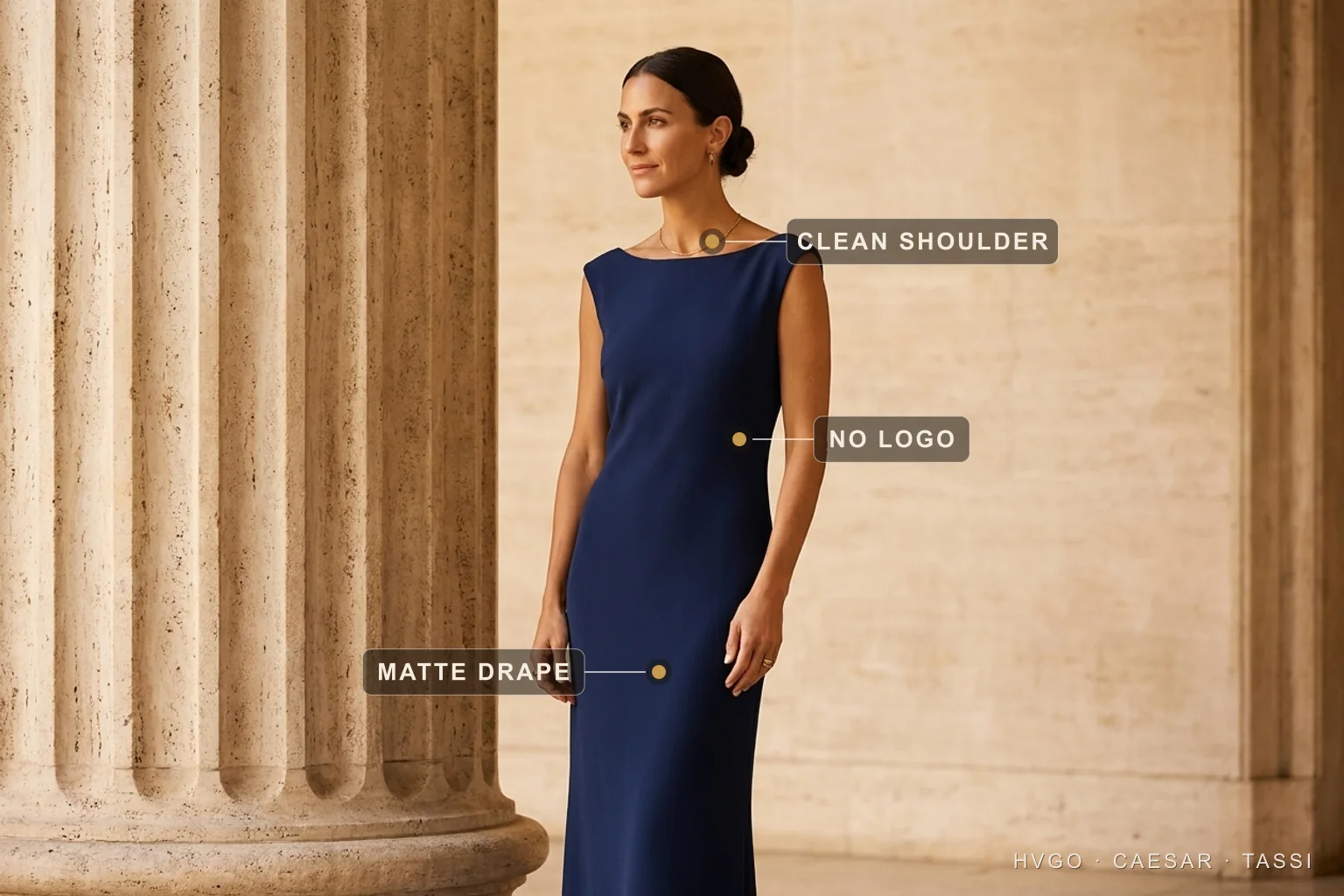
- Clean shoulder
- No logo
- Matte drape
#What is quiet luxury, really, when a house that makes women's clothes defines it?
Quiet luxury is a standard of make and read, not a price tier; a dress qualifies through construction, not through cost. Most explainers hand you a beige sweater and a calf tote and stop there. At Hugo Caesar Tassi we judge it the way a maker has to: by what the seam allowance, the lining and the shoulder line actually do.
#Quiet luxury is a standard of make, not a price tag
A dress reads quiet luxury when five things are true at once, and none of them is the receipt. The fabric falls in matte drape from the hip. The shell carries a full bagged lining. The seam allowances are finished. The shoulder seam sits at the shoulder edge. No logo appears on the outside.
Status migrated off the monogram and into the cut. A generation ago, a legible label did the talking; now the value hides in drape, lining and finishing, where only the wearer and a trained eye can read it. That migration is the whole concept in one move.
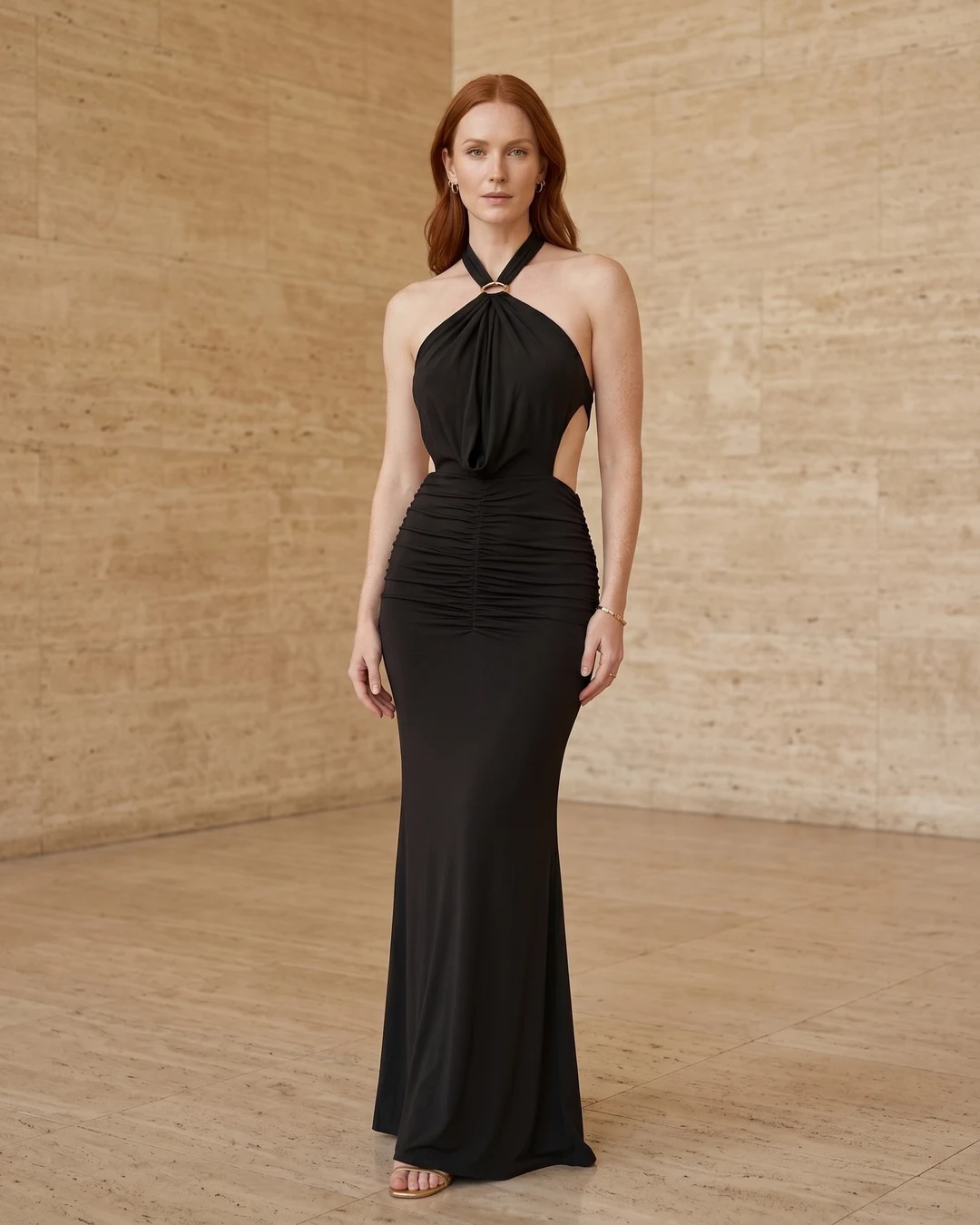
Here is the test that exposes the price myth. A €90 dress in matte modal, fully lined, clean at the shoulder, logo-free, reads quiet luxury. A €900 dress in shiny polyester with a half-lining and a brand plaque on the hip fails it. The Vipsania draped modal column gown carries one clean line and no exterior mark, so the price is irrelevant to the reading.
The edge case matters too. A logo-free dress in stiff, papery fabric that stands away from the body does not qualify, because drape is doing none of the quiet work. Absence of branding is necessary, not sufficient.
#Where the term came from and why it surged
Quiet luxury surged as a backlash against logomania, when women tired of advertising a brand and wanted the quality without the announcement. The swing was from loud luxury, with its visible hardware and season-stamped it-bags, toward unmarked make. The phrase caught because it named a preference women already held.
It has hardened from a trend into a standard. A trend cycles out in a season; a standard you can check on a garment stays useful, because matte drape and a finished seam do not expire. That durability is why this page treats quiet luxury as a definition rather than a passing mood.
This guide stays definitional. The wearable how-to, building the look on a smaller budget, lives in the looking expensive guide, and the deeper provenance story sits on the old money aesthetic pillar. Here, we settle what the words mean.
#How is quiet luxury different from old money and from new money?
Quiet luxury describes the garment, old money describes time, and new money describes visibility: three different axes, not three synonyms. They overlap in practice yet measure separate things. Read them apart and any outfit drops cleanly into place.
#The three-way distinction in one sentence each
Quiet luxury is about the garment, old money is about time, and new money is about visibility. Quiet luxury asks how a dress is made and how it reads. Old money asks how long a woman has kept and re-worn it. New money asks how legible the spend is on sight.
They overlap where you would expect. A true old-money wardrobe is usually quiet luxury, because pieces kept for a decade were chosen for cut and cloth over season-stamped flash. But the axes diverge sharply at the edges, which is exactly where most explainers collapse them.
The table sorts the four terms on the axis each one actually measures.
| Term | What it describes | The axis | The single tell |
|---|---|---|---|
| Quiet luxury | The garment | Make and read | Matte drape, full lining, no logo |
| Old money | The history | Time and provenance | Kept and re-worn for years |
| New money | The spend | Visibility | A legible logo or this-season it-piece |
| Stealth wealth | The wearer | Intent | Real money spent, refused on display |
Consider the divergence directly. A woman can buy a quiet-luxury dress this afternoon, but she cannot buy old money this afternoon, because old money is the accumulated time the same garment has already served.
#Quiet luxury vs new money: the logo is the tell
New money makes the price legible while quiet luxury makes it invisible, and the logo is the cleanest line between them. New money speaks through monograms, conspicuous hardware and the bag everyone recognizes this season. Quiet luxury routes every euro into cut, fabric and finishing instead.
Treat "new money" as a style register, not a verdict on the woman wearing it. Plenty of thoughtful, generous people dress in the legible-spend register because they enjoy it. The term describes the outfit's signal, and the foil of loud luxury, or logomania, simply marks the far end of the same spectrum.
Place a real outfit on it. A logo-bag-and-monogram-belt look sits at the loud end; a Cobalto navy crepe column with no exterior mark sits at the quiet end. The edge case: a discreet, small heritage motif woven tonally into the cloth reads quieter than a printed logo, because legibility, not branding alone, is what tips an outfit toward new money.
#Quiet luxury vs old money: make versus time
Quiet luxury can be bought into today, whereas old money is earned only by keeping a piece across years. The contrast is make versus time. A new dress can meet the make standard immediately; it cannot yet carry the patina and continuity that define old money.
Old money lives in the re-worn piece: the gown a woman wears to a third family wedding, the bag whose corners have softened. Quiet luxury is the precondition, not the proof: the make has to be good enough to survive that long. The full provenance treatment belongs on the old-money pillar, so this page names the line and stops, rather than duplicating that node.
#Is stealth wealth the same as quiet luxury, or something narrower?
Stealth wealth and quiet luxury are the same instinct seen from two sides: one names the wearer, the other names the garment. They are used interchangeably for good reason. The nuance only surfaces when you need to separate the woman from the dress she chose.
#Stealth wealth is the same instinct, named for the wearer
Stealth wealth describes a woman's intent, spending real money while refusing to show it, and quiet luxury describes the garment that intent produces. Same impulse, two vantage points. One sits on the person; the other sits on the cloth.
Because they share a root, treating "stealth wealth" as a separate, thin concept misleads more than it clarifies. The example is plain: a woman with serious means choosing an unbranded Travertine stone gown is practicing stealth wealth, and the gown itself is quiet luxury. The nuance only matters when a sentence must distinguish the buyer from the buy.
The counter-case keeps it honest. A woman of modest means in the same unbranded gown is not concealing wealth she lacks, yet her dress still reads quiet luxury. The garment standard holds even when the wearer's intent does not, which is why the two terms are not perfectly identical.
#Quiet luxury vs minimalism: close cousins, not twins
Minimalism is about less, while quiet luxury is about unmarked quality, so a richly draped gown can be one without being the other. They overlap on restraint and part ways on abundance. Minimalism strips down; quiet luxury can stay full, as long as the make stays unannounced.
A quiet-luxury dress can be a generous chiffon gown with knife pleats and a deep, fully lined sweep, which a strict minimalist reading would reject as too much fabric. The Claudia pleated-slit chiffon maxi gown is quiet luxury and decidedly not minimalist. Whereas minimalism counts pieces, quiet luxury weighs cloth and finishing, two different rulers entirely.
#Which fabrics and finishings make a woman's dress read as quiet luxury?
Quiet luxury shows up in fiber, weight and finishing: matte cloth that drapes, a full lining, and seams worked to a clean edge. You can verify all of it by hand. The recognition is physical, not aspirational, which is the part beige mood boards leave out.
#The five tells you can check on the garment
Five physical tells decide whether a dress reads quiet luxury, and a woman can check every one in the fitting room. Run them in order; five yeses is the standard met. The list below is the recognition checklist, distinct from any styling how-to.
- Matte drape: the fabric falls cleanly from the hip without standing away from the body or catching hard light.
- A full bagged lining: the shell is lined throughout, not left as a single unfinished layer.
- Finished seam allowances: raw edges are clean-bound or enclosed, not fraying inside the dress.
- A clean shoulder line: the shoulder seam sits exactly at your shoulder edge, neither drooping nor cutting in.
- No visible logo: nothing on the outside names the brand.
One failure mode sharpens the test. A dress can pass four tells and fail on a shoulder seam set an inch off the shoulder, which collapses the clean line that the whole reading depends on. Fit the shoulder first; a wandering seam undoes the other four. For the fiber detail behind these tells, the fabric guide covers chiffon, satin and crepe by hand and weight.
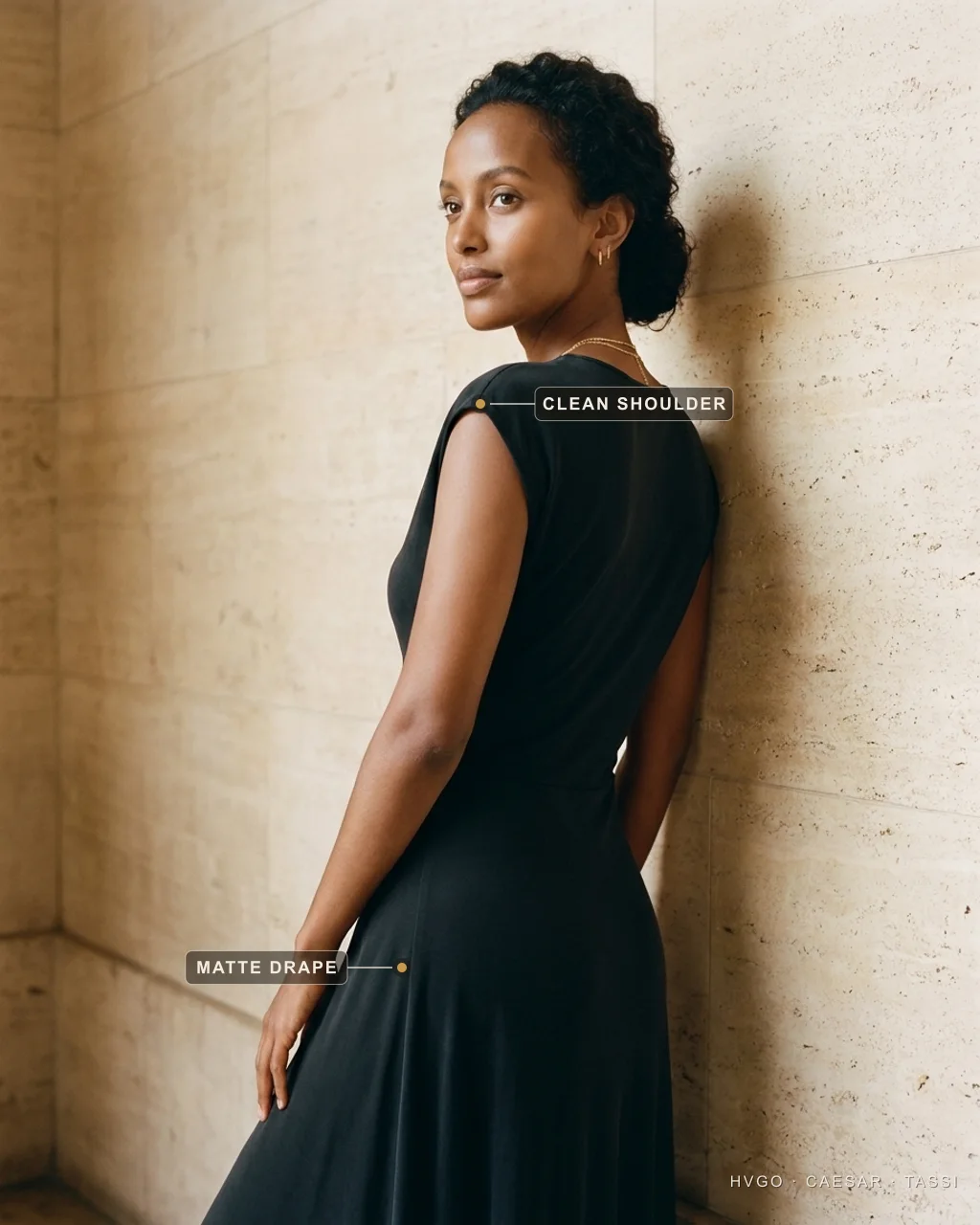
- Clean shoulder
- Matte drape
#Matte over shine, and the fibers that read quiet
Matte fabric reads quieter and more expensive by daylight, so crepe, modal and dry chiffon outrank high-shine satin before dark. Shine announces; matte withholds. By day, the house reserves obvious sheen for evening and lets weight and hand carry the quality signal.
Matte crepe is structured and dense; modal drapes like liquid yet stays dull; dry, knife-pleated chiffon catches almost no glare. The Vipsania draped modal column gown holds one clean matte line, and the Claudia pleated-slit chiffon maxi gown reads quiet through drape rather than glint. Satin earns its place after dark. Worn matte-side by day, it reads quieter than a glossed face.
#What does a quiet-luxury color palette look like for a woman?
A quiet-luxury palette is a field of restrained neutrals with at most one accent, not a clash of high-chroma color or busy print. Restraint is the signal. One focal point, one statement color, and the outfit stays quiet by refusing to compete with itself.
#Restraint first: a quiet field, one restrained accent
A quiet field plus a single restrained accent reads quietest of all, and a tonal or monochrome look reads quieter still. Build on neutrals; spend one accent at most. The mechanism is simple: every added loud color is another thing shouting for attention.
A neutral field runs Avorio ivory, Travertine stone, Basalt black, Cobalto navy and Cuoio tan, with one restrained accent such as Porpora wine. A head-to-toe Travertine look reads quietest because nothing breaks the line. The counter-case: a high-chroma palette with a clashing print pushes the same dress toward new money, because legible color does the loud work a logo used to do.
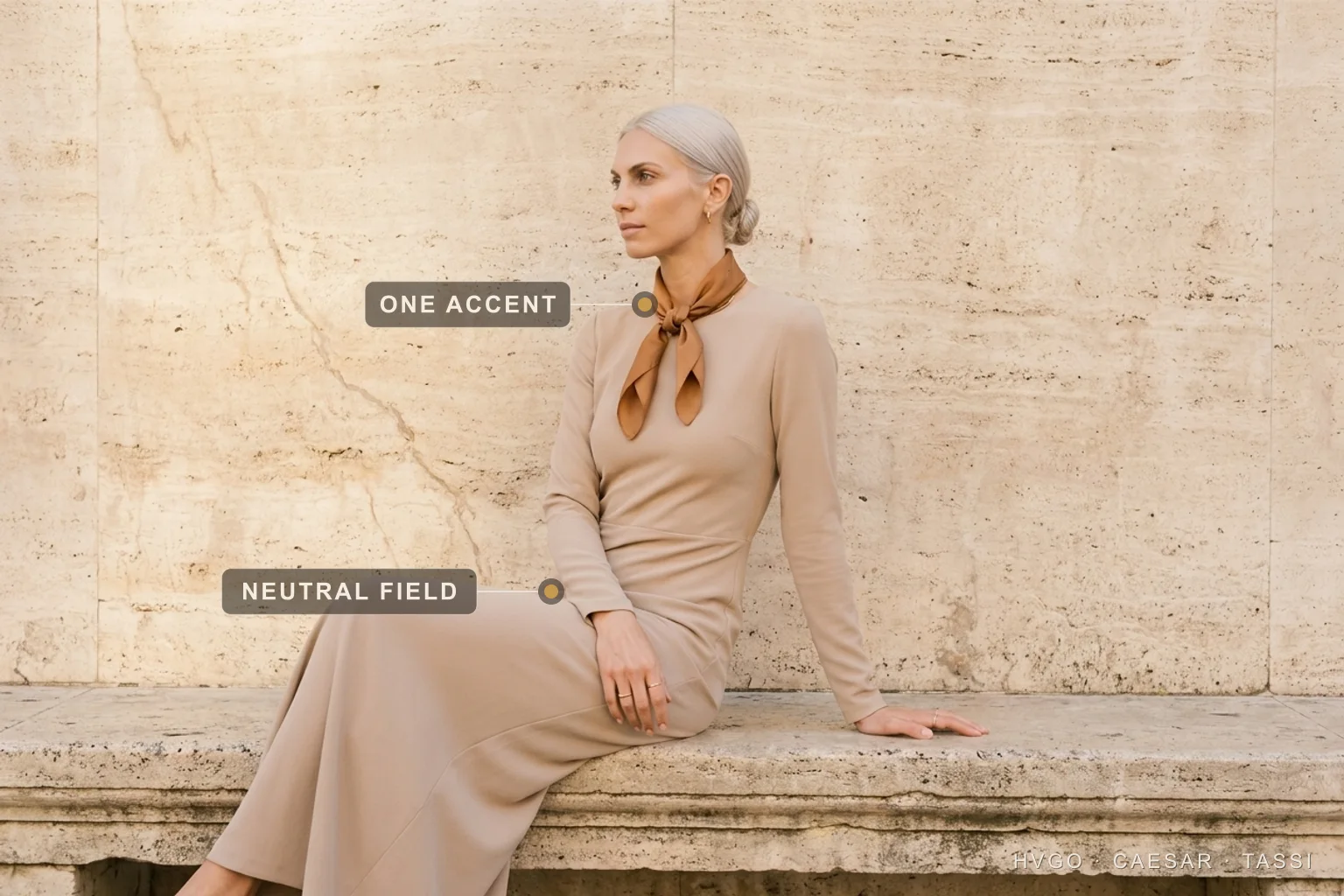
- One accent
- Neutral field
#Why the imperial palette is already a quiet-luxury palette
HCT's imperial palette was built on restraint, so it maps onto quiet luxury without adjustment. The colors were chosen as a disciplined set, not a rainbow. That discipline is the same restraint quiet luxury asks for, which is why the palette needs no translation.
Single-accent restraint is the principle here; the full combination logic, which neutral carries which accent and in what proportion, lives on the old-money color side of the pillar. This page names the rule so it stays the definitional anchor and leaves the chart to its proper node.
#Who is quiet luxury actually for, and the honest critiques
Quiet luxury suits any woman who wants felt quality over announced spend, but it draws fair criticism worth answering plainly. The look is not for every occasion, and it is not only for the wealthy. Both objections deserve a straight reply.
#"You have to be rich already": answering the objection
The case against quiet luxury says it secretly requires real money, and a make-based standard answers it directly. Some argue the aesthetic is sold to women as gatekept by wealth, all those four-figure neutrals. Where this falls short: if the standard is construction, then a well-cut, well-lined, logo-free dress in a restrained color qualifies at any price.
Construction is the rebuttal. Because the tells are physical (drape, lining, seams, shoulder, no logo), they cost effort and pattern skill more than they cost the buyer. The budget version of the look is the job of the looking-expensive guide, while the standard itself does not check your bank balance.
#When quiet luxury is the wrong call
The wrong register for quiet luxury is any occasion that actively wants shine, color or a statement. A festive event, a celebration that calls for sparkle, a dress code asking for joy: these reward the loud notes quiet luxury withholds. Treat it as a register to reach for, not a rule for every day.
The example is a New Year's gala that begs for a Vermiglio red and a glint of satin; the counter-case is a woman who simply prefers a bold statement and wears it well. For an event where quiet is right, the occasion dressing guide handles the formal version. Quiet luxury is one good answer, not the only one.
#How Hugo Caesar Tassi designs to a quiet-luxury standard
Hugo Caesar Tassi, a Roman atelier founded in 2004, designs to the make standard and has never put a logo on the outside of a gown. The house view: status lives in the cut. That position is older than the trend and outlasts it.
#The founder's view: status in the cut, not the label
The founder's view holds that quiet luxury is matte drape, full lining, finished seams, clean shoulders and no visible logo, because status moved from the monogram to the construction. Nata Imperare, born to rule, is read on the body, not on a label. Because the value sits in the make, the house has never marked the exterior of a gown.
That is the line between a working atelier and an anonymous quiet-luxury listicle. A listicle assembles a beige mood board; a maker can name the seam, the lining and the shoulder seat that decide whether a dress reads quiet. The difference is doing versus describing.
#The dresses cut to read quiet
Five HCT gowns demonstrate the standard, each reading quiet for a different construction reason. They are examples, not a checkout list. The point is to show the tells living in real garments.
- Vipsania draped modal column gown: matte modal, a single clean line, no exterior logo.
- Tullia pleated crepe column gown: a matte pleated column in a restrained color, shine withheld.
- Calpurnia fishtail satin evening gown: satin's quiet sheen reserved for evening, not daylight.
- Flavia strapless satin off-shoulder gown: a clean architectural cut chosen over surface decoration.
- Claudia pleated-slit chiffon maxi gown: quiet drape with one focal slit as the only statement.
#The verdict: quiet luxury vs old money vs new money, summarized
Across all four terms: quiet luxury is the garment, old money is the time, new money is the visibility, and stealth wealth is that same quiet instinct named for the wearer. Four words, four axes. Hold them apart and you can place any dress with confidence.
#The one-line recap and a self-check
The recap fits one line, and a five-point self-check applies it to any dress in your closet. Make for quiet luxury, time for old money, visibility for new money. To judge a piece you already own, choose the garment test below and run it once.
| Self-check | Pass condition |
|---|---|
| Matte drape | Falls cleanly from the hip, no hard glare |
| Full lining | Lined throughout, not a single shell layer |
| Finished seams | Allowances clean-bound or enclosed inside |
| Clean shoulder | Seam sits exactly at your shoulder edge |
| No visible logo | Nothing on the outside names the brand |
Five yeses means the dress reads quiet luxury at any price. Four with a failed shoulder means refit before you wear it, because the clean line is the load-bearing tell.
#Where to go next
The next reads split by what you want: provenance, budget, occasion, or the gowns themselves. Each route deepens one axis this page only defined. Pick the thread that matches your question.
For the provenance side, read the old-money pillar; for the budget how-to, the looking-expensive guide; for a formal event, the occasion guide. Across the wider style guides, the vocabulary settled here is assumed, so this page is the one to read first.
Now that the terms are settled, see the standard on the body: browse the evening gowns cut to read quiet luxury, explore the full edit, then read the old-money-aesthetic pillar for the provenance side of the story.
#Frequently asked questions
What does quiet luxury mean?
Quiet luxury means a garment reads expensive through how it is made rather than what it cost or whose logo it carries. The tells are physical: matte drape, a full lining, finished seams, a clean shoulder and no visible branding, so the quality is felt, not announced. A €90 dress can meet the standard while a €900 one fails it.
What is the difference between quiet luxury and old money?
The difference between quiet luxury and old money is that one is about the garment and the other is about time. Quiet luxury concerns how a dress is cut, lined and finished, and you can buy into it today. Old money concerns provenance and continuity: the piece a woman keeps and re-wears for a decade. A true old-money wardrobe is usually quiet luxury, but quiet luxury needs no inheritance.
Is quiet luxury the same as new money?
Quiet luxury is the opposite of new money in register, not the same thing. New money makes the spend legible through visible logos, obvious hardware and this-season's it-piece. Quiet luxury makes it invisible, routing all the value into cut, fabric and finishing.
Is stealth wealth the same as quiet luxury?
Stealth wealth is practically the same as quiet luxury, seen from two angles. Stealth wealth describes the wearer's intent, spending real money but refusing to show it, and quiet luxury describes the garment that results. Women use them interchangeably, and the nuance matters only when you separate the person from the dress.
How can I tell if a dress is quiet luxury?
You can tell a dress is quiet luxury by running a five-point check on the garment. Does the fabric fall cleanly in matte drape, is it fully lined, are the seam allowances finished, does the shoulder seam sit exactly at your shoulder, and is there no visible logo? Five yeses means it reads quiet luxury at any price.
Is quiet luxury just minimalism?
Quiet luxury is not just minimalism, though the two overlap on restraint. Minimalism is about less, with fewer pieces and plainer lines, while quiet luxury is about unmarked quality. A richly draped, fully lined chiffon gown can be quiet luxury yet far from minimalist.
More Style & Old Money guides
The Quiet-Luxury Capsule Wardrobe
Build a quiet-luxury capsule wardrobe the Roman way: the cost-per-wear math, the keep-for-a-decade rule, and a small imperial-palette set that recombines.
Build a buy-fewer-better capsuleGold or Silver Jewelry With a Dress? The Two-Step Rule That Settles It
A Roman atelier's two-step rule for gold or silver jewelry: read your skin undertone, then let the dress color break the tie. Color-by-color chart.
Choose gold or silverHow to Accessorize a Dress
A Roman atelier's method to accessorize a dress: choose one focal point, then let the rest recede. Neckline focal-point map, bag, scarf and shoe rules.
Master the one-focal-point ruleHow to Dress Elegantly
Five repeatable house rules from a Roman atelier to dress elegantly on any budget: one statement color, the right hem, shoulder-first fit, matte by day.
Learn the five elegance rulesHow to Look Expensive on a Budget
Look expensive on a budget: a Roman fabric house names five physical tells (drape, lining, seams, shoulder, color) no designer price can fake.
Learn the five expensive tellsHow to Wear Burgundy for Women
How to wear burgundy for women by skin tone, season and occasion: wine vs. oxblood vs. Tyrian red, what colors pair, and the gold rule.
Match your wine-red shade