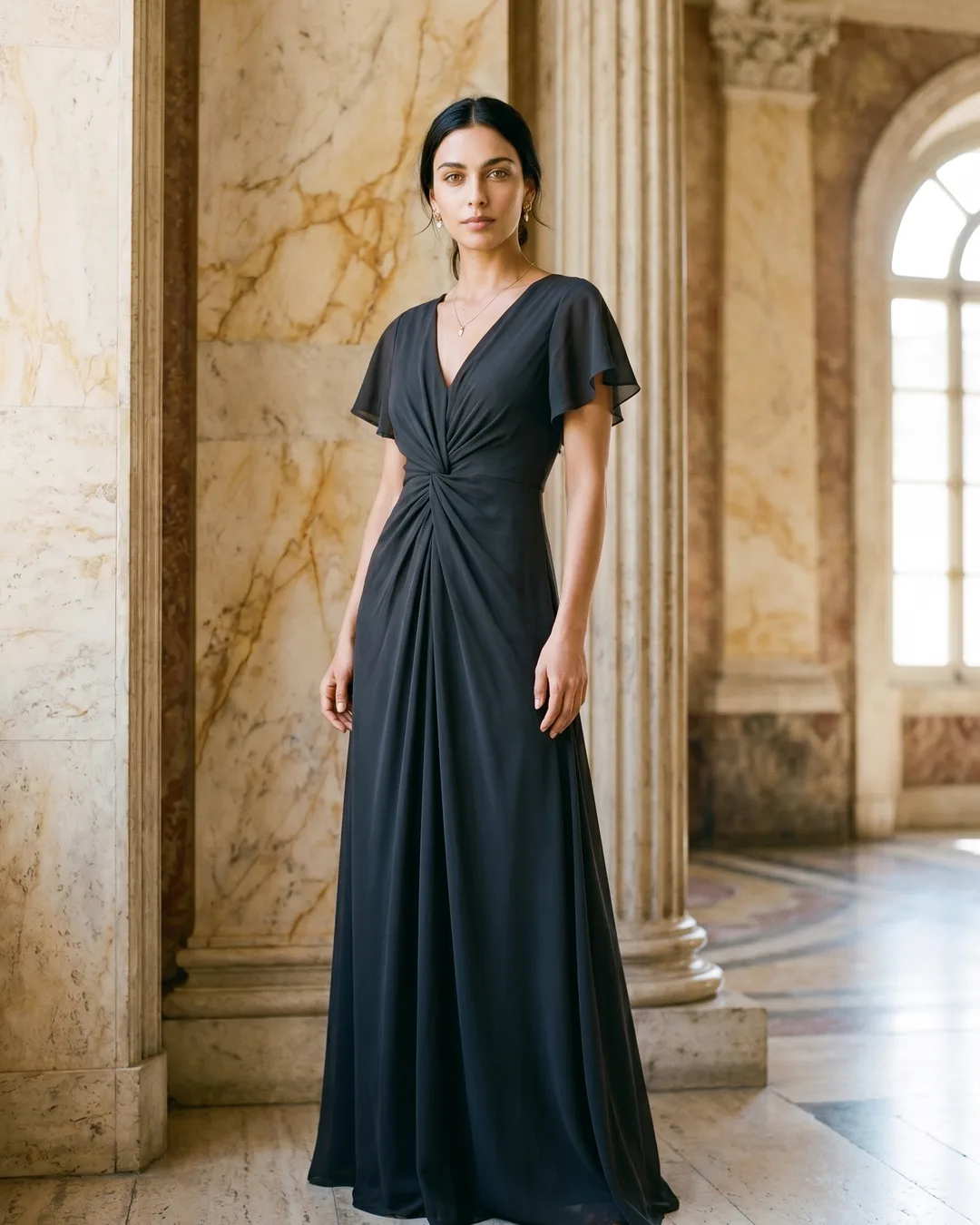
Chiffon, Satin and Crepe: A Wearer's Guide to Occasion-Dress Fabrics
A Rome-born house decodes occasion-dress fabrics: what chiffon, satin and crepe really are, how each drapes, and which to choose for your event.
On this page
Chiffon, satin and crepe are the three fabrics that build almost every occasion dress, and they differ by drape: chiffon floats, satin pours, crepe sculpts. Most labels confuse you because they blend fiber and weave into one word. Hugo Caesar Tassi cuts all three, so this guide explains them the atelier way.
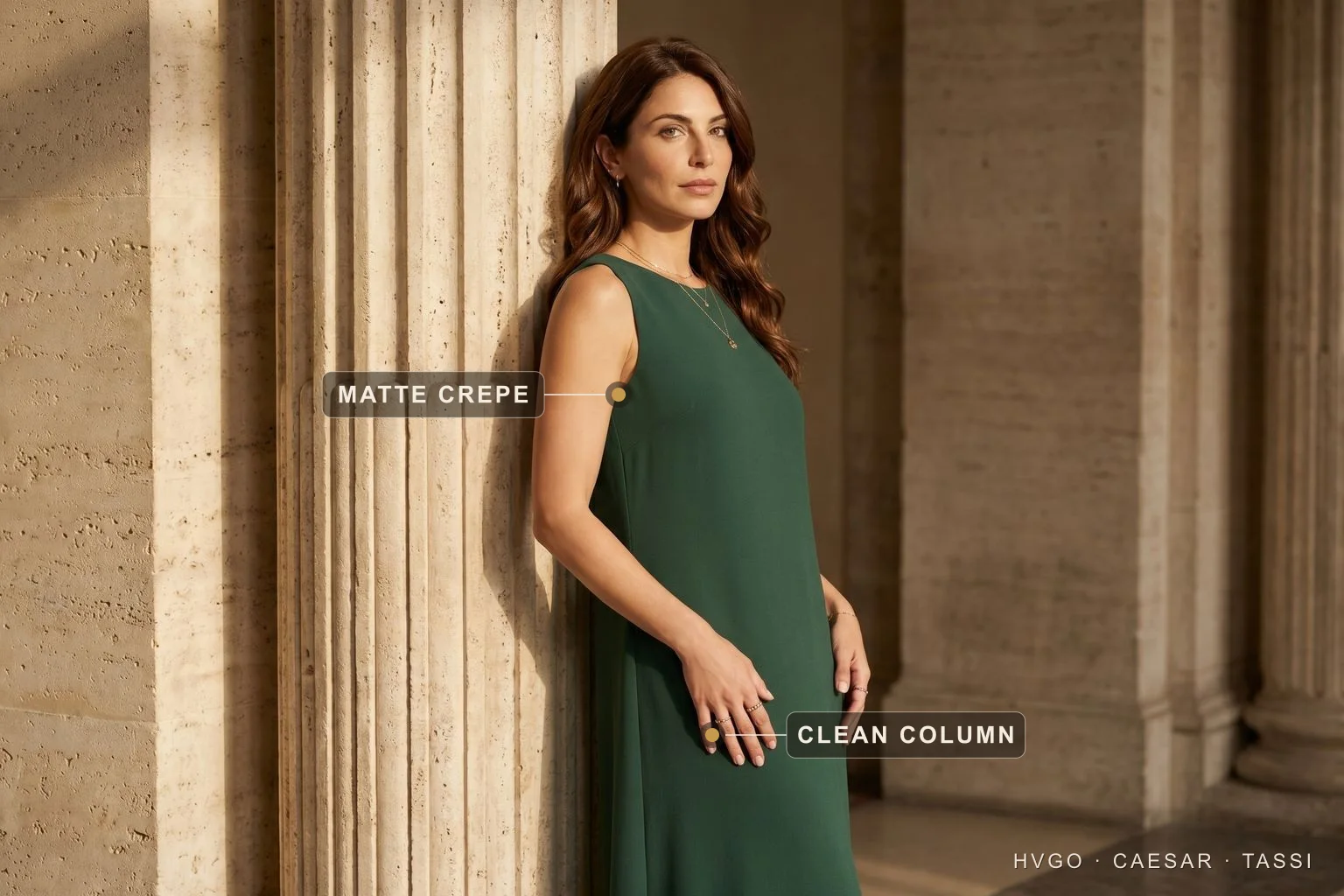
- Matte crepe — high-twist yarns pebble the surface so it scatters light, photographing kindly with no shine.
- Clean column — crepe's springy body falls in a composed vertical line that flatters nearly any figure.
Chiffon vs satin vs crepe
Three verbs decode the trio: chiffon floats, satin pours, crepe sculpts.
| Chiffon | Satin | Crepe | |
|---|---|---|---|
| Drape | Floats and flutters on air | Pours liquid and clings | Sculpts a clean, composed column |
| Weight | 20-40 g/m², sheer (needs lining) | 60-120 g/m², opaque | 120-200 g/m², fully opaque |
| In light / on camera | Glows translucent in backlight | High shine; flash can blow it out | Matte, scatters light, photographs kindly |
| Best occasion | Summer weddings, garden, daytime | Black-tie galas, evening receptions | Cocktail, christenings, polished daywear |
| Care & travel | Snags and water-spots most easily | Shows pulls and watermarks | Resists creasing, packs and shakes out |
| HCT gown & palette | Aemilia maxi in Porpora, Cipria | Calpurnia fishtail in Cobalto, Basalt | Tullia column in Verde Antico, Travertine |
#What are the three occasion-dress fabrics every woman should be able to name?
Chiffon, satin and crepe build the vast majority of women's occasion dresses, and naming them by drape beats naming them by fiber. One floats, one pours, one sculpts. A bride at a summer ceremony often wants chiffon for movement she can feel; a guest at a winter gala wants satin for the way it returns light across a dark room. The trio is not interchangeable, and the difference shows the moment you walk.
#What is chiffon fabric, exactly?
Chiffon is a sheer, ultra-light fabric woven plain from tightly twisted yarns, which gives it a faint pebbly grain and a floating fall. The twist sets the texture; the openness sets the transparency.
Chiffon weighs roughly 20 to 40 grams per square meter, light enough that a full skirt lifts on air, with highly twisted yarns that pebble the surface. Because it reads semi-transparent against skin, an occasion dress almost always lines or layers it, and the word itself comes from the French chiffe, meaning cloth or rag. It arrives in two common fibers, silk and polyester, and the fiber changes the price far more than the look. One edge case: georgette is chiffon's heavier, more opaque cousin, woven from the same crepe-twist yarns at a denser pick count, so it drapes with more body and sometimes needs no underlay.
#What is satin, and why it's a weave and not a fiber
The term describes construction, never the thread: long float yarns ride the surface to produce a glossy face and a matte back. That single structural fact resolves most label confusion.
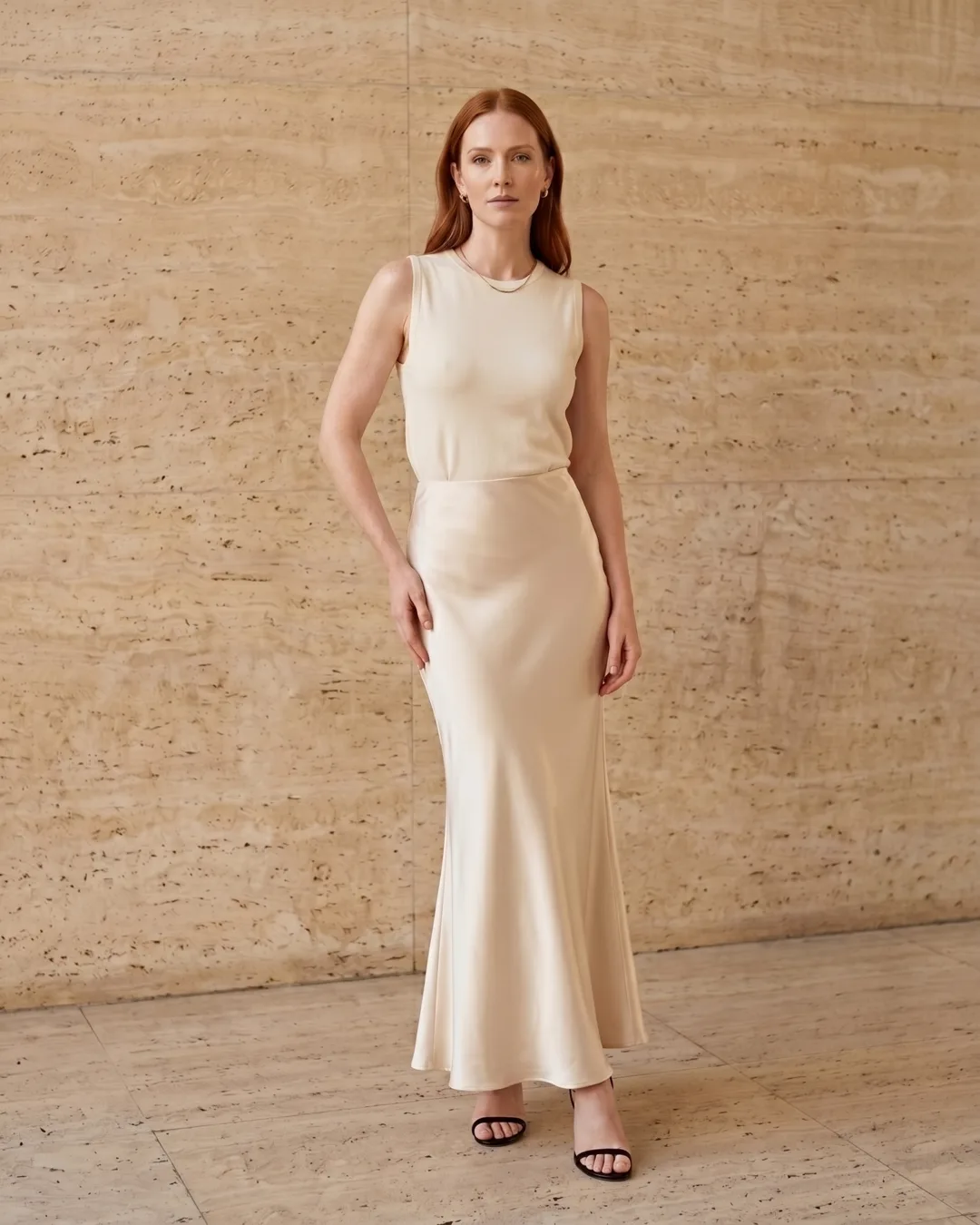
In a satin weave, each surface yarn floats over four or more crossing yarns before tucking under one, so light hits an almost unbroken plane and bounces back as liquid luster. Satin can be woven from silk, polyester or a blend, which is why "100% silk" and "satin" answer two different questions. It spans a wide stiffness range: fluid charmeuse, near 60 grams per square meter, pours and clings, whereas duchess and bridal satin stand away from the body. HCT bias-cuts its satin so the float runs diagonal, which lets the Calpurnia fishtail gown trace a figure rather than hang flat.
#What is crepe fabric for dresses?
Crepe is a mid-weight fabric with a faintly crinkled, grainy matte surface created by high-twist yarns, and it holds a clean structured line. It is the sculptural member of the trio.
High-twist yarns spring back after weaving, pebbling the surface so it scatters light rather than reflecting it. That matte grain is why crepe resists wrinkling and skims the body in a column. It runs heavier than chiffon, often 120 to 200 grams per square meter, opaque on its own with no lining for coverage. Common forms include silk crepe, the lighter crepe de chine, and the modal or polyester crepes the atelier favors. The counter-case: a very heavy crepe reads stiff and adds bulk, so the atelier keeps its crepe mid-weight to skim, not armor.
#Fiber versus weave: the distinction that decodes any occasion-dress fabric
Fiber is the raw thread; weave is how that thread is interlaced, and confusing the two is why most labels leave shoppers guessing. Silk crepe and polyester crepe share a weave but differ in fiber, whereas silk chiffon and silk satin share a fiber but differ in construction. That is the whole puzzle in one sentence.
#Fiber is the thread; weave is how it's built
The thread comes first, the construction second, which is why one raw material can become any of the three fabrics on this page. Picture silk thread three ways. Twist it tight and weave it open for the floating sheer of chiffon; float it long across the surface for the gloss of satin; over-twist it and let it crinkle back for the matte grain of crepe. Spin those same three constructions from polyester instead, and you get the same drapes at a lower price with different care. This is why a single bolt of fiber, handled three ways in our dress care and fabrics library, yields three different gowns.
#How to read a dress label like the atelier
A dress label answers two questions at once: the fiber word tells you what the thread is, and the construction word tells you how it was built. "100% silk" names only the fiber and leaves the drape open; "silk charmeuse" pins both, telling you a silk fiber in a fluid satin weave. Use this four-term decoder when a label gets fancy:
| Label term | What it tells you | Drape it signals |
|---|---|---|
| Charmeuse | Lightweight silk satin weave | Fluid, clings, high shine |
| Georgette | Dense crepe-twist plain weave | Floaty but opaque, light body |
| Crepe de chine | Light crepe weave, often silk | Soft matte, gentle structure |
| Duchess satin | Heavy, crisp satin weave | Stiff, sculptural, formal shine |
When a label confuses you on the rack, the smarter move is to read it against the silhouette you actually want, which our guide to choose a dress walks through step by step.
#How do the three occasion-dress fabrics drape, move and photograph?
Chiffon floats and flutters, satin pours and clings, crepe falls in clean columns, and each catches light differently enough to change a photograph. A woman walking in chiffon stirs air with every step; the same woman in crepe barely disturbs the hem. Both can be beautiful, yet they tell opposite stories on the body.
#Drape and movement on the body
Drape divides the trio cleanly: chiffon stays soft and weightless, satin turns liquid and clinging, crepe holds a composed sculptural line. Chiffon lifts and ripples because so little weight resists the air, which is why the Aemilia A-line maxi billows on a turn. Satin pours along the body and traces every curve, sensual but unforgiving of a waistband line. Crepe skims and holds, falling in a flattering column the way the Tullia crepe gown keeps a clean vertical mid-stride.
#How each fabric photographs and catches light
Chiffon glows translucent in backlight, satin reflects high shine that flash can blow out, and matte crepe absorbs light to photograph the most forgivingly. Stand chiffon against a window and it turns luminous, the light passing through rather than off. Satin throws a hard highlight, gorgeous in soft evening light but liable to read glossy under a photographer's flash, so it suits black-tie rooms more than a noon ceremony. Crepe scatters light evenly, hiding the surface shifts that shine exaggerates, which is why it photographs kindly across weddings, galas and family portraits alike.
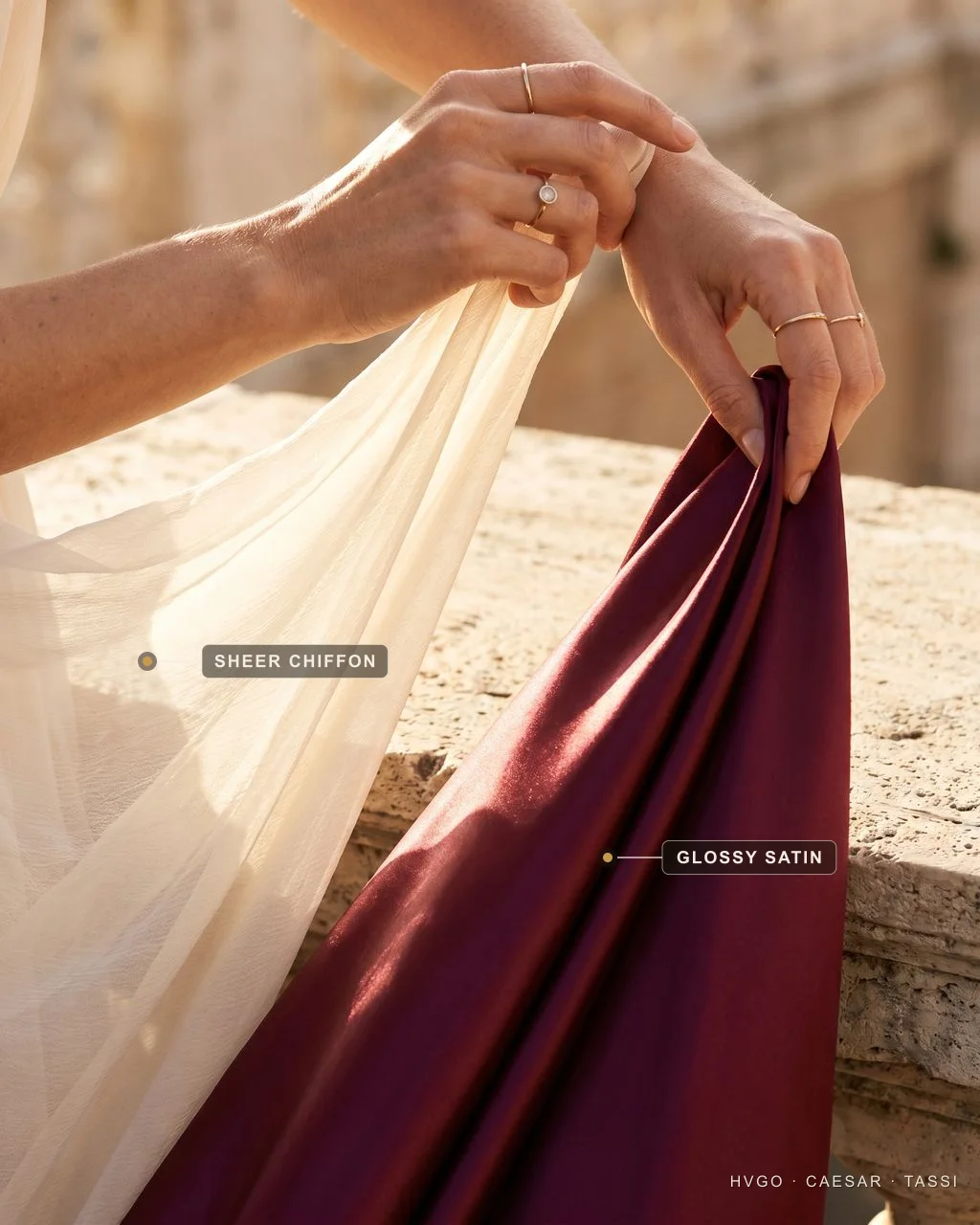
- Sheer chiffon — an open plain weave of tightly twisted yarns reads semi-transparent and floats on air.
- Glossy satin — long surface float yarns ride the top of the weave to bounce light back as liquid luster.
#Weight, sheerness and lining
Weight is the hidden variable that decides whether a fabric covers on its own and how fast a skirt moves. The lighter the cloth, the more it floats and the more it shows through, which is why the house fully lines its sheerest gowns with a concealed zip. The heavier the cloth, the slower and more deliberate the swing. Scan the contrast here:
| Fabric | Typical weight | Sheerness | Skirt movement |
|---|---|---|---|
| Chiffon | 20–40 g/m² | Semi-sheer, needs lining | Floats and lifts on air |
| Satin | 60–120 g/m² | Opaque, shows body lines | Pours in a liquid sweep |
| Crepe | 120–200 g/m² | Fully opaque | Swings in a heavy, clean arc |
#Silk or polyester: which occasion-dress fabrics are worth paying more for?
Silk wins on breathability and hand; polyester wins on durability, wrinkle resistance and price, so the right fiber depends on your event, not on prestige. A garden ceremony in July rewards silk's breathability; a destination wedding with a packed suitcase rewards polyester's crush resistance. Match fiber to conditions, not to a label.
#Silk chiffon vs. polyester chiffon
Silk chiffon breathes, drapes more softly and glows with a matte richness, whereas polyester chiffon resists wrinkles and snags, costs less and survives a gentle machine cycle. Silk chiffon feels cooler against skin and falls with a fluid softness, but it creases, water-spots and demands hand-care. Polyester chiffon shrugs off snags and crushing and machine-washes on delicate, though it reads shinier and breathes less in heat. Choose silk for comfort at a controlled indoor event; choose polyester for a travel-proof dress at an active, outdoor, all-day occasion.
#Where the money actually shows
The price gap shows up in luster quality, breathability and how the fabric ages, not in the silhouette across a room. Silk's irreplaceable advantage is its hand and soft matte glow, which photographs richer up close. Polyester's edge is endurance: a good polyester crepe outperforms a cheap silk at an event you will sweat through and dance in. Silk earns its premium in next-to-skin comfort, yet loses on a short, hot, high-motion night.
#Which occasion-dress fabric is best for your event and your figure?
Match chiffon to daytime and summer, satin to black-tie evenings, and crepe to anything in between, then refine the choice by your shape. A cathedral wedding at noon and a midnight charity gala call for opposite fabrics on the same body. Start with the room, then your frame.
#Match the fabric to the occasion
Occasion maps cleanly onto fabric, with chiffon for light daytime romance, satin for formal evening glamour, and crepe as the polished all-rounder. Use the event's formality and light as your guide.
- Chiffon suits summer weddings, garden parties and any floaty, daytime celebration.
- Satin suits black-tie galas, evening receptions and red-carpet-level dressing.
- Crepe suits cocktail events, office parties, christenings and polished daywear without shine.
- Georgette bridges the gap for a wedding where you want chiffon's float with more coverage.
These tiers track the formality logic of black-tie and wedding-guest planning, so let the invitation set the fabric first.
#Match the fabric to your body shape
Floaty chiffon skims and conceals, bias-cut satin celebrates an hourglass but reveals every line, and structured crepe flatters nearly every figure by skimming rather than clinging. Chiffon's airy fall glides over a tummy and softens upper arms, the choice when you want coverage with movement. Bias-cut satin honors a defined waist but shows every contour, so it pairs best with smoothing underlayers. Crepe skims most shapes evenly, the safest sculptural pick; to pin which logic fits you, work through how to find your body shape before you commit.
#What care does each occasion-dress fabric demand once you own it?
Silk versions lean dry-clean or cold hand-wash, polyester versions tolerate a delicate cycle, crepe resists wrinkles best, and all three prefer steaming to ironing. Care follows the fiber more than the weave, so a silk chiffon gown and a polyester crepe gown ask for very different laundry days even hanging side by side.
#Care at a glance, by fabric
Silk chiffon and silk satin want dry-cleaning or a cold hand-wash, while polyester equivalents accept a gentle delicate cycle, and every fabric here steams better than it irons. Silk's protein fibers scorch and water-spot, so cold water and a professional cleaner protect them, whereas polyester's synthetic fibers handle agitation and a mesh bag on delicate. Direct iron heat flattens chiffon's grain and burns satin's float, while a steamer relaxes creases without contact. For the step-by-step method, hand off to the full guide on how to care for an occasion dress.
#Wrinkle, snag and travel resistance
Crepe travels and resists creasing best, chiffon snags and water-spots most easily, and satin shows pulls and watermarks under stress. Crepe's high-twist springiness lets it fold into a case and shake out clean, the obvious choice for a destination event. Chiffon catches on rings and zippers and marks where a drink splashes, so it rewards careful handling. Satin telegraphs a snagged thread or watermark across its glossy face, making a long, crowded reception its hardest test. Pleated chiffon needs its own routine, covered in our note on how to care for pleated chiffon.
#How Hugo Caesar Tassi chooses its occasion-dress fabrics — and pairs each to a color
Hugo Caesar Tassi picks each fabric for the effect it produces, not the name it carries: luminous chiffon for movement, liquid satin for glamour, matte crepe for sculptural restraint. This is the house view, formed in Roma since MMIV under the motto Nata Imperare. It explains a deliberate omission: the atelier favors fluid charmeuse and matte crepe over stiff bridal satin, because quiet luxury is fabric weight, drape and fit, not sparkle.
#The atelier's fabric-to-effect rule
The atelier chooses fabric by the effect it should create on the body, treating drape and finish as the design decision rather than the label. A gown meant to move and catch a breeze gets luminous chiffon. One meant to trace a curve in a single fluid line gets liquid satin. For sculptural composure without a highlight, the cut is matte crepe. The counter-case the house declines is stiff bridal satin, which sparkles and stands away from the body in a way quiet luxury rejects.
#Fabric matched to the imperial palette
Color amplifies what a weave already does, so the house matches each fabric to the colorway that makes its finish work hardest. Pick the shade by the effect you want the fabric to push further, not by personal favorite alone; the table sets out where each pairing earns its place in the imperial palette.
| Fabric | Best palette match | Why the pairing works |
|---|---|---|
| Chiffon | Porpora (wine), Cipria (pink) | Sheer pleats catch and pass light |
| Satin | Basalt (black), Cobalto (navy) | Glossy float deepens dark tones |
| Crepe | Cornelia (rose), Verde Antico (green), Travertine (stone) | Matte grain looks rich without sparkle |
#The fabrics in the collection, decoded
Each HCT silhouette commits to one fabric effect, so you can choose by the look you want rather than guess from a name.
- Aemilia A-line chiffon maxi delivers airy, floating chiffon for daytime movement.
- Calpurnia fishtail satin evening gown delivers liquid, bias-cut satin for evening glamour.
- Claudia pleated-slit maxi gown delivers pleated chiffon that throws light as it moves.
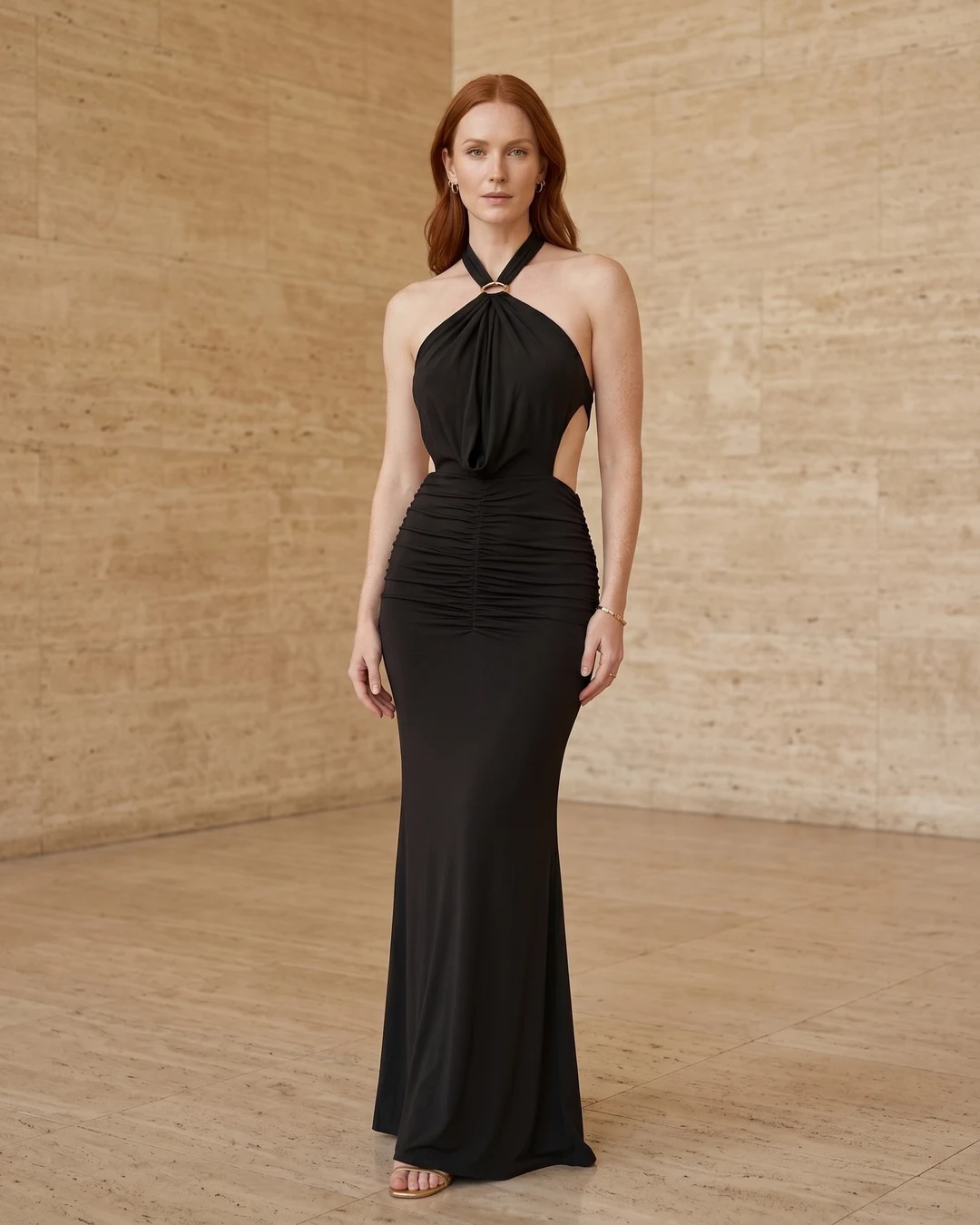
- Tullia pleated column gown delivers structured matte crepe in a sculptural line.
Once you know the effect you want, each fabric collection gathers one drape so you shop by feel, not by label.
#Chiffon, satin or crepe: a one-line rule for choosing your occasion-dress fabric
Reduce the whole choice to three verbs: float for chiffon, pour for satin, sculpt for crepe. Choose chiffon when you want light, romantic movement for a daytime or summer event. Choose satin when you want liquid shine and a body-tracing line for a formal evening. Choose crepe when you want polished matte structure that flatters almost any figure for almost any occasion.
#Frequently asked questions
What is chiffon fabric?
Chiffon is a sheer, very lightweight fabric woven plain from tightly twisted yarns, which gives it a faint grainy texture and a floating, airy drape. Because it reads semi-transparent, occasion dresses usually line or layer it. It comes in both silk and polyester.
What is the difference between chiffon, satin and crepe?
The difference between chiffon, satin and crepe is that chiffon is sheer and floaty, satin is glossy and liquid, and crepe is matte and structured. Satin and crepe describe how a fabric is woven, while chiffon describes a light plain-twist construction. Any of them can be made from silk or polyester.
Is silk or polyester chiffon better?
Silk chiffon is better for comfort and luxury, while polyester chiffon is better for durability and value. Silk breathes, drapes more softly and glows matte, but costs more and needs gentle care. Polyester resists wrinkles and snags and machine-washes on delicate, though it can look slightly shinier.
Which dress fabric drapes best?
The dress fabric that drapes best depends on the effect you want, since chiffon floats lightest, satin pours along the body, and crepe falls in a clean column. For a soft romantic fall, choose chiffon. For a sculpted, flattering line, choose crepe.
Is satin a fabric or a weave?
Satin is a weave, not a fiber, because its long surface float yarns create the signature glossy face and matte back. It can be woven from silk (charmeuse), polyester or blends. That is why satins range from fluid charmeuse to stiff duchess and bridal satin.
Which fabric is best for a summer wedding versus a black-tie gala?
The best fabric for a summer wedding is chiffon, while the best fabric for a black-tie gala is satin. Chiffon stays light, breathable and floaty for daytime heat; satin delivers the liquid shine that suits formal evenings. Crepe is the all-rounder, polished and matte enough for almost anything in between.
Now you can read any occasion-dress label by feel, float, pour or sculpt, and pick the fabric for the effect you want. See each one made wearable in our chiffon dresses edit, with the satin dresses and crepe dresses edits a click away.
More Care & Fabrics guides
How to Clean, Condition and Store a Leather Bag So It Ages Beautifully
The atelier's gentle routine to clean, condition and store a leather bag, plus the conditioning cadence that builds a patina and stops cowhide cracking.
Care for a leather bagHow to Wash, Store and Revive a Silk Scarf Without Losing Its Color or Sheen
Wash, de-crease, dry and store a silk scarf without dulling the color or warping the hem — the atelier's cold-water method and white-vinegar acid rinse.
Wash silk the right wayHow to Wash a Chiffon Dress at Home (Plus Satin and Crepe) Without Ruining It
The atelier's safe way to wash, refresh and steam chiffon, satin and crepe at home — plus the fiber test that decides hand-wash vs. dry clean.
Wash chiffon, satin & crepe safelyHow to Care for Pleated Chiffon Without Losing the Pleats
Wash, dry, store and travel with pleated chiffon without flattening the pleats — the atelier's heat-set method, hand-wash steps and a pleat-revival fix.
Keep the pleats knife-sharpHow to Pack a Dress Without Wrinkles
The atelier's fabric-by-fabric method to pack a dress wrinkle-free: roll chiffon in tissue, fold crepe on its seams, plus a 10-minute arrival revival.
Pack a dress wrinkle-freeHow to Remove Stains From a Dress
The atelier's fabric-safe way to remove wine, makeup, sweat, deodorant and oil stains from a delicate dress — blot, don't rub, and know when to stop.
Rescue a stained dress