The Quiet-Luxury Capsule Wardrobe: Buy Fewer, Better
Build a quiet-luxury capsule wardrobe the Roman way: the cost-per-wear math, the keep-for-a-decade rule, and a small imperial-palette set that recombines.
On this page
Build a capsule wardrobe by owning so well that a handful of pieces does the work of a closetful. At Hugo Caesar Tassi, a Roman house founded MMIV on the motto Nata Imperare (born to rule), the doctrine is simple: buy fewer, better, keep each a decade. This guide hands you the operating system behind it: the cost-per-wear math, the test a garment must pass, and a small imperial-palette set that recombines.
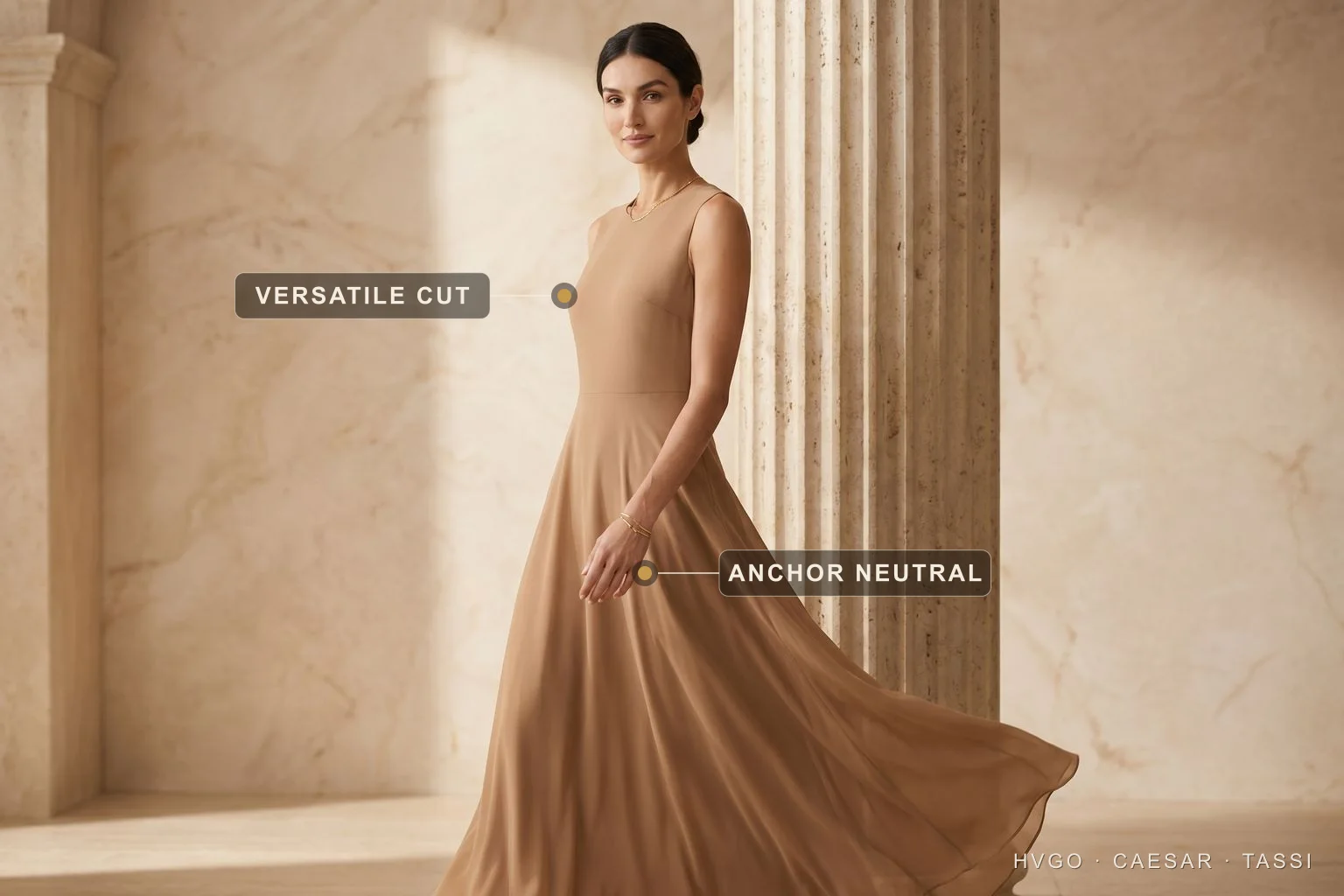
- Versatile cut — a clean A-line bodice and waist seam reads timeless, so the shape never dates
- Anchor neutral — a camel-stone tone pairs with every imperial neutral, letting one dress cross-combine
#What is a capsule wardrobe, and why does buying fewer, better pieces work?
A capsule wardrobe is a deliberately small set of pieces chosen so every one combines with the others, not a numbered shopping list. The mechanism is interchange: hold five or six dresses in a single palette and each garment pairs with the rest, so the closet behaves larger than its hanger count.
#A small, intentional set where everything works together
Most search results reduce the idea to "buy these 30 items," which misses how a capsule earns its keep. The count is downstream of the rule: five chiffon and crepe dresses in shared imperial neutrals yield more wearable outfits than a 40-piece closet of one-offs, because every neutral pairs with every other.
We read the capsule through dresses, women's occasionwear specifically. The Aemilia A-line chiffon maxi, cut to sit beside ivory and navy alike, is a hub; a loud floral that refuses every other color stays an orphan however well it is made.
#The buy-fewer-better doctrine, stated plainly
Buying fewer, better pieces decides your morning faster and reads more expensive, because higher fabric weight and cleaner cut carry a look that volume cannot. Fewer choices remove friction; better construction removes the cheap tells that flatten a closet of bargains.
This page is the build method, not the philosophy behind it. Readers who want the worldview first will find that the old money aesthetic guide decodes the instinct, and quiet luxury explained defines the standard a capsule assumes. Treat those two as the why and this one as the how.
#How a capsule wardrobe differs from a trend-led closet (and from a minimalist one)
A capsule is a connected set in a held palette; a trend-led closet is a pile of single-season one-offs, and a minimalist wardrobe optimizes for the lowest count rather than interchange. Three different goals, three different outcomes at the hanger.
#Capsule vs. the trend-led closet that empties itself
A trend-led closet feels full and still says "nothing to wear," because the pieces do not combine. Each microtrend dress arrives in a color no other piece shares, so it pairs with nothing and exits after one season.
A capsule compounds the opposite way. The Julia French-pleated chiffon maxi in a tonal neutral re-pairs across years, and the cost per outing keeps dropping. One closet loses money each season; the other gains reach. One failure mode breaks this, though: a capsule built in clashing colors collapses exactly like a trend closet, which is why the palette does the real work.
#Capsule vs. minimalist wardrobe: fewer-better, not just fewer
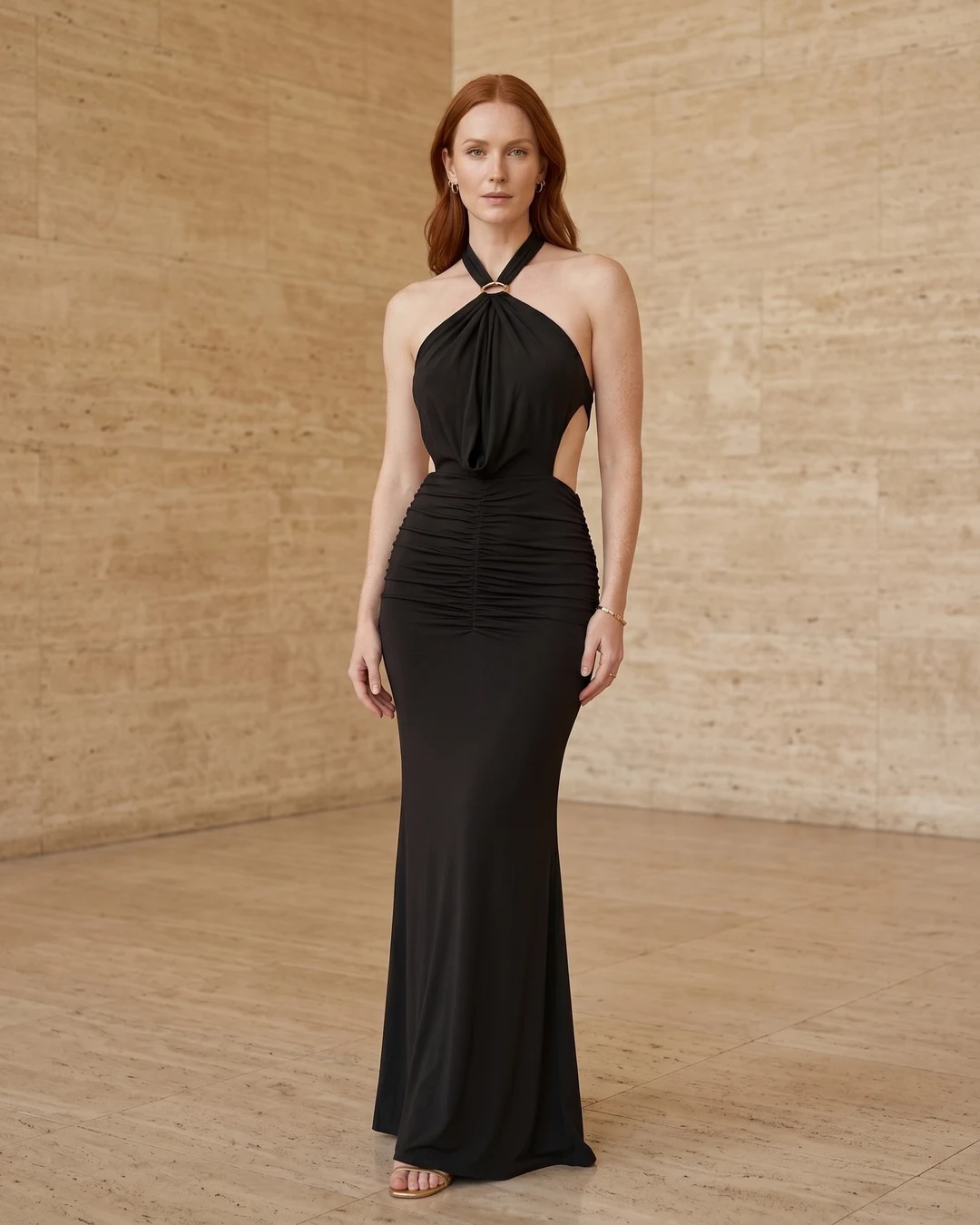
Minimalism chases the smallest number and the plainest line, whereas a capsule chases the most interchange per piece. A fully-draped chiffon column gown belongs inside a capsule because it recombines across occasions; a strict minimalist might cut it for being too much.
A capsule can therefore run richer than a minimalist closet and stay small, because finishing and drape justify the extra weight. Where it overlaps with minimalism: both reject the impulse buy. Where it diverges: a capsule keeps the statement dress a minimalist would release.
#The cost-per-wear math that makes a capsule wardrobe pay for itself
Cost-per-wear equals the price of a piece divided by the number of times you wear it, so an expensive dress worn often costs less per outing than a cheap one worn twice. This single formula converts the doctrine from belief into arithmetic.
#The formula, and a worked example
Run the numbers and the "extravagant" buy usually wins. A trend dress worn three times before it dates spreads its full price across three outings, so the price-per-wear stays high. An HCT occasion gown like the Calpurnia fishtail satin, worn twenty times across years, divides the same kind of price across twenty, a fraction of the per-outing cost.
Estimate wears honestly before you buy, not after: picture the next two years of real events and count the plausible outings. One exception survives the math: the once-only gown still earns a place when no rental matches the fit, though you count it as a one-wear cost and spend accordingly.
#What to spend more on, and what to spend less on
Spend up on the high-wear anchors and down on the genuinely occasional. Choose the anchor dress and the leather bag for the budget because they recombine into the most looks; the novelty piece worn once does not.
Fabric is why an anchor reaches a high wear count at all. Matte crepe holds its shape, a full lining keeps a dress hanging clean, and finished seams survive repeated wear. The construction detail lives in the how to look expensive guide; here the rule is that finishing lets a piece earn its keep.
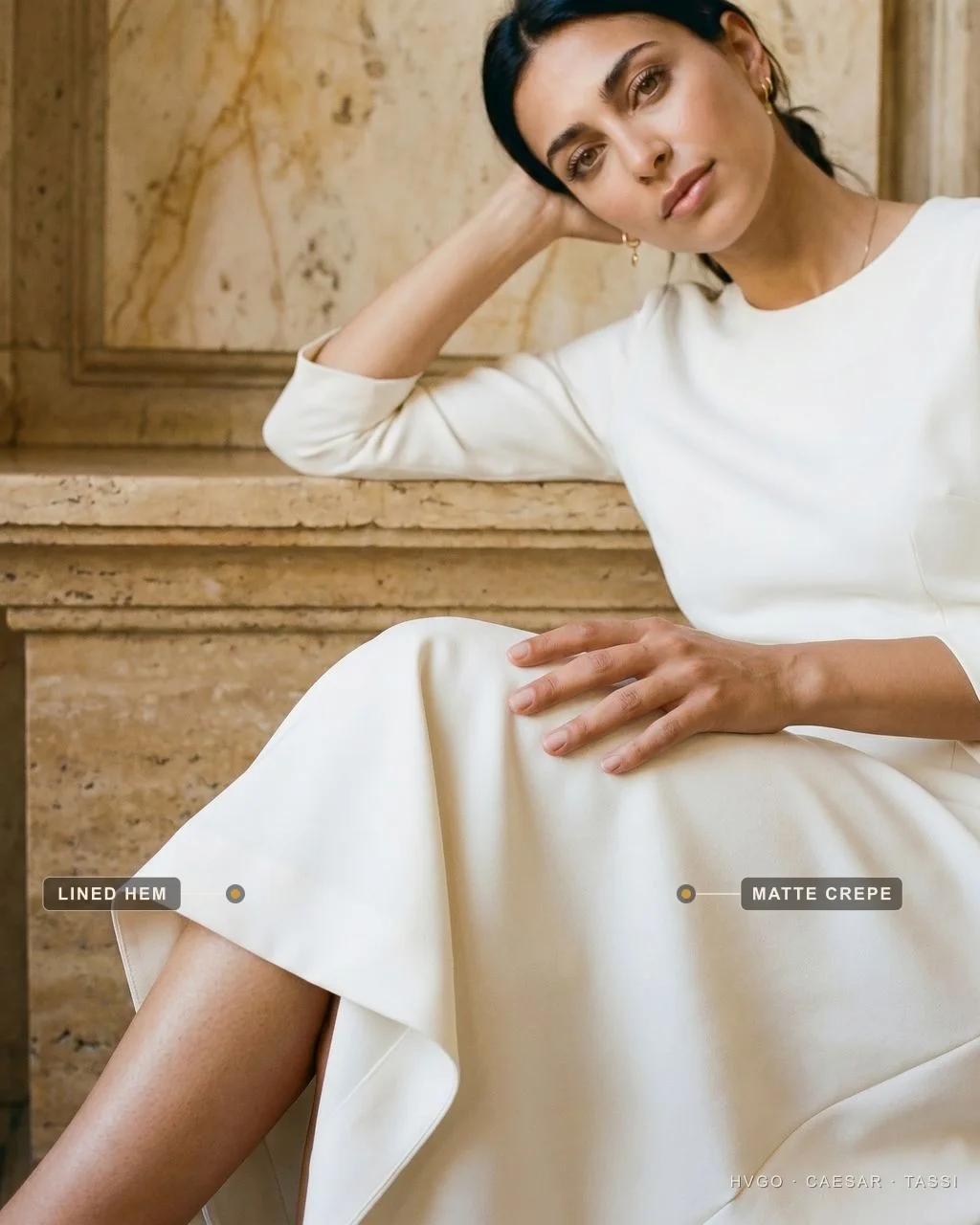
- Matte crepe — a structured, light-absorbing weave holds its shape and reads expensive without shine
- Lined hem — a clean fully-lined hem fold keeps the dress hanging true and survives repeated wear
| Spend bracket | Piece type | Why it earns the budget | House example |
|---|---|---|---|
| Spend up | High-wear anchor dress | Recombines across day and evening, 20+ wears | Aemilia A-line chiffon maxi |
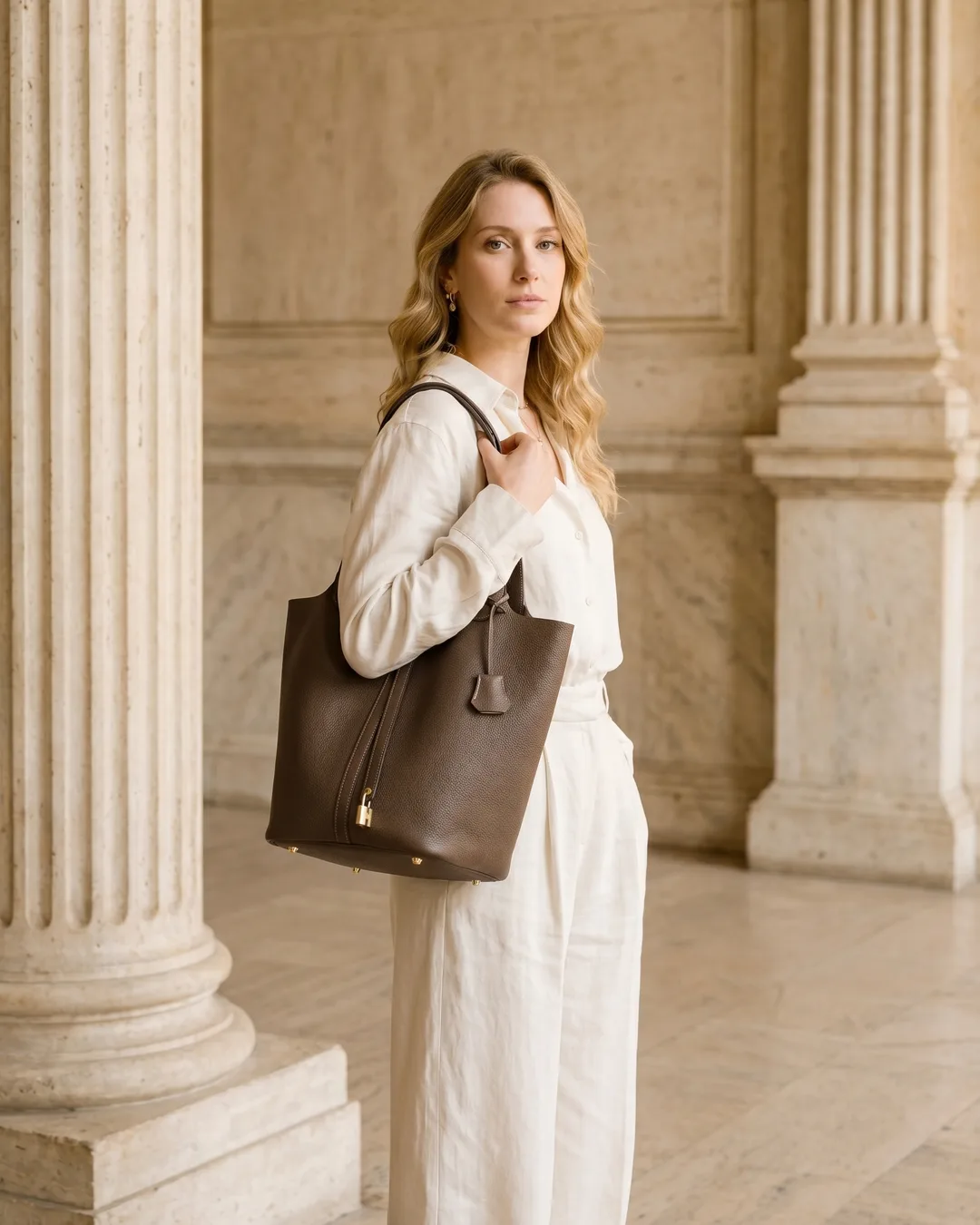
| Spend up | One leather bag | Re-styles every dress, carried daily | Palatina leather shoulder bag |
| Mid | Day-correct print | Lighter rotation, several wears a season | Livilla floral-print chiffon midi |
| Spend less | Single-occasion gown | Few plausible outings, counts as one-wear | a one-off rental-class dress |
#The keep-it rule: only the dress you'll keep a decade earns a place in the capsule wardrobe
A garment joins the capsule only if you would still wear it in ten years; anything that fails the test is a trend buy in disguise. The rule sorts hubs from orphans before money changes hands.
#The keep-for-ten-years test, in four questions
Run four questions on any dress and a single "no" disqualifies it. Each question targets one failure mode a decade exposes: fashion churn, fabric fatigue, fit, and palette isolation.
- Would I wear this silhouette in three years? Judge the shape, not the season's trend. A column line outlasts a cutout.
- Does it hold its shape and color? Structured crepe and a recycled chiffon in a colorfast imperial dye survive; a flimsy weave pills.
- Does it fit at the shoulder right now? The shoulder seam is the un-alterable tell; a hem moves, a shoulder rarely does.
- Does it combine with at least three pieces I already own? Palette decides this, and it is the question most buyers skip.
The Tullia pleated crepe column passes all four for most closets. Watch the third question hardest: a dress that fails only on the shoulder still fails outright, because a wrong shoulder never reads expensive however good the fabric.
#Why a kept dress is the most sustainable and the cheapest
The lowest cost-per-wear and the lowest waste come from the same place: the piece you never replace. A dress kept ten years skips ten replacement buys and ten discards, so it beats every churned alternative on both money and landfill. This is the old European instinct, keep and re-wear rather than refresh and discard, the wardrobe expression of Nata Imperare.
#How to build a capsule wardrobe, step by step
Build a capsule in three moves: define its job, edit and set one palette, then buy anchors before accents. The order matters, because counting pieces before naming the job is how every 30-item list goes wrong.
#Step 1: Define the capsule's job before you count pieces
Decide the life the capsule dresses first, and the number follows. A capsule for weddings and events needs a handful of occasion dresses; a seasonless wardrobe needs more. Name the use, whether work, events, or travel, then size to it.
A reader who attends six events a year needs five recombining dresses and two accessories, not a 30-piece closet. Overlap rewards her further: a woman whose work and social calendars share occasions can run one capsule for both.
#Step 2: Edit what you own, then set one tight palette
Start by editing the closet you already have, not by shopping. Keep what passes the keep-it test, release the rest, and the real gaps show themselves. Then choose one tight palette, a few neutrals plus a single accent, so every survivor recombines.
The house neutrals are Avorio (ivory), Cobalto (navy), Travertine (stone), Cuoio (tan) and Basalt (black), with Porpora (wine) as the one accent. The actual chart and pairings live in the old money color palette guide; this page keeps the method, so set the palette here and source the swatches there.
#Step 3: Buy the anchors, then add interchangeable accents
Acquire the high-wear anchor dresses first, then the leather bag and silk scarf that re-style them. Anchors carry the most outfits, so they justify the early spend; accents multiply what the anchors already do. Apply one-in-one-out so the capsule never creeps, since a single scarf swap turns one dress into two looks and a bag swap turns two into four.
Discipline breaks the moment priorities invert: adding a third bag before a missing anchor starts exactly the creep a capsule exists to prevent.
#How many pieces should a woman's capsule wardrobe have?
There is no universal number; the count follows the use, and the real rule is that every piece must combine. A magic "30" is a download, not a method.
#The count follows the use, not a magic number
A tight occasion capsule can be five or six dresses plus two or three accessories. A seasonless everyday wardrobe runs larger because it covers more situations. Either way, the test is interchange, not arrival at a target. A single-gala calendar proves the point: a woman with one annual event needs perhaps two dresses, not five, and forcing the count to thirty defeats the purpose.
#Seasonless vs. seasonal, and the recombination math
A seasonless capsule stretches one palette across fabric weights, lighter chiffon for summer, deeper crepe and satin for winter, whereas a seasonal capsule swaps a small set twice a year. The recombination math favors seasonless: five interchangeable dresses with two accessory accents produce far more outfits than seven items, because each accent re-colors each dress.
Hold the palette and the arithmetic compounds; break it and the same piece count yields fewer looks. That gap between outfits and hangers is what a capsule opens.
#Building the imperial-palette occasion capsule wardrobe (a few dresses, one bag, one scarf)
A working occasion capsule is a few dresses in held imperial neutrals plus one leather bag and one silk scarf as the changeable focal point. Small set, wide reach, day to evening.
The imperial-palette capsule edit
Four interchangeable dresses in held neutrals, plus the two accessories that re-style them all.
#The dresses: interchangeable shapes in a held palette
Choose shapes that cover the day-to-evening arc in one palette. The Julia French-pleated chiffon maxi anchors tonal daywear; the Aemilia A-line chiffon maxi is the fluid all-rounder; the Tullia pleated crepe column and the Calpurnia fishtail satin carry evening; the Livilla floral-print chiffon midi adds the lighter, day-correct note.
Each sits in an imperial neutral with Porpora as the single accent, so they cross-pair freely. Skew the arc and the set fails: two evening gowns with no daywear is a costume rack, not a capsule, so balance the daytime and night.
#The leather bag and the silk scarf that recombine it all
Two accessories re-style every dress: one unbranded leather bag and one silk square scarf. The Palatina leather shoulder bag (or the larger Esquilina leather tote for day) holds the look together; the Vesta silk square scarf is the day-to-evening switch, knotted at the neck for afternoon and slipped off for dinner to recolor the same dress in seconds.
Both pieces stay logo-free, so they hold the focal point rather than announce a label. Color discipline still governs the accessories: a bag in an off-palette tone fights the dresses instead of binding them, so keep the leather in Cuoio (tan) or Basalt (black).
#Worked recombinations: more outfits than hangers
Watch a handful of pieces become a week of looks. The Aemilia with the Esquilina tote and the Vesta scarf dresses a daytime wedding guest. Drop the tote for the Quirina envelope clutch and the Tullia column becomes the evening. Swap the scarf to Porpora and the same Aemilia re-colors for a different event.
Three named looks, five physical pieces, and the outfits outrun the hangers, which is the cost-per-wear thesis made visible. A single dress with no accent swap still gives one reliable look, but forfeits the multiplication the scarf and bag exist to deliver.
#How Hugo Caesar Tassi designs pieces worth keeping a decade
Hugo Caesar Tassi cuts fluid imperial fabrics in restrained palette colors, fully lined and logo-free, in silhouettes built to outlast trend cycles. The construction is what lets a dress survive ten years and reach the lowest cost-per-wear.
#The founder's doctrine: built to be kept, not replaced
A working Roman atelier founded MMIV on Nata Imperare designs against churn on purpose. Dresses ship fully lined with a concealed zip, chiffon comes knife-pleated or bias-cut in a recycled weave, satin is bias-cut, and crepe is matte and structured, so each choice protects shape and color across years. The silhouettes stay logo-free so nothing dates them to a season.
The detail a listicle hides decides everything here: a beautiful photograph over thin fabric collapses by year two, so finishing, not styling, wins the decade.
#The capsule edit from the collection
One line each on the anchor set keeps the choice simple:
- Julia French-pleated chiffon maxi: the tonal daywear anchor.
- Aemilia A-line chiffon maxi: the recombine-with-everything dress.
- Tullia pleated crepe column: the evening anchor.
- Livilla floral-print chiffon midi: the lighter day note.
- Palatina leather shoulder bag: the binding accessory.
- Vesta silk square scarf: the changeable accent.
Pull the dresses from the women's dresses edit and add the Palatina bag and Vesta scarf as the two recombining accents. Start with one anchor; do not buy the set at once.
#Your capsule wardrobe, summarized, and where to start
Six lines hold the whole method, and one anchor dress starts it.
#The build in six lines
- Define the capsule's job before counting pieces.
- Edit what you own down to the keep-it survivors.
- Set one tight palette: a few neutrals plus one accent.
- Buy the high-wear anchors first.
- Add one leather bag and one silk scarf to recombine.
- Run cost-per-wear and the keep-a-decade test on everything.
#Start with one anchor dress
The lowest-friction first move is a single interchangeable anchor in an imperial neutral, then build outward as events demand. Pick the dress that pairs three ways over five that pair none, and you can resist buying the full set at once.
Build the wardrobe that does more with less: start with one interchangeable anchor dress from the occasion dresses edit, add the leather bag and silk scarf that re-style it from women's accessories, and let cost-per-wear and the keep-a-decade rule decide everything you buy next. The pillar style guides hub holds the rest of the method.
#Frequently asked questions
How do I start building a capsule wardrobe?
Start a capsule wardrobe by deciding its job first, then editing and buying to it. Decide what it dresses (work, events, travel), edit down to the pieces you would keep a decade, set one tight palette of a few neutrals plus one accent, then buy the high-wear anchors before adding a bag and scarf. Let every new piece combine with at least three you already own.
How many pieces should a capsule wardrobe have?
A capsule wardrobe has no universal number of pieces; the count follows the use. A focused occasion capsule can be five or six dresses plus two or three accessories, while a seasonless everyday wardrobe runs larger. The real rule is that every piece must combine with the others, not that you hit thirty.
What is cost-per-wear and how do I calculate it?
Cost-per-wear is the price of a piece divided by the number of times you will wear it. A higher-priced dress worn twenty times over years can cost far less per outing than a cheap one worn three times. Estimating wears honestly before you buy is how you justify owning fewer, better things.
Is a capsule wardrobe the same as a minimalist wardrobe?
A capsule wardrobe is not the same as a minimalist wardrobe, though they overlap. Minimalism optimizes for less, the lowest count and plainest lines, while a capsule optimizes for fewer but better and fully interchangeable. A richly draped gown can belong to a capsule even though a strict minimalist might leave it out.
How do I build a capsule wardrobe on a budget?
Build a capsule wardrobe on a budget by spending up only on high-wear anchors and down on the occasional. Keep to one tight palette so everything recombines, and let cost-per-wear guide every choice. A well-cut, fully-lined dress in a restrained color worn for years costs less per wear than a string of trend buys.
What is the difference between a capsule wardrobe and a trend-led closet?
The difference between a capsule wardrobe and a trend-led closet is interchange versus isolation. A trend-led closet is single-season one-offs that do not work together, so it feels full yet leaves nothing to wear; a capsule is a connected set in a held palette that always has an answer. One loses value each season; the other compounds it.
More Style & Old Money guides
Gold or Silver Jewelry With a Dress? The Two-Step Rule That Settles It
A Roman atelier's two-step rule for gold or silver jewelry: read your skin undertone, then let the dress color break the tie. Color-by-color chart.
Choose gold or silverHow to Accessorize a Dress
A Roman atelier's method to accessorize a dress: choose one focal point, then let the rest recede. Neckline focal-point map, bag, scarf and shoe rules.
Master the one-focal-point ruleHow to Dress Elegantly
Five repeatable house rules from a Roman atelier to dress elegantly on any budget: one statement color, the right hem, shoulder-first fit, matte by day.
Learn the five elegance rulesHow to Look Expensive on a Budget
Look expensive on a budget: a Roman fabric house names five physical tells (drape, lining, seams, shoulder, color) no designer price can fake.
Learn the five expensive tellsHow to Wear Burgundy for Women
How to wear burgundy for women by skin tone, season and occasion: wine vs. oxblood vs. Tyrian red, what colors pair, and the gold rule.
Match your wine-red shadeOld Money Style for Women
The old money aesthetic for women, decoded by a Roman house: inherited taste over flash, the real building blocks, and how to wear it on any budget.
Shop the old money dress edit