How to Accessorize a Dress: The Rule of One Focal Point
A Roman atelier's method to accessorize a dress: choose one focal point, then let the rest recede. Neckline focal-point map, bag, scarf and shoe rules.
On this page
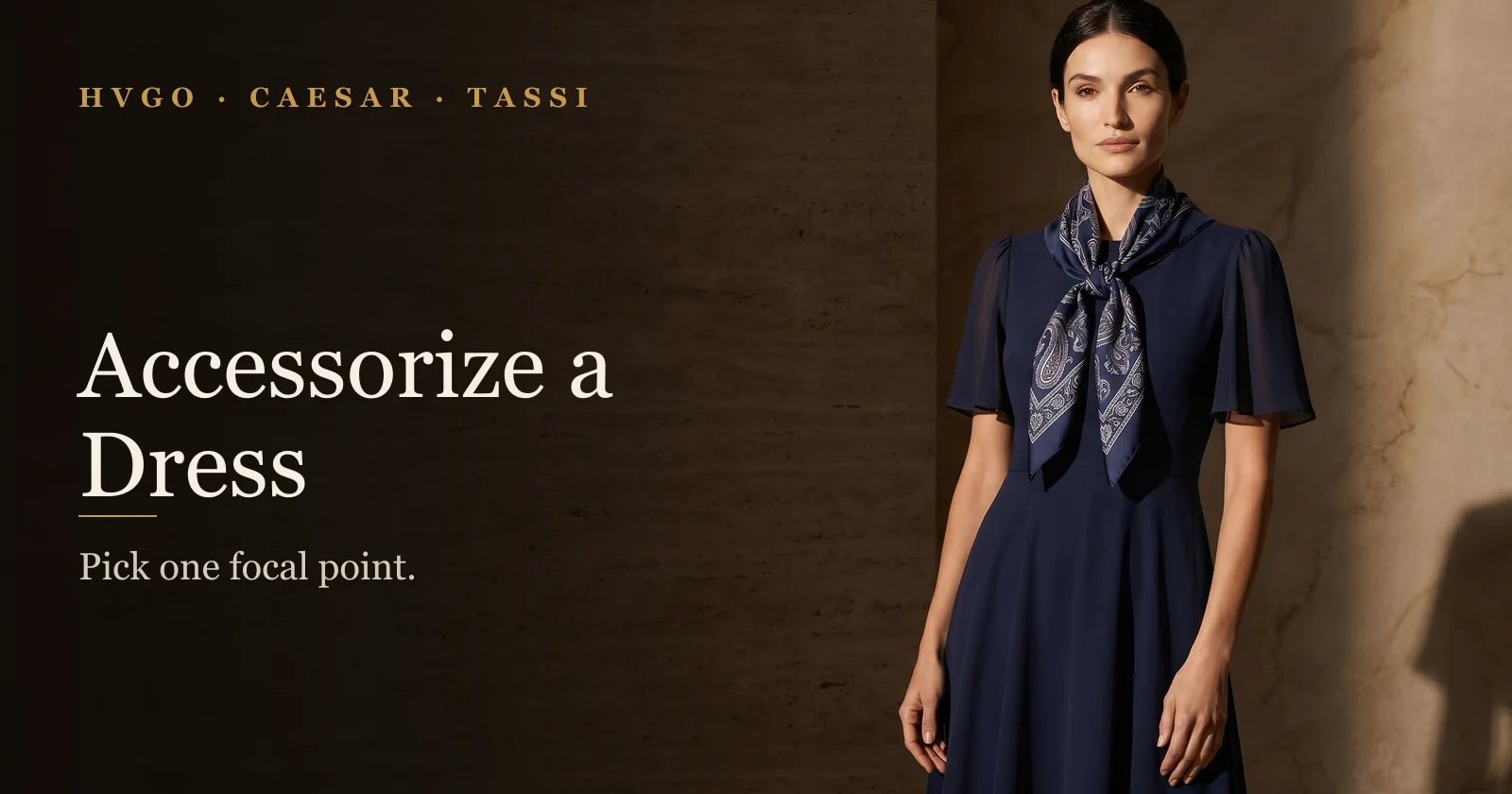
You accessorize a dress by choosing one focal point and letting every other piece recede behind it. Pick the single accessory allowed to be loud, a statement earring, a sculptural clutch, or a knotted silk scarf, then keep the bag, the belt, and the shoes quiet and tonal. Master that one decision and the rest of the outfit organizes itself, for a wedding, an evening, or an ordinary Tuesday.
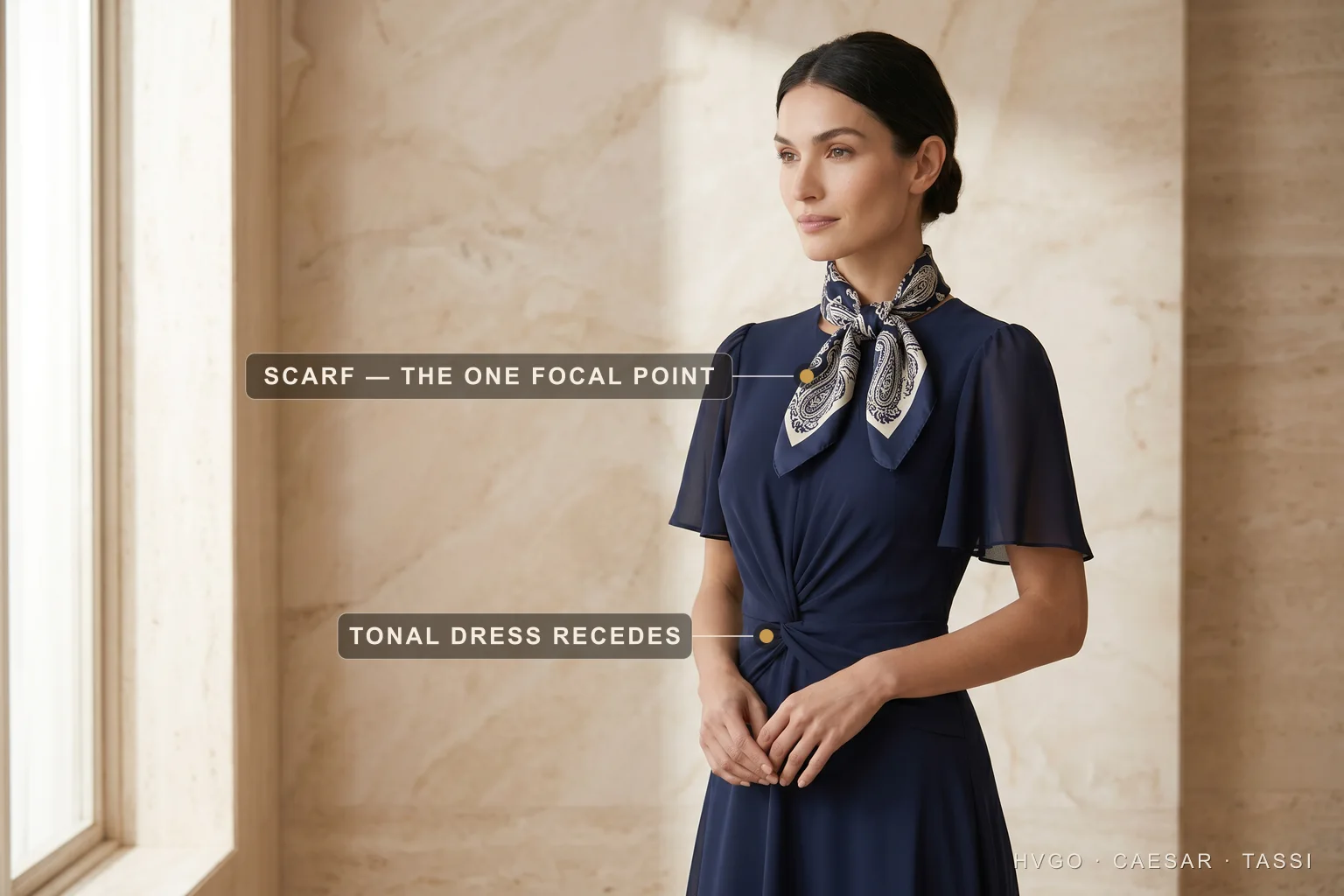
- Scarf — the one focal point
- Tonal dress recedes
The one-focal-point edit
Five things to do and five to avoid when finishing any dress.
- Name your one focal point before you dress, then keep the bag, belt and shoes quiet and tonal behind it.
- Let the neckline place the jewelry: a covered collarbone lifts it to the ears, an open one claims it at the collarbone, fill only one spot.
- Match the bag to the occasion, not the dress shade, a clutch that does not hang for evening, a structured shoulder bag or compact crossbody for day and weddings.
- Keep one consistent metal and let a single accent colour live on just one piece, the bag, the shoe or the scarf.
- Count your statements at the mirror and remove one if more than one competes, the edit that separates finished from fussy.
- Don't pile accessories onto a plain Avorio chiffon midi, one paisley scarf finishes it, earrings plus a belt plus a bracelet tip it into costume.
- Don't add a necklace to a beaded or pleated gown like the Claudia or Tullia, the dress is already the focal point, so studs and a tonal clutch are enough.
- Don't let one piece do two jobs, a jeweled belt that shapes the waist and shouts at once breaks the rule.
- Don't hang a strap across an evening gown or match a Verde Antico dress to a same-green bag, it reads like a uniform, not considered.
- Don't count a hat or fascinator as free, it is a statement, so the earrings drop to studs when you wear one.
#What does it mean to accessorize a dress the right way?
Accessorizing well means subtracting, not piling on. A woman finishes a dress when the garment leads and each accessory carries one job. The common mistake treats accessories as a volume dial: a plain Avorio (ivory) chiffon midi turns polished with one paisley scarf, then tips into costume once that scarf gains earrings, a belt, and a bracelet. A beaded gown runs the other way and needs almost nothing. Our style guides hub maps where each finishing decision lives.
#Accessories are punctuation, not the sentence
Accessories steady a dress the way a comma steadies a clause, never replacing it. Hugo Caesar Tassi (a women's occasionwear house, founded in Roma in 2004) teaches restraint as the first rule of finishing. A Tullia pleated crepe column gown holds a strong vertical line, so studs complete it, whereas a layered necklace fights the pleats.
#The four jobs an accessory can do
Every accessory should do one of four jobs, and no piece should do two.
- Add the focal point. One loud piece earns the eye.
- Define the waist. A belt marks the narrowest point on a column or shift.
- Carry a color. One accent piece ties the look together.
- Set the metal. One consistent metal fixes the temperature, gold or silver, never both.
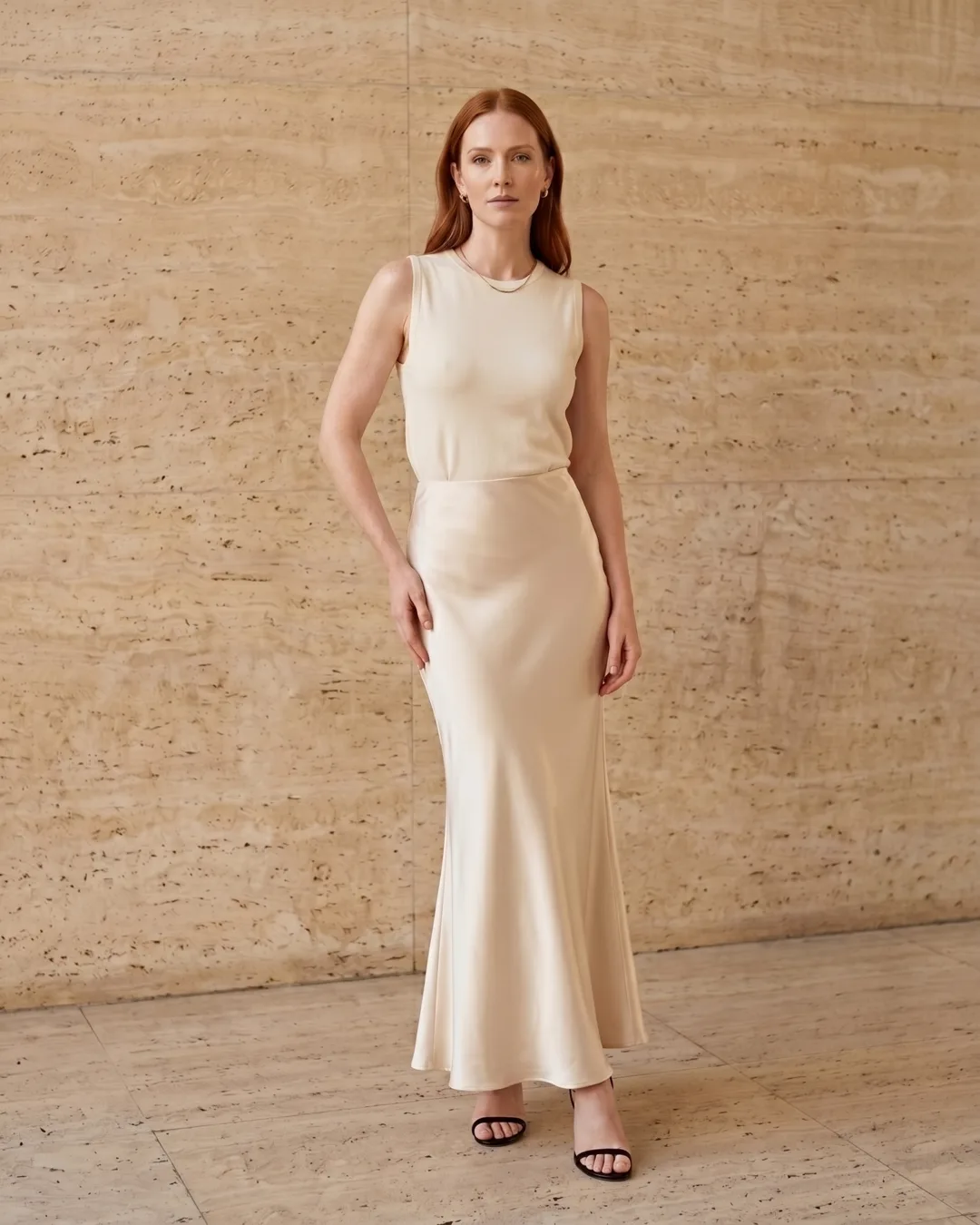
A Travertine (stone) shift shows it: a thin tonal belt defines the waist while a single drop earring adds the focal point. The trap is one piece doing two jobs, like a jeweled belt that shapes the waist and shouts at once.
#The rule of one focal point: the simplest way to accessorize a dress
One focal point per outfit, and everything else recedes to support it. The focal point earns the eye first, whether statement earrings, a sculptural clutch, a printed scarf, or the dress itself. A Cobalto (navy) crepe sheath with one oversized earring reads deliberate; that same sheath with the earring plus a beaded clutch plus a cuff reads undecided.
#Choose the single piece that leads
The lead is whichever piece you want noticed from across the room. Name it before you dress, then dress down to it: if a Palmyra twill silk scarf is the statement, the earrings shrink to studs and the bag goes tonal. Two leads at once cancel, because the eye cannot rank them.
#When the dress is already the focal point
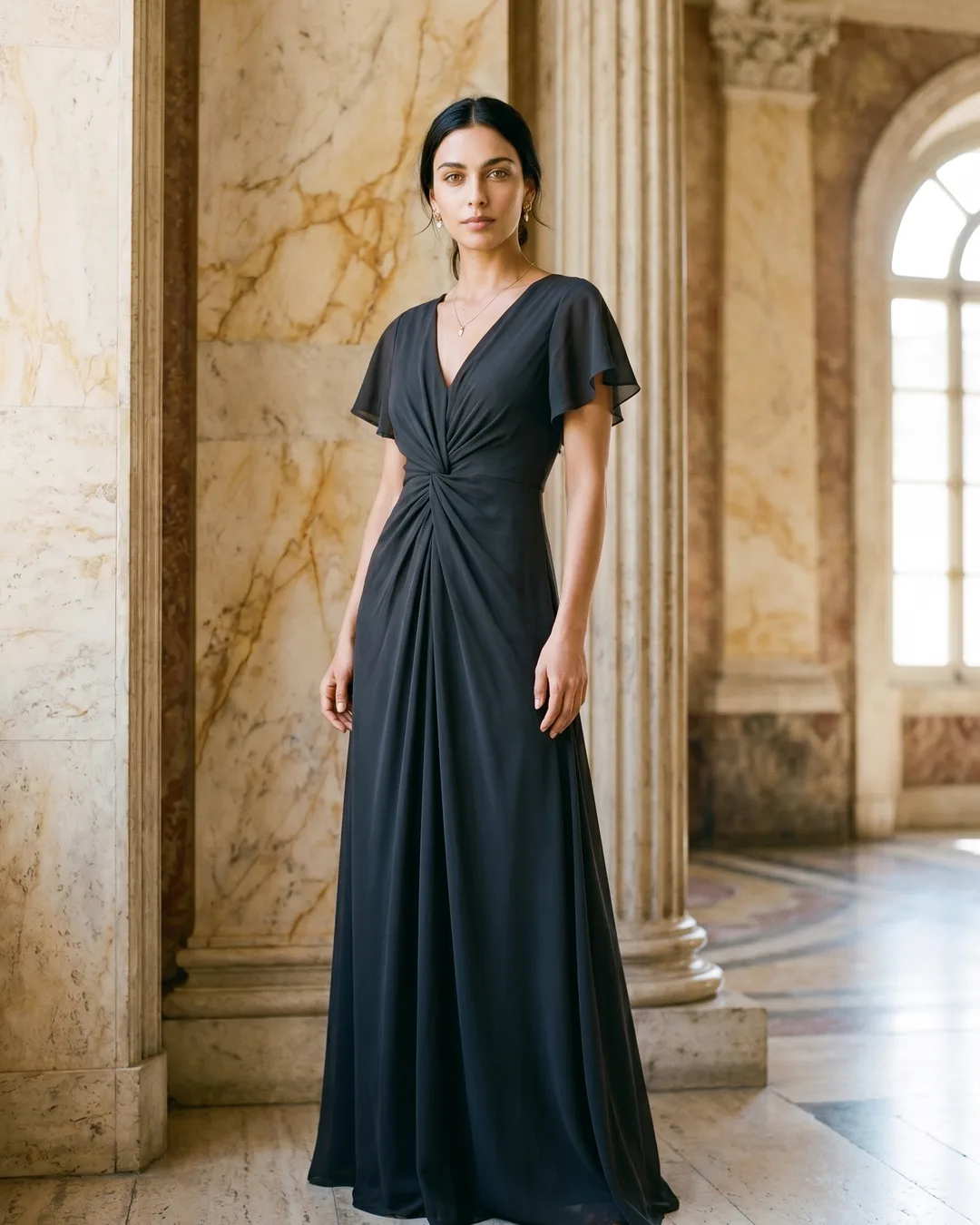
A pleated, beaded, or high-drama dress is the statement, so accessories stay near-invisible. A Claudia pleated-slit chiffon maxi gown is the focal point on its own, so it asks for studs, a tonal clutch, and a bare neck. The trap is a beaded gown paired with a necklace, a cocktail ring, and a crystal clutch: four statements at war.
#The "remove one thing" edit before you leave
At the mirror, count your statements and take one off if more than one competes. This single edit separates finished from fussy. Even at a maximal costume gala, one anchor reads better than five.
#Where the neckline puts your focal point: ears or collarbone
The neckline decides where your one jewelry focal point belongs, the ears or the collarbone, and which spot stays bare.
#The neckline decides where the eye lands, not which metal you buy
The neckline answers where, not which metal. Skin invites jewelry and fabric repels it, so a covered collarbone sends the eye up and an open one pulls it down. The separate question of gold versus silver, and keeping metals matched, belongs to our gold or silver jewelry guide.
#Covered necklines (high, crew, turtleneck) lift the focal point to the ears
A covered neckline fills the collarbone with fabric, so the focal point rises to the ears. Drop or statement earrings lead; the necklace stays off.
A high-neck or turtleneck dress covers the collarbone, so a necklace fights the fabric and the focal point lifts to drop earrings. A fine chain layered under a crew neck for warmth is invisible styling, not a statement.
#Open necklines (strapless, sweetheart, bare décolletage) put it at the collarbone
An open neckline bares the collarbone, so one pendant or short necklace claims it and the earrings drop to studs. A Flavia strapless satin off-shoulder gown leaves the décolletage open for a single pendant. Filling both spots doubles the one focal point the neckline meant to give you.
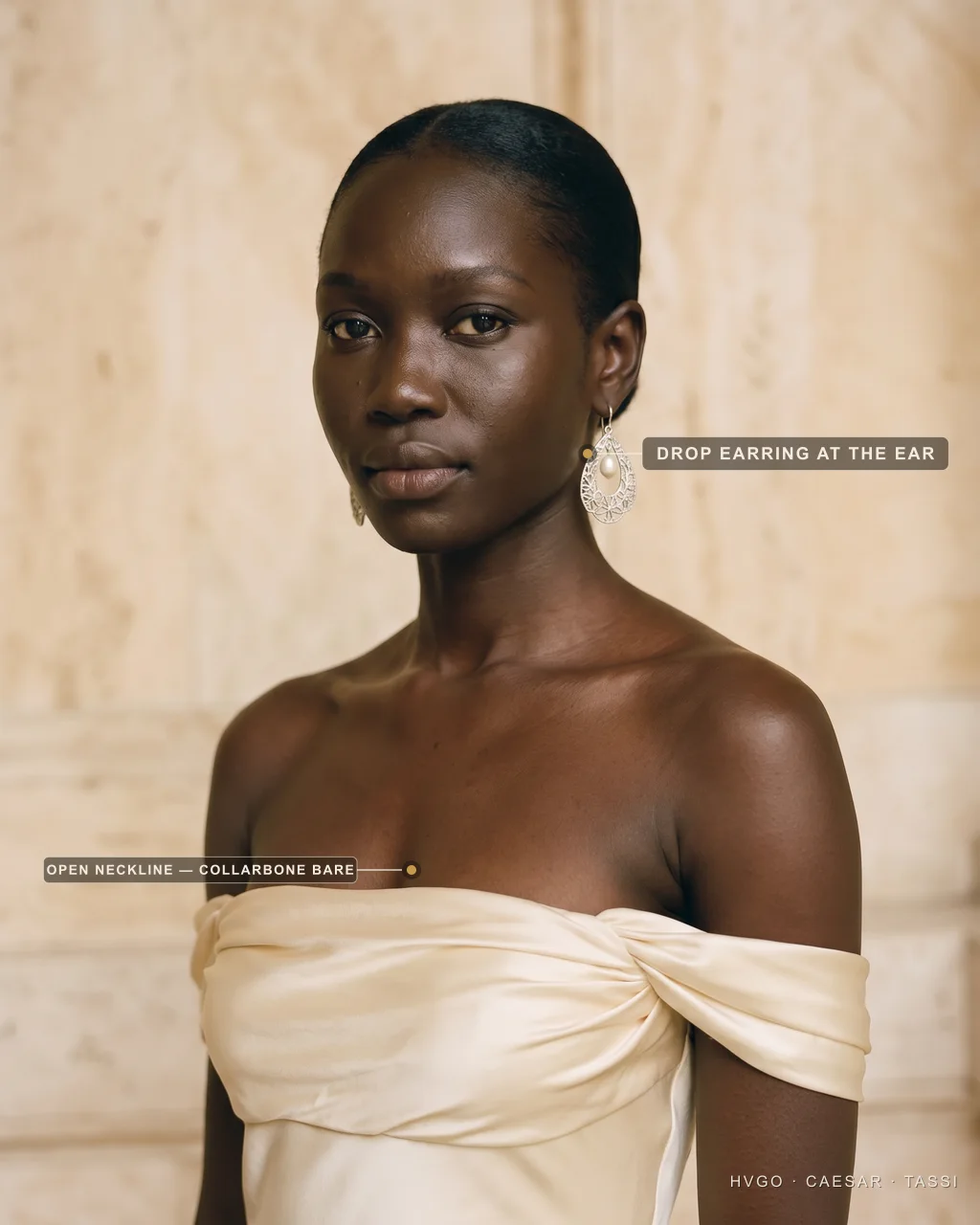
- Drop earring at the ear
- Open neckline — collarbone bare
#Directional necklines (V-neck, scoop, halter, one-shoulder) follow the line
A directional neckline draws a line, and the focal piece echoes it.
- V-neck. A pendant that follows the point reinforces the line to the chest.
- Scoop. A short necklace traces the curve, earrings kept small.
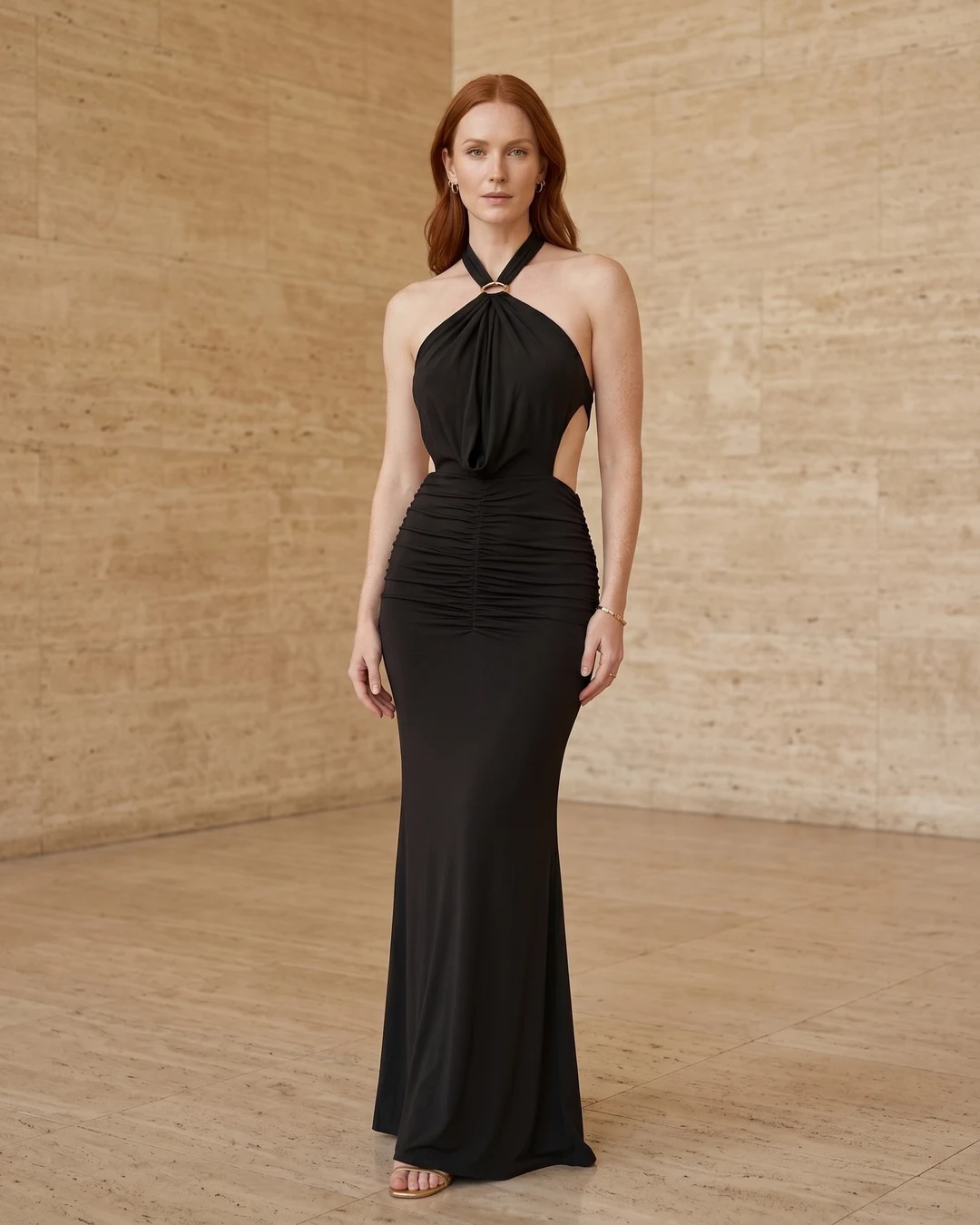
- Halter. Neck and back are bare, so earrings lead alone, no chain.
- One-shoulder. One asymmetric earring or cuff answers the bare side.
A halter on a Cipria (pink) crepe dress proves it: no room for a chain, so a clean ear is the only focal point. A deep evening V is the exception, where a longer pendant can extend the line if it stays the lone statement.
#What bag to wear with a dress for the occasion
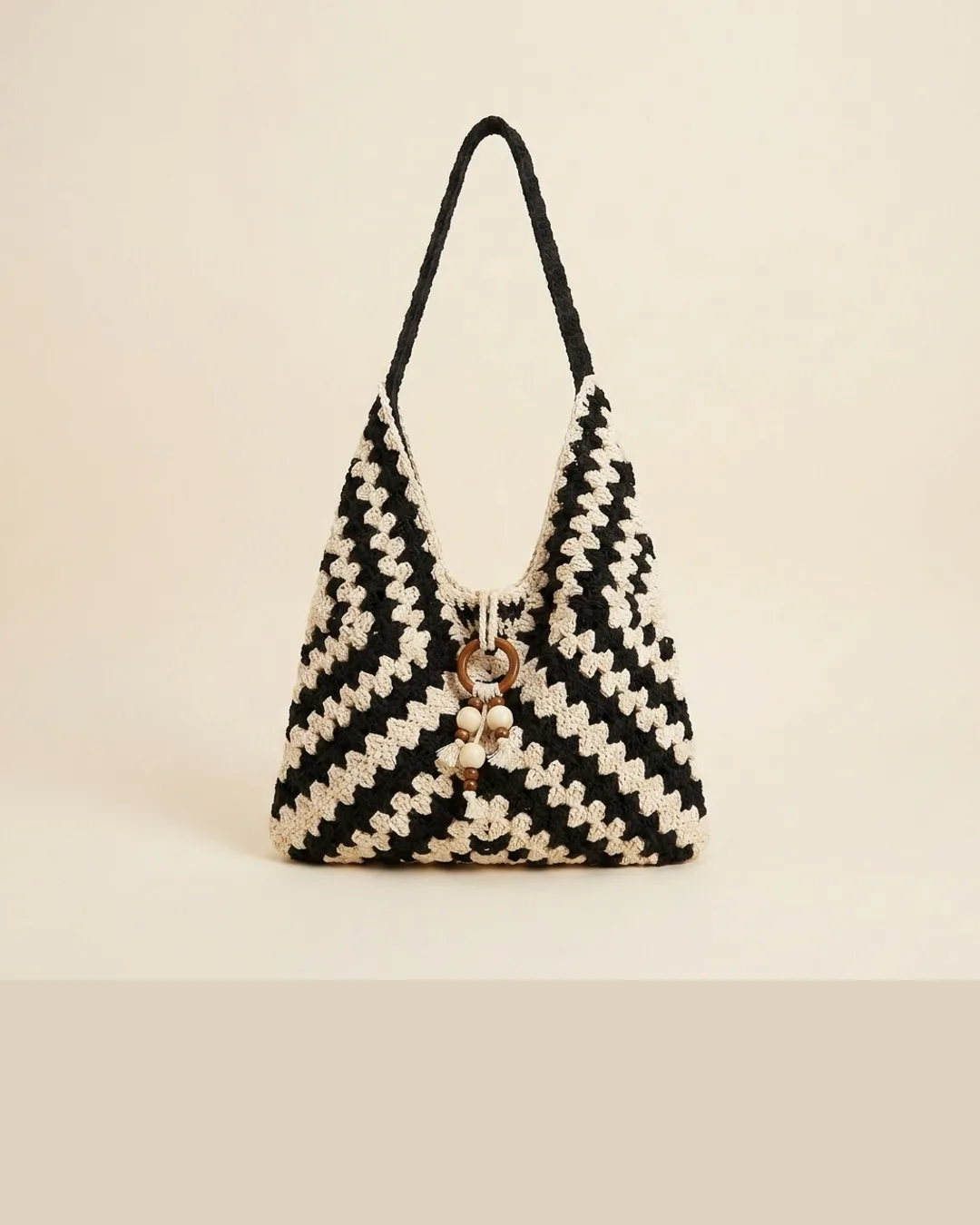
The occasion sets the bag, not the dress color. Evening wants a small clutch that does not hang; daytime wants a structured shoulder bag or compact crossbody.
#Evening: a clutch or envelope, nothing that hangs
Evening calls for a clutch or envelope held in the hand, never a shoulder strap. A clutch finishes a gown because nothing crosses the body to cut the line, and the Quirina leather envelope clutch held flat elongates the silhouette under a column gown. For a long formal night needing more than a phone, a slim chain pouch under the arm beats a tote.
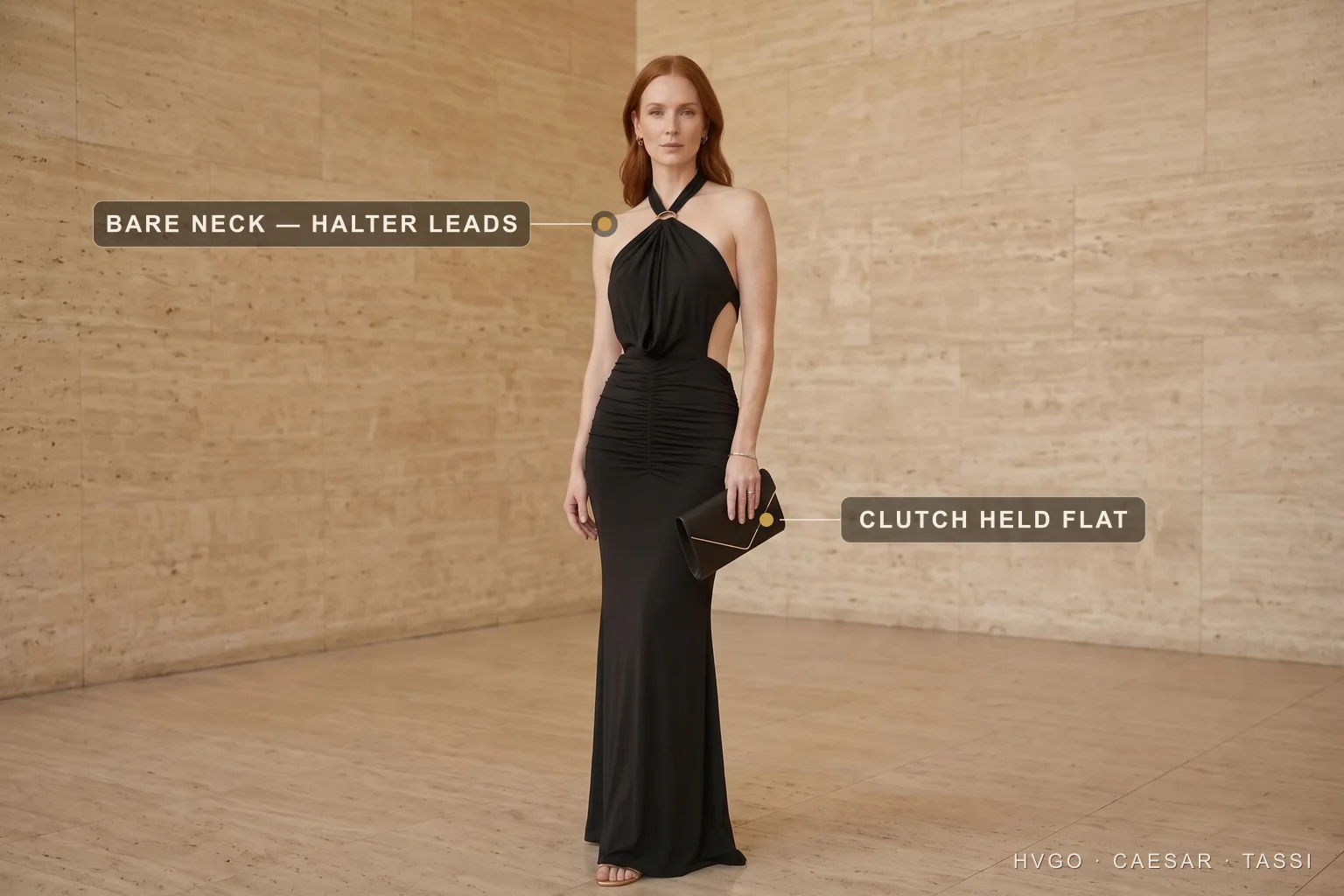
- Clutch held flat
- Bare neck — halter leads
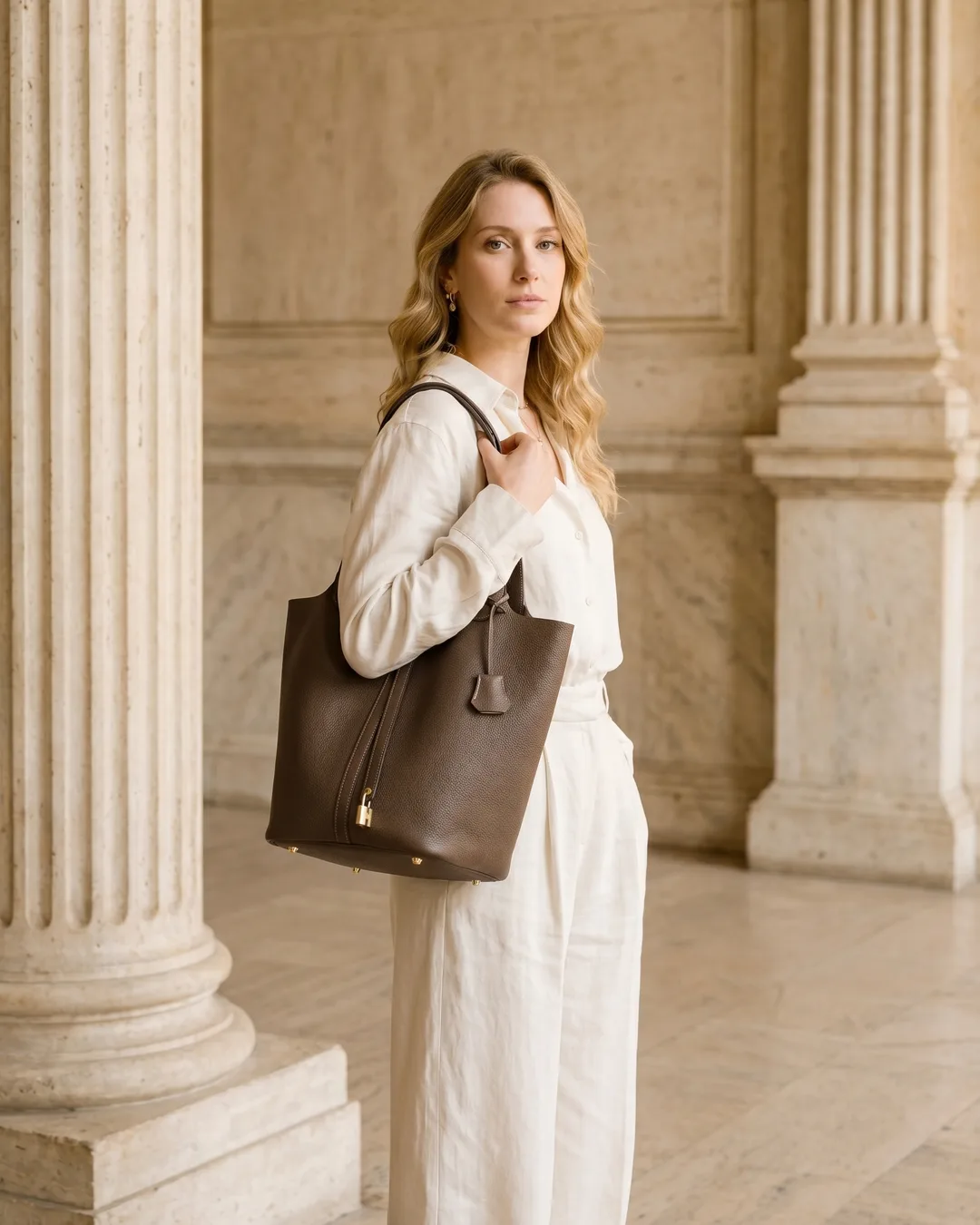
#Daytime and wedding-guest: a structured shoulder bag or small crossbody
Daytime and wedding-guest dressing wants hands free, so a structured shoulder bag or compact crossbody leads. A Palatina leather shoulder bag or a Capitolina color-block crossbody carries you through a ceremony and a reception. An oversized slouch tote droops by the third hour and pulls the outfit toward errand-running.
#Bag color: match the metal and the palette, not the dress exactly
Match the bag to your palette and metal, not the dress's exact shade.
- Cuoio (tan) anchors warm palettes and earthy dress colors.
- Basalt (black) grounds evening and any cool-toned dress.
- Avorio (ivory) lifts daytime and softens deeper shades.
- One accent lives on the bag only if the shoes stay neutral.
A Verde Antico (green) dress with a Cuoio tan bag reads considered, where a green bag matched exactly looks like a uniform. Monochrome dressing reverses that, since a bag in the dress's color family deepens the column.
#How to use a silk scarf to accessorize a dress
A silk scarf accessorizes four ways, and each counts as one focal point. Wear it at the neck, in the hair, on the bag, or as a belt, but pick one.
#The four ways to wear a square silk scarf
A square silk scarf works at the neck, in the hair, on the bag, or at the waist, never two at once.
- At the neck. A neck-tie or small knot frames the face.
- In the hair. A folded band lifts the focal point upward.
- On the bag handle. A knot softens a structured bag.
- As a belt. Threaded through loops, it defines the waist.
A plain Basalt dress turns expressive the moment a Tessera paisley scarf knots at the throat. One scarf at the neck and a second on the bag doubles your one focal point.
#When the scarf is the focal point vs a quiet finish
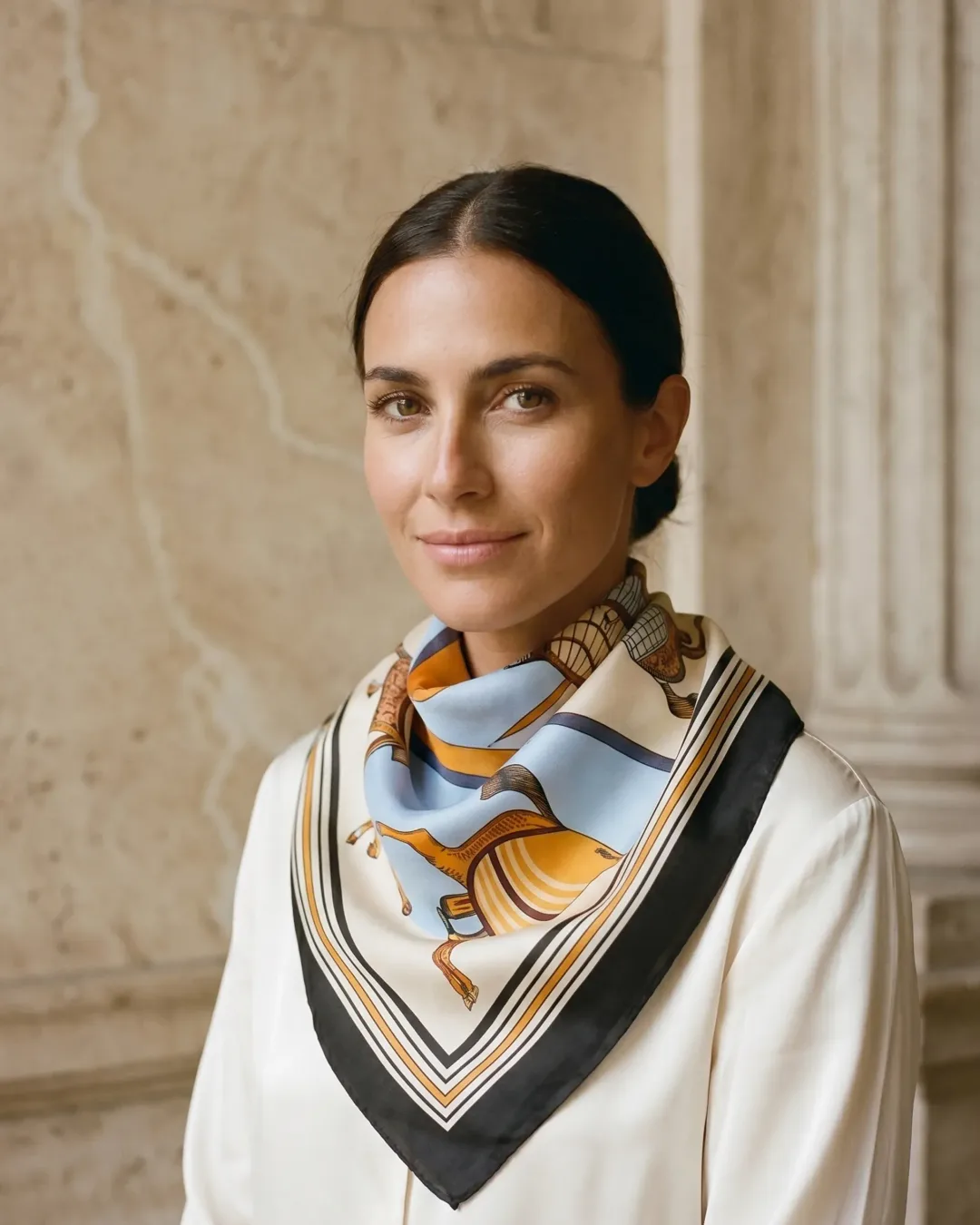
A bold printed silk leads, while a tonal silk merely polishes. A Palmyra or Carina printed silk on a solid Avorio or Basalt dress becomes the focal point, so the earrings shrink to studs, where a small tonal Vesta silk close to the dress color gives a quiet finish instead. On a busy printed dress, any scarf competes and is better left off.
#Belts, shoes and hosiery: how to accessorize a dress from the waist down
Below the waist, accessories should lengthen the line and stay quiet unless one is your chosen statement.
#A belt to define the waist (and when to skip it)
A belt earns its place only when the dress needs a defined waist. Use a tonal belt to shape a column, a contrast belt as a statement, and none on a fitted dress.
A thin tonal belt adds a waist to a straight Vipsania draped modal column gown without leading, while a Vermiglio (red) belt on a Travertine dress becomes the statement. Skip it on an already-fitted or beaded dress, where it cuts a horizontal line the silhouette never asked for.
#Shoes that lengthen, not interrupt
Shoes should extend the leg, so match them to the hem or to skin. A skin-tone heel under a maxi keeps one unbroken line, while a bright contrast shoe chops the leg at the ankle. Choose stilettos for black-tie and flat sandals for summer, and let either the bag or the shoe carry the accent color, never both.
#Hosiery and bare legs: when sheer, when not
Hosiery should agree with the season and the dress fabric. Sheer hose suits formal and cool weather, while bare legs suit summer daytime.
- Sheer nude finishes formal occasions and weddings in cool months.
- Sheer black pairs with evening and darker dresses.
- Opaque tights anchor winter looks and can add a color note.
- Bare legs read right for summer and casual daytime.
A sheer black hose under a Basalt satin evening dress reads correct for a winter gala, where bare legs would read underdressed. A heavy tight under featherweight chiffon clashes in weight.
#How dress length changes the accessory math
Dress length shifts where the drama belongs. A maxi's floor-length hem already does visual work, so the focal point moves up to earrings or a scarf and the bag stays small. A mini exposes more leg, so a flatter shoe and a smaller bag balance it. The midi sits in the forgiving middle, broken down by proportion in our length comparison guide.
#How to accessorize a dress for a wedding without overdoing it
A wedding asks you to finish to the dress code and never out-sparkle the bride.
#Dress-code-aware finishing
The dress code sets the accessory weight before anything else. Black-tie wants a clutch and one jewel; a garden wedding wants a structured bag and comfortable heels.
A black-tie wedding asks for a clutch plus a single restrained jewel, while a garden wedding asks for a structured bag and block heels you can stand in, since grass eats stilettos. A beach wedding goes further still: flat sandals and bare legs read correct.
#Hats, fascinators and sunglasses for a daytime occasion
A hat or fascinator counts as a statement, so the jewelry goes quiet when you wear one. At a garden wedding or the races, a hat leads, so the earrings drop to studs and elegant sunglasses finish the daytime look. The trap is counting the hat as free: a fascinator plus statement earrings plus a bold bag is three statements at once.
#One accent color, repeated once
Pull one accent color and repeat it at most once. Carry it on a single piece, then build the rest from neutrals like these.
- Avorio (ivory) is the fail-safe base for almost any wedding code.
- Basalt (black) grounds a formal evening reception.
- Cuoio (tan) warms a daytime garden palette.
- One accent lives on the bag, the shoe, or the scarf, not all three.
A Cornelia (rose) scarf as the single accent over an Avorio dress reads finished. Repeat that rose on the shoes and the bag too, and the look reads themed.
#How Hugo Caesar Tassi finishes a dress: the focal-point pieces
The house accessory edit is built around one-focal-point styling, so each piece is designed to recede or to lead.
#One clutch, one scarf, one earring — built to recede or to lead
Each house accessory is made either to disappear behind a dress or to become its statement. The Quirina envelope clutch and Palatina shoulder bag are the quiet finish, structured and tonal so a strong dress keeps the eye, while the Vesta, Carina, Palmyra, and Tessera silk square scarves are the statement option. Browse the full range of silk square scarves and the leather bags that pair with them.
#Pairing the catalog: which accessory finishes which dress
Match a quiet accessory to a loud dress, and a loud accessory to a quiet dress.
| Dress | What it is | Its focal point | The finishing piece |
|---|---|---|---|
| Tullia | Pleated crepe column gown | The dress | Studs + Quirina clutch |
| Claudia | Pleated-slit chiffon maxi | The dress | Studs + tonal clutch, bare neck |
| Livilla | Floral-print chiffon midi | A bold silk scarf | Tessera or Palmyra at the neck |
| Portia | Short-sleeve chiffon A-line | A bold silk scarf | Carina scarf, studs |
| Flavia | Strapless satin off-shoulder | Drop earrings | Drop earrings, bare collarbone |
The rule that generates every row reads the dress first: when the garment already leads, the accessory recedes; when the garment is plain, one accessory becomes the statement. The off-shoulder row is the exception, since the neckline, not the drama level, dictates where the jewelry sits.
#Your one-focal-point accessorizing checklist
Finish any dress by answering five questions in order. Run them before you leave and the outfit resolves itself.
#The five-question finish, in order
These five questions, in sequence, turn the whole method into a thirty-second check.
- What is my one focal point? Name the single loud piece first.
- Does my neckline put it at the ears or the collarbone? Let the neckline place the jewelry.
- Is my bag right for the occasion? Clutch for evening, structured bag for day.
- One consistent metal, one accent color? Keep metals matched and color to a single piece; which metal to commit to is its own decision, settled in the gold-or-silver-jewelry guide.
- What can I remove? Count the statements and take one off if more than one competes.
A woman who answers all five lands the look the first time, whether she dresses for a wedding or a Tuesday dinner. The one trap left is skipping the edit, which is where most over-accessorized outfits go wrong. For the wider discipline, our elegance rules and the necklines guide go deeper.
#Frequently asked questions
How do you accessorize a dress without overdoing it?
You accessorize a dress without overdoing it by choosing one focal point and keeping every other accessory quiet and tonal. Pick a statement earring, a sculptural clutch, or a bold scarf to lead, then count your statements in the mirror and remove anything that competes.
What bag goes with a dress?
The bag that goes with a dress depends on the occasion, not the dress color. For evening, choose a small clutch or envelope that does not hang. For daytime and weddings, choose a structured shoulder bag or compact crossbody in a tonal neutral rather than an exact match.
Should I wear earrings or a necklace with my dress?
Whether you wear earrings or a necklace depends on your neckline, which places your one jewelry focal point. A covered neckline like a high, crew, or turtleneck lifts it to the ears with a bare neck, while a strapless or low neckline puts a single pendant at the open collarbone, so you pick one spot, not both. Which metal goes there is a separate call, settled in our gold-or-silver-jewelry guide.
How do you accessorize a plain or simple dress?
You accessorize a plain dress by making one accessory the focal point so the dress becomes a calm backdrop. Choose a printed silk scarf, statement earrings, or a contrast belt as the single loud piece, then keep everything else minimal and tonal so nothing fights your one statement.
Should accessories match the dress exactly?
Accessories should not match the dress exactly; they should stay within one palette and one consistent metal. Let a single piece carry an accent color and choose tonal neutrals for the rest, which reads more expensive than a head-to-toe exact match. If you are unsure which metal to commit to, our gold-or-silver-jewelry guide settles it.
How do you accessorize a maxi dress?
You accessorize a maxi dress by moving the drama up high, since the hem already carries it. Choose statement earrings or a knotted silk scarf for the focal point, keep the bag small, and pick a tonal heel that lengthens the line under the floor-length hem.
Choose your one focal point from the house accessory edit, starting with the Quirina envelope clutch and the silk square scarves in our women's accessories collection, built to either recede behind your dress or quietly lead it.
More Style & Old Money guides
The Quiet-Luxury Capsule Wardrobe
Build a quiet-luxury capsule wardrobe the Roman way: the cost-per-wear math, the keep-for-a-decade rule, and a small imperial-palette set that recombines.
Build a buy-fewer-better capsuleGold or Silver Jewelry With a Dress? The Two-Step Rule That Settles It
A Roman atelier's two-step rule for gold or silver jewelry: read your skin undertone, then let the dress color break the tie. Color-by-color chart.
Choose gold or silverHow to Dress Elegantly
Five repeatable house rules from a Roman atelier to dress elegantly on any budget: one statement color, the right hem, shoulder-first fit, matte by day.
Learn the five elegance rulesHow to Look Expensive on a Budget
Look expensive on a budget: a Roman fabric house names five physical tells (drape, lining, seams, shoulder, color) no designer price can fake.
Learn the five expensive tellsHow to Wear Burgundy for Women
How to wear burgundy for women by skin tone, season and occasion: wine vs. oxblood vs. Tyrian red, what colors pair, and the gold rule.
Match your wine-red shadeOld Money Style for Women
The old money aesthetic for women, decoded by a Roman house: inherited taste over flash, the real building blocks, and how to wear it on any budget.
Shop the old money dress edit