How to Look Expensive on a Budget: The Five Tells Money Can't Fake
Look expensive on a budget: a Roman fabric house names five physical tells (drape, lining, seams, shoulder, color) no designer price can fake.
On this page
Looking expensive has almost nothing to do with what you paid and everything to do with five physical things no label can put on a price tag: how the cloth falls, whether it is lined, how its seams are finished, where the shoulder sits, and how deep the dye runs. As a Roman fabric house, Hugo Caesar Tassi reads garments the way a tailor does. Master these five tells and a 90-euro dress can out-read a 900-euro one.
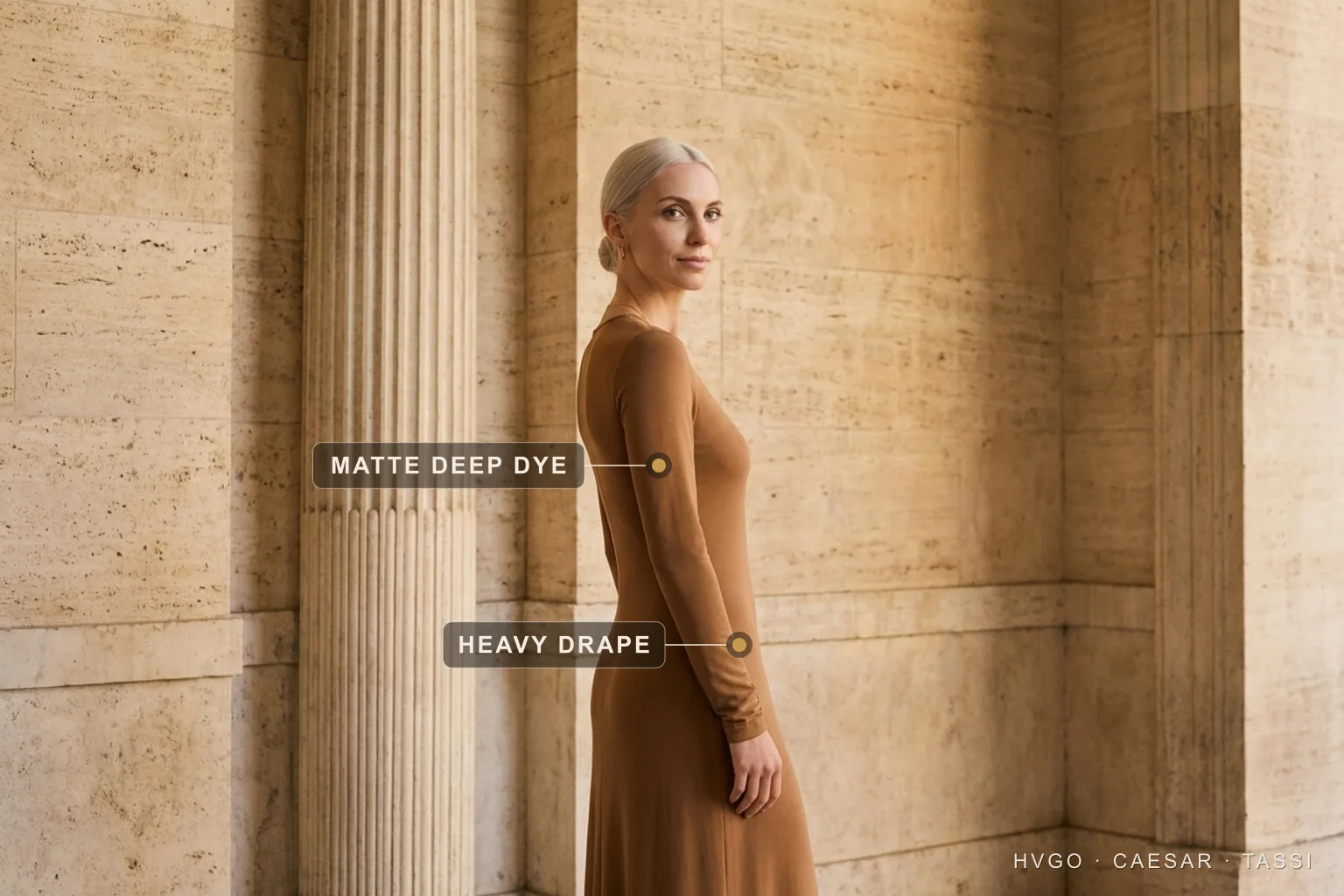
- Matte deep dye
- Heavy drape
The tells that read expensive
Money shows in restraint, fit and finish — not in logos.
- Fit at the shoulder first
- Keep to a tight, muted palette
- Choose matte, weighty fabric
- Press, line and finish edges
- Let one good piece lead
- Visible logos or monograms
- All-over shine in daylight
- Many bright colours at once
- Fast, thin, unlined fabric
- Over-accessorising the look
#Why some women always look expensive (and it isn't the price tag)
Some women read as costly because their clothes show four checkable signals, drape, finishing, fit, and restraint, that no receipt produces. Your eye registers them in under a second, long before it finds a logo. Money buys access to those signals yet never guarantees them.
#The difference between cost and the look of cost
Cost is what the till charges. The look of cost is a set of visible qualities the cloth either has or lacks, none of them printed on the receipt. A dense viscose dress falling in a clean column out-reads a thin polyester one at triple the tag, because the viscose carries weight the polyester cannot. The reverse holds too: even a pricey garment looks budget when worn creased, pilled, or three sizes loose.
#What the eye reads first when an outfit looks expensive
Silhouette and line register before any brand, scoring shoulder, drape, and hem in roughly that sequence. A clean shoulder and a hem at the knee or the floor signal money, while a mid-calf break signals compromise. That is why a tailored thrifted blazer can beat a boxy new one. The house's style guides hub collects the companion reads.
#The five tells that make a woman's outfit look expensive
Five physical tells separate costly-looking clothes from cheap ones: hip drape, full lining, finished seams, shoulder placement, and dye depth. You can check each in under a minute. All five can still fail on a pricey garment that was made carelessly.
#Tell 1: how the fabric falls from the hip
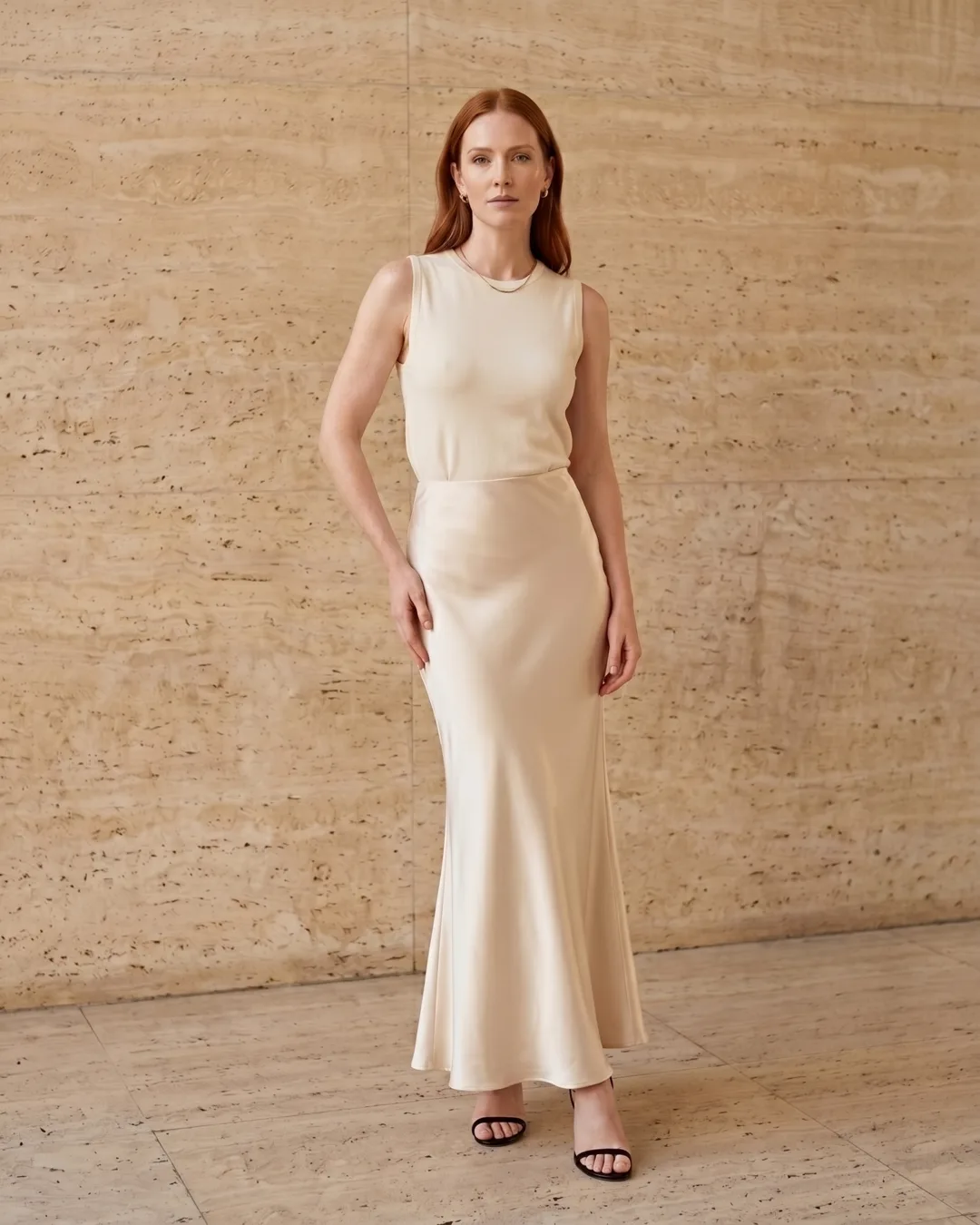
Costly cloth falls from the hip in a continuous fluid line; thin cloth either clings or stands stiff. A column gown in modal at roughly 200 grams per square meter (GSM) drapes, while a flimsy jersey at 90 GSM grips the body and maps every lump beneath it. The weight does the work: denser cloth carries its own falling momentum, so it skims past the hip instead of catching on it. Run the drape test right there in the fitting room. Pinch the fabric at the hip, lift it 10 centimeters, then release it, since good cloth resettles into vertical folds within a second while cheap cloth holds a crease. The opposite extreme also fails, a fabric so liquid it has no body, like a charmeuse that slumps off the frame.
#Tell 2: a full bagged lining, not a bare shell
A full bagged lining is the quickest signal of a quality garment, because the inner layer hides raw seams, stops cling, and adds structure. Turn the hem up to inspect it, since light coming through the skirt means the second layer is thin or missing. Cheap makers skip it first, because lining doubles the fabric and labor on every panel, and that omission is what lets a thin dress cling to tights and ride up. One trap remains: a scratchy backing sewn purely to save finishing time, so the real test is whether that layer is hemmed as carefully as the shell.
#Tell 3: finished seam allowances on the inside
Finished seam allowances, whether French, overlocked, or bound, mark a garment made with care; raw fraying edges mark one made fast. Flip the dress wrong-side-out and look for enclosed edges and flat topstitching, because puckering gives the rush away. Sheer fabric is the exception worth knowing, where a French seam is the correct choice, so judge by whether edges are finished rather than by one method everywhere.
#Tell 4: a clean shoulder line that sits where your shoulder ends
The shoulder seam must land at the bony point where your shoulder stops, neither dropped down the arm nor pulled toward the neck. This joint is the hardest part to alter and the first thing anyone judges. A seam falling 2 to 3 centimeters past the point lets the sleeve collapse and the bodice sag, pulling drag-lines across the bust that read instantly as ill-fitting. Re-setting a sleeve means unpicking the armhole, re-cutting the cap, and re-easing it, so the labor outprices most budget dresses, which is why the shoulder belongs at the top of your check. A deliberate drop-shoulder cut is fine when the pattern is built for it; an accidental drop on a set-in sleeve is the failure to reject.
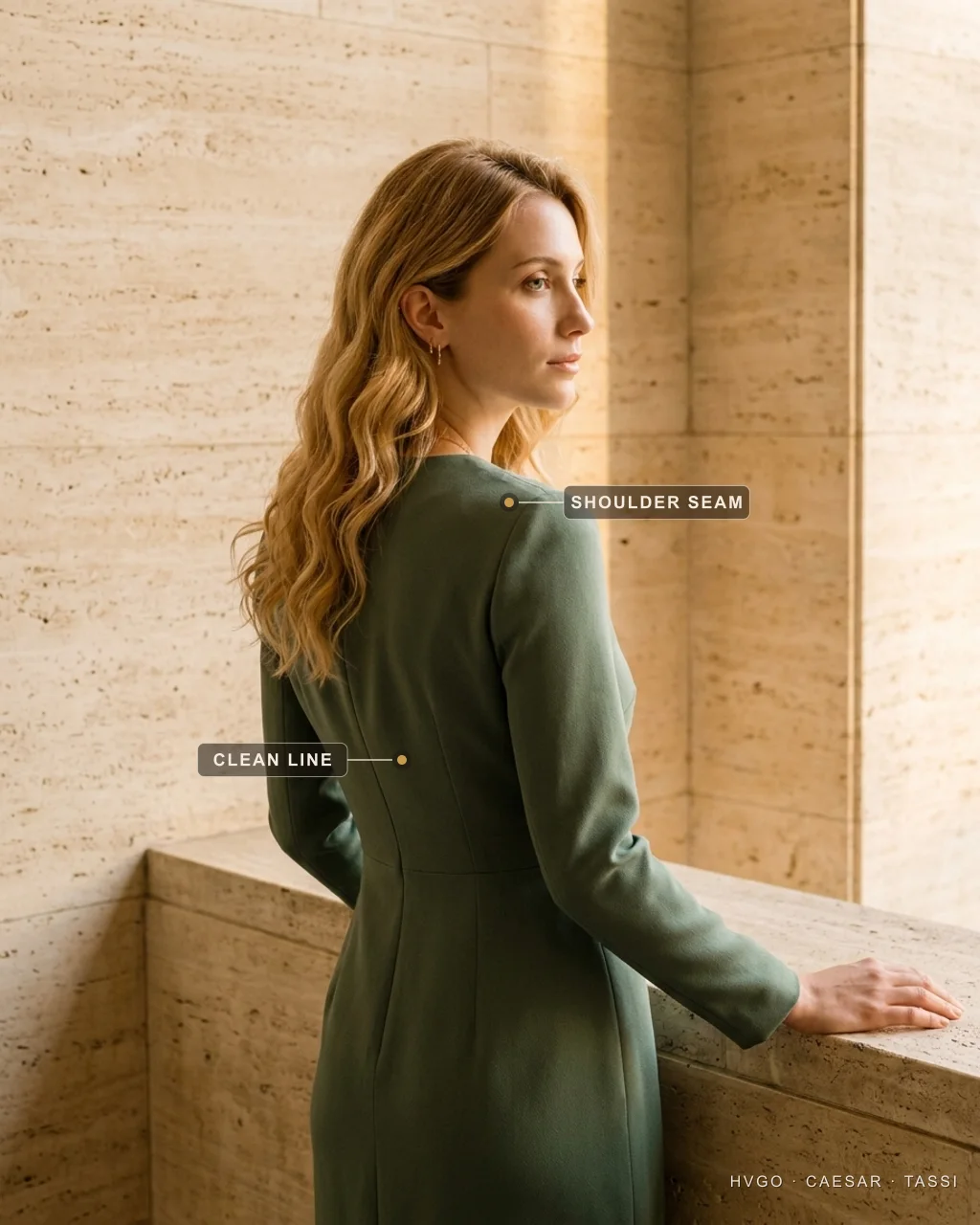
- Shoulder seam
- Clean line
#Tell 5: color restraint and depth of dye
Costly color is deep, evenly saturated, and held to one statement shade. Rich dye absorbs light, while thin over-bright dye sits chalky on the surface; a matte Basalt black out-reads a glossy one. A visible logo undoes all of this, overriding every other signal and dragging a restrained outfit toward bargain-bin. The house's quiet luxury explained guide treats dye depth at length.
#How to look expensive on a budget without buying designer labels
You look expensive on a budget by shopping for fabric content, correcting fit with a tailor, and grooming the result, not by chasing labels. The label is the priciest and least visible part of the equation. Cloth, fit, and polish buy far more of the look per euro.
#Shop fabric content, not the brand label
Read the care tag first and the brand label last, because fiber content predicts drape better than price ever does. Silk, modal, viscose, wool, and a dense polyester with weight all fall well, while papery polyester, crease-prone acetate, and stiff cotton do not. Watch the blend ratio: a high-viscose blend with a touch of elastane drapes and recovers, whereas a high-polyester one sits flat and shines. A 30-euro viscose dress with good hand beats a 120-euro polyester one with none, and this is where secondhand and mid-market racks win, since older garments were often cut in denser cloth. The catch is that silk demands gentle care to keep its richest fall.
#The 15-euro fixes a tailor makes that change everything
A handful of small alterations turn a budget garment into one that reads bespoke. These four return the most look per euro:
- Take in the waist so the dress skims instead of gaping, the fastest route to a tailored line.
- Shorten a sleeve to break at the wrist bone, never bunching over the hand.
- Re-hem to land at the knee or the floor, skipping the unflattering mid-calf.
- Adjust a shoulder only as a minor set-in tweak, since a major rebuild rarely earns its cost.
When the shoulder is badly cut to begin with, leave the garment on the rack; the rework outprices the dress itself.
#Grooming and polish: the free half of looking expensive
Grooming is the no-cost half of the equation, and it can outweigh the garment entirely. Clean hair, neat nails, lint-free cloth, and a well-kept leather shoe ask nothing of your wallet beyond a few minutes. A groomed woman in a 40-euro dress beats an unkempt one in designer, because a viewer scans the whole figure for upkeep before valuing the cloth. Lint, scuffed heels, and chipped polish read as neglect, the strongest budget signal of all. Push polish too far, though, and stiff lacquered styling tips back into costume.
#Maintenance is the cheapest luxury
Upkeep keeps a budget piece reading rich long after purchase, at almost no spend. A fabric shaver run over a knit removes the fuzz that signals age faster than any other flaw, and it costs less than a coffee. Steam relaxes fibers without the hard shine an iron presses into synthetics, so a steamed dress moves while a pressed one can look laminated. Hang structured pieces and fold heavy knits, since a knit left on a hanger stretches at the shoulder into exactly the dropped line you worked to avoid. The house's guide to chiffon, satin and crepe compared covers the fabric-specific care each cloth wants.
#What makes clothes look cheap (the tells to avoid)
Clothes look cheap from visible logos, shiny crease-prone synthetic, raw or puckered seams, missing lining, plastic buttons, and a dropped shoulder, plus flat dye. Each is the mirror image of a tell. Learning to spot them on sight saves you from buying the budget read by accident.
#The dead giveaways on the rack
These six signals announce a cheap garment before you ever try it on:
- Visible logos stamped across the chest, drowning out every quality cue around them.
- Plastic shank buttons that flex and glint rather than sitting flat and dense.
- See-through lining or none at all, exposing the construction in daylight.
- Raw or puckered seams fraying or gathered along the inside.
- Early pilling on the surface, the mark of a weak short-staple yarn.
- Flat, over-bright dye that lies chalky across the cloth.
Weigh how fixable each one is before you reject the piece: a lone plastic button is a five-minute swap, whereas a see-through lining is sewn in for good.
#Fit mistakes that undo a good fabric
Poor fit sinks even a fine fabric. A mid-calf hem, a gaping waist, a dropped shoulder, and a too-tight pull each waste good cloth, and the mid-calf hem trips up the most shoppers, which is why the house holds to a hem at the knee or the floor. The mid-calf break cuts the leg at its widest point and shortens the whole figure, so a 200-euro dress hemmed there can read cheaper than a 40-euro one hemmed to the knee. Cling is the one apparent exception, flattering only on a fully lined bias slip, never on a dress bought a size too small, where the fabric pulls into stress lines that map every seam underneath.
#Which fabrics and dresses reliably read as expensive on a woman
Matte silk, modal jersey, fluid viscose, crepe, and heavy chiffon look costly because each drapes heavy and recovers fast. Shape compounds the gain, since a long unbroken line photographs richest of all once you know how each cloth behaves.
#The fabrics that always look more than they cost
Five fabrics deliver a costly look at almost any price, united by a heavy fall and quick recovery. The table below sets their profiles side by side so you can match cloth to your budget.
| Fabric | Drape | Recovery | Reads expensive because | Budget watch-out |
|---|---|---|---|---|
| Matte silk | Fluid, heavy | Fast | Absorbs light, deep even dye | Needs careful, costly care |
| Modal jersey | Soft column | Very fast | Falls heavy, resists creasing | Thin modal slumps without body |
| Fluid viscose | Liquid fall | Moderate | Mimics silk at low cost | Creases if loosely woven |
| Structured crepe | Body with movement | Fast | Matte surface, holds a line | Stiff cheap crepe reads board-like |
| Heavy chiffon | Floating layers | Moderate | Weight stops the sheer cheap read | Light chiffon goes sheer and flimsy |
Match the cloth to the calendar: modal and crepe suit daytime because they bounce back fast, whereas silk and floating chiffon belong after dark.
#Dress shapes that flatter the budget
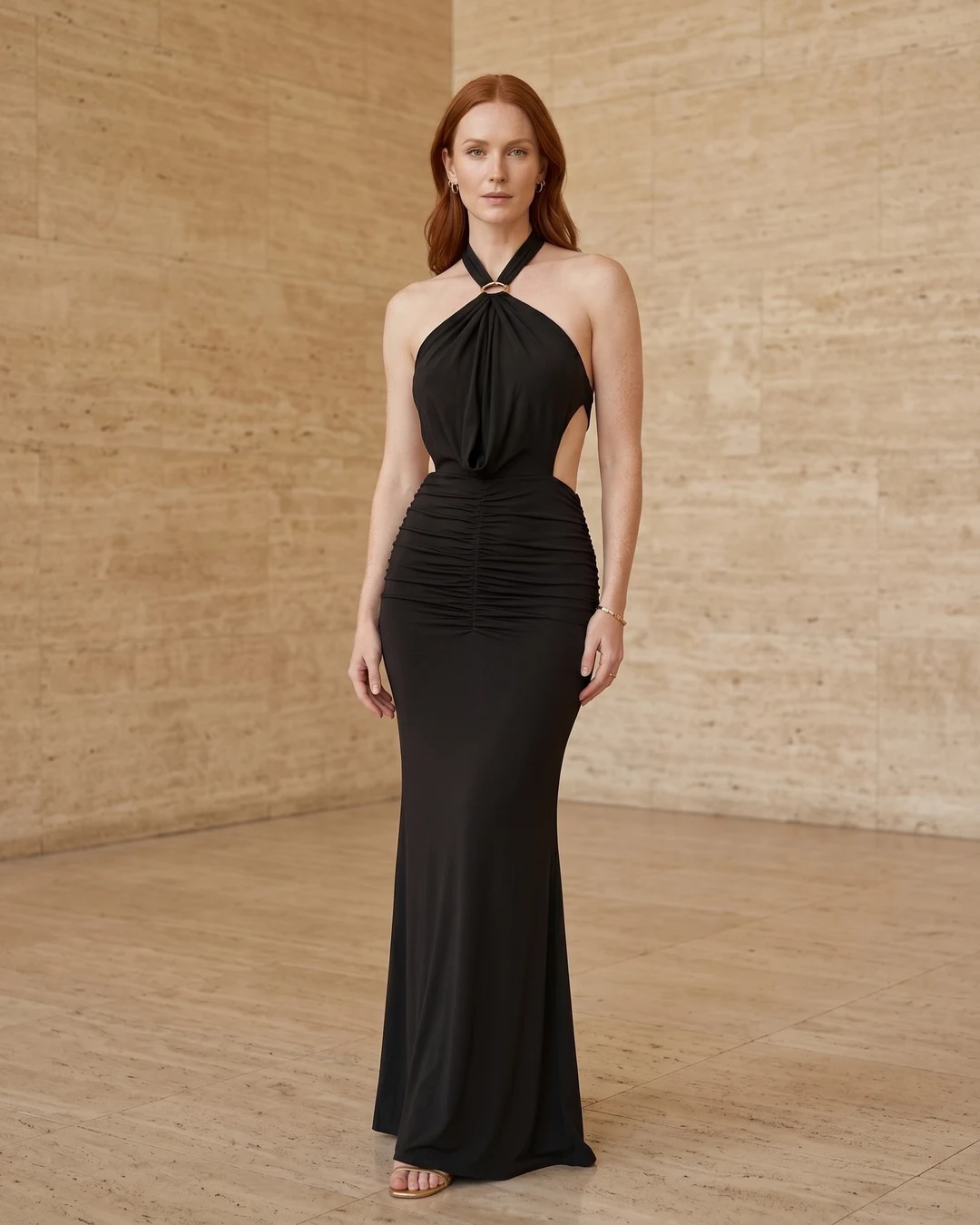
Three shapes squeeze the most costly read from the least money: the fluid column, the bias slip, and the pleated maxi. A long vertical sweep hands a viewer the uninterrupted silhouette it ties to wealth, so the taller the line stands, the more it forgives a modest cloth. The house's Vipsania column and Tullia pleated gown both build that line in, though the same column cut in a too-light cloth caves into a shapeless tube. The old-money aesthetic guide traces why long lines have signaled quiet wealth for a century.
#How accessories and color make a budget outfit look expensive
Accessories and color lift a modest outfit when you pick structure, one good shoe, and a single tonal palette over embellishment. Restraint is the rule that governs both. One well-made piece outperforms a heap of costume sparkle every time.
#Structure and one good shoe beat embellishment
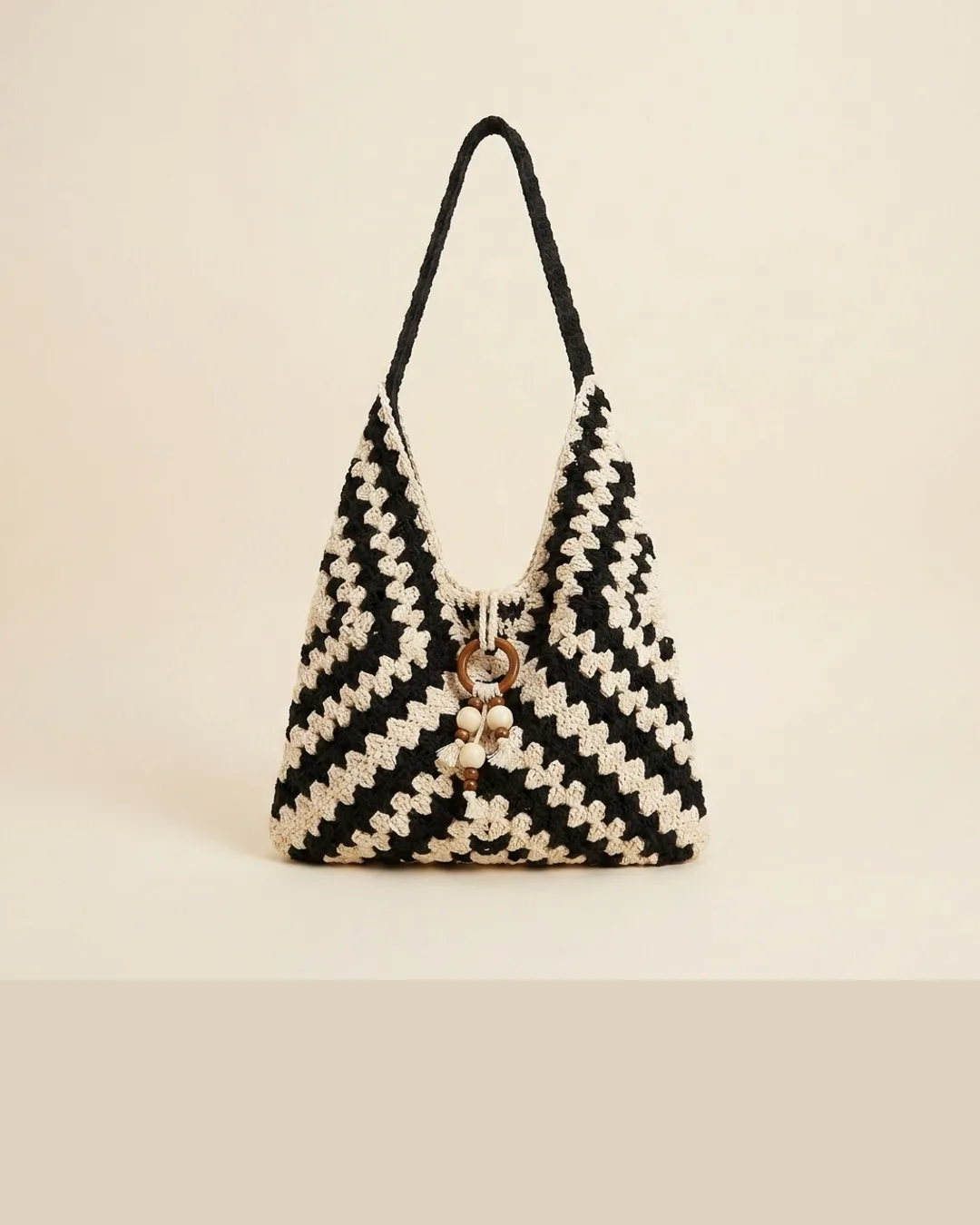
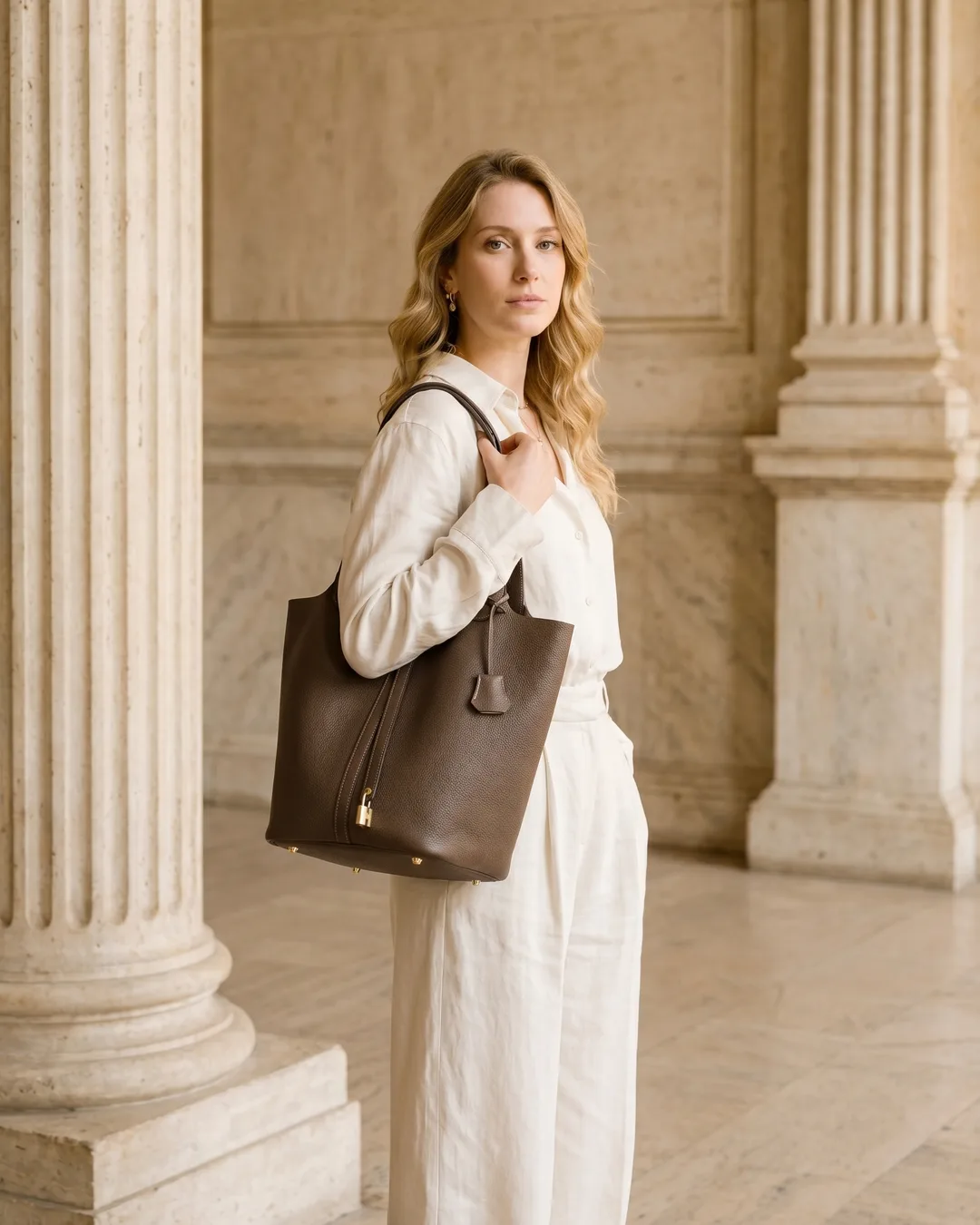
A structured leather bag, a real silk scarf, and a clean leather shoe out-rank any quantity of costume glitter, because structure itself signals quality. A bag that holds its shape unsupported, a scarf that drapes with weight, a shoe whose leather creases rather than cracks: each signals that something was paid for in material, not in logo. Put the whole accessory budget into one anchor piece. A single good shoe and bag finish a 50-euro dress better than three necklaces could, since one considered object reads richer than a pile of small ones. Gold over costume metal helps too, even a thin solid chain over a thick plated one, because plating wears to a green edge that announces itself.
#Tonal and monochrome dressing
Dressing in one color family from head to toe is the cheapest path to a costly look, because a single palette erases every clash and gives a viewer one clean line. A monochrome figure also lengthens, since no contrast break at the waist or hem cuts the body in two. Build the base from four house neutrals: Avorio (ivory), Travertine (stone), Basalt (black), and Cuoio (tan), each saturated enough to read rich and muted enough to layer tonally. Tone-on-tone is the safest version, a stone coat over a stone dress over stone shoes, which reads considered even when each piece came from a different shelf. Match shine levels too, not just hues, since a matte top beside a glossy skirt in the same color still clashes. The house's old-money color palette guide maps which neutrals stack cleanly together.
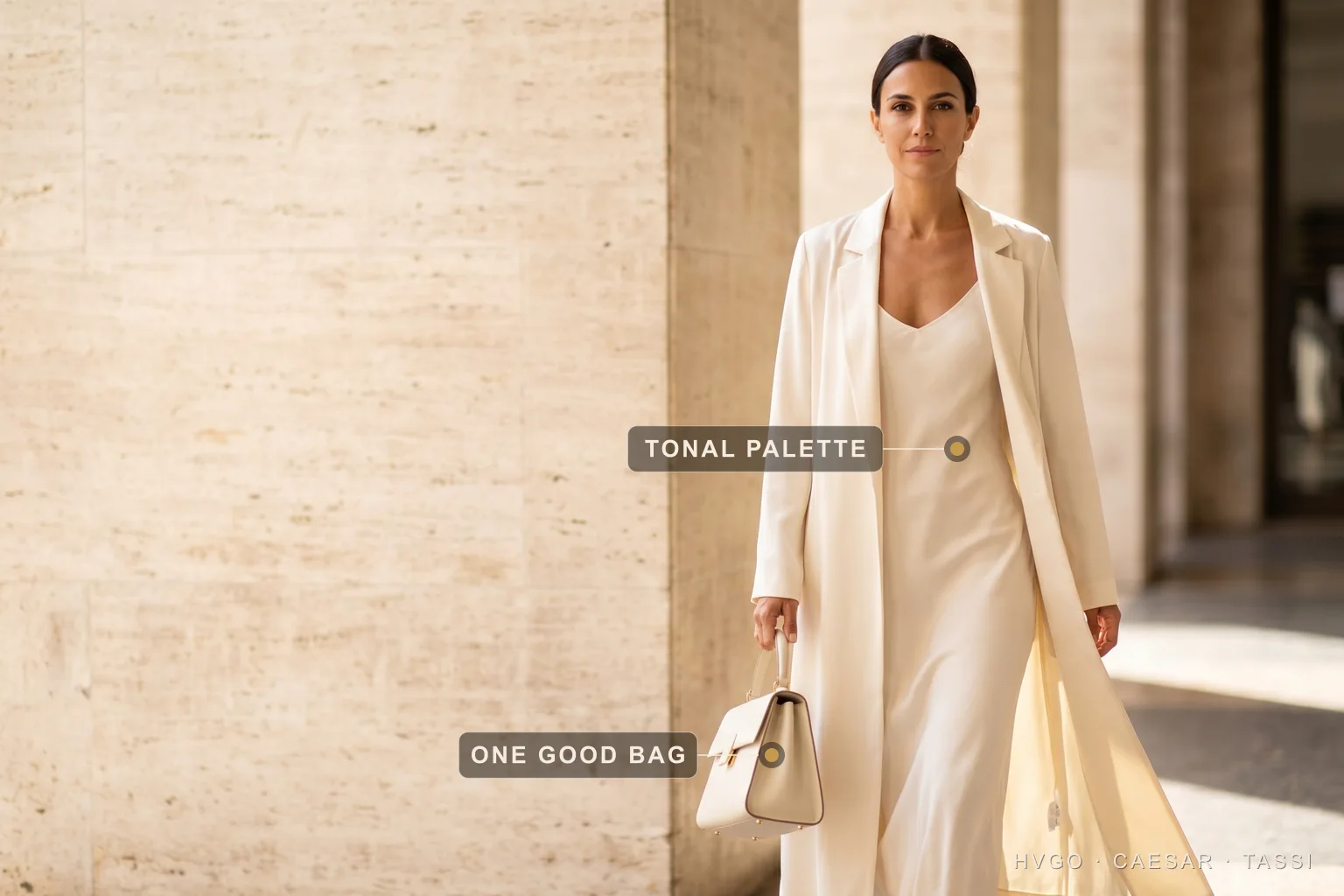
- Tonal palette
- One good bag
#How Hugo Caesar Tassi builds the expensive read into every dress
Hugo Caesar Tassi builds a costly look into every dress by making drape, full lining, and finished seams standard rather than optional. Founded in Roma in 2004 on a fabric-first principle, the house engineers in exactly what budget shoppers hunt for on the rack.
#Drape, full lining and finished seams as standard
Every house dress carries a complete inner layer and a concealed zip, so Tells 2 and 3 arrive built-in, and the Vipsania modal column gown delivers Tell 1 because modal falls heavy and springs back fast. The Tullia pleated crepe column gown proves Tells 1 through 3 together: knife-pleated crepe holds its line, the backing buries every seam, and the inside stays clean to the touch. None of this shows in a photograph. It shows when you hold the dress, flip the hem, and run a thumb along the inside edge, the exact test a careful shopper learns to run on any rack.
#The satin and chiffon pieces that carry the look
Flavia, a strapless satin off-shoulder gown, tames shine through a bias cut that turns the matte face forward, while Julia, a French-pleated chiffon maxi, shows how pleating adds the body that keeps chiffon from going sheer. The house publishes each model's height at roughly 175 centimeters, so you can judge where a hem will break on your own frame. The evening dresses edit gathers the satin gowns, Calpurnia among them.
#Your five-point checklist to make any outfit look expensive before you buy
Run five checks in order before you buy: drape, lining, seams, shoulder, dye. The sequence climbs from the easiest signal to the hardest to fix, so you can fail fast on any rack and move on.
#The fitting-room test, in order
Treat the five tells as a fixed routine, since drape and dye you can often live with, whereas a wrong shoulder you cannot. Work the list top to bottom and stop dead at the first hard fail.
| Step | Check | Pass | Hard fail |
|---|---|---|---|
| 1 | Drape from the hip | Falls in vertical folds, recovers fast | Clings or holds a crease |
| 2 | Flip the lining | Full lining, hemmed, opaque to light | See-through or absent |
| 3 | Inside-out the seams | Enclosed or overlocked, flat topstitch | Raw, fraying, or puckered |
| 4 | Check the shoulder | Seam sits at the shoulder point | Dropped or twisted on a set-in sleeve |
| 5 | Judge the dye | Deep, even, matte, no logo | Flat, chalky, over-bright, or branded |
Halt at step 4 the moment a shoulder fails, the one tell no tailor can fix for a sane price. Clear all five and the garment reads rich whatever the tag claims.
Run this five-point fitting-room test on the house's fabric-first pieces, starting with the draped column and pleated gowns in the women's dresses collection, where the lining, seams, and clean shoulder come built in as standard.
#Frequently asked questions
How can a woman look expensive on a budget?
A woman looks expensive on a budget by prioritizing fabric drape, a full lining, and a clean shoulder line over the brand. Stay within one tonal palette and put the saved money toward a quick tailor and steady upkeep. Fit and finishing signal money far more reliably than price does.
What makes clothes look expensive?
Clothes look expensive from five physical things money can't fake: how the fabric falls, whether it is fully lined, finished inside seams, a shoulder seam that sits exactly at your shoulder, and deep restrained color with no visible logos. You can verify each one on the rack. None of them depends on the label.
What makes a dress look cheap?
A dress looks cheap from visible logos, thin shiny crease-prone synthetic, raw or puckered seams, a see-through or missing lining, and plastic buttons. A dropped or twisted shoulder and flat over-bright dye finish the picture. Any two of these together are enough to read budget on sight.
Does fabric really matter more than the brand?
Fabric matters more than the brand, because a dense matte well-draping cloth in a mid-market dress looks costlier than a logo-heavy designer piece in thin synthetic. Your eye takes in cloth and line before it ever finds a label. Fiber content forecasts the costly look better than price.
What colors look the most expensive on women?
The colors that look most expensive on women are deep evenly dyed neutrals and one statement shade worn tonally. Ivory, stone, black, tan, and wine carry more richness than bright flat over-saturated colors. The effect peaks in matte fabrics, where no sheen competes with the hue.
How do I make a cheap outfit look expensive?
You make a cheap outfit look expensive by tailoring it to fit, steaming out the creases, and swapping plastic buttons or costume jewelry for quality metal. Hold to one color family and add a structured bag or a real silk scarf for finish. Upkeep and fit carry most of the load.
More Style & Old Money guides
The Quiet-Luxury Capsule Wardrobe
Build a quiet-luxury capsule wardrobe the Roman way: the cost-per-wear math, the keep-for-a-decade rule, and a small imperial-palette set that recombines.
Build a buy-fewer-better capsuleGold or Silver Jewelry With a Dress? The Two-Step Rule That Settles It
A Roman atelier's two-step rule for gold or silver jewelry: read your skin undertone, then let the dress color break the tie. Color-by-color chart.
Choose gold or silverHow to Accessorize a Dress
A Roman atelier's method to accessorize a dress: choose one focal point, then let the rest recede. Neckline focal-point map, bag, scarf and shoe rules.
Master the one-focal-point ruleHow to Dress Elegantly
Five repeatable house rules from a Roman atelier to dress elegantly on any budget: one statement color, the right hem, shoulder-first fit, matte by day.
Learn the five elegance rulesHow to Wear Burgundy for Women
How to wear burgundy for women by skin tone, season and occasion: wine vs. oxblood vs. Tyrian red, what colors pair, and the gold rule.
Match your wine-red shadeOld Money Style for Women
The old money aesthetic for women, decoded by a Roman house: inherited taste over flash, the real building blocks, and how to wear it on any budget.
Shop the old money dress edit