Midi vs Maxi vs Mini: The Dress Length Guide, in Real Inches
Every dress length in real inches: mini, midi, tea, maxi, measured on a 5'7\" fit model, plus a height rule for where each hits on you.
On this page
A mini stops above the knee, a maxi reaches the ankle or floor, and a midi fills the wide band in between. That middle band runs six inches, so two dresses both sold as "midi" can hit one woman's shin and another's ankle. This guide pins every length to real numbers read on a 5'7" fit model, then hands you a rule for your own frame.
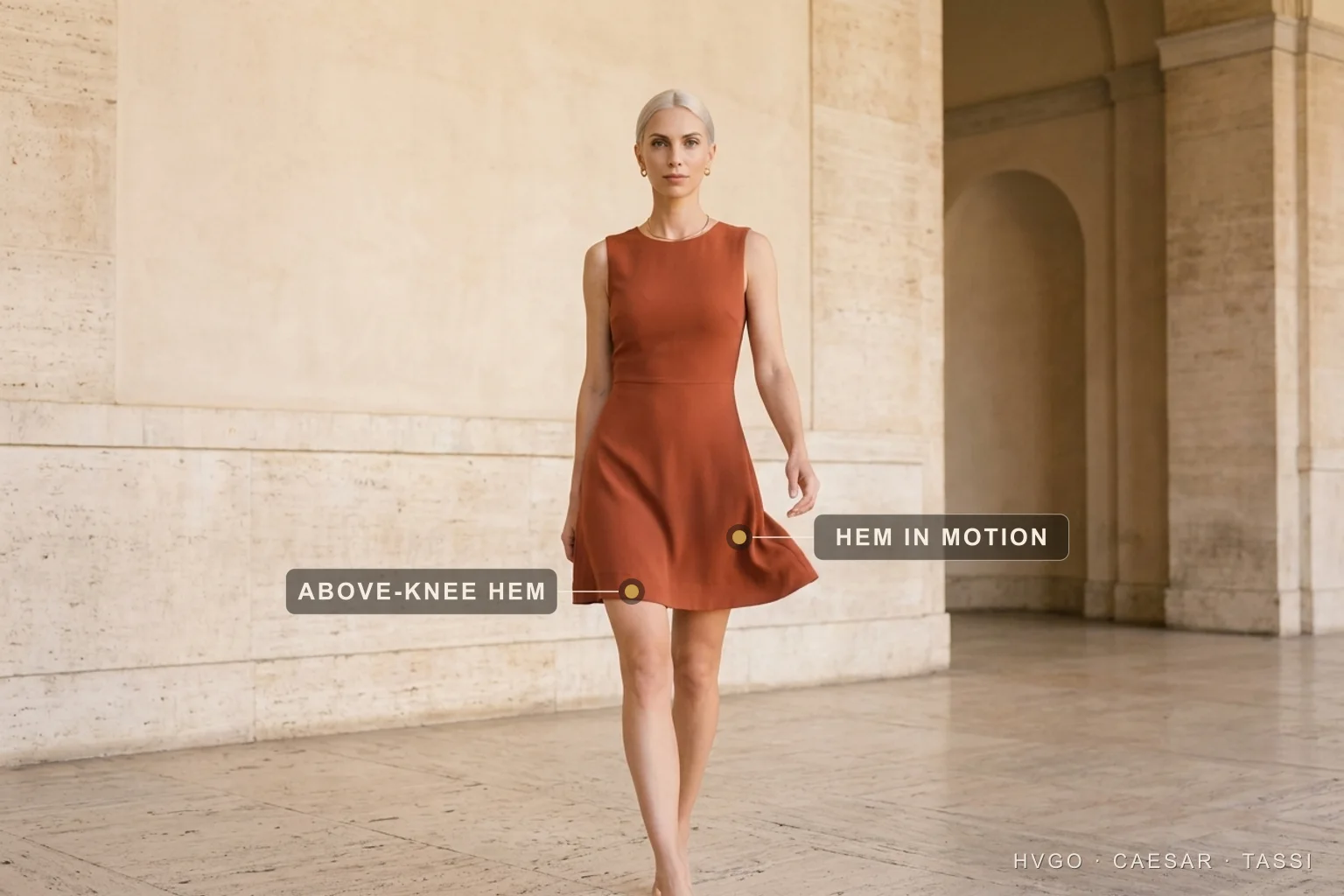
- Above-knee hem
- Hem in motion
Mini vs midi vs maxi
The three core lengths in real inches, read on a 5'7" fit model.
| Mini | Midi | Maxi | |
|---|---|---|---|
| Hollow-to-hem (5'7" model) | 33-36 in | 41-47 in | 56-60 in |
| Where it breaks on her | Mid-thigh to above knee | Below knee to lower calf | Skims or pools at the floor |
| Dress code | Cocktail, daytime, city | Semi-formal to daytime weddings | Black tie, galas, the opera |
| Best for height | Lengthens petite frames | Average frames wear as cut | Tall frames hit true floor |
| Watch-out | Reads underdressed at formal venues | Six-inch band hides at lower calf | Drags on petite without a heel |
| HCT to try | Portia chiffon A-line | Livilla floral-print chiffon midi | Vipsania draped modal column gown |
#Mini, midi and maxi: what each dress length actually means
Mini sits above the knee, maxi reaches the ankle or floor, and midi fills the wide gap between them, which is precisely why "midi" gets mislabeled. Mini and maxi each cover a narrow stretch of leg. The midi spans everything from just below the kneecap to just above the ankle bone, and that width is the whole problem.
Picture one chiffon dress on two women. On a 5'3" frame the hem grazes the ankle; on a 5'10" frame it reads as a high calf. One garment, two "lengths," one slippery label.
#The three core lengths in one sentence each
A mini stops above the knee, a midi falls anywhere between the knee and the ankle, and a maxi reaches the ankle or the floor. Mini is the shortest committed length and easiest to call on sight. Maxi is the longest, and its only real question is whether it skims the floor or pools on it.
Midi hides half a foot of variation inside one word. Read the inch number, not the word.
#The lengths between the big three: tea, ballet, ankle and floor
Four named lengths live inside the mini-to-maxi range: tea, ballet, ankle and floor, each a specific stopping point a label may use instead of the broad terms. Tea length sits at the formal end of midi, from mid-calf to just above the ankle. Ballet (or ballerina) length stops a touch lower, just over the ankle bone.
Ankle length clears the floor by a few inches and shows the shoe. Floor length is where maxi splits: a true floor hem skims the ground, whereas a "puddle" hem pools around the feet.
#Where each dress length falls in real inches (read off a 5'7" fit model)
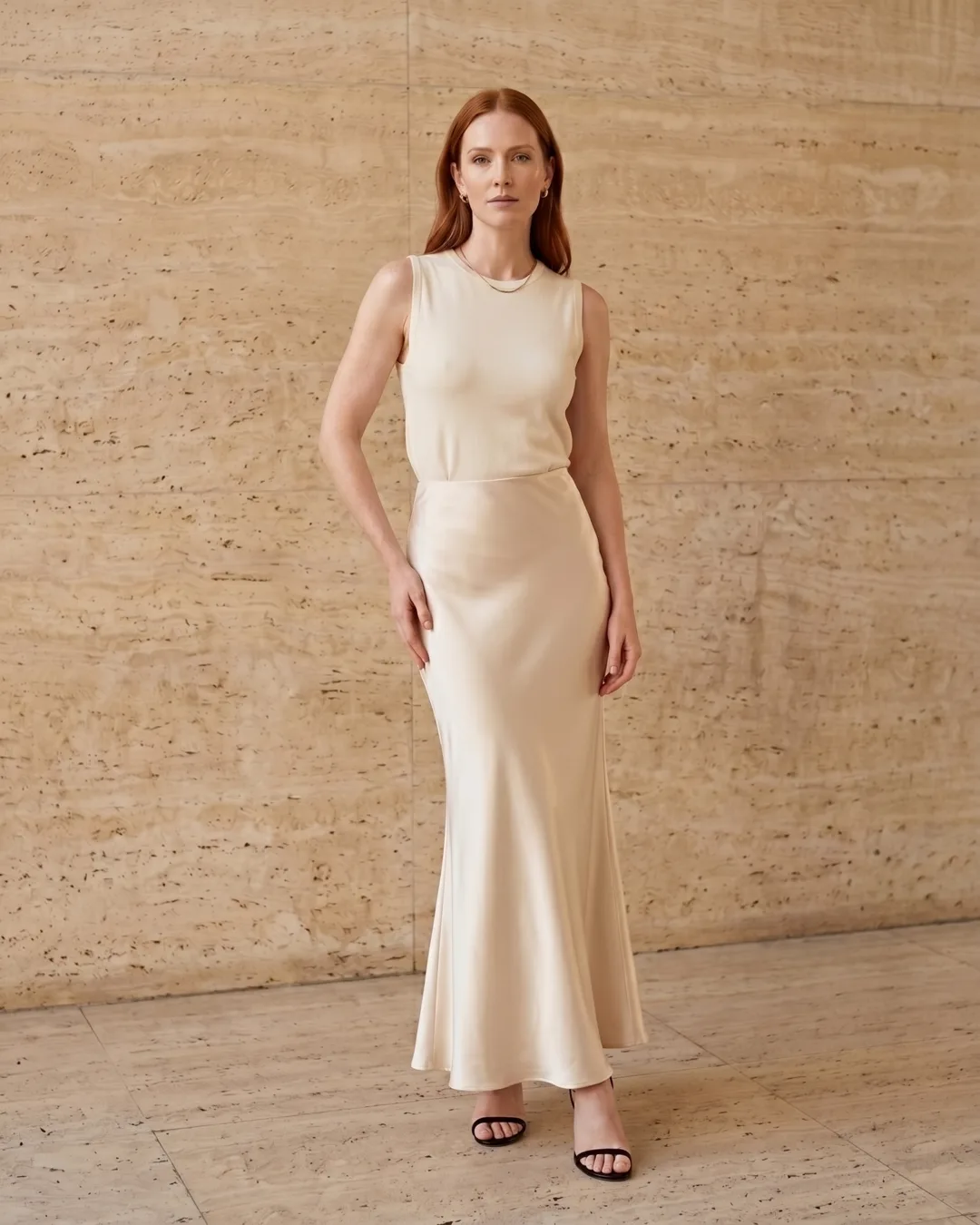
Measured on one Hugo Caesar Tassi fit model who stands 5'7" (175 cm), the standard lengths run from a 30-inch micro-mini to a 60-inch floor gown, all read hollow-to-hem. The house publishes its model's height for this reason: a number means nothing until you know the body it was read on. Most online guides describe a midi as "below the knee" and stop there, a phrase that covers six inches and helps no one choose.
#The HCT hem-length chart
Each length below lists the hollow-to-hem inches read on the 5'7" model, so you can match a label's vague word to a verifiable measurement. Use the table to translate any listing into a real stopping point before you order.
| Length | Hollow-to-hem (5'7" model) | Where it breaks on her |
|---|---|---|
| Micro-mini | 30-32 in | Upper thigh |
| Mini | 33-36 in | Mid-thigh to just above knee |
| Above-knee | 37-39 in | Just over the kneecap |
| Knee | 40 in | At the knee |
| Midi | 41-47 in | Below knee to lower calf |
| Tea | 47-48 in | Lower calf, near the ankle |
| Ballet | 49-50 in | Just above the ankle bone |
| Ankle | 52-54 in | At the ankle, shoe shows |
| Maxi / floor | 56-60 in | Skims or pools at the floor |
A 56-inch maxi shows a sliver of shoe on this model; a 60-inch hem pools at her feet. The same 60 inches on a 5'2" woman would drag, which is why the chart pairs with the height rule below.
#Why a "midi" can swing six inches
The midi band runs from 41 to 47 inches on the 5'7" model, so two midis can differ by half a foot and both be labeled correctly. A 41-inch midi clears the knee; a 47-inch midi sits at the lower calf, near tea length.
The Livilla floral-print chiffon midi and a 47-inch tea-cut dress both wear the midi label yet break at different points. Place a listing's stated hem inches on the chart above, then trust your eyes over the word.
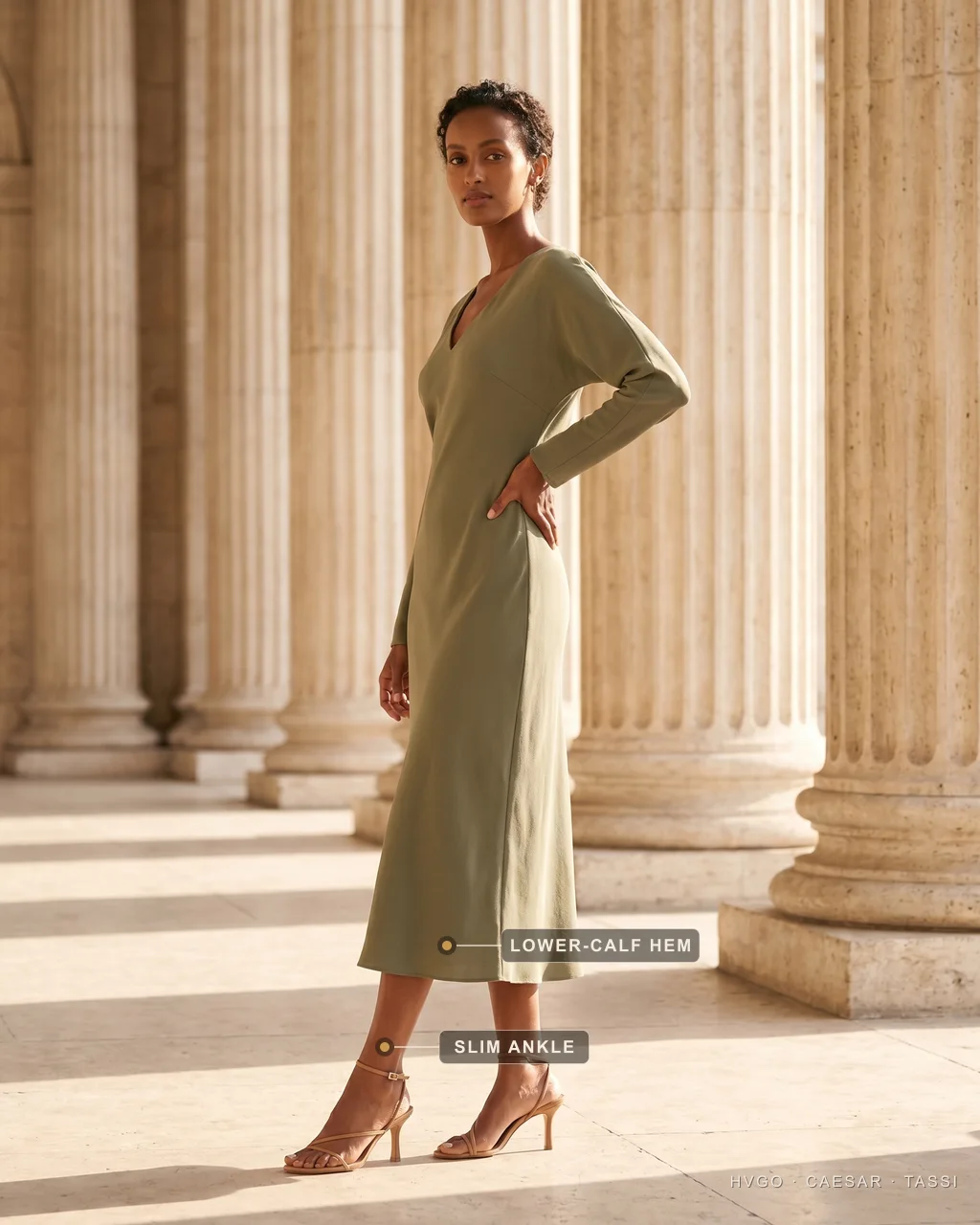
- Lower-calf hem
- Slim ankle
#How dress length is measured (and why inseam doesn't apply)
Dress length is measured hollow-to-hem, from the hollow at the base of the throat straight down to the hem, or waist-to-hem, never by inseam. A trouser uses inseam because it splits at the crotch and follows each leg. A dress hangs as one unbroken panel measured from a fixed top point.
A hem is sewn at one length and stays there, unlike a trouser you hem to your leg. To read where any dress lands on you, take your own hollow-to-hem with the dress measuring guide and compare it to the chart.
#How to predict where a dress length will hit on your height
Every inch you stand above or below the 5'7" model shifts a hem by roughly that same inch on your body. Shorter women wear hems lower; taller women wear them higher. A shorter frame uses up more of a fixed-length hem before reaching the floor, which drops the break and turns the chart into a prediction for any height.
#The height-math rule
Subtract your height from 5'7", and that gap in inches is roughly how much lower (or higher) every hem will break on you. Take the 47-inch midi, which sits at the lower calf on the model. On a 5'3" woman it drops about four inches and reads close to the ankle, an accidental tea length; on a 5'10" woman it rides up to mid-calf.
The edge case is the maxi. A 56-inch floor hem will drag on a 5'2" frame, so a petite woman either sizes to a shorter maxi or wears a heel. The same 56 inches hits true floor on a 5'9" woman without alteration.
Run the subtraction before you trust the label.
#Mind the calf "danger zone"
A hem that stops across the widest point of the calf shortens and widens the leg; the flattering choice breaks above or below that point instead. A horizontal line at the calf's fullest part draws the eye straight to the width. That is the trap a mis-judged midi springs.
Choose a midi that ends at the slim lower calf, or go full floor. Avoid the hem that lands dead center. A 2-inch to 4-inch heel can move a borderline hem off the danger zone. A taller woman has more room here, since her calf width sits lower relative to a fixed hem.
#Which dress length suits your height: petite, average or tall
Three height brackets read the lengths differently: petite (5'3" and under), average (5'4"-5'7"), and tall (5'8" and over). The chart is read at the top of the average bracket, so average frames get the lengths as designed while petite and tall frames apply the height rule above.
#Petite (5'3" and under)
A mini or a true ankle-skimming column maxi lengthens a petite frame, whereas a "midi" often drops to unintended maxi length and cuts the leg short. A four-inch height gap pushes the 47-inch midi down to the ankle. Petite women should size to the hem inches and favor a hem that ends at or above the narrow lower calf.
An unbroken column maxi reads as height because one continuous vertical line runs the eye down, whereas a tiered midi chops the leg into segments. The petite frame styling guide goes deeper.
#Average (5'4"-5'7")
Average frames wear the chart as written, so midi sits below the knee, tea length at the lower calf, and maxi at the floor, making this the most forgiving bracket. A 47-inch midi breaks where it was cut to break, no math required, since this is the range every length was drafted against. Heel height fine-tunes it: a flat holds the midi at the calf, while a 3-inch heel lifts the break and lengthens the line.
#Tall (5'8" and over)
On a tall frame every hem rides up about an inch per inch of extra height, so midi reads as mid-calf, maxi finally hits true floor, and mini can read very short. A 47-inch midi climbs to mid-calf on a 5'10" woman, while a 56-inch maxi that showed shoe on the model now skims her floor cleanly.
The watch-out is the mini: a 34-inch hem that sat at the knee on the model rides up several inches, so check the number before a daytime event.
#Which dress length is right for each occasion and dress code
Short reads cocktail and daytime, midi covers the broadest occasion range, and floor length anchors black tie, because the hem is half of what a dress code reads. Length signals formality before fabric or color register, so matching the hem to the invitation gets you halfway dressed correctly.
#Mini and knee-length: cocktail, daytime and city events
Mini and knee-length suit cocktail parties, garden events and city evenings, though not a cathedral, a gala, or the opera. A knee-length cocktail dress with a heel reads polished for a rehearsal dinner, since a short hem shows leg and signals daytime over ceremonial.
The counter-case is a formal religious venue or black-tie invitation, where a hem above the knee reads underdressed regardless of fabric. When the how to choose a dress guide calls for "formal," the mini stays home.
#Midi and tea length: the occasion all-rounder
Midi and tea length carry the widest occasion range, from semi-formal events to daytime weddings, christenings and the races, which makes the midi the single most versatile hem to own. Tea length, cut long at the lower calf, reads as the polished, conservative choice for a daytime ceremony.
A garden wedding suits the Livilla floral-print chiffon midi. The Portia short-sleeve chiffon A-line covers a daytime semi-formal without reading either casual or black tie.
#Maxi and floor length: black tie and evening
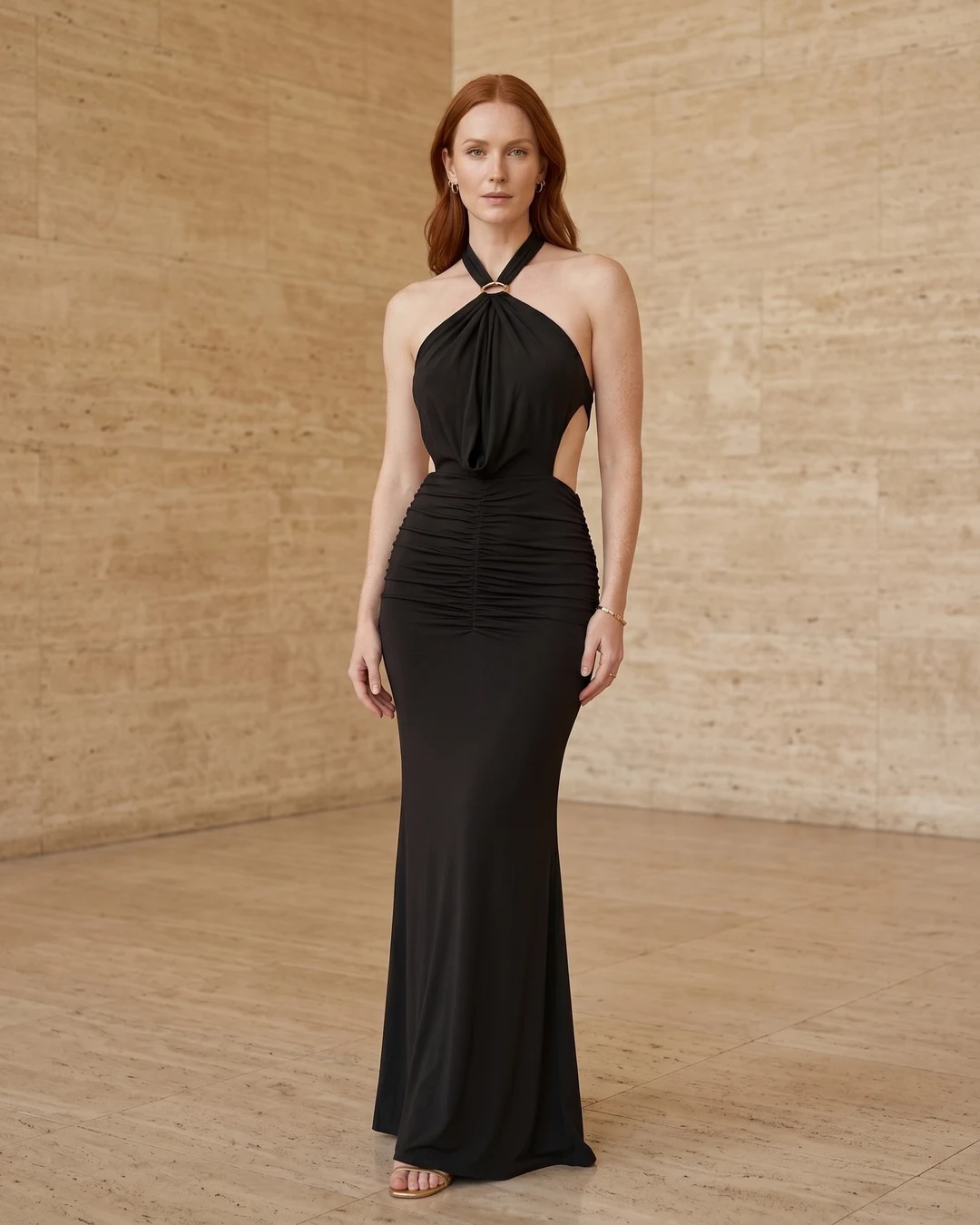
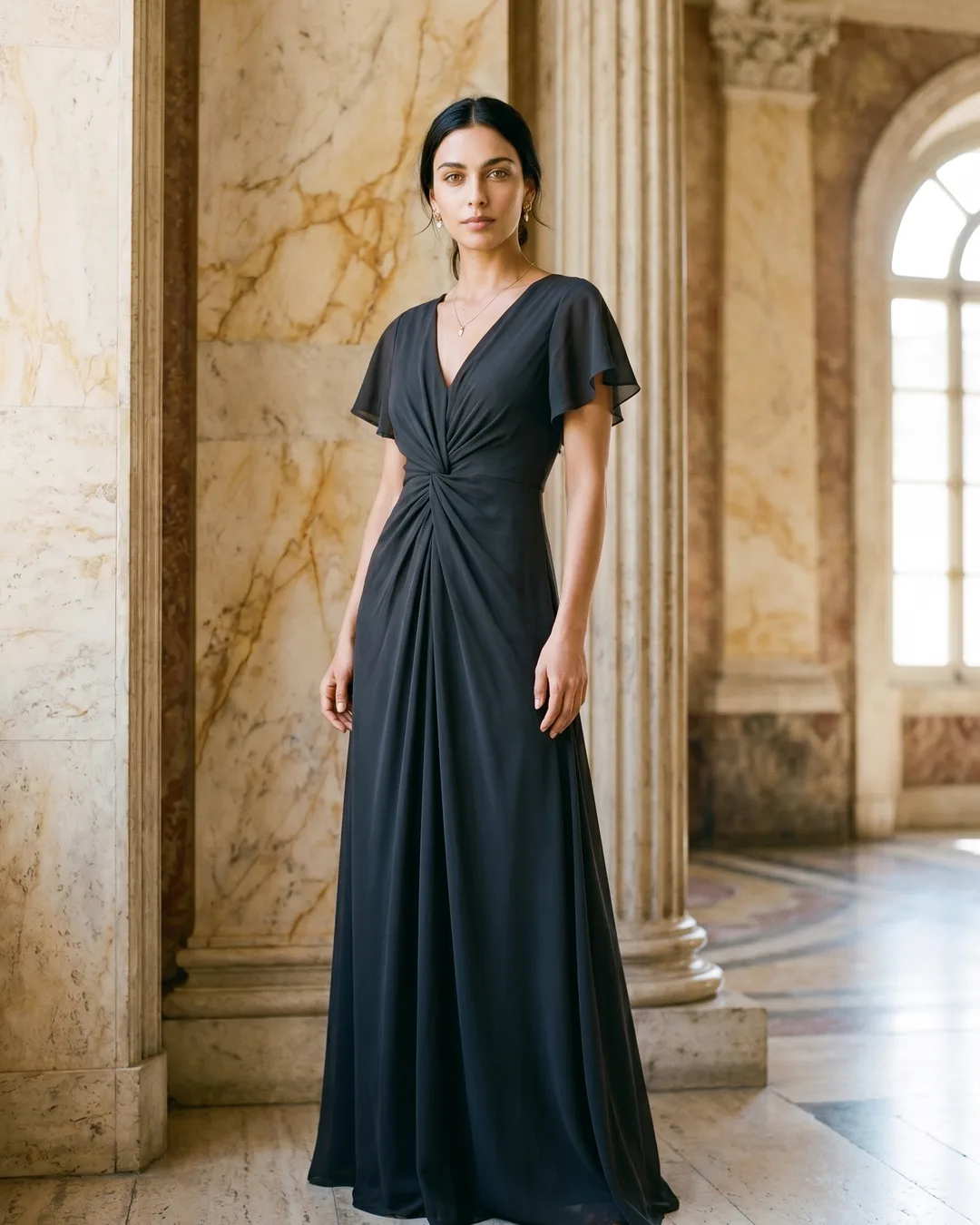
Floor-length maxi gowns answer black tie, galas and the opera, with the column or draped maxi reading as the most formal hem a woman can wear. A floor hem covers the leg entirely and reads ceremonial; the column line, the Roman column made wearable, keeps one unbroken vertical from shoulder to floor.
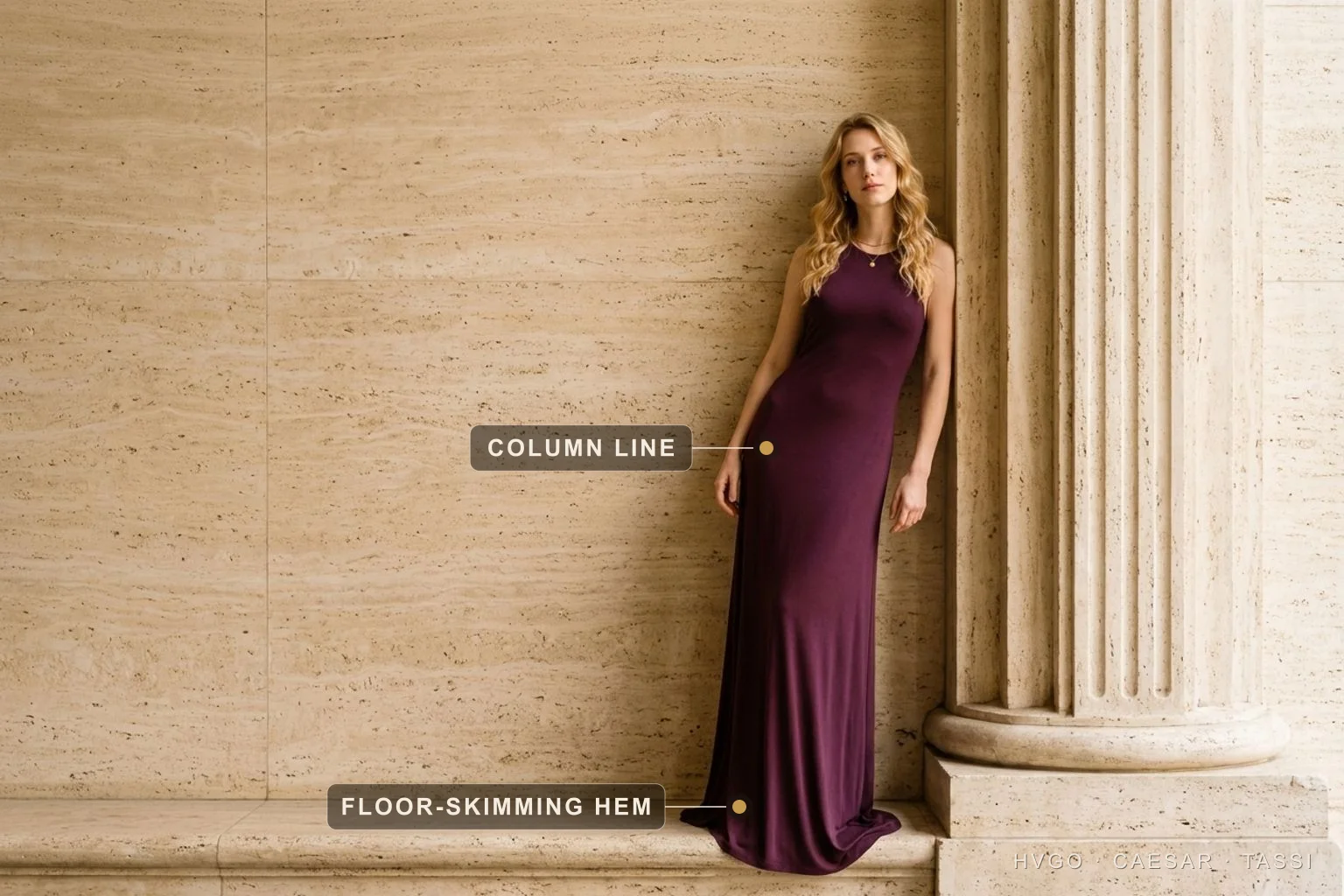
- Floor-skimming hem
- Column line
The house cuts several for this tier: the Claudia pleated-slit chiffon maxi and the Calpurnia fishtail satin gown for an evening, the Julia French-pleated chiffon maxi for a gala, the Vipsania draped modal column gown for the most formal read. The types of dresses guide maps the wider silhouette vocabulary around the hem.
#How fabric weight changes the way a dress length reads
The same hem inches read shorter in light chiffon and full-length in heavy satin, because fabric weight changes how the hem moves and where the eye stops. A house cutting chiffon, satin, crepe and modal sees one 47-inch hem land three ways.
#Why the same hem looks different in chiffon, satin and jersey
An 8 mm chiffon hem floats and shortens as it moves; bias-cut satin falls heavy and reads its full length; washed modal jersey skims the body and draws the line down. Light recycled chiffon lifts and flutters, so a 47-inch midi in chiffon can read shorter than its number in motion.
Matte structured crepe holds a clean edge and reads exactly its inches, while draped modal adds apparent length. A stiff-fabric midi can look longer than the same hem in fluid cloth. The chiffon, satin and crepe guide covers each fabric's drape in full.
#Heel height as part of the length equation
A 2-inch to 4-inch heel raises the apparent hem break and lets a woman wear a longer hem without the cloth dragging. The heel lifts the body inside a fixed-length dress, so the hem clears the floor and the break rises on the leg.
Match maxi length to heel deliberately: a 56-inch floor gown needs the heel that made it clear the ground when cut. For petite readers the same heel lifts a borderline-long midi to a flattering calf break.
#How Hugo Caesar Tassi states dress length, and how to use it to buy once
Every Hugo Caesar Tassi dress lists its real hollow-to-hem in inches, so a woman can predict the break on her own frame before she orders rather than gambling on a label. Paired with the published 5'7" model height, that number lets the height rule run before the dress ships, the whole point of buying fewer, better pieces.
#Every HCT dress lists its hem in inches
The product page prints the measured hollow-to-hem, not just the word "midi." Combine the listed inches with your height subtraction and you know where the hem lands before checkout: a 47-inch listing on a 5'4" woman predicts a near-ankle break.
The industry norm is a one-word label and a return when "midi" arrives as maxi. Read your own hollow-to-hem against the chart, and you order the length that already breaks where you want it.
#Which length to own first
For most women one well-cut midi covers the widest occasion range, with a floor-length maxi as the evening anchor. The midi answers semi-formal events, daytime weddings and the races; the maxi answers black tie.
Pick the midi first if your calendar leans daytime, or the maxi first if a black-tie event is already booked. Lean on the wider dress guides hub once you want neckline and silhouette to follow the length.
#Frequently asked questions
What is the difference between a midi and a maxi dress?
A midi ends anywhere between the knee and the ankle, while a maxi reaches the ankle or floor. On a 5'7" frame a midi measures roughly 41-47 inches hollow-to-hem and a maxi runs about 56-60 inches; the maxi is the longer, more formal length dress codes ask for at black tie.
How long is a midi dress in inches?
A midi dress measures about 41-47 inches from the hollow of the throat to the hem on our 5'7" fit model. Because the midi band spans the whole knee-to-ankle range, two midis can differ by half a foot, so check the stated hem number rather than the word "midi."
What is the best dress length for petite women?
The best dress length for petite women is a mini or a true ankle-skimming column maxi, both of which lengthen the leg. The trap is the midi, which often drops to maxi length on shorter heights, so size to the hem inches and pick a hem ending at or above the narrowest part of the calf.
Is tea length the same as midi?
Tea length sits inside the midi band, at its longer and more formal end. It runs roughly mid-calf to just above the ankle, about 47-48 inches on a 5'7" frame. Every tea-length dress is technically a midi, but not every midi is cut to tea length.
Where does a midi dress hit on a tall woman?
A midi dress hits higher on a tall woman, reading as a mid-calf length rather than the lower-calf break it was designed for. A hem cut as a midi for a 5'7" model rides up about an inch per inch of extra height, climbing three inches toward mid-calf on a 5'10" frame.
What dress length is most flattering?
The most flattering dress length ends above or below the widest point of your calf, never across it. A hem that breaks at the slim part of the lower leg lengthens the line, as does a floor-length maxi worn with a heel; the danger zone is a hem landing dead center on the calf.
Can you shorten a maxi or midi dress to a different length?
You can shorten a maxi or midi dress, since a hem is fixed cloth a tailor can take up. The cleaner buy is to read the stated hollow-to-hem inches against the height rule first and choose the length that already breaks where you want it, skipping the alteration entirely.
Now that you know exactly where each length will land on you, shop midi dresses for the occasion all-rounder or a floor-length maxi for the evening anchor, then confirm your own hollow-to-hem against the height rule before you order.
More Dress Knowledge guides
Dress Necklines Explained
Every dress neckline named, with the jewelry each one takes, the bust and shoulders it flatters, and the formality it signals. A house guide.
Decode every dress necklineDress Silhouettes Explained
Every dress silhouette explained: A-line, column, sheath, fishtail, empire, plus the fabric that holds each shape and the body it flatters.
Explore every dress silhouetteDress Sleeve Types
Every dress sleeve named and shown — how much arm each covers, the climate it suits and the occasion it signals, from cap and flutter to dolman.
Match a sleeve to the occasionHow to Choose a Dress
A quiet-luxury method for choosing a dress — occasion first, then silhouette, fabric, length, fit, and only then color. Buy one you'll wear for years.
Learn the five-step methodHow to Measure for an Occasion Dress
Take your bust, waist and hip dress measurements at home and match them to the HCT size chart, with US/EU conversion and per-fabric ease, to order once.
Find your size in the occasion dresses editTypes of Dresses
Every formal dress type named and shown — slip, column, A-line, sheath, fishtail, one-shoulder and more — each with its fabric and best occasion.
Name every dress type