Dress Necklines Explained: Jewelry, Flattery and Formality
Every dress neckline named, with the jewelry each one takes, the bust and shoulders it flatters, and the formality it signals. A house guide.
On this page
A neckline is the first line a dress draws on you. It frames the face, opens the décolletage, and quietly settles which earring, which necklace and which occasion the whole dress belongs to. Most guides list the shapes and stop there. This one names every neckline, shows what each does for your figure, and gives the house rule for the jewelry and the formality it carries.
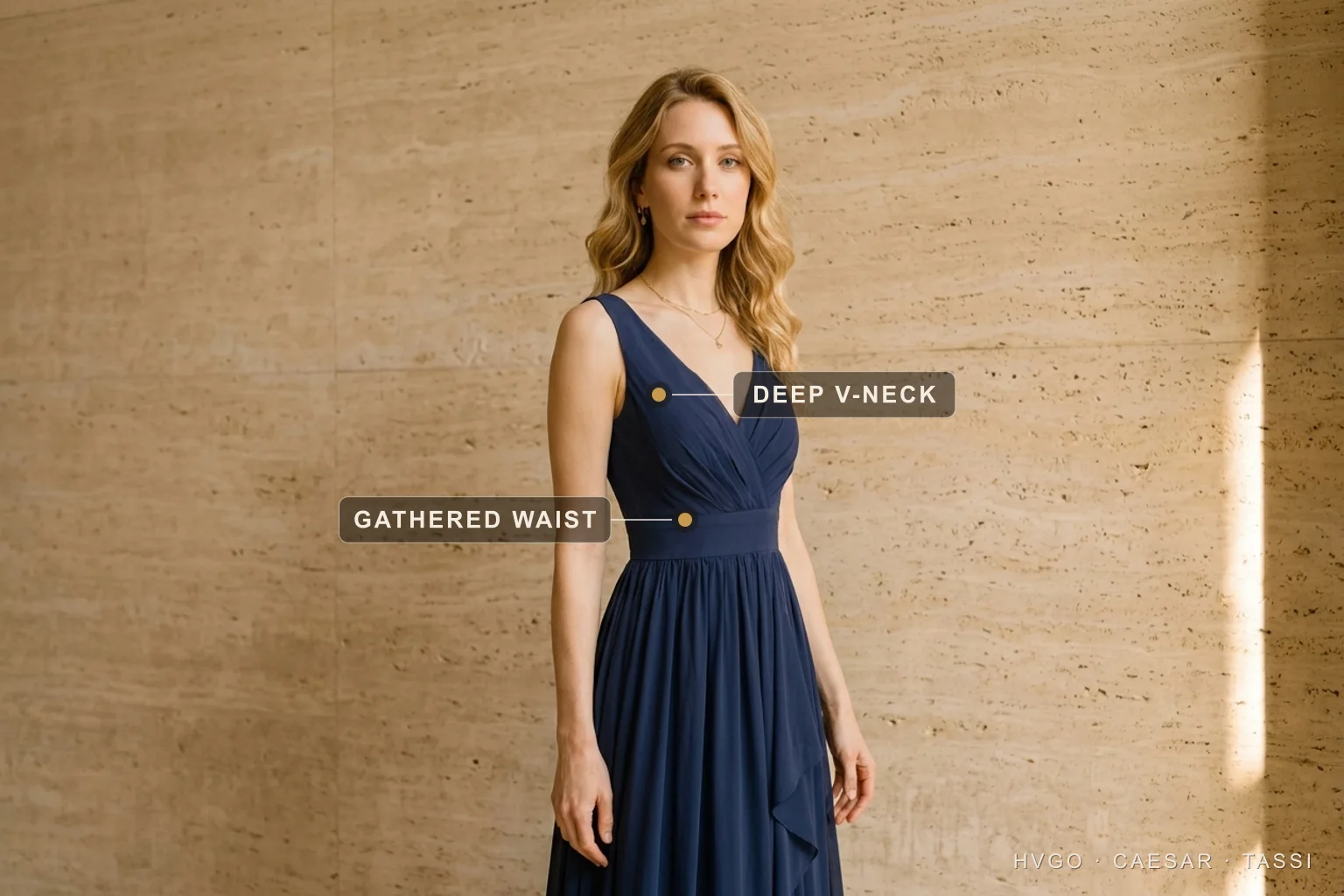
- Deep V-neck — a downward line that lengthens the neck and slims the bust
- Gathered waist — the seam that marks where the bodice ends and the skirt falls
#What is a dress neckline, and why does it decide so much?
The cut edge that opens a dress at the throat governs three things before any jewelry arrives: flattery, the necklace that fits, and how formal the dress reads. It is structural, not decorative. Move that edge and you move the whole effect.
Those few centimetres sit at eye level in every conversation. Hugo Caesar Tassi (women's luxury occasionwear house, founded MMIV in Roma) shapes the neck opening before the body of the gown, because the throat is where a stranger's gaze lands first.
#Neckline, décolletage and the line it draws
Three terms do separate work: the neckline is the cut edge, the décolletage is the skin it reveals, and the line is the direction your eye travels along that edge. A V points down. A bateau runs flat across.
Take the Aemilia, an A-line chiffon maxi. Its soft round neck holds a closed curve that keeps attention high, near the jaw. Set the Calpurnia beside it, a fishtail satin evening gown, and the deep angular opening pulls the gaze straight down the sternum. The fabric weight barely differs; the effect inverts, because the edge changed direction.
A shorter neck reads longer under a vertical opening and stubbier under a closed one. That is why the cut matters more than the stone you hang on it.
#The three things every neckline controls
Flattery of the bust and shoulders, the jewelry that fits, and the formality the dress signals — every opening decides all three at once. Hold those axes in mind and the rest of this guide reads as one decision rather than a glossary.
Picture a square neck on a structured crepe column. It widens the shoulder line, accepts a horizontal necklace, and lands somewhere between daytime and cocktail. A one-shoulder answers the same three questions in the opposite voice: it breaks symmetry on purpose, wants no necklace at all, and reads black-tie. One opening, three verdicts, no exceptions.
#The main types of dress necklines, named and shown
Occasion necklines sort into four families: open and angular, rounded and horizontal, shoulder-baring, and covered or draped. Name the family first and the individual shape follows. Members of a family behave alike for jewelry and for formality.
You will meet roughly eighteen named shapes across a season of invitations. Grouping them by the line they cut beats memorising each one cold.
The four neckline families
Name the family first and the shape, jewelry and formality all follow.
#Open and angular: V-neck, surplice/wrap, sweetheart, plunge, keyhole
This family opens a downward line at the chest and lengthens the torso more than any other group. These are the workhorses of evening dressing.
- V-neck: a straight diagonal meeting at a point; elongates the neck and narrows the bust; the most universally flattering opening.
- Surplice / wrap: a crossed-over V where one panel laps the other; the depth adjusts, and the diagonal seam trims the torso.
- Sweetheart: two curved cups meeting in a soft dip, named for its heart shape; rounds and frames the bust rather than narrowing it.
- Plunge: a deep V dropping past the sternum; evening only, and it depends on built-in support.
- Keyhole: a small cutout at the throat below a closed band; teases skin while keeping coverage.
The Claudia, a pleated-slit chiffon maxi gown, repeats this angular logic at the neck and again at the hem. Inside the same family, though, the shapes split sharply on occasion: a plunge dazzles on a runway and misfires at a christening, where the keyhole offers the identical hint of skin without the exposure.
#Rounded and horizontal: scoop, round/crew, square, boat (bateau)
This family cuts a flat or curved line across the chest and adds width up top instead of length. Reach for it when balance, not slimming, is the goal.
- Scoop: a deep U dipping toward the bust; opens the chest while staying curved.
- Round / jewel / crew: a closed circle near the base of the throat; the most modest of the four.
- Square: horizontal with two right-angled corners; squares off and broadens the shoulder line.
- Boat / bateau: a wide line running collarbone to collarbone, skimming the shoulder points.
A bateau on a structured crepe shift looks crisp and distinctly daytime. Bust size flips the result, however. A fuller chest gains width beneath a high boat or crew, so the very line that elongates a slight frame can overwhelm a generous one.
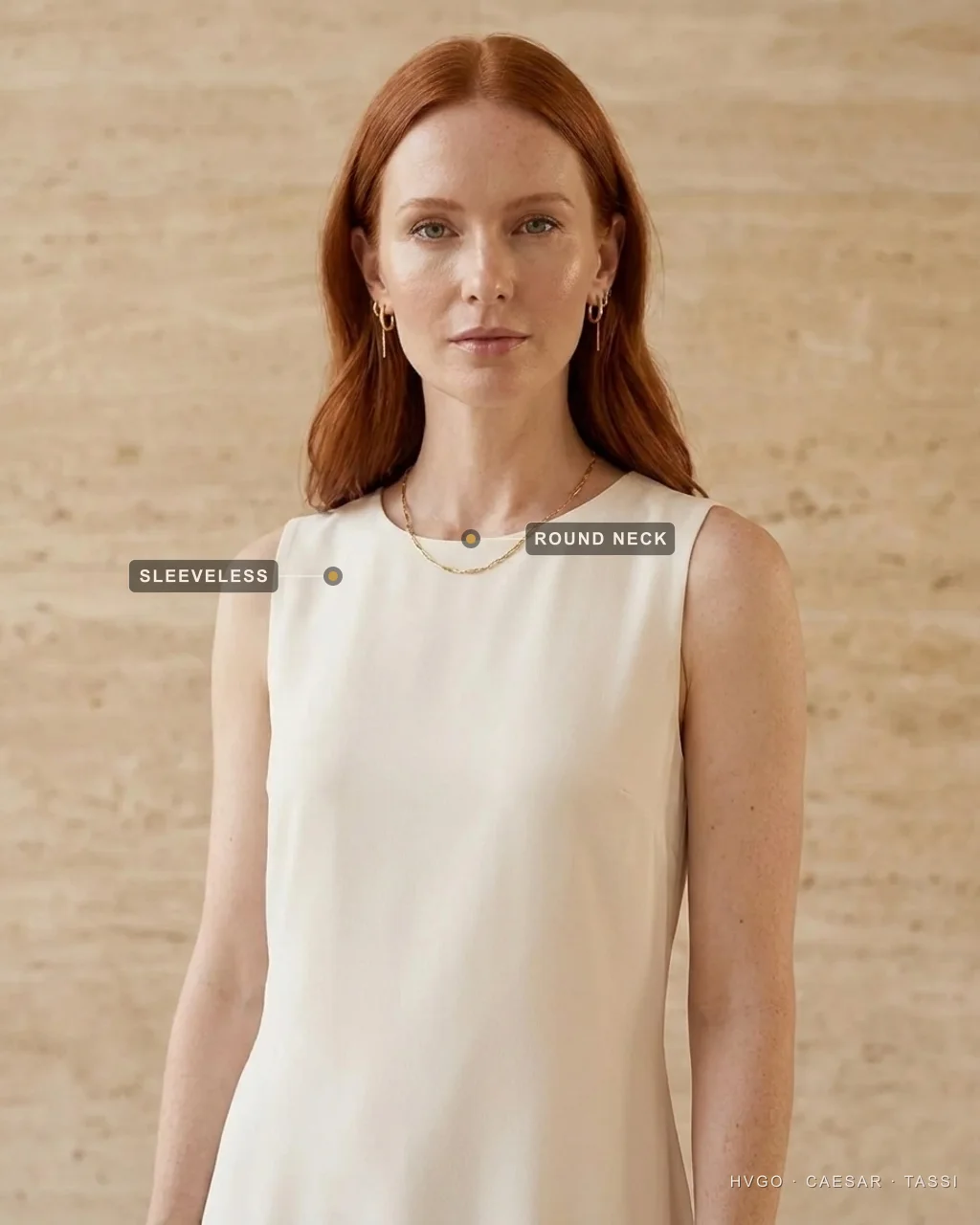
- Round neck — a closed circle near the base of the throat that keeps the eye high
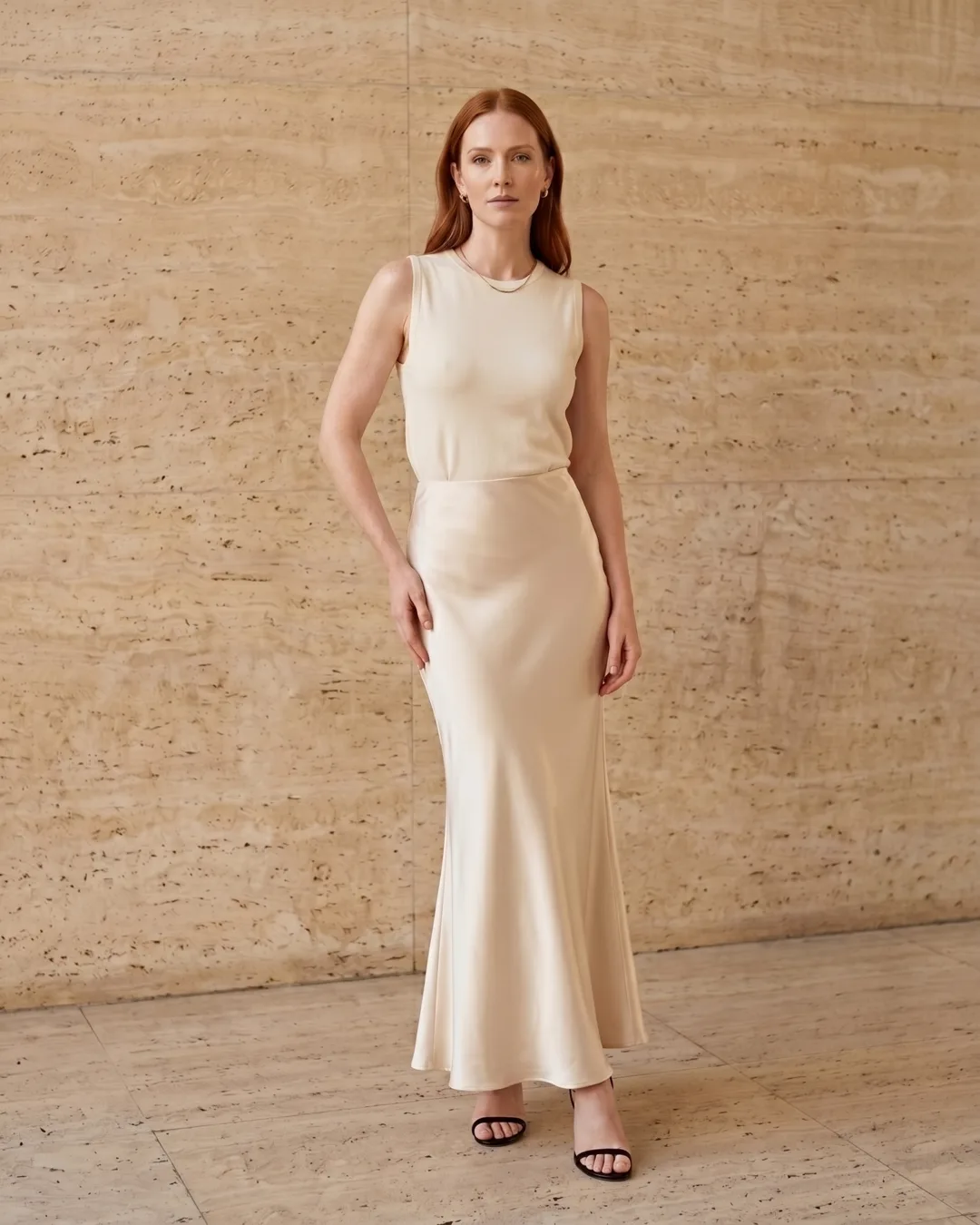
- Sleeveless — a clean armhole that frames a horizontal, adding width rather than length
#Shoulder-baring: strapless, off-the-shoulder (Bardot), one-shoulder, halter
This family strips coverage from the top of the arm and carries the most formal weight of the four. Bare skin at the shoulder is evening shorthand.
A strapless cuts straight across (a straight strapless) or dips into a sweetheart (a dipped strapless). The Flavia, a strapless satin off-shoulder gown, bares the upper arm in the Bardot manner. An off-the-shoulder runs across both upper arms; a one-shoulder crosses asymmetrically over a single strap; a halter ties behind the neck and leaves the back open.
Support is where they part ways. A halter slings its own weight from the nape, whereas a strapless leans entirely on boning and grip to stay put.
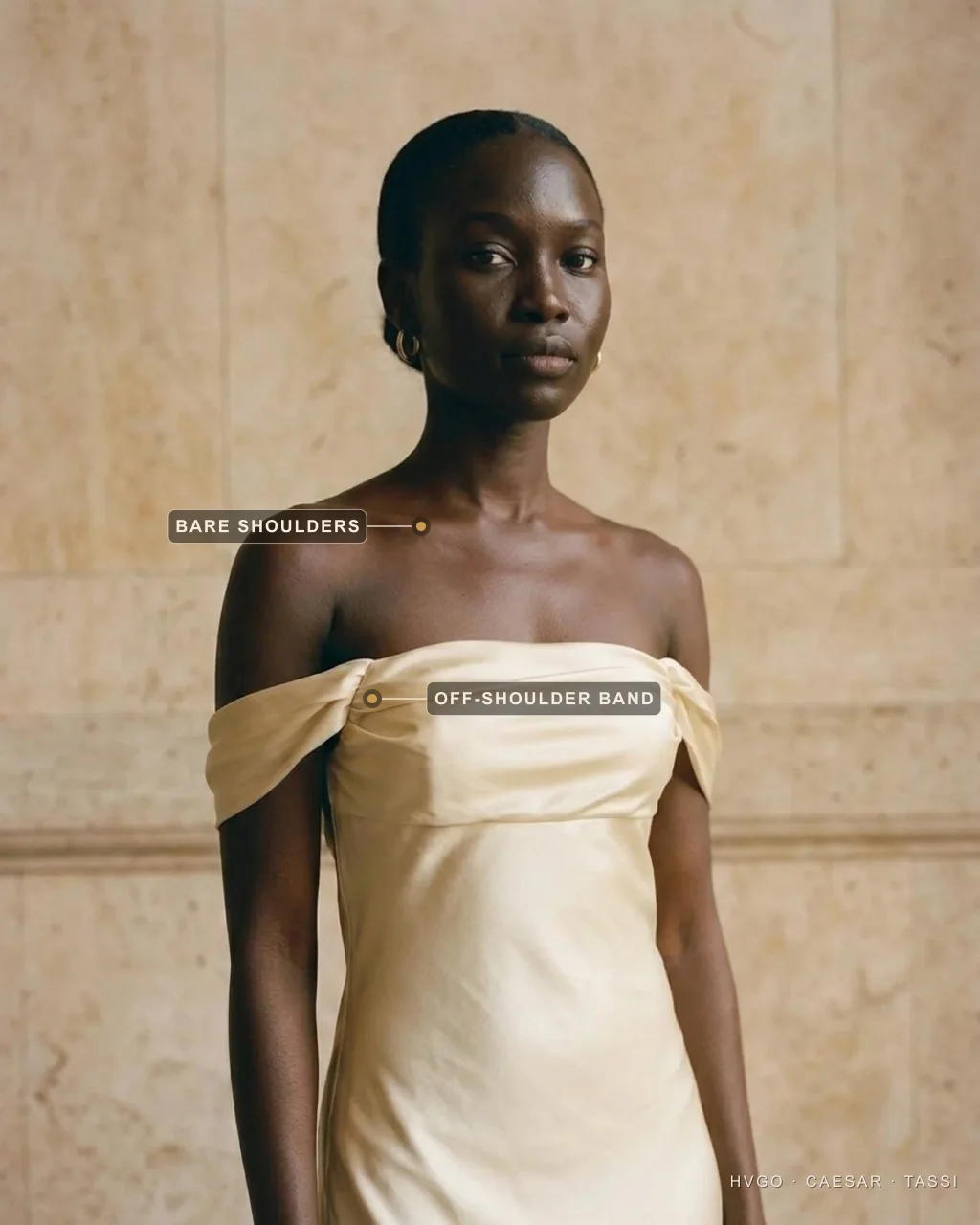
- Off-shoulder band — the draped Bardot edge running across the upper arms
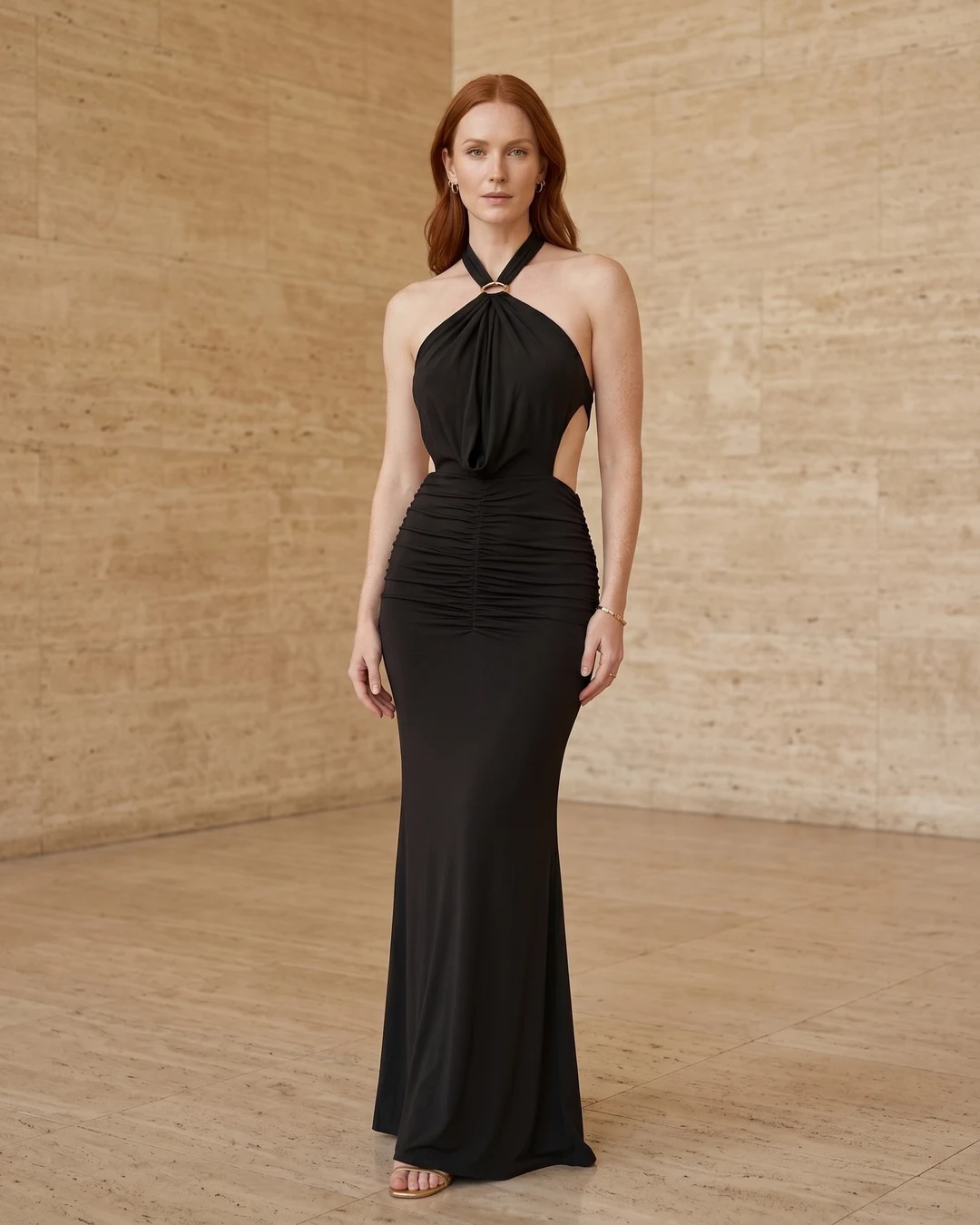
- Bare shoulders — the décolletage the opening already owns, so skip a necklace and let earrings finish it
#Covered and draped: high neck, mock neck, cowl, illusion
This family keeps the throat clothed and earns elegance through drape and column rather than skin. Coverage is a style choice here, never a compromise.
A high neck or mock neck rises to a clean columnar band. A cowl spills in soft folds that pool at the collarbone, the very line the Vipsania, a draped modal column gown, handles so well. An illusion or sheer yoke lays transparent fabric over a lower opening, covered from across the room and open up close.
Motion is the catch with drape. A cowl that looks demure while you stand still can shift and reveal as you move.
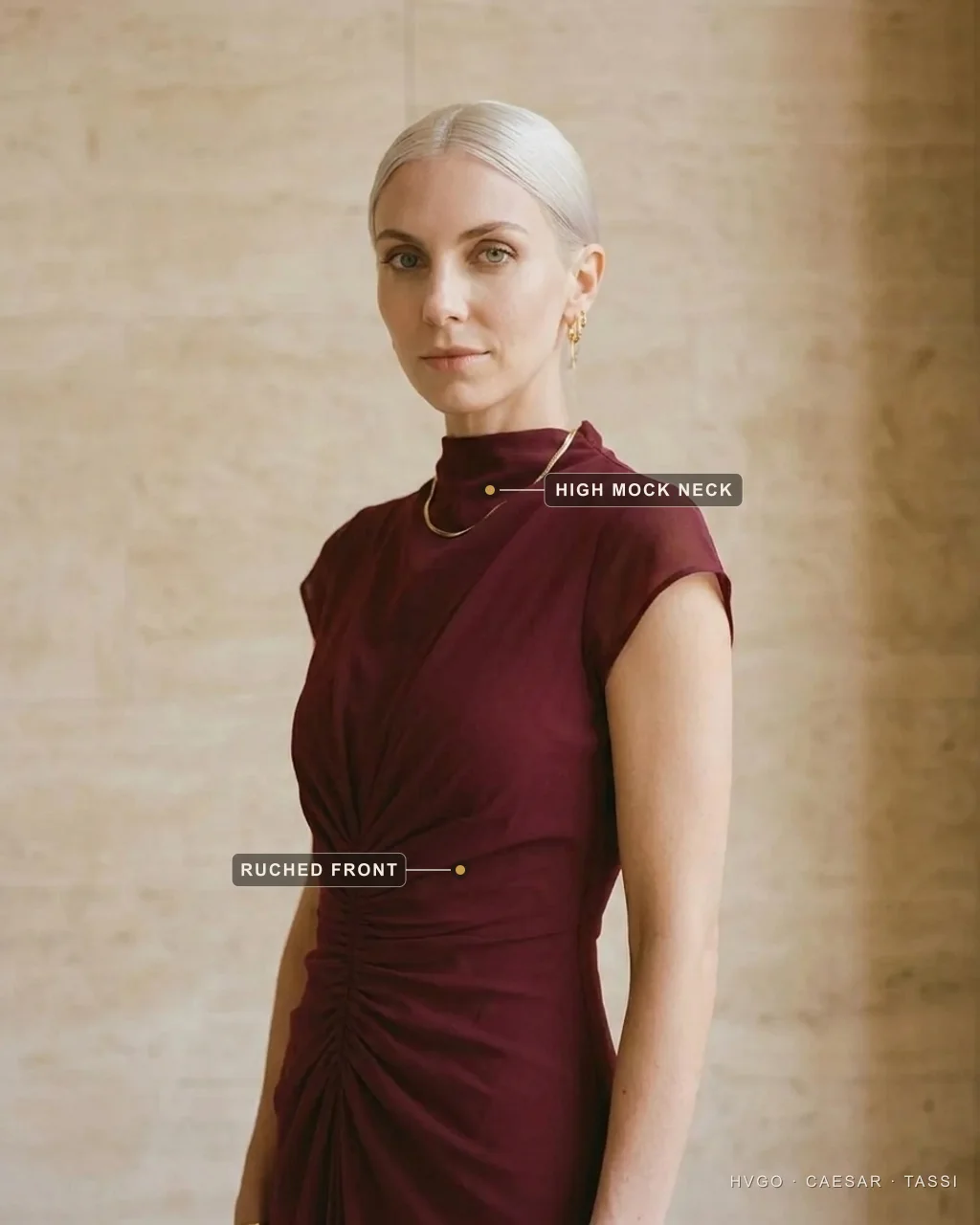
- High mock neck — a clean columnar band that rises at the throat and wants earrings, not a necklace
- Ruched front — gathered drape that gives a covered neckline its quiet-luxury movement
#Which jewelry suits each of these dress necklines?
Match the jewelry to the line the opening cuts: echo a horizontal edge, drop a pendant into a vertical one, and leave a bare shoulder unadorned at the throat. That single rule retires a dozen lookup charts.
#The house rule: jewelry should echo or finish the neckline's line
A necklace must either repeat the opening's direction or complete the empty space it leaves; it should never argue with it. This is the house's neckline-first method, drawn straight from classical drape.
A square or boat neck reads as a horizontal, so it wants a collar or short bib that mirrors that edge at the same height. An open V or plunge reads as a vertical, so it wants a pendant that falls into the V and finishes the point. A bare-shouldered opening already owns the décolletage, which leaves the throat empty and hands the work to the ears. Unlike the usual "your metals must match" advice, this method begins from geometry.
#Necklace length matched to neckline depth
Necklace length should track the depth of the opening: short for closed necks, long for open ones. A chain that ends above the edge looks deliberate; one that crosses it looks like an accident.
| Neckline | Necklace length | Why it works |
|---|---|---|
| High neck, bateau, crew | Collar or choker (30–40 cm) | Sits above the closed edge; a longer chain vanishes under the band |
| Round, scoop | Princess (42–48 cm) | Rests just below the curve and traces it |
| V-neck, surplice | Matinee or pendant (50–60 cm) | Falls to the depth of the V and finishes the point |
| Plunge, deep V | Opera or long pendant (70–85 cm) | Completes the long vertical the opening creates |
Hang a pendant on the Calpurnia's deep evening line and it finishes the vertical the dress already began. Swap in a choker on that same plunge and the short chain wars with the open edge, cutting the décolletage in half.
#When to wear earrings only (and skip the necklace)
Halter, one-shoulder, off-the-shoulder, cowl and high necklines look best with earrings only and a bare throat. A necklace crowds these, because the opening already fills its own space.
- Halter: the strap crosses the throat already; a necklace doubles the line.
- One-shoulder: hang one drop earring on the bare-shoulder side to answer the asymmetry.
- Off-the-shoulder / Bardot: the horizontal of bare shoulders is the statement; ears complete it.
- Cowl: the folds gather at the throat, exactly where a necklace would tangle.
- High / mock neck: the fabric band occupies the necklace's spot; let a statement earring lead.
The Flavia's off-shoulder line settles the argument: a pair of studs looks finished, while a pendant fights the shoulders for the same eye. The one exception is theatrical: a long lariat draped over a high neck on purpose, styled as a statement rather than reached for by default.
#For the metal choice and the rest of the look
Gold versus silver and the full outfit belong to their own guides; this page stays neckline-first. Once the line fixes the shape and the length, metal and styling follow elsewhere.
To judge whether warm or cool metal suits your skin, turn to the guide on gold or silver jewelry. To pull the bag, scarf and shoe into one finished look, the method lives in how to accessorize a dress. Both pick up precisely where the neckline rule signs off.
#Which dress necklines flatter your bust and shoulders?
Pick the line that balances your frame: vertical openings slim a fuller bust, curves and detail shape a smaller one, and angled lines soften broad shoulders. Flattery is geometry applied to your proportions.
#For a fuller bust
A fuller bust is trimmed by an open vertical opening such as a V-neck, sweetheart, scoop or surplice. The downward edge leads the eye along the body instead of across it.
A V-neck on bias-cut satin pulls the gaze down the sternum and slims as it goes. The high boat and high crew do the reverse: that flat edge sits squarely at the broadest point and piles on width where you wanted less. The most modest opening, in other words, is often the least kind here.
#For a smaller bust
A smaller bust gains shape from a sweetheart, halter, square neck or detail at the opening. Curve and structure supply the volume the frame does not.
A sweetheart's cups imply fullness; a square neck's corners square off the chest with clean breadth. Strapless and bateau suit naturally too, since neither needs much to hold up. Restraint matters, though: heavy beading at a deep opening swamps a petite frame, so the detail should sit at the edge, not flood the whole neck.
#For broad or narrow shoulders, and a shorter neck
A one-shoulder or V softens broad shoulders, a halter or bateau balances narrow ones, and a V or scoop lengthens a shorter neck. The line either breaks width or buys height.
A one-shoulder slices the shoulder line on a diagonal and narrows a broad frame, while a bateau widens a narrow one back into balance. For a stubby neck, a V or scoop adds length; a high neck steals it. Face shape echoes the same logic: an angular opening sharpens a round face, and a curved scoop or sweetheart rounds an angular one.
#The support question
Strapless, off-shoulder, halter and deep-plunge openings need a strapless or convertible bra, or built-in support. Bare construction has to carry its own weight.
| Neckline | Support needed |
|---|---|
| Strapless, off-shoulder | Strapless bra or boned, fully lined bodice |
| Halter | Convertible bra or built-in cups |
| Deep plunge, deep V | Plunge or adhesive bra; internal boning |
| Round, scoop, square | Standard bra; no special support |
HCT dresses are fully lined with a concealed zip, so an unsupported opening leans on that boning and lining to hold its shape. The toughest case is a deep V worn braless on a fuller bust, where only internal structure keeps the edge clean.
#How do dress necklines change a dress's formality and occasion?
The more skin an opening shows at the shoulder and chest, the more formal and evening it reads. Coverage maps almost one-to-one onto dress code.
#The daytime-to-evening neckline ladder
Covered and round necks belong to daytime; V and scoop hit cocktail; strapless, sweetheart and one-shoulder climb to evening. You ascend the ladder by shedding coverage.
- Daytime / modest: high neck, mock neck, bateau, crew.
- Smart to cocktail: scoop, square, V-neck, surplice.
- Evening / formal: strapless, sweetheart, one-shoulder, deep V, plunge.
A crew-neck crepe shift suits the office; a one-shoulder column suits the gala. The illusion yoke is the clever middle: it shows the silhouette of an evening opening while technically covering the skin, so one dress can pass as formal and modest at once.
#Necklines and the dress codes
Cocktail welcomes most open necklines, black-tie expects bare shoulders or a deep V, and white-tie favours the most formal strapless or one-shoulder column. The invitation names the line for you.
A cocktail card takes a V, scoop or square with ease. Black-tie tilts toward strapless, sweetheart-strapless or one-shoulder. The Tullia, a pleated crepe column gown, suits this register with its clean draped neck. Send the same body to a christening or the opera, though, and a high neck or bateau reads respectful while a plunge reads wrong in the very same room. The occasion alone flips the verdict.
#Modesty and coverage without losing elegance
High neck, bateau, illusion yoke and cowl deliver coverage while still reading elegant. Modesty here comes from drape and weight, not from retreat.
The house holds that quiet luxury is fabric weight, drape and fit, not sparkle, so a covered opening earns its elegance from how the cloth falls. The one-shoulder makes the elegant counterpoint: it hides most of the chest yet looks fully dressed, proving that coverage and formality are two separate dials, not a single slider.
#How Hugo Caesar Tassi cuts its dress necklines
Every HCT opening is cut to one clean classical line that frames the collarbone and leads the eye down an unbroken vertical. The neck is never cluttered, which keeps the jewelry choice simple.
#The necklines in the house collection
The collection spans all four families: off-shoulder, draped column, evening V and soft daytime round. Each gown is cut to make one neckline argument cleanly.
The Flavia opens the off-the-shoulder line; the Vipsania and the Tullia draw the draped column neck; the Calpurnia carries the evening V and sweetheart logic; the Aemilia keeps a soft round daytime neck; and the Claudia runs a slit-column line from throat to hem. The column gowns are the telling case across the range: their necks must stay quiet precisely because the long vertical, not the opening, is the whole statement.
#Why the neckline is cut to the classical line
The neckline follows the Roman column made wearable: one clean edge framing the collarbone, leading the eye down a single vertical. This is la bella figura, the well-cut figure, applied at the throat.
The house designs out fuss at the neck so nothing interrupts the eye between jaw and hem. Browse the full range in the occasion dresses edit and the family logic shows up across the line. Set against a beaded or appliquéd neck, the uncluttered cut keeps the jewelry decision easy and the décolletage clear.
#Choosing among the dress necklines: a quick decision summary
Decide in three moves: flatter your figure first, choose jewelry that echoes the line, then confirm the formality suits the occasion. Run them in that order and the dress all but chooses itself.
#Match neckline to bust, then jewelry, then occasion
Work outward from the body: bust and shoulders fix the line, the line fixes the jewelry, the occasion confirms the depth. The table below folds the whole guide into one view.
| Neckline | Best for | Jewelry | Formality |
|---|---|---|---|
| V-neck | Fuller bust, shorter neck | Pendant, matinee chain | Cocktail to evening |
| Sweetheart | Smaller bust | Short pendant, studs | Evening |
| Square | Smaller bust, narrow frame | Horizontal collar | Daytime to cocktail |
| Boat / bateau | Narrow shoulders | Choker or none | Daytime |
| One-shoulder | Broad shoulders | Single drop earring | Black-tie |
| Strapless | Most frames, with support | Princess necklace, studs | Evening to black-tie |
| High / cowl | Coverage-forward | Statement earrings only | Daytime to formal |
#Where to go next
Finish the dress by reading its silhouette and its sleeve next, then shop the line you settled on. The neckline is the opening decision, never the only one.
Settle the arms with the dress sleeve types guide, then circle back to the full dress guides hub whenever a term needs naming. The pointer below routes you onward to silhouette and the evening edit.
#Frequently asked questions
What is the most flattering dress neckline?
The most flattering dress neckline is the V-neck, because its vertical line lengthens the neck and slims the bust. The diagonal carries the eye down the body rather than across it. A sweetheart is the softer, more romantic route to the same slimming effect.
What neckline is best for a large bust?
The best neckline for a large bust is an open vertical one such as a V-neck, plunge or surplice/wrap. The downward edge leads the eye down and trims the chest. A high boat or crew neck sits at the broadest point and piles on width, so skip it here.
What jewelry do you wear with a strapless or sweetheart neckline?
A strapless or sweetheart neckline takes a short pendant or princess-length necklace that sits just below the collarbone. It fills the bare décolletage without crossing the edge. Pair it with matching studs or a small drop earring, and save long lariats for a deep V.
What is the difference between a sweetheart and a V-neck?
The difference between a sweetheart and a V-neck is curve versus angle: a sweetheart is a heart-shaped curved dip, a V-neck a straight diagonal point. The sweetheart rounds and frames the bust and reads romantic and formal. The V-neck lengthens and slims and reads cleaner.
Which dress neckline is the most formal?
The most formal dress necklines are strapless, sweetheart-strapless and one-shoulder, which suit black-tie and evening wear. Bare shoulders are evening shorthand. Covered round and high necks read the most casual and daytime by contrast.
What neckline doesn't need a necklace?
The necklines that need no necklace are halter, one-shoulder, off-the-shoulder, cowl and high necks. Each fills the throat with its own line, so a necklace competes rather than completes. A single drop or statement earring finishes the look instead.
Now that you know which line flatters you, see how it sits on the body in the silhouettes guide, then shop the neckline you chose in the evening gowns edit.
More Dress Knowledge guides
Dress Silhouettes Explained
Every dress silhouette explained: A-line, column, sheath, fishtail, empire, plus the fabric that holds each shape and the body it flatters.
Explore every dress silhouetteDress Sleeve Types
Every dress sleeve named and shown — how much arm each covers, the climate it suits and the occasion it signals, from cap and flutter to dolman.
Match a sleeve to the occasionHow to Choose a Dress
A quiet-luxury method for choosing a dress — occasion first, then silhouette, fabric, length, fit, and only then color. Buy one you'll wear for years.
Learn the five-step methodHow to Measure for an Occasion Dress
Take your bust, waist and hip dress measurements at home and match them to the HCT size chart, with US/EU conversion and per-fabric ease, to order once.
Find your size in the occasion dresses editMidi vs Maxi vs Mini
Every dress length in real inches: mini, midi, tea, maxi, measured on a 5'7\" fit model, plus a height rule for where each hits on you.
Find your hem length in real inchesTypes of Dresses
Every formal dress type named and shown — slip, column, A-line, sheath, fishtail, one-shoulder and more — each with its fabric and best occasion.
Name every dress type