Best Dresses for an Hourglass Figure: Tracing the Waist, Never Hiding It
The silhouettes, fabrics and necklines that trace an hourglass figure instead of hiding it, plus the atelier fluid-weight rule and HCT gowns to shop.
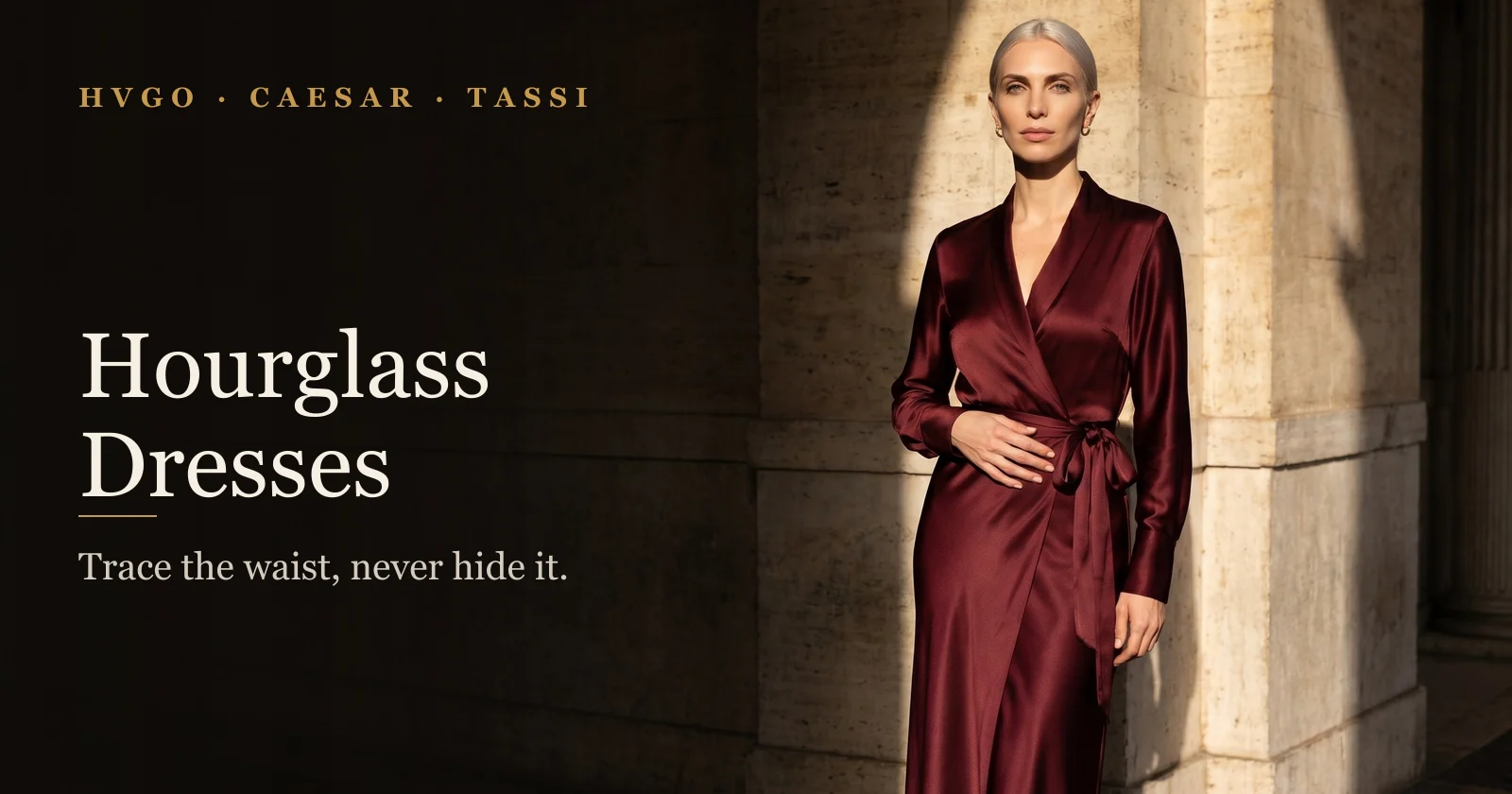
On this page
The best dresses for an hourglass figure trace your waist rather than build one, because you already carry the line every designer chases. A fitted silhouette in a fluid fabric, seamed at your true natural waist, does the whole job. Here is how the Roman atelier dresses it.
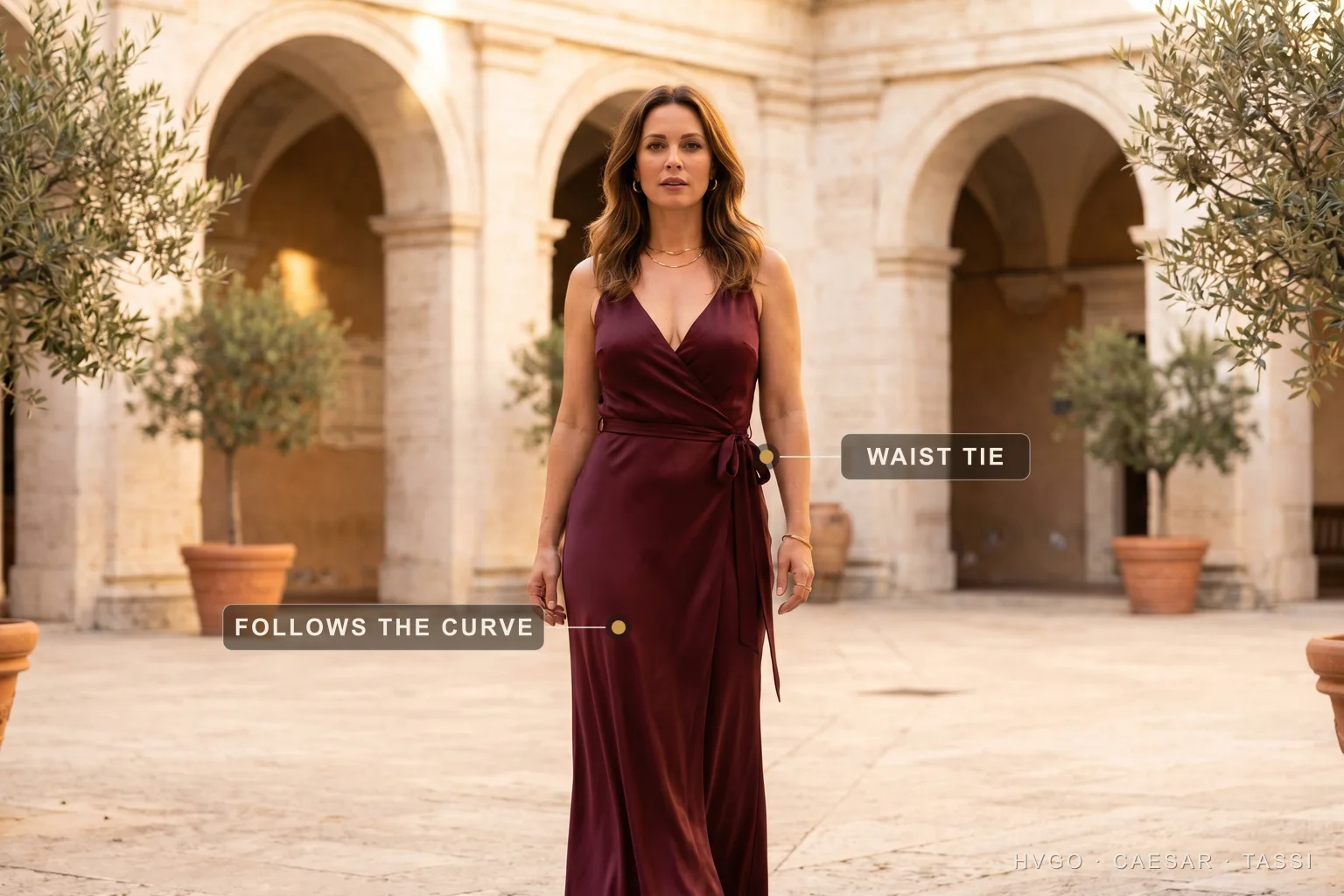
- Tie at the natural waist
- Bias satin follows the curve
Your hourglass dress, in three steps
Tell us the moment and what to trace first — we’ll name the cuts that follow your waist.
Enter your measurements (optional) to confirm the curve.
#What makes a dress flatter an hourglass figure?
A dress flatters an hourglass figure when its narrowest seam lands at your narrowest point and the fabric follows the curve below it. Your bust and hips sit within a few centimeters of each other, and your waist marks the indent between them that designers spend whole collections trying to fake.
The design problem inverts here. A rectangle figure needs a waist built in through seaming or a belt; a pear needs the eye lifted toward the shoulder. Your shape needs neither, and the fastest way to lose the definition you were born with is to drown the midriff under stiff cloth. The house elegance doctrine sets one focal point per outfit, and on this frame that point is the waist.
#The one rule: skim the waist, don't smother it
Skim the waist with fabric that moves; never pack structure around it. A dress that grips the torso then floats over the hip reads as curve, while one that stands away in a rigid drum reads as a box, whatever your measurements.
Take the Calpurnia fishtail satin gown: bias-cut satin contours the waist and releases below the knee, unlike a heavily interfaced A-line that holds its own shape regardless of the woman inside it. One honest exception: a soft midsection can make tight cling feel exposing, and the answer is a slip plus a bias seam, not a stiffer fabric.
#Where the waist seam should land on an hourglass figure
The waist seam belongs at your true natural waist, the narrowest horizontal line between ribs and hips. Set it 2 to 3 centimeters too high and you create an empire line that skips the curve; drop it toward the hip and you erase the indent under a straight panel.
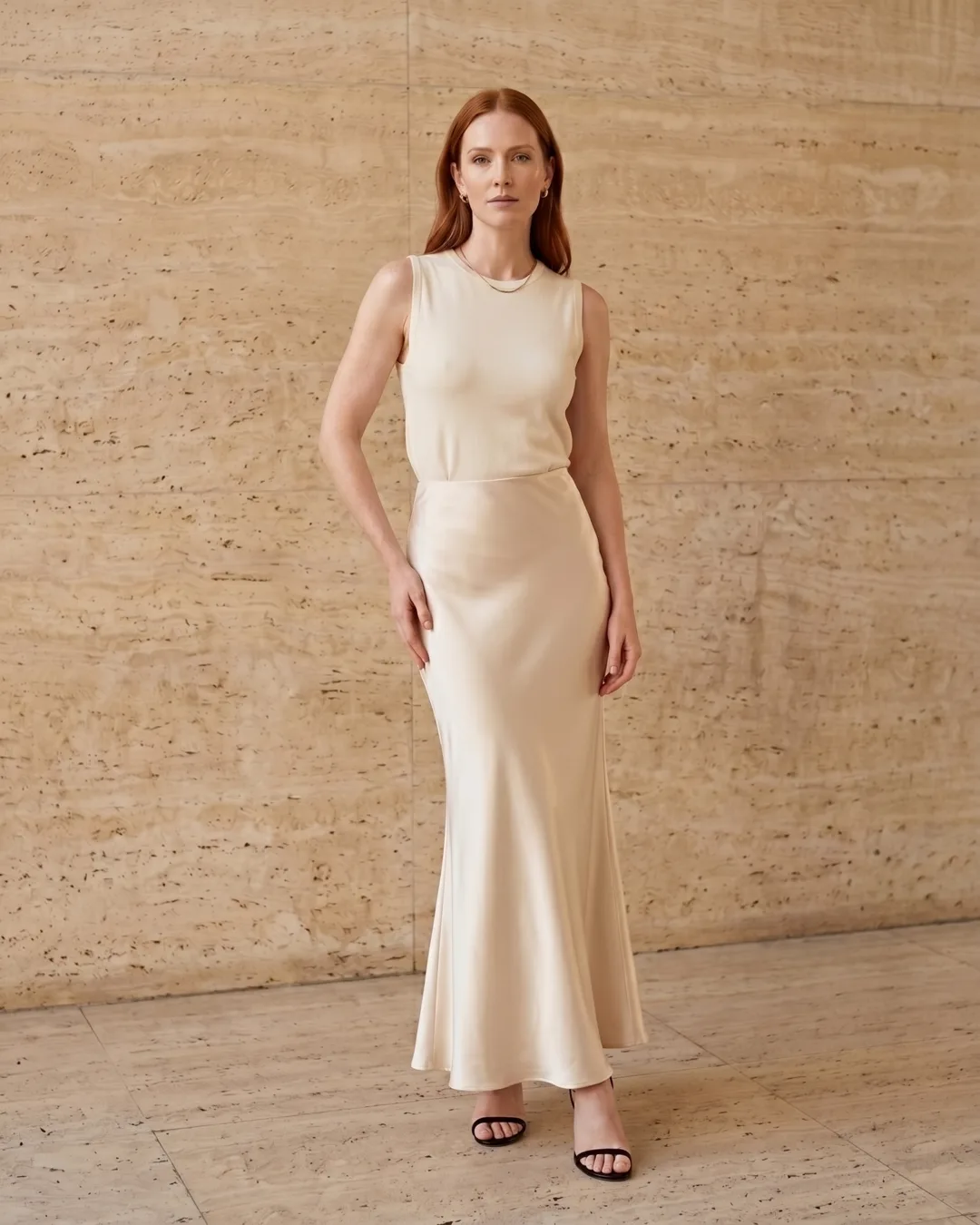
A set-in seam or self-belt cinched at that point declares the shape instantly, the way the Julia French-pleated maxi joins bodice to skirt at the natural waist. A tunic, shift, or 1920s drop-waist column does the opposite, hanging from the shoulder so the body reads as one straight tube.
#Petite vs. curvier hourglass proportions
The fluid-weight rule scales by proportion: a petite hourglass wants a higher, cleaner seam and less skirt volume, while a curvier hourglass wants drape with recovery. Both keep the seam at the natural waist; what changes is the volume below it.
A woman at 158 cm risks being swallowed by a full skirt, so a slim fishtail or soft column keeps her vertical line intact. A fuller frame wants fabric that follows and springs back rather than clinging flat. Still confirming your proportions? The body-shape pillar and the find your shape guide measure them first.
#Which dress silhouettes flatter an hourglass figure at an occasion?
Four silhouettes suit an hourglass at an occasion: fishtail, fluid column, fit-and-flare, and the wrap. Each fixes the narrowest point at the waist and lets the skirt resolve the curve below.
- Seam at the natural waist — a set-in seam or self-belt at your narrowest point.
- Fluid fabric that follows — bias satin or modal traces the curve, never bridges it.
- Curve-echoing neckline — a V, sweetheart or off-shoulder frames the bust.
- Boxy shift or shift — hangs straight and erases the waist.
- Drop-waist — moves the seam to the hip, flattens the curve.
- Stiff structured A-line — stands off the body and squares the line.
#Fishtail and trumpet gowns for an hourglass figure
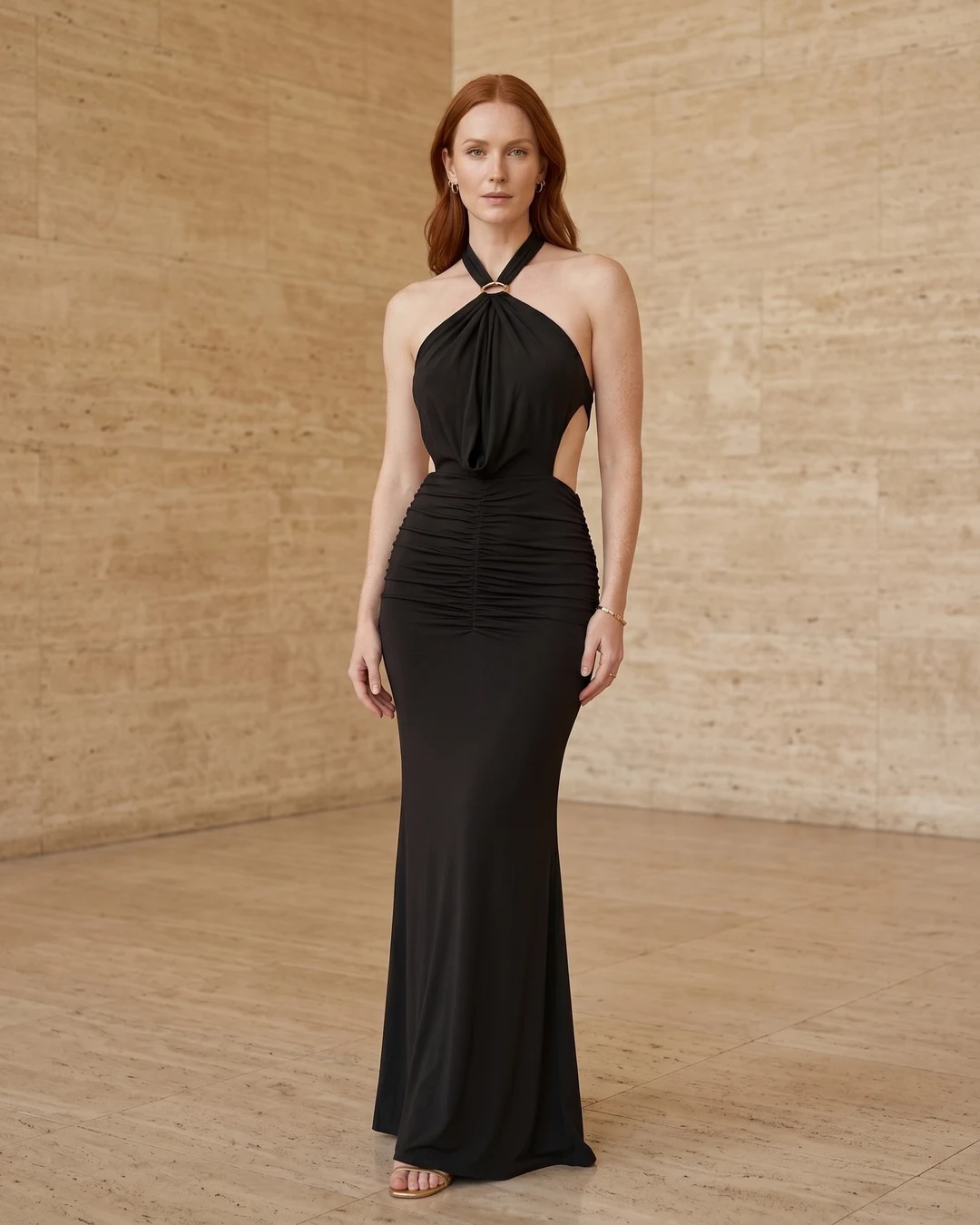
Fishtail and trumpet gowns are the most overtly curve-tracing evening silhouette, because they map the cut onto the body. The fabric follows the torso through hip and thigh, then flares below the knee, repeating your shape in cloth.
The Calpurnia evening gown is the house example: bias-cut satin holds the line to mid-thigh before the fishtail opens. The edge case is seated dinners and stairs, where a tight trumpet limits stride, so check the flare allows a full step.
#The fluid column and draped sheath
A column or sheath flatters this shape only in a fabric with drape; a stiff one fights the curve. Soft modal or satin falls into the waist and skims the hip, while a rigid column stands away and squares off the line.
The Vipsania draped modal column gown shows the difference: modal jersey has the weight to follow the waist instead of bridging it. A structured crepe column on the same body reads as a straight panel, so the atelier reserves stiff columns for figures that want a waist invented.
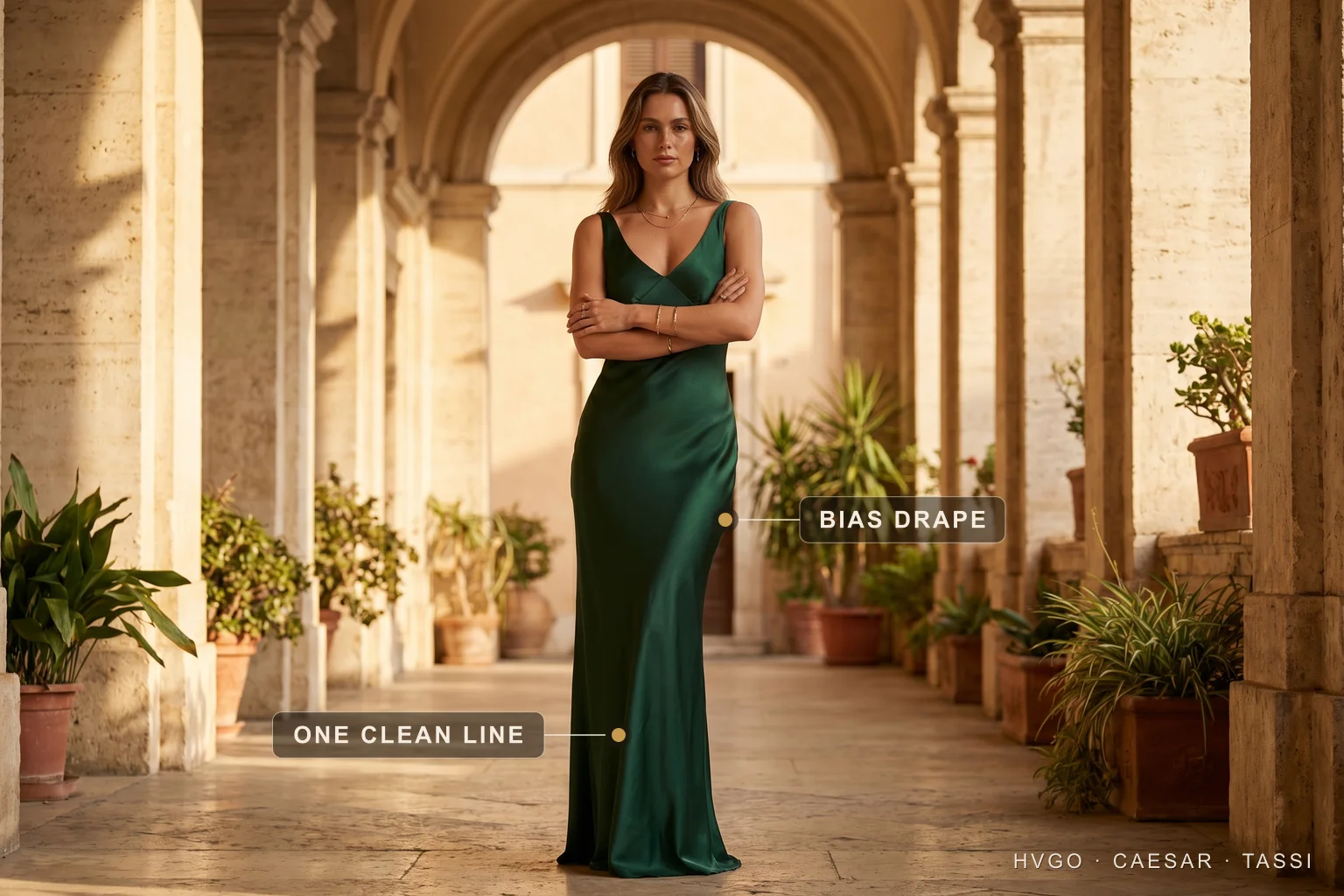
- Bias-cut line follows the curve
- One unbroken column
#Fit-and-flare and the French-pleated maxi
Fit-and-flare and the French-pleated maxi both fit the bodice and release the skirt from the natural waist, giving daytime a defined-waist option. The fitted top declares the curve; the flared skirt keeps the look soft rather than overtly evening.
The Julia French-pleated maxi reads as the daytime version of the rule, suited to a wedding or garden formal. Watch the flare: a skirt that springs too sharply can read as added hip, so a moderate flare in a fluid weight beats a crisp circle skirt.
#Wrap and self-belted dresses
The wrap is the most adjustable of these cuts, because you set the cinch at your exact waist every time you tie it. No fixed seam can match a tie you control to the centimeter.
Pick the wrap if you want a midi-length cut for less formal occasions, since it travels well and ties to your own waist. The honest limit is gape: a deep V wrap can pull open across a fuller bust, so a snap at the cross-point keeps it secure. For dressier moments, the satin and column gowns in the evening dresses edit take over.
#Which silhouettes should an hourglass figure avoid?
Avoid anything that hangs straight from the shoulder or stands away from the body: shifts, drop-waist cuts, oversized tiers, and stiff structured A-lines. Each one buries the waist that defines you.
A shift reads as a rectangle; a 1920s drop-waist column moves the seam to the hip and deletes the indent. Tiered and babydoll shapes add bulk to a balanced figure, while a boned A-line holds its own architecture and ignores yours. These four cuts share one failure mode:
- Shift and tunic: no waist seam, hangs as a tube, erases the indent.
- Drop-waist: seam at the hip, not the waist, flattens the curve.
- Tiered and babydoll: volume from the bust down adds bulk you don't need.
- Stiff structured A-line: rigid skirt stands off the body and squares the line.
The exception worth naming: a fitted bodice with a soft A-line skirt released from the natural waist is not the same garment as a stiff A-line, and it works. The waist seam decides it.
#How does fabric drape behave on an hourglass figure?
Fabric drape decides whether a dress follows your waist or bridges it, which matters more than the silhouette name on the label. Two dresses cut to one pattern read differently in fluid versus rigid cloth.
#Fluid weights that trace the waist (satin, modal, chiffon)
Bias-cut satin, draped modal jersey, and soft recycled chiffon trace the waist to within roughly a centimeter. Drape lets the fabric fall into the indent; recovery lets it spring back rather than pooling, so the line stays clean as you move.
This is the house fluid-weight test, the first-party rule the atelier applies before any silhouette decision. The Livilla floral-print chiffon midi proves it on a print: the chiffon still follows the waist though the pattern draws the eye. Hold a length against your midriff; if it falls into the curve and recovers when released, it will trace you.
#Stiff weights that read boxy (heavy crepe, structured taffeta)
Heavy crepe and boned taffeta square off the silhouette, because rigid fabric bridges the waist instead of dropping into it. The cloth holds a straight line from bust to hip and reads as a box on curves.
Structure has its place, but only locally. A clean bias-faced bodice uses a little firmness to support a fuller bust without adding bulk, while a full structured skirt or rigid column fights the curve you want to show.
#Smoothing the line: undergarments and clean finishing
A smooth slip, a bra fitted to your bust, and bias seaming let fluid fabric read clean rather than clingy. The slip removes surface drag so satin glides; the bra anchors the bust so the neckline sits right.
Hugo Caesar Tassi cuts dresses fully lined with a concealed zip, so the inside finishing already smooths the line. Add a slip under the fluid satins and the fabric reads as drape even on a softer midsection.
#Which necklines and waistlines suit an hourglass figure?
Pair a curve-echoing neckline with a natural-waist seam so the eye travels from shoulder to waist in one line. The neckline frames the bust; the waistline holds the gaze at your narrowest point.
#Best necklines for an hourglass figure: V, sweetheart, scoop, cowl, off-shoulder
V-neck, sweetheart, scoop, cowl, and off-the-shoulder all flatter this shape, because each echoes a curve and balances the bust. A V or sweetheart elongates the torso; a cowl adds movement; off-the-shoulder uses balanced shoulders to widen the frame above the waist.
The Flavia strapless satin off-shoulder gown sits in this group, opening the shoulder line so the waist below reads as the narrowest point. A high closed crew neck is the counter-example, shortening the neck and making a fuller bust read heavier.
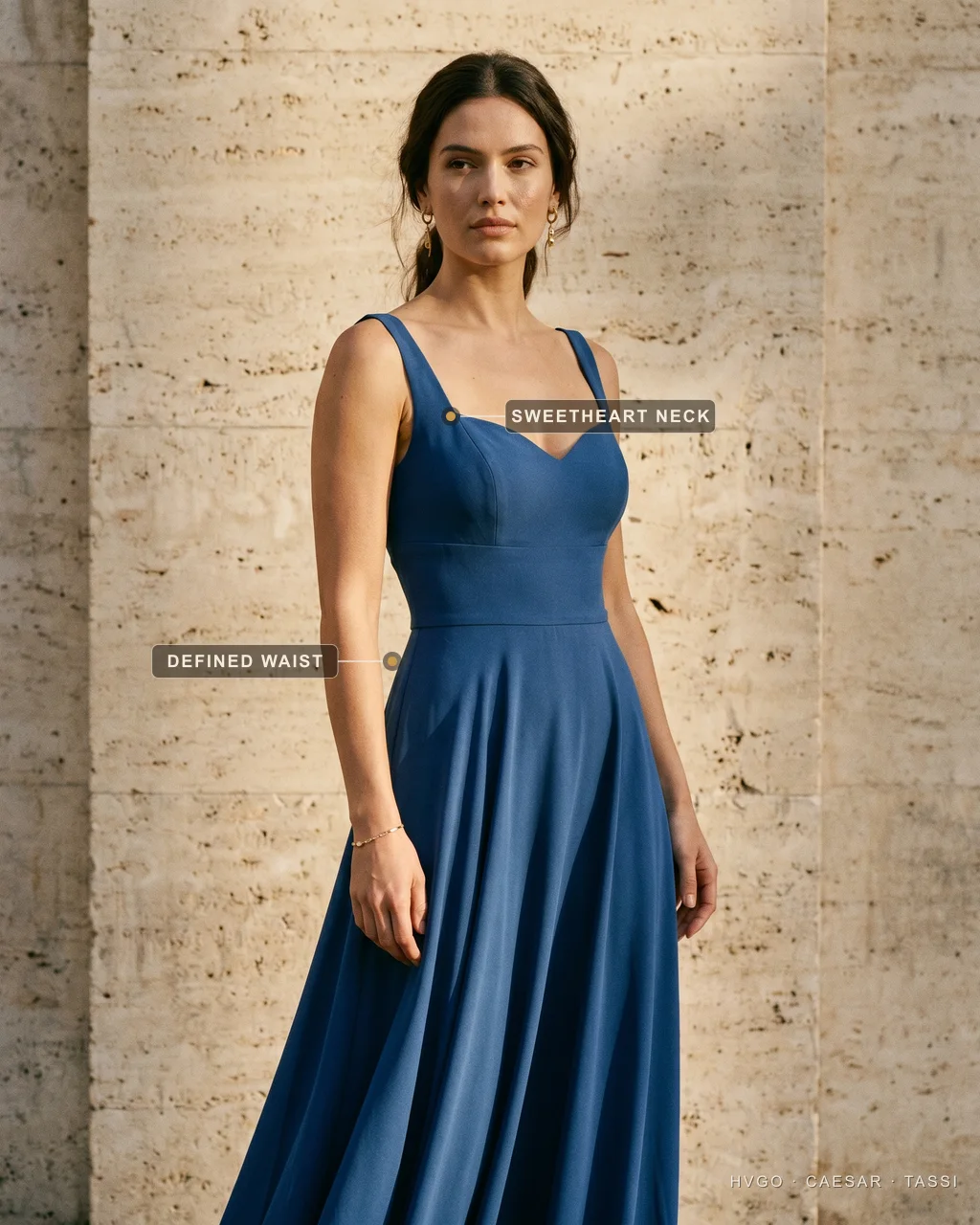
- Sweetheart frames the bust
- Defined waist nips in
#Best waistlines: natural, set-in, self-belt
Natural-waist, set-in, and self-belt waistlines all land at your true waist, unlike empire or drop seams that miss it. The seam placement is the whole decision; the neckline only supports it.
A self-belt in a contrast color does double duty, marking the waist and adding the single accent the elegance doctrine allows. An empire seam, by contrast, releases fabric from under the bust and hides the indent, suiting a different figure than yours.
| Neckline | What it does for an hourglass | Pair it with |
|---|---|---|
| Sweetheart | Frames the bust, elongates the torso | Natural-waist seam |
| V-neck | Opens the décolletage, draws a vertical line | Set-in waist |
| Cowl | Adds soft drape and movement up top | Self-belt at the waist |
| Off-the-shoulder | Widens the shoulder to balance the hip | Fitted bodice into natural waist |
| Scoop | Softens a fuller bust, keeps the curve | Bias-faced bodice |
#Which colors suit an hourglass figure at an occasion?
A single deep tone reads as one unbroken curve, while a contrast accent at the waist draws the eye straight to your narrowest point. Color either carries the line or breaks it.
#Using the imperial palette to frame the waist
One statement color per outfit keeps the line unbroken; a contrast seam or belt marks the waist deliberately. A column of Basalt, Porpora, or Cobalto reads as a single sweep from shoulder to hem, so the curve does the talking.
To accent the waist, set a self-belt or contrast seam in Avorio or Vermiglio against that deep ground. Skip a busy print: a bold horizontal repeat chops the body into bands and breaks the continuous line. A vertical or small floral, like the Livilla midi, follows the curve instead of cutting across it.
#How does an hourglass figure dress for a wedding or black-tie occasion?
Match the silhouette to the dress code: fluid daytime maxis for a wedding, full-length fishtail or column gowns for black-tie. The waist rule holds across both; only fabric and length shift.
#Wedding guest by dress code
For a daytime wedding choose a French-pleated maxi or floral chiffon midi; for an evening one move to satin gowns. Daytime reads softer and lighter, evening longer and richer, and both keep the seam at the natural waist.
The Julia maxi and Livilla midi cover daytime; the Calpurnia satin gown covers evening. The atelier designs occasion dressing to skip bridal white and funereal black for guests, so the imperial palette gives you safe ground. Confirm the formality against the wedding guest dress codes guide first.
#Black-tie and gala
Black-tie and gala call for full-length fishtail or fluid column gowns in a single deep tone. Length and a continuous color carry the formality; the waist seam carries the shape.
Pick Basalt, Porpora, or Cobalto for the gown and keep jewelry to one focal point. A small Quirina leather envelope clutch held at the hip keeps the eye traveling down the column rather than breaking the vertical line across it.
#How Hugo Caesar Tassi dresses an hourglass figure
The house steers curvy clients to fluid weights and a natural-waist seam, then tailors any waist gap by hand. The Roman atelier treats the dress as something that follows your line, never something that imposes one.
#Our recommended HCT gowns for an hourglass figure
Five gowns carry the rule across occasions, from evening satin to printed daytime chiffon. Each fixes the waist at your narrowest point in a fabric with drape.
- Calpurnia: bias-cut satin fishtail; the overt evening hourglass.
- Vipsania: draped modal column; soft fabric that traces the waist.
- Flavia: strapless satin off-shoulder; opens the shoulder, marks the waist.
- Julia: French-pleated maxi; the defined-waist daytime option.
- Livilla: floral-print chiffon midi; print that still follows the curve.
Browse the broader satin dresses and occasion dresses edits to see the same fluid-weight rule across more lengths.
#The atelier fit note
Size to your fuller measurement, your bust or hip, then tailor the waist if a gap remains. This shape often fits bust and hip cleanly but leaves room at the waist, and that gap is a quick alteration, not a reason to size down.
Sizes run S to 3XL (EU 34 to 44), and the house publishes each model's height near 175 cm so you can judge where a hem breaks on your own frame. A small waist take-in is the finishing touch that makes the dress follow your natural line.
What the atelier learned fitting the hourglass figure
Across the house’s fitting studio, the hourglass needed the least invention and the most restraint: trace the line, don’t add to it. A fluid fabric seamed at the true natural waist read as curve, where stiff structure or a dropped seam buried the very indent the figure is known for. The findings below are how the studio now cuts for the hourglass.
| Cut | What the studio observed | Verdict |
|---|---|---|
| Bias-cut fishtail | Contours the waist to mid-thigh, then flares below the knee; the overt evening curve. | Best for evening |
| Draped column / sheath | In fluid modal or satin, falls into the waist and skims the hip. | Best |
| Fit-and-flare / French-pleated | Fits the bodice and releases the skirt from the natural waist. | Best |
| Wrap / self-belt | Cinches at your exact waist; the most adjustable curve-tracer. | Best |
| Boxy shift / drop-waist | Hangs from the shoulder or drops the seam to the hip, erasing the indent. | Skip |
| Stiff structured A-line | Holds its own architecture and stands off the curve. | Skip |
The rule the study produced: trace the waist, never smother it — seam at your natural waist in a fabric that follows the curve.
#Your hourglass figure occasion-dress shortlist
Choose a fitted silhouette, a fluid fabric, a curve-echoing neckline, a natural-waist seam, and one deep color. That sequence turns the whole guide into a single decision you make before you shop:
- Silhouette: fishtail, soft column, fit-and-flare, or wrap.
- Fabric: bias satin, modal, or chiffon over stiff crepe.
- Neckline: V, sweetheart, scoop, cowl, or off-shoulder.
- Waistline: a set-in seam or self-belt at your true waist.
- Color: one imperial tone, with a contrast accent only at the waist.
If you carry the rule into the fitting room, you'll narrow to a handful of gowns fast. The same logic adapts to other figures: the pear shape and rectangle shape guides apply it elsewhere.
#Frequently asked questions
What is the best dress style for an hourglass figure?
The best dress style for an hourglass figure is a fitted silhouette in a fluid fabric with a seam at your natural waist. Fishtail, soft column, fit-and-flare, and wrap cuts all trace your defined waist instead of hiding it.
What dresses should an hourglass figure avoid?
Dresses an hourglass figure should avoid are boxy shifts, dropped-waist and empire cuts, oversized tiered or babydoll shapes, and stiff structured fabrics. Each one squares off your curves with cloth that bridges the indent rather than dropping into it.
What neckline is most flattering for an hourglass figure?
The most flattering necklines for an hourglass figure are V-neck, sweetheart, scoop, cowl, and off-the-shoulder. They echo your curves and balance a fuller bust while drawing the eye toward the waist. A high closed crew neck is the one to skip.
Is bias-cut satin good for an hourglass figure?
Bias-cut satin is good for an hourglass figure because it has the drape and recovery to follow your waist within roughly a centimeter. Draped modal behaves the same way, which is why the atelier steers hourglass clients toward satin and modal over stiff crepe.
What is the best wedding guest dress for an hourglass figure?
The best wedding guest dress for an hourglass figure is a French-pleated maxi or floral chiffon midi for daytime, and a satin fishtail or fluid column gown for evening. Each one is defined at the natural waist, so match the length and fabric to the stated dress code.
What colors are most flattering for an hourglass figure?
The most flattering colors for an hourglass figure are single deep tones like Basalt, Porpora, or Cobalto, which read as one unbroken curve. A contrast self-belt or seam in Avorio or Vermiglio draws the eye straight to your waist, while large horizontal prints break the line.
Shop the hourglass edit. Start with the satin and evening collections, or take our atelier fit note into any defined-waist gown that follows your natural line.
More Body Shape guides
Best Dresses for an Apple Shape
The apple-shape dresses that skim a fuller middle with cut, not shapewear: empire seams, bias drape and fluid crepe from the Roman atelier of HCT.
See the apple-shape editElegant Dresses for Women Over 50
Occasion dresses that flatter over 50 — a three-quarter sleeve, soft V neck and crepe that skims. The age-positive guide to weddings and evenings.
Dressing well over 50How to Find Your Body Shape
Take three measurements and learn your body shape for sure with the atelier ratio method and exact thresholds, not vague compare-to-fruit guesswork.
Find your body shapeHow to Dress an Inverted Triangle Body Shape
Open the neckline into a soft V to narrow broad shoulders, then add a skirt-width of pleated-chiffon volume at the hip until your shape reads balanced.
Style the inverted triangleBest Occasion Dresses for a Pear Shape
The shapes, necklines and fabrics that balance a pear shape: A-line chiffon that skims the hip and a neckline that lifts the eye one body-third up.
See the pear-shape editThe Petite Woman's Guide to Occasion Dresses
The lengths, waistlines and silhouettes that lengthen a petite frame, with the exact hem rule and the one-color column that reads taller.
See the petite edit