The Petite Woman's Guide to Occasion Dresses: Dress the Proportion, Not the Inches
The lengths, waistlines and silhouettes that lengthen a petite frame, with the exact hem rule and the one-color column that reads taller.
On this page
Dresses for petite women flatter most when they keep horizontal breaks few and high and let one long vertical line lengthen the frame. At 5'3" (160 cm) and under, a hem, a waist seam, or a color change costs more visual height than it would on a taller woman. This guide gives you the exact lengths, waist placements, and silhouettes that elongate the leg line.
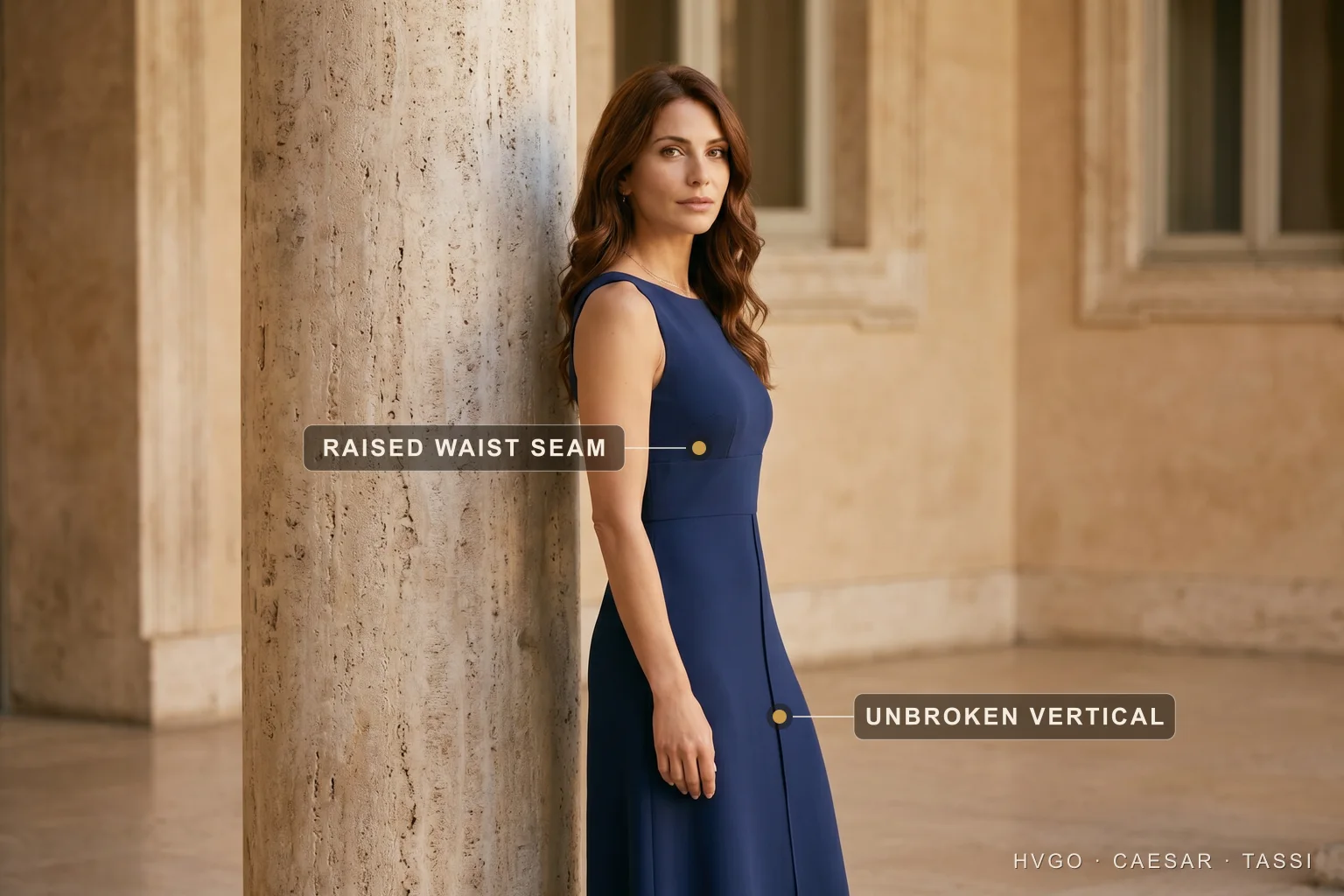
- Raised waist seam — placed above the natural waist, it shortens the torso and gifts the difference to the leg line
- Unbroken vertical — a single continuous colour gives the eye no horizontal break to stop on, reading taller
Petite occasion-dress checklist
Run this before you buy any occasion dress at 5'3" (160 cm) and under.
- Find your body shape first, then layer the petite lengthening rules on top of it.
- Keep one high break: a seam at or above the natural waist, or a natural waist with a narrow tonal sash.
- Land the hem at the slimmest part of the calf or fully to the floor, and have a maxi hemmed to your exact heel.
- Choose a one-color column or draped column (Cobalto, Basalt or Avorio) for an unbroken vertical from shoulder to hem.
- Open the neckline with a V or scoop and finish with a heel and a nude or tonal pointed shoe that continues the leg.
- Don't let a hem land at mid-shin or the widest swell of the calf, where it visually cuts the leg.
- Don't add a dropped or bulky waist, or a wide three-inch contrast belt, both steal height you can't spare.
- Don't color-block: a band of a second shade reintroduces the exact break a one-color column erases.
- Don't drown a small frame in oversized florals, huge ruffles, puff sleeves or stiff full skirts, match scale to your frame.
- Don't draw a hard line at the ankle with a black ankle-strap sandal under a pale hem.
#What "petite" really means for women (and why it isn't a body shape)
Petite names your height and frame, not your bust-waist-hip proportions, so you still have a body shape underneath it. The label covers women around 5'3" (160 cm) and shorter, however curves distribute. You read as a petite hourglass, a petite pear, or a petite rectangle, then add the lengthening rules on top.
#Petite is a height, not a figure
A petite woman identifies her figure exactly as a taller woman does, then layers height-specific rules over it. A petite pear at 5'2" balances her hip with a structured shoulder like a taller pear, then raises the waist seam and lifts the hem; the two sets of advice stack rather than replace each other. Treating petite as a sixth shape is the common error, so confirm your figure with the body shape finder first.
#Why proportion, not inches, is the whole game
A petite frame holds less vertical space, so every horizontal line takes a larger share and visually cuts height. Picture a 5'10" woman and a 5'1" woman in the same knee-hem dress with a contrast belt: those lines split the taller one into long thirds, but they carve the shorter one into halves. The fix is structural, not about wearing small. Keep the breaks few, place them high, and let one uninterrupted line run from shoulder to floor. A long-torso petite-tall woman is the exception, raising her seam more because her break sits low by default.
#Petite, short and small-frame, plus the curvy-petite note
Petite, short, and small-frame name three different things that often travel together: short-waisted means a high natural waist with long legs, short-legged means the reverse, and small-frame means narrow bones at any height. A curvy or petite-plus woman uses the identical proportion rules over her shape's advice, just in fabrics with more drape to skim rather than cling.
#Which dress lengths are most flattering for a petite frame?
A hem flatters a petite frame when it lands at the slimmest part of the calf or fully to the floor, never at mid-shin. That single rule resolves most petite length confusion, and the two safe landings sit above and below the calf's widest swell.
#The petite hem rule, with real reference points
The slimmest part of the calf sits just below the muscle's swell, where the lower leg tapers toward the ankle; hem there and the dress shows the leg's narrowest line, while a hem at the widest calf point visually amputates the leg. The in-between hem explains why off-the-rack dresses look "too long but not long enough": a midi cut for a 5'8" fit model lands at her slim calf and at your mid-shin. One length bends the rule, though: a tea-length hem with fluid movement survives a slightly low landing because the motion blurs its edge.
#Mini and above-the-knee
Mini and above-the-knee lengths show the most leg and read long, which suits cocktail hours and daytime. The caution runs the other way for formal events, where a very short hem reads juvenile rather than elegant at a gala.
#Midi, sub-length by sub-length
Midi is the trickiest length for petite because its sub-lengths split between flattering and shortening. A tea or lower-calf midi often lands on the widest calf and cuts the leg, whereas an ankle-grazing midi skims past and elongates. The Livilla floral-print chiffon midi works petite because its hem sits at the slim calf, and the midi vs maxi length guide maps every sub-length against the leg.
#Maxi and full-length (yes, petite women can)
A maxi flatters a petite woman whenever it skims the floor in one clean vertical and is hemmed to the chosen heel; the "no maxis if you're short" rule is a myth, and the real enemy is a hem that pools into folds at the floor. The Vipsania draped modal column reads tall, whereas a heavy gown that drags spoils the effect, its stiff full-length skirt defeating the length advantage.
#Where should the waistline sit to lengthen a petite figure?
A waist seam at or above the natural waist lengthens the leg line, while a dropped or bulky waist steals height a petite frame cannot spare. High and empire seams borrow length downward; dropped seams push the break low.
#High and empire waists lengthen the leg
Raising the waist seam above the natural waist shortens the torso visually and gifts the difference to the leg line. An empire seam sits just under the bust and works as a petite ally, and the Tullia pleated column gown shows the principle with its vertical pleats falling from a raised seam. Watch the bodice, though: a stiff empire bodice that juts away from the body adds width at the rib and undoes the lengthening.
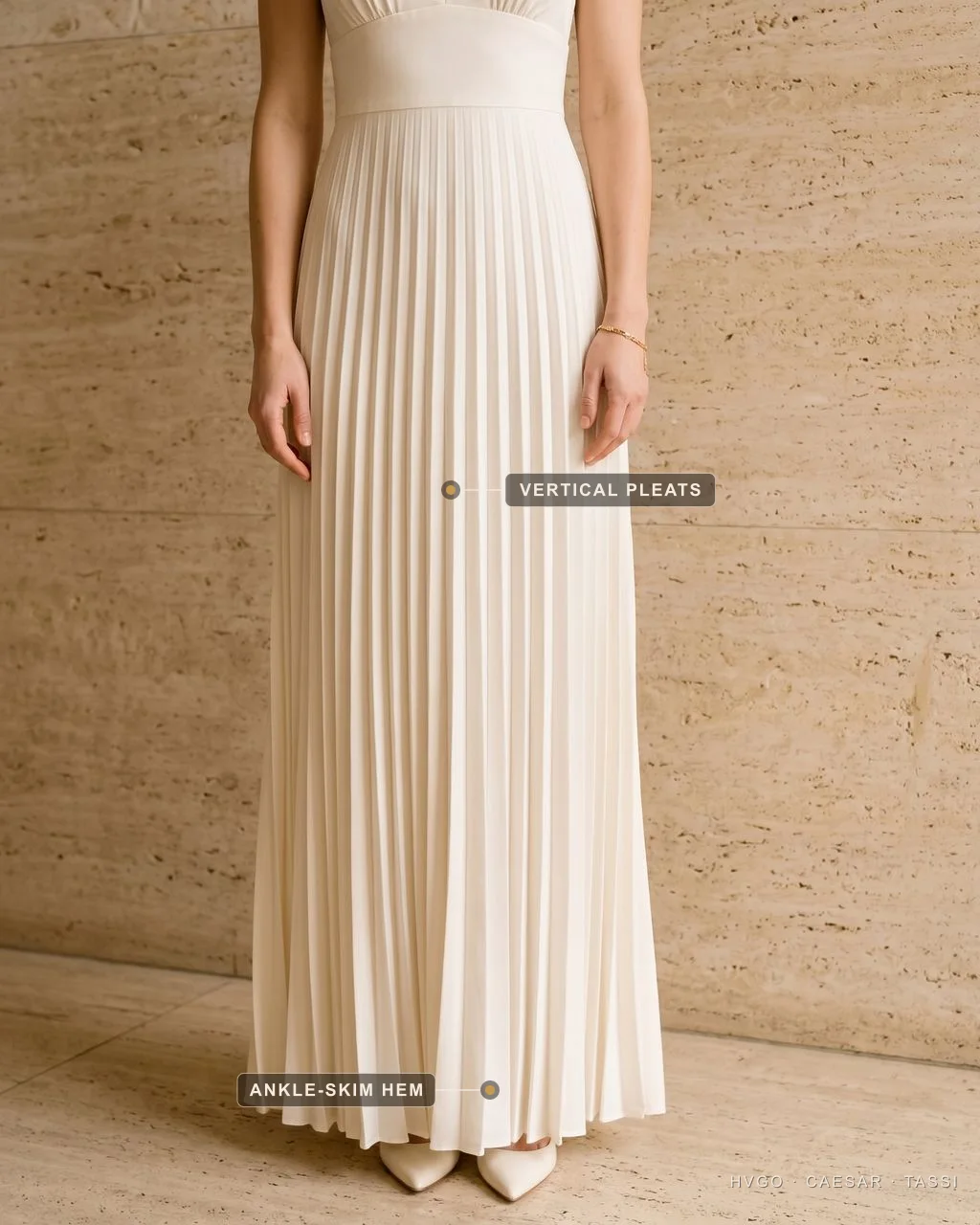
- Vertical pleats — fine repeating verticals draw the eye upward and add length the quiet way
- Ankle-skim hem — landing at the slim calf or just above the ankle elongates the leg, never mid-shin
#The natural waist, kept clean
A natural-waist seam still flatters petite when the proportion above and below stays balanced and any belt stays narrow and tonal. Compared to a one-inch self-fabric sash, a three-inch contrast belt is the most common petite-shortening mistake.
#Why a dropped or bulky waist works against you
A drop waist pushes the horizontal break below the natural waist and steals leg length, since the eye reads the lowest strong horizontal as where the leg begins. A barely-there drop with a fluid skirt can pass, but a structured 1920s drop waist with a hip detail is the silhouette to skip.
#Which silhouettes make a petite woman look taller?
A one-color column in a single continuous shade from shoulder to hem lengthens a petite frame more than any other silhouette. It draws an unbroken vertical with no color change to stop the eye.
| Silhouette | How it lengthens | Petite caution | Best for the petite figure |
|---|---|---|---|
| One-color column / sheath | Unbroken vertical, no break | Stiff fabric can read boxy | Hourglass, rectangle |
| Moderate A-line | Clean line from a high waist | Over-full skirt overwhelms | Pear, rectangle |
| Bias / draped column | Fluid line follows the body | Clings if fabric too thin | Hourglass, pear |
| Empire | Raised seam gifts leg length | Jutting bodice adds rib width | Most figures, esp. apple |
| Fishtail | Vertical column above the flare | Flare must release below calf | Hourglass with the height |
#The one-color column: the petite power move
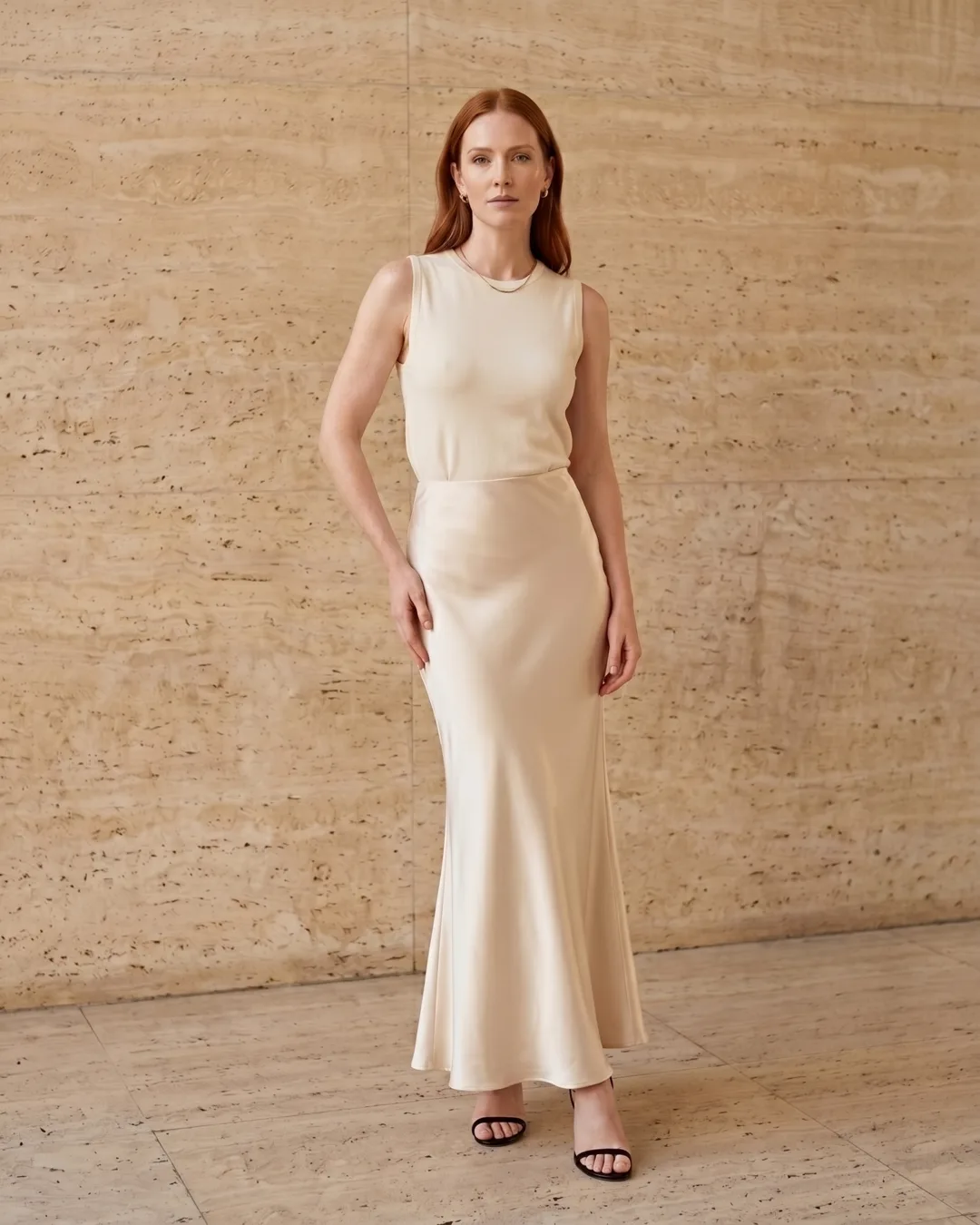
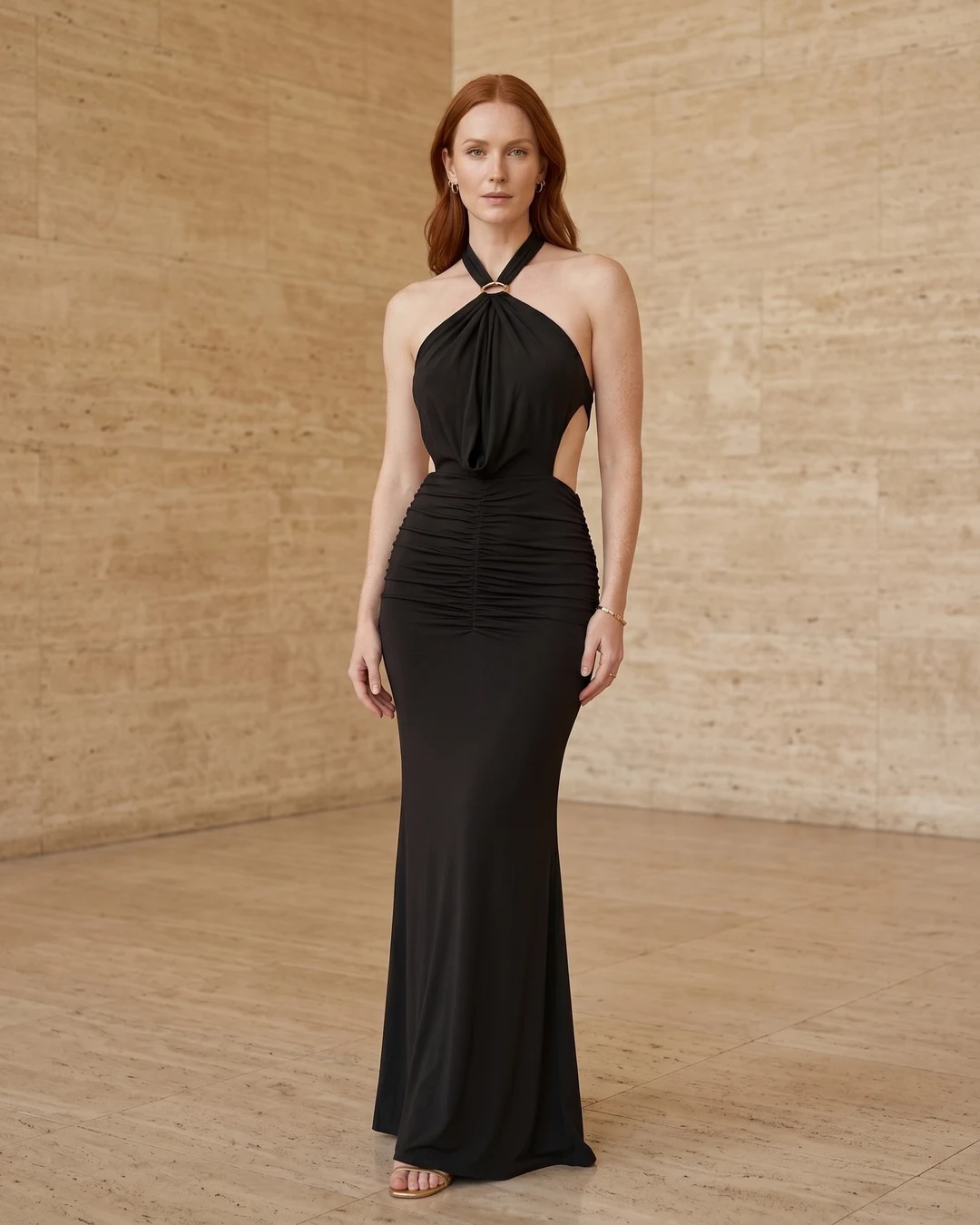
The single most lengthening silhouette is a column, sheath, or draped column in one color, because the unbroken shade gives the eye no place to stop. Tonal dressing, one color in varied texture, beats contrast, and the imperial palette offers ready-made tonal columns, from Cobalto navy to Basalt black to Avorio ivory. Beware the color-block version: a band of a second shade reintroduces the exact break the silhouette was chosen to erase.
#A-line and fit-and-flare, scaled down
An A-line lengthens by drawing a clean line from a high-ish waist, provided the skirt stays moderate enough not to overwhelm a small frame, as the Portia short-sleeve chiffon A-line shows. Volume is where it fails: a stiff, very full skirt adds width at the hem wider than the frame above it.
#Bias and fluid drape
A bias-cut or draped modal column falls in one long fluid line that follows the body and elongates without rigidity, the answer when a stiff column reads boxy; HCT cuts its satin on the bias and drapes its column gowns in modal for exactly this fall. Thin jersey on a curvier figure is the limit, where drape too fine clings at every curve.
#Fishtail and structured gowns, the petite caveat
A fishtail can flatter petite when the flare releases low, below the calf, leaving an unbroken column above it. The Calpurnia fishtail satin gown works on a petite-tall woman because the flare stays beneath the slim point, while the silhouette to approach with most care is a structured ball gown with a dropped waist and yards of skirt, which buries the leg.
#Necklines, sleeves and vertical lines that lengthen a petite frame
Open necklines, sleeves kept in scale, and any vertical detail all draw the eye upward and add length to a petite frame. A V-neck opens the décolletage; a fitted sleeve elongates the arm; a slit traces a line up.
#Necklines that lengthen the neck and frame the face
A V-neck, sweetheart, scoop, or halter opens the décolletage and draws a vertical line toward the face, lifting the eye's start so everything below reads longer. A high closed neckline does the opposite, foreshortening the frame by filling the space between collarbone and chin.
#Sleeve length and volume, kept in scale
Three-quarter and fitted long sleeves elongate the arm and keep the silhouette narrow. Compared to them, oversized puff sleeves and giant cuffs add width that overwhelms a small frame where it wants length.
#Vertical lines do the quiet lifting
Center-front seams, a slit, vertical pleats, a placket, and an open V all add a vertical the eye follows upward. The Claudia pleated-slit maxi stacks two of these, vertical pleats plus a leg-lengthening slit, so the line runs unbroken past the hem; overload is the trap, where three competing verticals clutter the line. The dress silhouettes guide shows how each cut carries its vertical.
#Scale: getting print, ruffle and embellishment right when you're petite
Print, ruffle, and embellishment flatter a petite frame only when their scale matches the frame, so small-to-medium detail sits in proportion. Oversized florals and huge ruffles read as wearing the dress rather than the dress fitting you.
#Match the scale of print and detail to your frame
Small-to-medium prints and fine detail sit in proportion on a short frame, while oversized florals and heavy embellishment overwhelm it: a 2-inch repeating motif registers as pattern, but a 10-inch single bloom swallows the bodice. One exception earns its place, though: a single placed motif, such as a fine vertical trail down one side, adds a vertical instead of a horizontal break.
#Fabric weight and drape on a small frame
Light, fluid fabrics fall close and long, while stiff or bulky fabrics add volume a small frame does not need. HCT's recycled chiffon over a clean lining, its bias-cut satin, its draped modal, and its matte crepe all skim and lengthen, whereas a stiff duchess satin builds volume that reads wider than the frame.
#How a petite woman should hem, heel and finish the look
A petite woman finishes the look by hemming the gown to her exact heel, choosing a heel and tonal pointed shoe, and deciding between a petite size and alterations. The longest line is only achieved with a tailor and a chosen shoe.
#Hem the gown to your heel, not the rack
A floor-length gown should be hemmed to the exact heel you will wear so it skims the floor without pooling, because the rack length is cut for a fit model's height. A barefoot beach ceremony only shifts the target, where you set the hem to the flat by the same rule.
#Heel height and a tonal shoe extend the leg
A heel, even a modest block or kitten, plus a pointed toe adds length to the leg line, and a nude or tonal pump continues the leg uninterrupted. Compared to that pump, a black ankle-strap sandal under a pale hem draws a hard line at the ankle where the leg should keep going.
#Petite sizing vs. tailoring a regular dress
A true petite size range wins when many built-in proportions need scaling at once, whereas tailoring a regular dress wins when the main fault is length and a tailor hems and takes up the straps.
| Decision factor | Choose petite size | Choose alterations on regular |
|---|---|---|
| Main issue is overall length | Either works | Tailor hems to your heel |
| Sleeve and waist-seam height both off | Petite scales all at once | Multiple alterations add up |
| Detail placement (pockets, seams) | Petite places to scale | Hard to relocate |
| Occasion gown, length-only fix | Petite if available | A hem and strap take-up suffices |
| Budget for alterations | No alteration cost | A hem plus straps is realistic |
A realistic alterations budget covers a hem and a strap take-up; a full bodice re-cut rarely pays off against a true petite size.
#How Hugo Caesar Tassi cuts dresses for a petite woman
Hugo Caesar Tassi cuts for petite by the rule of one high break and one long line: a single seam at or above the natural waist, a hem at the slim calf or to the floor, and one continuous color. The house, designed in Roma and founded in 2004, builds the proportion into the cut.
#The house petite proportion rule
The rule is repeatable: place one seam at or above the natural waist, land the hem at the slimmest calf or fully to the floor (never mid-shin), and let one continuous color carry the eye from shoulder to hem. The column line is the Roman column made wearable, and the imperial palette supplies the single shade. Where competitors leave "wear vertical lines" abstract, this formula gives three decisions you can measure on yourself.
#The dresses we steer petite clients to
Each HCT dress chosen for petite clients honors one high break and one long line, and each suits a different figure. The Vipsania draped modal column and the Tullia pleated column are one-color fluid columns that read tall, best for a petite hourglass or rectangle. The Livilla floral-print chiffon midi sets a fine-scale print at a slim-calf landing, the Claudia pleated-slit maxi pairs vertical pleats with a slit for a petite pear, and the Portia short-sleeve chiffon A-line gives a moderate flare, the right fit if you carry width at the hip. Every cut is fully lined with a concealed zip, in sizes S–3XL (EU 34–44), and the house publishes each model's height near 175 cm.
#Your petite occasion-dress checklist
Run this seven-point checklist before you buy any occasion dress as a petite woman. It compresses every rule above into one pass.
#The quick recap
- Read your body shape first, then layer the petite lengthening rules on top.
- Keep waist seams high, or natural and narrow and tonal.
- Hem at the slim part of the calf or to the floor, never mid-shin.
- Favor a one-color column or a moderate A-line.
- Pair a lengthening neckline with a print scaled to your frame.
- Hem the gown to the exact heel you will wear.
- Finish with a tonal pointed shoe that continues the leg line.
#Where to go next
Confirm your figure, settle the length question, then shop, because the petite rules sit on top of your shape. The body shape guides collect the per-shape advice this page builds on, and the rectangle shape guide is the one to read when your bust, waist, and hip run close.
#Frequently asked questions
What kind of dresses look best on petite women?
Dresses that look best on petite women are one-color columns or moderate A-lines with a high or natural-but-narrow waist, because an unbroken vertical and a single high break lengthen a short frame. Keep the hem at the slim part of the calf or to the floor, never mid-shin.
Can petite women wear maxi dresses?
Petite women can wear maxi dresses, and the "no maxis" rule is a myth. A maxi flatters when it falls in one clean vertical from a high or empire waist and is hemmed to skim the floor in the heel you will wear. The real enemy is fabric pooling at the hem, not the length.
Is a midi or a maxi better for a petite woman?
A midi or a maxi can both suit a petite woman; what matters is where the hem lands. A maxi reads long when hemmed to the floor. A midi flatters only at the slim calf or just above the ankle, whereas a mid-shin midi is the one length that shortens a petite frame.
Where should a dress hem hit if you're short?
A dress hem should hit the slimmest part of your calf, just below the calf muscle, or fall all the way to the floor. Avoid mid-shin and the widest point of the calf, where a horizontal hem visually cuts the leg.
How can I look taller in a dress?
You look taller in a dress by keeping one long, unbroken vertical line. Choose a single-color silhouette, place the waist seam high, open the neckline with a V, land the hem at the slim calf or the floor, and finish with a heel and a tonal pointed shoe.
Is petite a body shape?
Petite is not a body shape; it describes height and frame, usually 5'3" (160 cm) and under. You still have a body shape, whether petite hourglass, petite pear, or petite rectangle, and you layer the petite lengthening rules on top of your shape's silhouette advice.
Find your one long line in the occasion dresses edit, or start with the slim-calf and ankle-length midi dresses built to read tall.
More Body Shape guides
Best Dresses for an Apple Shape
The apple-shape dresses that skim a fuller middle with cut, not shapewear: empire seams, bias drape and fluid crepe from the Roman atelier of HCT.
See the apple-shape editElegant Dresses for Women Over 50
Occasion dresses that flatter over 50 — a three-quarter sleeve, soft V neck and crepe that skims. The age-positive guide to weddings and evenings.
Dressing well over 50Best Dresses for an Hourglass Figure
The silhouettes, fabrics and necklines that trace an hourglass figure instead of hiding it, plus the atelier fluid-weight rule and HCT gowns to shop.
See the hourglass editHow to Find Your Body Shape
Take three measurements and learn your body shape for sure with the atelier ratio method and exact thresholds, not vague compare-to-fruit guesswork.
Find your body shapeHow to Dress an Inverted Triangle Body Shape
Open the neckline into a soft V to narrow broad shoulders, then add a skirt-width of pleated-chiffon volume at the hip until your shape reads balanced.
Style the inverted triangleBest Occasion Dresses for a Pear Shape
The shapes, necklines and fabrics that balance a pear shape: A-line chiffon that skims the hip and a neckline that lifts the eye one body-third up.
See the pear-shape edit