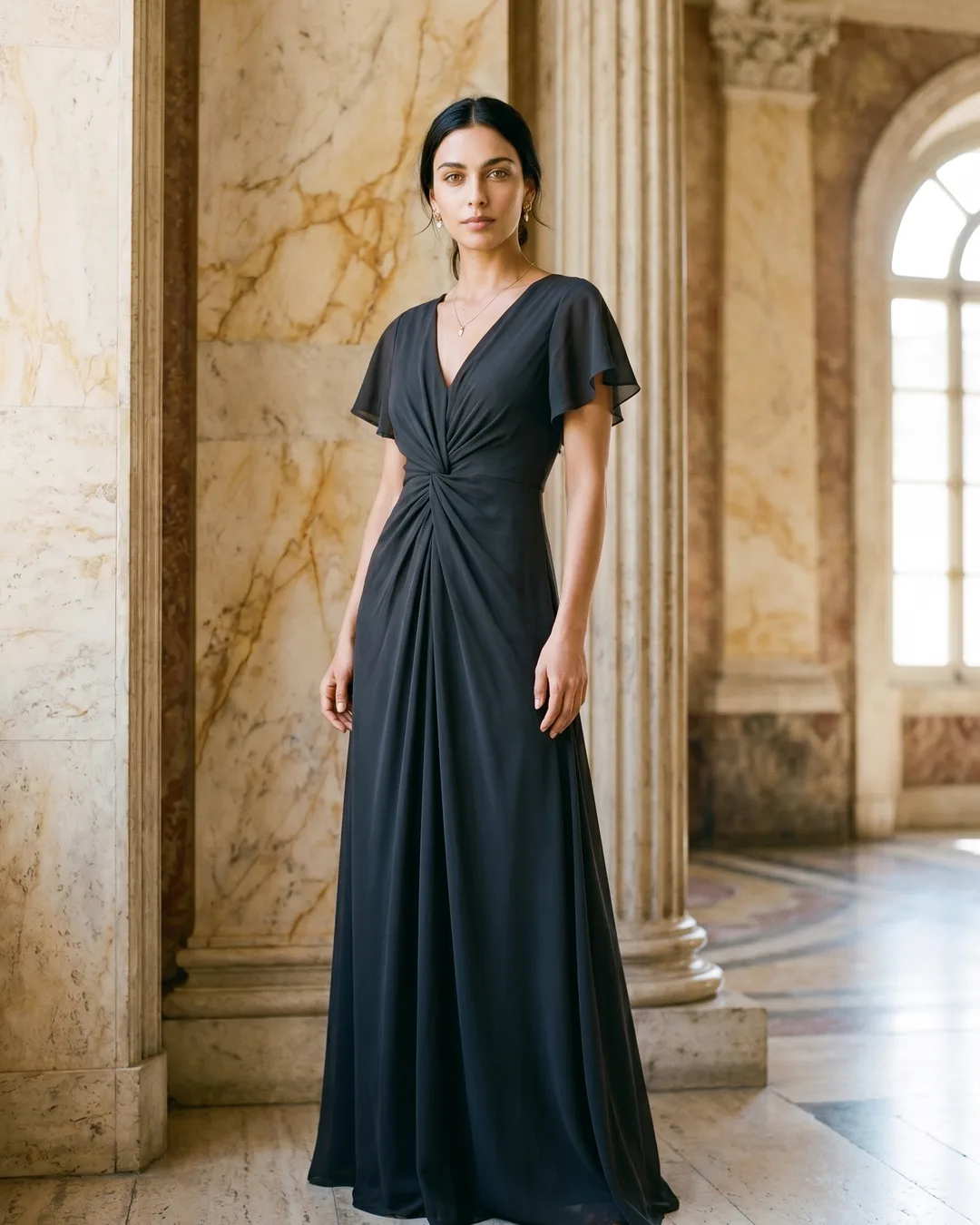
How to Find Your Body Shape: An Atelier Method in Three Measurements
Take three measurements and learn your body shape for sure with the atelier ratio method and exact thresholds, not vague compare-to-fruit guesswork.
On this page
To find your body shape, take three numbers and read two ratios: your bust, your natural waist and your full hip. Compare bust to hip, then waist to the larger of the two. Those comparisons name your shape, whether hourglass, pear, apple, rectangle or inverted triangle, with the same arithmetic a dressmaker runs before cutting a seam. No fruit chart, no squinting in the mirror, no guesswork.
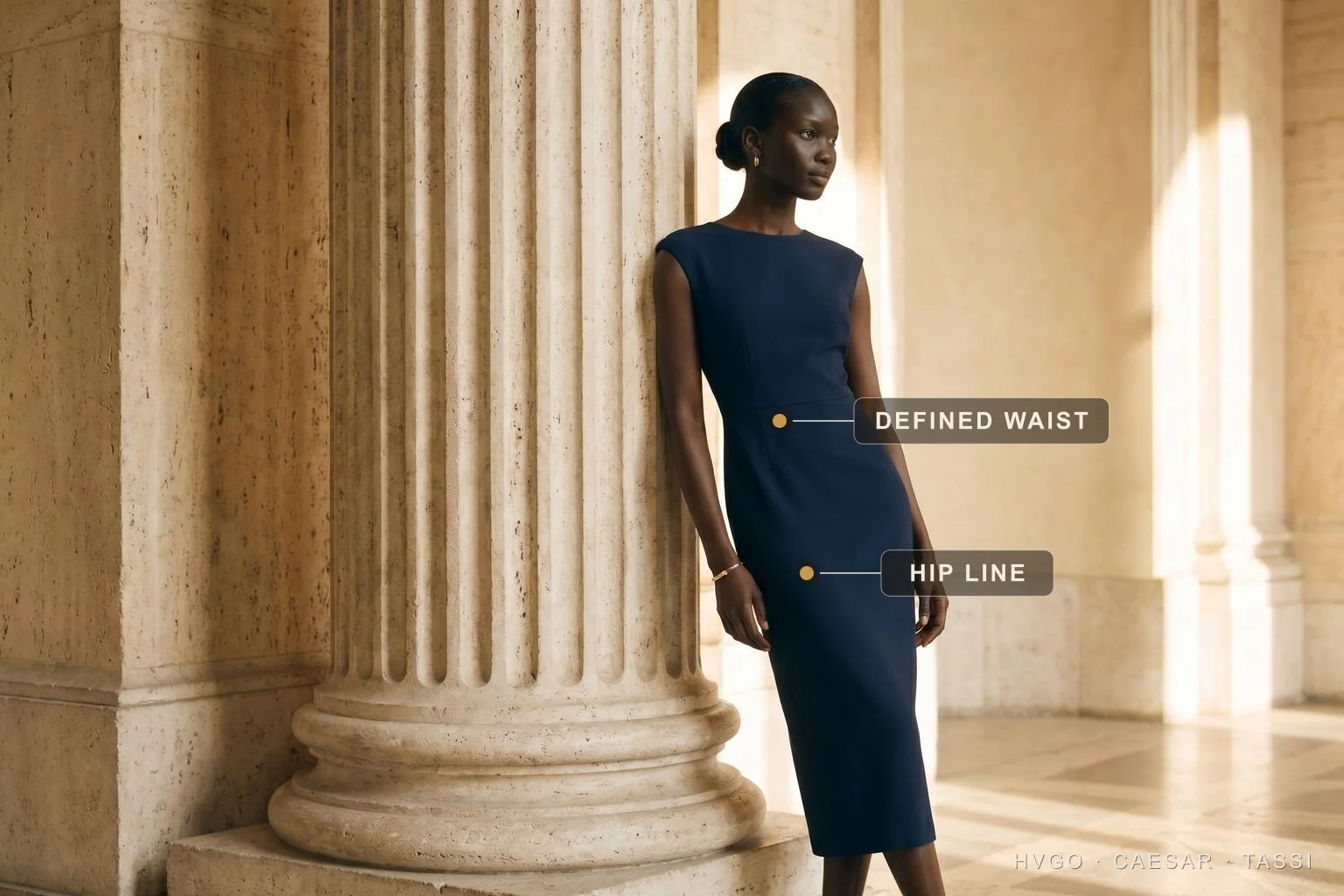
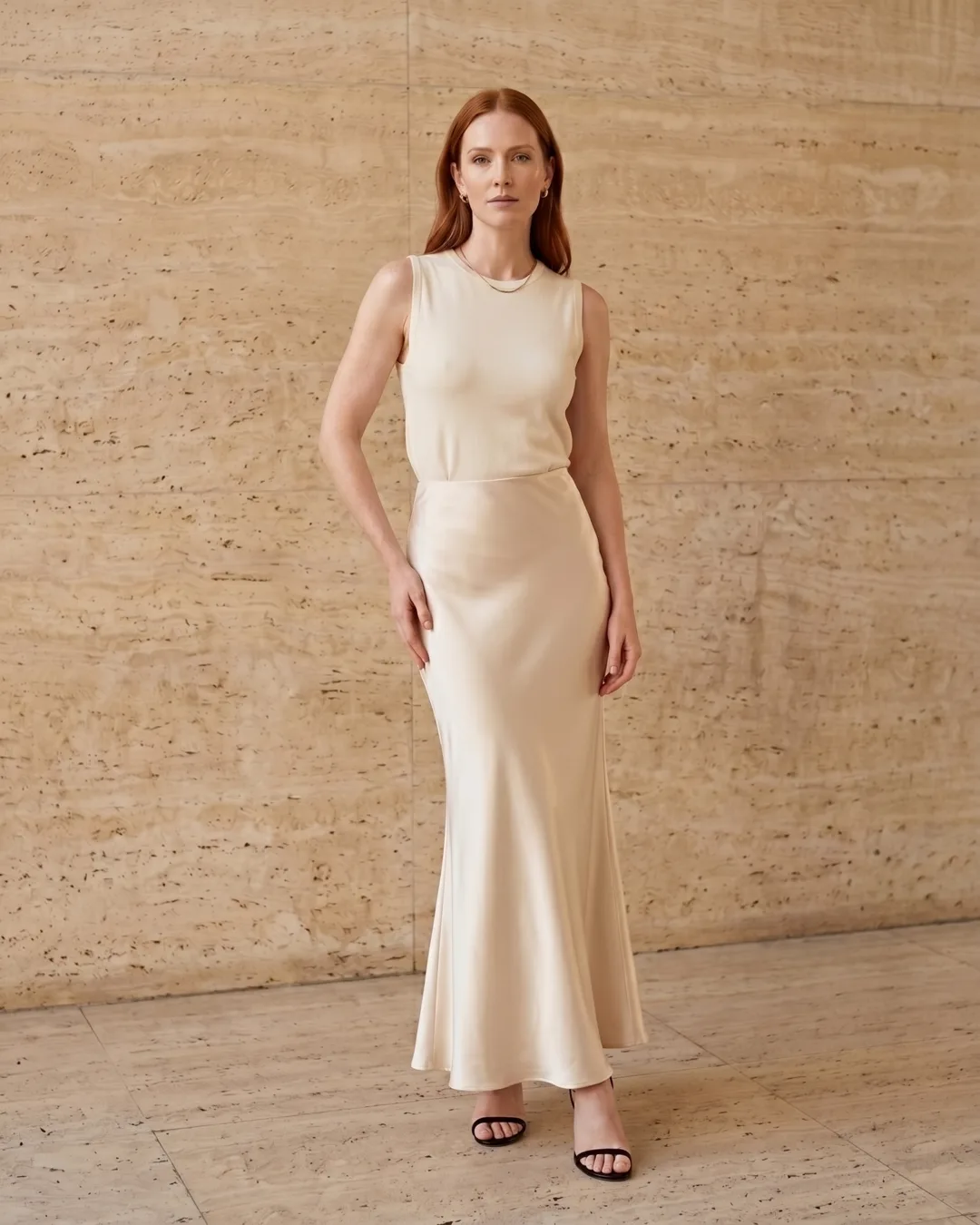
- Defined waist — where the dress nips in marks the narrowest point of the torso, the natural waist the tape reads
- Hip line — the smooth skim over the seat marks the full hip, the lower of the two width poles
Measure and name your shape
Three numbers, two comparisons, in one sitting.
- Set up once, then don't move Strip to fine underwear, stand bare-footed and relaxed, and keep a soft cloth tape, a mirror and a pen handy. Pick inches or centimetres and use that one unit for all three numbers.
- Measure your full bust Wrap the tape around the fullest part of the chest, level across the back and parallel to the floor, arms down. Snug, not compressing. Read it twice; a tape that rides up at the back undercounts a fuller bust.
- Find and measure your natural waist Bend gently to one side and the crease that forms is your natural waist, usually an inch or two above the navel, never the trouser line. Wrap it level with one finger of ease and record.
- Measure your full hip Feet together, tape around the widest part of seat and hips, level all the way round. Use the mirror to keep the back level. This full-hip number is the one that goes into the ratio.
- Run the two comparisons Balance first: hips more than ~5% wider than bust reads pear, bust/shoulders wider reads inverted triangle, within ~5% reads balanced. Then waist against your larger pole: ~25%+ smaller is a defined waist (hourglass), within ~25% is rectangle, equal or larger is apple.
- Read your shape into one focal point Name your shape, then let the house cut to it: a pear takes an Aemilia-style A-line chiffon to answer wider hips, an hourglass or apple a Vipsania-style draped modal column that skims the waist rather than cinching it.
- Don't pull the tape tight enough to dent the skin, or suck in your stomach
- Don't measure over a sweater or jeans, which add phantom inches
- Don't read the waist at your trouser line instead of the natural waist
- Don't mix inches and centimetres across the three numbers
#What is a body shape, and why measure for it?
A body shape is the proportion between your bust, waist and hips, how they relate to one another rather than how large or small you are. Two women three dress sizes apart can carry the identical shape, and the same gown silhouette suits them both. A label measures volume; the ratio between three measurements measures geometry. Hugo Caesar Tassi, a women's occasionwear house designed in Roma, reads that geometry first, because a dress is cut to a woman's lines, never to her store size.
This page is the doorway into the whole body-shape silo. Settle your shape here, and every per-shape guide downstream tells you which cut to wear.
#Shape is proportion, not size
Body shape describes the relationship between three widths; dress size describes one circumference at a time. A woman at EU 36 and a woman at EU 44 both read as pears when their hips sit wider than their bust by the same margin, and the A-line skirt that balances one balances the other. The proportions hold as the inches grow, so a shape diagnosis outlasts a weight change while a size on a tag does not.
One exception bends this rule: extreme bust volume. A slim-framed woman with a full cup can measure as an hourglass while her shoulders and hips read straight, so the bust circumference, not the rib cage, is what the ratio sees.
#Why a tape measure beats the mirror
The eye is the least reliable instrument you own for this. Clothing cut, posture, a belt, the light over your shoulder: each rewrites what the mirror shows, and a flattering read is not a true one. A confident diagnosis lets a woman shop well, whereas a hopeful one sends the wrong silhouette to her door.
Consider a woman who has dressed as a rectangle for years because tailored jackets flattened her waist. Measured bare over fine underwear, her waist clears the nip threshold and she is an hourglass in hiding. Unlike the mirror, the tape holds no opinion.
#Which three measurements reveal your body shape?
Three circumferences classify any figure: full bust, natural waist and full hip, with shoulder width as an optional fourth tiebreaker. Each captures a different zone the others miss. The bust sets the top width, the waist sets the definition, and the hip sets the bottom width. A dressmaker needs nothing more to file your shape correctly.
#Bust, waist and hips: the three numbers that matter
Full bust is the circumference around the fullest part of the chest; natural waist is the narrowest point of the torso; full hip is the widest point of the seat and hips. Bust and hip are the two width poles, and the waist tells you how sharply the body draws in between them. Shoulder width earns its keep when bust and hip read close: it separates a pear (narrow up top) from an inverted triangle (broad up top) when the bust circumference alone is ambiguous.
The counter-case is the broad-shouldered athlete whose bust reads modest. Her shoulders push her toward inverted triangle even though the bust tape reads small, the one moment the optional fourth number changes the verdict.
#Tools and setup: tape, mirror, fine underwear, bare feet
A flexible cloth or sewing tape is the one correct tool; a metal builder's tape cannot follow a curve and reads short across a bust or hip. Set up before you wrap, and keep the conditions identical for all three numbers:
- A soft cloth tape measure marked in both inches and centimeters
- A full-length mirror, or a friend to read the back of the tape
- Fine underwear or close-fitting clothes, never a sweater or jeans
- Bare feet, standing relaxed, breathing normally
- A pen and paper to record each number twice
Stay in one unit, inches or centimeters, for all three, since the ratio is a comparison and mixing units corrupts it. When you measure alone, the full hip is the hardest number to read level at the back, so the mirror is not optional there even when it is elsewhere.
#How to measure your body shape, step by step
Wrap the tape level and snug with one finger of slack, take each of the three numbers in turn, and record both inches and centimeters as you go. The discipline is the same for all three: parallel to the floor, snug without compressing, arms relaxed. A sloped tape or a held breath corrupts a reading and misfiles a shape.
#How to measure your bust
Pass the tape around the fullest part of your bust, level across the back and parallel to the floor, arms down at your sides. Keep it snug but not compressing, and record the full-bust number twice to confirm. A tape that rides up at the back reads small, the single most common reason a fuller bust gets undercounted. Choose the band-on-the-shoulder-blades line and hold it for both readings, since a tape that climbs half an inch hands you two different shapes.
#How to find and measure your natural waist
Your natural waist is the narrowest point of your torso, usually an inch or two above the navel, not the line where your trousers sit. Find it by bending gently to one side; the crease that forms is your natural waist. Wrap the tape there, level and snug, with one finger of ease, and record. The bend-sideways trick beats guessing, because the narrowest point sits higher than most women expect and lower than a high-waisted skirt suggests.
#How to measure your hips (high hip vs full hip)
Stand with your feet together and pass the tape around the widest part of your seat and hips, level all the way around; this full-hip number is your primary hip measurement and the one that goes into the ratio. Take a second reading across the upper hip, over the top of the hip bones, and call it the high hip. That high-hip number flags a fuller upper thigh marking a true pear, so it is context, not the input.
#Common measuring mistakes to avoid
Most mis-diagnoses trace to one of a handful of tape errors, and a wrong waist number misfiles more women than any other slip. Watch for these:
- Pulling the tape tight enough to dent the skin instead of resting it snug
- Letting the tape slope down at the back instead of holding it level
- Sucking in the stomach rather than breathing normally
- Measuring over bulky clothing that adds phantom inches
- Reading the waist at the trouser line instead of the natural waist
A waist held tight to 27 inches reads a full size narrower than the 29 inches you actually carry, and a too-narrow waist turns a rectangle into a false hourglass. Measure relaxed, or the ratio lies.
#How do shoulder, waist and hip ratios define each body shape?
Convert the three numbers into two comparisons, bust against hip and then waist against the larger of the two, and the pair of results names your shape. The first comparison places your width balance; the second reads your waist definition. This is the atelier ratio rule, the arithmetic a body-shape calculator hides behind a button.
#The atelier ratio rule (with exact thresholds)
Run two comparisons against fixed thresholds. First, balance: hips more than about 5% wider than your bust and shoulders read bottom-heavy (a pear); bust and shoulders more than about 5% wider than your hips read top-heavy (an inverted triangle); bust and hips within about 5% of each other read balanced. Second, waist definition, measured against the larger of your bust and hip.
| Comparison | Threshold | Reads as |
|---|---|---|
| Hips wider than bust/shoulders | more than ~5% wider | Pear (bottom-heavy) |
| Bust/shoulders wider than hips | more than ~5% wider | Inverted triangle (top-heavy) |
| Bust and hips close | within ~5% | Balanced |
| Waist vs. larger of bust/hip | ~25% or more smaller | Defined waist (hourglass) |
| Waist vs. bust and hips | within ~25% | Straight (rectangle) |
| Waist vs. bust and hips | equal or larger | Apple (round) |
The two comparisons work in order: balance first, then waist. A figure can be balanced and defined (hourglass) or balanced and straight (rectangle), so neither comparison alone settles the shape.
#A worked example: run your own numbers
Take a woman measuring 36-28-39 inches and walk the rule. Balance first: hips at 39 against a bust at 36 is a 3-inch gap, about 8% wider, past the 5% line, so she reads bottom-heavy. Waist next: her larger pole is the 39-inch hip, and 25% of 39 is roughly 10 inches, so a defined waist sits near 29 inches or less; her 28-inch waist clears it. Balanced-toward-hips plus a defined waist makes her a pear with a strong waist, not a true hourglass.
Now change one number. Hold bust and waist, drop the hip to 37: the gap to the bust falls under 5%, she reads balanced, and the cleared waist makes her an hourglass. One inch at the hip decides it, which is why the tape beats the eye.
#Which body shape are you: hourglass, rectangle, pear, apple or inverted triangle?
Five shapes cover almost every figure, each defined by where width sits and whether the waist nips in. Match your two ratio results to the definitions, and the borderline rule below settles any tie. Petite is a height variable layered on top, not a sixth shape.
#The five shapes, defined by their proportions
Each shape is a one-line read in measurement terms:
- Hourglass: bust and hip balanced within ~5%, waist clearly defined (25%+ nip)
- Pear (triangle): hips more than ~5% wider than the bust, waist defined-ish
- Inverted triangle: bust or shoulders more than ~5% wider than the hips
- Rectangle (straight): bust, waist and hip close, little waist nip
- Apple (round): fuller bust and midsection, waist the widest or least-defined point
Each shape owns its own downstream guide, so once you name yours you read only the page written for it. Start from the dressing for your figure pillar to see how all five connect.
#The borderline cases, settled
Three confusions account for most ties, and each has a single deciding question. Hourglass versus pear comes down to balance: bust and hips within 5% makes you an hourglass, and hips winning by more makes you a pear, even with a sharp waist. Rectangle versus hourglass comes down to the waist clearing the 25% nip. Apple versus inverted triangle comes down to where the width sits, midsection meaning apple and shoulders meaning inverted triangle.
The edge case worth naming: a pear with a very defined waist sometimes wants to call herself an hourglass. The rule refuses the upgrade, because the balance comparison runs before the waist comparison, and unbalanced hips settle it first. See the full read in the best dresses for a pear shape guide.
#Where petite and height fit in
Petite is a height bracket, typically 5'3" (160 cm) and under, not a separate shape. A short woman is a petite hourglass or a petite rectangle; the proportions are read the same way at any height, since the ratio compares your own three numbers to each other, not to a height standard. A woman of 5'10" and a woman of 5'1" with identical 36-28-39 numbers are both pears wanting the same balancing skirt cut to a different length.
#Should you trust a body shape calculator?
Trust a calculator only as far as the three numbers you feed it, because it applies the same fixed ratio cutoffs this page teaches and nothing more. The math is sound; the inputs are the risk. A calculator cannot see a tape you held at the trouser line instead of the natural waist.
#What a calculator actually does
An online body shape calculator takes your bust, waist and hip figures and runs them against preset percentage thresholds, the identical comparison you now do by hand. It is the ratio rule wearing a form field, reaching the same verdict as a careful hand measurement when the numbers are right and the same wrong verdict when they are not.
#Why measuring yourself wins
Measuring by hand wins because you control the inputs the calculator only receives. A form cannot catch a waist read two inches too low, a high hip mistaken for a full hip, or a bust band counted instead of the bust itself. Doing the arithmetic yourself means you know why you are a given shape, so you can re-run it confidently after a weight change or a pregnancy. To turn the same numbers into a fit, the how to measure your dress size guide picks up next.
#How Hugo Caesar Tassi reads your body shape into a dress
Once your shape is named, the house cuts a dress to follow your longest line and skim across exactly one focal point, never compressing it. That single-focal-point rule, the founder's atelier principle of la bella figura (the beautiful line), anchors the whole silo. Shape diagnosis is only the input; the silhouette is the output.
#From three numbers to one focal point
The house design lens reads your three numbers into a single decision: where the eye should land. A dress is then cut to draw to that one focal point and skim everywhere else, because one statement per outfit is the elegance doctrine the atelier works to. A pear's focal point sits up top to balance the hips; an inverted triangle's sits low to balance the shoulders.
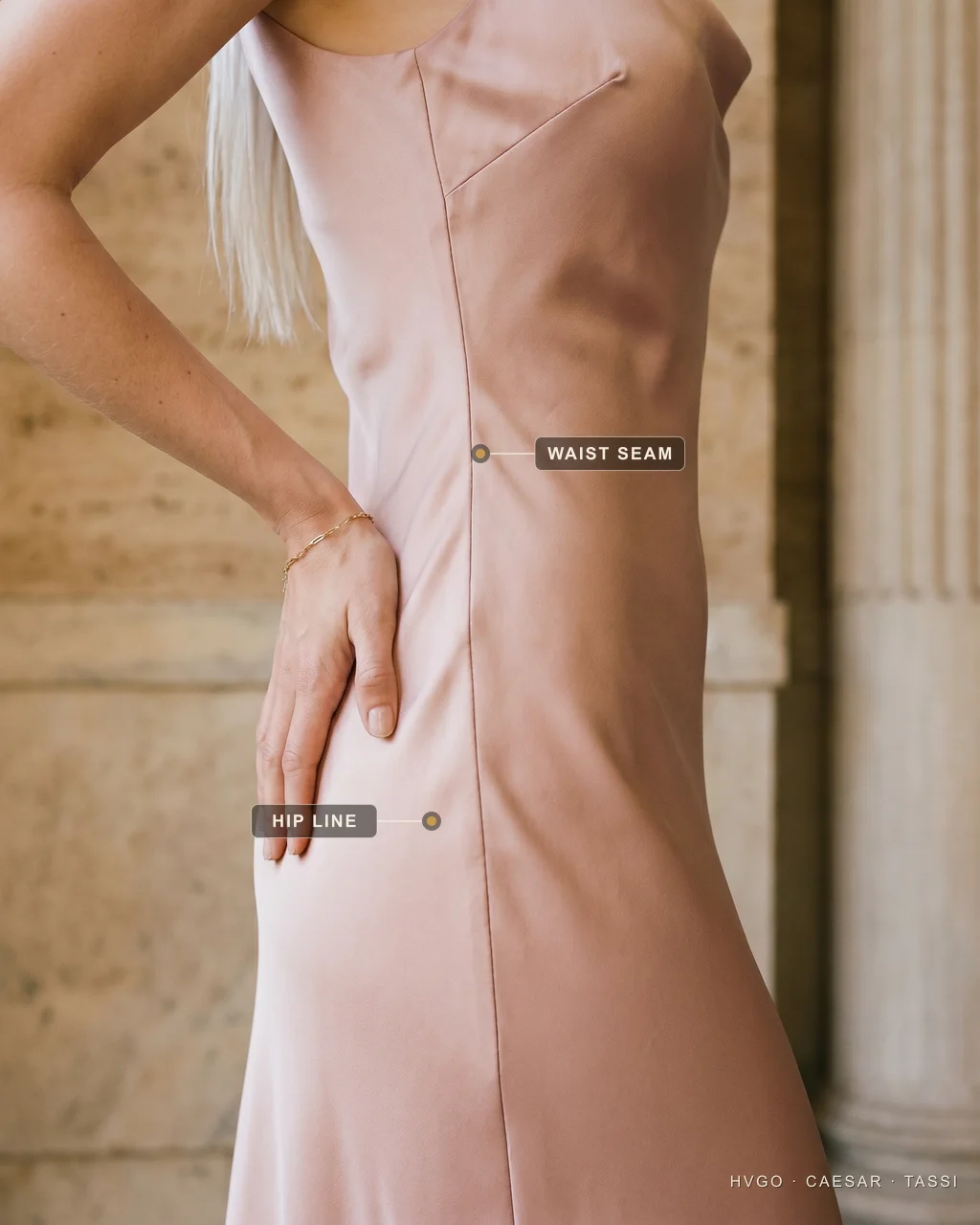
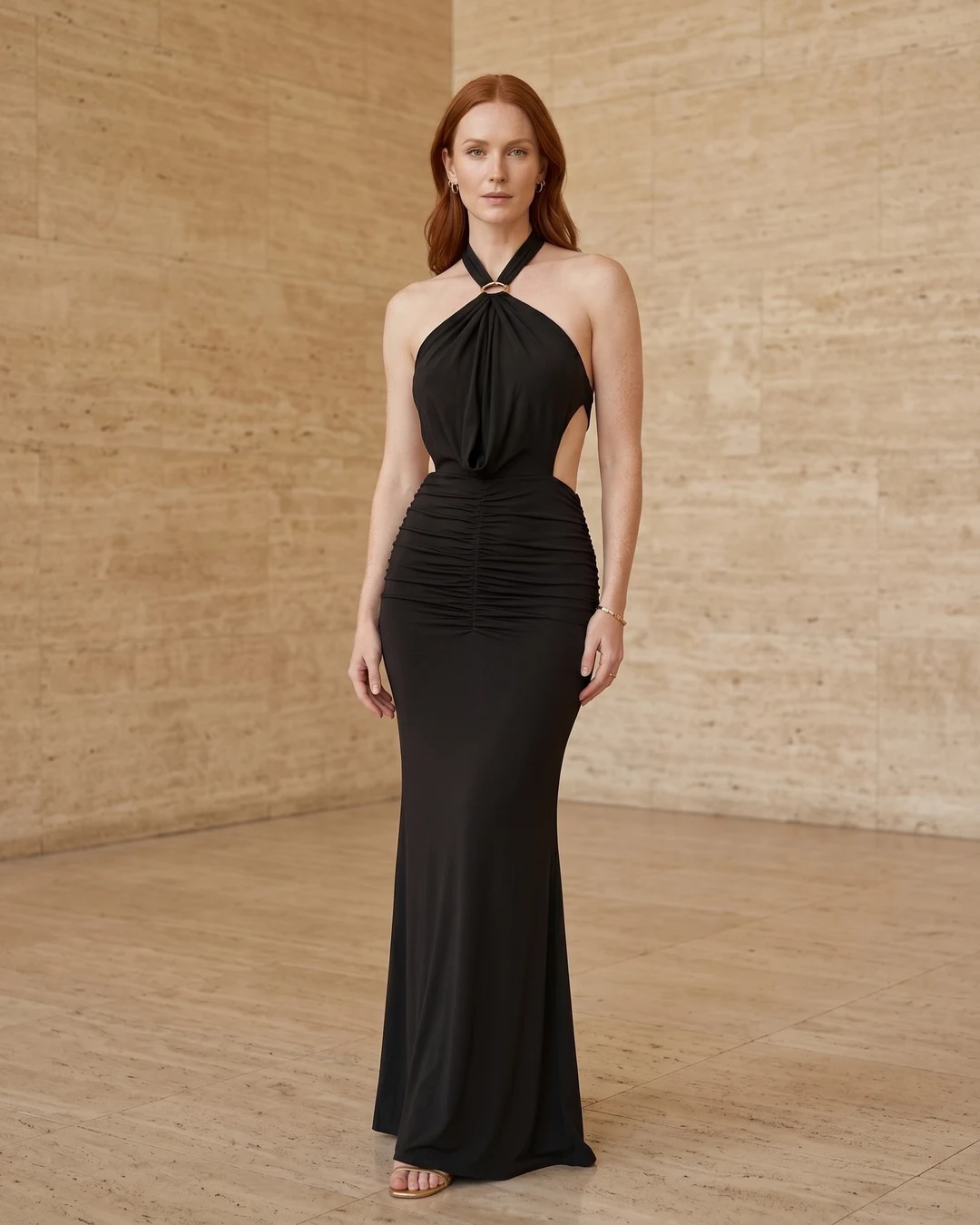
- Waist seam — the seam draws in at the narrowest point of the torso, tracing the natural waist a tape would find
- Hip line — below the waist the fabric releases and skims the full hip, the body's lower width pole
#Matching shape to silhouette and fabric
Each shape steers toward a silhouette and a fabric weight, so pick the cut your diagnosis points to rather than the one on the model. The table below is the at-a-glance handoff to the per-shape guides where the full recommendation lives.
| Shape | House silhouette | Fabric note |
|---|---|---|
| Pear | A-line, full skirt | Recycled chiffon over lining |
| Hourglass | Bias-draped column | Bias-cut satin or modal |
| Apple | Draped column, empire | Fluid modal, knife-pleated chiffon |
| Rectangle | Fit-and-flare or belted | Structured matte crepe |
| Inverted triangle | A-line, widened hem | Chiffon to add lower volume |
The Aemilia A-line chiffon maxi shows the pear strategy in cloth, where the skirt's volume answers wider hips; the Vipsania draped modal column shows the hourglass and apple strategy, where the drape skims a defined or fuller midsection rather than cinching it. For the full set, read best dresses for an hourglass figure, best dresses for an apple shape and best dresses for a rectangle shape.
#You know your body shape — what now?
With your shape settled, open the one guide written for it, then convert the same three numbers into a size before you shop. The diagnosis routes you; it does not dress you. Two short steps stand between your measurements and a dress that fits.
#Your shape, your guide
Map your verdict to your guide and read only that one. Balanced with a defined waist sends you to hourglass; hips wider sends you to pear; shoulders wider sends you to inverted triangle; close all around sends you to rectangle; a fuller midsection sends you to apple. Choose the guide your two ratios point to, not the one you wish you measured, since the cut that flatters follows the proportions you actually carry. At 5'3" or under, read your shape as its petite variant, where each guide names the cuts, necklines and hems the house recommends for that proportion.
#Turn measurements into a dress that fits
Your shape decides the silhouette; your inches decide the size. Use the same bust, waist and hip numbers against the size chart, then learn the cut names from the dress silhouettes guide so you recognize the right shape on sight before you shop. You measured once; everything downstream reuses those three numbers.
#Frequently asked questions
What are the three measurements I need to find my body shape?
The three measurements you need to find your body shape are your full bust, your natural waist and your full hip. Take the bust around the fullest part, the waist at the narrowest point of your torso (found by bending sideways), and the hip at the widest point of your hips and seat. Compared as ratios, those three numbers name your shape.
How do I find my natural waist to measure it?
You find your natural waist by bending gently to one side, where the crease that forms marks the narrowest part of your torso. It usually sits an inch or two above the navel, not at your trouser line. Measure there, level and snug, or you will misread your shape.
What are the five female body shapes?
The five female body shapes are hourglass, pear, inverted triangle, rectangle and apple. Hourglass is balanced bust and hips with a defined waist; pear has hips wider than the bust; inverted triangle has shoulders or bust wider than the hips; rectangle has bust, waist and hips close in measurement; apple has a fuller bust and midsection. Petite refers to height, not a separate shape.
How do I know if I'm an hourglass or a pear?
You tell an hourglass from a pear by comparing your bust to your hips first. If they sit within about 5% of each other and your waist is clearly nipped, you are an hourglass. If your hips measure more than about 5% wider than your bust, you are a pear, even with a defined waist.
Is a body shape calculator accurate?
A body shape calculator is accurate only to the degree your typed-in measurements are. It applies fixed ratio cutoffs to the bust, waist and hip numbers you enter, with no way to see a misplaced waist or a high-hip reading. Measuring by hand lets you catch the errors a calculator cannot.
Does my body shape change with weight or age?
Your body shape stays fairly stable with weight or age, even as your absolute measurements change. Where you carry width relative to your waist usually holds, so the ratios move together rather than reshaping you. Re-measure after a significant change and re-run the rule to confirm.
Now that the tape has settled your shape for certain, open your exact guide for the silhouettes the house recommends, then turn the same three numbers into the right size before you shop the occasion dresses edit.
More Body Shape guides
Best Dresses for an Apple Shape
The apple-shape dresses that skim a fuller middle with cut, not shapewear: empire seams, bias drape and fluid crepe from the Roman atelier of HCT.
See the apple-shape editElegant Dresses for Women Over 50
Occasion dresses that flatter over 50 — a three-quarter sleeve, soft V neck and crepe that skims. The age-positive guide to weddings and evenings.
Dressing well over 50Best Dresses for an Hourglass Figure
The silhouettes, fabrics and necklines that trace an hourglass figure instead of hiding it, plus the atelier fluid-weight rule and HCT gowns to shop.
See the hourglass editHow to Dress an Inverted Triangle Body Shape
Open the neckline into a soft V to narrow broad shoulders, then add a skirt-width of pleated-chiffon volume at the hip until your shape reads balanced.
Style the inverted triangleBest Occasion Dresses for a Pear Shape
The shapes, necklines and fabrics that balance a pear shape: A-line chiffon that skims the hip and a neckline that lifts the eye one body-third up.
See the pear-shape editThe Petite Woman's Guide to Occasion Dresses
The lengths, waistlines and silhouettes that lengthen a petite frame, with the exact hem rule and the one-color column that reads taller.
See the petite edit