How to Dress an Inverted Triangle Body Shape: Soften the Top, Build the Hip
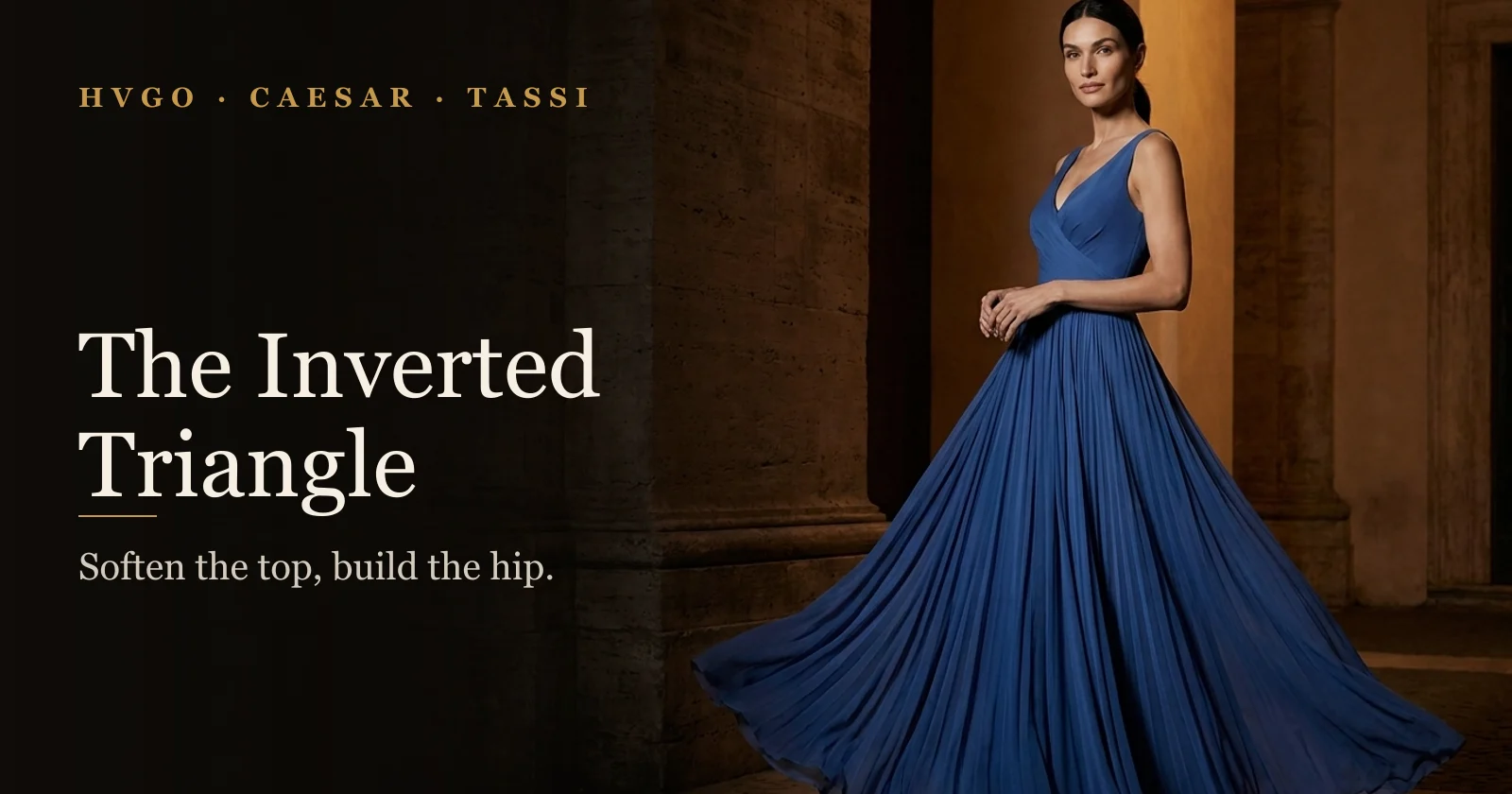
Open the neckline into a soft V to narrow broad shoulders, then add a skirt-width of pleated-chiffon volume at the hip until your shape reads balanced.
On this page
To dress an inverted triangle, do two things at once: narrow the shoulder line with a soft open neckline, and rebuild width at the hip with a skirt that flares. Your shoulders or bust read wider than your hips. The fix balances the halves rather than hiding either. This guide names the necklines, silhouettes and fabrics that do both jobs, then points to the Hugo Caesar Tassi dresses cut to make it easy.
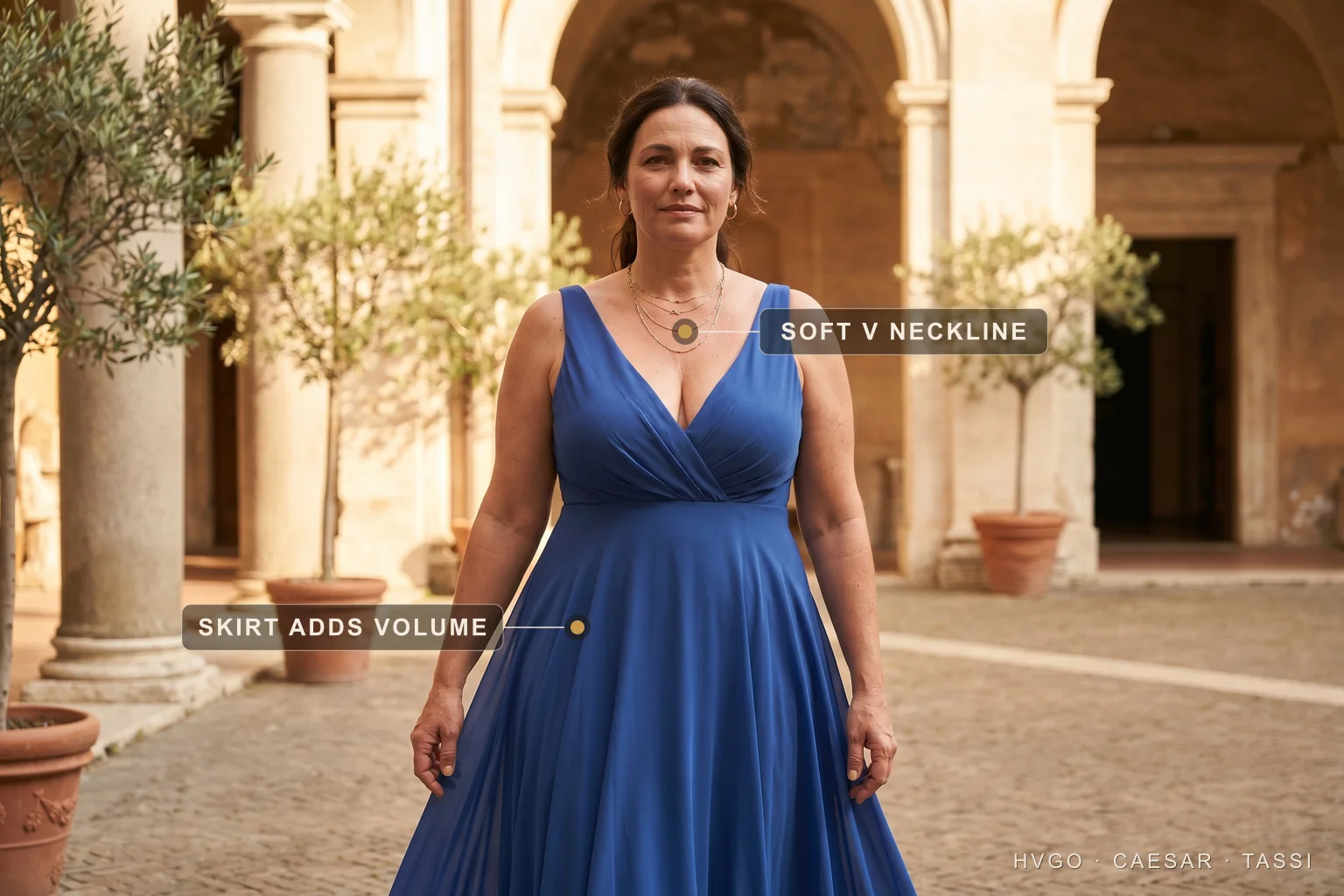
- Soft V narrows the shoulder
- Full skirt adds hip volume
Your inverted-triangle dress, in three steps
Tell us the moment and what to balance first — we’ll name the cuts that soften the shoulder and build the hip.
Enter your measurements (optional) to confirm the balance.
#What is an inverted triangle body shape, and what is a dress trying to balance?
Width sits up top while the hips stay narrow, so a dress works to slim the shoulder and add volume below. The proportion is the design problem. Every styling choice on this page traces back to one goal: bring the top in, push the bottom out, until your frame reads level from shoulder to hem.
#How an inverted triangle (and the broad-shouldered, athletic build) is proportioned
The shoulders or bust span wider than the hips, above a slim seat and often slim legs, with a waist that may sit lightly defined or nearly straight. A swimmer might measure 42 inches across the shoulders and 36 at the hip, a six-inch gap the eye reads instantly. The lower half stays straight, the seat small, the legs lean.
Three labels describe one figure. Broad-shouldered, athletic or swimmer's, and the older "carrot," "cone" or "wedge" all map onto the same top-heavy silhouette, so one rule serves all three. A woman with a fuller bust and narrow hips lands here too, even with softer shoulders, because the width still sits up high.
This differs sharply from neighboring shapes. A rectangle keeps shoulders and hips even with little waist definition, so it wants curve built in at both ends, not balance restored. An apple carries its width at the midsection rather than the shoulders, which moves the whole strategy to the waist. Confirm which one you are with the body shape finder before you commit to a cut.
#The two-part goal: narrow the top, build the hip
You balance an inverted triangle by drawing the shoulder line inward and adding curve below the waist until both halves read the same width. Picture the mirror image of a pear-shape strategy: where a pear shape dressing guide lifts the eye upward to fill out a narrow top, you pull it downward to fill out a narrow bottom.
Balance is the frame, not concealment. The old advice to "just wear a dark top" treats the shoulders as a flaw to mute, and it stops short, because a dark bodice on a stiff cut still armors the shoulder and leaves the hip empty. One concrete example: a black structured boat-neck shift reads top-heavy in any color, since the cut, not the shade, sets the width. Color helps only once the shape is right.
#Which necklines narrow and soften an inverted triangle's broad shoulders?
Open, downward necklines narrow the shoulder line; flat horizontal ones widen it. The neckline is your single most powerful lever here, because it sits directly on the widest point and either breaks that span or underlines it. For the full vocabulary of cuts, the dress necklines explained guide defines each one.
#The soft V-neck: the shoulder-narrowing default
A soft V-neck cuts a vertical line down the center, splitting the shoulder span into two narrower halves and shortening the visual width of the top. A V that drops to mid-sternum on a 42-inch shoulder pulls the eye through roughly a 4-inch channel of skin, which the brain reads as the new top width. The Flavia gown shows the counter-case: a strapless off-shoulder line is open but horizontal, so it widens.
Match depth to bust. A fuller chest wants a deeper plunge that keeps the V proportionate, while a modest V suits a smaller bust and daytime events. A surplice or wrap V forgives the most, since the crossover adds a second diagonal and skims a fuller bust without strain.
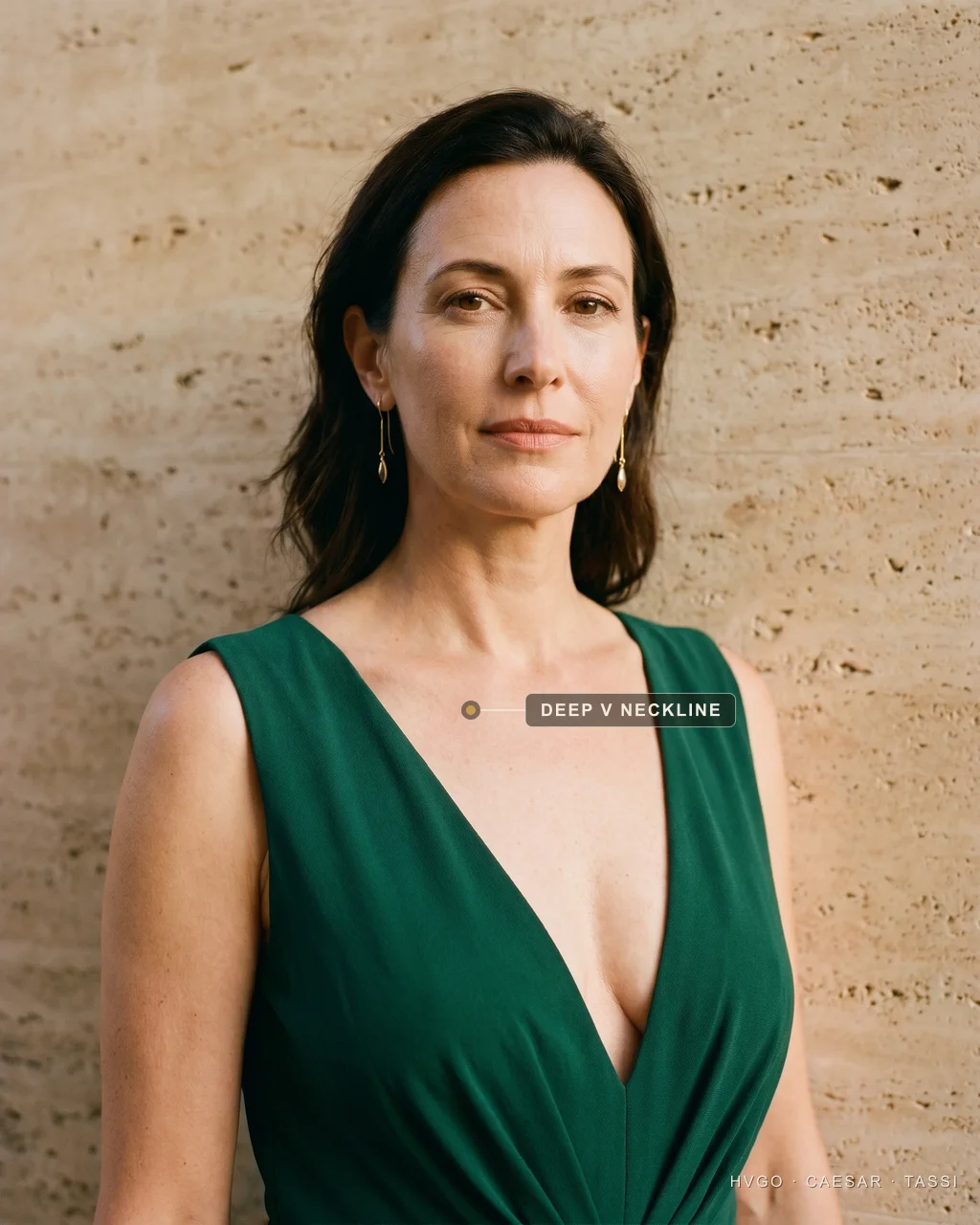
- Deep V draws a vertical and narrows the shoulder
#Scoop, halter and sweetheart: open without widening
A rounded scoop, a halter and a sweetheart all pull the line inward toward the neck, opening the chest without extending the shoulder. A halter routes the fabric up to a single point at the nape, so a 42-inch shoulder visually collapses toward a 6-inch neckband. Racerback cuts and narrow straps expose and slim the shoulder cap the same way.
Choose a deep open neckline over a high covered one. A sweetheart frames a fuller bust and adds a soft curve up top; a scoop reads easier for race day. The edge case: a high halter-collar that wraps the throat reverses the benefit, drawing a hard line across the collarbones instead of down the center.
#Necklines and sleeves that overload an inverted triangle's top (and the fix)
Bateau, off-the-shoulder, square and high collared necklines draw a hard horizontal across your widest point, and structured sleeves pile bulk onto the shoulder. A boat neck runs a straight line shoulder-to-shoulder, so a 42-inch span reads as a 42-inch bar. Cap, puff, padded and heavily beaded shoulders add visual inches exactly where you are subtracting them.
The fix is structural. Choose set-in or raglan seams that follow the natural shoulder slope, go sleeveless or pick a thin strap, and keep the shoulder clean and unembellished. Then add a focal pendant on a fine chain to pull the eye to the center line. Unlike a wide collar, a single pendant works downward, the same direction your V-neck already pulls.
#Which dress silhouettes add hip volume to an inverted triangle?
Skirts that release and widen from the waist rebuild the hip width an inverted triangle lacks. The bodice handles narrowing; the skirt handles the rebuild, and the more it flares, the more the lower half catches up to the shoulders.
- Soft open V or scoop — a vertical neckline narrows the broad shoulder.
- Clean, unpadded shoulder — set-in or raglan seams, no cap or puff.
- A-line or pleated skirt — adds a skirt-width of volume at the hip.
- Boat or off-shoulder neck — draws a hard horizontal across the widest point.
- Padded or puff sleeves — pile bulk onto the shoulder.
- Stiff straight column — flattens the hip and underlines the shoulder.
#A-line and fit-and-flare: the inverted triangle's workhorse
An A-line skirt releases from the waist and widens steadily toward the hem, manufacturing hip width to meet the shoulders. A skirt that adds 8 to 10 inches of sweep at the knee restores the inches the hip is missing, which is why this is the most reliable cut for a top-heavy figure. Aemilia (A-line chiffon maxi) and Portia (short-sleeve chiffon A-line) both work this way.
Midi and maxi lengths carry the most balancing power, since a longer skirt holds more sweep. A fit-and-flare nips the waist first, marking the narrowest point before the flare, which sharpens the contrast. The counter-case: an A-line so stiff it stands away from the body can read costume rather than balanced, so the fabric must move.
#Pleated, tiered and bias skirts that build the hip
Knife pleats, sunray pleats, gathers, tiers and a bias-cut sweep each add roughly a skirt-width of soft volume precisely at the hip. Twenty knife pleats released at the waist fold open into movement that the eye reads as width, without the bulk of a structured crinoline. Claudia (pleated-slit chiffon gown) and Julia (French-pleated chiffon maxi) both build the hip this exact way.
Movement is the mechanism. A bias-cut sweep floats and shifts as you walk, and float reads as width far more than a flat panel does. For a fuller catalog of these cuts, the silhouettes guide maps each one. A bias skirt over slim hips drapes close at the seat, so pair it with low tiers or gathers when you want more visible volume there.
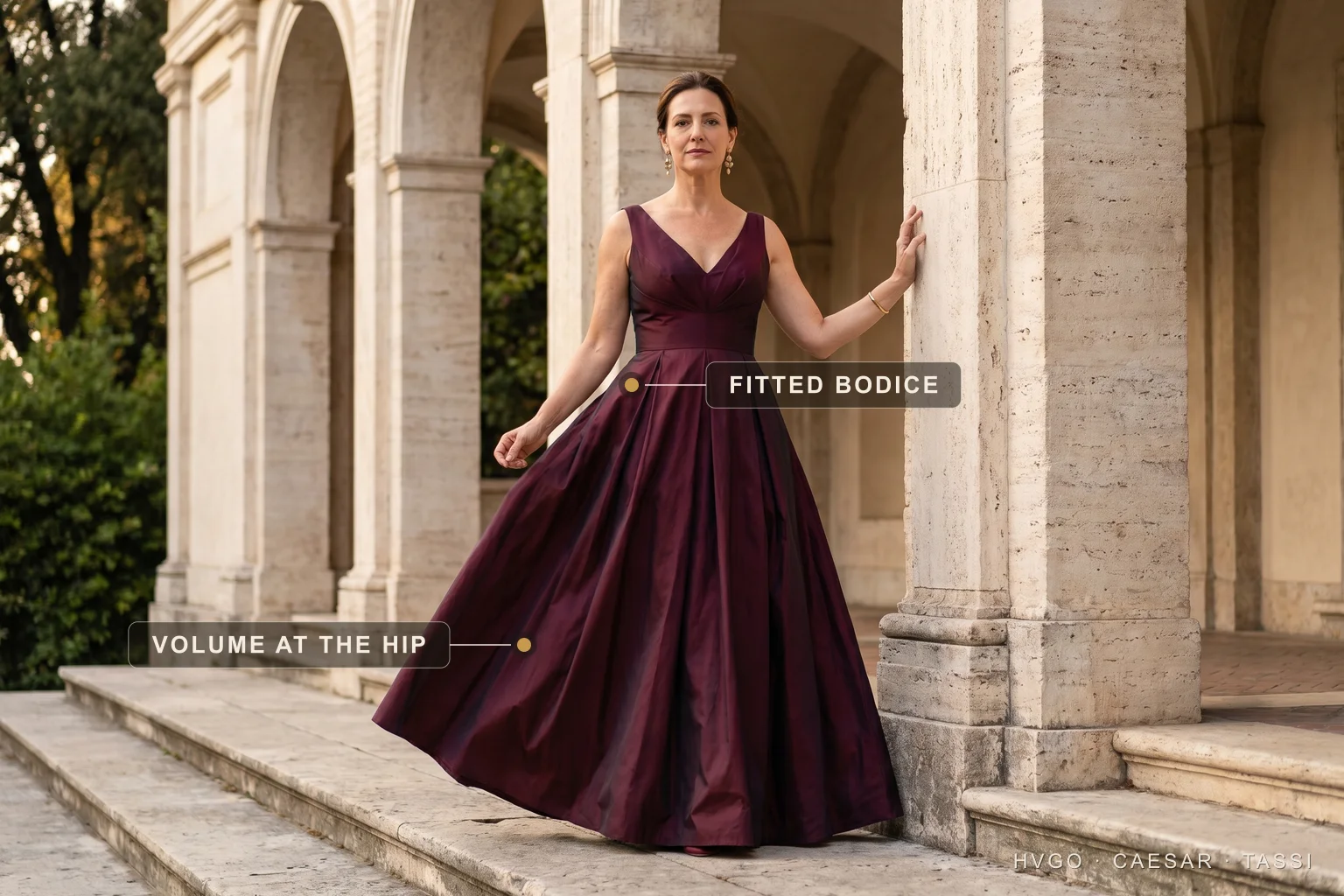
- Fitted V-neck bodice
- Pleated skirt builds the hip
#Full-skirt, ball-gown and low fishtail for black tie
A structured full skirt reframes the proportion from the floor up, while a low fishtail stays slim to mid-thigh then flares into a curve below the hip. A ball-gown skirt is the most decisive rebuild, restoring width whatever the shoulders do, which suits a formal wedding or a gala. A trumpet that breaks at mid-thigh adds the curve lower, where an inverted triangle wants it.
Pick by formality and nerve. A full skirt reads classic and forgiving; a fishtail reads dramatic and asks for confidence in the walk. The edge case to skip: a fishtail that flares high at the hip can sit oddly on a slim seat, so keep the flare low and let the slim section run long.
#Empire waist and the slim column (with care)
An empire seam set just under the bust skims a fuller chest and floats over slim hips, whereas a straight column or sheath flattens an already-narrow lower half and underlines the shoulders. The empire releases fabric from the highest point, so the whole lower half reads soft. Tullia (pleated crepe column) and Vipsania (draped modal column) show the column's risk and its narrow exception.
The column has one safe route. A fluid bias column with a low slit or a hip detail adds the curve a straight sheath denies, so reach for the draped, moving version rather than the architectural one. Whereas a stiff sheath leaves the hip flat and the shoulder loud, a bias column at least keeps the line soft.
#Which fabrics and details rebuild an inverted triangle's lower half?
Fluid fabric below the waist adds the illusion of width and curve, while stiff fabric up top armors and broadens the shoulder. Keep the structure low and the shoulder soft, and the same dress shifts from top-heavy to balanced on the hanger.
#Why fluid drape beats stiffness on a top-heavy figure
Soft, moving fabric below the waist reads as width and curve, because drape catches light and shifts with the body the way a flat stiff panel never does. A chiffon skirt that floats six inches off the leg in a breeze paints width the eye believes. The counter-case sits up top: a boned, structured bodice projects the shoulder forward and reads broader, so reserve any stiffness for the skirt alone.
#Chiffon, satin, crepe and modal placed where they help
Airy pleated chiffon and a bias satin sweep build hip volume and movement, matte crepe holds an A-line's clean shape, and draped modal jersey skims a slim lower half without clinging flat. Each fabric earns a job. Recycled knife-pleated chiffon floats widest; bias-cut satin pours a liquid sweep; matte crepe keeps an A-line crisp; modal drapes a column softly. Choose the airy weights for the skirt and save the firmer ones for a clean, quiet bodice.
Keep the bodice fabric light. A heavy brocade or beaded shoulder undoes a soft V the moment it adds bulk, so let the shoulder stay unstructured and load the texture into the skirt. The edge case: a clingy jersey with no drape can flatten a slim seat, so choose the draped weight, not the second-skin one.
#Color, pattern and detail, placed low
Carry the calmer, deeper tone and the clean line up top, then send the brighter color, print, ruffle or embellishment toward the hip and hem. This reframes the worn "dark on top" rule: the goal is not darkness but a quiet shoulder and a rich, busy hem that draws the eye down. Livilla (floral-print chiffon midi) does this, floating print low under a light neckline.
The HCT imperial palette pairs ready-made. Set a Basalt (black) or Cobalto (navy) bodice against a Vermiglio (red) or Verde Antico (green) skirt, and the contrast itself pulls the eye downward. A belt or sash in Cuoio (tan) marks a waist between the two halves, giving the balance a center point. Avoid the inverse, a bright printed shoulder over a plain dark skirt, which lights up the widest part.
#Dressing an inverted triangle for a wedding, gala or race day: balancing the shoulder line
Hold the two-move rule at every dress code: soft open neckline above, volume-building skirt below, with the formality tuned to the event. The occasion changes the fabric and the length, never the underlying balance.
#Cocktail and semi-formal weddings
Reach for a fit-and-flare or A-line midi with a soft V and a fuller skirt, dropping to tea length for daytime. A pleated chiffon A-line at the knee narrows the shoulder and flares the hip in one cut. Check the dress code first, since a black-tie-optional invite shifts you longer; the wedding guest dress codes guide sorts the labels.
#Black tie and the opera
Choose a V- or halter-neck A-line or full-skirt maxi gown with a soft shoulder and volume built into the skirt. A halter maxi narrows the top to a single point and lets a floor-length sweep do the rebuilding. The dramatic alternative is a low fishtail, slim to mid-thigh then flared, for a woman confident in a sculpted walk rather than a forgiving float.
#Race day and garden events
Pick an A-line with a defined waist and a soft open neckline, then add height with a fascinator rather than width at the shoulder. A vertical fascinator lifts the eye above the shoulder line instead of extending it sideways. Keep print and brightness toward the hem, and skip a wide-brimmed hat that echoes the broad-shoulder horizontal you are working to break.
#How Hugo Caesar Tassi cuts dresses for an inverted triangle and broad shoulders
The house balances a top-heavy figure with two precise moves: open the neckline into a soft V to narrow the shoulder, then let pleated or bias chiffon add roughly a skirt-width of volume at the hip. This is the inverse of the pear's one-third lift, named exactly rather than left to instinct.
#The house soft-V-and-skirt-width balancing rule
Narrow the shoulder line with a soft V, then add a skirt-width of fluid volume at the hip until the top and bottom meet in the middle. The rule is repeatable because both moves are measurable: the V sets the new top width, the skirt sweep sets the new hip width, and you adjust the skirt until they match. Where a single broad-shoulder listicle stops at "wear a V-neck," this pairs the neckline with a named volume target.
#The dresses we steer inverted-triangle clients to
Five HCT dresses execute the rule cleanly, each pairing a soft, unstructured shoulder with a skirt that widens low. They divide by mechanism rather than by occasion:
| Dress | Shoulder move | Hip-building skirt | Best occasion |
|---|---|---|---|
| Aemilia | Light A-line neckline | Chiffon that widens to the hem | Daytime, garden weddings |
| Portia | Short-sleeve soft shoulder | Chiffon A-line flare | Cocktail, semi-formal |
| Claudia | Clean pleated bodice | Pleated chiffon with a slit | Black tie, evening |
| Julia | Soft-shoulder bodice | French pleats, soft volume | Formal weddings, gala |
| Livilla | Light neckline up top | Floral print floated low | Race day, summer events |
Each earns its place by doing both jobs in one cut. Aemilia and Portia widen at the hem in fluid chiffon; Claudia and Julia build soft hip volume through pleats over a clean shoulder; Livilla carries the print and float low under a light neckline. None loads bulk onto the shoulder, which is the disqualifier.
What the atelier learned fitting the inverted triangle
Across the house’s fitting studio, the top-heavy figure balanced on two moves done together: a soft V to narrow the shoulder, and a skirt-width of fluid volume to rebuild the hip. A dark bodice alone never finished the job — the cut, not the shade, set the width. The findings below are how the studio now cuts for broad shoulders.
| Cut | What the studio observed | Verdict |
|---|---|---|
| Soft V / scoop / halter | Draws a vertical and narrows the shoulder line to the center. | Best |
| A-line / fit-and-flare | Releases from the waist and widens to meet the shoulders. | Best |
| Pleated / full skirt | Adds a skirt-width of soft volume precisely at the hip. | Best |
| Low fishtail | Slim to mid-thigh, then flares below the hip for evening. | Best for evening |
| Boat / off-shoulder / puff | Draws a horizontal or piles bulk across the widest point. | Skip |
| Stiff straight column | Flattens an already-narrow hip and underlines the shoulder. | Skip |
The rule the study produced: soften the top, build the hip — a soft V plus a skirt-width of volume until the halves meet.
#Your inverted triangle dress checklist
Soften and narrow above, build volume below, and place color low. Run this before you buy.
#The quick recap
- Choose a soft open V, scoop, halter or sweetheart neckline
- Keep the shoulder clean and unpadded, with set-in or raglan seams
- Pick an A-line, pleated, fit-and-flare or full skirt that widens at the hip
- Use fluid skirt fabric over a light, unstructured bodice
- Carry the brighter color, print and detail toward the hip and hem
- Avoid boat, bardot, off-the-shoulder and square necklines
- Skip cap, puff or padded sleeves and heavy shoulder beading
- Pass on stiff straight columns and sheaths that flatten the lower half
#Where to go next
Confirm your shape, study the detail guides, then shop the volume-rich edits. Start with the body shape pillar to place yourself among the shapes, compare against the rectangle shape guide and the apple shape guide if you are between two, then move to product once the rule is clear.
#Frequently asked questions
How should an inverted triangle body shape dress?
An inverted triangle body shape dresses by narrowing the top and building the bottom. Choose a soft V-neck or scoop with a clean, unpadded shoulder, then an A-line, pleated or full skirt in a fluid fabric that adds volume at the hip. Adjust the skirt sweep until your shoulders and hips read level.
What dresses are best for broad shoulders?
The best dresses for broad shoulders open the neckline and flare the skirt. Pick an open V or halter that draws the eye down the center, a soft set-in or raglan shoulder with no cap or puff sleeves, and a skirt that releases from the waist. An A-line or fit-and-flare in pleated chiffon is the most reliable combination.
What necklines suit broad shoulders?
Necklines that suit broad shoulders pull attention inward and downward. A soft V-neck, a rounded scoop, a halter and a sweetheart all narrow the shoulder line. Avoid boat, bardot, off-the-shoulder and square necklines, which draw a hard horizontal straight across your widest point.
What dresses should an inverted triangle avoid?
An inverted triangle should avoid anything that widens the top or flattens the bottom. Skip off-the-shoulder, bateau and square necklines, cap, puff or padded sleeves, and heavy shoulder embellishment. Pass on stiff straight columns and sheaths, which emphasize the shoulders while flattening an already-narrow lower half.
How do you make your hips look bigger or curvier in a dress?
You make your hips look bigger in a dress by adding volume below the waist. Choose a pleated, tiered, A-line or full skirt in a fluid fabric that flares from the waist. Carry the brighter color, print or detail toward the hip and hem so the eye reads width and curve in the lower half.
Is an athletic or swimmer's build the same as an inverted triangle?
An athletic or swimmer's build is the same as an inverted triangle for dressing purposes. Both share the top-heavy proportion of broad shoulders over narrow hips, so the same rule applies to each. Soften and narrow the shoulder line, then build volume back into the skirt.
Build your balance in the volume-rich styles of the maxi dress edit, or start with the A-line and pleated chiffon dresses cut to widen exactly where an inverted triangle needs it.
More Body Shape guides
Best Dresses for an Apple Shape
The apple-shape dresses that skim a fuller middle with cut, not shapewear: empire seams, bias drape and fluid crepe from the Roman atelier of HCT.
See the apple-shape editElegant Dresses for Women Over 50
Occasion dresses that flatter over 50 — a three-quarter sleeve, soft V neck and crepe that skims. The age-positive guide to weddings and evenings.
Dressing well over 50Best Dresses for an Hourglass Figure
The silhouettes, fabrics and necklines that trace an hourglass figure instead of hiding it, plus the atelier fluid-weight rule and HCT gowns to shop.
See the hourglass editHow to Find Your Body Shape
Take three measurements and learn your body shape for sure with the atelier ratio method and exact thresholds, not vague compare-to-fruit guesswork.
Find your body shapeBest Occasion Dresses for a Pear Shape
The shapes, necklines and fabrics that balance a pear shape: A-line chiffon that skims the hip and a neckline that lifts the eye one body-third up.
See the pear-shape editThe Petite Woman's Guide to Occasion Dresses
The lengths, waistlines and silhouettes that lengthen a petite frame, with the exact hem rule and the one-color column that reads taller.
See the petite edit