Elegant Dresses for Women Over 50: Occasion Dresses You Wear with Confidence
Occasion dresses that flatter over 50 — a three-quarter sleeve, soft V neck and crepe that skims. The age-positive guide to weddings and evenings.
On this page
Dressing elegantly over 50 comes down to cut, not cover-up: a sleeve that drapes the arm, a neckline that frames a softer décolletage, and a fabric with enough body to follow your line instead of clinging to it. You already know your taste. This guide names the silhouettes, sleeves, necklines, fabrics, and colors that deliver exactly that.
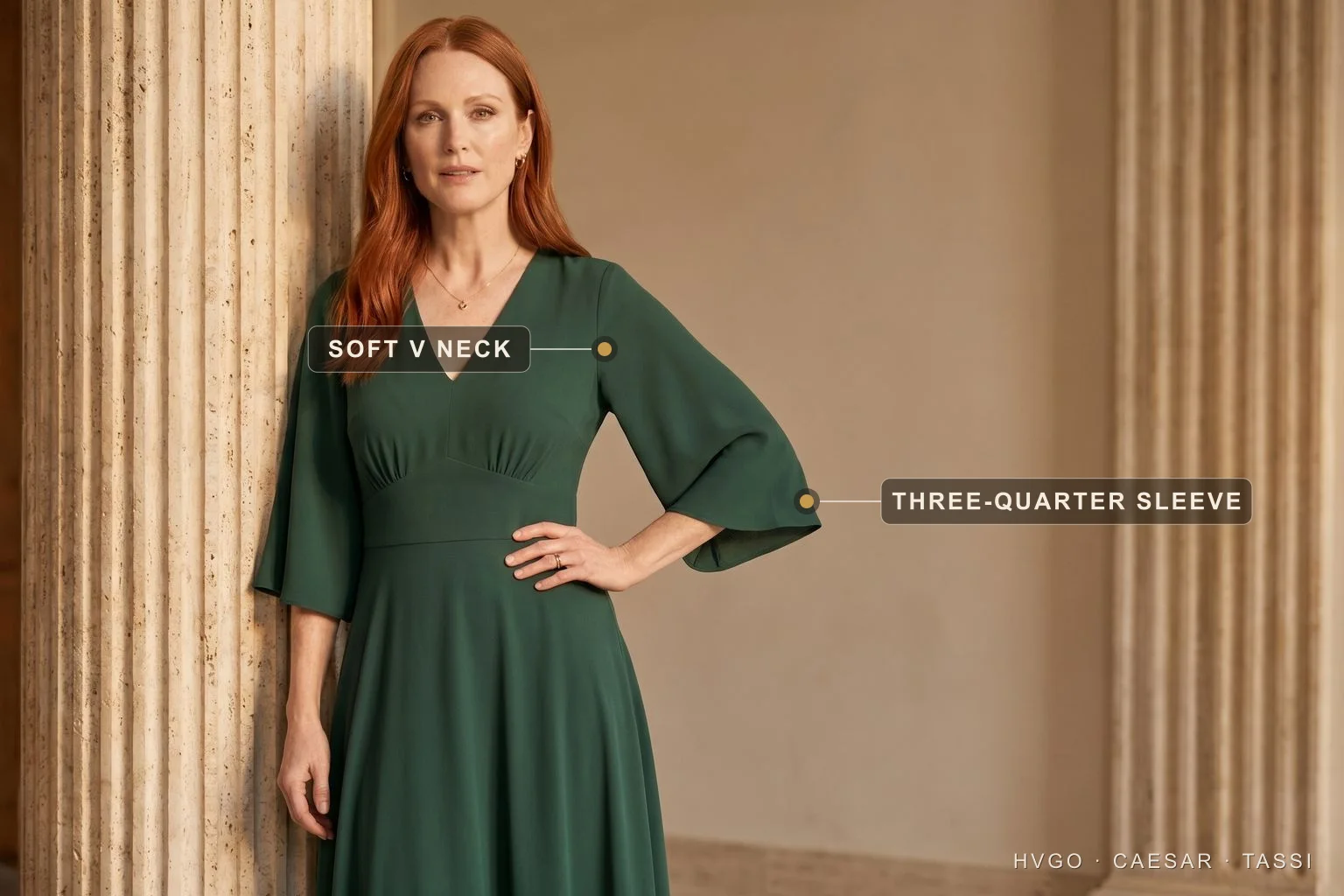
- Soft V neck — an open, considered V lengthens the neck and frames a softer décolletage without plunging.
- Three-quarter sleeve — drapes past the widest part of the upper arm and ends at the slimmest point of the forearm.
The over-50 age-positive rule
Cut that flatters the body you have now, never cover-up — run any occasion dress past this.
- Mark one focal point: a defined waist seam, empire seam, or faux-wrap, then let the skirt float over the hip
- Choose a fluid three-quarter or bracelet sleeve that drapes past the upper arm and ends at the slim forearm
- Open the neck with a soft V, scoop, boat, or cowl, and finish it with one focal necklace
- Pick fabric with body — substantial matte crepe or fluid silk and modal that skims, never clings
- Wear a saturated tone near the face from the imperial palette — Porpora, Cobalto, Verde Antico, Cornelia, or Avorio
- Hide in a forgiving tent a size up — buy your true size and lightly alter it to define a waist
- Let a dress fix everywhere at once with shoulder pads, a high neck, and a ruched hip all fighting
- Grip the arm with a tight sleeve in stiff cloth, or wear a rigid cap that sits like a wing
- Default to flat black or plain navy that can drain softening skin
- Cut the leg at its widest with a mid-calf hem or a too-short cocktail length
#What does dressing elegantly over 50 actually mean?
Dressing elegantly over 50 means choosing cut that flatters the body you have now, not concealing it or chasing a younger silhouette.
#Age-positive, not "age-appropriate"
Fifty-plus is a season of authority, so the real question is what flatters you, not what you can "get away with." The patronizing SERP frames age as a problem; Hugo Caesar Tassi treats it as a vantage point.
"Age-appropriate" polices you toward beige, whereas "age-defying" chases the bandage dress of 25; current is the word that matters. Consider the woman who buys a size up for comfort and vanishes inside a tent: her true size, lightly altered, defines a waist and reads far more polished.
#What changes after 50, and what the dress should do about it
Most women notice softer upper arms, a thicker waist, a softer neck, and sometimes a fuller bust, and a good dress answers each with cut. Skim and float; never compress.
The governing rule is one focal point only: a defined waist seam marks the narrowest part while a fluid skirt floats over the hip. Trouble starts when a dress tries to "fix" everywhere at once, since shoulder pads, a high neck, and a ruched hip cancel out and the eye finds no rest.
#Which occasion-dress silhouettes flatter women over 50?
The most reliable shapes mark a waist, then release into a skirt that skims the hip: A-line, fit-and-flare, wrap, empire, and the soft column.
#A-line, fit-and-flare and the soft wrap
An A-line sets a waist-defining bodice over a skirt that widens gently from the hip, skimming everything below. The waist is marked; the rest floats free.
A surplice bodice traces a waist without a clingy tie, the way Hugo Caesar Tassi's Portia chiffon A-line does at day length. Watch one thing: a true wrap that knots hard can dig, so choose the faux-wrap.
#The empire and the soft column
An empire seam sits under the bust and floats clean over a fuller midsection, while a fluid column drapes long without gripping.
The draped modal column translates the Roman column into something wearable, and the apple shape guide walks through empire seam placement. On a fuller bust, the empire can ride high, so set the seam a touch lower with a soft V above it.
#Hemlines that read elegant now
Midi and tea length are the everyday-occasion workhorses, full-length maxi owns evening, and just-below-the-knee suits daytime.
A midi on a 175 cm frame breaks at the slimmest part of the lower leg, and the house publishes each model's height so you can judge where a hem lands on you. Mid-calf is the length to avoid, because it cuts the leg at its widest.
#Which sleeves feel elegant and confident over 50?
A fluid sleeve drapes the arm rather than gripping it, which is why sleeves are the quiet hero of over-50 dressing, where length flatters more than coverage.
#The three-quarter and bracelet sleeve: the quiet hero
A three-quarter or bracelet sleeve drapes past the widest part of the upper arm and ends at the slimmest point of the forearm.
Hugo Caesar Tassi prefers this length, and a bracelet sleeve stops around 5 cm above the wrist, clearing the forearm for a cuff. Compare that with a tight sleeve in stiff cloth, which grips the upper arm instead of skimming it.
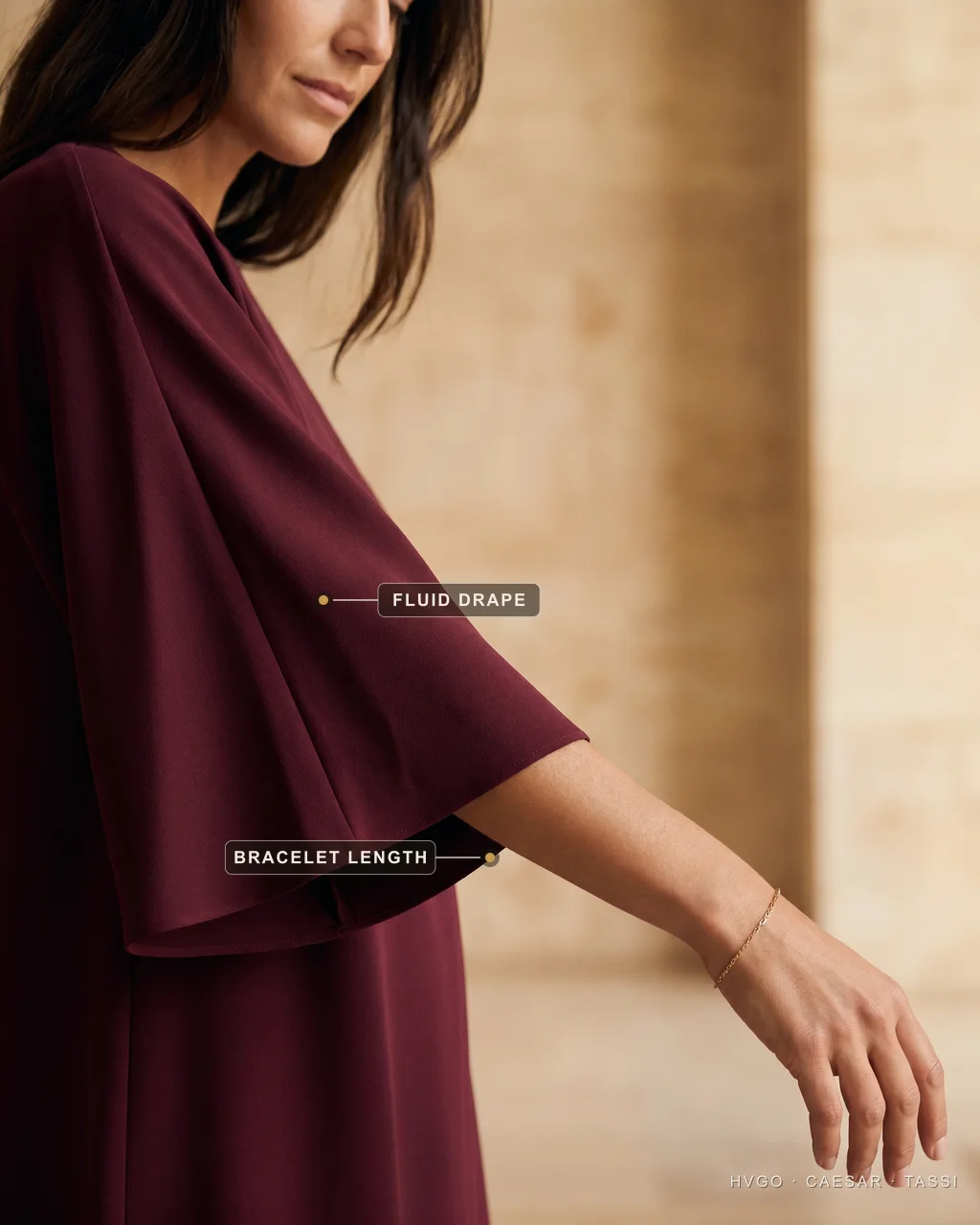
- Fluid drape — substantial matte crepe follows the line of the arm and floats away from the upper arm.
- Bracelet length — the sleeve stops about 5 cm above the wrist, clearing the forearm for a cuff or bracelet.
#Flutter, bell, soft cap and kimono sleeves
A flutter or bell sleeve floats away from the upper arm, a soft cap covers the shoulder lightly, and a kimono cut eases across the arm without bulk.
Match the sleeve weight to the cloth: a flutter sleeve wants georgette so it lifts, whereas a kimono sleeve eases across a fuller upper arm. One sleeve to skip is the rigid cap, which sits like a wing; a soft set-in cap stays quiet.
#Long sleeves, and the sleeveless-with-cover option
A long sleeve suits winter and evening, and a sleeveless dress worn with a chosen topper is a fully elegant option, not a compromise.
Add a bolero, kimono, wrap, or tailored jacket and the bare-arm question disappears while the dress's line stays underneath; the sleeve types guide holds the logic. The one misstep: a topper heavier than the dress drowns it.
#Which necklines flatter a softer décolletage over 50?
An open, considered neckline lengthens the neck and frames the décolletage rather than baring it or closing it off. Keep it open but never plunging.
#The soft V, scoop and surplice
A soft V or rounded scoop lengthens the neck and frames the chest, and the surplice wrap V is the forgiving everyday version.
An open V ending a hand-width below the collarbone suits a fuller bust, the way Claudia's pleated-slit chiffon maxi does for evening. A plunge to the sternum, by contrast, looks like hard work at any age.
#Boat, square and cowl necklines
A bateau frames the collarbone, a soft square sits clean across the chest, and a cowl drapes softly over a fuller bust.
A boat neck is the most graceful choice for a mother-of-the-bride photograph, framing the collarbone across hundreds of frames. A cowl in fluid silk gives a fuller bust room, though sloping shoulders want a soft scoop.
#Necklines to approach with care
A high, tight crew can shorten and harden the face, and a deep plunge looks effortful, so keep the neckline open and let one necklace finish it.
A close mock-neck cuts the neck short, so let one focal necklace at a soft V finish the look. The necklines guide sets out the principle.
#Which fabrics drape most flatteringly for women over 50?
Drape that is fluid but carries body is the whole game: it follows your line without clinging or pooling. Weight does the flattering, not stretch.
#Crepe: the house favorite
A substantial matte crepe holds its own line and skims the body cleanly, which makes it the single most flattering fabric after 50.
Crepe at a real weight falls from the waist seam in a clean vertical and glides past the hip, matte beating shine for daytime. Tullia's pleated crepe column gown shows it at full length.
#Silk, modal jersey, georgette and chiffon
Fluid silk and draped modal make a soft column, while georgette and chiffon give sleeves and overlays movement without weight.
Modal jersey drapes like liquid; silk georgette floats for a flutter sleeve; satin works best matte-side out. Silk too light for a fitted body is the exception, and it needs a full lining to hold its shape.
#Fabrics that betray the body
Clingy thin stretch jersey maps every line, and stiff scuba or bonded fabric armors the figure, so both work against you after 50. The two failures sit at opposite extremes.
| Fabric | How it behaves | Best occasion use |
|---|---|---|
| Matte crepe (substantial) | Holds a clean vertical, skims waist and hip | Daytime, mother-of-the-bride, races |
| Fluid silk / modal jersey | Drapes liquid, follows without gripping | Soft evening column, gala |
| Georgette / chiffon | Floats and lifts, adds movement | Sleeves, overlays, summer weddings |
| Thin stretch jersey | Clings and maps every contour | Avoid for fitted dresses |
| Scuba / bonded | Stands stiff, boxes the figure | Avoid for occasionwear |
#Wearing color over 50: beyond navy and black
Rich, saturated color worn near the face lifts the complexion as the skin softens, which makes color flattering rather than aging. The neutral-only default is a habit.
#Why color flatters, not ages
A saturated tone close to the face bounces warmth onto softening skin, where flat black can drain it.
A deep wine looks refined, whereas a neon shade shouts for attention and fights the wearer. Choose the tone that lifts your skin.
#The imperial palette for over-50 occasions
The imperial palette offers ready, flattering occasion colors well beyond navy and black, each a saturated tone chosen to sit near the face.
- Porpora (wine): the deepest option, regal for evening and black tie
- Cobalto (navy): navy worked to a deep saturation, so it lands as a color, not a default
- Verde Antico (green): a soft antique green that flatters warm and cool skin
- Cornelia (rose): a muted rose that lifts the complexion at daytime occasions
- Avorio (ivory): a warm ivory for events where you want light, never stark white
Pair a deeper tone with a quiet jacket and the outfit stays balanced; the house view on dressing elegantly builds on one statement color.
#What to wear to a wedding, the mother-of-the-bride role, and the races over 50
Match the dress to the brief: a sleeved midi for a guest, a column for the mother, an A-line for the races.
#The wedding guest over 50
A midi or tea-length A-line or wrap with a three-quarter sleeve and a soft V reads polished as a wedding guest.
A daytime garden wedding wants crepe in Cornelia, an evening reception silk in Porpora, and the house designs out white and black. The wedding guest dress codes page covers the cocktail and black-tie lines.
#Mother of the bride or groom
The mother-of-the-bride dress must photograph well all day, coordinate with the party without matching, and carry a sleeve and a jacket for the ceremony.
A refined A-line or soft column in Verde Antico or Cobalto coordinates with the wedding palette without copying the bridesmaids. The mother of the groom takes the quieter tone.
#Black tie, the opera and race day
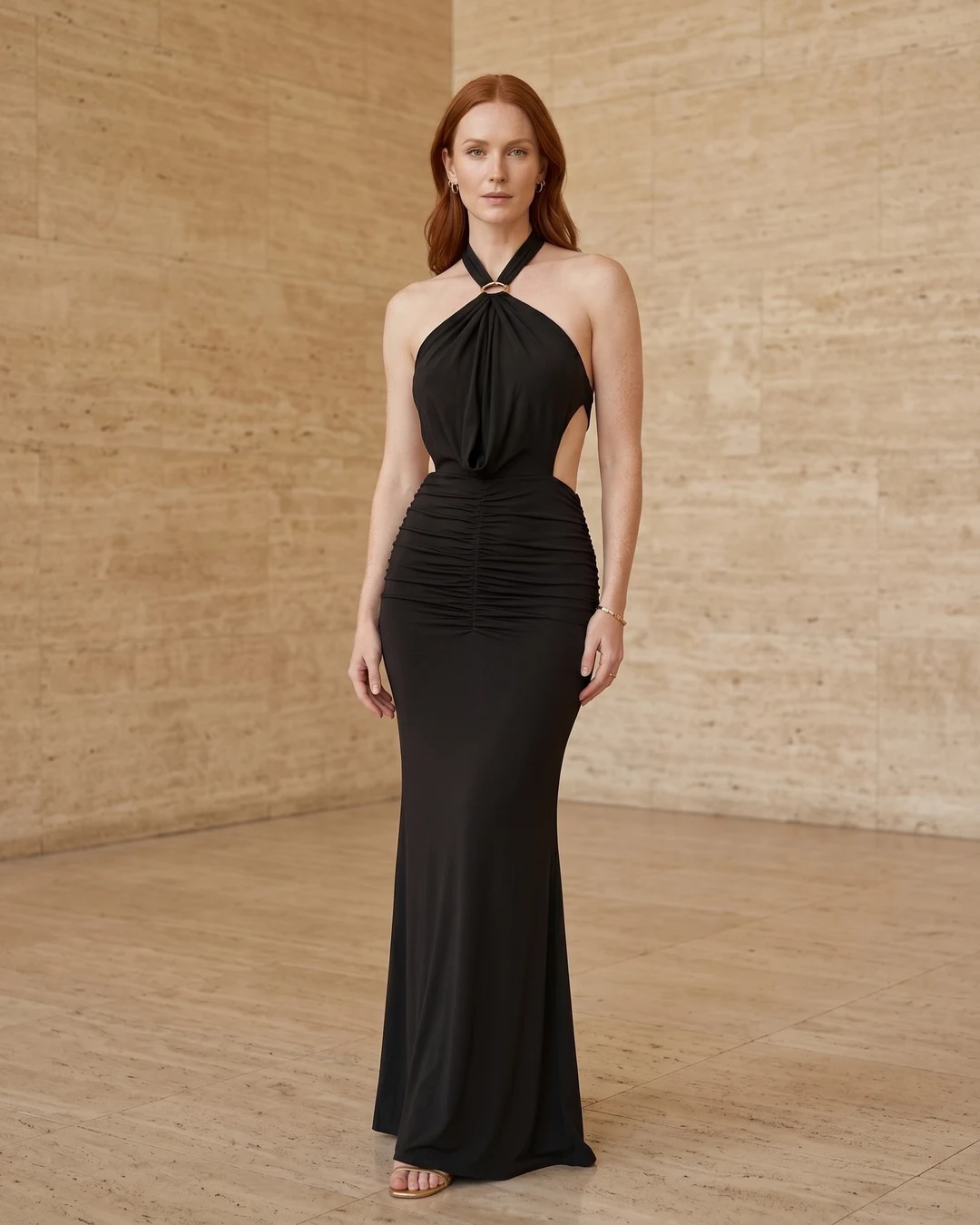
Black tie and the opera call for a full-length crepe or satin column or a fishtail with a wrap, while race day wants a structured A-line midi with a defined waist and a hat.
Calpurnia, a fishtail satin evening gown, suits black tie with a fine wrap. For the races, a crepe A-line midi, a real waist, and a fascinator look current and composed.
#The over-50 confidence layer: jackets, wraps and toppers
A jacket, bolero, kimono, or wrap finishes a sleeveless or short-sleeved dress and gives a cover that is chosen, not apologetic.
#The tailored blazer, bolero and kimono
A sharp blazer adds structure at the shoulder, while a soft bolero or kimono adds an elegant cover, and both let you wear a sleeveless dress with confidence.
A tailored blazer suits a crepe sheath; a soft bolero suits a chiffon A-line; a kimono suits an evening column. Pairing a structured blazer with a fluid gown backfires, since the stiff jacket fights the drape.
#The wrap, stole and shrug for evening
A silk or fine-knit wrap over an evening column gives warmth and grace for a cool ceremony without hiding the dress.
A wide silk stole falls long and frames the column, while a fine-knit shrug covers the upper arm for an outdoor evening. Both stay open at the front, so the neckline shows.
#How Hugo Caesar Tassi dresses women over 50
The house age-positive rule is a fixed set of choices made because they flatter, not because they hide. It is the deliberate opposite of concealment.
#The house age-positive rule
The atelier specifies a three-quarter or soft sleeve, a soft V or scoop neckline, a defined or empire waist, and a substantial crepe or fluid silk that skims.
The house favors a crepe with real body and a draping three-quarter sleeve for one reason: the cloth follows the woman. Color from the palette is treated as flattering, and "sleeveless plus a topper" is a legitimate option.
#The dresses we recommend, and how to wear them
Five dresses translate the age-positive rule into occasion-ready pieces across day and evening, each able to take a sleeve or a layer where it has none.
- Julia (French-pleated chiffon maxi): fluid pleats skim the midsection; add a bolero
- Claudia (pleated-slit chiffon maxi gown): full-length evening with a soft V; wear a silk wrap
- Vipsania (draped modal column gown): a soft column that flatters without clinging
- Tullia (pleated crepe column gown): a clean column for galas and the opera; add a stole
- Livilla (floral-print chiffon midi): a day-occasion midi with movement and a soft neckline
Browse the crepe dresses edit for body-rich styles, or scan the full range of all dresses once you have the shape in mind.
#Your over-50 occasion-dress checklist
Run this checklist against any occasion dress before you commit, and it will hold to the age-positive rule.
#The quick recap
| Element | Choose | Avoid |
|---|---|---|
| Waist | Defined seam, empire seam, or faux-wrap | The shapeless shift |
| Neckline | Soft V, scoop, boat, or cowl | Tight high crew, deep plunge |
| Sleeve | Three-quarter, flutter, soft cap, or sleeveless plus topper | Tight grip in stiff cloth |
| Length | Midi, tea, or full | Too-short cocktail, mid-calf |
| Fabric | Matte crepe, fluid silk, modal | Clingy jersey, stiff scuba |
| Color | A saturated tone from the imperial palette | Navy and black by default |
| Fit | True size plus a small alteration | A forgiving tent |
#Where to go next
Read the supporting guides, then shop the edits cut to these rules.
Start with the body shape pillar for the figure-by-figure method. For plus-size needs after 50, the plus-size occasion guide layers in extra fit detail.
#Frequently asked questions
What style of dress is most flattering for a woman over 50?
The most flattering style for a woman over 50 is a waist-defining A-line, fit-and-flare, or soft wrap in a fabric with body, like matte crepe, that skims rather than clings. Finish it with a three-quarter sleeve and a soft V or scoop neckline, so the waist marks the narrowest point.
What should a woman over 50 wear to a wedding?
A woman over 50 should wear a midi or tea-length A-line, wrap, or soft-column dress with a three-quarter sleeve and an open V or scoop neck to a wedding. Choose a rich color from the imperial palette, and add a tailored jacket or wrap for the ceremony.
Can a woman over 50 wear a sleeveless dress?
A woman over 50 can wear a sleeveless dress by choosing one she loves and adding a bolero, kimono, wrap, or tailored blazer. "Sleeveless plus a topper" is a fully elegant choice, not a compromise.
What neckline is most flattering over 50?
The most flattering necklines over 50 are a soft open V, a rounded scoop, a boat neck, or a soft cowl, each lengthening the neck. Avoid a high, tight crew that shortens the face and a deep plunge that looks effortful.
What sleeve length is best for over-50 occasion dresses?
The best sleeve length for over-50 occasion dresses is a fluid three-quarter or bracelet sleeve, which drapes past the widest part of the arm and ends at the slimmest point of the forearm. Flutter, bell, and soft kimono sleeves work the same way.
Should women over 50 wear color or stick to black?
Women over 50 should wear color, because a rich, saturated tone near the face lifts the complexion rather than aging it, where flat black can drain softening skin. The imperial palette, Porpora, Cobalto, Verde Antico, Cornelia, and Avorio, gives elegant options well beyond navy and black.
Find a dress cut to flatter you now in the occasion edit, or start with the skimming, body-rich styles built for the way you move and the way you want to be seen.
More Body Shape guides
Best Dresses for an Apple Shape
The apple-shape dresses that skim a fuller middle with cut, not shapewear: empire seams, bias drape and fluid crepe from the Roman atelier of HCT.
See the apple-shape editBest Dresses for an Hourglass Figure
The silhouettes, fabrics and necklines that trace an hourglass figure instead of hiding it, plus the atelier fluid-weight rule and HCT gowns to shop.
See the hourglass editHow to Find Your Body Shape
Take three measurements and learn your body shape for sure with the atelier ratio method and exact thresholds, not vague compare-to-fruit guesswork.
Find your body shapeHow to Dress an Inverted Triangle Body Shape
Open the neckline into a soft V to narrow broad shoulders, then add a skirt-width of pleated-chiffon volume at the hip until your shape reads balanced.
Style the inverted triangleBest Occasion Dresses for a Pear Shape
The shapes, necklines and fabrics that balance a pear shape: A-line chiffon that skims the hip and a neckline that lifts the eye one body-third up.
See the pear-shape editThe Petite Woman's Guide to Occasion Dresses
The lengths, waistlines and silhouettes that lengthen a petite frame, with the exact hem rule and the one-color column that reads taller.
See the petite edit