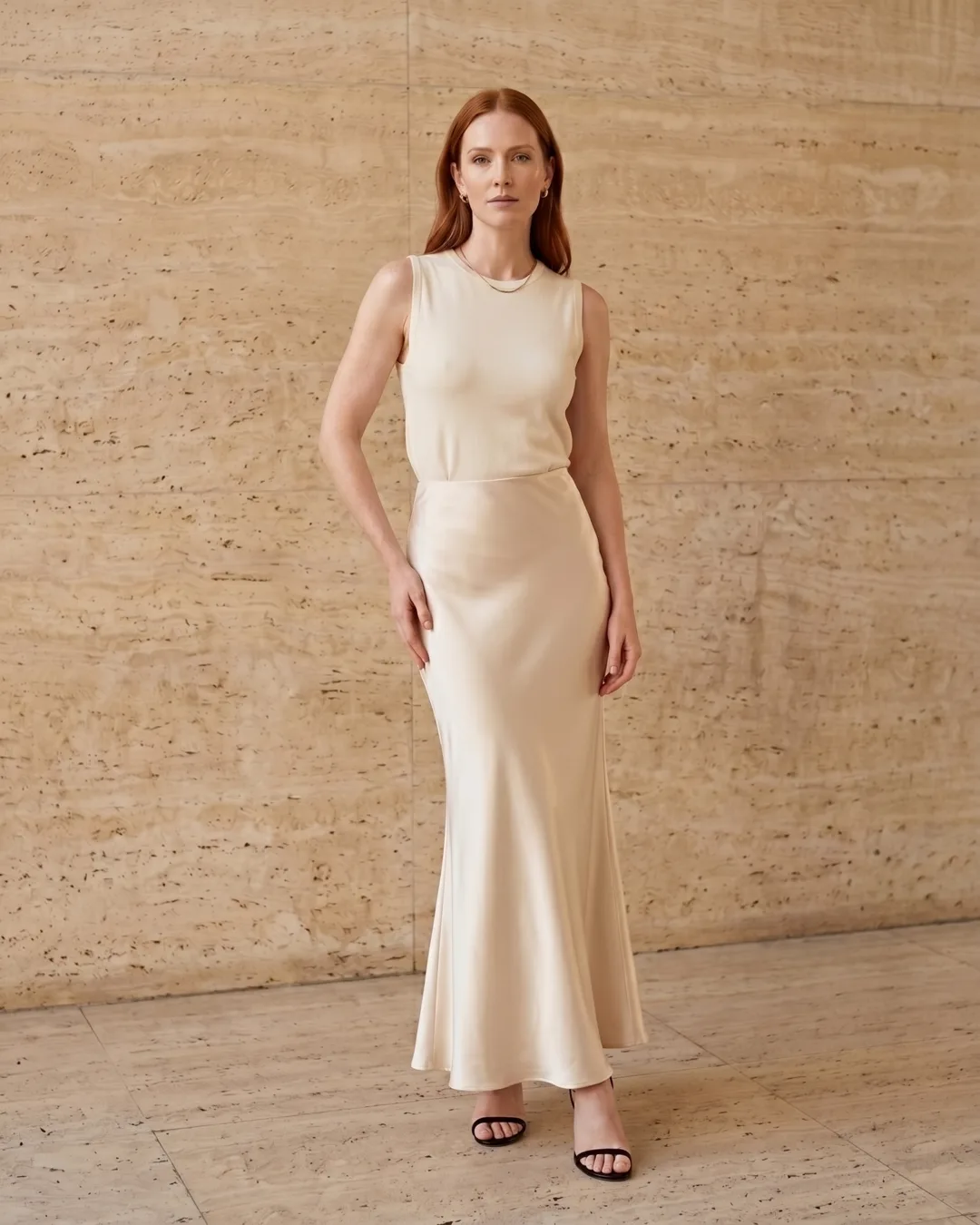
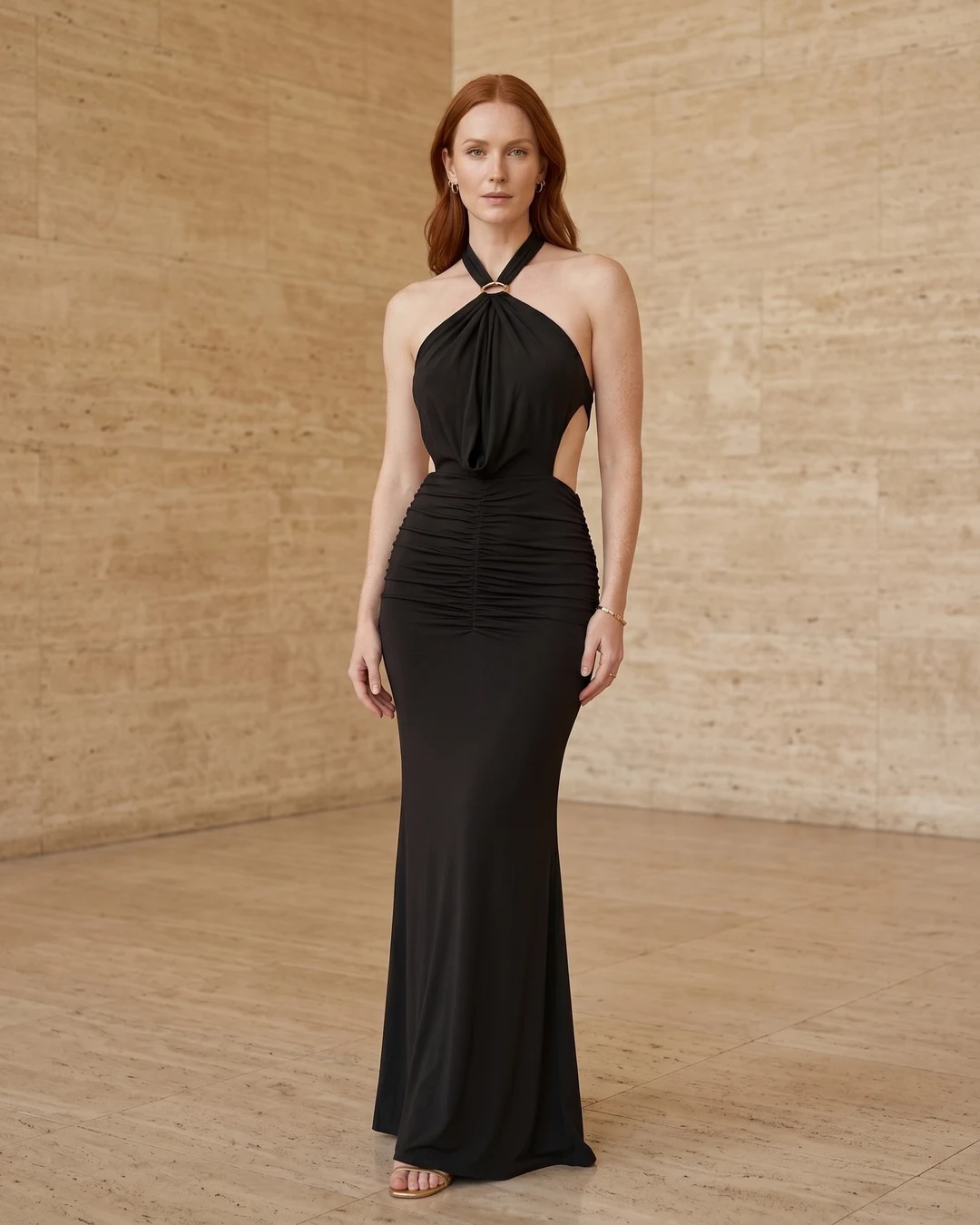
Best Occasion Dresses for a Pear Shape: Lift the Eye, Skim the Hip
The shapes, necklines and fabrics that balance a pear shape: A-line chiffon that skims the hip and a neckline that lifts the eye one body-third up.
On this page
The best occasion dress for a pear shape releases cleanly from the natural waist, glides over the hip in a fluid fabric, and carries a wide or bright neckline that pulls attention upward. Balance the two halves; never bury the lower one. This guide names the silhouettes, necklines and fabrics that earn it.
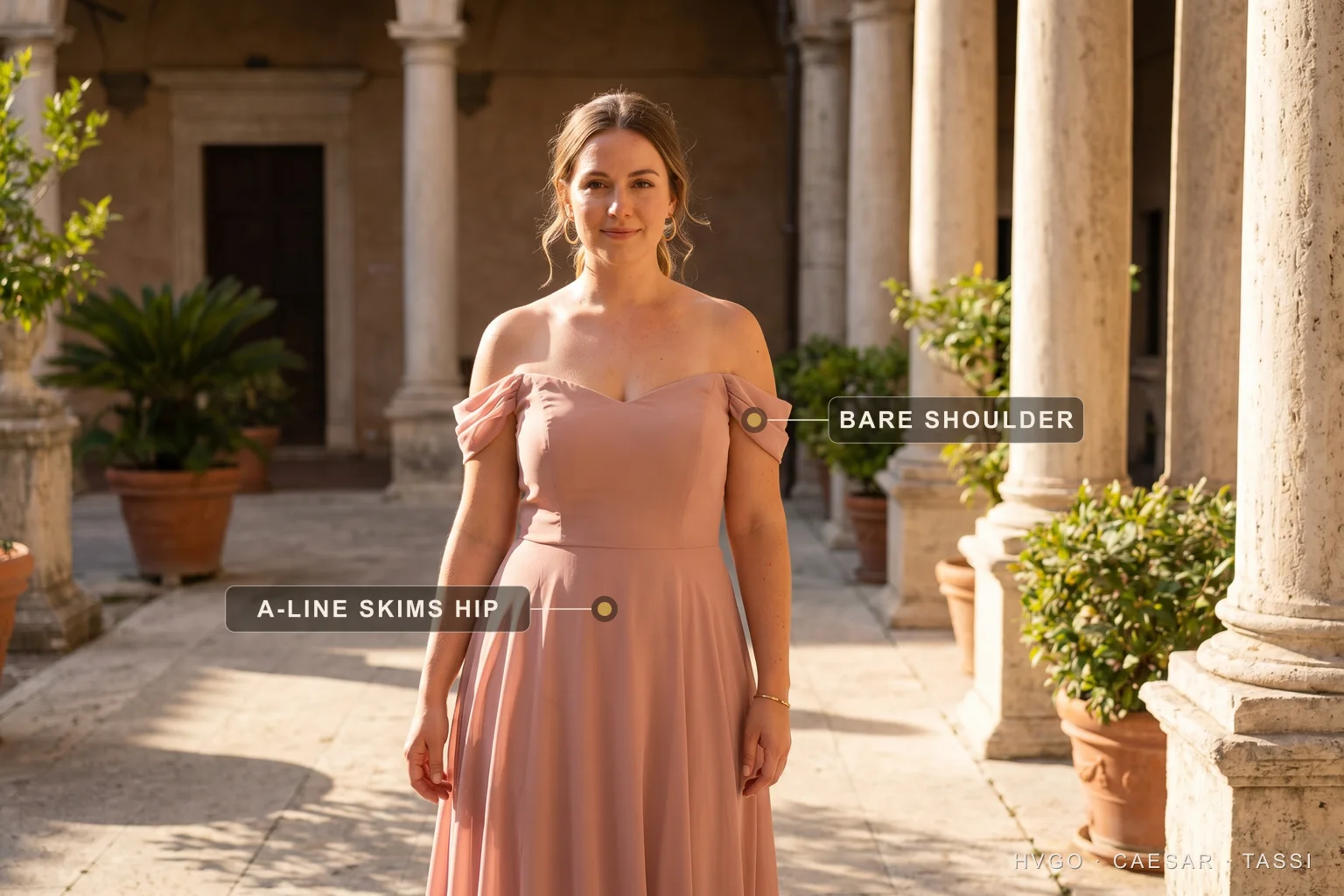
- Off-shoulder line broadens the shoulder
- A-line skirt skims the hip
Your pear-shape dress, in three steps
Tell us the moment and what to lift first — we’ll name the cuts that balance your line.
Enter your measurements (optional) to confirm the balance.
#What defines a pear shape, and what is a dress trying to balance?
A pear figure measures wider across the hips, seat and thighs than across the shoulders and bust, usually over a defined waist. The dress solves no flaw. Its job is to borrow width from below and lend it above until both ends read level. That single move, repeated through every silhouette here, is the entire brief.
#How a pear (triangle) figure is proportioned
This figure carries roughly 5–8 cm more circumference at the hipline than at the shoulder, with a waist that nips between them. Shoulders sit narrow, the bust reads small to medium, and visual mass settles low. Tailors call it the triangle for exactly that reason. Set it beside its neighbors and the contrast sharpens: an hourglass matches shoulder and hip within a centimeter or two, needing no rebalancing, while a rectangle shows little taper at the middle, so its task is to invent a waist. Only the triangle owns a top and bottom that genuinely disagree in width.
One variant catches people out. The spoon adds a high hip shelf, a visible ledge where the flesh flares above the thigh, so the seam must clear it. A standard waist seam lands true; a spoon wants 1–2 cm higher.
#The single goal: lift the eye and widen the shoulder line
Visual balance arrives by adding apparent width up top, not by shaving it off below. Broaden the collarbone with an open neckline, warm the upper third with color, and the hipline stops reading as the dominant line. Seat and thigh stay put; their relative weight shifts.
The tired instruction here is "wear dark on the bottom." It does half the work. A darker skirt recedes the hip, true, but left alone it yields a heavy base under a flat crown, and the proportion gap survives. The repair is a pairing: a deeper tone below and a brightened, structured top. Camouflage caps you at hiding; lift delivers a dress that suits the event. For the logic across all figures, the dressing for your figure pillar shows where the triangle sits.
#Which dress silhouettes balance a pear shape?
Every reliable cut shares one mechanic: the skirt leaves the waist and refuses to grip the hip. A-line, fit-and-flare, empire and full skirt all release at or above the widest point and drop free of it. The cuts that fail invert this, hugging precisely where you carry volume.
| Silhouette | Where the skirt releases | Hip read | Best occasion |
|---|---|---|---|
| A-line / fit-and-flare | natural waist | skims, never grips | day-to-formal, most events |
| Empire | under the bust | falls free of waist and hip | softer waist, fuller tummy |
| Full skirt / ball gown | natural waist, with volume | concealed top-down | black tie, formal weddings |
| Column / pencil | hip and thigh | clings to widest line | avoid |
| Stiff fishtail | knee, flaring outward | widens the widest point | avoid unless released low |
- Open or wide neckline — off-shoulder, boat or V broadens the shoulder, lifts the eye.
- Skirt released at the waist — an A-line or fit-and-flare skims, never grips the hip.
- Brighter, structured top — keep print and detail above the waist, deeper tone below.
- Column or pencil — traces the hip and thigh, the widest line.
- Drop-waist — sits the seam on the hip, stacking width.
- Stiff mermaid — erupts at the knee, over the widest point.
#A-line and fit-and-flare: the pear's default
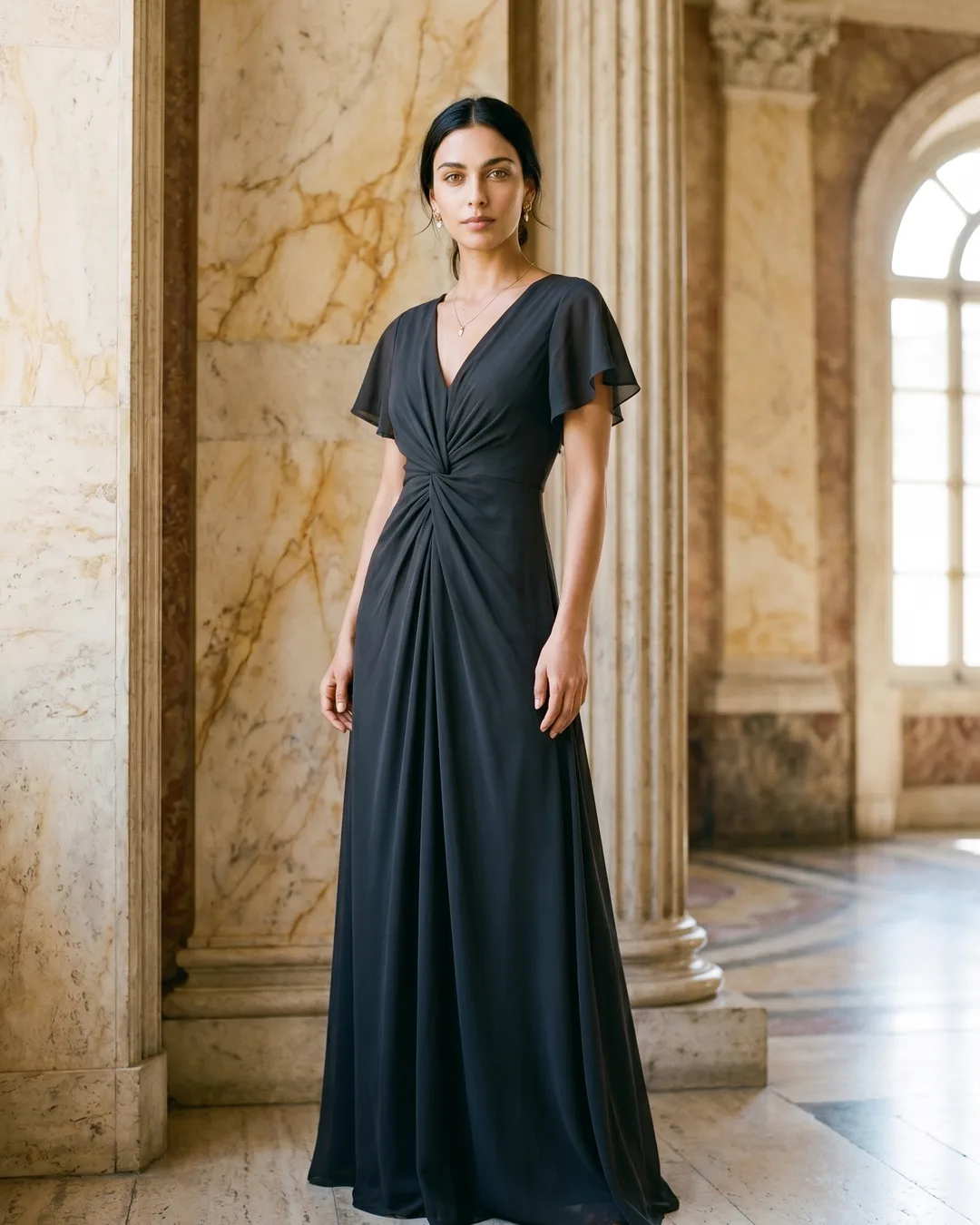
An A-line nips at the defined waist, then widens to the hem in a clean wedge, clearing thigh and seat without contact. Fit-and-flare repeats the trick with a closer bodice and a sharper kick, and both place the only fitted point where the body is smallest. The HCT Aemilia, an A-line chiffon maxi, runs this at full length; the Portia, a short-sleeve chiffon version, runs it shorter for daytime.
Length is the lever. A midi flatters most heights, while a maxi carries the line to the floor for evening. Watch one edge case: a very stiff cut in heavy cloth can stand off the body like a bell and read boxy, so reach for fluidity over structure.
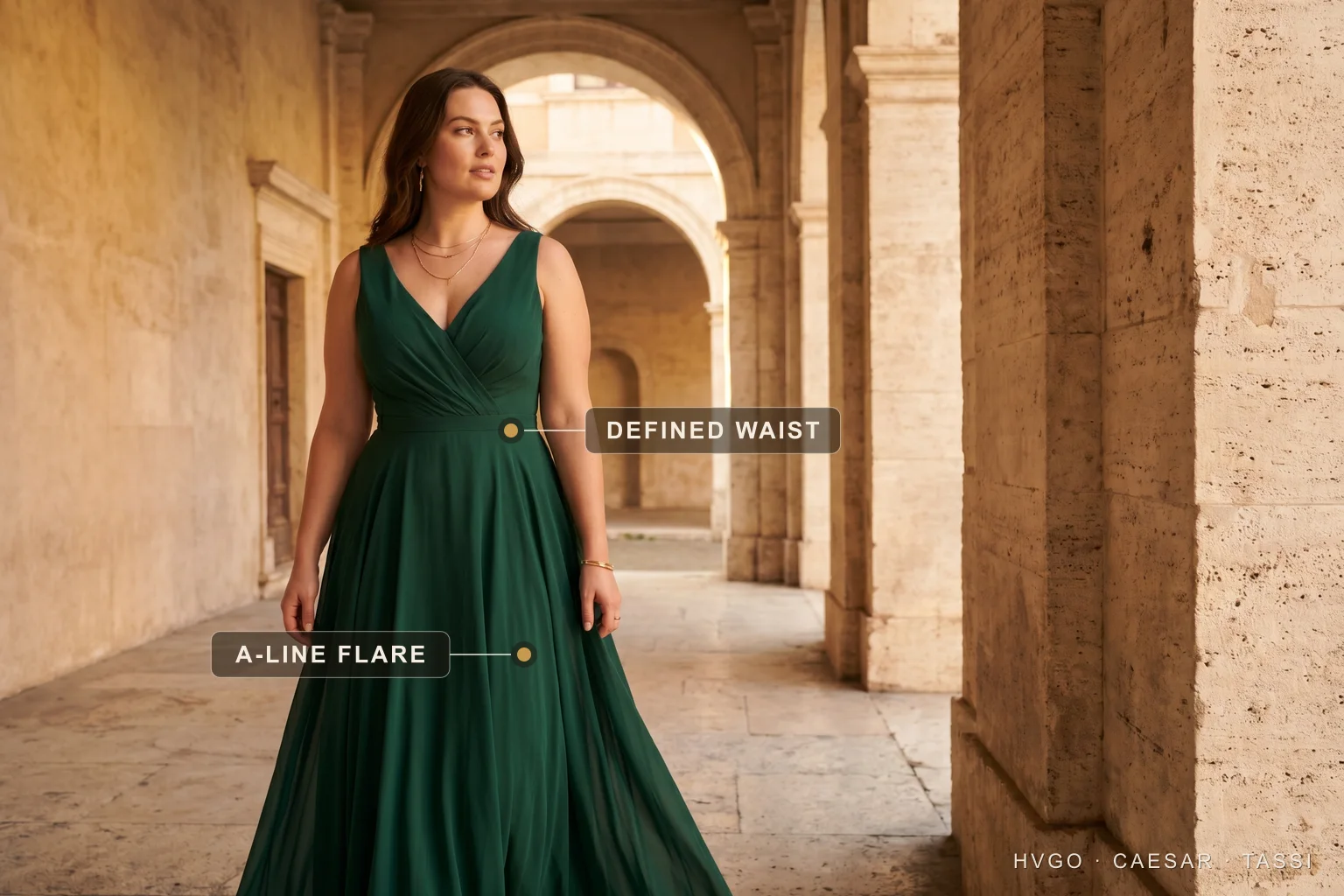
- Defined waist — the only fitted point
- Skirt flares clear of the hip
#Empire waist for a softer release
An empire seam sits directly under the bust and drops everything free from there, skipping waist and hipline. That makes it the better choice when the midriff is less defined, the tummy fuller, or a tight seam feels confining. The high line also reads as one long vertical, adding apparent height.
The trade-off is information. Floating over the middle, the cut reveals less of the waist, so a wearer with a striking waist surrenders her strongest asset. Pick empire for ease; choose A-line when you want the waist on show.
#Full-skirt and ball-gown for black tie
A structured full skirt buries the hipline under volume and resets proportion from the shoulders down, which is why galas and formal weddings suit it. Run wide enough, the hip vanishes as a reference and the eye reads the bodice and the sweep. The Claudia, a pleated-slit chiffon gown, reaches a kindred effect through pleats that fall clean from the waist rather than sheer mass.
The counter-case is scale. A petite frame can disappear inside a true ball gown, so the fuller the skirt, the more height it demands; below roughly 165 cm, a moderate maxi flatters where a vast skirt swamps.
#Silhouettes to approach with care
Three cuts fight the figure rather than serve it. A column or pencil traces hip and thigh directly, advertising the broadest line. A drop-waist parks its seam onto the hip, stacking width where it already gathers. A stiff mermaid clamps through the thigh and erupts at the knee, landing its flare over the widest body.
One exception is precise. A soft fishtail that releases below mid-thigh grazes seat and thigh first, then breaks late, keeping volume off the widest point. Cut high and rigid, that same outline becomes the worst choice on the list.
#Adjusting the rule for a petite or tall pear shape
Height changes the hemline math, never the principle. A petite frame keeps the skirt to midi or tea length and the seam high and crisp, so the lower half never engulfs her; a maxi can foreshorten her by hiding the leg. A taller frame carries a sweeping maxi and a longer torso with ease, letting the seam sit true rather than raised.
The shared law holds either way: the seam is the lift point, landing at or just above the natural waist whatever the height. Drop it and the skirt begins on the hip, undoing the balance.
#Which necklines and shoulders draw the eye upward on a pear shape?
A neckline rebalances two ways: a horizontal line widens the shoulder, a vertical line carries attention to the face. Either pulls the gaze up and off the hip, and either outranks the skirt as the first thing a room registers. The dress necklines explained guide details each shape; below is how they serve the triangle.
#Open and horizontal necklines that broaden the shoulder
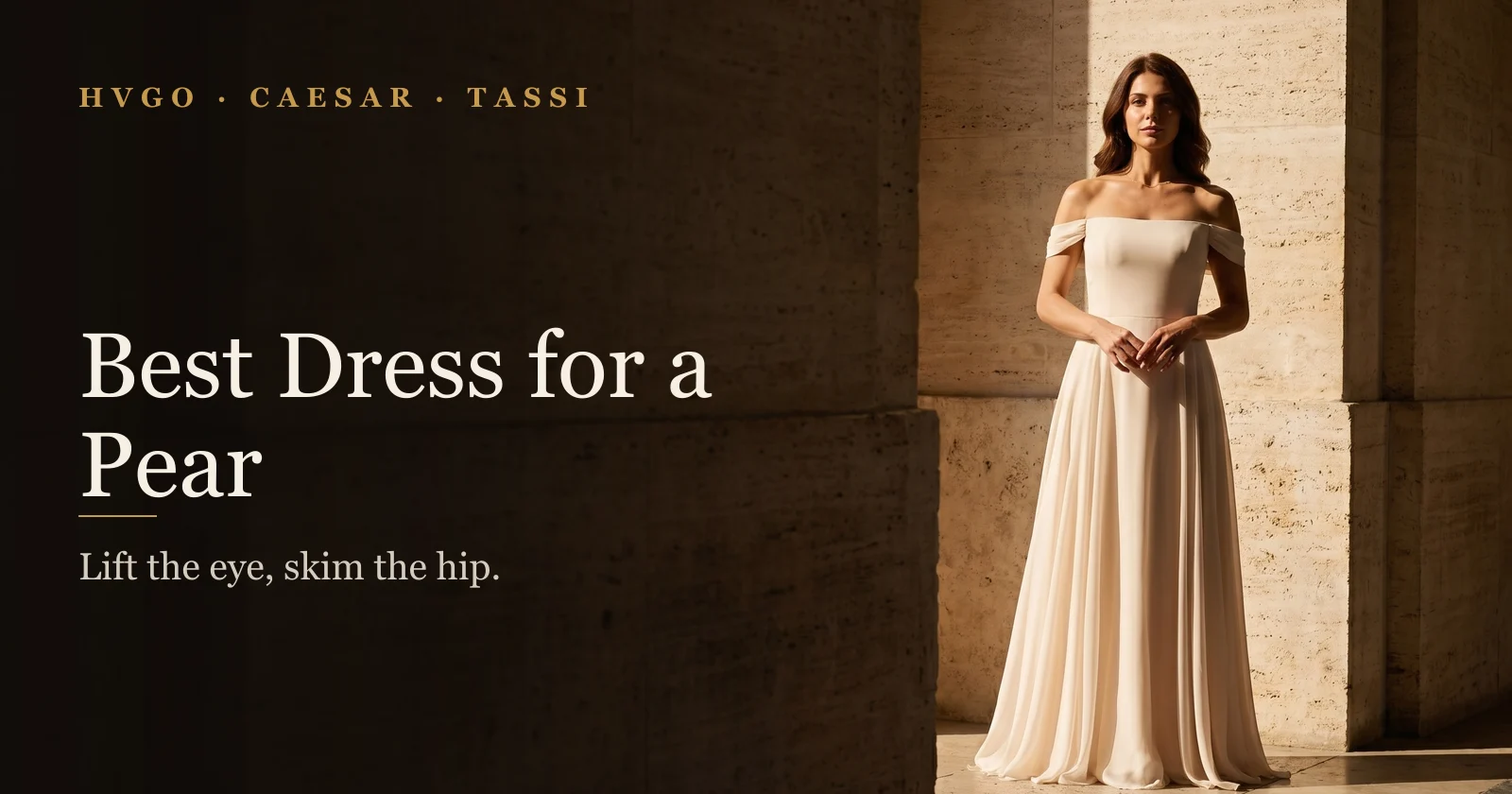
An off-the-shoulder or bardot line rides across the collarbone and bares 10–15 cm of shoulder, drawing a strong horizontal that widens the upper body toward the hip. Boat and sabrina cuts do it more demurely; square and sweetheart shapes frame the décolletage and open the chest. The Flavia, a strapless off-shoulder satin gown, is built around this widening line, and the wider the bared span, the more upper width the eye reads against the lower half.
Caution lives in bust scale. On a fuller chest the bared line can read top-heavy and tip the balance too far, so a generous bust leans to a soft boat neck over a wide bardot.
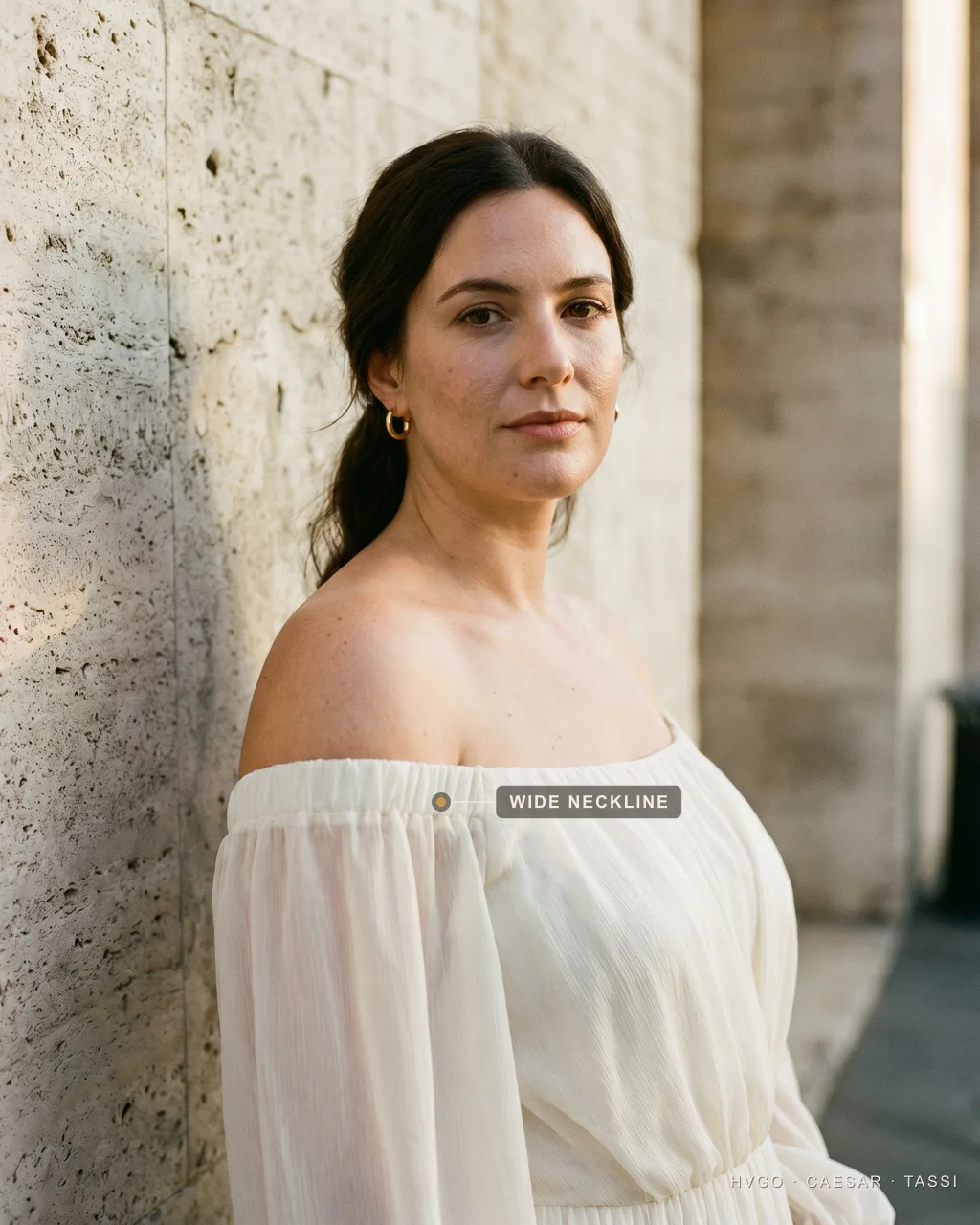
- Wide neckline broadens the shoulder and lifts the eye
#V-neck, halter and one-shoulder for height
A V-neck cuts a vertical down the chest and a sightline to the face, lengthening the torso and flattering a smaller bust. A halter runs the line up the neck and bares the shoulder; a one-shoulder plants an asymmetric focal point the gaze chases. Each trades horizontal width for vertical lift, useful when broadening matters less than elongating.
Where it slips: a deep, narrow V can read as a downward arrow on slight shoulders, so anchor it with a sleeve detail that restores some width.
#Sleeves and shoulder detail as the lift
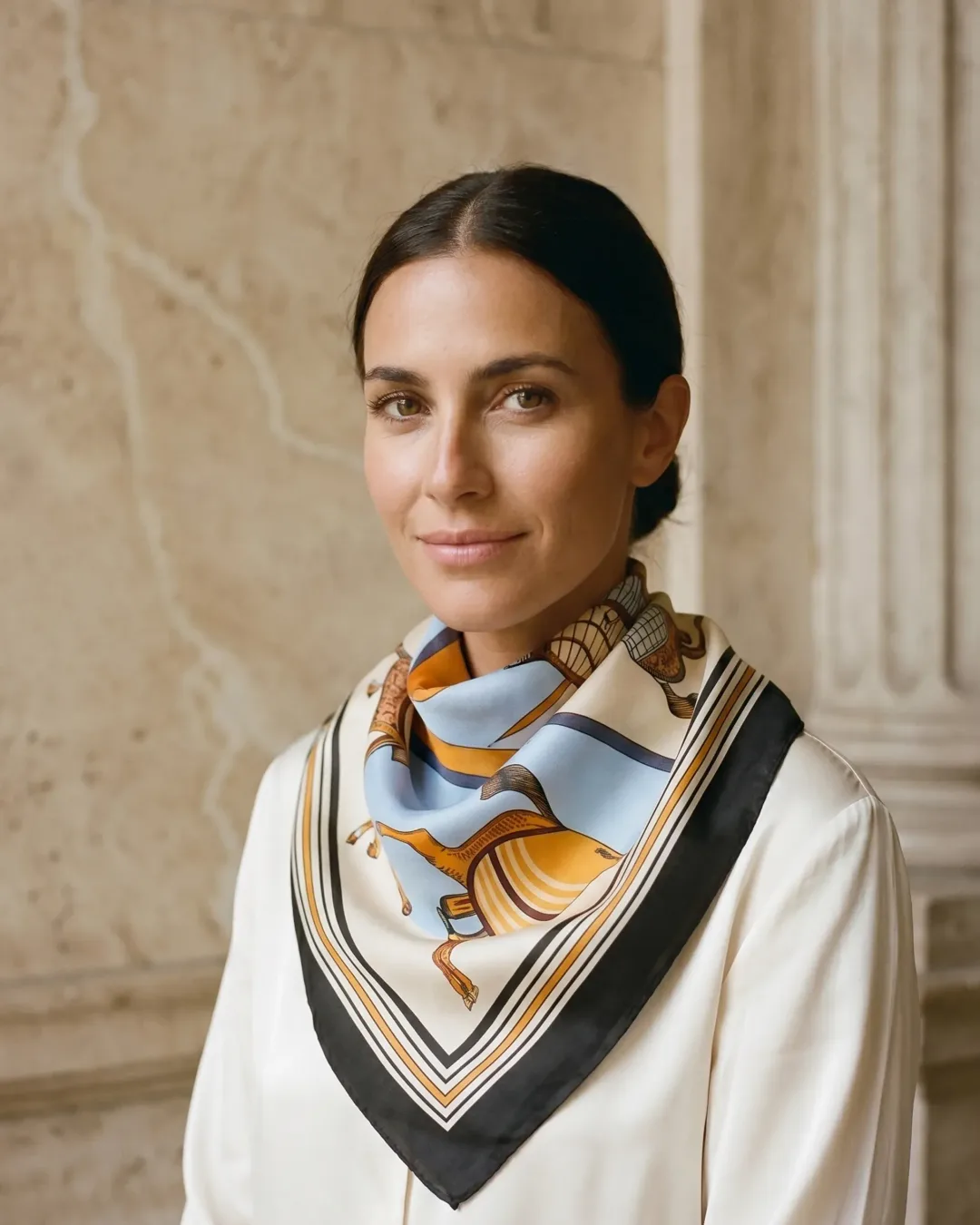
Flutter, puff and bishop sleeves add visible width at the shoulder, the cheapest structural broadening on offer. A little embellishment or light padding achieves the same with less bulk. Knot one Carina or Vesta silk square at the collarbone and the gaze settles there, well clear of the hip.
The trap is doubling up. A puff sleeve plus a wide bardot plus heavy beading overloads the top and breaks balance the other way, so commit to one shoulder device, not three.
#Which fabrics skim a pear shape's fuller hip instead of clinging?
Fluid cloth falls past the seat and thigh; stiff or clingy cloth snags on them and broadcasts the width. Drape decides this, not the fiber's name, and the right weight glides where a tight knit would map every curve. A flattering cut lives or dies here.
#Why drape beats stiffness on the lower half
High-drape cloth such as chiffon or modal jersey hangs in soft vertical falls that leave the waist and clear the hip without touching down. A stiff weave holds its own form and balloons off the body; a clingy stretch molds to the thigh. Skimming grazes the widest point and keeps falling; clinging stops there and grips.
#Chiffon, satin, crepe and modal on a pear figure
Airy chiffon over a clean lining glides best of all, the lining carrying the shape while the chiffon floats clear of the seat. Bias-cut satin skims when generous and clings the instant it goes narrow, so the cut beats the fiber every time. Matte crepe stays forgiving in an A-line yet turns boxy in a column, and draped modal jersey is the most lenient of all over thigh and hip. The dress silhouettes guide pairs each cut to its cloth in depth.
#Color and print, placed correctly
Recast the dark-below habit as a pairing: a richer tone underneath and a brighter neckline above does the lifting that darkness alone never finishes. Concentrate prints and beading near collarbone and face, so the detail draws the gaze where you want it. The HCT imperial palette offers ready-made top-light, bottom-deep pairings: Avorio (ivory) or Cipria (pink) at the neckline over Porpora (wine) or Basalt (black) below.
Mind the print scale on the skirt. A large, high-contrast motif across the hip enlarges it, the opposite of the aim, so keep bold pattern above the seam and let the lower half stay quiet.
#Lining, structure and the right foundation underneath
A clean built-in lining lets chiffon and satin slide past the hip rather than catching on skin or seams. HCT dresses are fully lined with a concealed zip for precisely this. Beneath, seam-free shaping briefs and a smoothing slip keep the surface even, so a fluid skirt reads as one unbroken fall.
What wrecks it is hardware. A hip-level seam, a grip-line edge or a hard waistband prints through thin chiffon and snaps the line, so reach for foundations that skim rather than bind.
#What to wear to a wedding, gala or the races as a pear shape
Match the cut to the dress code, but hold the rule constant: waist-released skirt, lifted neckline. Only length, fabric weight and formality move between a daytime wedding and a black-tie gala. Pin down the code first, then choose.
#Cocktail and semi-formal weddings
A fit-and-flare or A-line midi with an open neckline reads correctly semi-formal and balances the figure at once. Tea length suits a daytime ceremony, where light chiffon over lining keeps the look unfussy. The Livilla, a floral-print chiffon midi, holds print and float up top for this exact brief.
#Black tie and the opera
Black tie calls for a full-skirt or A-line maxi with a statement neckline and a defined shoulder. The long line carries the formality, while the off-shoulder or wide bodice does the lifting. Volume below paired with a strong shoulder above gives the most gain here.
#Race day and garden events
Race day rewards an A-line with a marked waist and a neckline that clears a hat or fascinator brim, so a boat or square neck beats a tall halter. Keep the palette pale up top to lift the gaze under a wide brim, and let the skirt move in open air.
#How Hugo Caesar Tassi cuts dresses for a pear shape
Hugo Caesar Tassi cuts for the triangle by pairing a structured neckline with a waist-released A-line in airy cloth, shifting the visual weight up by one body-third. The house has designed occasionwear from Roma since 2004 under the motto Nata Imperare, and its proportion doctrine is quantified, not vague.
#The house one-third lift rule
The one-third lift rule joins a structured neckline to an A-line that releases from the natural waist in cloth light enough to glide, moving the gaze up by a measured third of the body. It names the amount where generic advice names only a direction. The figure needs that exact third, no more, or the balance overshoots and the top reads heavy.
#The dresses we steer pear clients to
Five HCT dresses run the rule directly, each on a different mechanic.
- Aemilia, an A-line chiffon maxi: the skirt releases from the waist and the chiffon glides over the hip on a clean lining.
- Portia, a short-sleeve chiffon A-line: the same glide at midi length, with a soft sleeve adding shoulder width.
- Flavia, a strapless satin off-shoulder gown: the bared line broadens the shoulder toward the hip.
- Livilla, a floral-print chiffon midi: print and float held aloft, the lower half left calm.
- Claudia, a pleated-slit chiffon evening gown: pleats falling clean from the waist with a high focal slit.
What the atelier learned fitting the pear shape
Across the house’s fitting studio, one move balanced every pear-shape fit model: lift, never hide. Borrowing width up top with an open neckline and releasing the skirt from the waist read level and elegant, where ‘dark on the bottom’ alone left a heavy base under a flat crown. The findings below are how the studio now cuts for the triangle.
| Cut | What the studio observed | Verdict |
|---|---|---|
| A-line / fit-and-flare | Releases at the waist and skims the hip; the figure’s most reliable cut. | Best |
| Off-shoulder / boat neck | Draws a horizontal that broadens the shoulder toward the hip. | Best |
| Empire | Drops free from under the bust; kind to a softer waist or fuller tummy. | Best |
| Full skirt / ball gown | Buries the hipline under volume; resets proportion for black tie. | Best for evening |
| Column / pencil | Traces the hip and thigh and advertises the broadest line. | Skip |
| Stiff mermaid | Clamps the thigh and flares at the knee, over the widest point. | Skip |
The rule the study produced: lift the eye, skim the hip — borrow width up top and let the skirt fall free below.
#Your pear-shape dress checklist
Run this before you buy: waist-released skirt, lifted neckline, fluid fabric, brighter top, deeper base. It folds the whole guide into a fitting-room test you can apply to any dress in under a minute.
#The quick recap
| Do | Don't |
|---|---|
| Choose an A-line or empire skirt that leaves the waist | Pick a column or pencil that clings to the hip |
| Open the neckline or run a vertical V to raise the gaze | Leave the shoulder flat and bare of detail |
| Add a sleeve, pad or shoulder accent for width up top | Stack three shoulder devices and overload the crown |
| Wear fluid chiffon, modal or generous-cut satin | Wear a stiff mermaid that erupts at the widest point |
| Place brightness and print above the seam | Run a large bold motif across the hip |
| Keep the deeper tone and quiet detail below | Lean on dark-below alone to do the balancing |
#Where to go next
Confirm your shape first, then read the related guides before you shop. Already balanced top and bottom? The hourglass figure guide fits you; carrying width higher through the midsection? The apple shape guide does. Ready to buy, the A-line chiffon dresses edit holds the cuts named here.
#Frequently asked questions
What is the best dress style for a pear shape?
The best dress style for a pear shape is an A-line or fit-and-flare that releases from the natural waist and glides over the hip. Pair it with an open or statement neckline that broadens the shoulder and raises the gaze, keeping the waist as the only closely fitted point.
Should a pear shape wear an A-line dress?
A pear shape should wear an A-line dress, because it is the figure's most reliable silhouette. The cut nips at the defined waist, then floats clear of the hips, balancing a fuller base against a narrower crown. Worn in chiffon over a clean lining, it glides rather than grips.
Do off-the-shoulder dresses suit a pear shape?
Off-the-shoulder dresses suit a pear shape well, drawing a horizontal across the collarbone that broadens the upper body. That added width brings the shoulders into balance with the hips. A fuller bust softens the effect with a boat neck instead.
What dresses should a pear shape avoid?
A pear shape should avoid hip-clinging columns, drop-waist styles and stiff mermaid cuts that flare at the widest point. Each one adds or traces width exactly where the figure already gathers it. Choose a skirt that leaves the waist instead.
What necklines flatter a pear shaped body?
The necklines that flatter a pear shaped body are open horizontals and lengthening verticals. Off-shoulder, boat, square and sweetheart cuts broaden the shoulder, while a V-neck, halter or one-shoulder runs a vertical to the face. Both pull attention off the hip.
Can a pear shape wear a fitted maxi dress?
A pear shape can wear a fitted maxi dress when it fits at the waist and falls in fluid cloth like chiffon or draped modal. The skirt then glides rather than grips. Avoid a narrow stretch column that clings to the thigh.
Not sure you read as a pear shape? Confirm it with the body-shape finder at body-shape finder, then find the cut that lifts your line in the occasion edit, or begin with the A-line chiffon styles in the chiffon collection.
More Body Shape guides
Best Dresses for an Apple Shape
The apple-shape dresses that skim a fuller middle with cut, not shapewear: empire seams, bias drape and fluid crepe from the Roman atelier of HCT.
See the apple-shape editElegant Dresses for Women Over 50
Occasion dresses that flatter over 50 — a three-quarter sleeve, soft V neck and crepe that skims. The age-positive guide to weddings and evenings.
Dressing well over 50Best Dresses for an Hourglass Figure
The silhouettes, fabrics and necklines that trace an hourglass figure instead of hiding it, plus the atelier fluid-weight rule and HCT gowns to shop.
See the hourglass editHow to Find Your Body Shape
Take three measurements and learn your body shape for sure with the atelier ratio method and exact thresholds, not vague compare-to-fruit guesswork.
Find your body shapeHow to Dress an Inverted Triangle Body Shape
Open the neckline into a soft V to narrow broad shoulders, then add a skirt-width of pleated-chiffon volume at the hip until your shape reads balanced.
Style the inverted triangleThe Petite Woman's Guide to Occasion Dresses
The lengths, waistlines and silhouettes that lengthen a petite frame, with the exact hem rule and the one-color column that reads taller.
See the petite edit