What to Wear to an Italian Wedding: A Guest's Dress Code, Decoded
A Roman house decodes what to wear to an Italian wedding: the real no-black and no-white rules, church cover-up, and North-vs-South dress code.
On this page
Wear a dressy midi or fluid maxi in a rich, non-white color, shoulders covered for the church, in a fabric that survives heat and a five-hour banquet. Two rules outrank the rest: leave white to the bride, and treat black with caution. Everything else flexes by region, season, and ceremony.
This is the Hugo Caesar Tassi atelier's first-party brief on dressing as an invitata (a woman guest), written from Rome for the wedding you've actually been invited to.
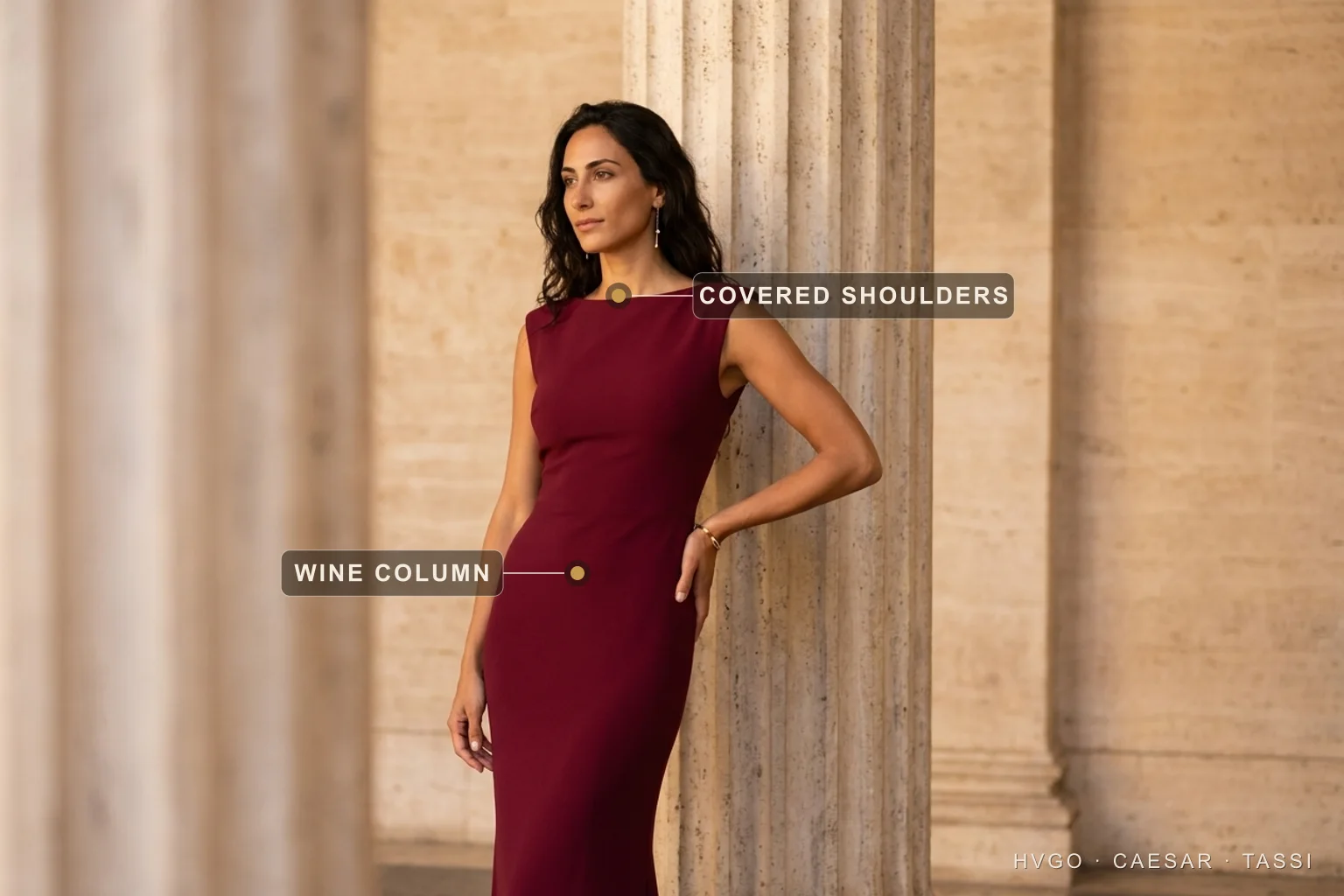
- Covered shoulders
- Wine column
An Italian wedding, decoded
European weddings dress up; church ceremonies need covered shoulders.
Shop occasion dresses#What should you wear to an Italian wedding? The short answer for a guest
Choose a colorful, knee-or-longer dress, cover your shoulders for the ceremony, and pick a fabric that breathes through a long day. An Italian wedding rewards confident color and quiet polish, never white and rarely full black, across a matrimonio that runs from a late-morning rite through an aperitivo to a long banquet and dancing past midnight.
#The one-line verdict before the details
Picture a Cornelia rose chiffon midi with the shoulders covered by a folded silk square: that outfit lands well at almost any Italian wedding. The verdict compresses to four words: elegant, colorful, covered, never bridal.
Take a Tuscan vineyard at noon in July, where a fluid Aemilia A-line chiffon maxi in Verde Antico green earns its place with a silk scarf for the blessing and a block heel for the gravel. Shift that same day to a December comune ceremony in Milan and the chiffon leaves you cold; a structured crepe column in Cobalto navy holds the room instead.
#First, read the ceremony, the region, and the season
Three variables reset the brief: civil versus church, North versus South, and high summer versus spring or autumn. Each gets its own section below, so resist deciding before you've read all three. The formality ladder itself (cocktail, formal, black-tie) lives one level up in our dress-code guide, since this page stays cultural rather than definitional.
#Civil or Catholic? How the Italian wedding ceremony decides your outfit
The ceremony type sets your coverage: a Catholic rite demands covered shoulders and a modest hem, while a civil one relaxes both. Read the invitation for chiesa (church) or comune (town hall) first, because that word changes your neckline, hem, and cover-up.
#A church wedding (matrimonio religioso): cover up for the chiesa
A Catholic ceremony expects covered shoulders, no plunging neckline, and a hem at or below the knee. The elegant solution dresses a sleeveless gown for the rite, then reveals it for the reception: wear a strapless Flavia satin gown, drape a silk square across the shoulders for the vows, and fold it into the clutch once you reach the garden. Watch the small rooms, though. A sacristy or chapel wedding runs stricter than a cathedral, and a neckline that passes from twenty pews back looks bare up close.
#A civil wedding (matrimonio civile) at the comune
A civil ceremony loosens the coverage rule but never the polish, so a sleeveless dress needs no scarf. The venue resets the formality more than the legal form does: a Renaissance palazzo asks for the same restraint a church would, whereas a garden comune lets a guest lighten to a printed chiffon.
#From ceremony to banquet to ballroom: dressing the long day
The Italian wedding day arcs across roughly ten hours, so one outfit must carry a covered church through a candlelit dinner: add a scarf for the rite, shed it for the dancing. You will sit, toast, and dance late, so choose a waist you can eat in and a fabric that moves.
#Can you wear black to an Italian wedding? The real convention
Black is not banned, but it reads riskier in Italy than in the States because it still carries a mourning association for older guests. The honest verdict is caution, not prohibition: younger and Northern Italians now accept it, while a traditional family weighs it against lutto (mourning).
#Why black still carries a mourning association in Italy
Head-to-toe black at a celebration can register as funereal to a grandmother who wore lutto for a year after a loss, an association strongest among older and Southern relatives and faintest among younger Milanese guests. A black dress that flatters at a sleek Como reception can unsettle the nonna at a small family wedding in Noto.
#How to wear black safely if you choose it
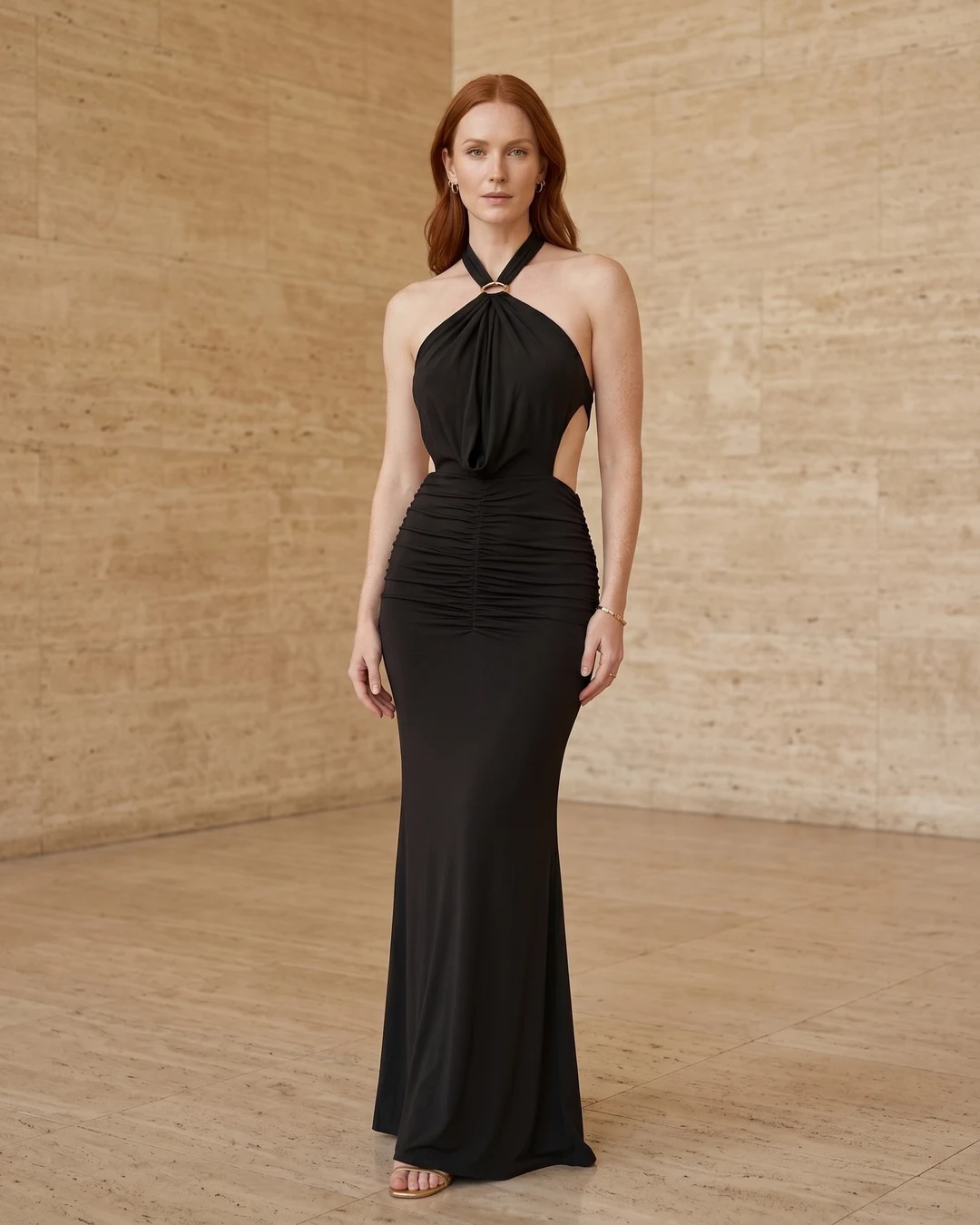
Break the black with color and reserve it for the evening: a Cornelia rose silk scarf, a Vermiglio red clutch, or a floral print over a black base lifts the look out of mourning territory, and skip it entirely when the guest list runs traditional, Southern, or family-heavy. One setting forgives pure black outright, a black-tie reception in the North, where a fluid evening column in Basalt looks polished rather than somber.
#Why you can't wear white to an Italian wedding (and the shades that count as white)
White belongs to the sposa (the bride) alone, and the rule extends to ivory, cream, champagne, and blush-white. Wearing it is a genuine brutta figura (a bad impression), enforced as firmly in Italy as anywhere on earth, and no regional softening applies.
#Leave white to the sposa
Arriving in cream beside a bride in ivory creates exactly the confusion the rule prevents, so the fix is a different color family, not a careful shade of off-white.
#The near-white shades that also read bridal
Ivory (the house calls it Avorio), cream, champagne, and blush-white all photograph as bridal under bright Italian sun. The camera flattens subtle warmth, so a "barely off-white" dress you trust in the mirror betrays you in the album.
#How to cover your shoulders and knees for an Italian church wedding
Cover your shoulders, avoid bare straps, keep the neckline modest enough to kneel and lean, and hold a knee-or-longer hem. This rule applies to a Catholic ceremony specifically: dress for the building, then undress for the party.
#The coverage rule for a Catholic ceremony
Shoulders stay covered, straps get layered or avoided, and the hem sits at the knee or below for a Catholic rite, while a relaxed civil or garden wedding drops most of this. A guest sits, stands, and kneels through a Mass, so a neckline that gapes when she bends fails the rite.
#The silk scarf as the elegant Italian cover-up
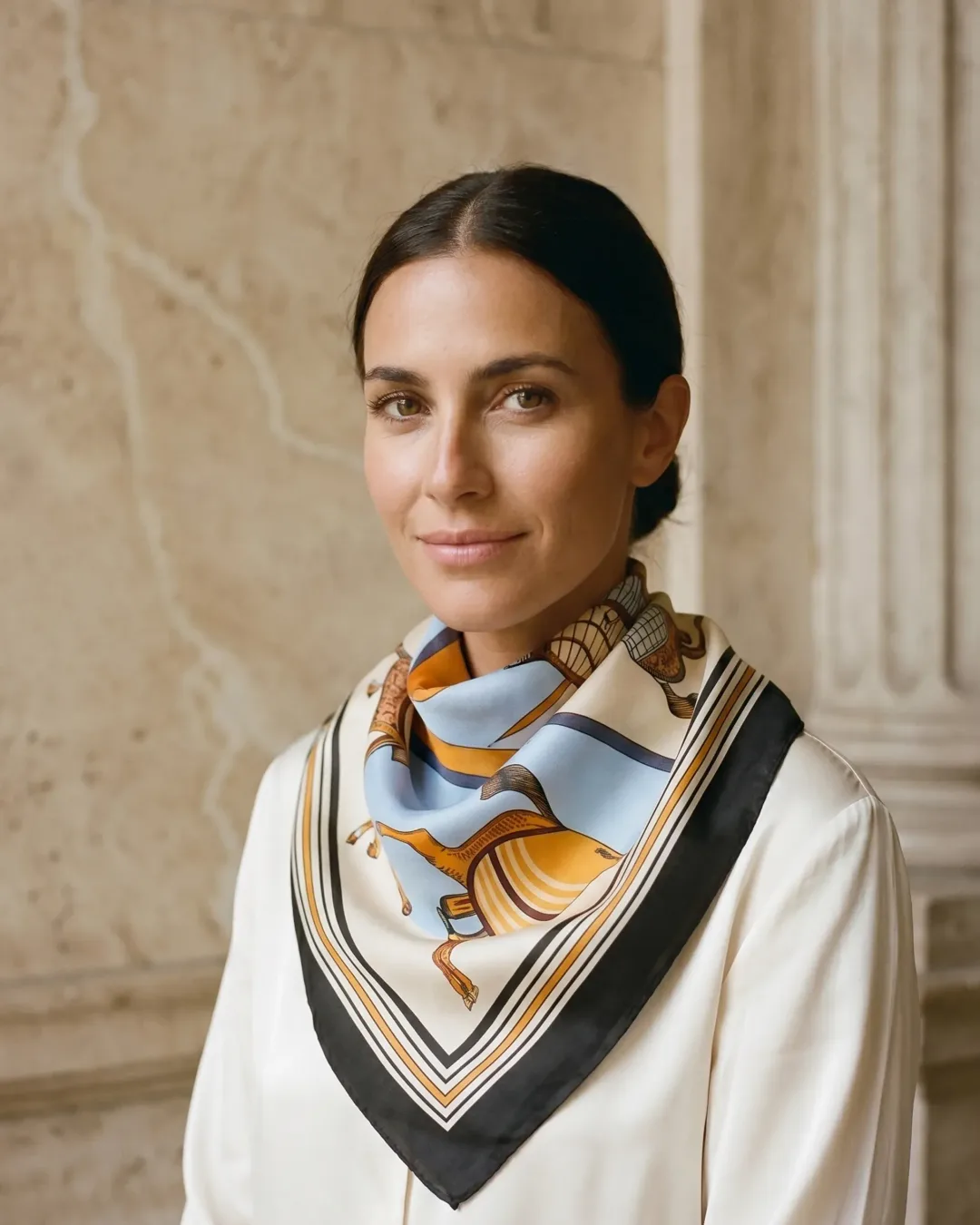
A large silk square worn over the shoulders for the rite, then folded into a clutch once outside, is this page's signature solution, and a coprispalle (a shawl) does the same with more drama. Either beats a bolero or shrug in summer, because silk breathes where a knit layer traps heat.
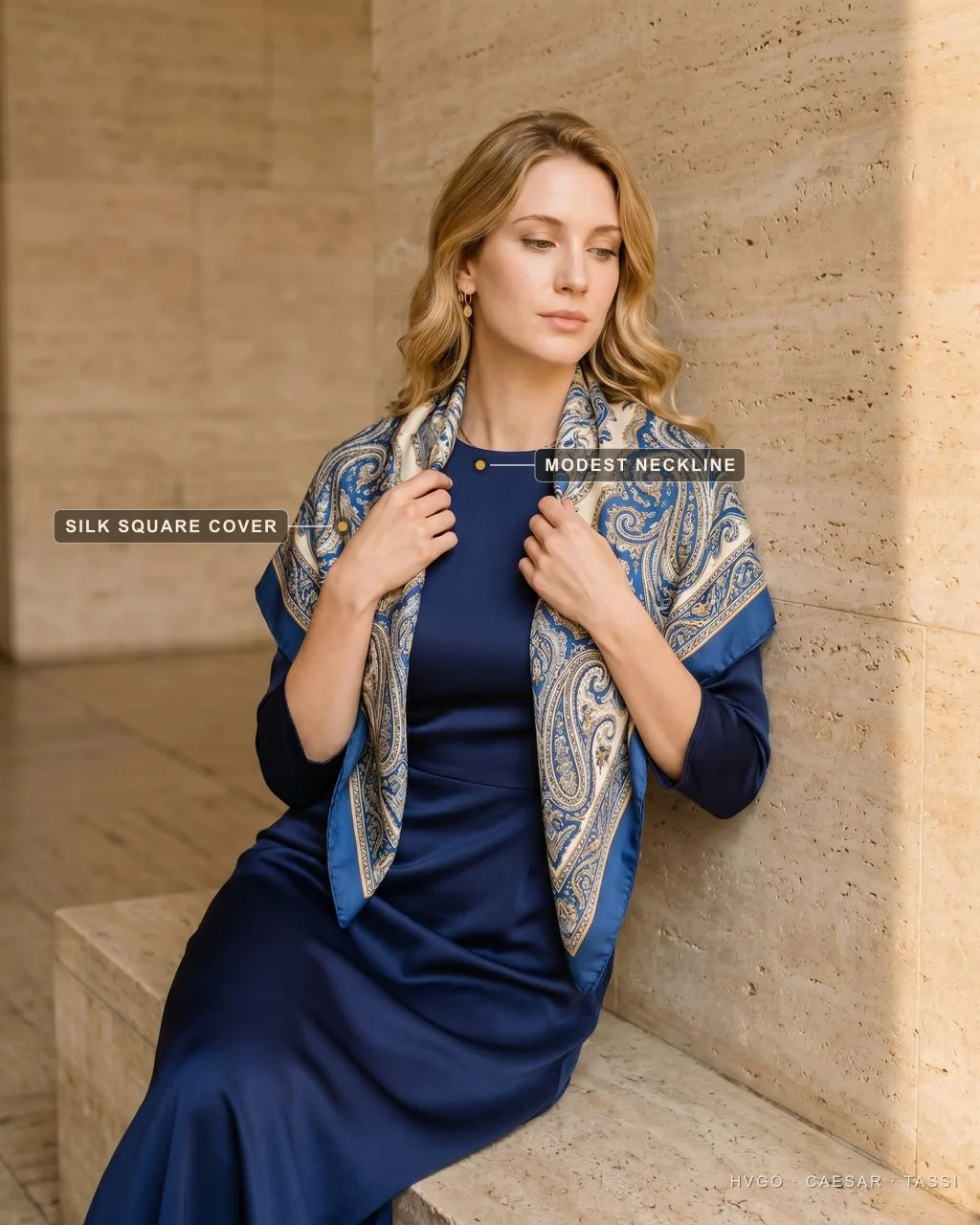
- Silk square cover
- Modest neckline
Knot a Palmyra twill silk square at the shoulders over a Julia French-pleated chiffon maxi for the vows, then loosen it into an evening layer once the dancing starts. Browse the silk scarves for the cover-up, and read the silk scarf care guide to keep it crisp.
#North versus South: does an Italian wedding's region change what you wear?
Yes, region changes the brief: Northern weddings lean sleeker, cooler-toned, and more formal, while Southern ones run warmer, brighter, and more exuberant. Dress Milan-restrained for a Puglia masseria and you underplay the room; do the reverse and you overplay it. Generic wedding guides translate one Italy; the country dresses as at least two.
#Northern Italy: sleeker, cooler, more formal
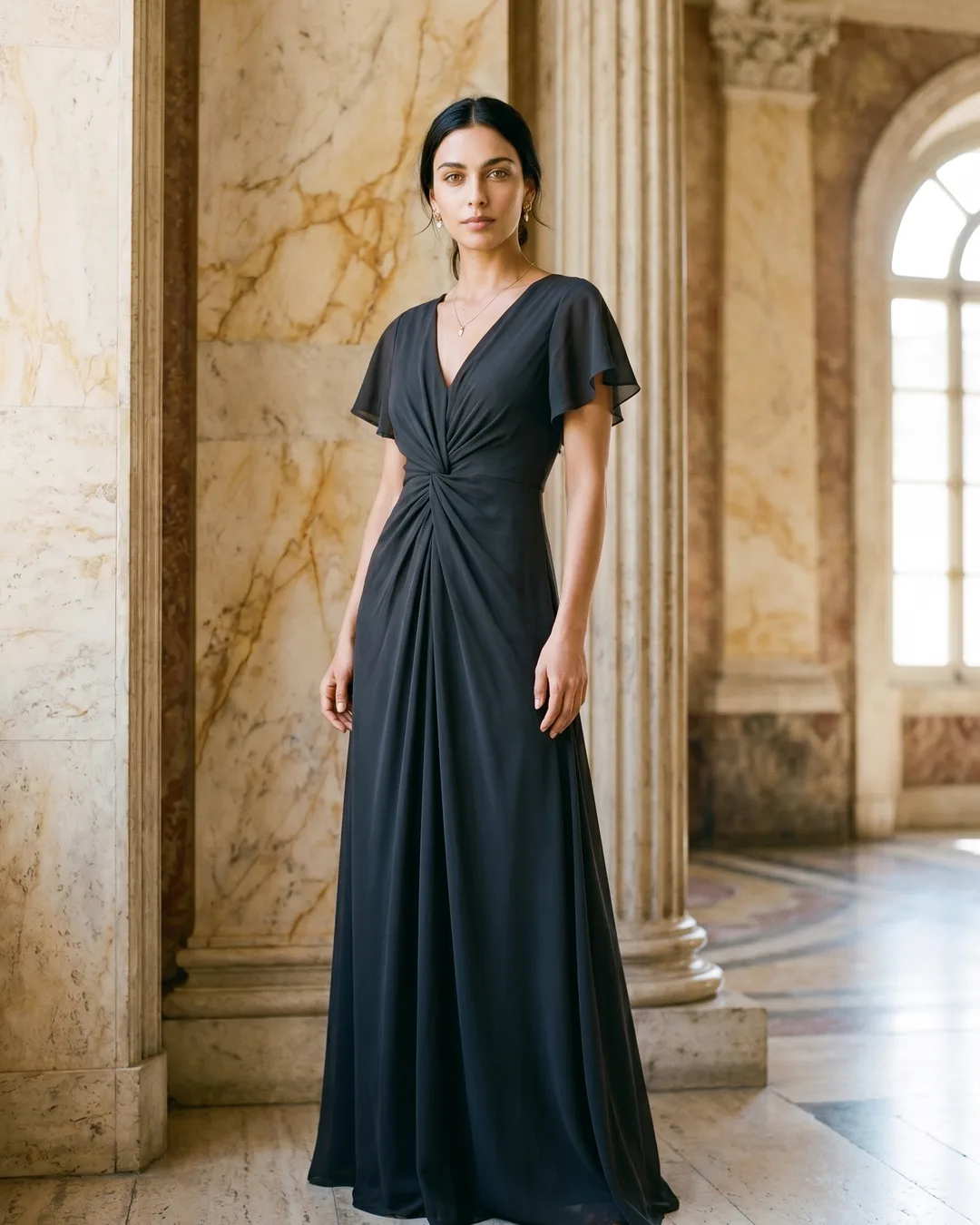
Milan, Lake Como, and the Veneto favor refined, restrained dressing: a column or tailored silhouette in an understated palette, like a Tullia pleated crepe column in Cobalto navy or a Vipsania draped modal column in Travertine stone. At a Como villa in September, a structured maxi sits right against the stone, where a vivid floral would shout louder than the setting wants.
#Southern Italy: warmer, brighter, more exuberant
Naples, Puglia, and Sicily lean warmer, more colorful, and more celebratory, where florals, jewel tones, and fluid fabrics belong, answered by a Livilla floral-print chiffon midi or a Vermiglio red maxi. The festive South welcomes more print and saturation than a Northern reception would, so a guest who dresses safely neutral in Sicily can read as underdressed.
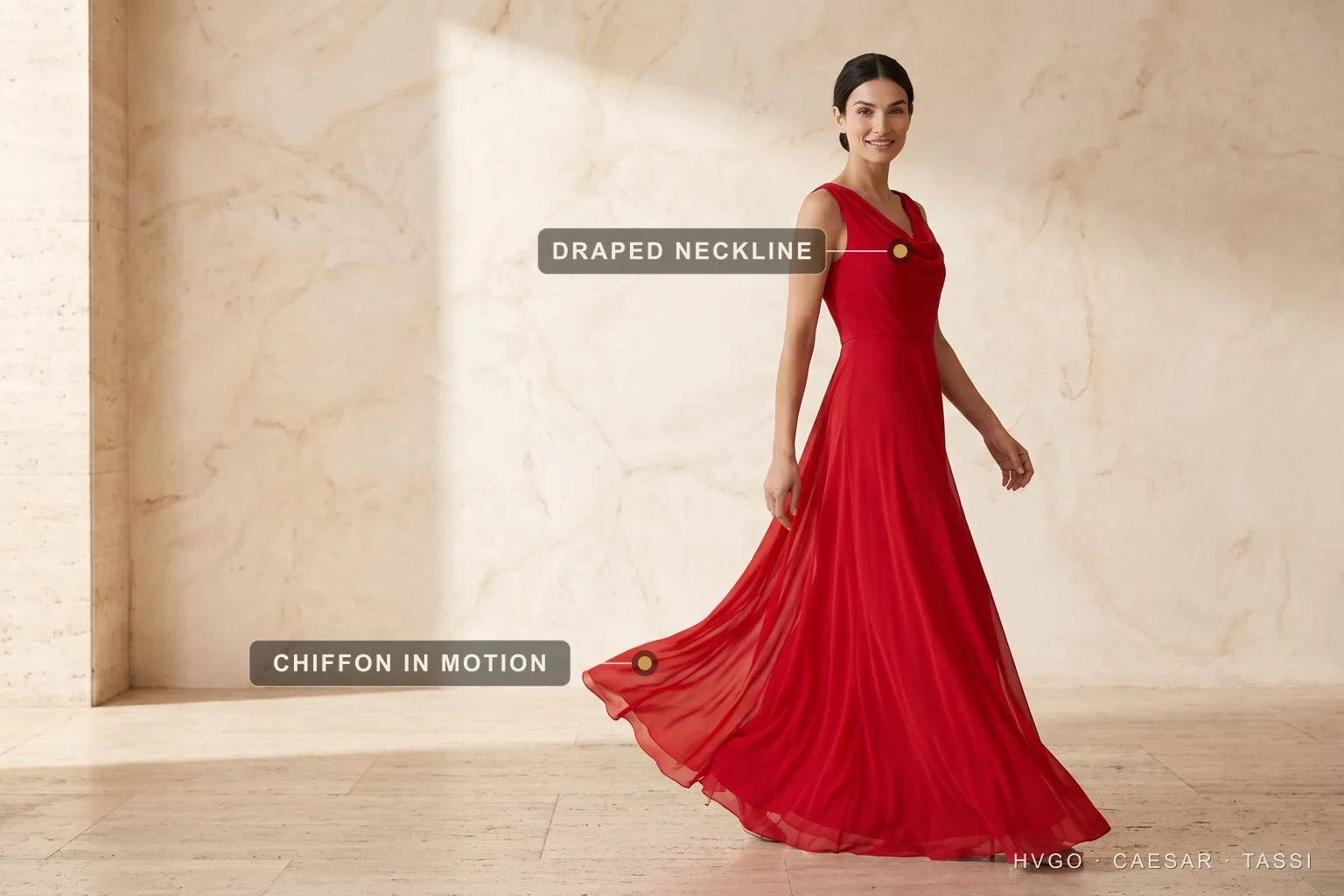
- Draped neckline
- Chiffon in motion
#Destination and outdoor Italian weddings, season by season
A vineyard, villa, masseria, lakeside, or coastal setting adds ground and weather to the brief, and the season decides the fabric weight. High summer (June through September) calls for the lightest chiffon and silk with the scarf as your only layer, while spring or autumn (April, May, October) wants a heavier crepe or satin maxi, a coprispalle, and a closed shoe for cooler stone churches.
For the full warm-weather styling, see our summer wedding guide, and for the Northern lakeside mood, the Lake Como edit sets the regional tone.
#Colors that flatter at an Italian wedding (the imperial palette)
Rich, celebratory tones win: Porpora wine, Vermiglio red, Verde Antico green, Cobalto navy, and Cornelia rose. Italians dress in confident color for a wedding, not safe neutrals, and the imperial palette was built to stay off the bridal-white spectrum while reading joyful in bright Mediterranean light.
#The rich, celebratory tones an Italian wedding rewards
A Cornelia rose midi flatters a midday garden in soft saturation, whereas a deep Porpora suits a candlelit banquet. Worried that strong color competes with the bride? It does not. White is the bride's signal; color is yours.
#Florals and prints, the Southern and summer way
A soft floral chiffon is the classic warm-Italian-wedding print, reading more naturally in the South than the North. Keep the base off the bridal-white spectrum, since a white-ground floral still photographs bridal, while a jewel or dark ground solves it cleanly. A bold floral that delights at a Puglia masseria can feel busy at a restrained Veneto reception.
#What not to wear to an Italian wedding
Avoid white and all near-white shades, head-to-toe black, a too-short mini, anything sheer for church, beachwear at a formal villa, and novelty prints that pull focus. These outfits earn a brutta figura, each breaking a convention the room reads instantly. The principle is restraint toward the family: look polished without competing.
#The outfits that read as a brutta figura
The clearest missteps form a short list worth memorizing before you pack:
- White, ivory, cream, champagne, or blush-white, which is the bride's territory.
- Head-to-toe matte black with no color break, which strikes older guests as funereal.
- A too-short mini for a church rite, which fails the coverage rule.
- Sheer or deeply revealing cuts for a Catholic ceremony, wrong for the chiesa.
- Beachwear, denim, or sundresses at a formal villa, underdressed for the setting.
- Loud novelty prints that pull focus from the family.
#The quiet practical mistakes guests make
The subtler errors are logistical, and they undo an otherwise perfect outfit. Three habits trip up Anglo guests in particular:
| Mistake | Why it fails | The fix |
|---|---|---|
| Stiletto heels | Sink into cobblestone, gravel, lawn | A block heel that grips |
| No church cover-up | Locked out of a Catholic rite | A folded silk square in the bag |
| Underdressing | Italy dresses up far more than most | Aim one notch higher than home |
| Wilting summer fabric | Heavy cloth clings and creases | Recycled chiffon or bias-cut silk |
| A fascinator or formal hat | Reads British, not Italian | Let hair, an earring, or the scarf carry it |
One etiquette note frames the whole day: bring la busta, the cash gift sealed in an envelope, which is the expected present rather than a registry item. And on the headpiece many Anglo guests get wrong, an Italian wedding is not a British one, so a fascinator or formal hat looks out of place.
#How Hugo Caesar Tassi dresses an Italian wedding guest
The house maps each silhouette to the setting: Aemilia for a summer vineyard, Livilla for a Southern church-to-garden day, Julia for a formal Northern evening. Every piece arrives in a rich, non-white imperial color, fully lined with a concealed zip.
#The house picks, matched to the wedding
The Aemilia A-line chiffon maxi suits a summer vineyard, the Livilla floral-print chiffon midi answers a warm Southern or church-to-garden day, and the Julia French-pleated chiffon maxi carries a Northern evening reception. The cover-up rotates with the dress: a Palmyra, Carina, or Vesta silk square covers the shoulders for the chiesa, then loosens for the dancing.
#The Roman lens on dressing for a wedding
These conventions come from the culture, not a style blog: the motto Nata Imperare ("born to rule") and the principle of la bella figura shape an aesthetic of confident, considered color over timid neutrals. For the deeper philosophy behind that lens, the bella figura guide explains how Italians read an outfit, while this page stays on the wedding.
#Your Italian wedding outfit, decided
Leave white to the bride, go easy on black, cover your shoulders for church, and choose rich color in a fabric that breathes. Those four rules survive every region and season. Calibrate them by the two axes you've now read: civil versus Catholic, and North versus South.
A church rite raises your coverage while a civil one relaxes it; the South pushes you brighter, the North pulls you sleeker. Hold the four rules, flex the two axes, and you've solved the day. For the dresses, the occasion dresses and chiffon dresses edits hold the silhouettes above.
Have your invitation in hand? Choose your dress in the Hugo Caesar Tassi occasion-dress and chiffon edits: the Aemilia A-line chiffon maxi for a summer villa, the Livilla floral midi for a Southern church-to-garden day, and add a silk scarf that covers your shoulders for the chiesa and becomes your evening wrap.
#Frequently asked questions
Can you wear black to an Italian wedding?
Black at an Italian wedding is not strictly banned, but it's riskier than in the States because it still carries a mourning (lutto) association for older and traditional guests. If you wear it, break it up with a colored scarf or clutch, reserve it for an evening reception, and skip it for a traditional Southern or family-heavy guest list.
Is the no-white rule strict at an Italian wedding?
The no-white rule at an Italian wedding is very strict: white belongs to the bride (sposa) alone, and that extends to ivory, cream, champagne, and blush-white. All of these photograph as bridal under bright Italian sun and candlelight. Wearing them is a genuine social misstep, not a gray area.
Do I have to cover my shoulders for an Italian church wedding?
Covering your shoulders for an Italian church wedding is expected for a Catholic ceremony: use sleeves or, most elegantly, a large silk scarf you can fold away after the rite. Keep the neckline and hem modest enough to kneel and lean, since a civil or outdoor ceremony relaxes the rule considerably.
How dressed-up are Italian weddings?
Italian weddings are very dressed-up: Italians dress with real polish and confident color, and the day runs from a midday ceremony through a long banquet and late dancing. Aim higher than you might at home, and never underdress for the joy of the day.
What's the difference between a Northern and Southern Italian wedding for a guest?
The difference between a Northern and Southern Italian wedding is tone: Northern weddings (Milan, Lake Como, the Veneto) run sleeker, cooler-toned, and more formal, while Southern ones (Naples, Puglia, Sicily) run warmer, brighter, and more exuberant. Lean into color and fluid fabrics in the South, and favor restrained column and tailored lines in the North.
What should I wear to a destination wedding in Italy in summer?
For a destination wedding in Italy in summer, choose a breathable chiffon or silk midi or fluid maxi in a rich, non-white color, with a block heel for cobblestones and gravel. Carry a silk scarf as your church cover-up and evening wrap. See our summer-wedding guide for the full warm-weather edit, season by season.
More What to Wear guides
What to Wear to a Christening
What to wear to a christening, by a Roman house — modest, daytime-elegant outfits in church-safe colors that honor the day, never reading bridal.
Dress for a christeningBlack-Tie Attire for Women
A Roman house decodes black-tie attire for women: floor-length or not, the right fabric and jewelry, and how optional, creative and gala differ.
Decode the four black-tie rungsCocktail Attire for Women
A Roman house decodes cocktail attire for women: the exact length (knee to mid-calf, never floor), the right fabric, and how it differs from black tie.
Decode cocktail attireWhat to Wear to Royal Ascot and the Races
The enforced Royal Ascot enclosure rules for strap width, hem and hat size, plus a Roman house rule for balancing a hat against your dress.
Pass the Ascot enclosure rulesWhat to Wear to a Summer Wedding
A Roman fashion house on what to wear to a summer wedding: the breathable fabrics, flattering bright-light colors and hems that survive grass and sun.
Dress a summer weddingWhat to Wear to the Opera
How dressed-up the opera really is, house by house: from La Scala's opening night to a relaxed Met evening, plus matinee, box and intermission etiquette.
Calibrate opera dress codes