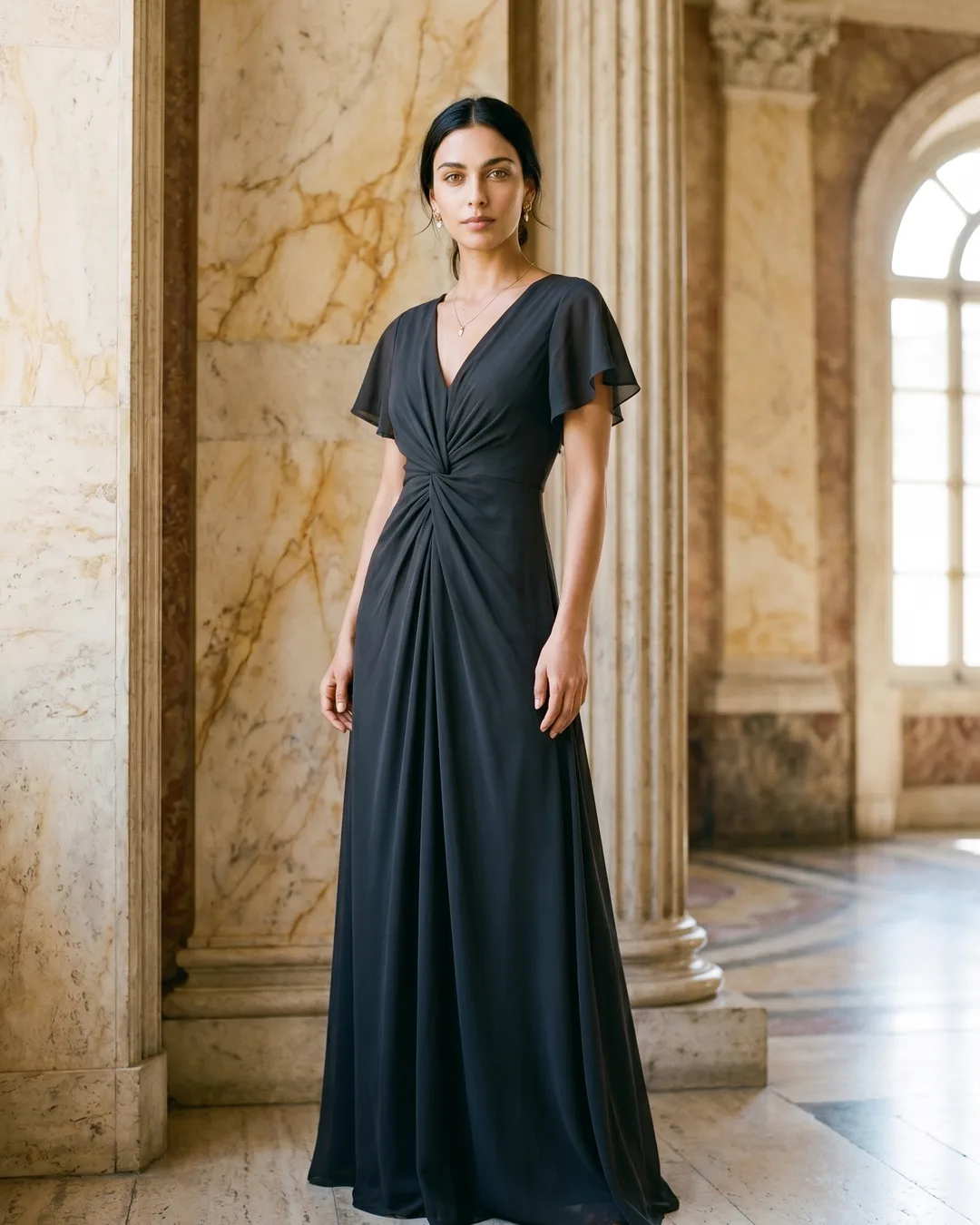
How to Choose a Dress: The Quiet-Luxury Method for Choosing a Dress That Lasts
A quiet-luxury method for choosing a dress — occasion first, then silhouette, fabric, length, fit, and only then color. Buy one you'll wear for years.
On this page
Choose a dress in a fixed order, starting with the occasion and ending with color, and you buy one you wear for years rather than once. Hugo Caesar Tassi (women's occasionwear house, Roma, MMIV) teaches a five-step sequence that demotes color to last, with a cost-per-wear rule attached.
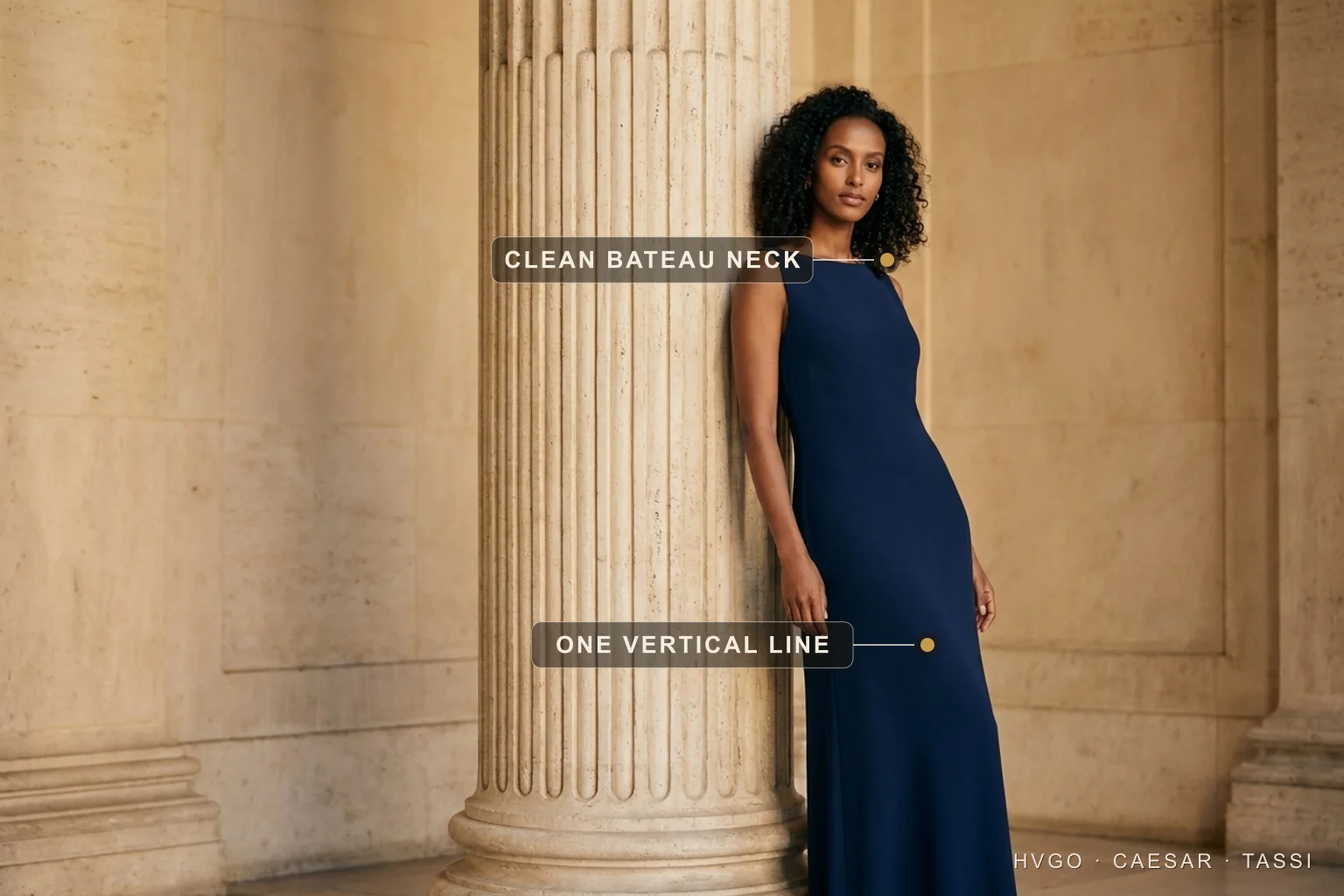
- Clean bateau neck
- One vertical line
The five-step order
Work the steps in order and color comes last on purpose.
- Occasion first Name the event and its dress code before any garment. Black-tie means floor-length; a 2 p.m. garden ceremony means a daytime midi. The code rules options in or out before taste enters.
- Then silhouette Pick the cut that suits both the room and your frame, kept to one unbroken line from shoulder to hem. An A-line chiffon like the Aemilia honors a covered wedding; a fishtail satin like the Calpurnia answers a black-tie gala.
- Let fabric decide Cloth is the biggest lever on whether a dress reads expensive. Match drape to the line: matte crepe holds a column (Tullia), satin skims on the bias, chiffon floats. Default to matte over shine, especially in daylight.
- Length and fit, measured Set the hem at the knee or floor, never the unflattering middle. Confirm bust, waist and hip with a tape before you order, allowing more ease for a structured crepe than for a bias satin.
- Color last, and built to repeat Only after the first four pass, choose a re-wearable palette shade by undertone: Cobalto and Cornelia for cool, Cuoio and Verde Antico for warm. A striking color cannot rescue a wrong cut, cloth or fit.
- Never start from a color or a trend, the way most worn-once dresses are bought.
- Never wear white, ivory or stark black as a wedding guest, even when it flatters you.
- Never push to color when an earlier step has failed, stop at that step instead.
#Why choosing a dress goes wrong (and the order that fixes it)
Most women choose backward, falling for a color or a trend first, then forcing the occasion, the figure and the budget around it. The result hangs unworn after one outing. A fixed order fixes it: lock what cannot bend before you indulge what can.
#The backward way most women choose a dress
The failure starts at the rail. A guest buys a strapless mini in Cornelia (rose) for a cathedral wedding because the color flattered her in the mirror; the venue required covered shoulders, so the dress never left the closet. What it ignored was structural, not aesthetic.
Reverse the order and the regret disappears: a woman who books the occasion in first rarely returns the dress, because the hardest filters cleared before she fell for anything.
#The five-step decision order, at a glance
The house method runs as a numbered sequence, color dead last on purpose, each step narrowing the field the next one searches.
- Occasion: the event and its dress code set the hard floor.
- Silhouette: the cut that suits both the room and your frame.
- Fabric: the single largest lever on whether it reads expensive.
- Length: the hem your height and the code call for.
- Fit: measured ease at bust, waist and hip, confirmed before order.
Color and trend come after all five, treated as the final filter rather than the opening move, with the cost-per-wear math attached at the end.
#Step 1: start with the occasion, not the dress
Lock the event and its formality before you look at a single garment, because the dress code rules options in or out before taste enters. Occasion is the one filter you cannot negotiate on the night.
#Name the event and its dress code first
Read three signals: the invitation wording, the venue, and the time of day. "Black-tie" on heavy card points to a floor-length gown; a 2 p.m. garden ceremony points to a daytime-formal midi. A ballroom gala and a parish-hall christening demand opposite registers.
Match the occasion to its register before anything else:
- Wedding guest: coverage and color discipline; defer to the couple, never white.
- Gala or black-tie: floor-length, one focal point, evening fabric.
- The opera: formal but seated for hours; structure over flounce.
- Ascot or the races: daytime formal with a hat; hemlines watched closely.
- Christening: modest daytime; covered shoulders are common.
Watch for the unstated code: a 5 p.m. start with no dress line usually means semi-formal, and when the wording stays silent the venue decides.
#Let the code set your hard constraints
A code dictates coverage, formality and a length floor before preference matters. Black-tie rules out a knee-length cocktail cut for the principal guest; daytime formal rules out a backless column. The wedding, gala and races breakdowns live in the dedicated explainers, so the dress guides hub is where you confirm exact rules before silhouette.
#Step 2: pick the silhouette that flatters and suits the room
Choose the cut that answers to both the occasion and your frame, in that order. A silhouette can be beautiful and still be wrong for the room or for your proportions.
#Match silhouette to the occasion and to you
Four silhouettes carry most occasions. An A-line skims from a defined waist for a daytime wedding; a column falls straight for a formal evening; a sheath traces the body for a structured gala; a fishtail flares below the knee for black-tie drama. Each must clear two tests at once: the code and your body shape.
A worked example: for a formal wedding, an A-line chiffon like the Aemilia maxi flatters a broad range of frames while honoring a covered brief, whereas a fishtail satin gown like the Calpurnia answers a black-tie gala instead.
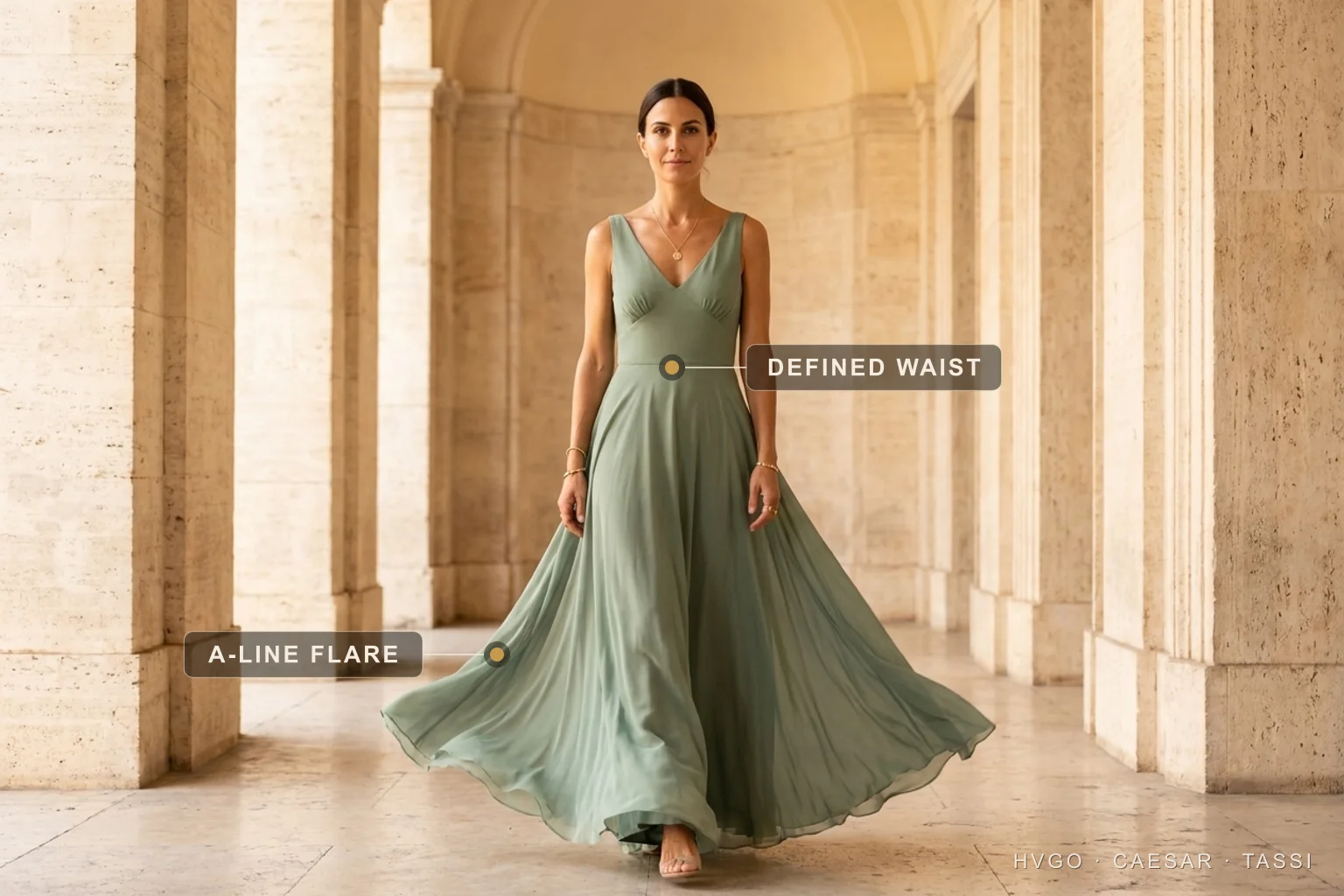
- Defined waist
- A-line flare
Mind the body-shape mismatch: a column demands a near-vertical line, so a frame carrying width at the hip often reads better in an A-line that releases from the waist. The full taxonomy sits in the how to find your body shape walkthrough.
#One unbroken line: the classical proportion rule
The house test is simple: the eye should follow one vertical line from shoulder to hem without snagging. A belt that chops the torso or a busy waist seam breaks that line and shortens the frame.
When a silhouette passes the room test but fails the line test, change the cut, not the accessories. This rule of one focal point and one unbroken line is the spine of la bella figura.
#Step 3: let the fabric decide whether it looks expensive
Fabric is the single biggest lever between looking expensive and looking cheap, ahead of price or logo. Two dresses in identical cuts diverge entirely on cloth.
#How chiffon, satin, crepe and modal jersey actually hang
Each cloth moves differently, and the movement is the look. Match the fabric to the line you want the dress to hold:
| Fabric | How it hangs | Reads best as | Quality tell |
|---|---|---|---|
| Crepe | Matte, holds structure | Sheath, column | Weight that resists creasing |
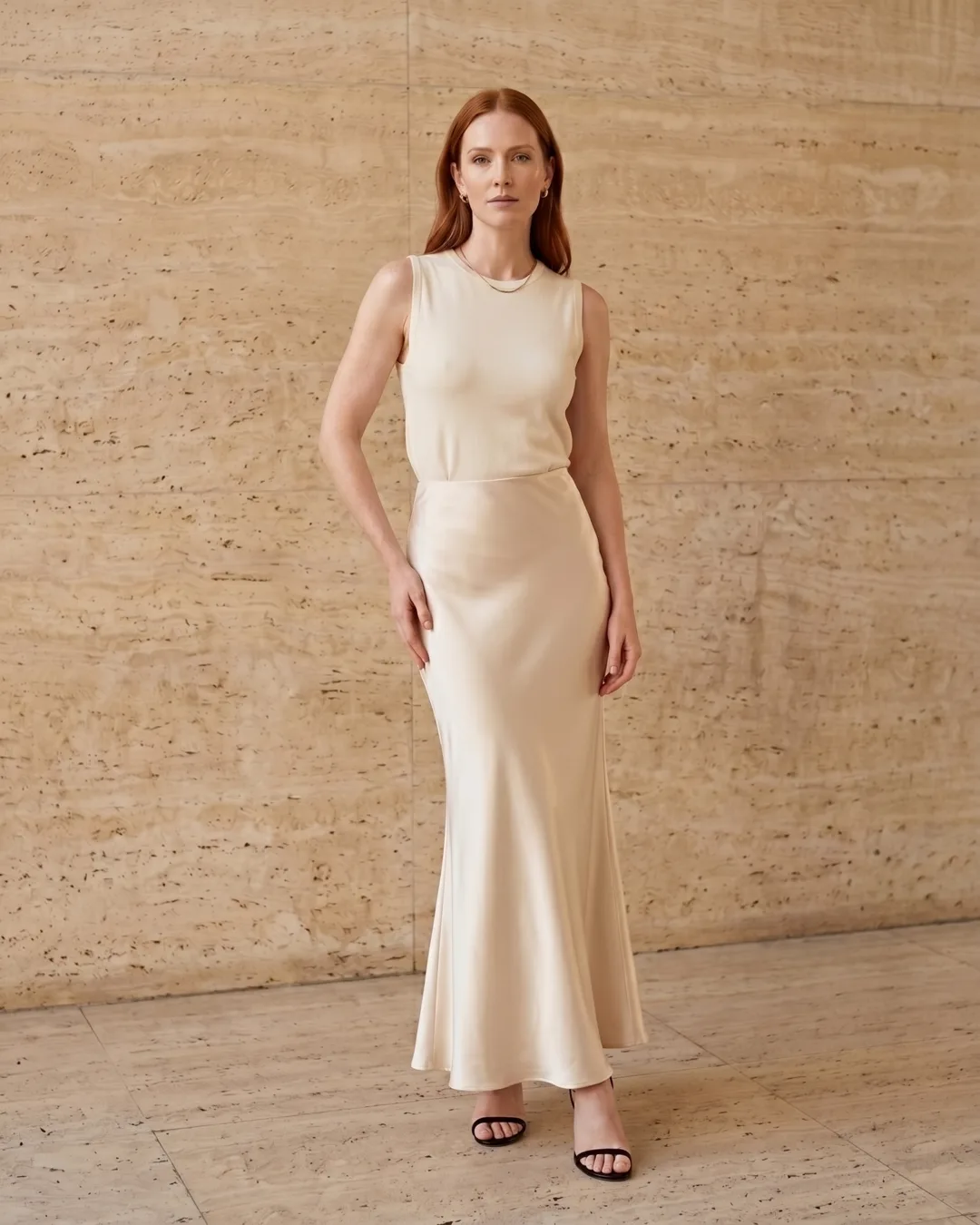
| Satin | Liquid, skims on the bias | Fishtail, evening gown | Bias cut, even sheen |
| Chiffon | Floats, layered for opacity | A-line maxi, midi | Recycled fiber, knife pleats |
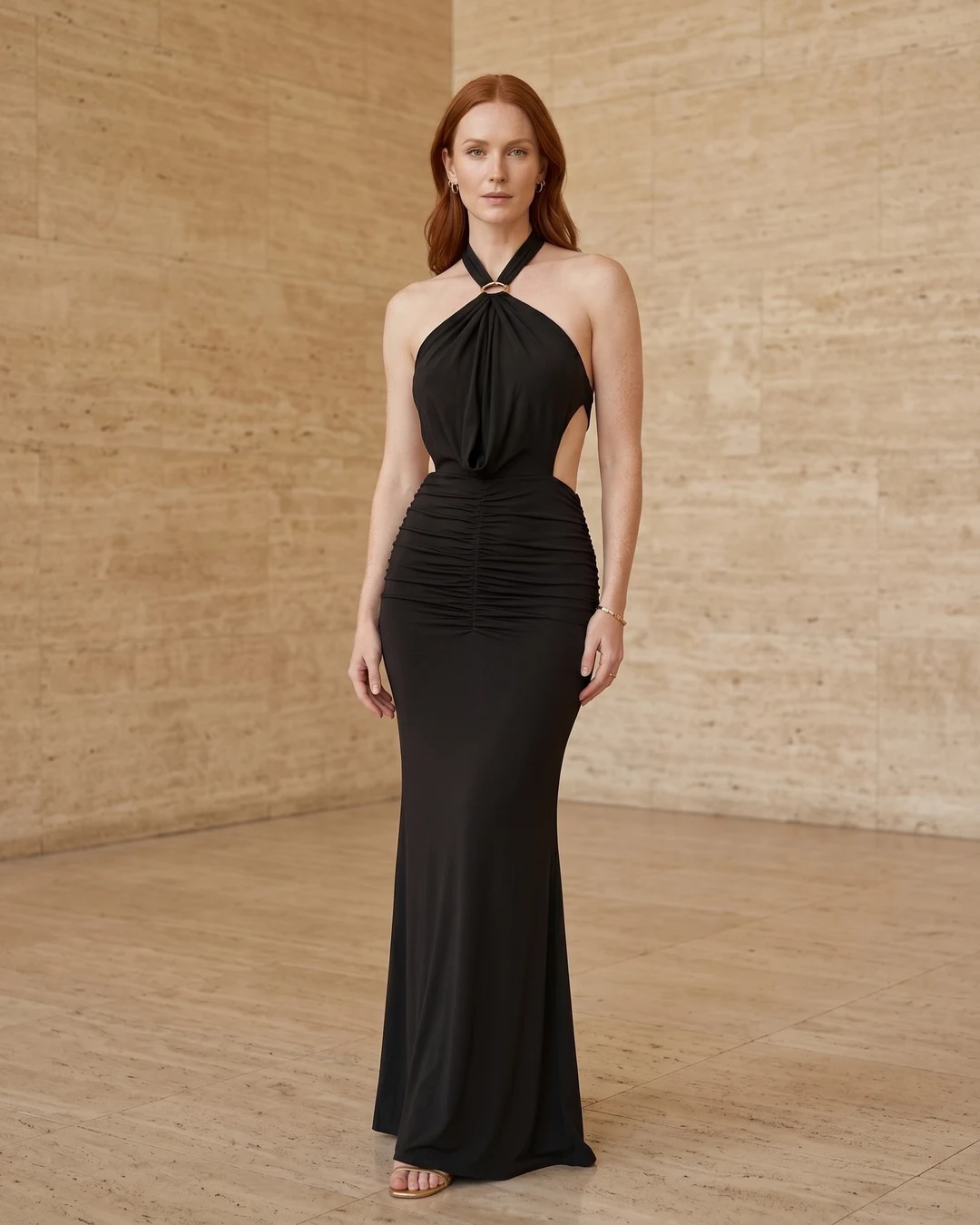
| Modal jersey | Drapes a true vertical column | Draped column gown | Soft hand, no clinging |
A concrete case: the Tullia pleated crepe column gown holds a clean architectural line because matte crepe resists slumping, whereas the Vipsania draped modal gown falls softer and moves with the body.
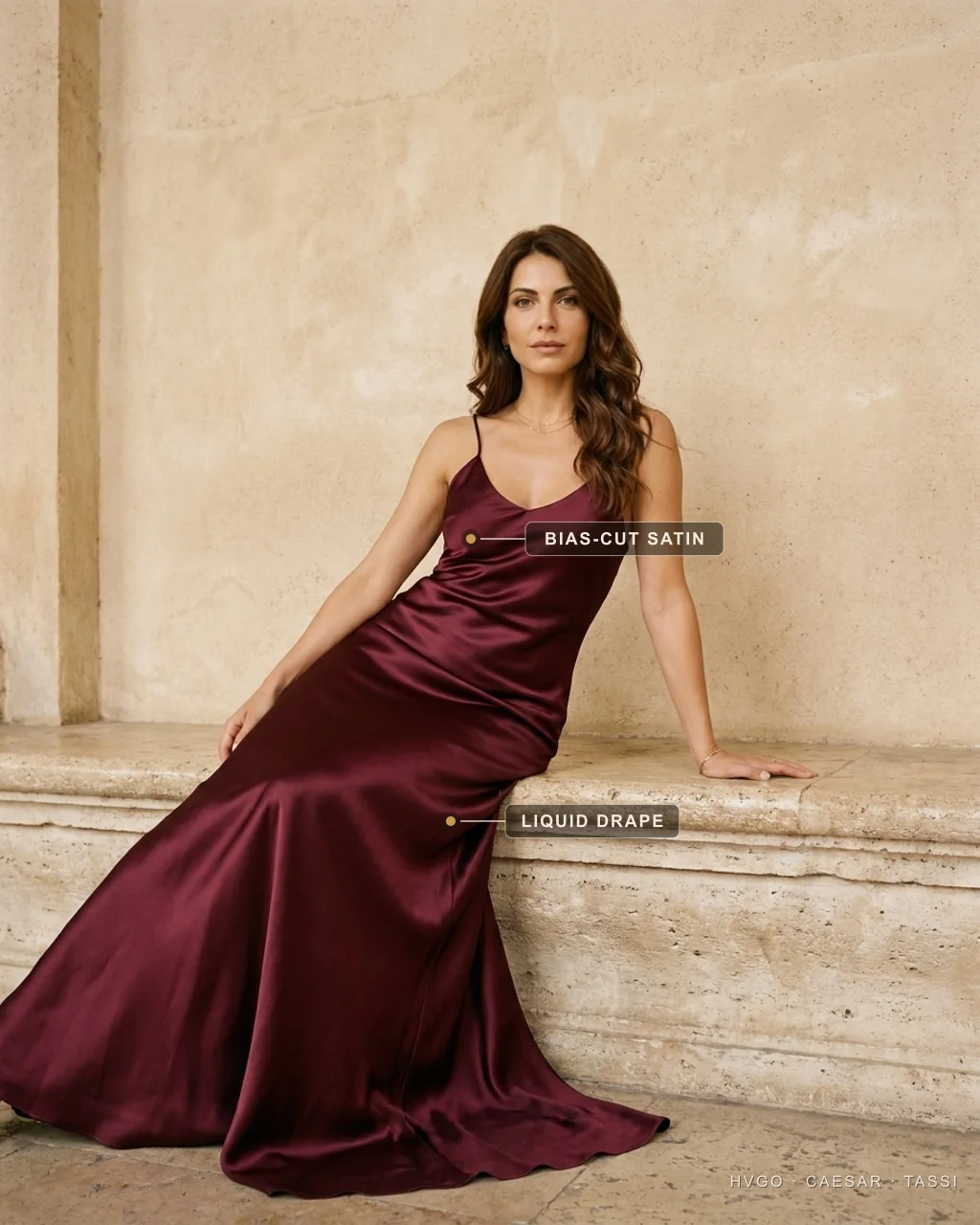
- Bias-cut satin
- Liquid drape
Watch shine in daylight. High-sheen satin reads formal under evening light but brash at a noon ceremony, where matte crepe or floating chiffon suits the hour. Matte before shine is the house default.
#Check the construction before you check the price
Read the inside before the price tag, because a garment that looks expensive after several wears is built that way.
Inspect four things: a full lining, clean seam finishes, a weighted hem that hangs straight, and the fiber content on the label. Hugo Caesar Tassi dresses are fully lined with a concealed zip; the chiffon is recycled and knife-pleated or bias-cut, the satin bias-cut, all signs the cloth was chosen for drape rather than cost. What each spec means sits in what is chiffon, satin & crepe.
#Step 4: get the length and the fit right for your frame
Length must answer to your height and the code together, and fit must be measured, never guessed. A flattering silhouette collapses if the hem breaks at the wrong point or the bust gapes.
#Pick the length your height and occasion call for
Four lengths cover the field: mini, midi, tea and maxi. The code sets the floor; your height sets the break point. Black-tie pushes toward maxi; daytime formal sits at midi or tea; mini rarely suits a formal occasion. Because the house publishes each model's height (about 175 cm), you can judge where a hem breaks on your own frame.
Beware the in-between hem. A mid-calf length can shorten a petite frame; the elegance doctrine keeps the hem at the knee or the floor, never the unflattering middle. Exact inch ranges and petite and tall rules live in the midi vs maxi vs mini length guide.
#Measure before you order, never after
A flattering choice fails without true bust, waist and hip numbers and the right ease for the cloth. Measure first; the tape is the cheapest tool in the decision.
Different cloths need different ease: a bias satin skims with almost no allowance, while a structured crepe sheath needs room over the waist. Sizes run S–3XL (EU 34–44), so the gap between adjacent sizes is real, and measuring closes it. Confirm your numbers in the how to measure your dress size guide against the house size chart, because fit comes before color.
#Step 5: choose color last, and choose it to repeat
Color is the final filter because it is the easiest thing to fall for and the weakest thing to build a purchase on. A striking shade cannot rescue a wrong cut, cloth or fit.
#Why color is the final filter, not the first
Color is where nearly everyone starts and exactly where you should finish. Starting there produces the worn-once dress: the shade passes the mirror test while the occasion, silhouette and fit fail behind it. A buyer who picks Porpora (wine) first may land a gown too formal for her daytime christening, whereas one who reaches color last is choosing among dresses that already suit the event.
#Pick a shade you'll wear more than once
Re-wearability beats trend, and skin undertone is the starting point: cool undertones carry Cobalto (navy) and Cornelia (rose), warm undertones lean into Cuoio (tan) and Verde Antico (green). The imperial palette is built as a repeatable wardrobe rather than a seasonal one:
- Porpora (wine): formal evenings, autumn and winter weddings.
- Basalt (black): galas and the opera, though never a funeral or as a wedding guest's safe default.
- Cobalto (navy): the all-occasion alternative to black, day or evening.
- Avorio (ivory): daytime formals away from any bridal setting.
- Cornelia (rose): christenings, the races, spring daytime events.
One exception governs the wedding guest. Occasion dressing designs out bridal white and funereal black, so ivory and stark black both move down the list at a wedding even when they flatter you. Color earns its place only by repeating.
#How Hugo Caesar Tassi applies cost-per-wear to choosing a dress
Judge a dress by cost-per-wear, not sticker price, and the whole decision shifts from one event to several years. The math is one line, and it reframes everything above.
#The cost-per-wear rule, with the math
The formula is price divided by realistic wears equals true cost. A €600 gown worn six times across two years costs €100 per outing; three €120 impulse dresses worn once each cost €120 per outing and fill triple the closet.
Some argue the opposite: a cheaper dress lowers the risk if your taste changes. The order itself answers that worry. When occasion, silhouette, fabric, length and fit all pass before color, taste-change risk is already small.
#A small capsule beats a full rail
Buy fewer, better. A capsule of three covers most of a year: one column or sheath for formal evenings, one A-line or maxi for weddings, one daytime midi for christenings and the races. That is the practical shape of Nata Imperare ("born to rule"): dress to command the room you are in, not to chase the rail.
Care is part of the value, because a dress is only an investment if it lasts. Storing a lined garment correctly keeps the cost-per-wear falling; the routine sits in the occasion dress care guide.
#Choosing from the house collection, step by step
Run the five steps on real dresses and the method stops being abstract. Each pick below cleared the first four steps before color.
- Black-tie gala: Calpurnia fishtail satin evening gown; floor-length, bias satin, evening shine.
- Formal wedding: Aemilia A-line chiffon maxi or Claudia pleated-slit chiffon maxi; covered, flowing, never white.
- Column-line evening: Vipsania draped modal column gown or Tullia pleated crepe column gown; one unbroken vertical line.
- Daytime event: Livilla floral-print chiffon midi; matte daytime register, knee-to-tea length.
Daytime is where many shoppers slip: the Livilla midi suits the races or a christening because its print and length stay daytime, where a satin gown would overshoot the hour. Run the five steps across the occasion edit and the field narrows fast.
#Your dress-choosing checklist (the decision, summarized)
Five questions decide every dress, and answering them in order is the whole method. Run the list before you buy.
#The five questions to answer before you buy
- Occasion locked? Event and dress code named before any dress.
- Silhouette right? Flatters your frame and suits the room, one unbroken line.
- Fabric sound? Hangs the way the line needs and is fully lined and built well.
- Length and fit measured? Hem at the knee or floor, ease confirmed by tape.
- Color repeats? A shade from the palette you will wear more than once.
When any answer is no, stop at that step rather than pushing to color. A single failed question is what produces the dress worn once.
#Where to go next
The method is fixed; the detail you still need depends on the open step. When silhouette is the question, go deep on the silhouette and body-shape guides; when fit is, work the measuring guide and size chart. For the principle behind it all, read quiet luxury occasion dressing, where quiet luxury is fabric weight, drape and fit rather than sparkle. Then browse all Hugo Caesar Tassi dresses and let the five steps decide, not the prettiest color.
#Frequently asked questions
What should I consider first when choosing a dress?
The first thing to consider when choosing a dress is the occasion and its dress code. Lock the event and its formality, then work through silhouette, fabric, length and fit, and leave color for last.
How do I choose a dress that actually suits me?
A dress suits you when its silhouette and length match your body shape and height and the fit is confirmed by real measurements. Take true bust, waist and hip numbers, then check that the eye follows one unbroken vertical line from shoulder to hem.
How do I pick the right dress for a wedding?
The right dress for a wedding starts from the dress code and the season, not the color. Choose a flowing A-line or column in chiffon, crepe or satin, keep length and coverage right for the venue, and pick a shade that is not white, cream or close to the bridal party.
Why shouldn't I choose a dress by color first?
Choosing a dress by color first fails because color is the easiest thing to fall for and the worst place to start. A striking shade cannot rescue a wrong silhouette, fabric or fit, and color-first buying is what produces dresses worn only once.
How much should I spend on an occasion dress?
The right spend on an occasion dress is judged by cost-per-wear, not the sticker price. Divide the price by how many times you will realistically wear it; one well-chosen dress re-worn across several events often costs less per outing than three cheap dresses worn once.
How do I know if a dress is good quality?
A good-quality dress shows it in the fabric content, the lining and the seam and hem finishes. Check the fiber on the label, look for a full lining and clean finishes, and see whether it holds its shape off the body.
You have the method, so now apply it. Work the five steps on the occasion-ready edit, or read the one detail guide your decision still needs, starting with dress silhouettes explained.
More Dress Knowledge guides
Dress Necklines Explained
Every dress neckline named, with the jewelry each one takes, the bust and shoulders it flatters, and the formality it signals. A house guide.
Decode every dress necklineDress Silhouettes Explained
Every dress silhouette explained: A-line, column, sheath, fishtail, empire, plus the fabric that holds each shape and the body it flatters.
Explore every dress silhouetteDress Sleeve Types
Every dress sleeve named and shown — how much arm each covers, the climate it suits and the occasion it signals, from cap and flutter to dolman.
Match a sleeve to the occasionHow to Measure for an Occasion Dress
Take your bust, waist and hip dress measurements at home and match them to the HCT size chart, with US/EU conversion and per-fabric ease, to order once.
Find your size in the occasion dresses editMidi vs Maxi vs Mini
Every dress length in real inches: mini, midi, tea, maxi, measured on a 5'7\" fit model, plus a height rule for where each hits on you.
Find your hem length in real inchesTypes of Dresses
Every formal dress type named and shown — slip, column, A-line, sheath, fishtail, one-shoulder and more — each with its fabric and best occasion.
Name every dress type