How to Measure for an Occasion Dress: Take Your Dress Measurements at Home
Take your bust, waist and hip dress measurements at home and match them to the HCT size chart, with US/EU conversion and per-fabric ease, to order once.
On this page
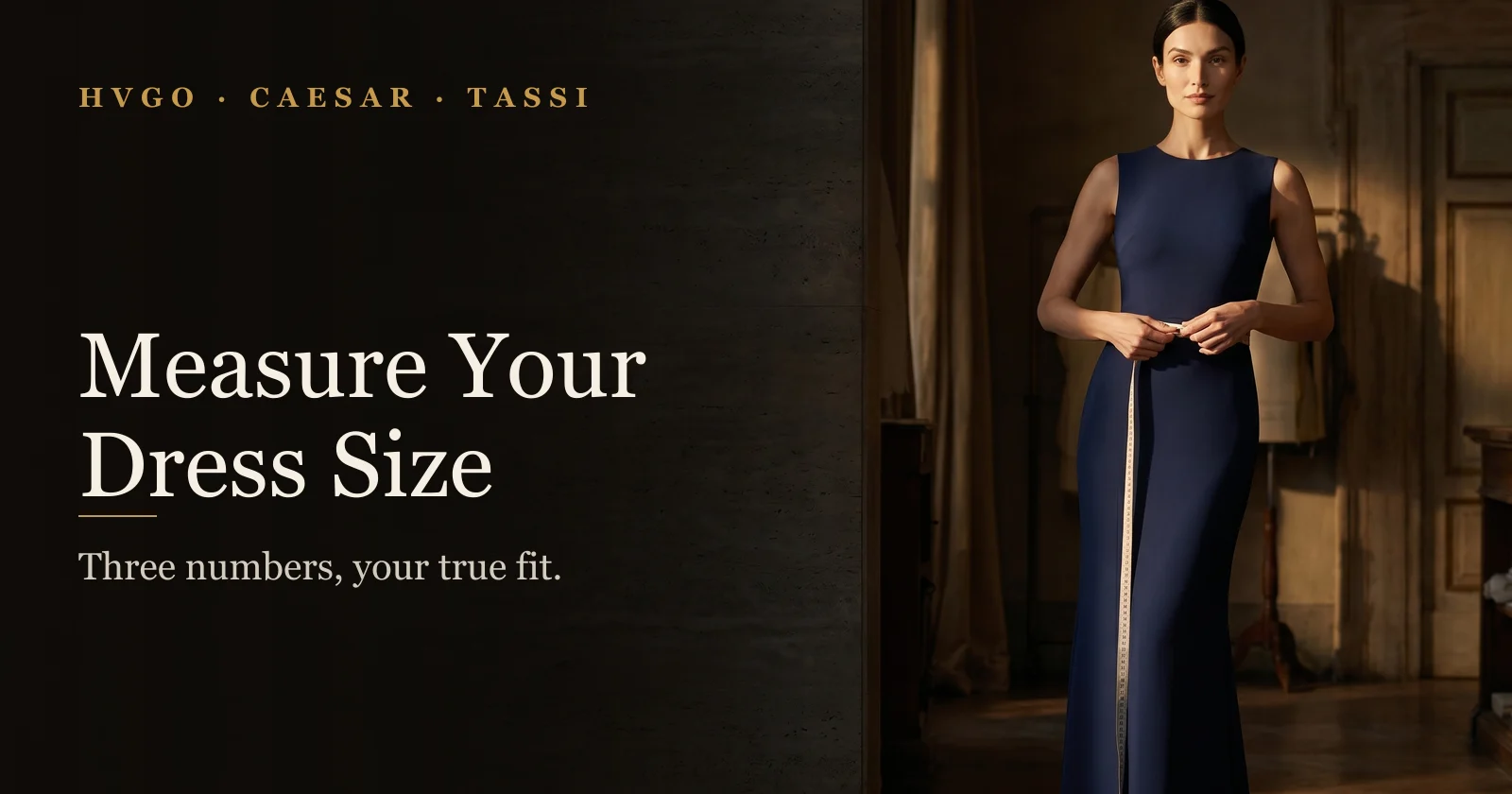
Measuring your dress size at home takes three numbers, read with a soft tape held level and one finger loose: full bust, natural waist, full hip. An occasion gown adds two more, hollow-to-floor and bicep. You then match the largest number to the chart and adjust for fabric, because the inches decide your fit, not the store label you usually buy.
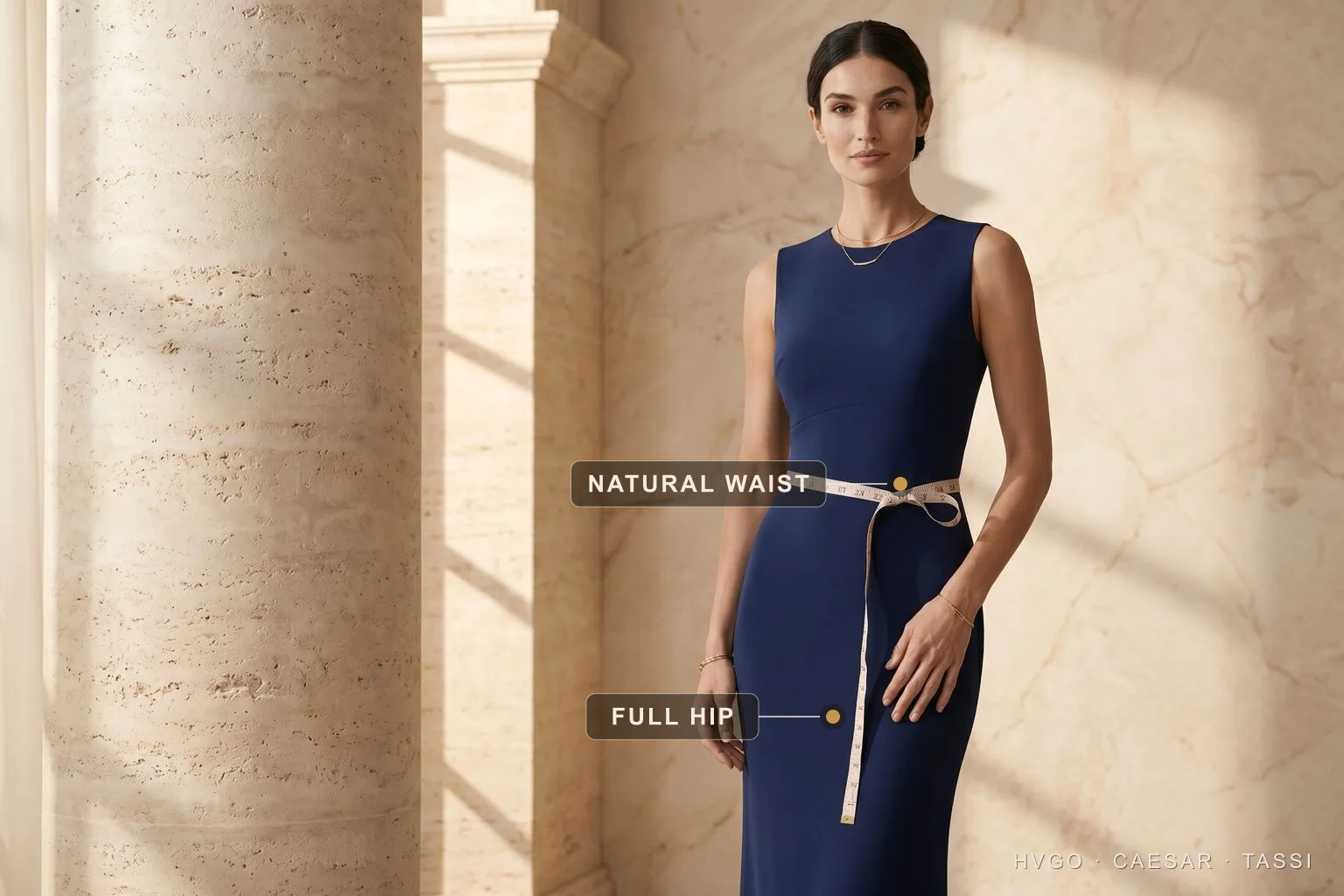
- Natural Waist — the seam the chart sizes the closure and concealed zip to
- Full Hip — the measurement that controls how the skirt releases below the waist
Measure for an occasion gown
Five numbers, a soft tape held level with one finger of slack, taken in the bra and heels you will actually wear.
- Full bust Wrap the tape around the fullest point over a normal supportive bra, neither padded nor a minimizer. This governs the bodice and the cut of a strapless style like Flavia.
- Natural waist Find the narrowest part of your torso and measure level, breathing normally. The waist sets the concealed-zip closure and carries a column gown's fit.
- Full hip Measure the widest point around the seat. This controls how the skirt releases below the seam, from a fluid Aemilia chiffon A-line to a fishtail.
- Hollow-to-floor Standing in your event heels, measure from the hollow at the base of your throat straight down to the floor. This sets the hem of any maxi or floor-length gown like Claudia.
- Bicep, armhole and shoulder Only for a sleeved or off-shoulder style: measure around the fullest part of your relaxed upper arm. A 10-inch sleeve will not close over an 11.5-inch arm, however well the bodice sits.
- Match the largest to the chart, then adjust for fabric Size to your biggest core number, then read the per-fabric note: true to measure in matte crepe, size down in bias-cut satin, hold smaller on pleated styles like Tullia.
- Never hold your stomach in or pull the tape tight; record your relaxed, breathing measurement.
- Never measure over a sweater or jeans, or use a padded or minimizer bra.
- Never use a rigid ruler; a soft tape follows the curve, a ruler reads short by an inch.
- Never take hollow-to-floor barefoot when you will wear a heel, or the gown lands short.
#What dress measurements do you actually need before you order?
Every size chart reads three numbers first, then asks for two gown-only ones the moment length or sleeves enter the picture. The three are full bust, natural waist and full hip. The extras are hollow-to-floor for length and bicep for sleeves. A floor-length satin gown ordered four weeks before a wedding cannot wait for a second fitting, so the numbers you record now decide whether it arrives ready or goes back in the box. Miss the extras and a flawless bodice can still pinch at the arm or pool at the hem.
#Start from your three core numbers (and where to take them)
Full bust governs the bodice, natural waist sets the seam that defines the silhouette, and full hip controls how the skirt falls below it. Each chart column rests on this trio because each number maps to a different construction zone: bust to the cut of the cup and shoulder, waist to the closure and the concealed zip, hip to the skirt's release.
This guide picks up after you hold those three, so the wrapping itself lives with our body shape guide, which owns body measurement. Knowing your waist reads 28 inches is only half the job; you still need to know that the waist is what the chart sizes the closure to. A strapless gown like Flavia leans almost entirely on the bust and a snug underbust, whereas a column gown leans on the waist instead. Same trio, a different number carrying the weight.
#The gown extras the body chart never lists: hollow-to-floor and bicep
A body-shape diagnosis never needs your height off the floor or the girth of your arm, yet a gown demands both. Hollow-to-floor sets the hem of a maxi or floor-length dress; bicep, armhole and shoulder-to-shoulder set the fit of any sleeve. These describe the garment's reach rather than your shape, which is why a generic read skips them entirely.
Treat them as the inventory here; the next section teaches each one hands-on. The shorter and looser the cut, the fewer numbers it asks of you, so a brief A-line like Portia wants neither extra.
#The tools: why a soft tape (not a ruler) and what to wear
A soft cloth tailor's tape measure wraps a curved body, while a rigid ruler cannot follow the arc of a bust or hip and reads short by an inch or more. Measure over thin unpadded undergarments, never over a sweater or jeans, standing relaxed in front of a mirror. Keep four things within reach:
- A soft tape measure marked in both inches and centimeters
- A mirror, or a second person to read the back numbers
- A pen and paper to record every figure twice
- The size chart open on screen before you start
A tailor works the tape around a still client; you are measuring yourself, so the mirror earns its place. Back length is the one number that almost always needs a second pair of hands.
#How do you take the gown-only measurements bust, waist and hip leave out?
Two measurements separate a dress order from a body-shape read: hollow-to-floor for length and bicep for sleeves. Both follow the same discipline as the core three, and you take both in the conditions you will actually wear. Get them wrong and the bodice can fit while the gown fails at the hem or the upper arm.
#Hollow-to-floor: the length number bust/waist/hip never gives you
Measure from the hollow at the base of your throat straight down the front of your body to the floor, standing in the shoe height you will wear to the event. This single vertical number sizes a maxi or floor-length gown's hem more than any width measurement does, since length, not width, is the second most-returned fit issue on long dresses. A Claudia pleated-slit maxi sized to a flat 60 inches reads four inches short on a woman who measured barefoot but wears a four-inch heel.
Tea-length and midi dresses forgive far more here, because a hem that breaks an inch high looks intentional rather than wrong.
#Bicep, armhole and shoulder: the sleeve numbers a fitted gown needs
For a fitted-sleeve, long-sleeve or off-shoulder style, measure the bicep around the fullest part of your relaxed upper arm, then the armhole and shoulder-to-shoulder across the back. The bicep is the single most overlooked dress measurement, which explains why a perfect bust, waist and hip can still bind at the arm. A fitted long sleeve cut to a 10-inch bicep will not close over an 11.5-inch arm, however well the bodice sits.
On a strapless or sleeveless gown you skip all three, and a generous armhole hides any small error you might have made.
#The garment level-and-snug rule and the dress-fit tolerance it sets
Hold the tape parallel to the floor, snug against the body but not compressing it, with one finger of slack underneath. That one finger is not arbitrary: it maps to the wearing ease a dress needs to let you sit, reach and breathe. Measure over a normal supportive bra that is neither padded nor a minimizer, breathe normally rather than holding your stomach in, and record every number in inches and centimeters before you open the chart. A waist pulled tight to 27 inches with the stomach held reads a full size smaller than the 29 inches you actually carry, and the gown arrives unwearable.
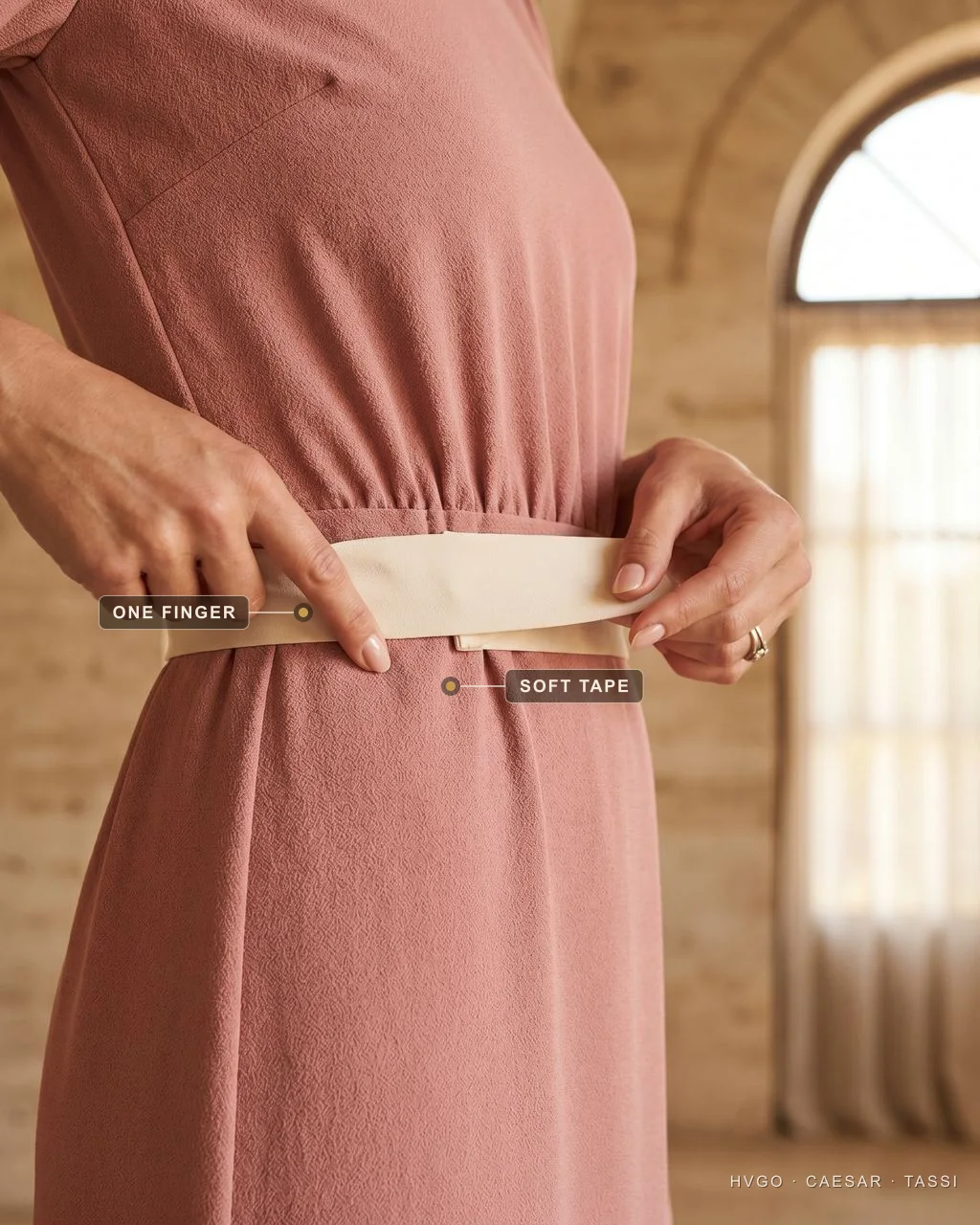
- Soft Tape — a cloth tailor's tape wraps the curved waist where a rigid ruler reads short
- One Finger — the single finger of slack that maps to a dress's wearing ease
A heavily boned bodice wants the snug end of that finger; a soft draped style tolerates the loose end.
#How do your dress measurements convert across US and EU sizing?
A US dress size sits roughly 32 numbers below the Italian size a European house prints, yet the only input you trust is your inches. US 4 lands near IT 36 to 38, and US 8 lands near IT 40 to 42. Conversion gets you to the right neighborhood; the chart's centimeter figure gets you to the right size.
#Reading the HCT size chart
Read the chart one row at a time, find which column your largest core number lands in, and that column becomes your starting size. You size to the largest measurement because letting a seam out is rarely possible, while taking a too-large waist or strap in almost always is. A woman whose bust reads a size 10 but whose hip reads a size 12 starts at 12 and has the bodice taken in, not the skirt let out.
On a bias-cut or stretch fabric the largest number can ease over a half-size, which lets you hold the smaller column without altering anything.
#US, EU, IT and UK conversion at a glance
The table below converts the four labels you meet on an occasion dress, stepping up by twos. Use it to translate a habit, not to choose a size.
| US size | EU size | IT size | UK size |
|---|---|---|---|
| US 2 | EU 34 | IT 38 | UK 6 |
| US 4 | EU 36 | IT 40 | UK 8 |
| US 6 | EU 38 | IT 42 | UK 10 |
| US 8 | EU 40 | IT 44 | UK 12 |
| US 10 | EU 42 | IT 46 | UK 14 |
| US 12 | EU 44 | IT 48 | UK 16 |
A European house like Hugo Caesar Tassi labels by EU and IT, which is why an American buyer sees an unfamiliar number on the tag. The Italian size running about 30 to 32 above the US size explains the gap, though it never replaces matching your real centimeters to the chart.
#Why vanity sizing means you ignore the label and trust the inches
The same printed "size 8" has drifted several inches across brands and across decades, a creep called vanity sizing, so the label tells you nothing reliable. Only the centimeter or inch figure on the chart is a fixed input. A woman who has bought a store size 6 for years may measure into a size 10 on a true garment chart, and the chart is correct. Order to your inches, not to your habitual store size, even with a brand you think you know.
#How does fabric ease change the dress measurements you should choose?
Ease is the gap between your body and the garment, and it shifts the size you pick more than any single measurement does. The same numbers can call for one size in structured crepe and a size down in bias-cut satin. Knowing the fabric is half of knowing your size.
#Wearing ease vs. design ease
Wearing ease is the room a garment needs to let you move and breathe; design ease is the extra width the designer builds in for the intended look, from body-skimming to fluid. A column gown and an A-line in the same labeled size feel completely different because the A-line carries far more design ease through the skirt. Unlike wearing ease, which stays roughly constant, design ease is a style choice you read from the cut.
A fully boned bodice has almost no wearing ease at the rib, so you size it to your relaxed, breathing measurement rather than your held one.
#The HCT per-fabric ease guide
Each fabric carries its own sizing instruction, drawn from how the cloth moves on the body rather than from a formula. To learn what each fiber is, see chiffon satin crepe in the care silo.
| Fabric | Ease behavior | Size rule | Between sizes |
|---|---|---|---|
| Matte crepe | Cut close and structured | Size to your true measurement | Size up |
| Bias-cut satin | Skims and gives ~2 cm | Size to measurement | Size down |
| Chiffon over lining | Forgiving and fluid | Size to measurement | Hold either |
| Pleated or draped (modal, French pleat) | Absorbs a half-size | Size to measurement | Hold smaller |
A Tullia pleated crepe column reads structured at the rib yet absorbs a half-size through its pleats, which is why the fabric note, not the fiber name alone, drives the call.
#What to do when you fall between two sizes
The house default is to size up to your larger measurement and have the waist or straps taken in, because letting a seam out is rarely possible once the garment is cut. A tailor can remove an inch from a waist in an afternoon, whereas adding one means recutting the panel. Bias-cut satin and any stretch are the exception, where the cloth skims and gives, so you hold your smaller size.
Should the between-sizes gap sit at the bust on a strapless gown, size up regardless, since a too-tight strapless bodice keeps no margin to give.
#How do you get your dress measurements when you have no tape measure?
You can read a size chart accurately with a length of string and a rigid ruler, or by measuring a dress that already fits. Neither replaces a proper soft tape, though both land you on a confident size in a pinch.
#The string-and-ruler method
Wrap a length of non-stretch string or a phone charging cable around each landmark, pinch where it meets, then lay it flat against a yardstick or rigid ruler and read the length. A shoelace works the same way. The result lands you in the right chart column, provided the string does not stretch as you pull it. Avoid a springy elastic cord, the one material that lengthens under tension and reads large.
#Borrowing a known garment's measurements
Lay a dress that fits you well flat on a table and measure it seam to seam across the bust and the waist, then double each number for the full circumference. This cross-checks your body numbers rather than replacing them, since a garment carries its own ease that your body does not. Reach for it as a sanity check when your tape reading and your usual size disagree, not as your only input.
#How Hugo Caesar Tassi grades its dress measurements across the collection
Hugo Caesar Tassi sizes you to a real garment chart graded from a fit model, published in inches and centimeters with US, EU and IT labels, rather than a generic calculator. The chart describes finished dresses, not an algorithm's guess, so it already accounts for our cut and our seam allowances. You find it under the size tab on every product page.
#Our size chart and fit model
A fit model is a real woman whose body the house grades the base size on, then steps up and down from in true increments. Because the chart reads from finished garments, it carries the actual ease of each style rather than a flat assumption. Every product page exposes the same chart in its size tab, so the number you read against your bust is the number sewn into the dress.
#Cut and fabric across the collection
Some styles you true-size and some you size down, and the fabric tells you which. The close, structured ones read true to measure; the pleated and draped ones absorb a half-size; the fluid chiffon ones run forgiving:
- True to measure: Calpurnia fishtail satin and Flavia strapless satin, both structured
- Absorbs a half-size: Tullia pleated crepe column, Vipsania draped modal column, Julia French-pleated maxi
- Runs forgiving: Aemilia A-line chiffon maxi, Portia short-sleeve chiffon A-line
Browse these across our evening gowns collection and read each one's fabric note before you choose. A structured satin and a draped modal in the same labeled size will not behave the same on your frame, and that contrast is the whole lesson.
#Why we don't hand you a generic size calculator
Some shoppers expect a quick height-and-weight calculator, and the case for one is convenience. The case against it is accuracy: no calculator knows our cut, our linings or our concealed-zip closure, and a number drawn from height and weight alone says nothing about how a bias-cut skirt falls. We size you to a real graded garment instead, then carry that judgment through the per-fabric note on each product page. The trade-off we accept is more reading for you up front in exchange for far fewer returns.
#Your three-minute dress measurements checklist before you order
Run six steps in order and you hold a sizing decision you can trust before checkout. The whole pass takes about three minutes once your core numbers are in hand. Compare your finished list against the chart rather than against memory.
#The quick recap
Work the order of operations below from top to bottom, and settle each step before moving on. The full procedure is also written out across the dress guides hub for printing.
- Have bust, waist and hip in hand (take them with the body-shape finder if you do not)
- Add hollow-to-floor for any gown and bicep for any sleeve
- Hold the tape level and snug with one finger of slack
- Match the largest of the three to the chart column
- Adjust the column for fabric ease using the per-fabric rule
- Size up when you fall between, except on bias or stretch
#Where to go next
Still missing your three core numbers? The body-shape finder walks you through wrapping the tape. With them in hand, confirm the hem on your height through the dress length guide, then settle the cut with how to choose a dress. Each picks up where this one stops, so you never measure the same thing twice.
#Frequently asked questions
What measurements do I need to buy a dress?
The measurements you need to buy a dress start with full bust, natural waist and full hip, the same trio you would take to find your body shape. For an occasion dress, add hollow-to-floor, taken throat to floor in your event heels, for length, and on a sleeved or off-shoulder style add your bicep. When you have not taken your three core numbers yet, the body-shape finder walks through wrapping the tape.
What's hollow-to-floor and why does a gown size need it?
Hollow-to-floor is the vertical drop from the base of your throat to the floor, taken standing in the shoe height you will wear. It sets a maxi or floor-length gown's hem, and length is the fit error that returns more gowns than any width measurement does. Measure it last, after your shoes are on.
What do I do if I'm between two dress sizes?
Between two dress sizes, you size up to your larger measurement and have the waist or straps taken in. Letting a seam out is rarely possible once a garment is cut, so the larger size protects you. The exception is bias-cut or stretch fabric, where the cloth skims and gives, so you hold the smaller size.
How does a US dress size convert to EU sizing?
A US dress size converts to EU sizing at roughly 32 numbers below the Italian figure, so US 4 lands near IT and EU 36 to 38 and US 8 near 40 to 42. Because labels vary between houses, you match your actual inches to the chart rather than convert your store size. The conversion finds the neighborhood; the chart finds the size.
Do I need to measure my arm for a sleeved dress?
Yes, you measure your arm for a sleeved dress by adding your bicep and shoulder width. Take the bicep around the fullest part of your relaxed upper arm. A dress that fits perfectly at the bust, waist and hip can still pinch at the arm, which is why the bicep is the measurement most often skipped and most often regretted.
How often should I re-measure for a dress?
You re-measure for a dress before any sight-unseen order and again after a weight change, a pregnancy or more than a few months. An old number is the quiet cause of most first-order returns. Fresh measurements cost three minutes and save a return shipment.
Take your three numbers, open the size tab against the HCT chart, and order your fit with confidence in the occasion dresses edit.
More Dress Knowledge guides
Dress Necklines Explained
Every dress neckline named, with the jewelry each one takes, the bust and shoulders it flatters, and the formality it signals. A house guide.
Decode every dress necklineDress Silhouettes Explained
Every dress silhouette explained: A-line, column, sheath, fishtail, empire, plus the fabric that holds each shape and the body it flatters.
Explore every dress silhouetteDress Sleeve Types
Every dress sleeve named and shown — how much arm each covers, the climate it suits and the occasion it signals, from cap and flutter to dolman.
Match a sleeve to the occasionHow to Choose a Dress
A quiet-luxury method for choosing a dress — occasion first, then silhouette, fabric, length, fit, and only then color. Buy one you'll wear for years.
Learn the five-step methodMidi vs Maxi vs Mini
Every dress length in real inches: mini, midi, tea, maxi, measured on a 5'7\" fit model, plus a height rule for where each hits on you.
Find your hem length in real inchesTypes of Dresses
Every formal dress type named and shown — slip, column, A-line, sheath, fishtail, one-shoulder and more — each with its fabric and best occasion.
Name every dress type