Dress Sleeve Types: A Coverage-and-Occasion Guide to Dress Sleeves
Every dress sleeve named and shown — how much arm each covers, the climate it suits and the occasion it signals, from cap and flutter to dolman.
On this page
A dress sleeve settles three things at once: how much arm the dress covers, how warm it keeps you, and how dressed it reads. Most guides recite a seamstress's bishop-to-raglan alphabet without saying what to wear to a July garden party. This one names every dress sleeve type a woman meets in occasion wear, shows the skin each leaves bare, and gives the climate and dress code it belongs to.
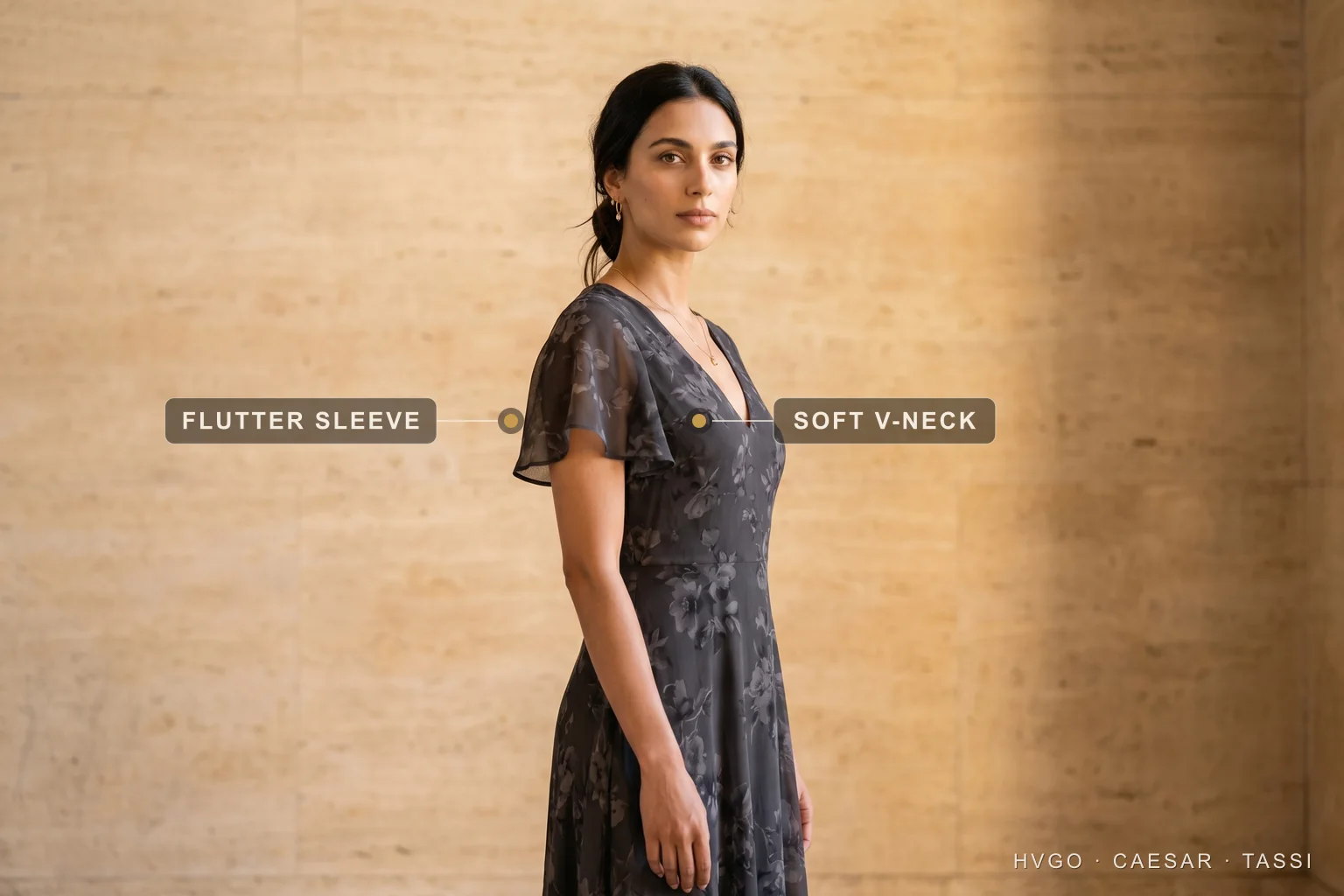
- Flutter sleeve — a loose chiffon ruffle that drapes the bicep with no underarm seam, so it veils more skin than a cap yet stays just as cool
- Soft V-neck — opens the chest and lifts the eye to the face
The dress sleeve at a glance
Eight occasion-wear sleeves, what each covers and where it belongs.
#What do dress sleeves actually decide?
A sleeve fixes coverage, warmth and formality in one cut.
#Sleeve, armhole and length: the words untangled
The sleeve covers the arm, the armhole joins it to the bodice, and length is where cloth stops, apart from shape: a set-in version sits on a shoulder seam, a raglan runs diagonally from the collar, and a dolman is cut in one with no seam.
Read length for coverage and shape for character, picturing Julia's French-pleated chiffon set in for a crisp vertical against a soft dolman where cloth pours from neck to wrist.
#The three things every sleeve controls
Coverage measures skin, warmth tracks fabric weight, and formality follows the register the cloth sets.
An open arm in a satin column reads black-tie, while the same cut in cotton reads picnic. Fabric outranks reach. Hugo Caesar Tassi, the Roma occasionwear house founded in 2004, drapes each sleeve straight down the arm rather than gripping it. A wrist-length cut sounds warmest and most modest, yet sheer netting screens the eye while leaving skin almost bare and cool. That gap is why this guide keeps two questions apart. Judge a style on coverage, then judge it again on heat.
#The main dress sleeve types, named and shown by length
Read by length, occasion sleeves run from sleeveless through cap, flutter, short, elbow and bracelet to the wrist.
#No sleeve and barely-there: sleeveless, strap, cap and flutter
These four span an open arm to a soft ruffle over the upper third.
A tank cut leaves the whole arm bare. A spaghetti strap shrinks coverage to a cord. A cap clears only the shoulder ball, roughly the top 5 cm, halting before the underarm. A flutter adds a loose ruffle across the bicep with no underarm seam, so it veils more skin than a cap yet breathes the same. Portia, an A-line in chiffon, wears that flutter on a real garment: cloth above, open air beneath. Watch the cap on a fuller arm, where its band lands at the widest point and draws the eye there.
#Mid-arm: short, elbow-length and three-quarter sleeves
Short, elbow and three-quarter lengths clothe the upper arm to mid-forearm, the polished middle for almost any daytime invitation.
A short cut ends mid-bicep, and an elbow cut stops at or above the joint. The three-quarter, also called the bracelet length, finishes near mid-forearm, the slenderest part of the lower arm. That is why it both flatters and vents at the wrist. Livilla's floral chiffon midi wears it as daytime-polished, neither bare nor wrapped. Yet even this length banks more warmth than a flutter, so reach alone will not keep you cool. Treat it as the safe default until you know the venue.
#Full coverage: long, bishop and fitted sleeves
Wrist-length cuts, whether straight-fitted or a softly gathered bishop, are the most covering and warmest family.
A flat fitted version runs clean to the wrist. A bishop gathers fullness through the forearm into a snug cuff for a softer hand. Sleek satin or matte crepe turns a full sleeve sharply formal, the way Vipsania's column gown carries its draped line. Printed chiffon makes the same reach gentle and modest for a daytime service. So the length lives a double life, set by cloth rather than by inches. In modal or crepe, though, it is the wrong call for a hot-weather wedding.
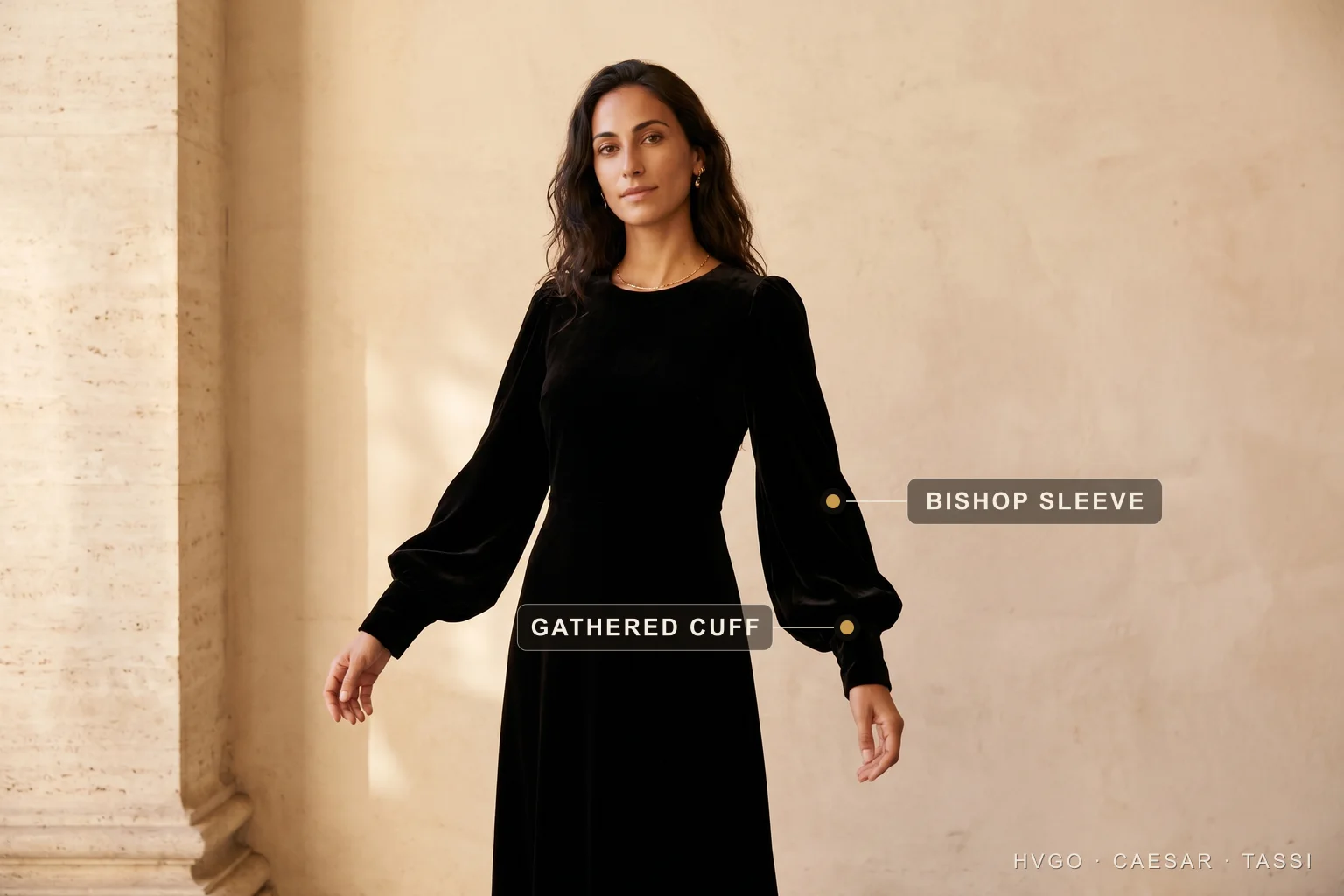
- Bishop sleeve — wrist-length with soft gathered fullness through the forearm for a fuller, romantic hand
- Gathered cuff — the snug wrist band the bishop fullness draws into
#The statement and volume dress sleeves, and where they belong
Statement sleeves trade coverage for drama through gathered volume, flares and draped width.
#Puff, balloon, bell and leg-of-mutton
This family stacks engineered volume at the shoulder or forearm: a puff or balloon at the shoulder, a bell flaring from elbow to wrist, a gigot broad up top and fitted below.
Each reads boldly and dates faster than a plain cut, so the house elegance doctrine grants it the outfit's only focal point. That earns a gigot a creative-black-tie evening but lets it overwhelm a quiet church service.
#Dolman, batwing and kimono: the draped sleeve
Built in one with the bodice from a deep low armhole, these drape the bicep with no tight band anywhere.
A dolman or batwing keeps no shoulder seam and a deep underarm, so cloth sweeps from neck to wrist. A kimono repeats the idea on a wider, squarer line. Nothing grips the arm anywhere. That is why all three cover forgivingly and suit a relaxed, modest formality, the register of a long lunch. That softness is also the ceiling: a batwing reads fluid rather than sharp. It disappoints when a dress code wants a crisp, tailored edge.
#Illusion, sheer mesh and cold-shoulder sleeves
An illusion sleeve in sheer mesh gives the look of coverage with the warmth of almost none.
Fine net traces the arm without weight. On camera it looks finished, while in the room it breathes like an open arm. The cold-shoulder inverts the trick: a wrapped arm with a cutout baring the shoulder ball. Pick the sheer netting if you want evening polish and a christening's modesty together. The cold-shoulder belongs at a daytime party rather than a service, since its open shoulder reads younger. One conceals to look proper; the other reveals to look relaxed.
#One-shoulder and off-the-shoulder: sleeve or neckline?
A one-shoulder hides a single shoulder yet reads fully dressed, whereas an off-the-shoulder bands below both and leaves the arms open.
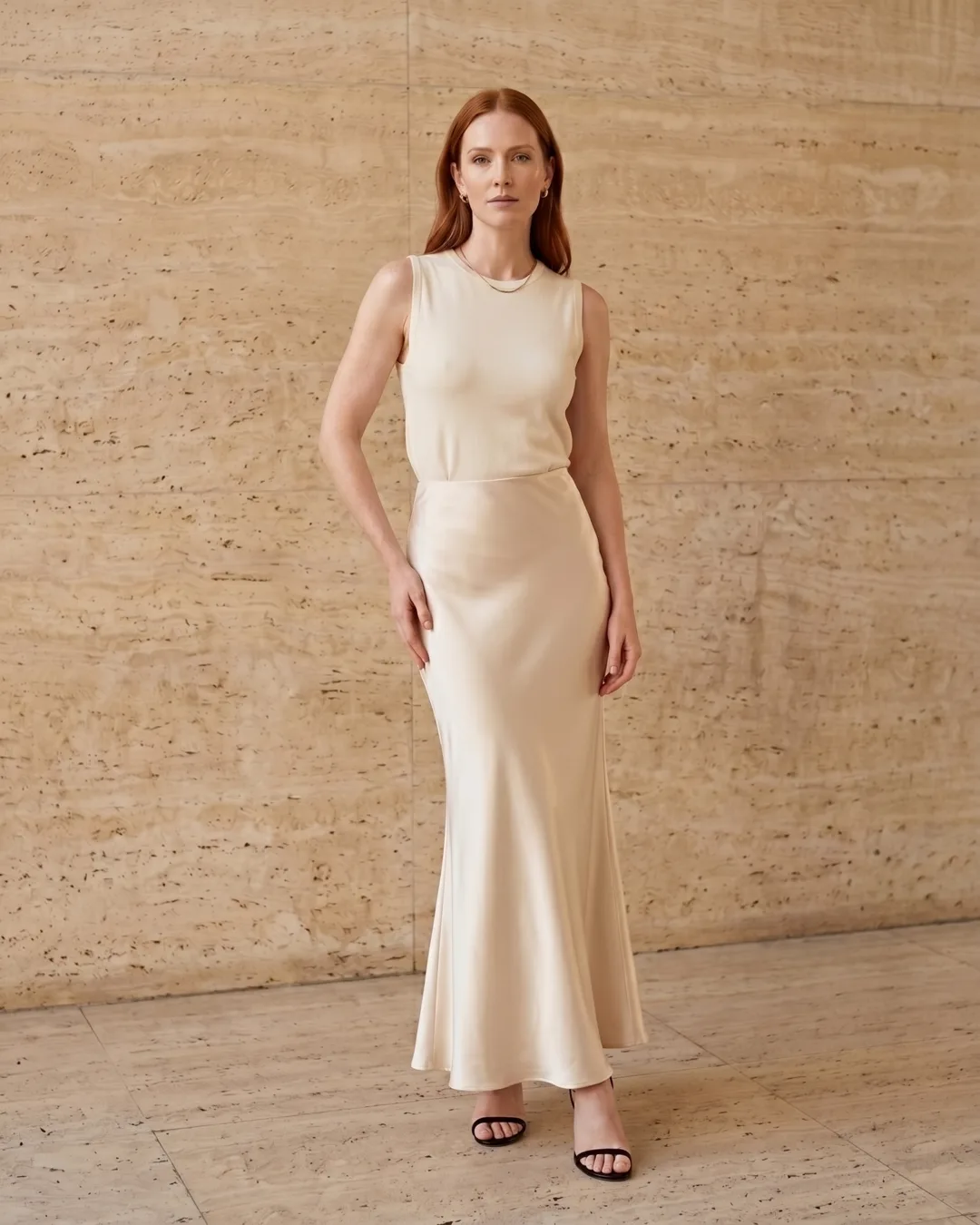
The one-shoulder is the formal compromise that covers little yet photographs as deliberate evening dress, while the Bardot drops its band below the shoulder line, as Flavia's off-shoulder satin gown does. For where collar ends and sleeve begins, the dress necklines explained guide maps each neckline against face and frame.
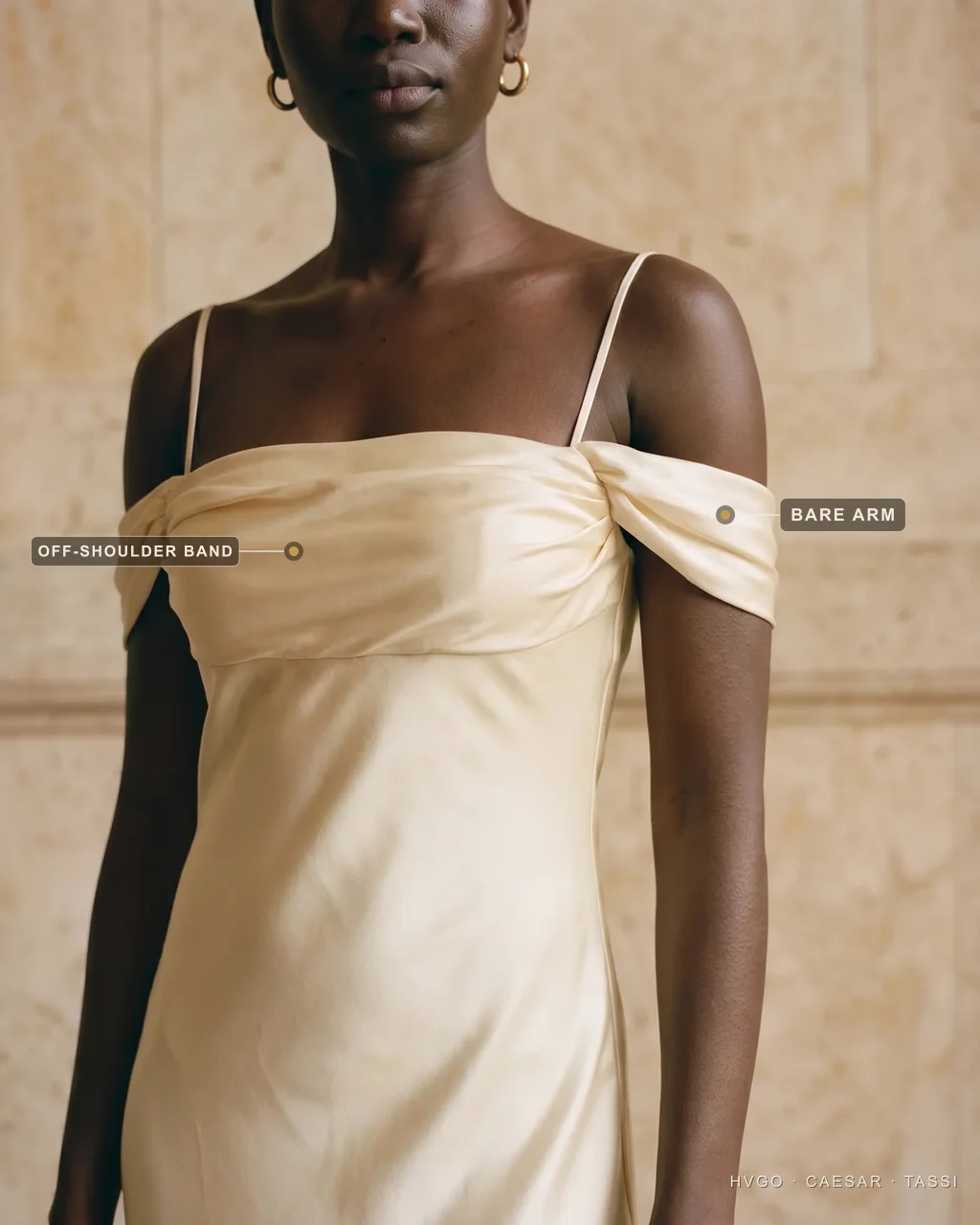
- Off-shoulder band — a draped Bardot edge that sits below the shoulder line
- Bare arm — open arms signal dressing up, the most formal reading
#Which dress sleeves give the most modest coverage?
The most modest cuts are the fitted long, the soft bishop and the forgiving dolman, with sheer netting as the dressy light option.
#For a christening, a church wedding or the opera
For a service, a fitted long, a soft bishop or a draped dolman covers the arm and reads composed.
A sewn-in sleeve looks chosen. A bolero thrown over a strapless gown looks improvised. Aemilia's A-line chiffon maxi answers a daytime service with gentle coverage, while sheer netting grants evening cover without the heat. Match the cloth to the room, since modal that warms a cold cathedral turns stifling in a packed summer chapel. Plan with the christening dressing guide and the opera dressing guide open beside this page. Both name the temperature a service runs and how long you sit in it.
#Covering the upper arm without heat or bulk
Flutter and dolman cuts veil the upper arm while staying breathable, and sheer netting hides the eye yet banks no warmth, so none of these will keep you warm.
#Which dress sleeves stay cool, and which keep you warm?
Sleeveless, cap and flutter in airy chiffon stay coolest, while full and bishop cuts in crepe, satin or modal keep you warmest.
#Summer, garden parties and hot-weather weddings
For summer heat, pick sleeveless, cap or flutter in light chiffon, or a loose bracelet or dolman for movement and shade without cling, since strong sun burns exposed arms while light netting shields and breathes.
#Winter, evening chill and over-air-conditioned venues
For winter, evening chill or a fierce air-conditioned hall, choose full or bishop cuts in crepe, satin or modal for real warmth.
A January evening is the obvious case. The drafty opera house in August, or a reception hall chilled to the bone, is the one most women forget, and it catches an uncovered gown cold. Tullia's pleated crepe column and Vipsania's modal column both hold heat through the arm, so you still face a choice. Layer an open gown under a wrap, or commit to a built-in sleeve. The sleeve wins a long cold evening because nothing slips off, whereas a wrap wins a quick step outside.
#How formal are different dress sleeves, from sleeveless to long?
Bare arms read most formal, full sleeves split between sharp evening and modest daytime, and short or cap read everyday-polished.
#The sleeve formality ladder
Sleeveless and strap rank most dressed, full sleeves rank either very formal or modest-daytime by fabric, and short and cap rank everyday.
| Sleeve | Upper-arm coverage | Coolest climate fit | Formality reading |
|---|---|---|---|
| Sleeveless / strap | None | Summer heat | Most formal in satin; casual in cotton |
| Cap | Top 5 cm only | Hot weather | Everyday-polished |
| Flutter | Soft drape, breathable | Garden party | Daytime to semi-formal |
| Short | Mid-bicep | Warm weather | Everyday-polished |
| Three-quarter / bracelet | To mid-forearm | Mild, all-rounder | Cocktail to wedding-guest |
| Fitted long | Full, to wrist | Winter, cold halls | Black-tie in satin; modest in chiffon |
| Bishop | Full, gathered cuff | Cool weather | Romantic, modest-formal |
| Dolman / batwing | Full, draped loose | Mild | Relaxed, comfortable formality |
| Sheer illusion | Visual only | Warm evening | Black-tie-friendly, modest look |
| One-shoulder | One arm bare | Warm | Formal evening |
#Matching the sleeve to the dress code
Cocktail accepts most lengths, black-tie favors bare arms or sleek full sleeves, daytime leans short-to-bracelet, and a church wants real coverage, while the bracelet length stays the safest wedding-guest all-rounder across codes.
The snag is a black-tie wedding in a cold cathedral, where an open gown fits the code yet leaves you shivering, so sheer netting or fitted satin settles dress code and comfort together.
#Which dress sleeves flatter your arms?
A sleeve flatters when it ends where the arm is slimmest and drapes the bicep without gripping.
#Reading flattery by where the sleeve ends
End it at a narrow point, mid-forearm or past the widest bicep, never banding across the fullest part, so the cut slims for you and a tight cap at the broadest point never widens the line.
#Coverage for the upper arm, gently
Flutter, bell, dolman and soft long cuts drape the bicep without gripping, so a loose sleeve covers more flatteringly than a tight one.
Volume forgives where tension reveals, so you should favor drape over cling if you want to cover the upper arm, and skip the tight short cut that bands the biceps. The rule holds right across the women's dresses range, where the cut is meant to skim, though heavy brocade is the exception that only adds bulk.
#How Hugo Caesar Tassi cuts its dress sleeves
The house drapes its sleeves down a clean vertical, breathable in chiffon for day and fluid in satin or modal for evening.
#The covering and breathable sleeves: Portia, Livilla, Aemilia
Portia's short-sleeve A-line, Livilla's floral midi and Aemilia's A-line maxi answer the garden-party brief with chiffon that veils the upper arm yet breathes in heat.
A formal evening is where all three meet their edge, since the chiffon day register reads too soft for a gala, so let the satins take the night instead.
#The fluid and bare evening sleeves: Vipsania, Julia, Flavia
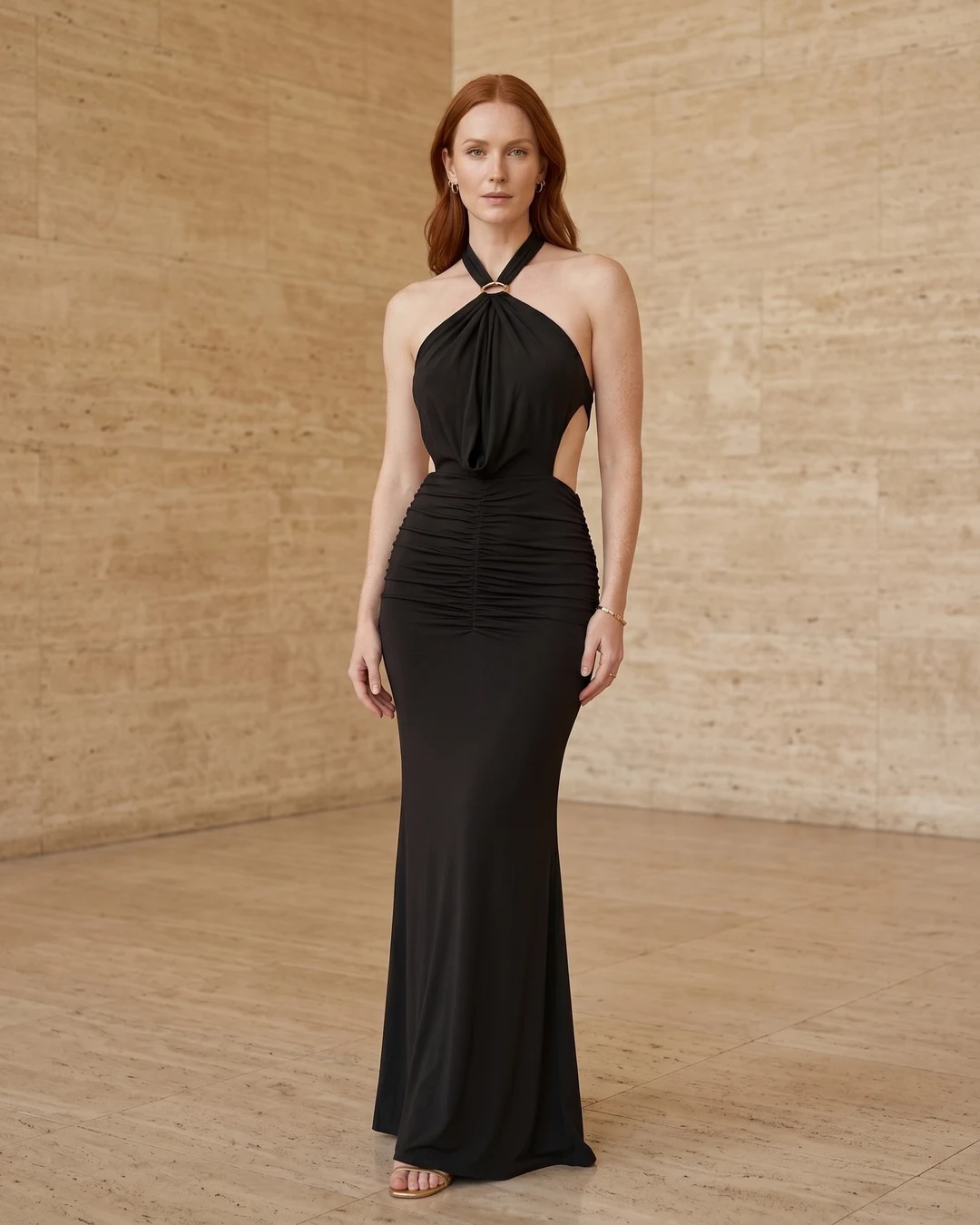
Vipsania's draped-modal column, Julia's French-pleated maxi and Flavia's strapless satin off-shoulder gown show the house dressing with and without a sleeve, from a draped shoulder to a fully open arm.
Flavia bares the arm entirely and still reads black-tie, which proves the ladder, since a satin column with no sleeve outranks most wrapped cuts for evening, though that open line wants the layering noted earlier for a cold venue.
#Why the sleeve is cut to the classical line
Each house sleeve drapes the arm without breaking the eye's vertical travel, la bella figura, the clean unbroken silhouette of the Roman column made wearable.
No gigot ever competes with a printed Cornelia bodice. Anyone after maximal drama meets the house preference plainly, which is elegance over spectacle.
#Choosing among the dress sleeves: a quick coverage-and-occasion summary
Decide coverage first, then climate, then dress code: three questions in order settle the sleeve.
#Three questions: how much arm, how warm, how dressed
Ask how much arm to cover, how warm the venue runs, and how dressed the invitation reads, in that order, since coverage rules out the most options fastest, climate eliminates the wrong fabric next, and dress code decides last.
The order catches the classic trap: a wrapped cut that satisfies modesty and code, then fails the climate test in heavy crepe at a summer wedding, where the table above settles the call at a glance.
#Where to go next
Complete the dress's shape with the necklines and silhouettes guides, then shop the sleeve you chose.
A sleeve names the arm, a neckline names the shoulder and face, and a silhouette names the whole line. The dress silhouettes guide maps the body line your cut sits on, and the dress guides hub gathers every dress decision in one place.
#Frequently asked questions
What are the most common dress sleeve types?
The most common dress sleeve types sort by length and by shape.
By length they run sleeveless, cap, flutter, short, elbow, three-quarter and long; by shape, fitted set-in, bishop, puff, bell, dolman or batwing, and illusion. Length tells you coverage while shape tells you the mood.
What is the difference between a cap sleeve and a flutter sleeve?
A cap sleeve and a flutter sleeve differ in their cut and their coverage.
A cap is a small fitted shape sitting over the top of the shoulder only, barely reaching the arm, whereas a flutter is a soft loose ruffle falling over the upper arm with no underarm seam, so it conceals more while staying just as cool.
What dress sleeves are best for a wedding as a guest?
The best dress sleeves for a wedding guest are the three-quarter and bracelet lengths.
They photograph well, suit most dress codes and stay cool, the safest all-rounder; pick a long or sheer-net cut for a winter or church ceremony, and flutter or cap for a summer garden one.
What sleeves are most flattering for fuller arms?
The most flattering sleeves for fuller arms are loose drapes that skim rather than grip.
A flutter, bell, dolman or soft long cut drapes the bicep without banding it, and a bracelet length ends at the slim mid-forearm, so avoid a tight short sleeve that cuts across the broadest part.
Are sleeveless dresses appropriate for formal events?
Sleeveless dresses are appropriate for formal events, and often the most formal choice.
Bare arms signal dressing up, which is why a sleeveless satin gown reads as evening wear; for a church service or a chilly venue, pair it with a sleeve or a wrap, or pick a covered design instead.
What is the most modest dress sleeve?
The most modest dress sleeve is a fitted long cut to the wrist.
A soft bishop and a forgiving dolman follow close behind for full coverage, and a sheer-net version reads modest and dressy at once while staying light against the skin.
Now that you can match a sleeve to your arm, your climate and your invitation, complete the dress's shape with the necklines and silhouettes guides, then shop the sleeve you chose in the occasion dresses edit.
More Dress Knowledge guides
Dress Necklines Explained
Every dress neckline named, with the jewelry each one takes, the bust and shoulders it flatters, and the formality it signals. A house guide.
Decode every dress necklineDress Silhouettes Explained
Every dress silhouette explained: A-line, column, sheath, fishtail, empire, plus the fabric that holds each shape and the body it flatters.
Explore every dress silhouetteHow to Choose a Dress
A quiet-luxury method for choosing a dress — occasion first, then silhouette, fabric, length, fit, and only then color. Buy one you'll wear for years.
Learn the five-step methodHow to Measure for an Occasion Dress
Take your bust, waist and hip dress measurements at home and match them to the HCT size chart, with US/EU conversion and per-fabric ease, to order once.
Find your size in the occasion dresses editMidi vs Maxi vs Mini
Every dress length in real inches: mini, midi, tea, maxi, measured on a 5'7\" fit model, plus a height rule for where each hits on you.
Find your hem length in real inchesTypes of Dresses
Every formal dress type named and shown — slip, column, A-line, sheath, fishtail, one-shoulder and more — each with its fabric and best occasion.
Name every dress type