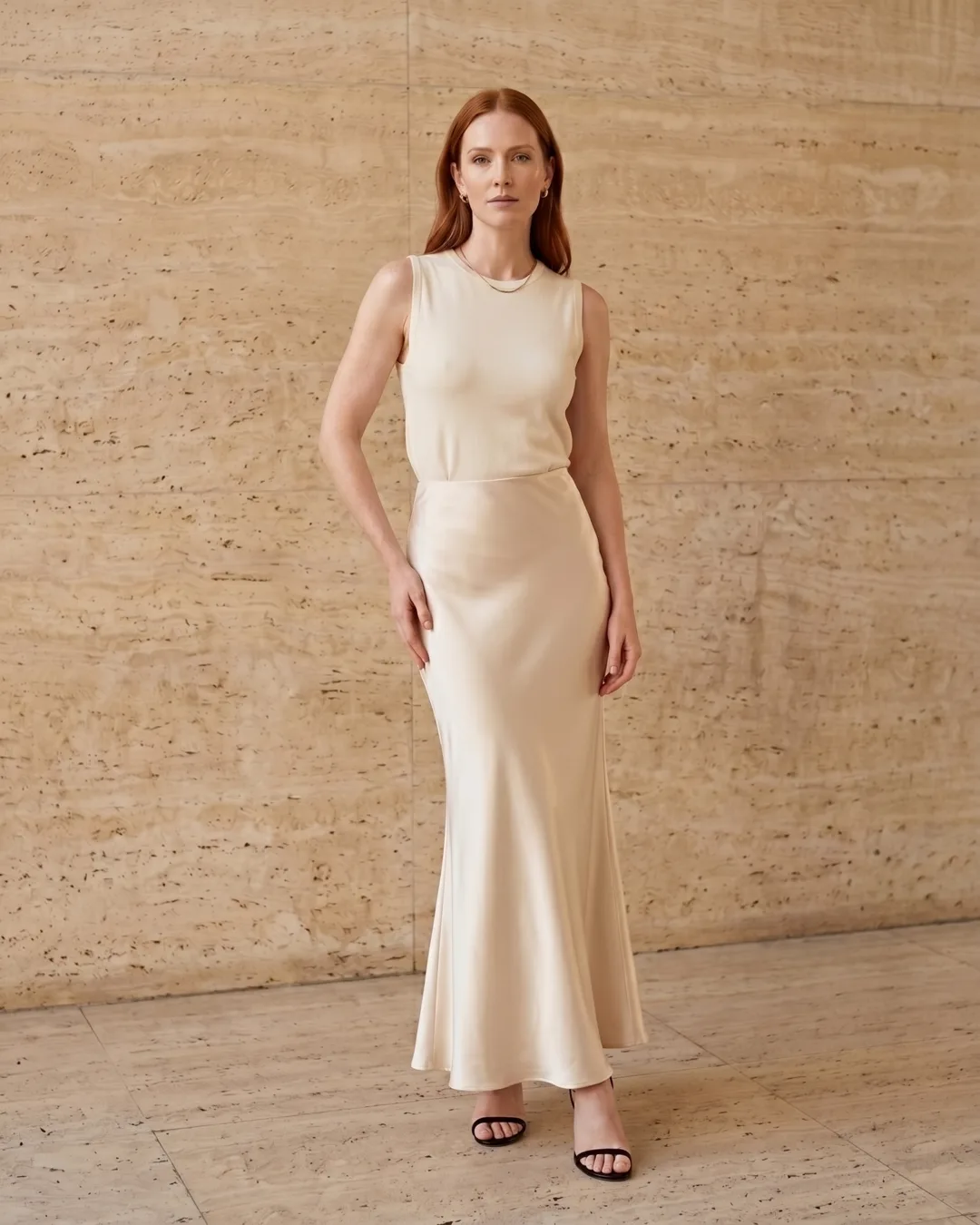
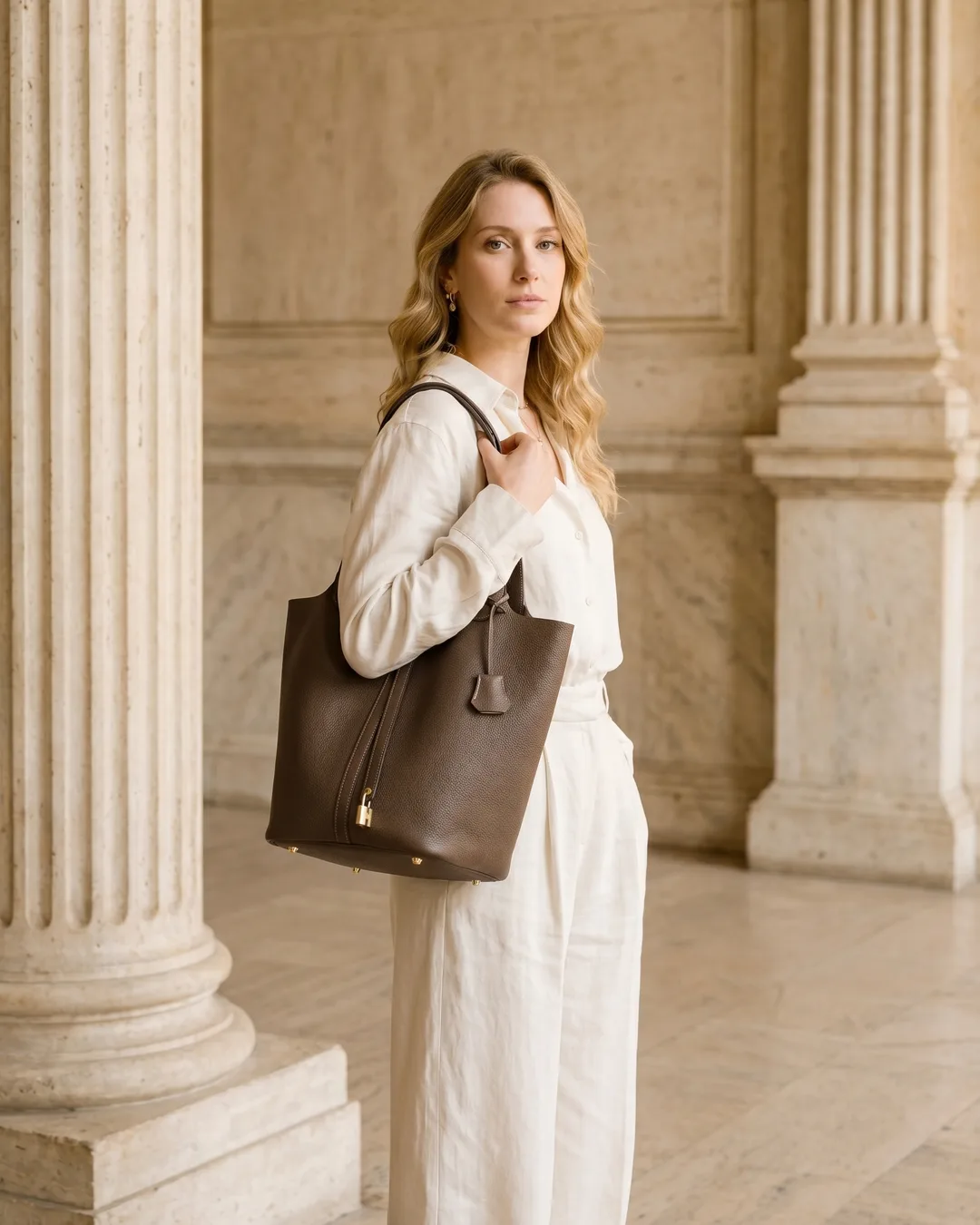
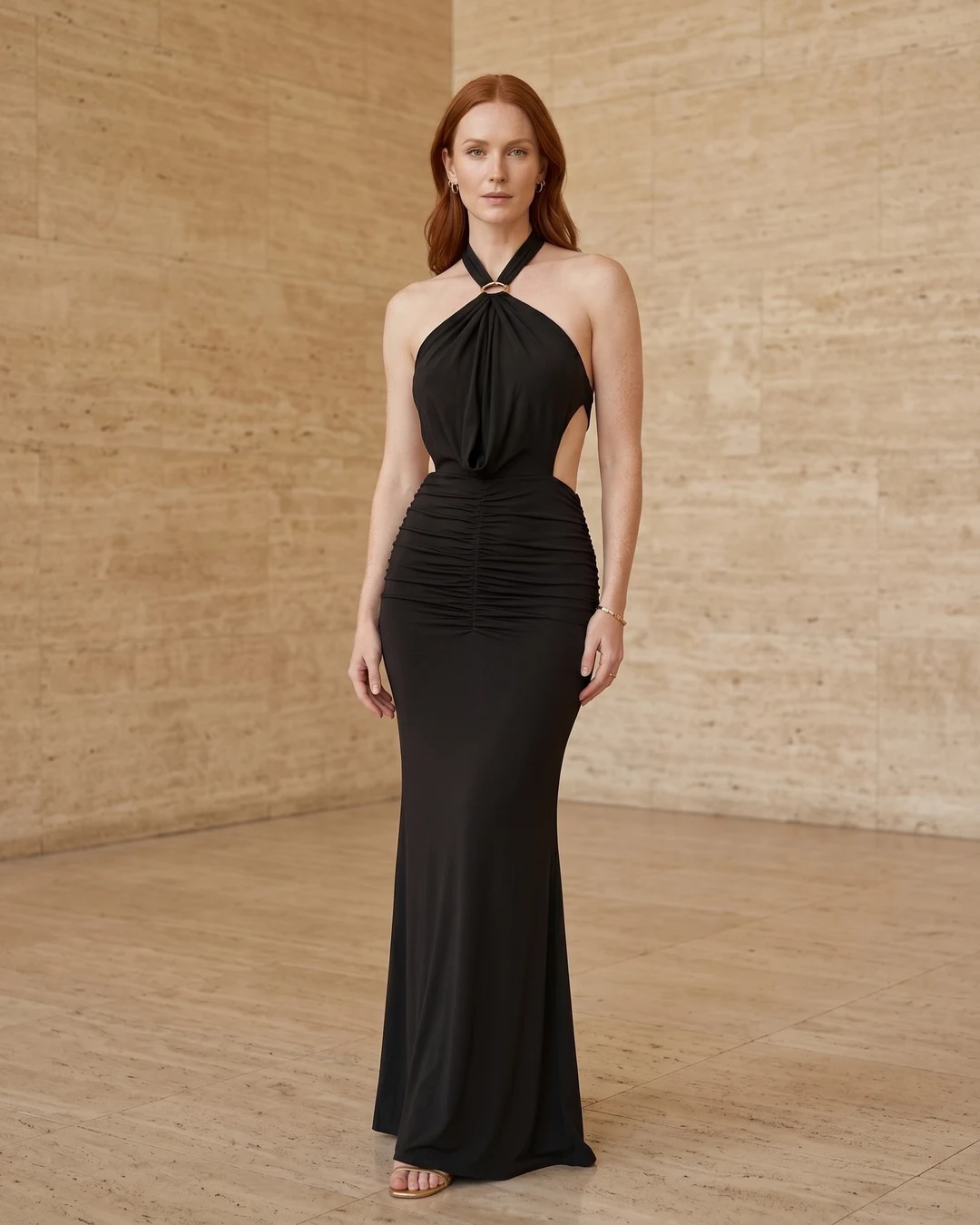
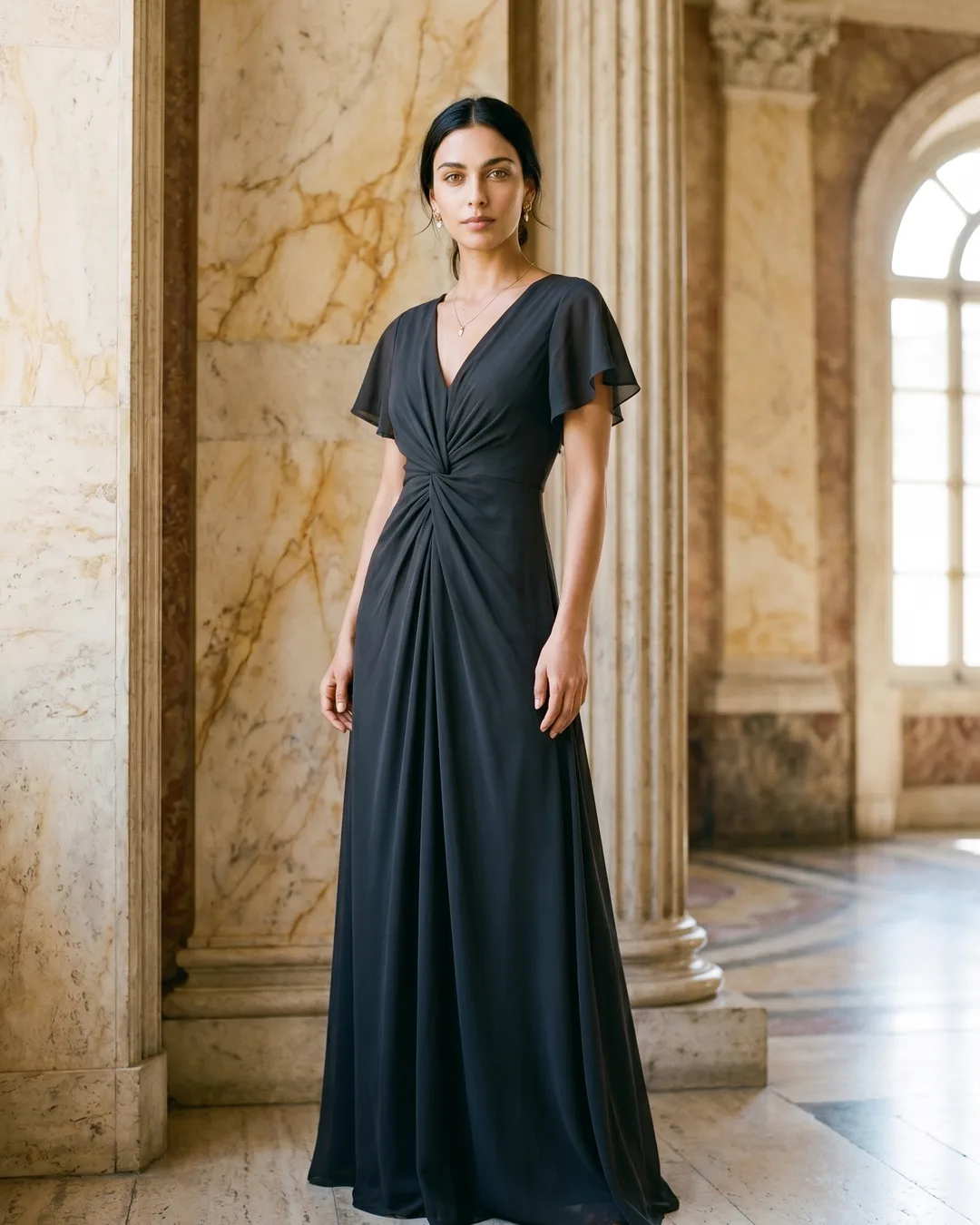
What to Wear to a Christening: Quiet Elegance for a Sacred Day
What to wear to a christening, by a Roman house — modest, daytime-elegant outfits in church-safe colors that honor the day, never reading bridal.
On this page
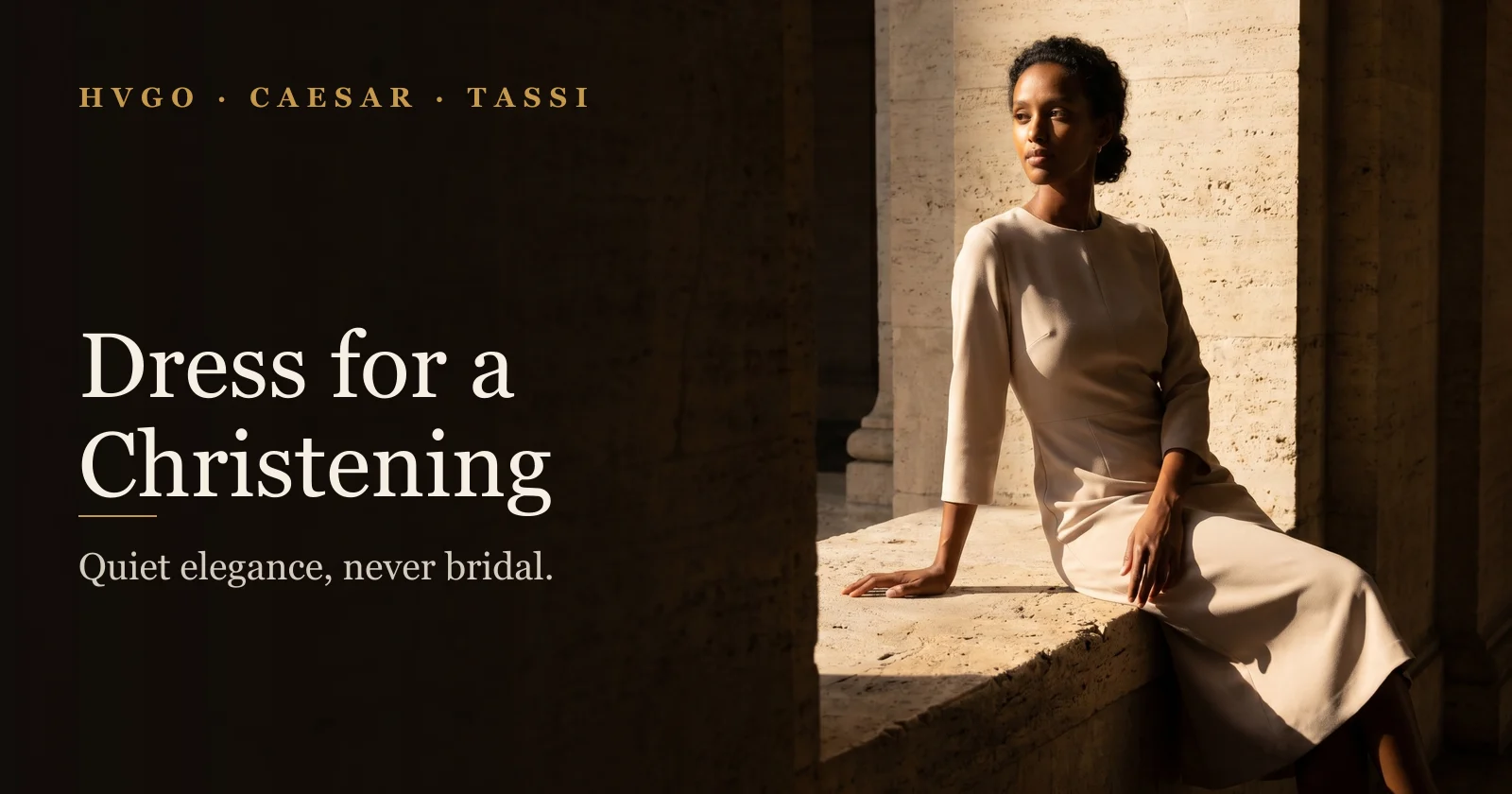
Wear a modest daytime dress that covers the shoulders, falls to the knee or below, and lands on a soft color that is never white, ivory, cream, or champagne. The baby's gown should hold the only white in the room. Settle that, and the rest of the outfit follows on its own.
Hugo Caesar Tassi dresses the christening guest the way a Roman house dresses for a sacred morning: present, respectful, beautifully understated.
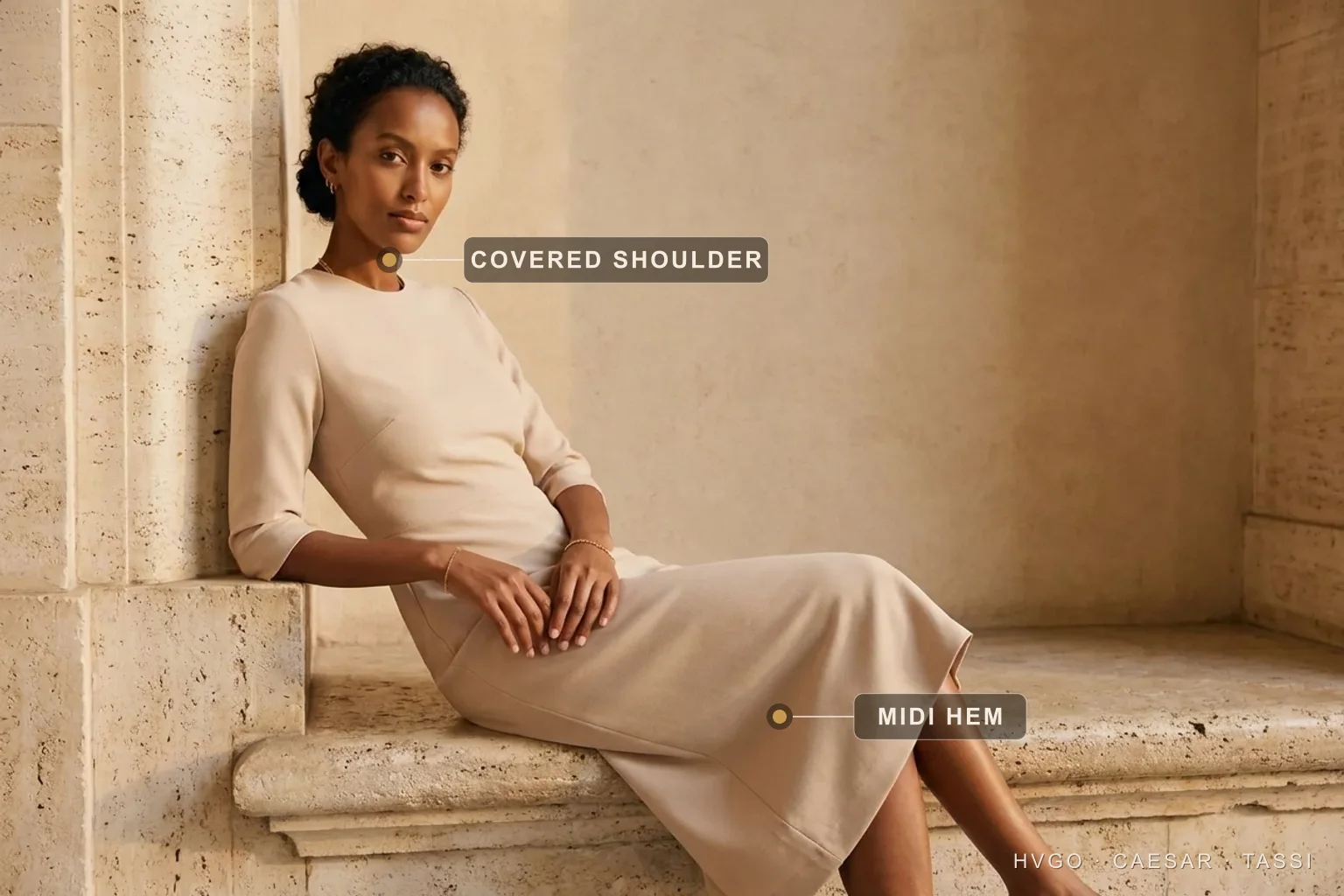
- Covered shoulder
- Midi hem
A christening, decoded
A religious venue asks for covered shoulders — add a silk scarf or chiffon shawl for the ceremony.
Shop occasion dresses#What to wear to a christening: the short answer before the details
A knee-to-floor dress with covered shoulders, in a gentle non-white color and a matte daytime fabric, answers almost every christening invitation. Smart, respectful, never bridal. That single brief carries the godmother, the mother, and the guest in the back pew alike.
A baptism happens in a church, in daylight, around a font. There a baby in white holds the single focal point. Your dress earns its place by receding toward that point.
#The christening dress code in one line
A christening reads as semi-formal daywear with church modesty layered on top. The dress should reach the knee at minimum, cover the shoulders, and sit in a quiet shade like Verde Antico (antique green) or Cipria (soft pink). Picture a guest at a noon chapel: dusty-rose crepe midi, low heels, a slim clutch. That outfit has answered the whole question. A high-formality cathedral baptism is the one exception, where a maxi suits the scale, though the modesty floor and the white restriction still hold.
#Who's reading this: godmother, mother, grandmother or guest
Your role nudges the dial, never the rules themselves. The godmother (madrina) and the mother both stand near the font and appear in the family photographs, so each dresses a notch more considered. A grandmother leans formal and comfortable for a long morning. An ordinary guest aims for polished-but-receding, choosing nothing that pulls a single eye from the family. Each of those roles keeps its own section below.
#How modest does a christening outfit really need to be?
Cover the shoulders, keep the neckline high enough to kneel and lean without adjusting, and choose a hem that clears the knee. Modesty in a church is practical rather than severe. You will sit, stand, and possibly hold an infant, so the dress has to behave through all of it.
The simplest test is movement. A neckline that gaps when you bend toward the font, or a hem that rides up when you sit, is a dress fighting the occasion.
#Covered shoulders, sleeves and necklines for a church
The house coverage rule puts shoulders under fabric and keeps necklines closed. Sleeves, cap sleeves, or straps wide enough to read intentional all pass; spaghetti straps and strapless cuts do not. A sleeveless dress is not disqualified, though. A recycled-chiffon overlay or a bias-cut silk scarf turns a bare cut into a church-correct one, the way the Livilla floral-print chiffon midi works beneath a matching wrap. Only a deep cowl-back gown defeats that fix, because no wrap can rescue an open back.
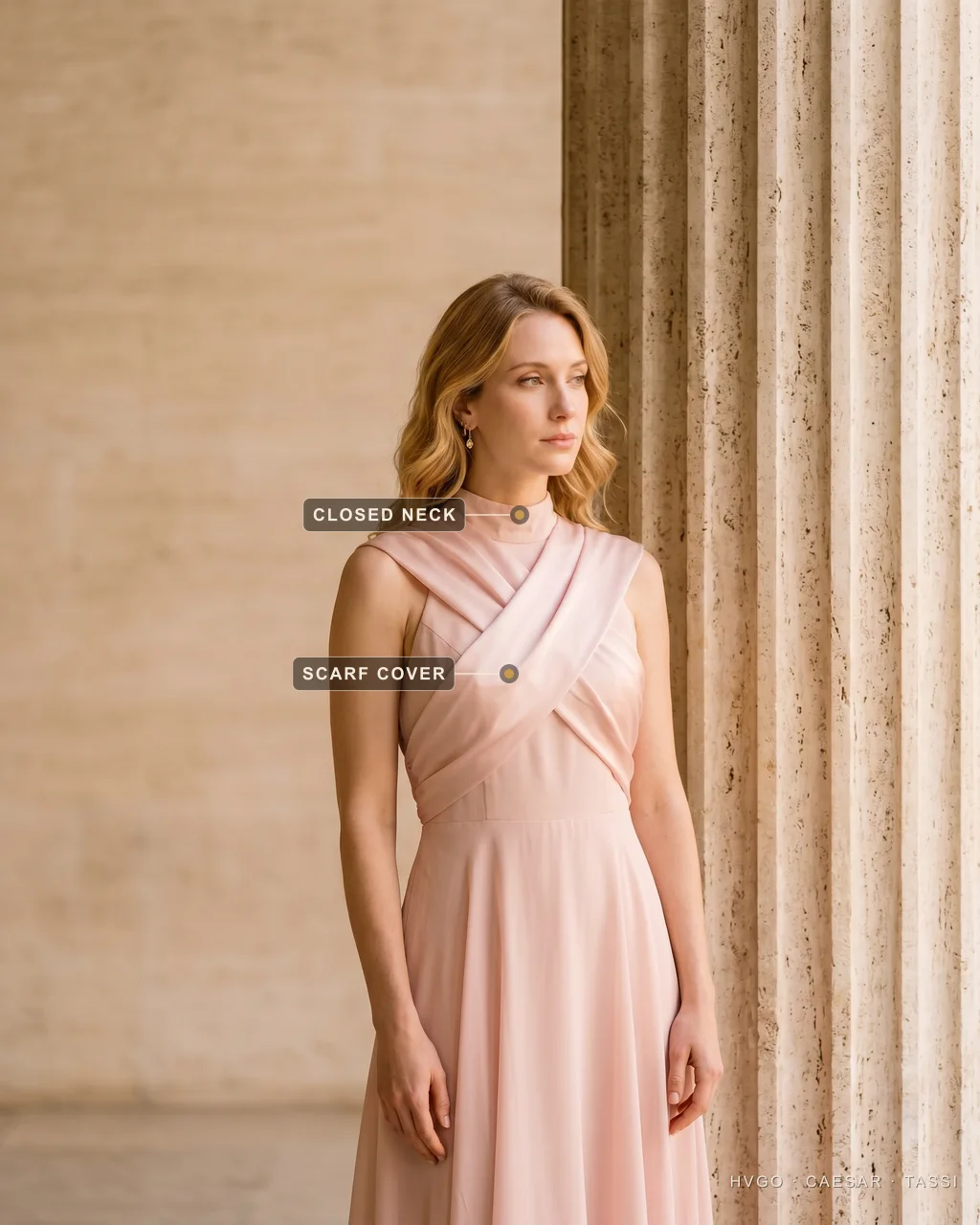
- Scarf cover
- Closed neck
#How long should the hem be for a christening
Knee-length is the practical floor, a midi does everything, and a maxi suits the godmother or a formal cathedral. House elegance doctrine puts a hem at the knee or the floor and warns off the unflattering middle, so a baptism rewards the longer end of that range. A tea-length crepe dress at a village chapel sits exactly right. A thigh-grazing shift fails on length alone, even in a flawless color.
#Comfort for a long ceremony
A christening rite runs twenty to forty minutes of standing, sitting, and often kneeling, sometimes with a baby in your arms. Crepe holds its line in a pew. Recycled chiffon moves without crushing, and modal recovers after you sit, where stiff cotton or dry linen would crease by the second hymn. Pick a hem you can stride in, too: a godmother climbing font steps with a child needs room to move, which rules out a tight column for that role.
#Which colors should you avoid at a christening — and which to choose instead
Leave white, ivory, cream, and champagne to the baby, soften any black with color, and choose dusty, gentle tones instead. Color does more work than silhouette on this day, because a wrong shade lives in the photographs long after the cut is forgotten.
| Color | Verdict | Why | Best role |
|---|---|---|---|
| Avorio (ivory), cream, champagne | Avoid | Reads on the baby's white spectrum in photos | None |
| Pure black, unbroken | Use with care | Can read funereal at a joyful sacrament | Guest, softened only |
| Verde Antico (antique green) | Recommended | Quiet, daytime, reverent without somber | Any role |
| Cipria (soft pink), Cornelia (rose) | Recommended | Gentle, celebratory, photographs softly | Godmother, mother, guest |
| Travertine (stone) | Recommended | Neutral that never reads bridal | Mother, grandmother |
| Cobalto (navy) | Recommended | Formal, safe, flattering in daylight | Any role |
| Porpora (wine), used softly | Recommended | Rich yet restrained for cooler seasons | Godmother, guest |
#Why white, ivory, cream and champagne are off-limits
The baby's christening gown is the only white the room should carry, and the house stretches that ban across every near-white. Champagne, cream, and ivory all photograph as one bridal spectrum, so a guest in champagne crepe still steals the eye that belongs to the child. One nuance survives: a print with white in it can pass when another color clearly dominates, which is why a Livilla floral on a green ground reads as green.
#Is black appropriate at a christening?
Black works at a christening once you soften it, and turns somber when you do not. Modern Western and Italian practice both allow black for a baptism, provided you break the funereal weight. Add a colored silk scarf, choose a fluid crepe, and let a touch of Cornelia rose or Cobalto navy lift the look. The version to skip is the all-black, high-shine outfit that arrives straight from a funeral, since a baptism marks a beginning rather than an ending.
#The colors that read respectful and celebratory
Dusty, gentle tones suit a sacred daytime room better than bright or neon shades. Verde Antico, Travertine, Cipria, Cornelia, Cobalto, and a soft Porpora all sit in the right register: dressed enough to honor the day, quiet enough to recede toward the font. A neon coral flatters at a summer party, then turns loud against pale plaster. The same cut in dusty rose simply settles into the room.
#What should a godmother wear to a christening?
A refined midi or maxi in a soft color, with covered shoulders, a photogenic fabric, and a low or block heel for standing at the font. Her look is the most considered guest look present, and the one rule it adds is that it must never upstage the mother.
#The godmother's role and why her outfit matters more
The madrina often stands at the font and may carry the baby during the rite. She is photographed beside the parents through the whole ceremony. Her dress should read as the room's best-judged guest look: elevated, never attention-seeking. The mother and child hold the focus by right. A practical consequence follows. Anything that catches on a baby is out. A heavily beaded bodice or a loose-sequin skirt fails twice, on safety and on its evening register.
#A godmother christening outfit, built
Build the madrina look in layers that survive the day. Begin with a fabric that photographs cleanly and resists snagging, such as a French-pleated chiffon maxi (the Julia) or an A-line chiffon maxi (the Aemilia) in a muted shade. Add covered shoulders, a low or block heel for standing on stone, and a discreet leather clutch. Watch one scenario in particular: an outdoor cathedral-garden christening, where a maxi hem meets grass and gravel, so a block heel beats a stiletto every time.

- Pleated maxi
- Block heel
#What the mother, grandmother and a guest each wear to a christening
The family hosts dress a touch more formal and intentional, while a guest dresses polished and deliberately receding. Role decides degree, not direction, and everyone obeys the same coverage, hem, and color rules. Family co-host and may dress up; a guest dresses down a half-step and coordinates rather than matches.
#The mother and grandmother of the child
The mother and grandmother both dress a notch more formal than the guests, coordinating with the godmother without matching her. The mother often hosts the christening lunch afterward, so her outfit has to carry from a solemn church to a celebratory table without a change. A modal column gown (the Vipsania) in Travertine, with a wrap for the rite, manages both registers in one piece. The grandmother leans toward comfort across a long morning, in a crepe midi and closed footwear. The pairing to avoid is a matchy mother-godmother duo, which photographs as a uniform.
#The ordinary guest
A guest aims for polished, modest, and deliberately receding. A midi in a quiet color, minimal jewelry, and nothing that competes with the family is the safest formula present. The Portia short-sleeve chiffon A-line in Cipria, with a slim clutch and low heels, lands exactly there. Jewelry is where guests overthink it. One pair of small earrings reads correct, whereas a full stack of statement pieces reads as competition.
#Do Catholic, Orthodox and Protestant traditions change what to wear to a christening?
Catholic and Orthodox christenings tend to run more formal and more conservative on coverage, while a Protestant dedication can feel a touch more relaxed. Tradition shifts the dial inside the same rules, so read the church and the family before you finalize the hem and the sleeve. When unsure, dress to the more conservative reading, since extra coverage never causes offense.
#How tradition shifts the dress code
Coverage expectations climb from Protestant to Catholic to Orthodox, broadly. An Orthodox baptism, often a full-immersion rite in an ornate church, expects sleeves and a longer hem. A Catholic christening sits close behind on formality, near the register an Italian wedding guest would recognize. A Protestant dedication can read closer to smart daywear. A head covering enters only where a tradition or family requests it, and the bias-cut silk scarf you brought for your shoulders doubles as that covering. Even a relaxed-dress request holds one line: you still keep the white restriction, because that rule serves the baby rather than the formality.
#From the font to the christening lunch
One outfit should carry from a solemn church to a celebratory table. The christening lunch relaxes the room, so the wrap comes off, the shoulders show, and the same dress reads lighter without a change. A guest in a chiffon midi with a removable overlay shifts from reverent to festive by folding that overlay into her clutch. Over-covering pays here. A look pitched for the church always relaxes for the lunch, while a look pitched for the lunch can never re-cover for the church.
#Fabric, season and finishing details for a christening
Matte chiffon, crepe, and modal read correct for a morning sacrament, while high-shine satin and sequins read evening and pull focus. The time-of-day rule that governs eveningwear runs in reverse at a baptism: daytime wants matte before shine, exactly as house elegance doctrine prescribes. Season then decides weight and layering, never the rules themselves.
#Daytime fabrics over evening sheen
Matte fabrics read morning; sheen reads night. Recycled chiffon, matte crepe, and draping modal sit correctly in church daylight. Bias-cut evening satin and any sequin throw catch the light and pull focus from the font, so the Calpurnia fishtail satin gown belongs at a gala. A low-sheen duchess fabric in a deep matte tone can still pass at a formal cathedral, which proves that sheen is the disqualifier, not richness.
- Do choose matte chiffon, crepe, or modal in a soft non-white color
- Do keep shoulders covered with a sleeve, overlay, or wrap
- Do pick a block or low heel rated for standing on stone
- Don't wear white, ivory, cream, champagne, or unbroken black
- Don't reach for high-shine satin, sequins, or a mini hem
- Don't add denim, beachwear, or a loud bridal-toned print
#A summer christening versus a winter christening
A summer christening wants lightweight chiffon and breathable layers, while a winter one wants fuller fabric and closed footwear. For a warm-weather church, a breathable chiffon or crepe midi keeps coverage comfortable when a silk scarf replaces a heavy wrap. For a cold stone church, add real sleeves, a wool-feel wrap, and closed shoes, since the floor holds the chill. Coverage stays constant across both seasons. The summer trap is dropping the shoulders for the heat; the winter trap is over-bundling into a coat that swallows the dress.
#Layering and footwear that survive a church floor
A wrap, a chiffon overlay, and a bias-cut silk scarf each handle modesty and warmth, and a block heel survives stone where a stiletto sinks. The scarf does three jobs: a shoulder cover, a head covering where requested, and a color note that softens a plain look. Footwear is the quiet failure point. A church floor of stone or worn tile traps a thin stiletto through the standing portions, whereas a block heel keeps you steady at the font.
#How Hugo Caesar Tassi dresses you for a christening
The house maps real silhouettes to the day by role, each in a soft, church-safe imperial color. The governing principle is one considered piece rather than many loud ones, which is the la bella figura discipline applied to a sacred morning.
#The house picks, by role
A guest reaches for the Livilla floral-print chiffon midi or the Portia short-sleeve chiffon A-line, both modest and gentle in color. A godmother or mother steps up to the Julia French-pleated chiffon maxi or the Aemilia A-line chiffon maxi, each photogenic and font-ready. Both suit Verde Antico, Cipria, or Cobalto rather than any near-white. Winter cathedrals ask for more. There chiffon alone runs cold, so a modal column such as the Vipsania, layered beneath a wrap, holds warmth and formality together. Compare these cuts across the chiffon dresses edit and the broader midi dresses range.
#Finishing the look with restraint
Finish with one considered piece, never a pile of them. A bias-cut silk scarf for modesty and warmth, a slim leather clutch, and understated jewelry complete the outfit without crowding it. The house rule of one focal point only means the dress, the scarf, or a single piece of jewelry leads. Picture the opposite: statement earrings, a bold cuff, a printed clutch, and a contrast wrap worn at once. Each is fine alone, yet together they read as noise, against everything la bella figura and how to dress elegantly teach for a sacred day.
#Your christening outfit, settled in three rules
Cover the shoulders, keep the hem at the knee or below, and leave white to the baby in favor of a soft color. Three rules carry the whole day, whichever role you hold, and the silhouette and accessories simply follow from them.
#The three-rule recap
Hold the three rules and you cannot go wrong. Keep your shoulders under a sleeve, overlay, or wrap. Hold the hem from the knee to the floor. Choose a gentle non-white shade like Verde Antico, Cipria, or Cobalto so the baby's gown stays the only white in the room. A guest takes the Portia or Livilla midi; a godmother or mother takes the Julia or Aemilia maxi, each in one of those soft colors with a single finishing piece. Restraint is the whole point, the same instinct that governs a wedding guest dress codes decision and every other ceremony in the what to wear library.
#Frequently asked questions
Can you wear white to a christening?
White is the one color to avoid at a christening, along with ivory, cream, and champagne, since the baby's christening gown should stay the only white in the room. The bridal-white logic from weddings applies here, widened to every near-white shade, so choose a soft color like antique green, dusty rose, or navy instead.
Is it okay to wear black to a christening?
Black is acceptable at a christening when you soften it with a fluid fabric and a touch of color, though heavy funereal all-black can read somber at a joyful sacrament. Modern Western and Italian practice both allow it under that condition, so add a colored silk scarf to lift the look off pure mourning.
What should a godmother wear to a christening?
A godmother wears a refined midi or maxi in a soft color, with covered shoulders, a photogenic fabric, and a low or block heel for standing at the font. It is the most considered guest look in the room, elevated but never so striking that it upstages the mother.
Do you have to cover your shoulders at a christening?
Covered shoulders are expected at most christenings, achieved with sleeves, a chiffon overlay, or a wrap over a sleeveless dress. A place of worship asks for more coverage than a party, so pair that with a neckline modest enough to lean and kneel comfortably through the rite.
What length dress is appropriate for a christening?
A knee-length dress is the practical minimum for a christening and a midi is the ideal do-everything hem. A maxi suits the godmother or a formal cathedral, while a mini reads too casual for a place of worship and pulls focus the day cannot spare.
What should I wear to a summer christening?
A summer christening calls for a breathable midi in lightweight chiffon or crepe, in a soft color, with covered shoulders kept comfortable by a silk scarf rather than a heavy wrap. Lightweight layering replaces winter's fuller fabric, finished with a low block heel for standing on a church floor.
Have the day in mind? Choose your christening dress in the Hugo Caesar Tassi occasion dresses edit for the soft, covered, church-safe pieces this guide recommends.
More What to Wear guides
Black-Tie Attire for Women
A Roman house decodes black-tie attire for women: floor-length or not, the right fabric and jewelry, and how optional, creative and gala differ.
Decode the four black-tie rungsCocktail Attire for Women
A Roman house decodes cocktail attire for women: the exact length (knee to mid-calf, never floor), the right fabric, and how it differs from black tie.
Decode cocktail attireWhat to Wear to an Italian Wedding
A Roman house decodes what to wear to an Italian wedding: the real no-black and no-white rules, church cover-up, and North-vs-South dress code.
Decode the invitata dress codeWhat to Wear to Royal Ascot and the Races
The enforced Royal Ascot enclosure rules for strap width, hem and hat size, plus a Roman house rule for balancing a hat against your dress.
Pass the Ascot enclosure rulesWhat to Wear to a Summer Wedding
A Roman fashion house on what to wear to a summer wedding: the breathable fabrics, flattering bright-light colors and hems that survive grass and sun.
Dress a summer weddingWhat to Wear to the Opera
How dressed-up the opera really is, house by house: from La Scala's opening night to a relaxed Met evening, plus matinee, box and intermission etiquette.
Calibrate opera dress codes