What to Wear to a Winter Wedding: A Warm, Elegant Guest Guide
A warm, elegant winter wedding guest guide: the fabric weights, jewel tones, sleeves and wraps that keep you photogenic and genuinely warm.
On this page
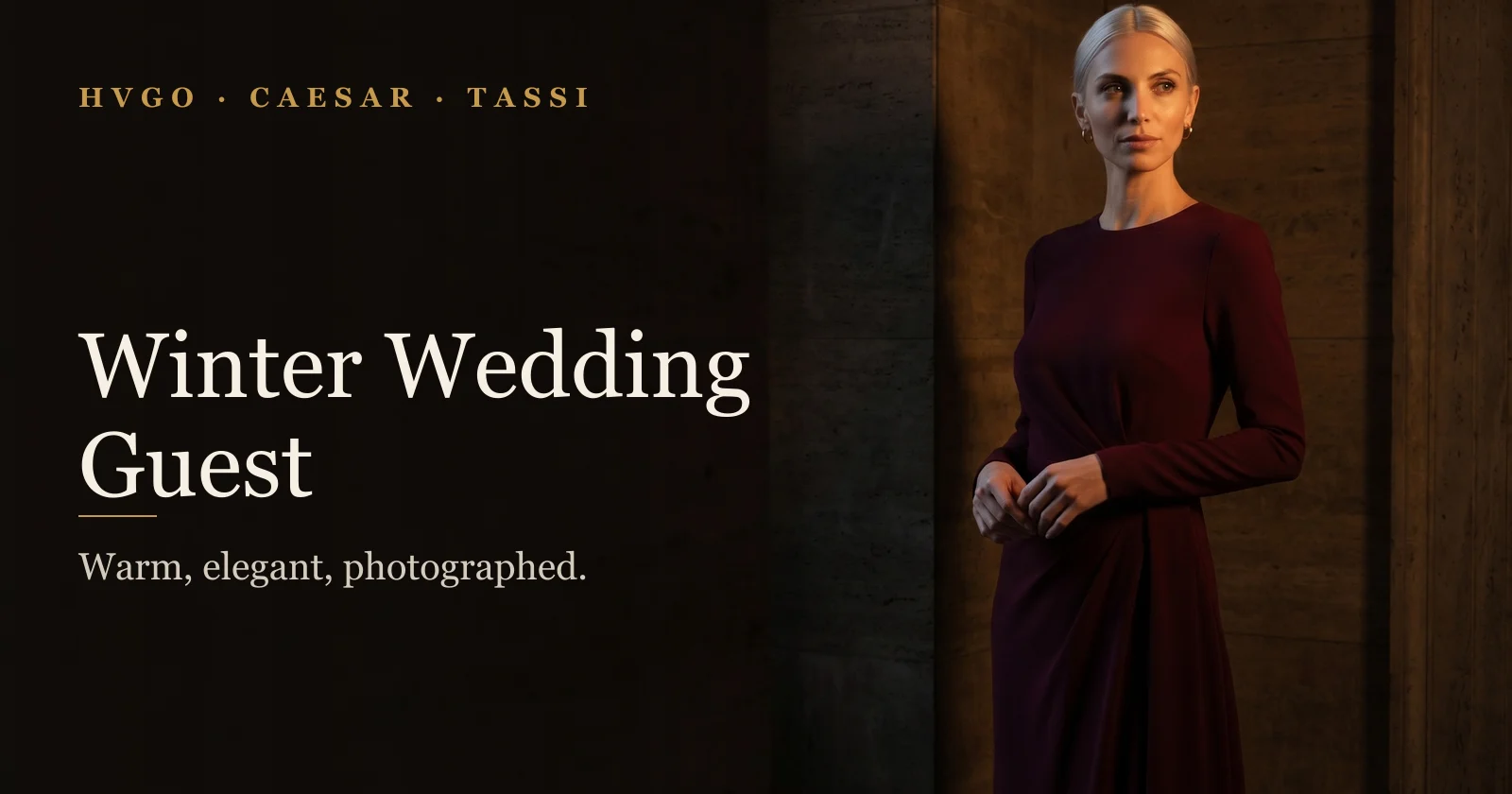
Dress for a winter wedding in a heavy-fabric gown, a deep jewel tone, a real sleeve, and a narrow layered stole. Warmth comes from fabric weight, not thickness. A December evening ceremony usually runs late, cold, and formal.
Most roundups solve for the photograph and leave you shivering on a frosted courtyard. Hugo Caesar Tassi flips that order: warm first, photographed second. The sections below settle fabric, color, sleeve, wrap, length, and shoe in sequence, the way a Roman atelier dresses a cold-season guest.
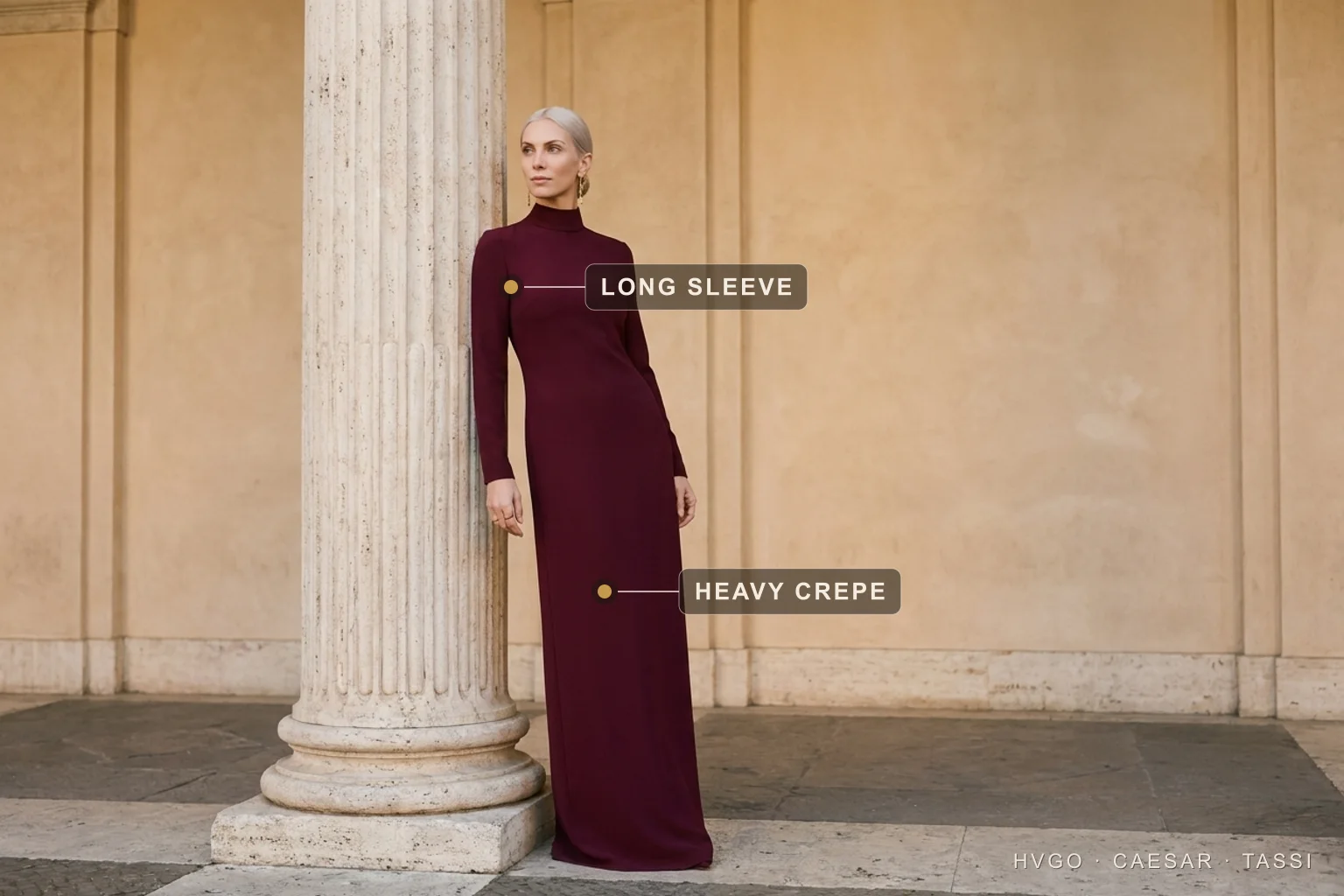
- Long sleeve
- Heavy crepe
A winter wedding, decoded
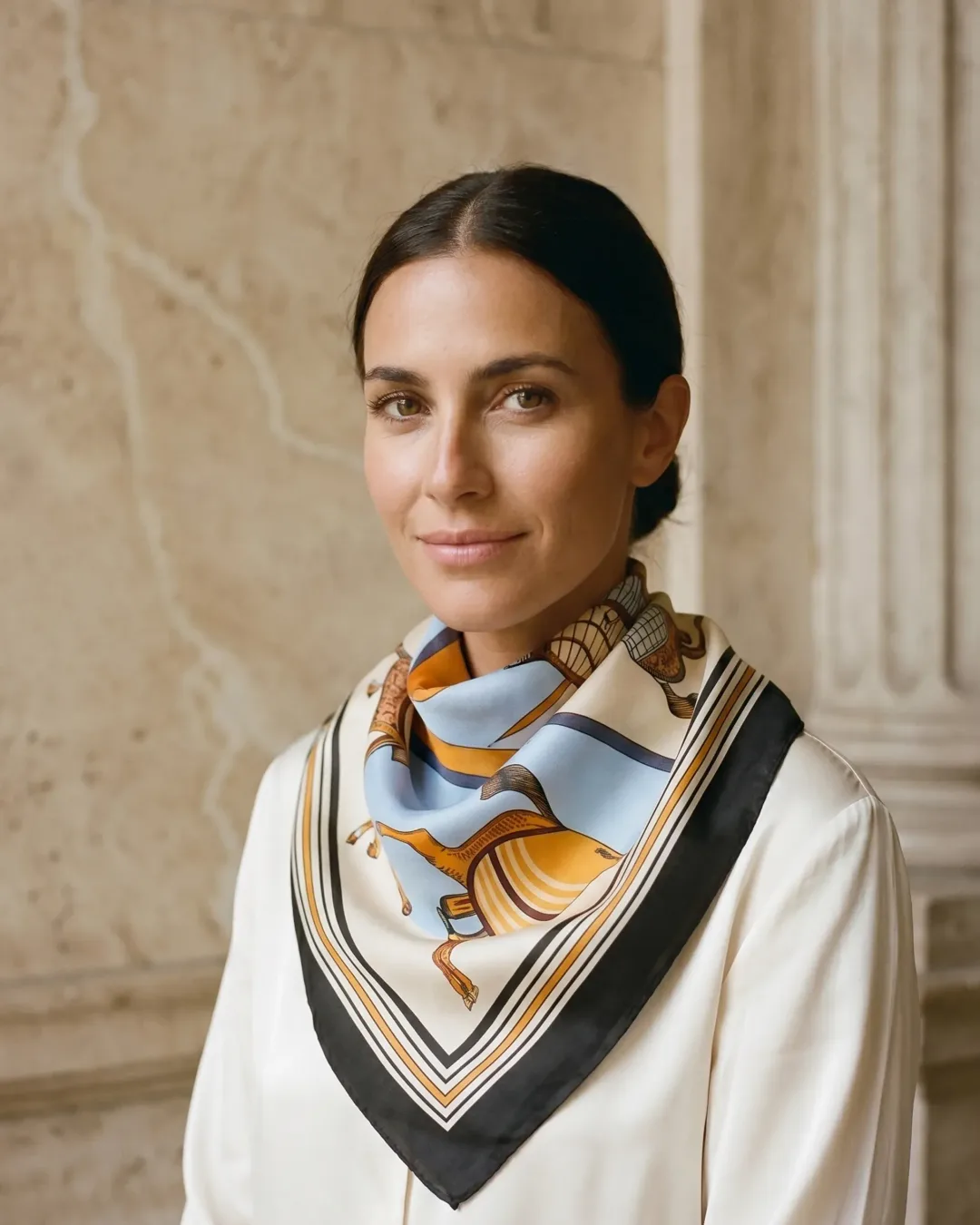
Layer with a tailored coat and a silk scarf; the dress stays the focal point.
Shop evening gowns#What makes a winter wedding guest outfit different from any other season
Cold weather forces three decisions at once: an insulating fabric, real coverage, and a wrap that survives the gap between a stone church and a heated hall. Summer dressing ignores all three. The season, not the dress code alone, governs every call you make.
#Warm first, photographed second: the winter guest's order of decisions
Settle warmth through fabric weight and layering before you reach for color or trend. A December evening reception tends to lean black-tie, begins after 5 p.m., and runs past midnight, so you spend hours in 40-degree air moving between rooms. Three variables then shift everything. A vineyard ceremony outdoors demands a velvet sleeve and opaque hosiery; a heated ballroom lets a modal jersey column breathe. Frozen stone against a warm room decides whether the wrap stays on through the vows.
One scenario trips up most guides: a heated reception with a 30-second outdoor photo break needs a removable layer, not a thicker dress. Plan for the coldest two minutes, then shed.
#Reading your invitation for the cold-weather cues
A January six o'clock ceremony at a historic estate signals formality and a frigid evening. Venue and start time encode temperature as reliably as they encode the code itself, and noon in a barn reads nothing like dusk in a cathedral. Cold-season nuptials tip black-tie more often than June ones, because formal evenings and freezing nights both reward floor-length coverage. When the card says "black tie" or "formal," a full-length gown earns its keep twice.
The black-tie attire guide handles the strictest end of that calibration; this page stays on the temperature.
#Which dress fabrics keep a winter wedding guest warm without looking heavy
Heavy matte crepe, duchess satin, velvet, and modal jersey trap warmth while still draping; thin chiffon and georgette run cold. What separates them is mass per square yard, not how stiff a swatch feels. A fluid dense cloth beats a rigid thin one for both heat and movement.
#A warmth-versus-drape ranking of the formal fabrics
Judge each evening cloth on three axes: insulation, drape, and how it photographs once the light drops. The table below ranks the house fabrics so you match heat to the venue without guessing.
| Fabric | Warmth | Drape | Low-light photo | Best cold-weather use |
|---|---|---|---|---|
| Velvet | Highest | Structured, plush | Absorbs light, deepens tone | Outdoor or unheated stone ceremony |
| Duchess / matte satin | High | Heavy, sculptural | Matte holds shape on camera | Formal evening, black tie |
| Heavy matte crepe | High | Fluid yet weighty | Reads rich, no glare | Evening, body-skimming column |
| Modal jersey | Medium-high | Soft, body-tracing | Even, no shine | Heated hall, fluid column |
| Ponte | Medium | Structured stretch | Flat, clean | Daytime formal |
| Chiffon / georgette | Low | Airy, floating | Sheer, summery | Save for warm weather |
Take Calpurnia, the fishtail satin evening gown: its duchess-satin mass holds up against a drafty vestibule. Livilla, a floral chiffon midi, dazzles in June and freezes you by February. Lovely cloth, wrong calendar page.
#Why fabric weight beats fabric thickness
Fluid heavy crepe holds more body heat than a stiff thick weave, because density and a close drape beat bulk. The trapped air a garment keeps against your skin does the insulating; a rigid cloth that stands off the body sheds it at every step. A lined column gown also outperforms an unlined fuller skirt, since the lining adds a second layer where it counts. Every Hugo Caesar Tassi dress arrives fully lined with a concealed zip. For a frozen-stone service, slide a thermal slip under modal jersey rather than swapping to a heavier dress.
Warmest is not automatically right. A velvet gown in a 72-degree ballroom overheats fast, so read the room's true temperature, not the date. Still decoding the invitation? The what to wear hub points to every event guide.
#Jewel tone dresses for a winter wedding: the colors that flatter in low light
Saturated jewel tones read richer under candlelight and overcast daylight than they ever do in summer sun, which makes deep color the season's strongest play. Burgundy, emerald, sapphire-navy, and garnet gain depth as the light falls. Pastels wash out the moment it does.
#The winter jewel-tone palette, ranked for a cold-weather wedding
Cold daylight runs low, warm, and flickering, and saturated pigment soaks it up instead of bouncing it back. A wine gown looks costly at a candlelit December reception yet merely dark at a July noon. Rank the season's deep tones by how they behave in that dim glow.
- Porpora (wine): the richest cold-season tone; deepens under candlelight and flatters most complexions.
- Verde Antico (antique green): emerald's quieter cousin; reads luxurious against pale neutrals.
- Cobalto (navy): sapphire-adjacent; the formal substitute for black, with more life on camera.
- Vermiglio (red): garnet-leaning crimson; festive without tipping into costume.
- Plum and aubergine: the moodiest of the group; commanding by evening, muddy in flat daylight.
Tullia, the pleated crepe column gown, in Porpora hands you a deep tone and a warm heavy cloth at once. Contrast that with sapphire under flat midday light at an outdoor January service, where the same shade falls cold and lifeless. Hold the deepest jewels back for evening.
#Winter neutrals and the colors to leave at home
Basalt black stays the easy formal default and carries any wrap or accent you pin to it. Travertine stone and Cuoio tan give softer footing when black turns severe against pale skin, and all three read seasonally correct. The no-white rule tightens in cold months rather than easing. Ivory, champagne, and silver photograph close enough to a bride's gown to invite the comparison, and warm reception light pulls Avorio ivory and a white dress nearer still. Leave them at home.
Ready to commit to wine head to toe? The burgundy styling guide handles the full monochrome route.
#What to wear to a winter wedding with sleeves — and how to add them elegantly
A long-sleeve column gown solves heat and formality in a single garment, which makes the sleeve your highest-leverage choice. Three-quarter, bishop, cap, and illusion cuts each add coverage at a different register. A sleeve is warmth you never have to carry in your hands.
#The sleeve types that suit a formal winter wedding
A full-length cut reads most formal and adds the most heat, sealing the arms against church-cold air; three-quarter splits the difference for a warmer hall. Cap sleeves lend structure and a little modesty without real insulation, so they suit a mild daytime service. Bishop sleeves pool warmth at the wrist while staying dramatic; illusion versions in tulle add coverage that photographs as bare skin. Julia, the French-pleated chiffon maxi, shows how a covered top half balances a fluid skirt. Reserve full coverage for frigid venues, since a heavy sleeve in a 72-degree ballroom only makes you sweat.
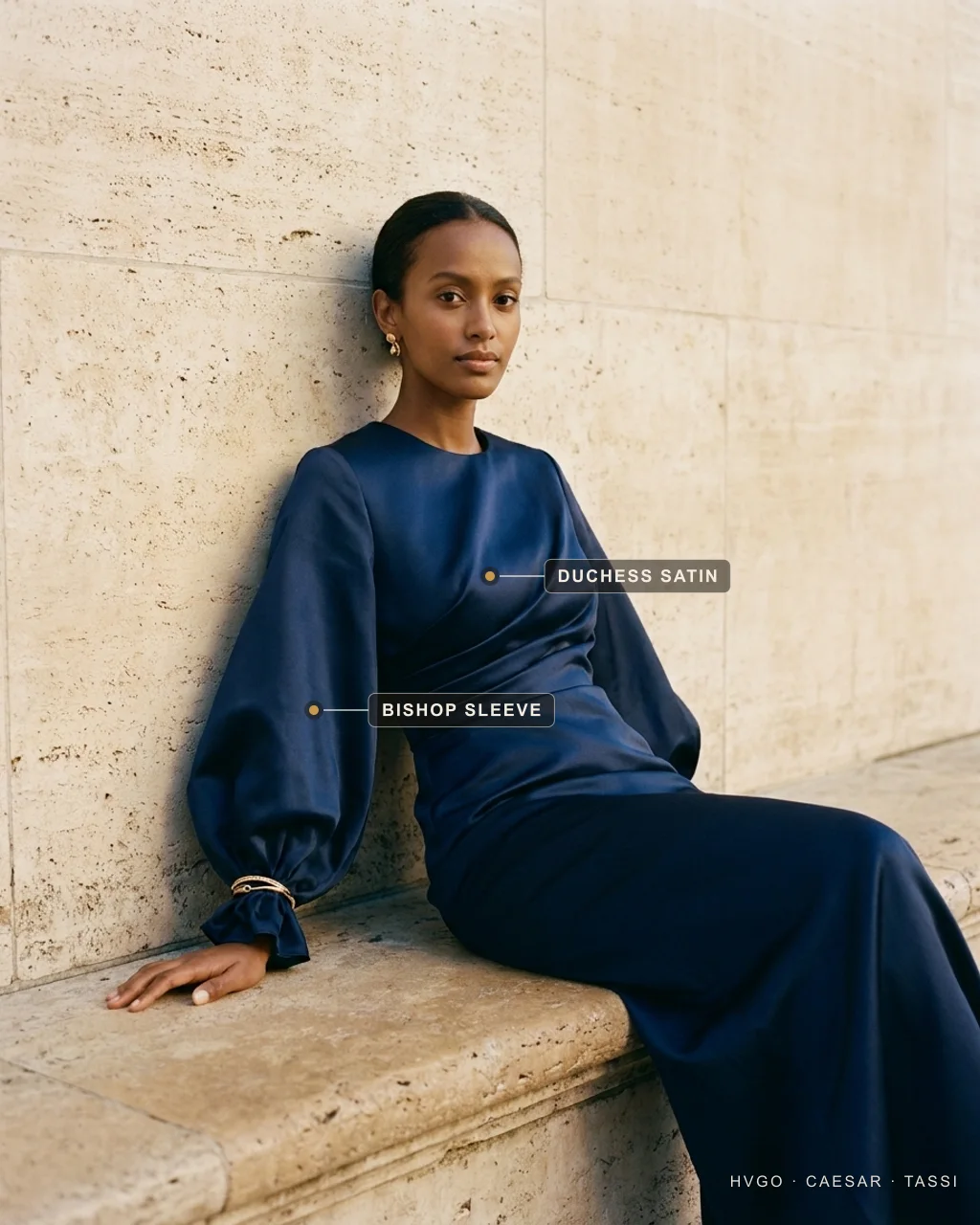
- Bishop sleeve
- Duchess satin
The dress sleeve types dictionary lists every cut.
#Keeping a sleeveless or strapless gown if you love it
Add warmth on top instead of changing the dress. Layer a bolero, capelet, opera glove, or stole over a bare or strapless evening gown, and it survives the cold while you keep the silhouette you love. Flavia, the strapless satin off-shoulder gown, takes a faux-fur stole on arrival and goes bare for the dance floor. Push that to an outdoor ceremony in hard wind, though, and a thin wrap over open shoulders cannot hold heat through a 20-minute vow exchange.
There, a real sleeve wins.
#The winter wedding guest wrap: how to cover up without crushing the dress
The right cover warms you without flattening the gown's line, and the pick turns on warmth, formality, and your neckline. A narrow stole, capelet, bolero, cape, or tailored coat each behave differently over a gown, and the wrong one crushes the very silhouette you chose your fabric to create.
#Choosing your cover — stole, capelet, bolero, cape or coat
Weigh the five covers by heat, formality, and how each meets a neckline, so you match the cover to the gown rather than reaching for a pashmina by reflex.
| Cover | Warmth | Formality | Works best over |
|---|---|---|---|
| Pashmina / stole | Medium | Versatile | A column or any neckline |
| Faux-fur stole | High | Formal evening | Strapless or off-shoulder |
| Capelet | Medium | Formal | High or jeweled necklines |
| Bolero | Low-medium | Daytime to evening | A fuller skirt |
| Tailored coat / cape | Highest | Arrival only | Anything, then coat-checked |
A faux-fur stole over Flavia's off-shoulder neckline frames the shoulders rather than burying them. Swap in a structured bolero over a slim column and it slices the vertical at the hip, cropping your height. Match the cover's structure to the skirt's volume.
#Layering a wrap over a column gown without flattening the line
Wear a narrow stole long and open over a column silhouette to keep the vertical intact. Anchor it at the shoulders and let both ends fall past the hip, so the eye travels floor to crown uninterrupted. Fluid drape suits a slim column; structured tailoring suits a fuller skirt.
Vipsania, the draped modal column gown, takes an open trailing stole gracefully because the jersey and the wrap move together. The house method closes at the coat check: surrender the tailored coat or cape on arrival, after crossing the cold inside it, and photograph uncovered yet warm. On a backless gown, a front-tied cover defeats the open spine; there you drape, never knot.
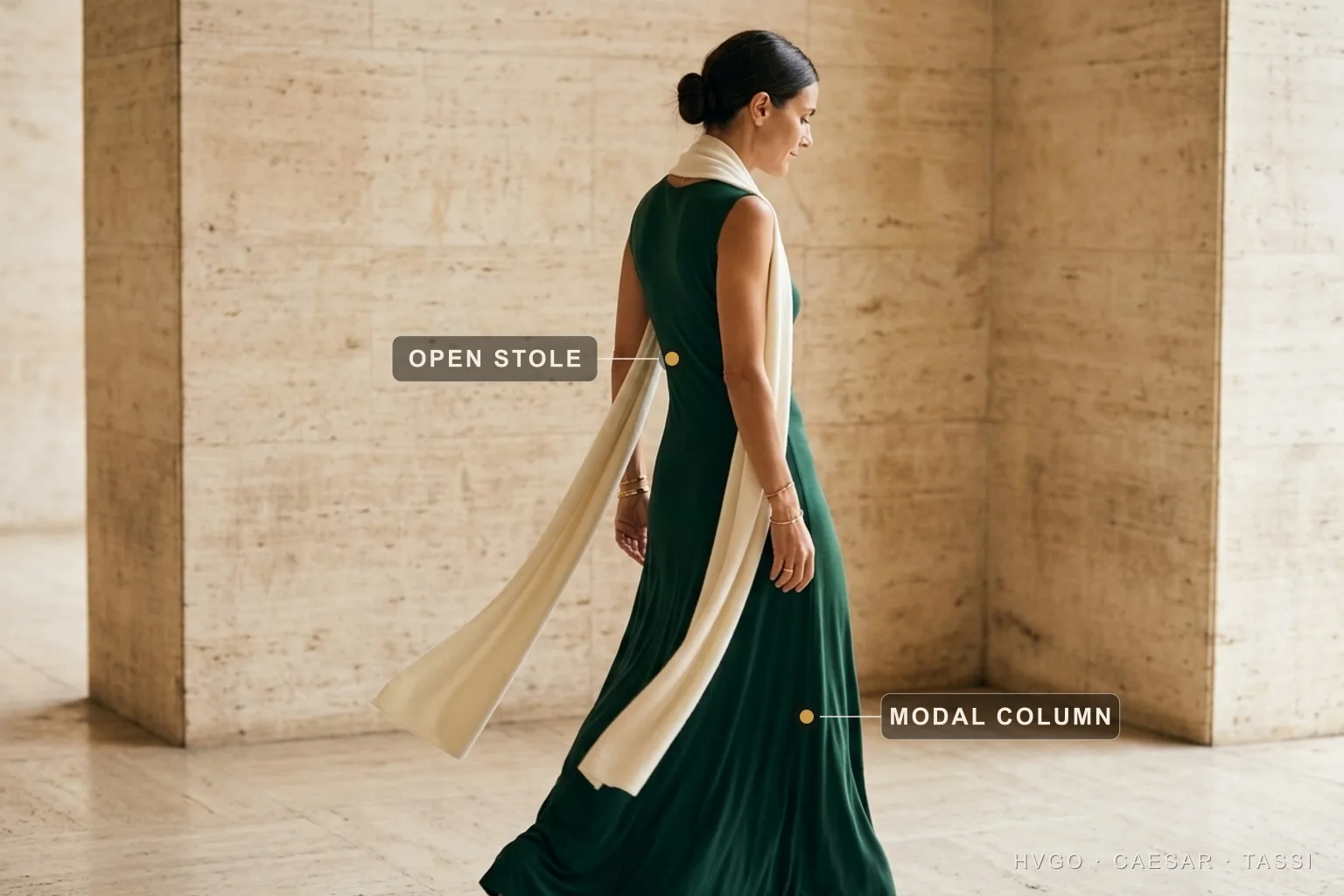
- Open stole
- Modal column
#Which dress length and shoes work for an indoor winter wedding
Floor-length and midi beat mini in the cold because longer hems shield more skin and read more formal in dim light. A closed-toe pump in suede or satin finishes the look where an open toe leaves you exposed. Length and shoe complete the warmth chain that fabric began.
#Why floor-length and midi beat mini in winter
A floor-sweeping maxi is the warmest, most formal evening option, covering the legs and reading correctly for a black-tie December night. Midi is the flexible day-or-evening length, landing mid-calf where hosiery does real work. A mini reads cold and casual and bares the most skin in the harshest season. Claudia, the pleated-slit maxi evening gown, delivers full-length formality with a slit that still lets you stride. Pair a mini against an outdoor January service, by contrast, and you stack the least coverage onto the lowest temperatures.
A midi with opaque hosiery is the safe middle for movement without bare leg.
#Shoes, hosiery and the tights question
A closed-toe pump in suede or satin beats an open-toe sandal, sealing in heat and matching the season's coverage. A block heel adds footing on icy ground where a stiletto sinks or slides. Opaque tights bring real warmth and read perfectly correct; sheer ones add polish with less heat. Reach for a higher denier, roughly 40 to 80, when the ceremony sits outdoors or on frozen stone, and keep them skin-close for a heated room.
Watch the extreme: very high-denier opaques under a formal floor-length gown can tip daytime, so weigh denier against the room's heat and the code.
#How Hugo Caesar Tassi dresses a winter wedding guest
The house edit maps heavy-fabric column and satin gowns in deep jewel tones onto the season's warmth-and-formality demand. Each gown marries an insulating cloth to a candlelit-rich color. Together they handle the cold without a single trend call.
#The house's cold-weather guest edit
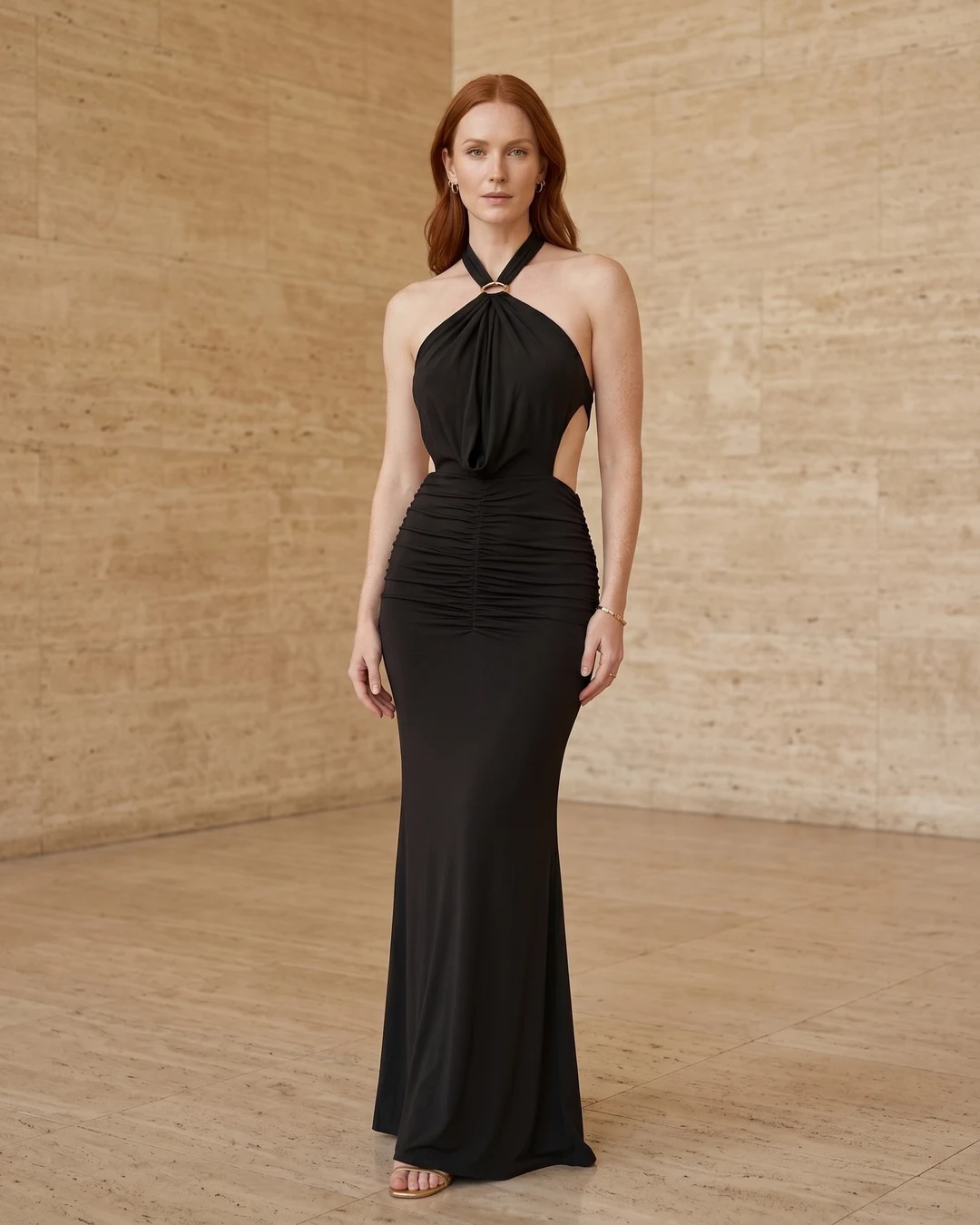
Start with Tullia, the pleated crepe column, in Porpora: a warm vertical line in heavy matte crepe. Vipsania, the draped modal column, brings fluid body-warming jersey for a heated room. Calpurnia's fishtail satin and Flavia's strapless satin both carry duchess-satin mass for evening heat, while Claudia's pleated-slit maxi handles floor-length formality. Name each one in a deep shade: Porpora, Verde Antico, or Cobalto. The contrast inside the edit is summer chiffon: a Portia A-line or a Livilla midi is built for warm light and would chill a guest in February.
Right house, wrong season.
#Why these fabrics and these tones win in the cold
Matte heavy satin and modal jersey insulate while still moving, the weight-over-thickness idea applied to real gowns. The satin's mass holds heat; the modal's drape tracks the body with no stiff air gap, and both stay clean on camera in low light. Porpora and Verde Antico deepen under candlelight, gaining richness exactly where pastels flatten, and a narrow stole added over any of them leaves the column intact. See the weights in person across the evening gowns and satin dresses collections.
#Your complete winter wedding guest outfit, decided
Build the outfit in one order: fabric, color, sleeve, wrap, shoe, each choice narrowing the next. Lock the warm heavy cloth first and the rest falls into place. Five decisions in sequence leave nothing to chance at the door.
#Build it in order: fabric, color, sleeve, wrap, shoe
Work this checklist top to bottom and you reach the door warm, formal, and ready for the lens.
- Fabric: choose heavy matte crepe, duchess satin, velvet, or modal jersey; skip chiffon and georgette.
- Color: pick a deep jewel tone for evening, a soft neutral for day; avoid white, ivory, and champagne.
- Sleeve: add a long, three-quarter, or illusion cut, or plan a cover for a bare gown.
- Wrap: pair a narrow stole with a column or a structured bolero with a fuller skirt; coat-check the heavy outer layer.
- Shoe: finish on a closed-toe suede or satin pump with denier-appropriate hosiery.
One worked example pulls it together: Tullia in Porpora, a long-line crepe under a faux-fur stole for arrival, opaque 40-denier tights, and a closed-toe satin pump. Settled on warm and formal? Shop the deep-tone evening and satin gowns. Then read the summer wedding guide when a warm-weather invitation lands, or the dress code guide if you still need to decode the card.
#Frequently asked questions
What is the best fabric for a winter wedding guest dress?
The best fabrics for a winter wedding guest dress are heavy matte crepe, duchess satin, velvet, and modal jersey, which stay warm while draping beautifully. They trap body heat through mass and a close drape, not bulk. Thin chiffon and georgette are summer cloths that run cold; hold them for warm weather.
What color should I wear to a winter wedding?
The color to wear to a winter wedding is a deep jewel tone, since wine, emerald, sapphire-navy, and garnet read richest in low light. Basalt black, Travertine stone, and Cuoio tan work as easy neutrals. Avoid white, ivory, champagne, and silver near the bride.
Can I wear a sleeveless dress to a winter wedding?
You can wear a sleeveless dress to a winter wedding if you add warmth on top rather than changing the dress. A stole, capelet, bolero, or opera gloves let you keep a strapless or bare gown. They carry you warm between rooms without altering the silhouette.
Should a winter wedding guest wear tights?
A winter wedding guest can wear tights, and opaque or sheer pairs are perfectly correct while adding real warmth. Reach for a higher denier, roughly 40 to 80, when the ceremony sits outdoors or on frozen stone. Keep them sheer and skin-close for a heated evening room.
What do you wear over a dress to a winter wedding?
Over a dress at a winter wedding you wear a pashmina or faux-fur stole, a capelet or bolero, or a tailored coat or cape. Worn open and long over a column gown, the cover warms you without flattening the line. Hand the heavy outer layer to the coat check before photos.
Is a long-sleeve dress appropriate for a winter wedding?
A long-sleeve dress ranks among the most appropriate winter-guest choices, solving warmth and formality in one garment. A long-sleeve column or midi seals the arms against cold air. Illusion or bishop cuts add coverage without reading heavy.
More What to Wear guides
What to Wear to a Christening
What to wear to a christening, by a Roman house — modest, daytime-elegant outfits in church-safe colors that honor the day, never reading bridal.
Dress for a christeningBlack-Tie Attire for Women
A Roman house decodes black-tie attire for women: floor-length or not, the right fabric and jewelry, and how optional, creative and gala differ.
Decode the four black-tie rungsCocktail Attire for Women
A Roman house decodes cocktail attire for women: the exact length (knee to mid-calf, never floor), the right fabric, and how it differs from black tie.
Decode cocktail attireWhat to Wear to an Italian Wedding
A Roman house decodes what to wear to an Italian wedding: the real no-black and no-white rules, church cover-up, and North-vs-South dress code.
Decode the invitata dress codeWhat to Wear to Royal Ascot and the Races
The enforced Royal Ascot enclosure rules for strap width, hem and hat size, plus a Roman house rule for balancing a hat against your dress.
Pass the Ascot enclosure rulesWhat to Wear to a Summer Wedding
A Roman fashion house on what to wear to a summer wedding: the breathable fabrics, flattering bright-light colors and hems that survive grass and sun.
Dress a summer wedding