Plus-Size Occasion Dresses: Color, Confidence and Cut
Plus-size occasion dresses in flattering cuts and real color, not just black. Silhouette, fabric and confident fit from the Roman house of HCT.
On this page
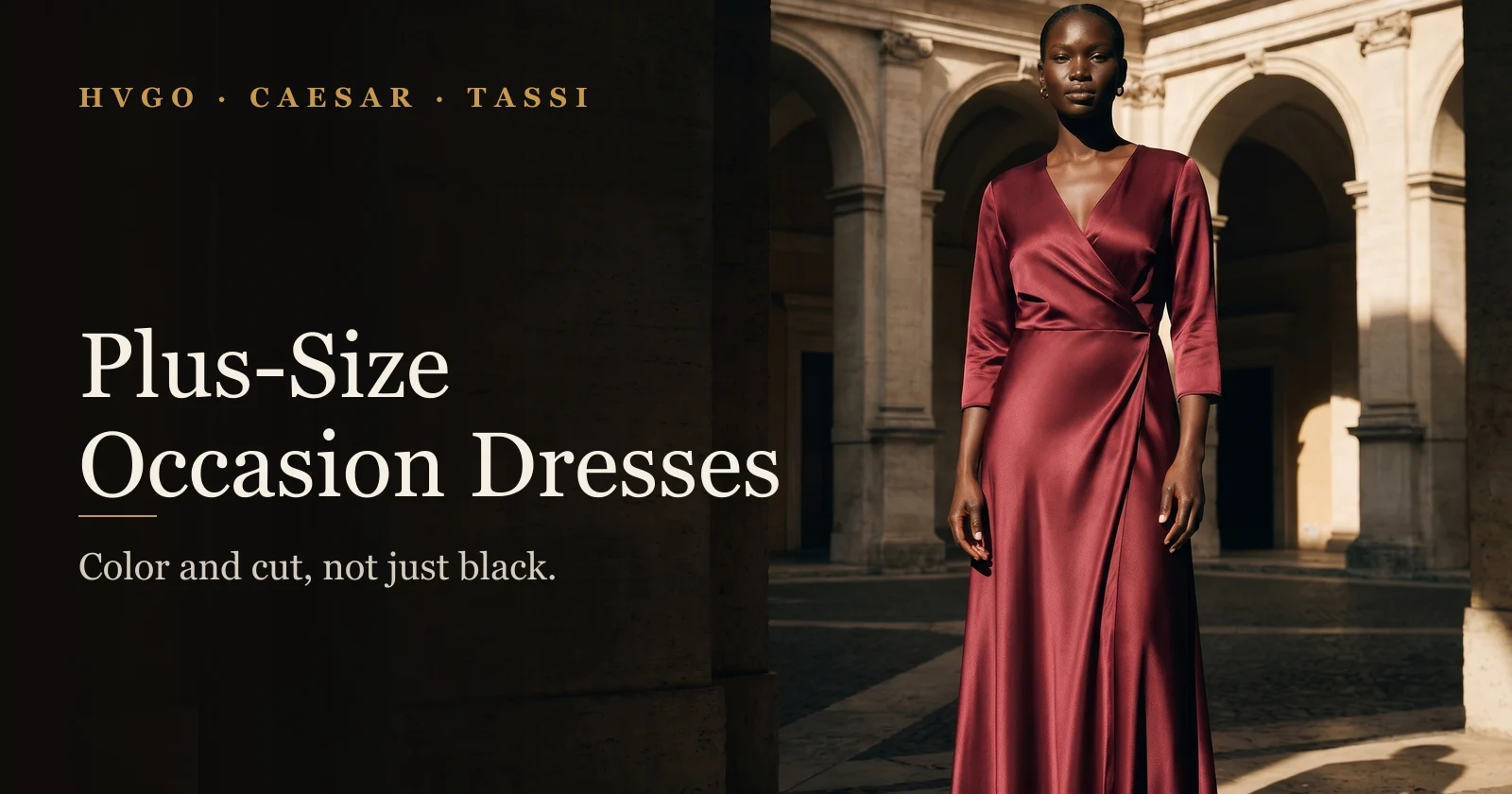
A plus-size occasion dress should make you the most striking woman in the room, not the most camouflaged. The cut and the cloth do the work: a fluid weight that skims, a defined or released waist, and a long vertical line in one rich color. Hugo Caesar Tassi (HCT), the Roman occasionwear house, dresses that premise across its full palette.
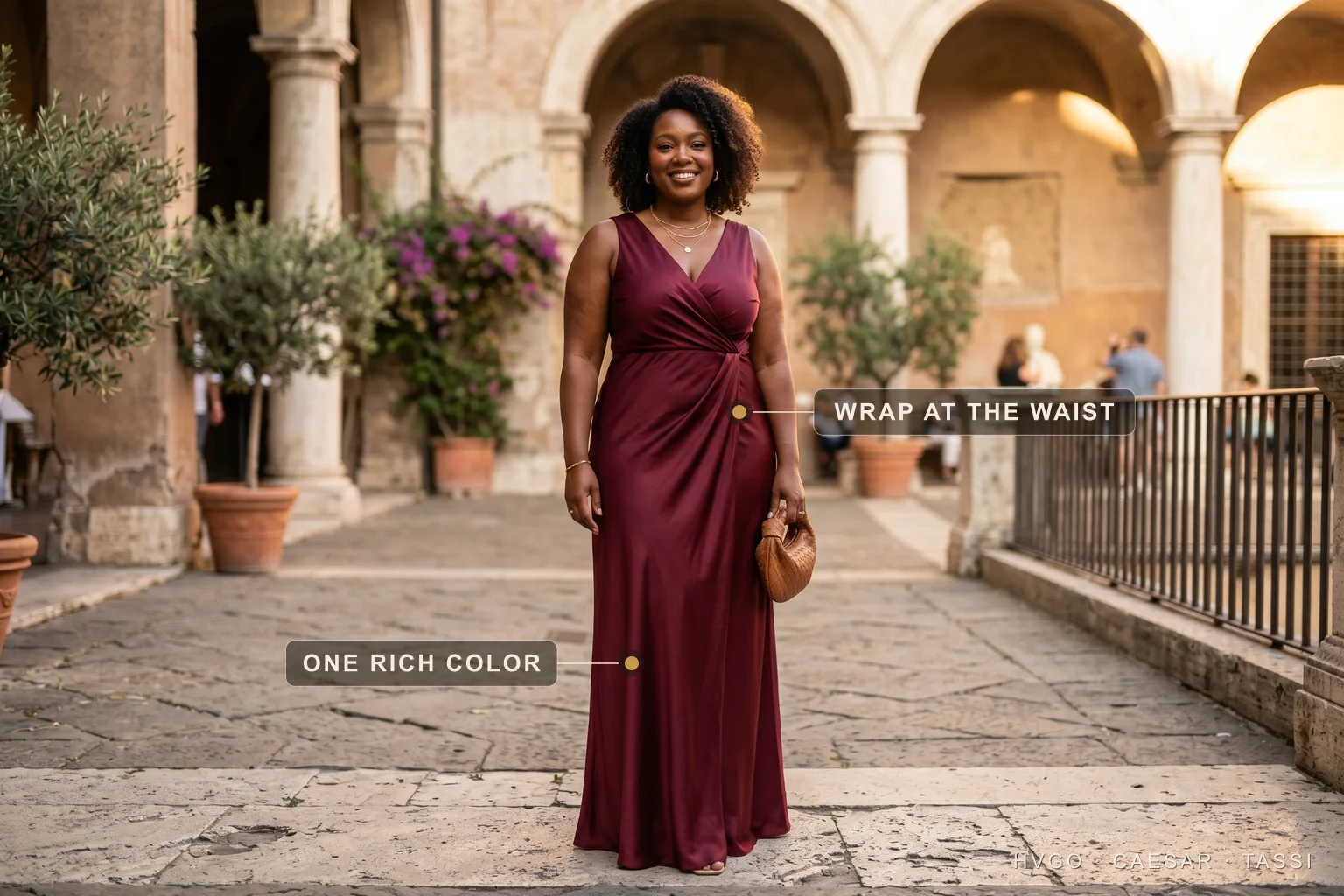
- Wrap crosses and defines the waist
- One saturated color — a long, unbroken line
Your plus-size occasion dress, in three steps
Tell us the moment and what you want to feel — we’ll name the cuts and a color built to command the room.
Enter your measurements (optional) and we’ll point you to the right cut.
#What makes a great plus-size occasion dress (beyond "wear black")
Three levers decide it: a silhouette suited to your proportion, a fluid lined fabric that drapes, and a fit that supports rather than grips. Color is the fourth, and the one most guides surrender. Every gown in the house is built to skim and support, then offered in wine, navy and deep green so slimming black is never your only choice.
#Why the slimming-and-black default fails you
The "minimize yourself" advice treats a fuller figure as a problem to solve, and it signals apology over presence. Most listicles repeat two words, black and slimming, then stop. A bias-cut satin in Porpora (wine) skims the same midsection a black sheath would cling to, and it announces you instead of erasing you.
The house motto is Nata Imperare, born to rule. A woman dressed to command attention stands in saturated color, not in a shade chosen to vanish. One honest exception holds: black still earns its place at a somber memorial, where bright tone would jar. Beyond those few rooms, color wins.
#The three things that actually matter: cut, fabric, fit
Cut sets the line, fabric controls how cloth meets the body, and fit decides comfort across a full day. Nail the silhouette and a fuller hip balances a defined shoulder. Pick a fluid georgette over a stiff brocade and the cloth falls clear of the stomach instead of tenting across it. The pages below follow that order, and the pillar on dressing for your figure frames all of it.
#Which silhouettes flatter a curvier frame most
Four cuts carry fullness with ease: empire, A-line or fit-and-flare, wrap, and soft column. Each manages volume differently, so the right pick depends on where your figure runs full.
- Empire, wrap or soft column — releases or defines the waist, never grips.
- Fluid, fully lined cloth — drapes clear of the body instead of clinging.
- One saturated color — a long, unbroken vertical line.
- Stiff cinched waistband — grips the fullest point and prints a line.
- Thin, unlined fabric — clings to or tents over the body.
- Large high-contrast print — chops the figure into blocks.
#Empire and raised-waist gowns
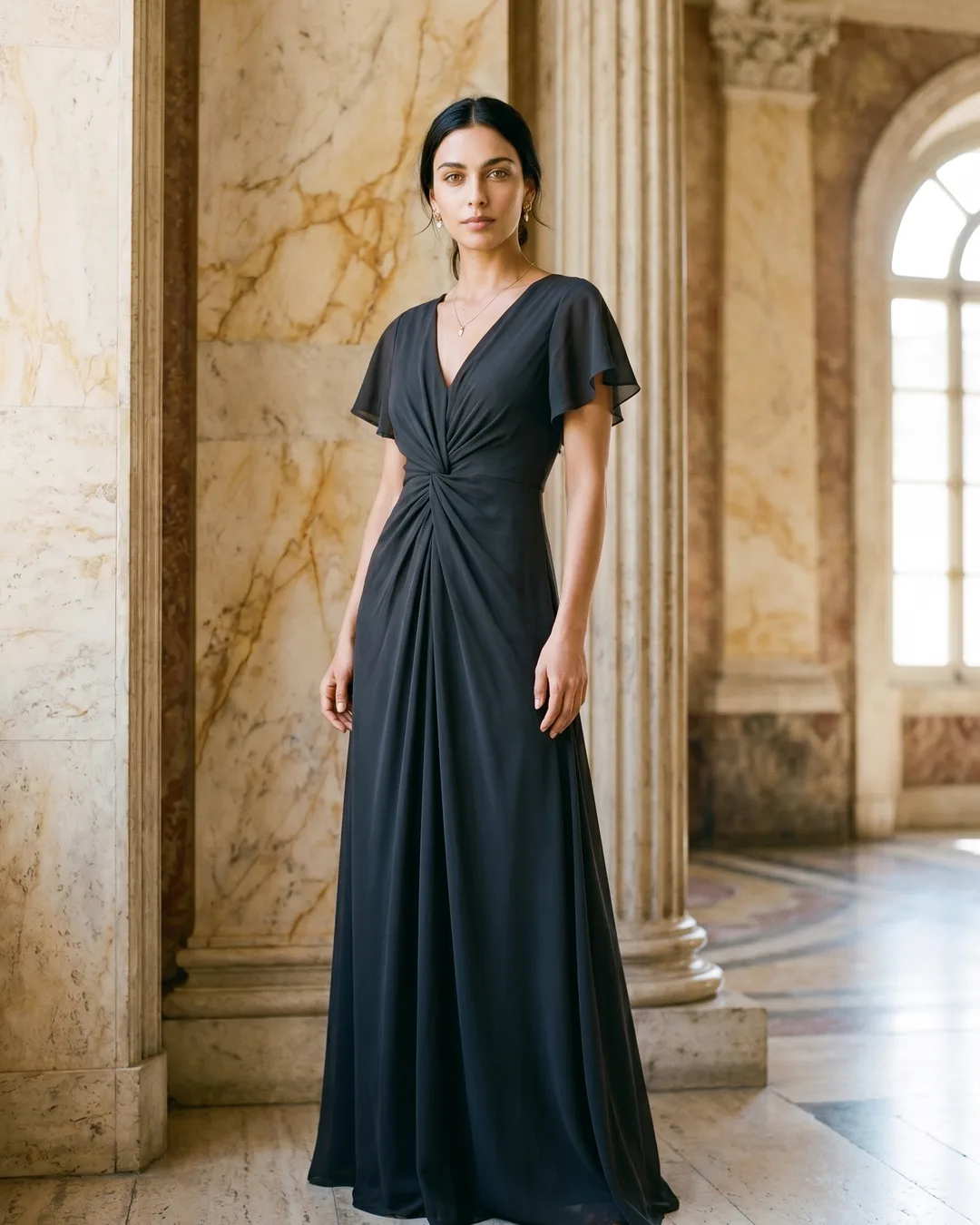
An empire gown sets its seam just under the bust and lets the fabric fall in a clean vertical sweep over the midsection. The waist registers at its narrowest point while the skirt skims below, the better choice when fullness gathers through the middle, as the French-pleated Julia chiffon maxi shows. One edge case: a smaller bust on a wider frame, where the raised seam can hang shapeless until a defined V-neck above it restores the proportion.
#A-line and fit-and-flare
An A-line traces the upper body, then opens into a skirt that clears the hip without gripping it. That flare moves with you on a dance floor instead of straining at the seat; Portia, a short-sleeve chiffon A-line, sets wider hips against a fitted shoulder. Where it disappoints: a very light A-line in thin chiffon can collapse on a tall frame, so look for a lined skirt weighty enough to hold the shape.
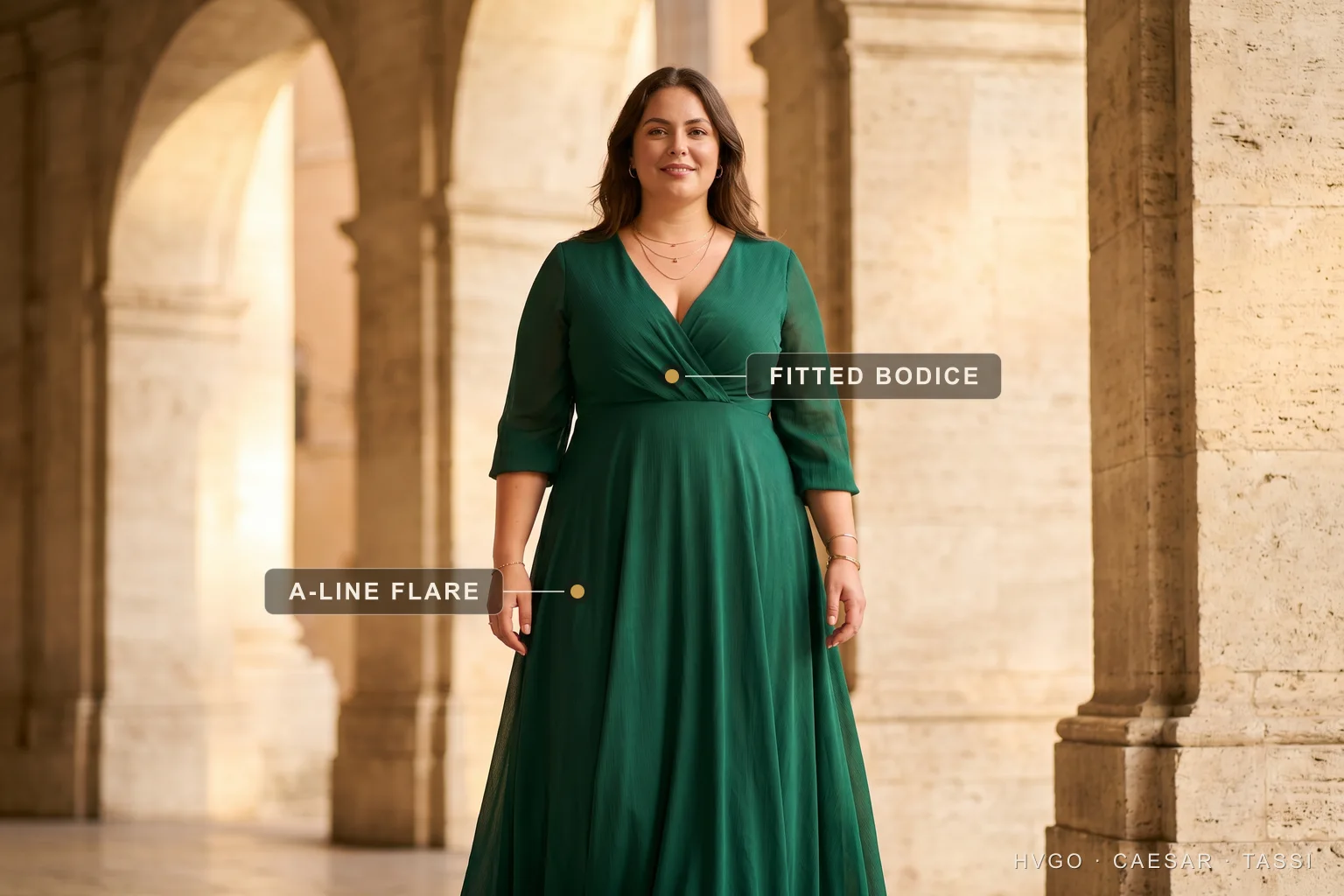
- Fitted bodice defines the shoulder
- A-line skirt flares clear of the hip
#Wrap and faux-wrap with a soft V
A wrap crosses on the diagonal, defining the waist and lengthening the torso in a single move. The self-tie adjusts ease across bust and hip independently, unlike a rigid band that fits one and fails the other. Pick a faux-wrap over a true wrap when you want that diagonal line with all-day security and no readjusting between courses.
#Soft column and bias-drape gowns
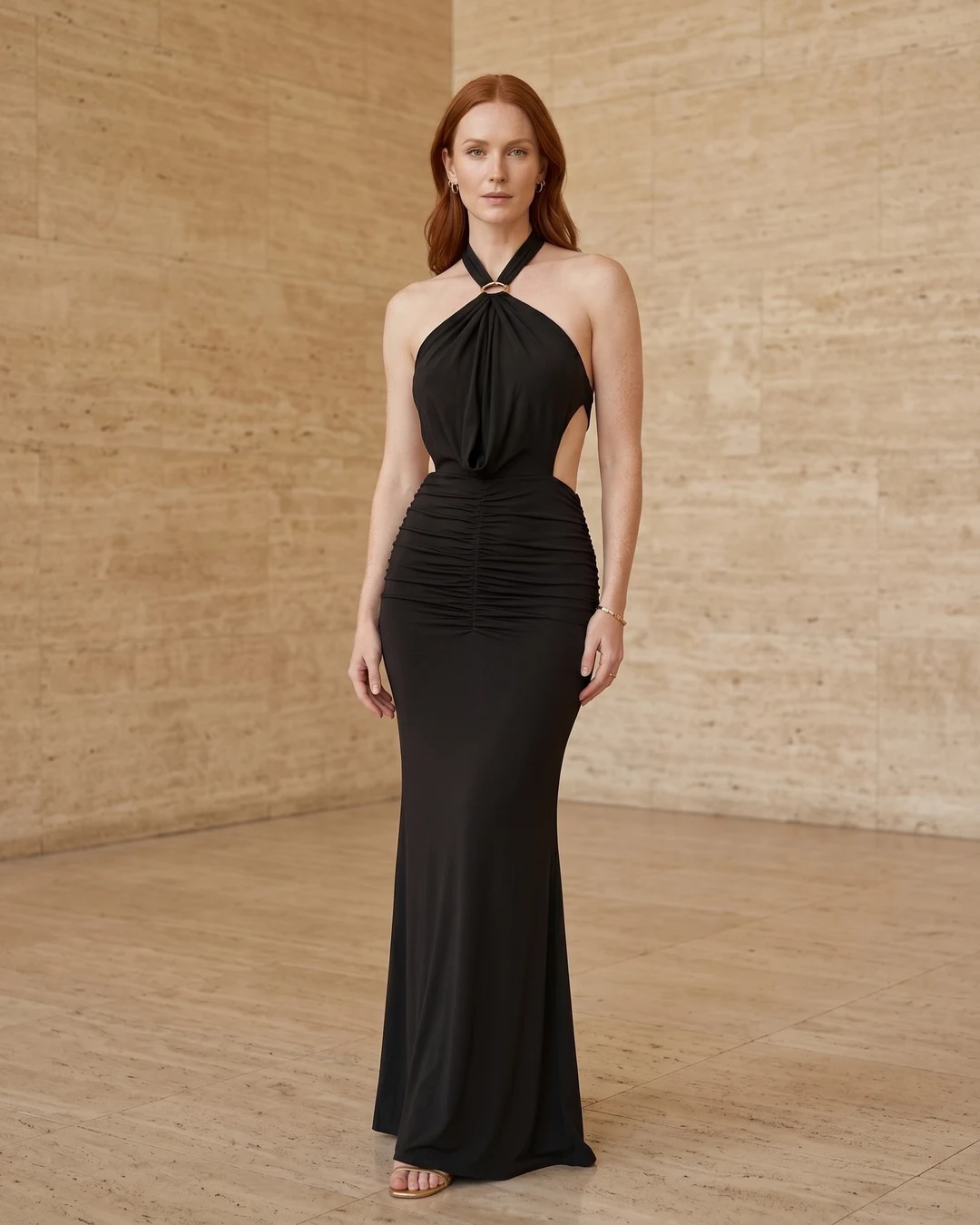
A soft column runs one unbroken vertical from shoulder to floor, adding height while skimming the whole figure. Draped modal and bias-cut satin fall close without clinging, because bias cloth eases around a curve instead of pulling across it. Vipsania, a draped modal column gown, lengthens the silhouette and stays fluid; for evening, the Calpurnia fishtail satin gown holds through the thigh, then flares lower down. The caution: a fishtail that breaks too high can pin a wide hip, so keep that flare below the knee.
#Which fabrics drape and hold on a curvy frame
Fluid, lined cloth drapes; stiff or thin single-layer cloth clings or tents. Weight and lining decide the outcome far more than the fiber name, and a substantial lined fabric keeps its shape through a long evening.
#Fluid weights that skim: chiffon, crepe, modal jersey, georgette
Chiffon, crepe, modal jersey and georgette each fall away from the body because they carry drape without stiffness. HCT chiffon is recycled, knife-pleated or bias-cut, and matte; the crepe is matte and structured; modal jersey glides with a soft weight; georgette moves on a fine grain. A matte surface looks quiet and expensive, whereas high shine magnifies every contour. The explainer on chiffon and crepe details each one.
#How satin looks rich without clinging
Substantial lined satin looks luxe and keeps its line; thin shiny single-layer satin clings and maps the body. The house satin is bias-cut, so it eases over a curve, and fully lined, so it carries its own structure rather than the shape beneath. A lined satin column falls in one plane, whereas a featherweight unlined version ripples at every step. Browse the lined construction in the satin dresses edit instead of grabbing the first glossy gown on the rail.
#Lining, structure and built-in support
A full lining delivers opacity, a smooth surface, and a second layer that lifts the silhouette off the body. Every gown here is fully lined with a concealed zip, and built-in bust support steadies a strapless or off-shoulder neckline without a separate bra. The exception is a very light summer chiffon, where the lining does most of the shaping, so confirm it is cut as generously as the shell.
#Which colors work beyond black on a curvy figure
Deep saturated color slims as well as black and lands with far more impact, which is why the imperial palette runs through every occasion gown. A long line in one rich tone carries height and authority that black cannot, because black recedes while color holds the eye.
#Rich, saturated tones from the imperial palette
Five imperial tones carry a curvy silhouette with confidence: Porpora, Cobalto, Verde Antico, Vermiglio and Cornelia.
| Imperial tone | American color | Effect | Best for |
|---|---|---|---|
| Porpora | wine | rich, regal | evening, black-tie |
| Cobalto | navy | deep, slimming | weddings, galas |
| Verde Antico | green | jewel-toned, fresh | autumn, daytime formal |
| Vermiglio | red | bold, commanding | statement occasions |
| Cornelia | rose | warm, soft | spring, cocktail |
A deep wine column stands every bit as elegant as black at a winter gala, and it photographs with a life that black flattens.
#How to wear color with a long line
Monochrome dressing in one rich tone elongates best, because an unbroken color block draws the vertical line longer. Keep the dress, the shoe and the accessory in one family so the tones extend the line rather than chopping it. Print earns its place when it stays small to medium in scale on a fluid ground, as on the floral-print Livilla chiffon midi; a large high-contrast print, by contrast, splits the body into blocks and cuts the figure short.
#Which necklines and sleeves flatter a fuller bust and arms
Open necklines frame the face and bust, and fluid sleeves cover the upper arm by choice, never by apology.
#Necklines that frame the face and bust
A V-neck, surplice, square or soft scoop opens the chest and lifts the eye toward the face. A V-neck lengthens the neck and offsets a fuller bust by breaking the horizontal; a surplice crosses on the diagonal; a square neck frames a décolletage cleanly. Set one focal point at the neckline and let the rest stay calm. A high boat neck, unlike these, broadens a fuller bust and shortens the neck, so it ranks as the weaker option here.
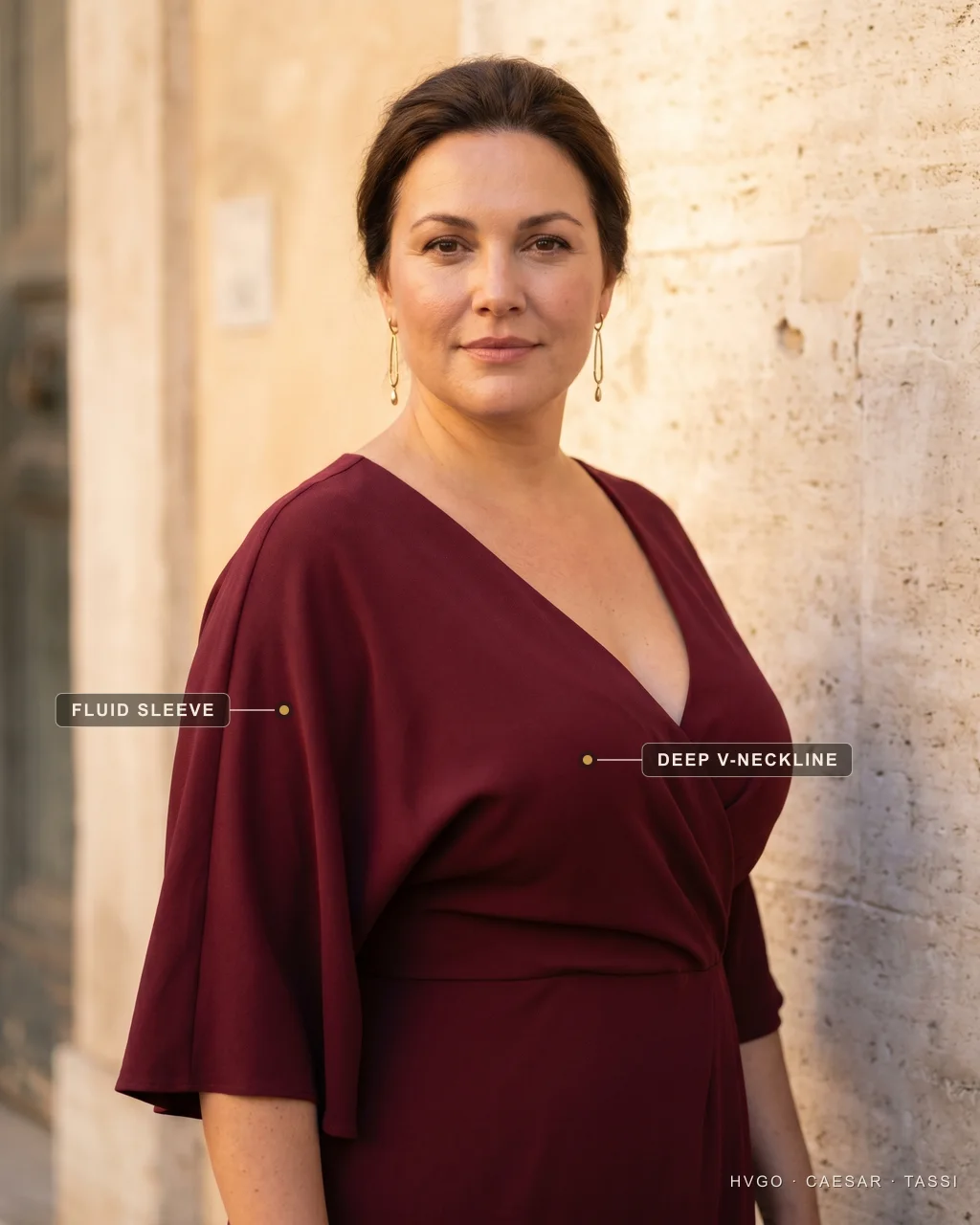
- Deep V-neckline opens the chest
- Fluid sleeve drapes the upper arm
#Sleeves and arm coverage you'll actually enjoy
Three-quarter, flutter and soft cap sleeves drape fabric over the upper arm for comfort, not concealment. A three-quarter sleeve ends at the slimmest point of the forearm; a flutter sleeve floats free; a soft cap grazes the shoulder lightly. Pick sleeves when you want arm ease through a long day, since coverage should answer the room and your own comfort. A tight set-in sleeve, by contrast, binds the arm and undoes the point.
#How to match a curvy occasion dress to the dress code
Match fabric weight and length to the formality: a fluid midi for daytime, a full-length column for black-tie. The code sets the floor; your silhouette and color do the rest.
#Cocktail, semi-formal and daytime weddings
Cocktail and daytime weddings invite a fluid A-line or wrap midi in chiffon or crepe with a soft V and three-quarter sleeves. A rich color or a small-scale print suits the lighter mood. A defined or empire waist keeps it polished, and a midi hem stays comfortable through a long ceremony and lunch.
#Black-tie, galas and the opera
Black-tie and the opera call for a full-length soft column in bias satin or draped modal, worn monochrome in a saturated tone. A fishtail or a leg slit looks dressed-up when the flare or the opening sits below the knee; set higher, the same detail turns constricting. Evening accessories finish the line, and a pleated crepe column suits the most formal rooms of all.
#How to choose your size and fit with confidence
Size to your largest measurement, then take in the smaller areas, because letting out a too-tight seam is rarely possible. HCT sizes run S to 3XL (EU 34 to 44), and the right cut does most of the work before any tailoring.
#Reading the size chart and your own measurements
Measure your bust, waist and hips, compare all three to the chart, and select the size that fits your largest number. A fuller hip should set the size for an A-line, whereas a fuller bust should set it for a wrap. Sizing to the largest figure gives the seam room; sizing to the average strains it. The walkthrough on how to measure shows where to hold the tape.
#Fit, support, shapewear and small alterations
Allow ease at the bust and hip, set the hem for your height, and save alterations for small refinements like a nip at the waist or a strap. HCT publishes each model's height (around 175 cm) so you can judge where a hem will break on your own frame. Light smoothing shapewear refines the line under a closer satin, yet it should support and never compress you into a different shape.
#How Hugo Caesar Tassi cuts for a curvy figure: the house fit philosophy
HCT cuts fluid imperial fabrics to skim and lines them to support, offered across the full color range so no woman defaults to slimming black. This is the atelier principle, drawn from la bella figura, the Roman habit of carrying yourself beautifully.
#The atelier principle
Every gown starts from confidence, not concealment, and is built to be seen. Fluid chiffon, crepe, modal and bias satin are cut to fall clear of the body, fully lined, and supported at the bust where a neckline asks for it. Each comes in Porpora, Cobalto, Verde Antico, Vermiglio and Cornelia, so a curvy woman names her color rather than accepting the only "safe" one.
#Wearing it with confidence
Correct length, a heel to draw out the line, one focal point and one considered accessory carry the look further than any single garment. Set the hem to break cleanly at the floor or just above the shoe, and keep one statement while everything else stays calm. Posture finishes the dress; apology unpicks it.
#Which Hugo Caesar Tassi gowns we recommend for a curvy frame
Five lined, supportive gowns carry fullness across evening, black-tie and wedding-guest occasions. Each holds a long line and arrives in the imperial palette; name your color when you order.
#Evening and black-tie
Three column-line gowns suit the most formal rooms: Tullia, Vipsania and Calpurnia. Tullia, a pleated crepe column gown, runs clean vertical pleats from shoulder to floor; Vipsania, a draped modal column gown, skims the midsection; Calpurnia, a fishtail satin evening gown, holds through the thigh then flares lower. Choose Tullia for the straightest line, Vipsania for the softest drape, and Calpurnia for movement at the hem.
#Statement and wedding-guest
Two gowns make a confident wedding-guest or statement entrance: Flavia and Claudia. Flavia, a strapless satin off-shoulder gown, uses structured satin to steady a bare neckline; Claudia, a pleated-slit chiffon maxi, keeps the column line and adds a leg slit for movement. Pick Flavia for a confident neckline with built-in support, or Claudia for a long line plus a flash of leg, and request Cobalto or Porpora for either.
What the atelier learned cutting for a curvy figure
Across the house’s fitting studio, one lesson held on every curvy fit model: confidence is cut in, not corseted on. A fluid, fully lined gown in a saturated color consistently read longer, calmer and more commanding than the same body squeezed into a slimming black sheath. The findings below are how the studio now cuts — and colors — for a fuller frame.
| Cut | What the studio observed | Verdict |
|---|---|---|
| Empire / raised waist | Releases the cloth over the middle and marks the narrowest point under the bust. | Best |
| A-line / fit-and-flare | Traces the shoulder, then clears the hip without gripping it. | Best |
| Wrap / faux-wrap | Defines the waist on the diagonal with self-adjusting ease across bust and hip. | Best |
| Soft column / bias satin | Falls in one fluid, fully lined plane that eases around the curve. | Best for evening |
| Stiff cinched sheath | Grips the fullest point and prints a hard horizontal across it. | Skip |
| Thin unlined single-layer | Clings and maps the body, or tents stiffly off it. | Skip |
The rule the study produced: dress from confidence, not concealment — choose a fluid cut and a real color, and let the line do the rest.
#Your plus-size occasion-dresses checklist
Five checks confirm a gown will carry your figure with confidence before you buy. Run them in order.
- Silhouette right: empire, A-line, wrap or soft column, matched to where your figure runs full.
- Fabric fluid and lined: chiffon, crepe, modal or substantial bias satin, fully lined.
- Color real: a saturated imperial tone such as wine, navy or green, never a default black.
- Neckline and sleeves for confidence: an open neckline and the sleeve coverage you genuinely want.
- Size to your largest measurement, then refine the smaller areas with a small alteration.
#The five-point recap
The recap fits one line: fluid cut, lined fabric, real color, confident neckline, true size. The atelier also publishes companion guides for an apple shape, a pear shape, and for dressing after 50.
#Frequently asked questions
What is the most flattering occasion dress for a plus-size figure?
The most flattering occasion dress for a fuller figure is a fluid empire, wrap or soft column in a lined fabric. Crepe, modal or substantial bias satin defines the waist or releases over the middle and drapes instead of clinging. A long line in one rich color carries height and elegance.
Do plus-size women have to wear black to a formal event?
Plus-size women do not have to wear black; black is one option, not the rule. Deep saturated tones such as wine, navy and forest green slim just as well and land with far more impact, which is why HCT builds occasion gowns across the full imperial palette.
What should a plus-size woman wear to a wedding as a guest?
A plus-size wedding guest looks best in a fluid A-line or wrap midi or maxi in chiffon or crepe. A soft V-neck with three-quarter or flutter sleeves, a rich color or small-scale print, a defined or empire waist, and a long hem keep it polished and comfortable all day.
Which plus-size occasion dresses have sleeves?
Occasion dresses with sleeves come in three-quarter, flutter or soft cap styles cut in fluid fabric. The cloth drapes over the upper arm rather than gripping it. Coverage stays a comfort choice, never concealment, on wrap, A-line and empire gowns.
How do I choose the right size in a plus-size occasion dress?
You choose the right size by measuring your bust, waist and hips and sizing to the largest measurement. Have the smaller areas taken in if needed, confirm the lining and built-in support, and allow ease through the bust and hip.
Do I need shapewear under a plus-size occasion dress?
Shapewear is not required under an occasion dress when the cut is right. A lined, fluid gown skims on its own; light smoothing shapewear can refine the line under a closer satin, yet it should support and never compress you into a different shape.
Dress to be seen, not to disappear. Explore the occasion dresses edit in your color, starting with the Vipsania draped-modal column gown.
More Body Shape guides
Best Dresses for an Apple Shape
The apple-shape dresses that skim a fuller middle with cut, not shapewear: empire seams, bias drape and fluid crepe from the Roman atelier of HCT.
See the apple-shape editElegant Dresses for Women Over 50
Occasion dresses that flatter over 50 — a three-quarter sleeve, soft V neck and crepe that skims. The age-positive guide to weddings and evenings.
Dressing well over 50Best Dresses for an Hourglass Figure
The silhouettes, fabrics and necklines that trace an hourglass figure instead of hiding it, plus the atelier fluid-weight rule and HCT gowns to shop.
See the hourglass editHow to Find Your Body Shape
Take three measurements and learn your body shape for sure with the atelier ratio method and exact thresholds, not vague compare-to-fruit guesswork.
Find your body shapeHow to Dress an Inverted Triangle Body Shape
Open the neckline into a soft V to narrow broad shoulders, then add a skirt-width of pleated-chiffon volume at the hip until your shape reads balanced.
Style the inverted triangleBest Occasion Dresses for a Pear Shape
The shapes, necklines and fabrics that balance a pear shape: A-line chiffon that skims the hip and a neckline that lifts the eye one body-third up.
See the pear-shape edit